András Schiff clavichord Recorded July 2018 Kammermusikssaal H. J. Abs, Beethoven-Haus, Bonn Engineer: Stephan Schellmann Cover photo: Jan Jedlička Produced by Manfred Eicher Release date: January 27, 2023
“When I’m at home, my day always begins with Bach. It used to be on the piano, now it’s on the clavichord, even before breakfast. After a few of the Inventions I feel reborn. My ears, my mind, soul and spirit are cleansed.”
Few keyboardic constructions feel as tangible as the clavichord. If only for that reason, it takes getting used to. Yet if you are willing to meet it on its own terms, its internal resonances and breadth of character soon become apparent. As the go-to of Johann Sebastian Bach, it deserves a spotlight in this music—not only for its sound but also for its spirit. For while its intimacy is a given (allowing as it did the luxury of private interpretation for both composers and enthusiasts), and its history and Bach’s relationship to it are well documented, there’s something about letting it sing for itself, and I can think of few hands more capable of doing just that than those of pianist András Schiff, whose humble admission crowns this review.
The six-part Capriccio sopra la lontananza del fratello dilettissimo (Capriccio on the departure of a beloved brother) is a delightful inauguration to the instrument’s flavor. Though lesser known than the Inventions and Sinfonias (a.k.a., the Two- and Three-Part Inventions, split between this album’s two discs), they speak nakedly and with the programmatic lucidity required of them. The bigger, canonical collection after them dons new garments (if not sheds old ones) in the present recording. Knowing that Bach likely intended them for the clavichord gives us a renewed understanding of their provenance. The faster movements (cf. Invention No. 4 in d minor, Sinfonia No. 15 in b minor) sparkle, while the slower ones (cf. Invention No. 2 in c minor, Sinfonia No. 4 in d minor) feel more robust than ever. The middle realm (cf. Invention No. 15 in b minor, Sinfonia No. 11 in g minor) gives us the best of both worlds. Such is the magic of the clavichord: Despite its slimmer character and build, it holds its own and then some in a basket woven of lower pitch (a’ = 404 Hz). One highlight in this regard is the lutelike Sinfonia No. 9 in f minor, which walks up a flight of stairs, making the pull of gravity palpable.
Between these are the Four Duets (of which No. 3 in G major is especially wholesome) and the Ricercar à 3 from Das Musikalische Opfere, which, along with the concluding Chromatic Fantasia and Fugue,is the biggest revelation herein. Whereas the orchestral sensibilities in one are still very much alive, albeit refracted and distilled, the other shows the subtlety of the “Bebung” technique, whereby the performer adds vibrato with vertical pressure of the fingertip. Thus, these pieces’ complexities become more apparent because they cannot hide within the piano’s cavernous architecture. The fugue is a wonder. Feet to ground, it knows where it stands and how to take joy in the life it has been freely given.
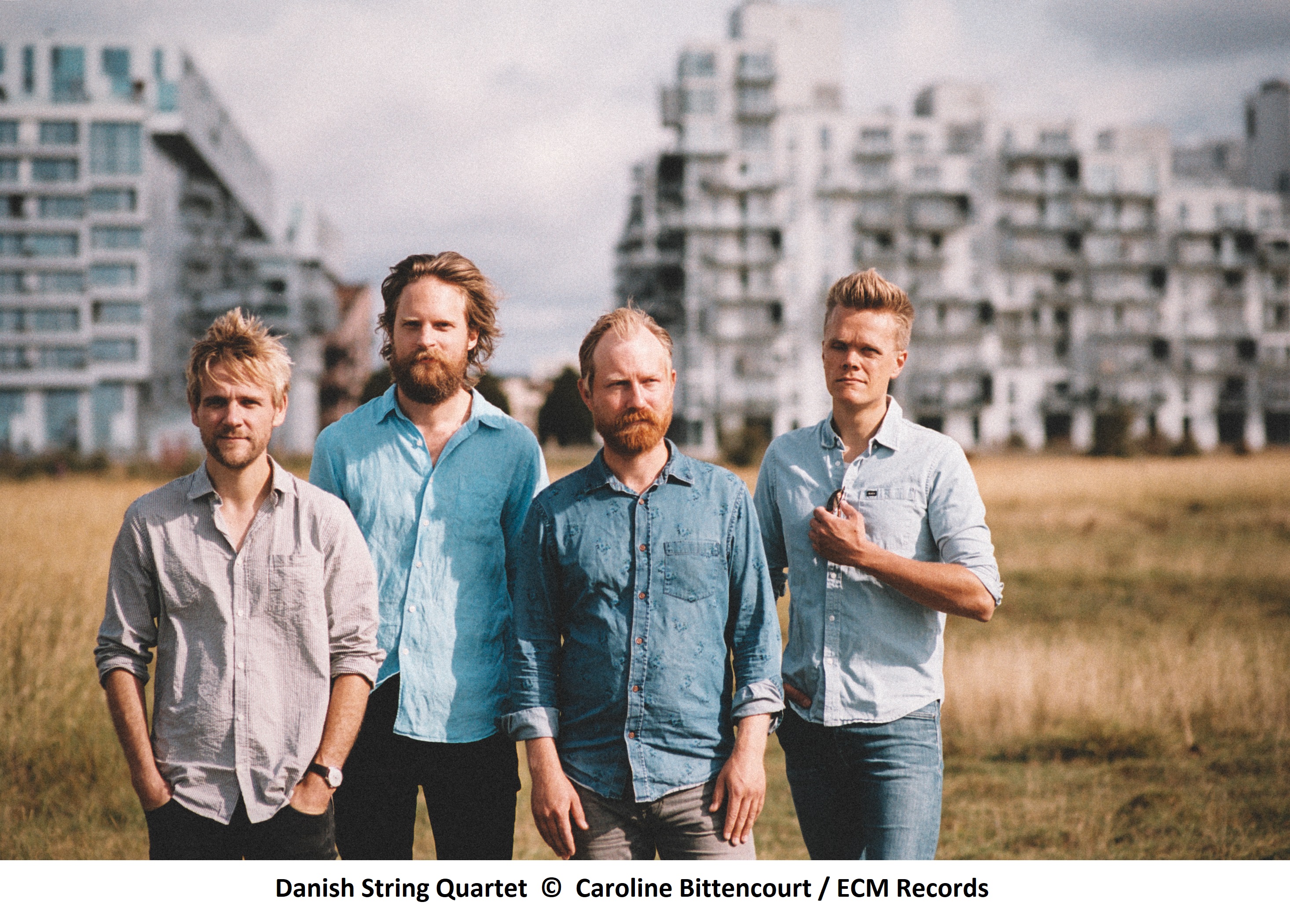
Rune Tonsgaard Sørensen violin Frederik Øland violin Asbjørn Nørgaard viola Fredrik Schøyen Sjölin violoncello Recorded June 2021 Festsal, KFUM/KFUK, Copenhagen Engineer: Markus Heiland Cover: Eberhard Ross Produced by Manfred Eicher Release date: April 14, 2023
The Danish String Quartet concludes its nearly eight-year journey pairing Ludwig van Beethoven’s five late string quartets with works by Johann Sebastian Bach and later composers. Looking back, I can’t help but smile at how deeply and patiently the DSQ has fertilized the soil of this project to yield the richness of spring harvest.
As the musicians humbly observe, “Micromanagement is rarely a successful strategy when it comes to late Beethoven.” Therefore, if the music feels almost fiercely detailed, it’s because the relationships between the notes speak up for themselves at every turn. Indeed, it’s impossible to encounter the initial stirrings of the String Quartet No. 16 in F major, op. 135, wherein the composer returns not only to the quadripartite form but also to his astonishment of the past, without blushing. And what, you might wonder, is immediately apparent this time around? Nothing less than the undeniable realization that the late Beethoven deviates from other “standard” quartets of the repertoire (including his earlier own) in how inevitable it feels. Whether in the lucidity of the second movement or the dark pastoralism of the third, every sound takes on a physical appearance. The sheer grit the Danes bring to these contrasts is wonderous. Whereas the faster rites of passage would give little room for personal interpretation in less capable hands, in the present context, they are vessels in which the pudding of proof is artfully mixed. In the final stretch, which begins in gentler territory while also expressing great urgency, the call and response between cello and violins opens the door into a run across an open field where life itself becomes the map leading the way to the other side.
Anton Webern’s String Quartet of 1905 (the second of two he wrote that year) brought about a sea change in the genre. Although played in one continuous 18-minute stretch, it takes on a nominal structure in three sections (“Becoming,” “Being,” “Passing Away”) based on the work of painter Giovanni Segantini. Its shifts between darker and lighter keys, between exhalations and holdings of breath, would seem to mirror Beethoven, while its central fugue casts a shadow further back to Bach. The more one immerses oneself in it, the more fragmentary it becomes. As with the canvases that inspired it, one is tempted to isolate a mountain from land and sky, all the while missing out on the benefit of zooming in further on individual plants, puffs of cloud, and rocky imperfections that can only be described as “hymnal” in shape.
The setting for these diamonds consists of Baroque prongs. Whereas Bach’s chorale prelude, Vor deinen Thron tret ich hiermit, opens the program as one would wake up from a coma only to realize how much the world has not changed, the Contrapunctus XIV from The Art of Fuguereleases its pollen by the light of the moon, windswept in evening breezes to places we cannot touch until our bodies wither. Being unfinished, it ends mid-statement, leaving the remainder to toss about in the waves of our unworthy fancy. Sometimes, the best way to answer a question is by posing another.
Anja Lechner violoncello Recorded May 2023, Himmelfahrtskirche, Munich Engineer: Peter Laenger Cover photo: Sam Harfouche Produced by Manfred Eicher Release date: October 18, 2024
A solo program is never a solitary endeavor. While it may nominally include a lone performer—in this case, cellist Anja Lechner, in her first such recording—it is ultimately a conversation with the music, engineer, producer, and oneself. And in the trifecta of composers assembled here, we are included in that conversation. Throughout the opening swoon of A Question, one among a handful from former Scottish mercenary Tobias Hume (c. 1579-1645), and its companion piece, An Answer, the beginning and the ending become indistinguishable. (I also like to think that the answer comes unintentionally in the snatch of bird song heard at the end of the latter track.) Harke, Harke features pizzicato colorations and bow tapping—and may, in fact, be the first score to feature a col legno instruction—for delectable contrast. These pieces are from Hume’s 1605 collection of dances and miniatures, “The First Part of Ayres,” welcoming us into a sound-world that begs uninterrupted listening.
German pre-Classicalist Carl Friedrich Abel (1723-1787), another viol master who returned to the form a century and a half later, yields two vignettes in d minor. Where his Arpeggio is an enchantment, shining across the strings in refracted sunrise, the Adagio is a piece of paper blown down a cobbled street by the wind of an oncoming storm.
Against this backdrop, the Cello Suite No. 1 of Johann Sebastian Bach (1685-1750) is a piece of a fallen star. In the Prélude, there is enough shadow to remind us that even the most joyful discoveries depend on sorrows, rendering their contours all the more pleasurable to behold. Lechner wields her bow as the weaver does a shuttle. From where she sits, the frays of the tapestry’s backside are within reach, while from our perspective, it is richly and coherently patterned. As the Allemande shapes the clouds and sky, the Courante and Sarabande populate the valley below with equal measures of vibrance and infirmity. In the Menuet, we encounter the tinge of old age, where eyes still sparkle with the naivety of youth even as they are tempered by the cataracts of regret. The final Gigue frees the soul from its cage.
Given how heartfully Lechner renders all of this, moment by precious moment, how can one not reflect upon her spirit of exploration and improvisation through a career as varied as her repertoire? We are all the more blessed by her ability to pull life from her instrument as one draws water from a well. Like the composer himself, even when repeating the same format in the Cello Suite No. 2, she holds the power of variation incarnate. This Prélude is a drop of ink preserved in water, holding its color and identity no matter how much the Allemande may jostle it. Lechner maintains a level voice, holding firm to the horizon so that the occasional flight toward the sun or dive toward the ocean floor feels all the more novel. In that sense, the Courante is as vivacious as the Sarabande is funereal, each a stage setter for the final footwork.
Further aphorisms from Hume, each addressing a different facet of the human condition, conclude the recital. By turns playful and sensual, they delight with such titles as Hit It In The Middle and Touch Me Lightly. The strongest musculature is reserved for A Polish Ayre, which reminds us of just how physical the cello can be. Throughout these interpretations, Lechner is ever the shaft of light to its prism, splitting a spectrum of mastery that can only flourish behind closed eyes. The result is an act of great intimacy built over years of trust with ECM and its listeners, giving her soil to plant a variegated garden of nourishment. She has the dirt under her nails to prove it. Let the water of our high regard be its rain.
Danish String Quartet Frederik Øland violin Rune Tonsgaard Sørensen violin Asbjørn Nørgaard viola Fredrik Schøyen Sjölin violoncello Recorded November 2017, Reitstadel Neumarkt Engineer: Markus Heiland Cover: Eberhard Ross Produced by Manfred Eicher Release date: March 12, 2021
Ludwig van Beethoven’s five late quartets must be reckoned with. In the words of the Danish String Quartet, presenting the String Quartet No. 14 in C-sharp minor of 1826, they “changed the game.” In saying as much, we might very well ask ourselves: What was the game to begin with? How far back does it go? With whom did it start? Augmenting the famous profession that “all roads lead back to Bach,” this recording charts as many paths forward as it does retrospectively. As for the game itself, we can say that it involves not only musical idioms but also hints of visual art, literature, religion, war, migration, and, dare I say, hope.
To know Beethoven’s Op. 131 is to take a full view of humanity, with all its triumphs and tragedies. The opening Adagio, the first of seven movements, spins fibers of tenderness into a muscle that flexes in tune with emotional suspensions, thus emphasizing the DSQ’s fitness as much as the composer’s. The Allegro that follows surprises with dance-like energies but may just as easily be interpreted as a coping mechanism against the grief that preceded it. Its extroversions are deeply entwined with introversion. Other movements, like the lively Presto, share their secrets more openly, taking on a litheness of clarity rarely heard in other renditions. The closing Allegro wears its heart on its sleeve just as securely, emboldening (not flaunting) its awareness as a modus operandi of exposition. But it’s in the gargantuan fourth movement, a nearly 15-minute Andante, where most of this vessel’s cargo is tallied in its keep. What begins as a spider’s thread of narrative sweetness morphs, as if in answer to the subtle insistence of the cello’s pizzicato, into a fog of impressions that resolves itself into a dew of urgent memories. All the more fitting that this quartet was never performed in the composer’s lifetime. For while its mixed receptions have morphed into high regard, the music reminds us of the necessarily contrasting organs in its body. As these meticulous musicians remind us, none will function on its own but only when connected to the larger whole.
For his String Quartet No. 1, op. 7, Sz. 40 (1909), Béla Bartók took inspiration from Beethoven’s opus 131. Both open in lament. That said, Bartók evokes a distinct shade of darkness made modern not only by its tonality but also in the interpretation so lovingly given here. The DSQ enhances the piece’s metallic sheen without neglecting the patina it already had when first composed. When the viola announces itself in the opening Lento, it does so not out of desperation but infirmity. At this point, the heart is already so weakened that beating its drum feels like an uphill climb. Somehow, Bartók affords us a view of the valley to show that achievement means nothing without hardship. Even the Allegretto that follows emerges hesitantly, an animal out of hibernation before proclaiming its heritage. The digging cello of the Introduzione that follows sets up the storytelling of an Allegro for the ages. The atmosphere is chiseled in something more durable than stone: an alloy of reinforcement made possible only by the laying of human hands on natural materials. Forgoing any illusion of permanence (everything decays), Bartók recognizes that imperfection is always a reliable receptacle for creative ideas. As the strings move—sometimes in unison, mostly apart—they prove that cohesion isn’t always obvious or visible. Rather, it is born through the message of interpretation. Every gesture of insistence in the violins gives way to glorious resolution, jumping from the edge of a collective inhalation. Is this triumph or just a return to baseline? You decide.
Because Beethoven was deeply inspired by Johann Sebastian Bach’s The Well-Tempered Clavier, it only makes sense to include a fugue (this one in C-sharp minor, the very key signature used in Beethoven’s 14th quartet), as arranged by Emanuel Aloys Förster. Its tessellated configuration is a breath of higher origin, smoothing over the postmodern cracks with a reminder of what makes beauty earn its name: the scars of our destitution.
Fred Thomas piano Aisha Orazbayeva violin Lucy Railton violoncello Recorded 2012/2018 University of Huddersfield, courtesy of Pierre-Alexandre Tremblay Recording and mixing engineer: Alex Bonney Balance engineers: Pierre-Alexandre Tremblay and Rob Sutherland (trios), Elliott Parkin (solos) Recording producer: Fred Thomas Cover photo: Manos Chatzikonstanzis Mastering: Christoph Stickel Executive producer: Manfred Eicher Release date: October 22, 2021
Three Or One documents the prismatic transcriptions of pianist Fred Thomas, who for this project dips his fingers into the font of Johann Sebastian Bach’s Orgelbüchlein. He adds to that unfinished book of organ chorales and canons a selection of vocal movements and other Bachiana, lovingly sequenced by producer Manfred Eicher. As revealed in a liner note, Thomas sought to “subvert the associations of the piano trio (so remote from Bach) and induce a hushedness that I heard in his compositions.” Bringing said trio to life are violinist Aisha Orazbayeva and cellist Lucy Railton, whose sense of color, space, and time humble the proceedings to a scriptural level.
The opening chorale, “Ach bleib bei uns, Herr Jesu Christ” (BWV 649) gives majesty to the very air as if it were only a medium for melody. Such presence is strong yet yielding throughout, as most apparent in the organ pieces. Of these, “Herr Christ, der ein’ge Gottes Sohn” (BWV 601) is especially touching for its heartfelt composition and centuries-delayed interpretation. “Ich ruf zu dir, Herr Jesu Christ” (BWV 639) is another spiritual well from which is drawn the water of life itself.
The arranging is as sensitive as the playing. Whether in the delicate cello pizzicato of “Durch Adams Fall ist ganz verderbt” (BWV 637) or the sustained violin lines of “Erbarm dich mein, o Herre Gott” (BWV 721), one can feel the close-eyed bliss of the creative process in both directions. The program offers solo piano interpretations as well, including a flight of four cantata arias and a sinfonia. In these are light-footed grace, intensifying passion, geometric wonder, and childlike whimsy all rolled into a holistic package.
Culminations of these signatures are found in the shining beacons of “Liebster Jesu, wir sind heir” (BWV 633), in which the strings blend like siblings while the piano sermonizes as if to a congregation of three, and “O Gott, du frommer Gott” (BWV 767), in which the violin sings as if a choir of one. Perhaps, this is a hidden nuance of the album’s title, referring not only to the number of musicians but also an evangelical diversity. Another doctrinal nugget is “Gott, durch deine Güte” (BWV 600), in which a closely miked violin played sul ponticello fills the left channel with birdlike movements.
We can be sure that everything gained here is the result of something lost. Hence the poignancy of what we are hearing: the cycle of birth and death that allows these beauties to exist in the first place. We can feel history coming together as much as separating, working to define the sounds through equal parts memory and unknowability. Notes Thomas: “Bach set out to discover, not create, the musical rules of the universe.” Indeed, there is much to discover in these hymns, sung before we could ever sing them.
Thomas Zehetmair Baroque violin
Recorded August 2016, Propstei St. Gerold
Engineer: Hannelore Guittet
Mastering: Christoph Stickel
Cover: Fidel Sclavo
Executive producer: Manfred Eicher
Release date: November 15, 2019
The Sonatas and Partitas for Violin Solo, inked by Johann Sebastian Bach under the trim title of Sei Solo (pseudo-Italian for “Six Solos”), are often lumped among his “secular” instrumental works, albeit as the crowning achievement of their kind. Yet they are every bit as spiritual as his cantatas and just as glorious in their ability to activate metaphysical particles in the listener. That said, they are more than illustratively hagiographic, for they are their own acts of transcendence.
We know little of the genesis of the Sei Solo, though Bach was accomplished enough as a violinist that he would have possessed requisite understanding of the instrument’s inner life to write them. And where some violinists—wittingly or not—take to obscuring the bodywork required of the interpreter, Thomas Zehetmair broke new ground in this regard with his recording for Telefunken in 1983. Said recording came to me by way of Teldec’s 1992 reissue (which I purchased on CD after wearing out my vinyl copy) and has been my benchmark ever since. Only later, once I saw that Zehetmair was being featured on an increasing number of ECM productions, including accounts of the solo works of Eugène Ysaÿe and Niccolò Paganini, and especially in light of ECM’s other takes on the Sei Solo by John Holloway and Gidon Kremer, I hoped he might one day think to revisit Bach’s masterworks. Imagine my elation when I saw the press release for this recording in my inbox. It was eminently worth the wait.
Now playing on period instruments that, by sheer coincidence, date from Bach’s birth and death years of 1685 and 1750 (along with two bows from around 1720) and recording in the priory of St. Gerold, a location known well by ECM aficionados as a favorite of the Hilliard Ensemble, Zehetmair brings more than thirty years of bonus experience to these personal interpretations.
Zehetmair’s use of gut strings, combined with the immediacy of playing without a shoulder rest, is palpable. As before, he eschews demonstrative pitfalls, lets endings exhale, and understands the architecture inherent to each movement, but this time brings the wisdom of life itself to bear on music that is, too, life itself. His ornamentation has grown in both detail and control—drawing from within rather than adding from without—and emphasizes the importance of reflective surfaces to give light meaning.
The Sonata No. 1 in G minor moves across his strings with the grandest of gestures, as if in that very sweep he describes the fullness of an entire village with all the histories, triumphs, and tragedies it has seen. Standing in the center of that village is a church where Bach himself can be seen praying for a world that is increasingly turning its ears away from the beauty it was designed to preserve. The initial effect is so inwardly focused that when extroversions like the Allegro emerge, they do so with light in their grasp. Zehetmair’s pacing is as magnificent as it is organic, swimming with the currents of time as a fish fearing neither hook nor net. His dynamics are also noteworthy, holding back with artful righteousness. Even in the briefer Siciliana, he ensures that every note has its say among a congregation of voices lifted high. Even the urgency conveyed in the final Presto is tempered by faith. Its balance of legato and rhythmic scraping is crepuscular.
The Allemanda that opens the Partita No. 1 in B minor is one of the most heroic passages of the entire collection (and, incidentally, where Zehetmair began the first recording). It is rendered here like an erratic brush painting. In moving through its narrative, cycling back to its repeat mark as if to confirm a memory before leaving it behind, Zehetmair allows previously glossed-over double stops to resonate a touch longer, speaking in a voice that can only resonate through hair and string. He plays the Double with such grace as to be its own hymn; the Corrente likewise. The Sarabande and its own double are hauntingly exquisite, as is the Tempo di Borea, which dances its way through the heart as if it were a springboard into doctrinal truth.
As Stanley Ritchie writes in his book on interpretations of the Sei Solo: “There is no such thing as ‘unaccompanied’ Bach.” This statement, I imagine, refers not only to the fact that the violinist must have an intuitive command of multiple strings and arpeggios (the connections of which bleed richly into one another in St. Gerold’s acoustics), but also to the music’s own self-referentiality. The Grave that begins the Sonata No. 2 in A minor, for instance, is certainly a ghost of the Allemanda that began the preceding Partita, and sets up the Fuga as if it were a closing statement from a pulpit. But then the tenderness of the Andante weaves its threads like a shroud for a glorified body and prepares to receive the sacrament of the final Allegro. Played at an initially conservative tempo, it escalates—as the flesh is wont to do—in abandonment of a rhythmic ideal, shifting from one phase to the next as if each were born of its own tempo.
The Allemanda of the Partita No. 2 in D minor breaks the chain of its cousins and forms a more rounded and contemplative sonic sculpture. Jumping over to the Giga, we encounter another wonder of the arpeggio in its ability to converse with itself. All of which brings us to the mighty Ciaccona. Despite taking on a life of its own as a self-contained performance piece, it is best heard in context. Zehetmair’s bowing comes across with sentience, as if compelled to communicate by something far more powerful than words: namely, melody. So, too, must we read carefully the Adagio opening the Sonata No. 3 in C major that follows as a continuation of that restless fatigue, and the organ-like Fuga that follows it as the beginning of a revival taken to fullness of joy in the concluding Allegro assai. What the exuberant Preludio of the Partita No. 3 in E major lacks in duration it makes up for in Zehetmair’s purity of interpretation. His mixture of the royal and the rustic is uniquely his own, as is true also of the Gavotte. And because the two Menuets feel like such snapshots out of time, the final Bourrée and Gigue are surely recreations of the past.
For me, at least, the bar has been set even higher by the one who placed it there to begin with. In so doing, Zehetmair has left us with a document unlike any other. The transformation he has undergone in a matter of decades—the same to which we are granted access over the span of two CDs—puts me in mind of Verses 1-7 from Psalm 102:
Hear my prayer, O LORD, and let my cry come unto thee. Hide not thy face from me in the day when I am in trouble; incline thine ear unto me: in the day when I call answer me speedily. For my days are consumed like smoke, and my bones are burned as an hearth. My heart is smitten, and withered like grass; so that I forget to eat my bread. By reason of the voice of my groaning my bones cleave to my skin. I am like a pelican of the wilderness: I am like an owl of the desert. I watch, and am as a sparrow alone upon the house top.
So, too, does the lone instrument gaze upon the world from its vantage point, waiting for grace to show itself. But one also knows that goodness is never far behind wherever evil treads, and that divine protection is ours for the taking because it is offered freely against enemies whose melodies reign dissonant and unsweet. Bach gives one such set of armor, and here it has been tempered to mirror shine.
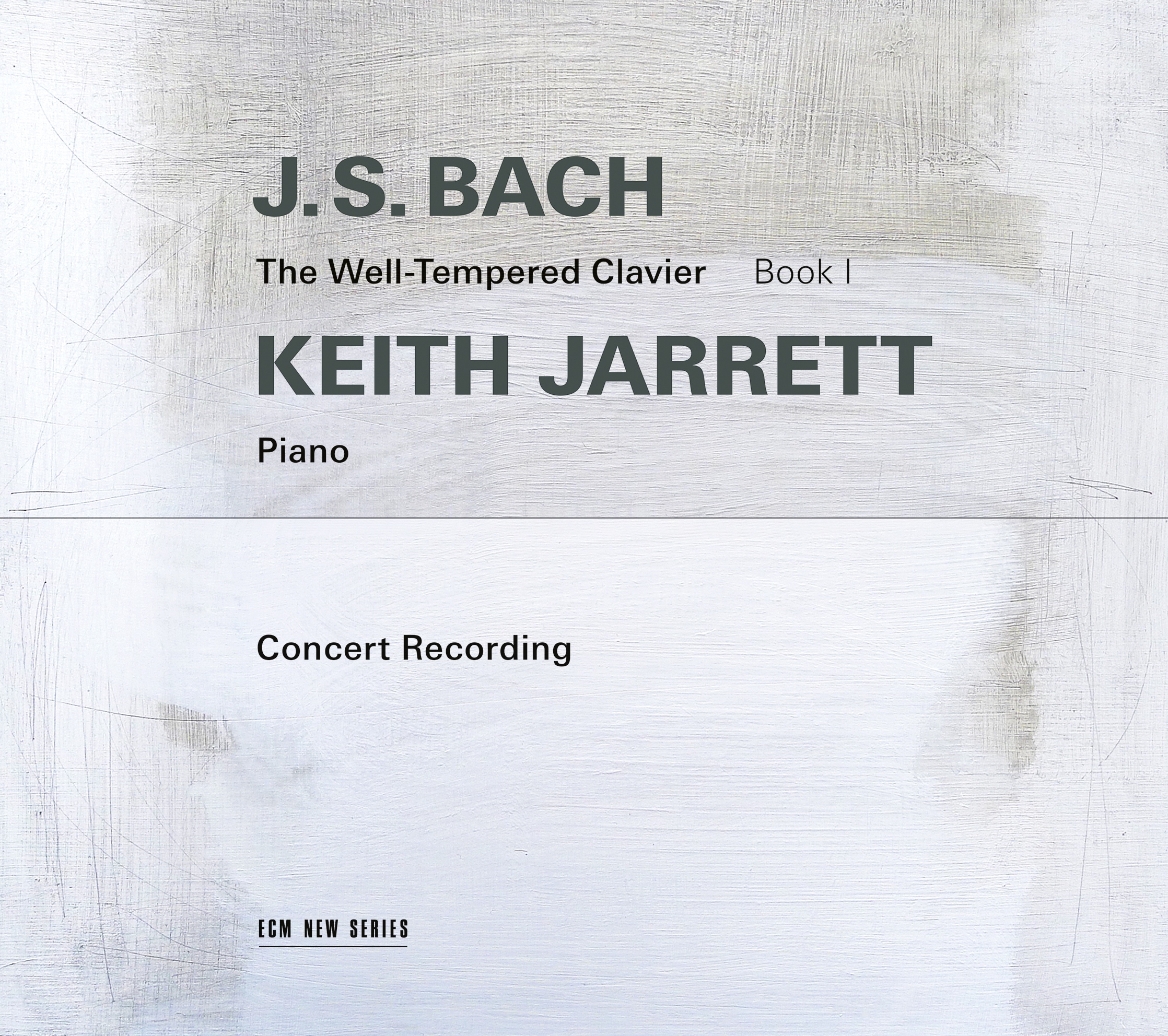
Keith Jarrett piano
Concert recording, March 7, 1987
at Troy Saving Bank Music Hall, Troy, New York
Engineer: Tom McKenney
Mastering: Christoph Stickel
Executive producer: Manfred Eicher
Release date: June 14, 2019
After recording Book I of Johann Sebastian Bach’s The Well-Tempered Clavier for ECM on piano in February of 1987, on the 7th of March that same year he performed it live at the Troy Savings Bank Music Hall in upstate New York. Throughout this archival recording, we see a side of Jarrett not so much hidden as broken wide open in his life as an improviser. His restraint is poetry in motion, figuring this masterful music with a touch that’s intimately bound to the score. Even in the more dramatic flourishes of the c minor and C-sharp major preludes, there’s a sense that he is submerging any impulse to flourish in a bath of deference.
In Jarrett’s hands, each pairing of prelude and fugue takes on the very character one presumes it was meant to have: which is to say, standing with resolute individuality as part of an interlocking embrace that cannot be broken apart. Issuing from these portals is a spiritual force that weaves between realms as Jarrett between notes. When he slips from the realm of C into that of D, where the latter’s major dyad feels blessed by a watery hand, he clarifies Bach’s inversions, rendering minor keys as stages for joy and their major counterparts as jumping points for faith.
Whereas D has its playful veneer, E casts aside all notion of folly and turns even the liveliest fugue into a fierce puzzle of longing. The e-flat prelude is an especially ponderous example of composer and interpreter working in harmony to communicate truth. That said, there’s no Platonic ideal lurking within, but rather a feeling tailored to every listener. If any exuberance is to be found in this phase of the journey, it’s in the e minor fugue, but even there it looks rather than speaks through a filter of tangled intentions. In light of this, the F major prelude’s wider net lets through more than it catches, interested as it is in preserving the terms of its passage. Landfall is suspended until the F-sharp major prelude, wherein Jarrett wears the tenderest of hearts on his muscled sleeve, and pulls out a treasure map in the key of f-sharp minor.
And treasure he does indeed find in G terrain, of which major and minor preludes yield their respective fugal gems. All the while, rewards of the A major prelude have awaited our triumphal return, hoisting up flags and drinks alike in the manner of tribute. Thus, we are primed for the B-flat major prelude, in which Jarrett’s quick-thinking fingers revel in the joy of safety. In closing, the b minor pairing embroiders a dream in waking filament. Its every stepwise turn introduces a new color in the tapestry and tempers the final fugue with intimations of obscurity, morality, and nothingness. The flesh may only whisper, but by now we know the calling of a higher power whose volume—though compressed into a single keyboard—matches that of millions more in aggregate.
Kim Kashkashian viola
Recorded November 2016 and February 2017 at American Academy of Arts and Letters, New York
Engineer: Judy Sherman
Mastering: Christoph Stickel
Produced by Manfred Eicher
Release date: October 12, 2018
“Living with Bach: a true and faithful companion who patiently provides a merciless and transparent reflection of one’s failings in vision and simultaneously gives the deepest comfort in all circumstances.”
–Kim Kashkashian
If you were to unravel all the blood vessels contained in the average adult, they would stretch to a distance of 100,000 miles. And while the Six Suites of Johann Sebastian Bach (BWV 1007-1012) have always felt like such an unraveling, heard now from the viola of Kim Kashkashian, one becomes aware of that distance in an entirely new way. Whereas on the cello the extent of their totality feels surprising and overwhelming, here it takes an intimate, inevitable quality. In that respect, Kashkashian makes us believe that this music has passed through every molecule of her own body before a single note has tingled from the regard of a microphone.
Kashkashian heats expectation to the consistency of glass, cools it, and shines new light through its resulting prism by starting with Suite II in D minor. At first, one might miss the “depth” of the cello, but what the viola may lack in octave it makes up for with a resolutely vocal quality. With so much emotion at hand, the listener feels inadequate to contain it all. Yet both composer and interpreter assure us of having enough corridors within us to provide passage. In her rendering of the Sarabande especially, Kashkashian hasn’t so much revealed something once hidden by the screens of former performances, but taken the first pictures of this moon’s far side. Indeed, whereas other performers have focused on the face that’s always illuminated—whether by force of history or convention—Kashkashian shines her creative light onto a darker plane that was always there but for so long went unseen.
Only next do we find ourselves swaddled by Suite I in G major. At last, we get those familiar arpeggios, making their appearance all the more savory for their anticipatory marinade. What might normally be experienced as the seed, then, becomes the stalk born from that seed, at last graspable as an object of silent regard, not unlike the bow used to elicit its photosynthesis. Kashkashian shows her greenest spectrum in the Allemande, tracing every life-giving vein from edge to edge. Here, as also in the Courante that follows and the Menuet a skip beyond, she takes her time, allowing rhythms and ornaments to suggest their own variations and appearances.
Anyone missing the cello’s grit will find it dutifully preserved in C-minor Suite V. Between the angular Prélude and the laddering Gavotte, there’s plenty of sediment to be sifted through. The latter movement is a major turning point in that respect, and was for these ears the moment when the viola took on its spirit as a voice to be reckoned with in its own terms. What becomes clearer from this point forward is that everything Kashkashian plays is infused with as much of her being as Bach’s very own.
While “thinking out loud” is a descriptor often reserved for jazz improvisors, throughout Suite IV in E-flat major, Kashkashian shows us that classical musicians at the highest level are equally deserving of the accolade. Whether in every studied pause of the Allemande, masterful bowing of the Courante, or lively restraint of the duple Bourée, she shifts the light to reveal facets that, while forever singing, need a temporary amplifier to become audible.
Suite III, written in the fundamental C major, is a pantheon among temples, and therefore holds itself with a dignity that the other suites can only taste in shadow. Its own Allemande is another master class in syncopation and finds Kashkashian moving as would a linguist through a text so fully clothed in marginalia that, despite not being written in the native tongue, becomes second nature through years of anthropological internalization. So, too, the Courante, which leaps not from the strings but from the bow bidding them to resonate. Neither has the Bourée sounded so connected to its physical means, cracking in the ear like the softest of whips.
Just as the album began with the unexpected, so does it end as it should: with Suite VI in D major. Offering the most arresting Prélude of the collection, the microtonal rocking of which glows phosphorescently in its present handling, the suite is wisdom incarnate. The Sarabande is another manifesto of tenderness rarely so sustained, and delivers us like children into the dawn-drenched Gavotte. And where would we be but lost without its declamatory Gigue. Like its previous five counterparts, it gives us closure in order to hold us true to ourselves and our experiences. As Paul Griffiths in his liner essay notes of these farewells: “Gigues complete the landscape drawn in each key, not by the composer, not by the instrument, not by the performer, but by all three—complete it and leave.” We, however, stay behind, closing our eyes against the grain of what we’ve just heard in full knowledge that no such experience will ever honor us again. And so, we fold every artery, vein, and capillary we can call our own back into the suitcases of our skin, stepping back on the train of life and counting every track as we try to recall what it all felt like before these sounds compelled our detour into peace.
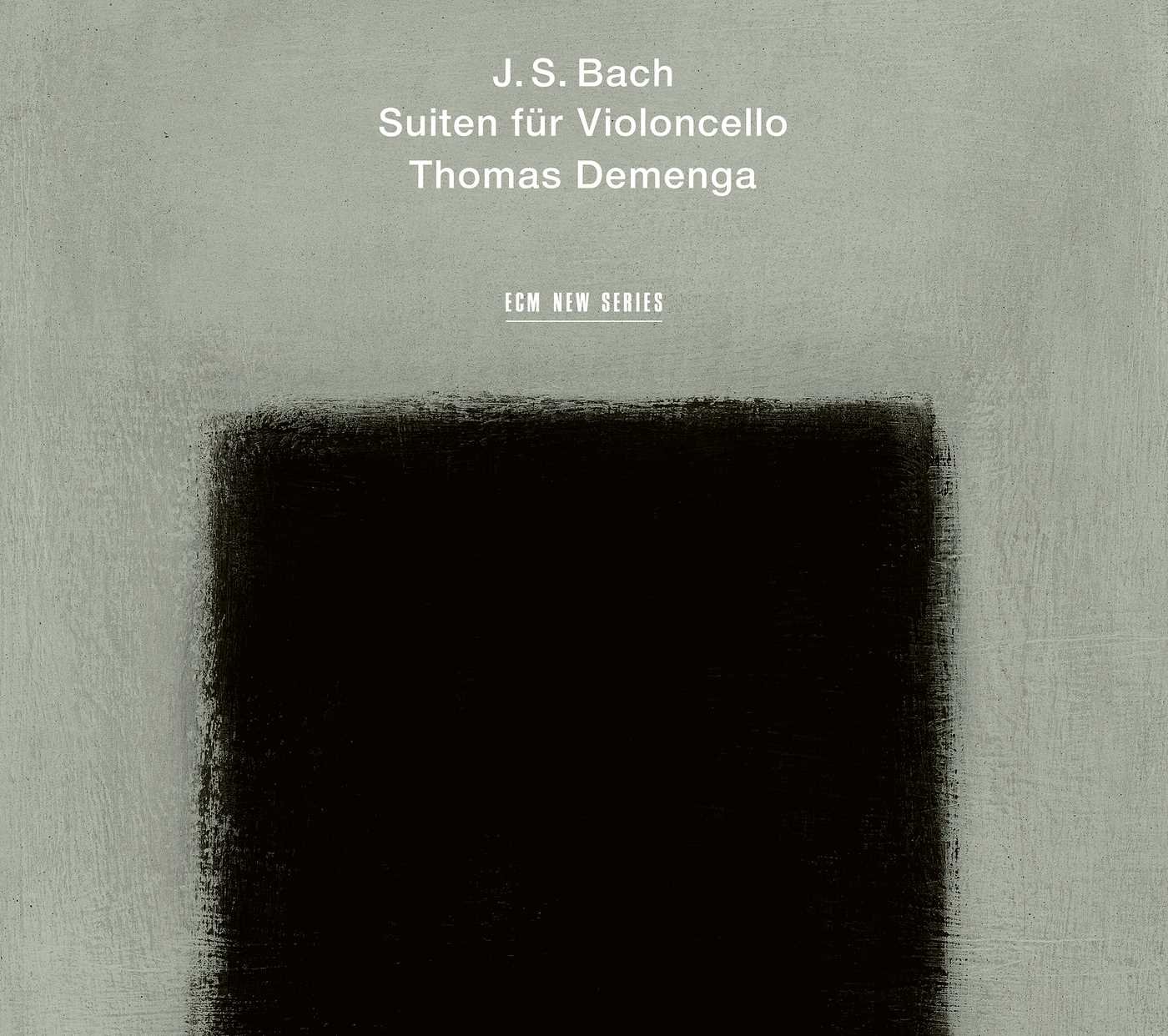
Thomas Demenga violoncello
Recorded February 2014, Hans Huber-Saal, Basel
Engineer: Laurentius Bonitz
Executive producer: Manfred Eicher
Release date: October 27, 2017
The Cello Suites of Johann Sebastian Bach, like his Sonatas and Partitas for solo violin, are touchstones for listeners and performers alike. In the latter sense, Thomas Demenga approaches them through an ECM lens for the second time here. Having first fragmented his traversal between 1986 and 2002 through a series of pairings with contemporary works, thereby suggesting exciting new relationships, here he uncovers intra- rather than interrelationships, moving from fundament to firmament and back again with mind and hands sculpted by experience into something unmissable.
Where some interpretations might seek to add something new, Demenga’s embrace something old, always there but too often crucified on the scoreboard of modernism. Here we encounter a return to form, if not also a form of return, in the deepest interest of music that springs eternal from Creator to creator. Referred to in Thomas Meyer’s liner essay as “every cellist’s gospel,” the Cello Suites do more than encourage rereading; they demand it. Having played these masterpieces for more than 50 years, Demenga understands that no one is ever “done” with them and that we’re all born and expire in its swaddling echoes.
In the First Suite, he carries an antique sensibility from first inhale of Prélude to last exhale of Gigue, working shadows into familiar nooks and crannies as if they constituted a physical substance. That same feeling of breath, more than metaphorical, whispers, rasps, and soliloquizes through the Second Suite’s philosophical journey. Its Prélude liquifies the heart and feeds it to another in a cycle of life that cannot be qualified by any other means than the gut strings and baroque bow with which Demenga has chosen to articulate every stroke. The Courante is strangely beautiful in its jagged denouement, while the Sarabande that follows it speaks with haunting urgency and the concluding Gigue with three-dimensional tactility.
The lithe stirrings of the Third Suite’s Prélude and Allemande form a dyad of such emotional integrity as to occupy a realm all their own. As in the famous Bourrée I & II, he dives inward for pearls of wisdom, unpolished and offered in their own shells, glorious specimens of nature whose perfection communicates in the language of imperfection. Demenga’s trills and glissandi are as surprising as they are organic, and flow of their own volition.
Says Demenga of Bach, “His music is detached from personal feelings and dramas or other events to which many composers give expression in their music. That is why his music is so pure and why it possesses, we might say, something divine.” In interest of that expression, this performance is made all the more solitary for its attention to dance-informed structures. This is especially evident in the program’s second half, which through the prism of the Fourth Suite shines a light striated with as much solemnity as exuberance. From the throaty Prélude unspools a narrative of timeless impulses. In the Allemande and Courante that follow, one can feel the soul of a viola da gamba squeezing through the strings, as if the latter were portals of mastery to which our ears must seem as eyes hungry for vistas beyond the known. And in the footwork of the final Gigue, the press of flesh into soil is vivid and alive.
From that sunlit scene Bach pivots into the twilight of the Fifth Suite. Here the modesty of its inception tangles in moral debate with its fleshly Courante—made all the more carnal for Demenga’s intuitive bowing—before finding solace in the blushing Gigue.
This leaves the Sixth Suite to stand as its own Book of Revelation, a scriptural culmination of all that came before it, a fulfillment of prophesies as old as they are indisputable, and which spread the good news of salvation not through words but actions.
As the opening movements—not least of all in the dizzying Prélude—suggest, we must find our own way into this music not by way of deciphering but in the knowledge of receiving a gift in and of faith. And if the finality of its Gigue is any indication, we must treat farewell as the opening of a deeper relationship with life itself, personified in every tremble of the waiting ear and reciprocated whenever we need to be reminded of purpose.







 Between Sound and Space: ECM Records and Beyond