J. S. Bach: Motetten – The Hilliard Ensemble (ECM New Series 1875)

Johann Sebastian Bach
Motetten

The Hilliard Ensemble
Joanne Lunn soprano
Rebecca Outram soprano
David James countertenor
David Gould countertenor
Rogers Covey-Crump tenor, organ
Steven Harrold tenor
Gordon Jones baritone
Robert Macdonald bass
Recorded November 2003, Propstei St. Gerold
Engineer: Peter Laenger
Produced by Manfred Eicher

It was during a concert given by the Tallinn Chamber Orchestra and Estonian Philharmonic Chamber Choir in the fall of 1995 that a Bach motet’s masterful weaves of light and sound first nourished these ears. With infinitely branching listening paths before me, however, I never explored the motets further—that is, until the ECM connection came full circle with this wondrous recording from the Hilliard Ensemble. Or should I say, the Hilliard Ensemble in duplicate, for here the quartet is joined by sopranos Joanne Lunn and Rebecca Outram, countertenor David Gould, and bass Robert Macdonald for a special session in the familiar acoustics of Austria’s Propstei St. Gerold.

Very little is known about the circumstances surrounding the composition of these motets, but as Martin Geck’s liner notes remind us, their significance in Bach’s oeuvre is on par with The Well-Tempered Clavier, equally monumental as examples of counterpoint and absolute harmony. They are, one might say, extra-musical insofar as they express themselves far beyond the words at their core, beyond the note values ascribed to those words, and beyond the constraints that pigeonhole them into meters and divisions. Rather, they lose themselves blissfully in the finer details of their flowering.

From the first threads of Singet dem Herrn ein neues Lied one can feel the utter control these singers possess. Listening to them is like feeling the music being born from Bach’s mind, fresh and free from the pitfalls of excessive scrutiny. Lunn and Outram stand out especially, ringing out over the others like carillon overtones in a music overcome by a melismatic spirituality (listen also for their striking high that ends this opening motet). The shimmering space therein gives us some of the more intimate moments on the disc, nesting in mind and body with all the gentility of an autumn breeze. These motets all end on resolved chords, offering a sign of hope and tranquility in the wake of their roiling seas. On that note one can hardly praise this recording without highlighting the crisp diction throughout. This attention to linguistic color is perhaps what most separates it from those rendered in larger forces. Moments like the “Gute Nacht, O Wesen” portion of Jesu, Meine Freude are as tactile as our own bodies. Others of sheer transcendence abound, as in the final chorale of Fürchte dich nicht, ich bin bei dir and the Alleluia of Lobet den Herrn, alle Heiden. Yet it is in the last, Ich lasse Dich nicht, du sengnest mich denn (often elided from Bach motet recordings, due to its contested authorship), that we find ourselves bathed in deepest calm, for here is the breath turned sacred, that it might begin a life of its own.

Thomas Demenga plays J. S. Bach/B. A. Zimmermann (ECM New Series 1571)

Thomas Demenga
J. S. Bach/B. A. Zimmerman

Thomas Demenga cello
Thomas Zehetmair violin
Christoph Schiller viola
Recorded February/July 1995
Engineer: Terje van Geest
Produced by Manfred Eicher

There is a time for everything,
and a season for every activity under heaven.

Cellist Thomas Demenga continues his Bach project by juxtaposing the Baroque master’s d-minor Suite No. 2 with the work of Bernd Alois Zimmermann (1918-1970), one of the most important non-Darmstadters after World War II. As ever, Demenga makes a convincing argument for the pairing (interestingly enough, most of the criticism of Demenga’s project sees the Bach as filler). In this case, Zimmermann is something of an effortless choice, for his fondness of quotation and respect for tradition were at the heart of his artistry. His approach to time in this regard was particularly significant, drawing on intersections of influence through a wide range of trends and idioms.

Thus do we find ourselves in the comforting waters of Bach’s generative whispers from the moment we dive in. For this performance Demenga adopts the approach of a viola da gamba player (to greatest effect in his raspily inflected Courante). This sound draws out the music’s inherent gaseousness, in which one feels something dark and cosmic taking shape. Demenga’s notecraft ensures that every molecule feels connected through a legato of silence. He digs as deep as he can for those distinct Bach lows, plows double stops as if they were fertile fields, and maintains subtle independence of line in the Sarabande. He bows the Menuets as if with shadows, then elicits one of the finer renderings of the Gigue I’ve yet heard, striking a fine balance between jubilation and regret.

The boldness of this architecture may seem an ill fit to Zimmermann’s sonatas, which despite their meticulous scoring also call for an improvisatory approach. This puts the musician in a potentially compromising space, though if anyone is up to the challenge, it’s Demenga. Many of Zimmermann’s works were considered unplayable when first written, the Cello Sonata of 1960 not least of all. Drawing from his usual pool of spatial and temporal concerns, the piece moves beyond the Romantic notion of cello as vox humana and into the realm of speech, action, and embodiment. In his liners, Demenga notes a particularly difficult passage in the first movement, which encompasses three distinct time-layers: “while the upper voice, played on the bridge, produces a continuous ritardando, the middle one is the most striking, because of its very large range and numbers of notes played pizzicato, and then the lowest, played on the nut of the bow, sounds like a scarcely perceptible accelerando.” Despite its brevity, unpacking the finer implications thereof took Demenga weeks to perfect.

That said, like all walls it can be, and is, overcome in such a way as to render those difficulties invisible and meaningless. It is a testament to his playing that the potentially distracting technicalities of this music become vital mechanisms to their own forgetting. In addition, the more the music progresses, the more one realizes that its virtuosity stems not only from the obvious difficulties, but more importantly from the way the performer must treat every cell as its own motivic entity while maintaining a sense of continuity (as in the “Fase” movement). Between the boldly intoned opening and the ethereal resolutions of “Versetto” we feel the cellist walking the edge of our Umwelt, stitching a morpheme for every step like a bead into patchwork.

Before this we are treated to two nearly intriguing sonatas. The Violin Sonata of 1951 was written after the composer’s concerto for the same. Demenga’s conceit is strengthened by a B-A-C-H cipher and likeminded spirit (notably in the Toccata). From the Paganini-esque heartbeat to the dramatic pizzicato slap that closes it, this is a tapestry of musical lines that is sure to delight. Christoph Schiller makes delicate work of the 1955 Viola Sonata thereafter and undoes a few of the frays left dangling. Subtitled “To the song of an angel,” the one-movement sonata was written in memory of the composer’s daughter Barbara, who died soon after her birth. This self-characterized “chorale prelude” is based on Gelobet seist Du Jesu Christ and tracks a pseudo-scientific journey of private inquiries. At times the instrument duets with its own implications, while at others it shatters itself into a hundred pieces.

This program is about nothing if not intimacy. Not only by virtue of the solo repertoire—Zimmermann himself believes the solo to be the only way by which one may access an instrument’s “almost inexhaustible power”—but also because of the way in which that repertoire speaks through the hands of such capable musicians. This is no-frills playing of music that, while at times distorted, rings forever crystalline in our memory of it.

<< Eleni Karaindrou: Ulysses’ Gaze (ECM 1570 NS)
>> Dave Holland Quartet: Dream Of The Elders (ECM 1572)

Bach/Webern: Ricercar (ECM New Series 1774)


Johann Sebastian Bach
Anton Webern
Ricercar

The Hilliard Ensemble
Monika Mauch
soprano
David James countertenor
Rogers Covey-Crump tenor
Gordon Jones baritone
Münchener Kammerorchester
Christoph Poppen
Recorded January 2001, Himmelfahrtskirche, Sendling, München
Engineer: Andreas Neubronner
Produced by Manfred Eicher

With Ricercar Christoph Poppen continues where he left off on Morimur. While the goal of the latter project was to reveal what was hidden, here it is to direct our ears to what is already there. To achieve this Poppen bridges the J. S. Bach divide now to Anton Webern, highlighting an early Bach cantata—“Christ lag in Todesbanden” (Christ lay in the bonds of death)—as a genetic link to Webern’s op. 5 and the String Quartet of 1905, and ultimately to Webern’s own rendering of the six-part ricercar from Das musikalische Opfer (The Musical Offering). Herbert Glossner, in his liner notes, analogizes the relationship between the cantata and the ricercar in architectural terms, with the former standing at the center and the latter providing the cornerstones. The structural comparisons are far from arbitrary. They provide key insight into the potential for both composers to interlock in fresh and enlivening (more on this below) ways.

The bookending ricercar does, in fact, support the program like the columns of some aged temple, letting the language therein build from the afterlife of a single oboe line. This weave seems to pull the orchestra from a profound slumber, also drawing from within it deeper threads that unfold rather than obscure their source. This is no mere interpretation, but a bodily dip into Baroque waters. The same can be said of Poppen’s project on the whole: Ricercar is neither trying to modernize Bach nor even to accentuate the timelessness of his music, but rather taking an informed look into the prism of its inception. Paired with the conductor’s variegated arrangement of the 1905 quartet, it pours like the sun through an open curtain. On this side of the spectrum the music has a similarly fugal structure and sits comfortably in its shell, yet also bleeds into the cup of Bach’s fourth cantata. The soaring organ and heavy foliage of strings and voices in the opening movement accentuate the kaleidoscopic effects of all that have fed into it thus far. The assembled forces accelerate into a beautifully syncopated passage that almost rings of Steve Reich’s Tehillim in the allelujas. The cantata’s only duet, here between soprano Monika Mauch and countertenor David James, is a crystal of fine diction (especially in the words, “Das macht…”), as are the respective tenor and baritone solos from Rogers Covey-Crump and Gordon Jones. The performances are carefully striated and blossom in the glory of their full inclusion (whereas in Morimur only selections were decidedly offered out of their immediate contexts).

All of this gives us a profound feel for the concept and for the awakening stirrings of Webern’s Five Movements for String Quartet, performed here in the composer’s own expanded version. Not unlike the preceding cantata, it awakens in plush contours into a duet of sorts before regaling us with tutti and solo passages in turn. This constant negotiation between speaker and spoken heightens the music’s physicality and thus its mortal vitality, so that in its throes we think not of death but rather of the life-giving soil in a landscape now heavily traveled. For while it is tempting, of course, to read these works as if they were written on the brittle paper of death, one cannot help but feel the affirmation of survival thrumming through their veins. Each is a universe in fragments waiting to be painted, and the exigencies of our fragile existence its subjects.

Bach: Die Kunst der Fuge – Keller Quartett (ECM New Series 1652)


Johann Sebastian Bach
Die Kunst der Fuge

Keller Quartett
András Keller violin
János Pilz violin
Zoltán Gál viola
Ottó Kertész cello
Recorded May 1997, Altes Stadttheater Eichstätt
Engineer: Peter Laenger
Produced by Manfred Eicher

In the end, we self-perceiving, self-inventing, locked-in mirages are little miracles of self-reference.
–Douglas R. Hofstadter, I Am a Strange Loop

One is tempted, perhaps, to experience the fugue as a puzzle. In that puzzle are strings of numbers unraveling from a central rope, even as they spin into one. Yet when listening to Bach’s Art thereof, and especially in the Keller Quartett’s sensitive hands, we find that even our best similes are weak and arbitrary, for this music, this expression of internal power, is alive. By no means universal, it takes a different form every time to every listener. We in turn can take comfort in knowing that the final triple fugue was never finished, for into it the composer wove his signature B-A-C-H (B-flat-A-C-B) theme, as if signing off on a lifelong document. Thus is The Art of Fugue an “emancipatory work” in the estimation of Hans-Klaus Jungheinrich, who in his accompanying essay goes to great lengths to demythologize the unrealistic pedestals upon which the work has been placed. The instrumentation was never resolutely determined, though it was likely intended for the nascent pianoforte. The string quartet presents a compelling solution. In this respect the Kellers push the envelope, varying tempi considerably and in doing so point us to a humbling truth: namely, that if this was to be Bach’s most lasting statement, it had to be invisible.

One with a deeper background may train a musicological magnifying glass to every weaving line, but these ears are more interested in the effect than the cause. And of that effect, I am at pains to say anything worthwhile. Although its movements comprise a moving target of speeds and densities, a constant hum runs through them. It is something we feel rather than hear. Cellist Ottó Kertész is particularly well suited, evoking the slightly metallic continuo of yore with a tinge of intangibility. (This, I think, explains the curious production, which favors distance and cavernousness—it is not historically informed, but seeks to inform history.) That being said, the music is nothing if not expressible. It might very well be Bach’s swan song, and therefore the culmination of his craft, but I prefer to hear it as a homecoming, a clearing of clouds to let fall the darkness that nourishes all artists, paling into the light that embraces them once they’re gone.

One day, we encounter this music and it sings to us. But then the voices stop mid-phrase, as the Kellers have preserved them, and suddenly the galaxy unravels, leaving us floating in the stagnant pool of all silence. Listen, and you know there is truth in the number:

One.

Johann Sebastian Bach: Ich hatte viel Bekümmernis (ECM New Series 2229)

Johann Sebastian Bach
Ich hatte viel Bekümmernis

Heinz Holliger oboe
Erich Höbarth violin, direction
Camerata Bern
Recorded December 20-22, 2010
Radiostudio Zürich
Engineer: Andreas Werner
Produced by Manfred Eicher

Of
a tree, of one.
Yes, of it too. And of the woods around it. Of the woods
Untrodden, of the
thought they grew from, as sound
and half-sound and changed sound and terminal sound…
–Paul Celan, “And with the Book from Tarussa” (trans. Pierre Joris)

On October 4th, within an hour of having listened to this album for the first time, I went out for lunch, when I noticed a peculiar sight. There, sitting at an outdoor table, was a hermetic figure with a Monarch butterfly resting on his outstretched hand. How could I not engage him in a conversation? The man, I soon found out, was Rolfe Sokol, a local fixture in Ithaca, New York for over a decade and one of the most sought-after violin teachers in the area. Rolfe had saved the injured butterfly after spotting her on the side of the road. During her recovery from two crimped legs and a damaged wing, she hardly left him. As Rolfe animatedly informed me, drawing his story as he might a bow, the butterfly spent most of her time on his shoulder or perched on a finger, living off the sugar water he provided. When she had recovered enough to make short flights, he took her to the park, where she greeted strangers but always returned.

Rolfe and I inevitably turned to topics musical. After being regaled with stories of some of my favorite violinists and composers, I asked if he was familiar with ECM Records and with Heinz Holliger’s latest Bach recording. Though the answer was no on both counts, he did tell me how the butterfly reacted most positively, fluttering her wings and “stamping” her forelegs, whenever he or his students played Bach. Upon hearing this, I immediately asked for Rolfe’s address and later sent him a copy of Ich hatte viel Bekümmernis to aid in the butterfly’s recovery, for the title—which translates to “I had much affliction”—seemed appropriate for one in a stage of healing. It is in that spirit of rejuvenation that I discuss the music at hand.

Rolfe’s butterfly

With his usual blend of humility and cogency, Holliger gives us in his liner notes an informed account of these recordings, which together represent a pastiche of reconstructions, arrangements, and restorations from, to recapitulate his quoting of Hegel, the “fury of disappearance” that so befell much of Bach’s oboe literature. Such unrecoverable shadows will have cast themselves over many a Baroque enthusiast and so bear no redrawing here. In any case, after listening to this recording almost once per day since receiving it so kindly from a faraway friend, I have become as intrigued by where its beauties are going as by where they came from.

Holliger’s latest for ECM is so rich it’s almost unhealthy. Three sinfonia introductions, two from among Bach’s cantatas and one from an Easter Oratorio, form its crux. Some music simply stills us, and the darkening swells of “Ich hatte viel Bekümmernis” (BWV 21) constitute such music. Holliger and violinist Erich Höbarth intertwine like birds in slow motion, each leaving a trail of something forgotten, blazing across the sky in a slow-moving fire, by which only one’s fate can be written, ever out of reach but always readable in the light of divine countenance. But where my description may be overblown, Holliger’s technique never is, always held in check by a profound reserve that allows the music to flourish on its own terms. Bach’s mournful reflection sings with a palpable retrograde, and from its first draw pulls the center of our being toward that of some unnamable other.

Of the four concertos offered here, the c-minor for oboe, violin, strings and basso continuo (BWV 1060) is the most humbling. Joined front-stage by the nimble fingerwork of Höbarth, Holliger details a multivalent sound palette. And in the d-minor (BMV 1059) his legato phrasings explore parts of the surrounding orchestral architecture that most oboists would neglect to see, let alone articulate. The slow, waltz-like quality of the Adagio is an especially profound wind-up for the heavenward lob of the Presto that concludes. Holliger looks even more inwardly in the A-major concerto (BWV 1055). Here, he luxuriates in the subtle turns of phrase and moments of tension that seem to stretch between orchestra and soloist and dance across water with every trill. And then there is Bach’s reworking of an Alessandro Marcello concerto, which glistens with poised ornamentations. A lively dance in the Presto percolates with bewitching charm as Holliger populates every interstice with his inextinguishable passion.

As one who believes the assembled performers to be a virtually uncriticizable combination, I risk redundancy in praising their results as a scintillating tour de force of tempo, timbre, and above all vocality. In light of the already wondrous 1982 recordings of BMV 1055 and 1059 on Philips with the Academy of St. Martin-in-the-Fields (back during the latter’s hyphenated golden age), this could never be anything less than superlative in its complementary light.
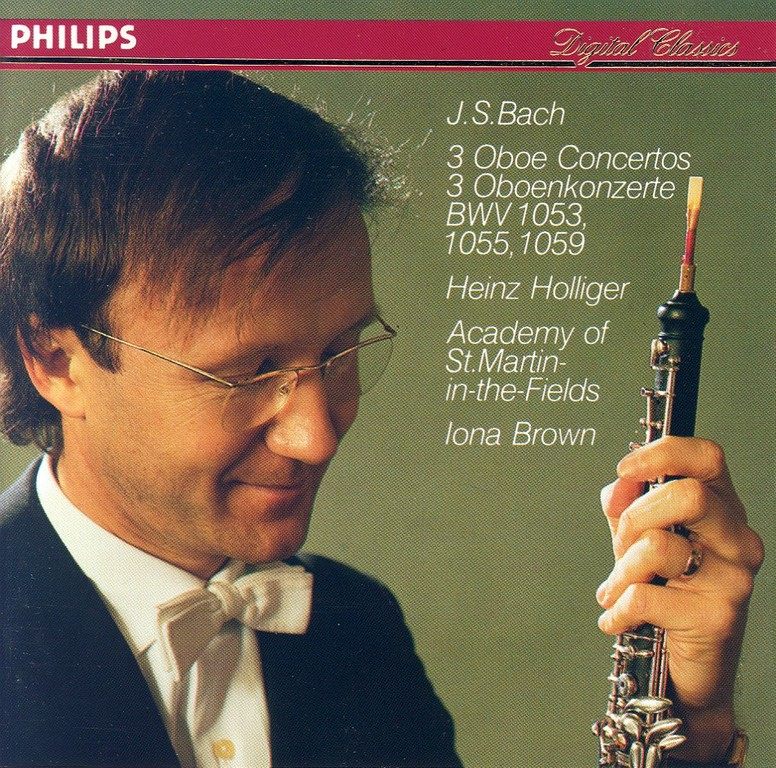
Yet one notices also the striking differences between the two. ECM’s recording, while bright, explores this music’s deeper colors, balancing the swirls of refinished wood with an expertly miked continuo. Holliger’s playing has rarely sounded so earthy, so focused on its ephemeral task. These are not reimaginings but reawakenings. And while tempted, I hesitate to use the term “benchmark recording,” as it would speak of its interpretive possibilities as having been branded in time, checked off on the never-ending tick sheet of Bach recordings.

It is also tempting, following Hans-Klaus Jungheinrich, to think that “all roads lead back to Bach.” Yet rather than see Bach as the endpoint to a musical funnel that cuts across histories and geographies, we might better witness the avatar of a composer whose gestures of humility brought to fruition a sense of openness. We do well to resist painting Bach as a Universalist. In search of a alternate analogy, I return to the butterfly. Monarchs are known for their annual 2500-mile migration. Contrary to popular belief, no single pair of wings survives the entire journey. In essence, the group is a kaleidoscope of constant regeneration that returns a different entity from when it left. Like those roving splashes of black and burnt orange, Bach’s music itself travels in a constant state of regeneration, such that every fresh performance, every pair of ears newly enchanted, spreads its own venation of appreciation.

Two weeks ago I ran into Rolfe for the first time since our initial meeting, only to discover that his lepidopteran companion had not survived the cooling Ithaca climate in time to hear this album, but that when he received it he did play it for her. And so, in the interest of continuing this chain of memorial, which began with the death of Bach’s favored pupil (fresh in the composer’s mind when penning the titular sinfonia) and which is linked by Holliger’s loving dedications to the memories of his brother, Eric, and friend Gabriel Bürgin, if you ever find yourself in possession of this jewel of an album I hope you might also take a moment to remember Rolfe’s butterfly, who I like to imagine now rests contentedly on Bach’s shoulder, her proboscis no longer necessary for the music of the spheres that will forever sustain her.


Bach: Six Partitas – Schiff (ECM New Series 2001/02)


Johann Sebastian Bach
Six Partitas

András Schiff piano
Concert recording, September 21, 2007, Historischer Reitstadel, Neumarkt
Engineer: Stephan Schellmann
Produced by Manfred Eicher

After completing his highly praised Beethoven cycle, pianist András Schiff returns to Bach in this spot-on live recording of the Six Partitas. Though published as his Opus 1, the Partitas were Bach’s last compositions for keyboard. Both reasons make it a keystone in the mythical Bach pantheon. Although “partita” is essentially a euphemism for “suite,” in Bach’s hands the form was opened to a freer and more complex sense of infrastructure and performative demands.

The introductions show both composer and performer at their best. The Praeambulum of Partita V is a tour de force of rhythmic urgency and dynamic control. The Fantasia of Partita III is another astounding inauguration, its resplendence cluing us into the genesis of the music to follow. The meditative Praeludium of Partita I contrasts sublimely with the Sinfonia of Partita II, the latter a stately lead-in to the courtliest of the Partitas. The accompanying Allemandes overwhelm with their sparks, conflagrating our souls into rapt attention. The pacing throughout is nothing short of extraordinary. Schiff’s sprightly Correntes glisten like rain-drenched leaves, tempering their surrounding flames with a quiet power.

Schiff truly excels in his ornaments. Take, for example, the heart-stopping trills of the Partita III Tempo di Minuetta, his detailed graces in the Passepied of the same, and the half-step motions of his Partita I Gigue. The Partita II Gigue provides some especially enlivening moments in which the right hand goes high and left hand carries the rhythm downward. Such motions broaden the expanse of the music into epic territories, which is all the more amazing for music that is so closely confined to the arm span of a single performer. Not to be outdone by his own passionate spirit, Schiff finesses his way through the Sarabandes of Partitas I and IV with the gentle persuasion of an aristocrat stripped to the naked heart. Also of note are the flowing syncopations of the Partita II Rondeau, played here to perfection in one of the performance’s most glorious turns. The following Capriccio pirouettes its way through a deft and vivacious choreography.

Schiff’s ordering—V, III, I, II, IV, VI—is conscious, moving in ascending keys from G major to E minor. It also carries us into the most heartfelt pieces therein. Partita VI is the castle of these sprawling grounds. Its lofty spaces give ample breathing room for the loveliest Sarabande of the collection, not to mention a strikingly forward-looking melody. Moving with a delicate ease and supreme comfort, it primes us for the epic Fugue through which all comes to a rousing close.

I have no interest in staking a claim in the already bristling ground of musical criticism as to whether Schiff is the better interpreter. All this humble admirer knows is that, like the other superstars to which one might compare him, he is unafraid to show us how he “feels” Bach. It’s not as if he accesses some pure core of the music that others do not, for he plays it as if it were his own. Whether or not one agrees with his stylistic choices, his commitment to them is undeniable. And perhaps said commitment is a more profound measure of the performer. If we consider some of the greats in this regard—Glenn Gould, Rosalyn Tureck, Sviatoslav Richter, and Tatiana Nikolayeva—we find in each a style without regret, an allegiance to a particular historical moment (or possible transcendence thereof, in the case of Gould), and a total lack of interest in relativity. Each performance is not an ingot to be judged against the quality and density of others, but is a reflection of the musician’s own creative makeup that is beyond petty comparison. Rather than look at how and why interpretations differ, as listeners we can only find the differences they bring out in ourselves. And are we not also contributing to the uniqueness of the performance? For the same music can change with our moods and circumstances. And so, when we approach the Partitas, perhaps it benefits the music more to consider what we have to bring to the experience that no other listeners can bring, just as we might expect the same for the musician performing it. For me, the strength of Schiff’s playing is that it duly reminds us of our role on the other side of the piano, foregrounding our engagement, which is the music’s lifeblood. We see this in Schiff’s Beethoven cycle, his Schumann, and his Goldberg Variations. And now, with the Partitas we are given a greater responsibility to provide that “live” feeling ourselves in whatever private chambers we inhabit, or with whomever we might share it. This music is always there for us.

Like Bach’s other masterworks for solo instruments, the Partitas have a distinctive aura of completeness about them, which is to say they feel entirely self-satisfied. And it is this satisfaction Schiff brings to his playing: not a sign of arrogance, of professed authority, nor even of excellent musicianship, but rather the consummation that the music invites in the performing and in the listening. This is the genius of Bach: not the music itself, but in knowing our ability to hear in it forgotten pieces of ourselves. It may not be universal music, but so help me if it isn’t universally musical.

Bach: Inventionen und Sinfonien/Französische Suite V – Fellner (ECM New Series 2043)


Johann Sebastian Bach
Inventionen und Sinfonien/Französische Suite V

Till Fellner piano
Recorded July 2007, Mozartsaal, Wiener Konzerthaus
Engineer: Markus Heiland
Produced by Manfred Eicher

What is a “Bach interpreter”? Is it someone who draws from creative reserves to put as unique a spin as possible on much-performed repertoire? Must s/he be selfless and allow the music to “speak for itself”? After a four-year wait, Austrian pianist Till Fellner follows up his humble ECM debut recording of Bach’s Well-Tempered Clavier with the often overshadowed Two and Three Part Inventions, through which he answers these questions with one of his own: However Bach is painted, what is the image being maintained?

From note one, this is a clearer, more present album than Fellner’s somewhat murkier (and no less affecting) WTC. He holds up every piece to his jeweler’s eye, that we might better see its overall prismatic nature. His rhythms are protean and proper, giving the faster movements just enough pep to gain savory traction while lacing the slower ones with a luxuriant sweetness. As with his last studio effort, Fellner shows a profound ability to draw out the denser implications of the latter (particularly Inventions No. 6 and No. 7; Sinfonias No. 2, No. 6, and No. 7). The more rapid flights are so clearly separated in his fingers that one never gets lost in their overload of grace. From the gravid yet fluid treads of Inventions No. 4 and No. 8 to the trill-infused menagerie of No. 10 and the invigorating No. 13, each instructive development unfolds a new page in this evolving book. Two Sinfonias—No. 11 and No. 15—grow especially more complex with each new listen. Their aquatic transparency and sweeping runs bow like a servant at court to a faceless monarch of sound. Fellner caps the program with a spacious rendition of Bach’s French Suite No. 5. Showing again his supreme pacing in the opening Allemande, he continues through a must-stop-whatever-you’re-doingly gorgeous Sarabande on his way to a winged Gigue.

Intended as the Inventions were as mere didactic exercises, their lines are unmitigated and succinct. Yet for all their brevity, a macrocosm of chords swings between its molecular monkey bars. Fellner plays utterly pianistically, and in doing so makes no qualms about the newness his style can bring. The variable volume of the instrument is taken full advantage of by Fellner, who allows choice notes to ring out and descend. In doing so, he manages to pull off an astounding feat: reinvigorating Bach with utter complacency. Says Fellner of these pieces: “Literally every note counts.” But when he plays, it all comes down to one.

Michelle Makarski: Caoine (ECM New Series 1587)

Michelle Makarski
Caoine

Michelle Makarski violin
Recorded June 1995, Propstei St. Gerold
Engineer: Stephan Schellmann
Produced by Manfred Eicher

With such varied artists as Paul Giger, John Holloway, and Thomas Zehetmair vying for the violin enthusiast’s attention, ECM has revitalized the solo program perhaps more than any other label. Yet nowhere has it found such a colorful proponent of new and established repertoire alike as American musician Michelle Makarski. For Caoine, her first solitary ECM effort (she had previously appeared as soloist in Keith Jarrett’s Bridge of Light), Makarski has assembled a unique collection of music to be discovered. The program opens with the formidable “Passacaglia” of Heinrich Ignaz Franz Biber, a composition whose methods and melodies are one in the same. What seems on the surface purely etudinal breeds its own robust musicality without ever flaunting itself as such. Its ostinato of G, F, E-flat, D is repeated 65 times, each successive variation requiring deeper attention on the part of the performer. Being one of the earliest extant paragons of solo violin literature, it is perhaps the ideal meta-statement with which to begin such an album. Although the piece employs the full gamut of techniques available to the virtuoso at the time of its composition (ca. 1670), the result is solemn and rich in cosmological potency. The visceral title track is by Stephen Hartke, one of America’s most distinctive composers who has seen minimal but vital representation on ECM. The title itself (pronounced “keen,” from which the English word of the same spelling is derived) is a Celtic word referring to, in the composer’s words, the “wail or dirge sung by professional mourners in old Ireland.” Hartke’s almost folkloristic approach nestles comfortably in its surroundings. It seems to round itself into an emotive orifice, projecting its cries through funereal motions with all the tenacity of a genuine inner grief. After this catharsis, Max Reger’s “Chaconne” (1910) returns our attention to the Baroque. While blatantly indebted in Bach, Reger follows his own bold trajectory in this rather demanding piece. Makarski negotiates its many turns with just the right balance of force and finesse, not to mention an expert control of harmonics. Selections from George Rochberg’s 50 Caprice Variations (1970) pave the way to a tender performance of Bach’s first Partita (1720). The Variations speak in their own idiosyncratic vocabularies, never afraid to admonish and alleviate in the same breath. Nos. 41 and 42 stand out for me, the former for its Prokofiev-like syncopation and the latter for its high metallic sheen. These deconstructions of Paganini’s Caprice No. 24 speak directly to Rochberg’s essayistic fixations. As intertextual as they are self-negating, they comprise an homage individually wrapped in bite-sized morsels. As for the Bach, Makarski has felicitously chosen my favorite among the composer’s Sonatas and Partitas. Her performance of the captivating Allemande comes through with refined grace and rhythmic economy through to the sparingly realized finale.

What links these pieces is an appreciation of the originary motif as an aesthetic not necessarily of size, but more accurately of scale, mining the paradox of its highly expansive potential through the process of recapitulation. This is encapsulated most beautifully in the final track, in which Bach unpacks, not unlike Biber, a staggering amount of information from a mere handful of ordered gestures. Makarski’s profound recital is built as much around the variation of theme as around the theme of variation, pulling its red thread gracefully through four centuries of musical history in the span of a single CD.

Alternate cover

<< Egberto Gismonti: Meeting Point (ECM 1586)
>> Louis Sclavis Sextet: Les Violences de Rameau (ECM 1588)

Bach: 3 Sonaten für Viola da Gamba und Cembalo – Jarrett/Kashkashian (ECM New Series 1501)

J. S. Bach
3 Sonaten für Viola da Gamba und Cembalo

Kim Kashkashian viola
Keith Jarrett cembalo
Recorded September 1991, Cavelight Studio, New Jersey
Engineer: Peter Laenger

The exact dates of Johann Sebastian Bach’s Sonatas for Viola da Gamba and Harpsichord are contestable. We do know they were composed sometime in the 1740s, making their unity as a set tenuous at best. Still, on their own, they glisten with the genius that bore them. Though more commonly played on the period instruments for which they were written, one may still find the occasional cello filling in. On this recording, we find a unique substitution in the viola, which shares hardly more than a name with its predecessor. This is accomplished by transposing any notes below the viola’s range, making for a relatively buoyant sound. Purists take note: this is, in my humble opinion, the finest interpretation of these much-recorded sonatas. Admittedly, this opinion is as much informed by the fact that it is the first I ever heard of these works as it is by the stellar musicianship that follows Keith Jarrett and Kim Kashkashian wherever they go.

The opening Sonata in G BWV 1027is a warm embrace of Baroque elegance. Jarrett captivates from bar one, his continuo providing bold bass lines as Kashkashian’s deeply sustained tones guide us through foggy waters. The second movement, while airy enough, manages to support its fill of weighty trills and rhythmic spontaneity. The Andante establishes an even tighter bond as Kashkashian dots the i’s and crosses the t’s of Jarrett’s solid arpeggios. A rather bold intimacy is maintained throughout, lending the movement an almost orchestral fullness. It is at such moments—i.e., those where expansive instrumental coverage is implied through rudimentary means—that Bach’s creativity sparkles. This tightly knit synergy carries over into the final movement as the viola harmonizes with Jarrett’s sharply syncopated left hand before doing the same with his right. The harpsichord then takes the lead as the viola provides further diacritical accents to a smooth finish.

The lush Adagio that begins the Sonata in D BWV 1028 glows like a dying fire. It dangles on an unresolved note before diving headlong into the magisterial Allegro that follows. Another beautiful Andante awaits, this time led strongly by the viola, again harmonizing with the left hand, while another confident lead-in to the final Allegro births contrapuntal bliss.

The real tour de force here, however, is the Sonata in G minor BWV 1029 that closes out the trio. The angled playing of the opening Vivace describes an exultant rejuvenation. The viola seems to find purchase in every nook and cranny carved out by the harpsichord in anticipation of the potent repeat; every precisely measured note of the Adagio sends off vibrations of the utmost gorgeousness; and the concluding Allegro is introduced by a fibrous dance which is immediately spun by the viola into an indestructible c(h)ord. The riveting descending motif at the end rings in the heart long after its completion.

The range of sound from Jarrett and Kashkashian impresses as the powerful duo navigates Bach’s intricate contours with active precision and an overarching sense of freedom. Kashkashian’s warm, sandy tone meshes so well with Jarrett’s lively harpsichord that one would seem the symbiote of the other. Upbeat tempos and a gracious resistance to filler material clock the album at a modest 39 minutes. But with such enthralling music to be had, captured at the height of passion, the urge to listen afresh is only intensified. Easily one of ECM’s finest New Series releases, and a resilient exemplar of the label’s fresh take on the tried and true.

<< Jan Garbarek Group: Twelve Moons (ECM 1500)
>> John Abercrombie: November (ECM 1502)