Ludwig van Beethoven: The Piano Concertos (ECM New Series 2753-55)

Alexander Lonquich
Münchener Kammerorchester
Ludwig van Beethoven: The Piano Conceros

Alexander Lonquich piano, direction
Münchener Kammerorchester
Daniel Giglberger
 concertmaster
Recorded January 2022
Rathausprunksaal, Landshut
Engineer: Markus Heiland
Cover: Fidel Sclavo
An ECM Production
Release date: November 8, 2024

After a years-long relationship with the Munich Chamber Orchestra, pianist Alexander Lonquich had an opportunity to perform Beethoven’s entire cycle of piano concertos over the course of an autumn evening in 2019. The present recording draws upon that collaboration as a gesture of preservation. Composed between 1790 and 1809, the five completed concertos are what the pianist calls “outward-looking creations” and give us insight into the composer’s depth and breadth of mind. 

Lonquich begins, naturally, with the Piano Concerto No. 2 in B-flat major, op. 19, given that it was written first but published second due to Beethoven’s initial displeasure with it. Although its opening movement immediately calls Mozart to mind, there are plenty of distinctive colorations to enjoy in its ferocious ebullience, and its central departure into more delicate textures is a marvel. The Adagio is haunting for its sustain-pedaled penultima, setting up the final Rondo, which introduces a veritable horse race of energy to reckon with.

The Mozartian flavors continue in both the Piano Concerto No. 1 in C major, op. 15, and Piano Concerto No. 3 in c minor, op. 37. Whereas the former’s martial beginnings (bordering on overbearing with the occasional blast of timpani and brass) and symphonic conclusion speak with the inflection of a true Classicalist, the second movement adopts a romantic sway. Its soliloquy drips from Lonquich’s fingers like moonlit water, while the surrounding brushwork lends dimension to the scene. The wind writing is especially poignant, blending with the soloist as organically as a forest envelops every tree. The op. 37 mirrors this format almost to a T, beginning with another garagantuan Allegro con brio. At 17 minutes, it’s nothing to take lightly and flows more comfortably to my ears than its op. 15 counterpart. Perhaps it’s the minor key, the more mature writing, or a combination of the two, but whatever the formula, it is bursting at the seams with inspiration and invention, not least of all in the cadenza. (It also seems to foreshadow the Fifth Symphony in the same key, to be written five years later.) Between it and the foot-tappingly engaging third act is cradled another beautiful Largo. As an inward turn, it looks to itself as if through a glass darkly. Yearning for the future, it glows like an ember of possibility.

The Piano Concerto No. 4 in G major, op. 58, opens with even more resolutely symphonic textures, as winds and brass weave a tapestry of pastoral imagery. At 20 minutes, it is half the length of the average symphony and deserves regard as a universe unto itself. The piano’s entrance is timid, almost mocking, before it exuberantly courts the orchestra in a dance of ambitious proportions. Like the Rondo at the other end of the tunnel, it emerges confident, almost brash, in its virtuosity. The Andante con moto operates at a whole other level at their center. Originally conceived with the Orpheus myth in mind, it is by turns agitated and contemplative. This push and pull continues until the piano unfurls its grief alone in a tangled catharsis.

In his liner notes for the album, Lonquich conceives a title for the Piano Concerto No. 5 in E-flat major, op. 73: “Battle, Prayer and Folk Festival.” For while the opening joys seem set in stone, they quickly crumble as more desperate convolutions come to the fore before the piano moves to its highest registers in a rousing meta statement. The Adagio un poco moto, perhaps the most recognizable movement of the collection, is easily heard anew in the present rendering, so crisp are its articulations that the smoothness of their skin feels real to the touch. Beethoven himself in the score marks the piano’s entrance “like the break of dawn,” but as Lonquich notes, what follows “feels to me like the attraction of a nocturnal source of light, which seems to be robbed of its radiance just five bars before the end.” And in that regression, we feel all sorts of trepidations shuffling through the mind until we land on the rousing third movement, where the sun indeed has the last word. Despite its many asides, tempering the sense of victory with that of retrospection, the music moves forward with confidence. Beethoven holds the flowing arpeggios and boisterous dances in constant check so as not to let time rule over space. With a brief yet inspiring finale, it sweeps us away in its arms and runs as far as its legs will carry us.

Ruth Killius/Thomas Zehetmair: Bartók/Casken/Beethoven (ECM New Series 2595)

Ruth Killius/Thomas Zehetmair
Bartók/Casken/Beethoven

Thomas Zehetmair violin, conductor
Ruth Killius viola
Royal Northern Sinfonia
Recorded live June 2014
at The Sage Gateshead
Engineer: Hannelore Guittet
Cover photo: Max Franosch
Executive producer: Manfred Eicher
Release date: February 17, 2023

The triptych on offer here is proof positive of violinist Thomas Zehetmair’s boldness as a conductor. With his wife, violist Ruth Killius, he brings together an intriguing assortment at the helm of the Royal Northern Sinfonia. Most surprising is British composer John Casken’s That Subtle Knot, which receives its premiere recording. This double concerto for violin, viola, and orchestra was written in 2012-13 and is dedicated to the present performers. Taking its inspiration from the poetry of John Donne, whose characteristic attention to physiological detail is beautifully mirrored throughout, it charts a course of passionate complexity through two movements. The lone viola of “Calm” unfolds in an unnamed wilderness, searching its past but finding traces of the future. As the violin steps foot onto the same landscape a divider’s distance away, the orchestra hints at natural obstacles between them: a mountain face, a ravine, a river too wide to cross. And yet, none of this bars one from knowing and empathizing with the other. Moments of dance-like energy are necessarily brief so that even when they reach a state of agreement, it is always mediated through the environment. Despite its title, “Floating” is rife with dramatic highs and lows. If anything, it floats in the sense of something being tossed about in the wind and never being allowed to land until it has been battered and bruised. Like a human relationship, it weathers the storm, finding its bearings the emotional lessons it has learned. The high note on which it ends is a testament to the power of perseverance.

What a fascinating companion this work has in the form of Béla Bartók’s Concerto for Violin and Orchestra. Although largely considered his final work, despite some controversy to the contrary, it is a shot in the dark of the year in which it was written (1945). Regardless of provenance and subsequent revisions, it proves itself more than ever to be a beacon of the viola repertoire at the touch of Killius’s bow. She arrives on the scene in a burst of light, courting the orchestra into a dance of knotted proportions. The more the Moderato develops, the tighter that knot becomes, unraveling itself only in dreams. There is nothing inviting or conciliatory about the viola’s restlessness. It is always unsettled, and therein lies the spell. Speaking of spells, one cannot help but be enchanted by the central movement, which speaks to the heart of this piece and its composer. Its brevity after the gargantuan first makes it all the more poignant. In the last, marked Allegro vivace, a superb articulation abounds. Every thought—both on paper and in the minds of those interpreting it—is lucid to the core, working into a concise and spirited finish.

And where to end this three-legged race? Why, in the well-worn yet crucial binding of Ludwig van Beethoven’s Fifth, of course. The urgency of its familiar opening statement is given special urgency while still giving those pastoral asides room to breathe. What is remarkable is that, despite this energy, which carries over even into the flowing violins of the slower second movement, the winds are never drowned. Rather, they speak like a Greek chorus, carrying omniscience in their hands. Also notable is the sheer delicacy of the pizzicato in the third movement, so crisply captured in this recording, and the breadth of the concluding Allegro, in which a not-so-subtle knot of grace and affirmation ties itself before our very ears.

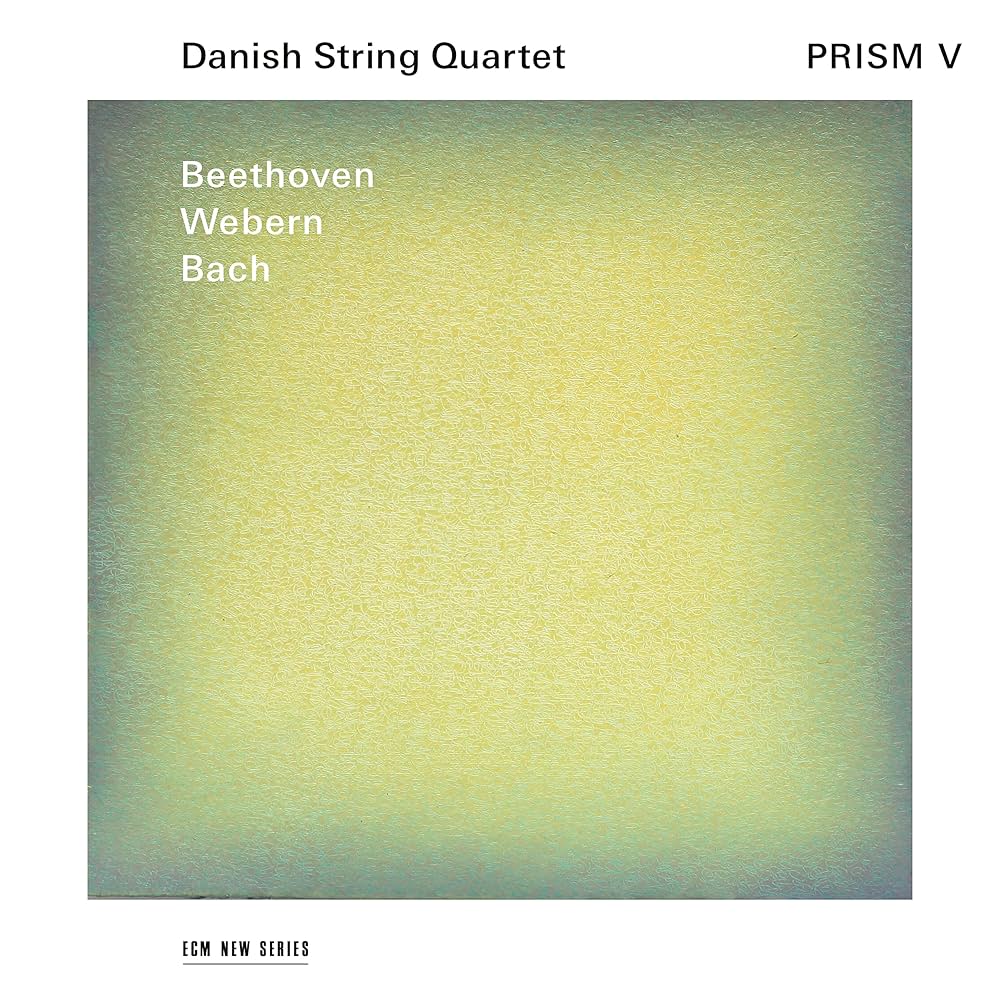
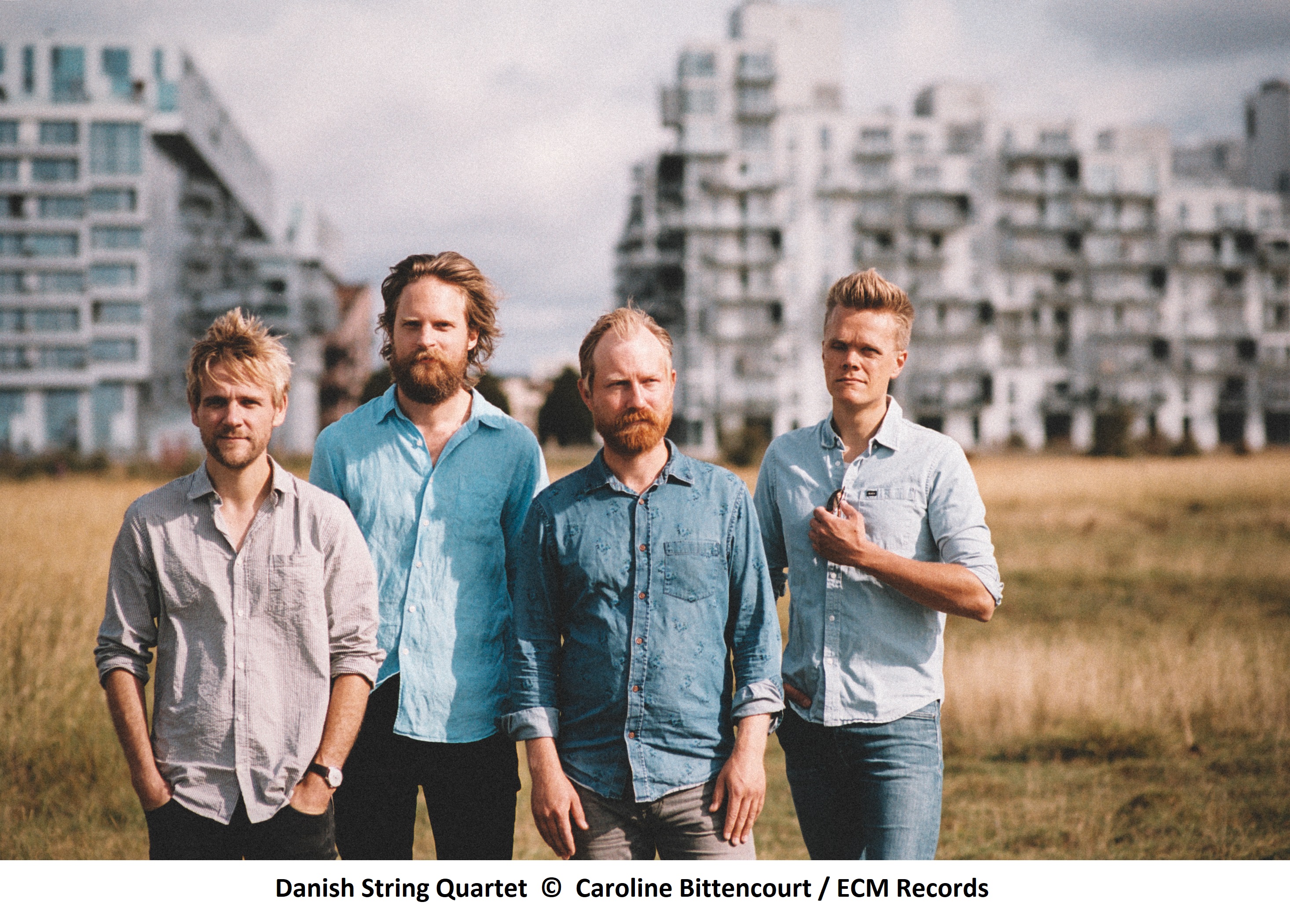
Danish String Quartet: PRISM V (ECM New Series 2565)

Danish String Quartet
PRISM V

Rune Tonsgaard Sørensen violin
Frederik Øland violin
Asbjørn Nørgaard viola
Fredrik Schøyen Sjölin violoncello
Recorded June 2021
Festsal, KFUM/KFUK, Copenhagen
Engineer: Markus Heiland
Cover: Eberhard Ross
Produced by Manfred Eicher
Release date: April 14, 2023

The Danish String Quartet concludes its nearly eight-year journey pairing Ludwig van Beethoven’s five late string quartets with works by Johann Sebastian Bach and later composers. Looking back, I can’t help but smile at how deeply and patiently the DSQ has fertilized the soil of this project to yield the richness of spring harvest.

As the musicians humbly observe, “Micromanagement is rarely a successful strategy when it comes to late Beethoven.” Therefore, if the music feels almost fiercely detailed, it’s because the relationships between the notes speak up for themselves at every turn. Indeed, it’s impossible to encounter the initial stirrings of the String Quartet No. 16 in F major, op. 135, wherein the composer returns not only to the quadripartite form but also to his astonishment of the past, without blushing. And what, you might wonder, is immediately apparent this time around? Nothing less than the undeniable realization that the late Beethoven deviates from other “standard” quartets of the repertoire (including his earlier own) in how inevitable it feels. Whether in the lucidity of the second movement or the dark pastoralism of the third, every sound takes on a physical appearance. The sheer grit the Danes bring to these contrasts is wonderous. Whereas the faster rites of passage would give little room for personal interpretation in less capable hands, in the present context, they are vessels in which the pudding of proof is artfully mixed. In the final stretch, which begins in gentler territory while also expressing great urgency, the call and response between cello and violins opens the door into a run across an open field where life itself becomes the map leading the way to the other side.

Anton Webern’s String Quartet of 1905 (the second of two he wrote that year) brought about a sea change in the genre. Although played in one continuous 18-minute stretch, it takes on a nominal structure in three sections (“Becoming,” “Being,” “Passing Away”) based on the work of painter Giovanni Segantini. Its shifts between darker and lighter keys, between exhalations and holdings of breath, would seem to mirror Beethoven, while its central fugue casts a shadow further back to Bach. The more one immerses oneself in it, the more fragmentary it becomes. As with the canvases that inspired it, one is tempted to isolate a mountain from land and sky, all the while missing out on the benefit of zooming in further on individual plants, puffs of cloud, and rocky imperfections that can only be described as “hymnal” in shape.

The setting for these diamonds consists of Baroque prongs. Whereas Bach’s chorale prelude, Vor deinen Thron tret ich hiermit, opens the program as one would wake up from a coma only to realize how much the world has not changed, the Contrapunctus XIV from The Art of Fuguereleases its pollen by the light of the moon, windswept in evening breezes to places we cannot touch until our bodies wither. Being unfinished, it ends mid-statement, leaving the remainder to toss about in the waves of our unworthy fancy. Sometimes, the best way to answer a question is by posing another.

Paul Griffiths: Mr. Beethoven (Book Review)

If fiction is the art of revivification, then let Mr. Beethoven be one of the most self-aware products of its wonders. The 2021 novel from Paul Griffiths grafts archival leaves to branches of nourishing speculation to imagine a journey the German composer might have taken in 1833 (six years after his death) to America to finish an oratorio on the Biblical figure of Job.

Although the Handel and Haydn Society of Boston indeed considered commissioning such a work, the only motif of it we will ever know may be articulated in the mind’s ear as we read of its stumbling fruition and premiere. Written in a narratively and stylistically episodic style and using only statements recorded as having been uttered by Der Spagnol, it unfolds not unlike his Ninth Symphony, building a dome’s worth of clouds one wisp at a time until the light of something divine pushes its way through to illuminate the ground at our feet anew.

If any of this sounds too good to be true, that’s because it’s too true to be good. Whereas the “real” Beethoven—as if the persona of that name weren’t already enigmatized by our constant recapitulations—reads to us today like the quintessential poète maudit, he marks the zoetrope of this book in moments of pandering frustration but also, more importantly, cadenzas of openheartedness, interpersonal profundity, and sheer delight.

Hints of a holistic portrait shade the opening act, wherein we encounter Beethoven as an enigma aboard a ship in the Atlantic bound for New England. He is a figure rendered by charcoal in intercontinental candlelight rather than oil in the Roman sun. “A stare, from a stranger,” we are told, “can be a flooding of humanity through whatever dams of difference.” Thus, we see and feel through the eyes of characters as fleeting as their target’s evergreen status. Such moments point to one of the novel’s most brilliant aggregations of historical impulse in Griffiths’s ability to articulate Beethoven before his place in the canon, itself in flux at this point, was assured by the validation of hindsight. By the same token, it emphasizes the unique disjointedness of place one experiences at sea before making landfall in realms of emotional economy. Says the muse of takeaways: Recognition is never universal.

By the time he gets to Boston, Beethoven’s dishevelment reads not like a caricature of the man but as the ravages of a harrowing journey. When encountering subsequent dramatis personae, we view them as he does: in his polite disinterest in Lowell Mason (responsible for the commission), in his enjoyment of Quincy under the auspices of hostess Mrs. Hannah Hill (a widow in whose company the bee legs of his heart collect no small amount of pollen), in his disappointment with the Reverend Ballou (a dismal librettist whose failures end up provoking a textual revival), and in his enchantment with Thankful (a sign language teacher and interpreter variously dubbed his “ear” and “amanuensis”). Every instance in which Herr Beethoven shakes a hand, exchanges words, or consumes a morsel of food reinforces the illusion that the music is imminent.

Each chapter is a composition unto itself. Whether in his iridescent vignette on the Fourth of July or in the careful construction of possible yet unprovable interactions, Griffiths sews his story with a leitmotif of concerns that make it clear he is wrestling as much as we are with the implications of his reality. While Chapter 32 is almost entirely footnotes, 33 only dialogue with dynamic markings, and 38 a single run-on sentence, these artifices never feel out of place or contrived. Each is a libretto unto itself for a musical work yet to be written.

From the selection of voices to travails with the local punditry, the story arc is pulled like a shuttle through looms marked by clefs instead of wooden frames, culminating in a virtuoso performance from musicians and Griffiths alike, as the author provides a full text for the oratorio, interleaved with reflections such as:

“To this Boston audience, the music is untoward, beyond familiar reference points, and yet at the same time wondrous, perhaps most of all in its successions of harmonies, how they float, swerve or dive while also proceeding forward inexorably, how they keep their sights on that one sure path while sometimes veering to the side or soaring high above, carrying their first listeners into new air.”

The book’s constant fourth-wall breaking may be its greatest pleasure. At one point, Griffiths even invites us to call him out on his conceit, only to retreat further into its fascinating depths. Hanging on what-might-have-beens (“it could all so easily have gone a different way,” “Scraps of paper might have survived,” etc.), he is content to vary his approach to the theme at hand as a seasoned improviser at the keyboard.

Among the many things to adore about Mr. Beethoven is that it sidesteps the trap of forcing a creative swoon. Unlike The Agony and the Ecstasy, whose Michelangelo rhapsodizes in the presence of unhewn marble, itself a cipher for escape, we get none of the romantic privilege of the artist at work. Hints of influences, witting or not, also make this a joyful effort. Top notes of James Cowan’s A Mapmaker’s Dream and Thomas Pynchon’s Mason & Dixon and a splash of Umberto Eco in the middle make way for a powerful dry down that leaves plenty of room for Griffiths’s base notes to settle in the nose for the long haul. In the latter vein, nods to his own work (“Let me tell you,” says Mrs. Hill at one point, naming his Ophelia novel) remind us of who is telling the story. Setting aside such comparisons leaves us with a three-dimensional object to regard in the light of our hopeful imaginations. The more we turn the key, the more it can sing when we let go. 

Like the composer, we hear nothing yet feel every note.

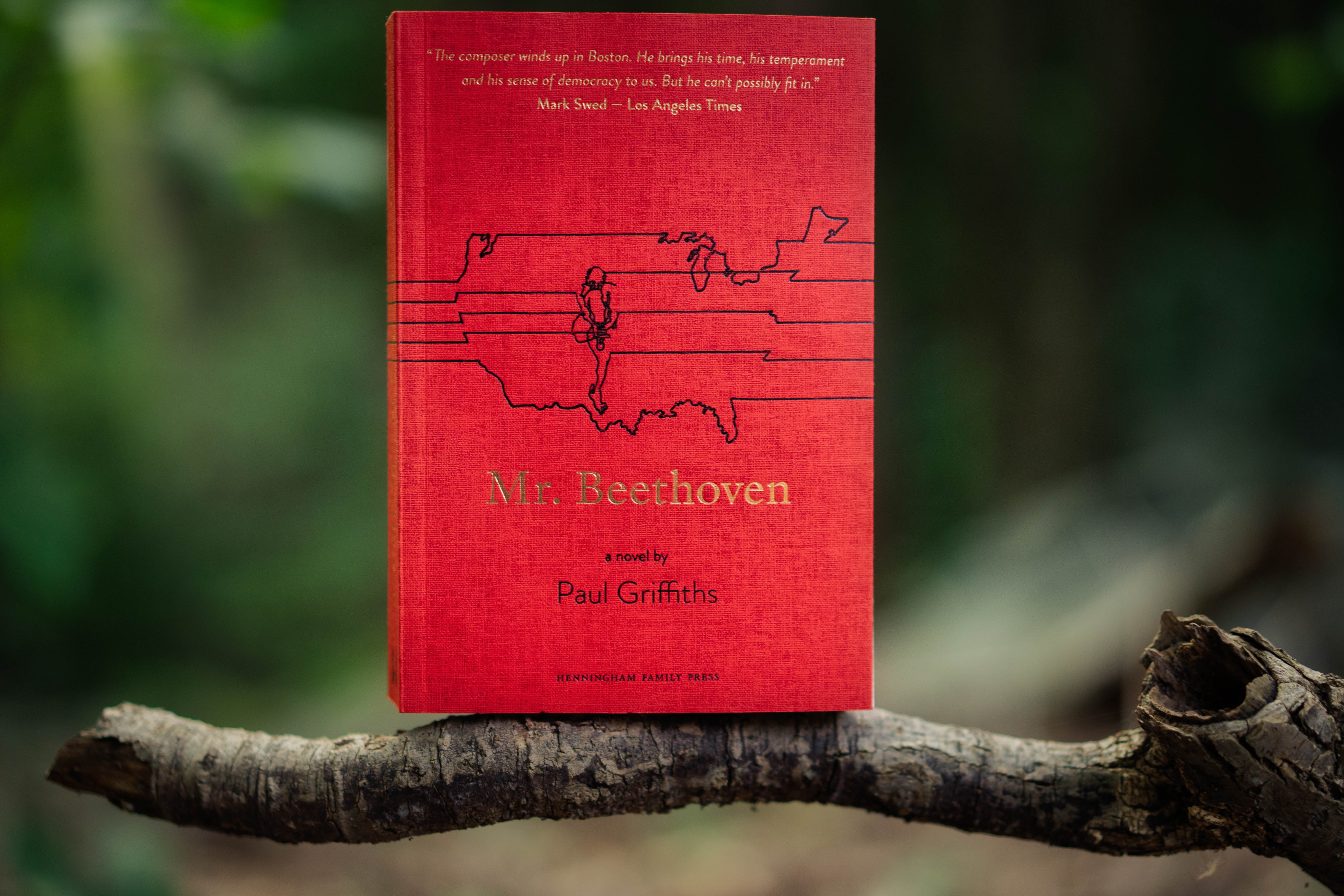
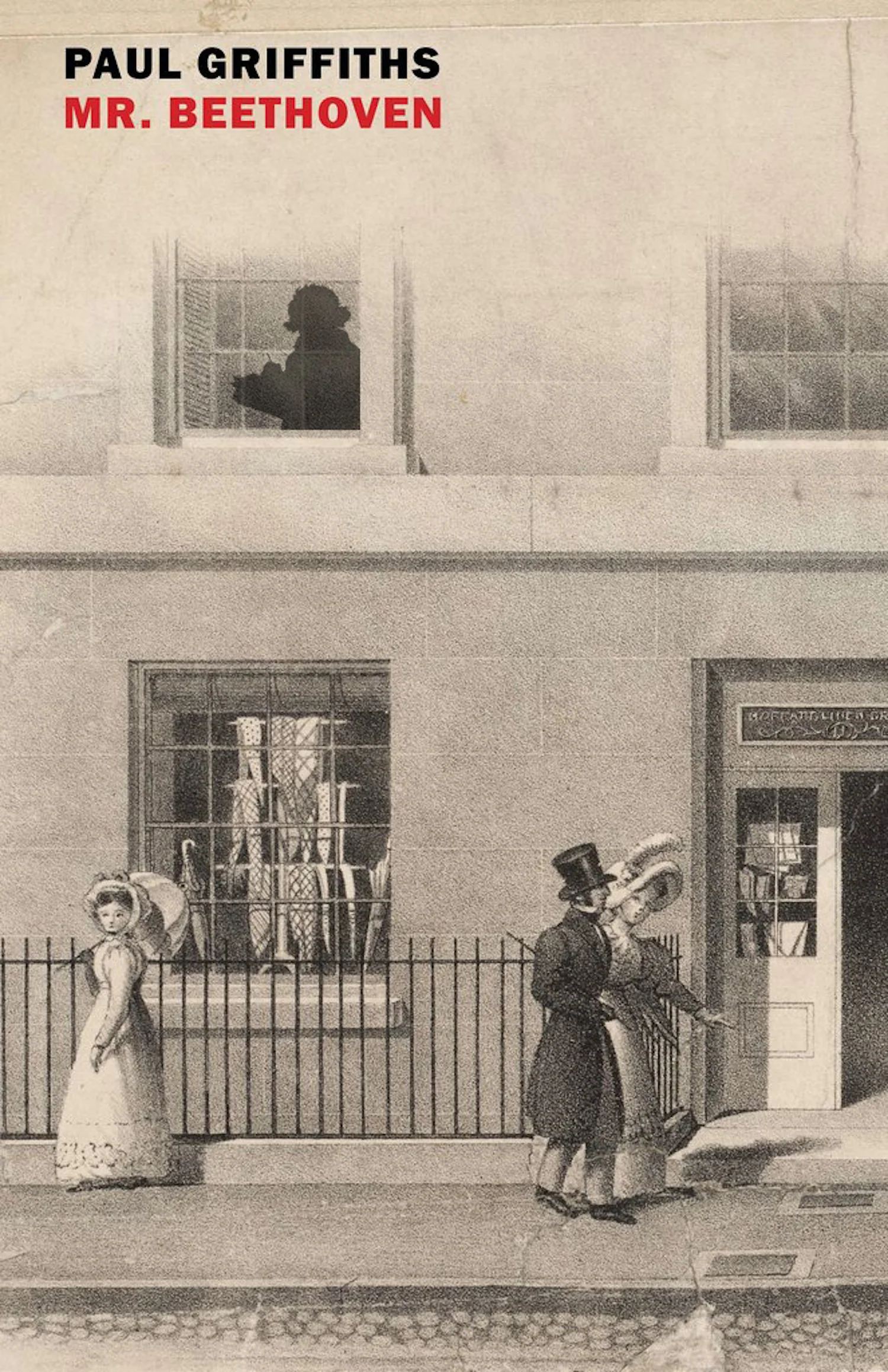
Mr. Beethoven is available from New York Review Books (pictured below) for those in the U.S. or from Henningham Family Press (pictured above) for those in Europe.

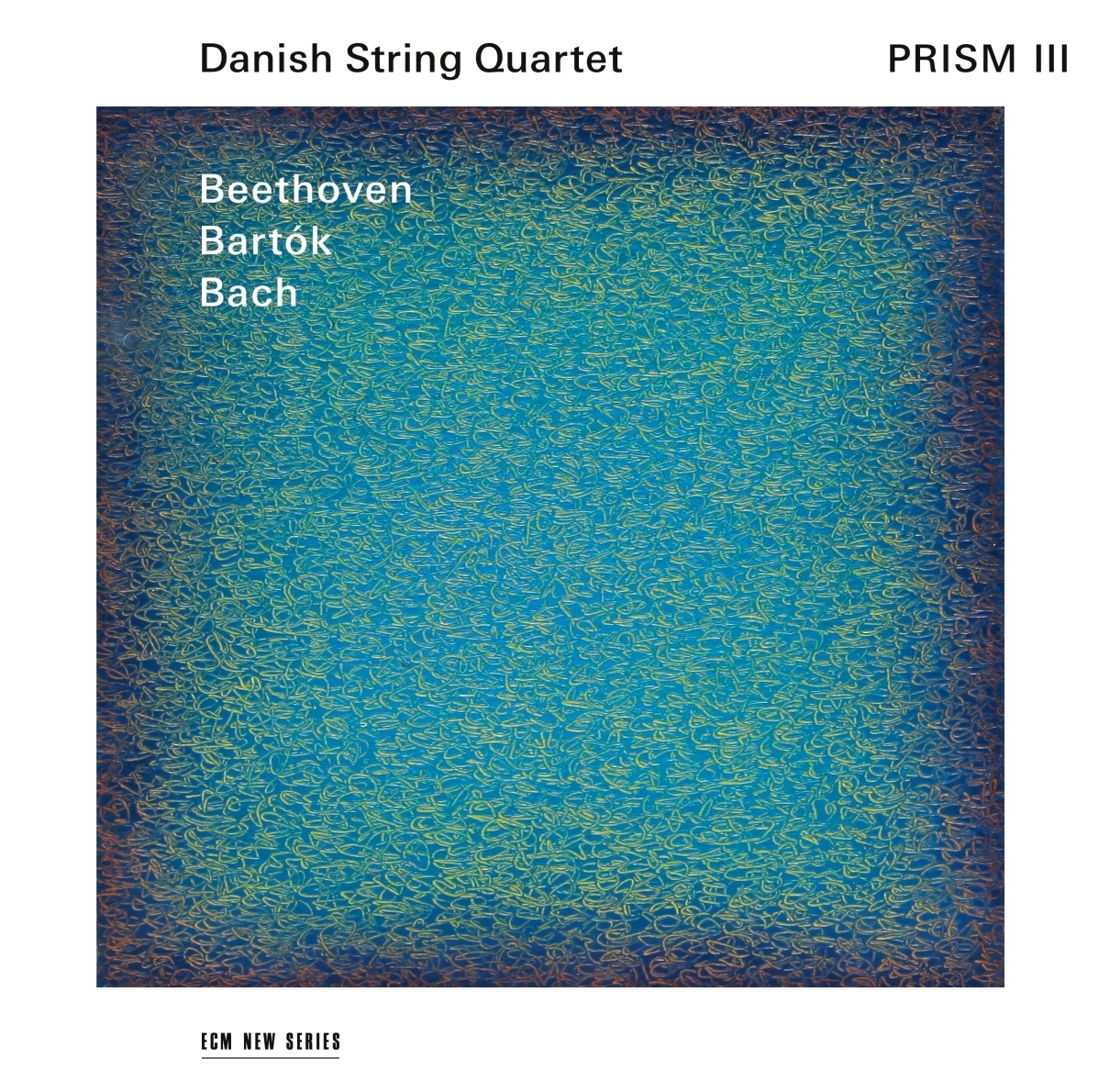
Danish String Quartet: PRISM III (ECM New Series 2563)

Danish String Quartet
PRISM III

Danish String Quartet
Frederik Øland violin
Rune Tonsgaard Sørensen violin
Asbjørn Nørgaard viola
Fredrik Schøyen Sjölin violoncello
Recorded November 2017, Reitstadel Neumarkt
Engineer: Markus Heiland
Cover: Eberhard Ross
Produced by Manfred Eicher
Release date: March 12, 2021

Ludwig van Beethoven’s five late quartets must be reckoned with. In the words of the Danish String Quartet, presenting the String Quartet No. 14 in C-sharp minor of 1826, they “changed the game.” In saying as much, we might very well ask ourselves: What was the game to begin with? How far back does it go? With whom did it start? Augmenting the famous profession that “all roads lead back to Bach,” this recording charts as many paths forward as it does retrospectively. As for the game itself, we can say that it involves not only musical idioms but also hints of visual art, literature, religion, war, migration, and, dare I say, hope.

To know Beethoven’s Op. 131 is to take a full view of humanity, with all its triumphs and tragedies. The opening Adagio, the first of seven movements, spins fibers of tenderness into a muscle that flexes in tune with emotional suspensions, thus emphasizing the DSQ’s fitness as much as the composer’s. The Allegro that follows surprises with dance-like energies but may just as easily be interpreted as a coping mechanism against the grief that preceded it. Its extroversions are deeply entwined with introversion. Other movements, like the lively Presto, share their secrets more openly, taking on a litheness of clarity rarely heard in other renditions. The closing Allegro wears its heart on its sleeve just as securely, emboldening (not flaunting) its awareness as a modus operandi of exposition. But it’s in the gargantuan fourth movement, a nearly 15-minute Andante, where most of this vessel’s cargo is tallied in its keep. What begins as a spider’s thread of narrative sweetness morphs, as if in answer to the subtle insistence of the cello’s pizzicato, into a fog of impressions that resolves itself into a dew of urgent memories. All the more fitting that this quartet was never performed in the composer’s lifetime. For while its mixed receptions have morphed into high regard, the music reminds us of the necessarily contrasting organs in its body. As these meticulous musicians remind us, none will function on its own but only when connected to the larger whole.

For his String Quartet No. 1, op. 7, Sz. 40 (1909), Béla Bartók took inspiration from Beethoven’s opus 131. Both open in lament. That said, Bartók evokes a distinct shade of darkness made modern not only by its tonality but also in the interpretation so lovingly given here. The DSQ enhances the piece’s metallic sheen without neglecting the patina it already had when first composed. When the viola announces itself in the opening Lento, it does so not out of desperation but infirmity. At this point, the heart is already so weakened that beating its drum feels like an uphill climb. Somehow, Bartók affords us a view of the valley to show that achievement means nothing without hardship. Even the Allegretto that follows emerges hesitantly, an animal out of hibernation before proclaiming its heritage. The digging cello of the Introduzione that follows sets up the storytelling of an Allegro for the ages. The atmosphere is chiseled in something more durable than stone: an alloy of reinforcement made possible only by the laying of human hands on natural materials. Forgoing any illusion of permanence (everything decays), Bartók recognizes that imperfection is always a reliable receptacle for creative ideas. As the strings move—sometimes in unison, mostly apart—they prove that cohesion isn’t always obvious or visible. Rather, it is born through the message of interpretation. Every gesture of insistence in the violins gives way to glorious resolution, jumping from the edge of a collective inhalation. Is this triumph or just a return to baseline? You decide.

Because Beethoven was deeply inspired by Johann Sebastian Bach’s The Well-Tempered Clavier, it only makes sense to include a fugue (this one in C-sharp minor, the very key signature used in Beethoven’s 14th quartet), as arranged by Emanuel Aloys Förster. Its tessellated configuration is a breath of higher origin, smoothing over the postmodern cracks with a reminder of what makes beauty earn its name: the scars of our destitution.

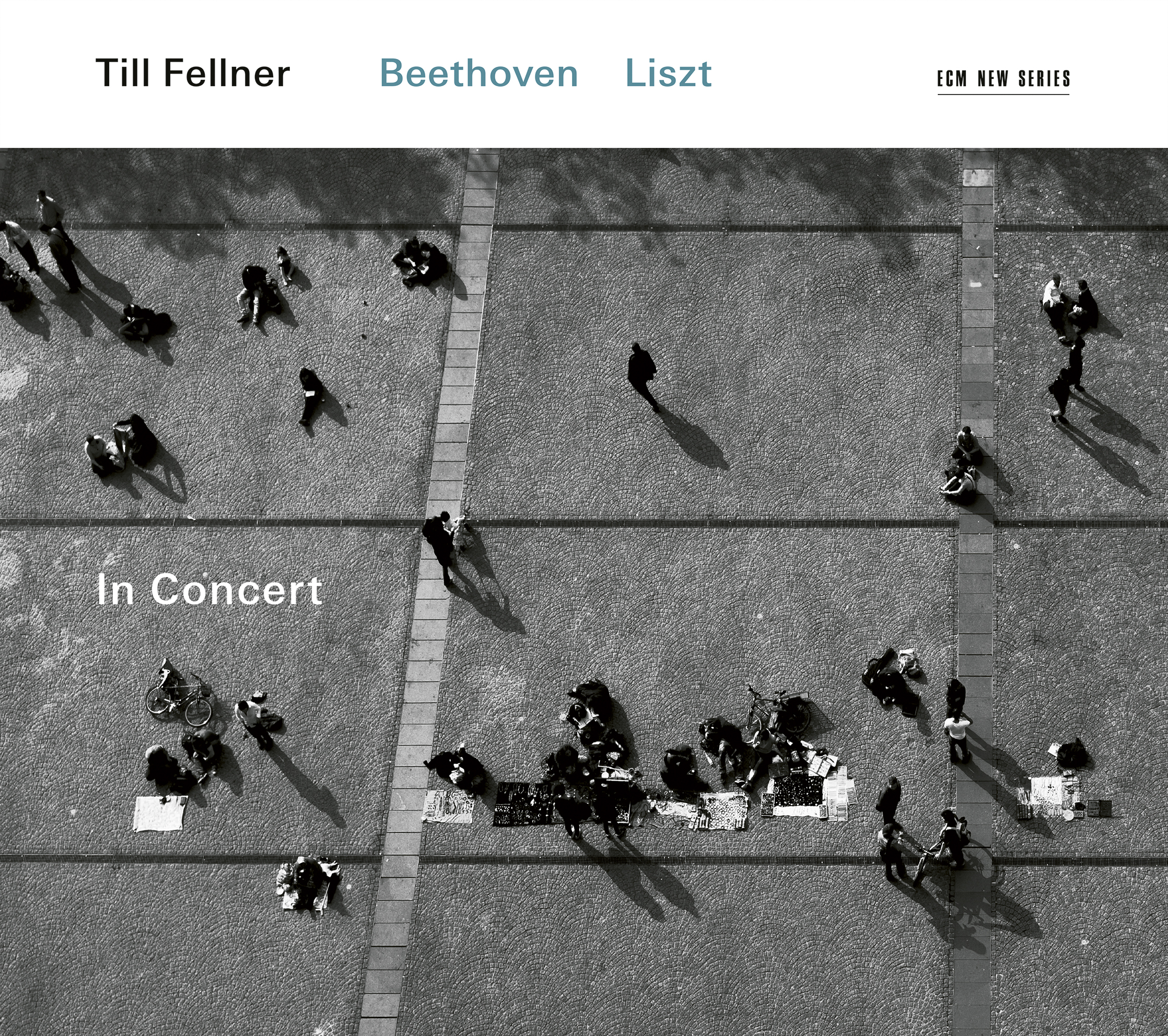
Till Fellner: In Concert – Beethoven/Liszt (ECM New Series 2511)

2511 X

Till Fellner
In Concert: Beethoven/Liszt

Till Fellner piano
Années de pèlerinage
Concert recording, June 2002
Wien, Musikverein, Großer Saal
Tonmeister: Gottfried Zawichowski
Engineer: Andreas Karlberger
An ORF Recording (Austrian Broadcasting Corporation/Radio Österreich 1)
Sonata No. 32
Concert recording, October 2010
Middlebury College Performing Arts Series
Mahaney Center for the Arts, Robison Hall
Tonmeister: Mark Christensen
Mastering: Markus Heiland
An ECM Production
Release date: November 2, 2018

But where of ye, O tempests! is the goal?
Are ye like those within the human breast?
Or do ye find, at length, like eagles, some high nest?
–Lord Byron, Childe Harold’s Pilgrimage

After a mosaic of recordings spanning the gamut from J. S. Bach to Thomas Larcher, Till Fellner returns to ECM with a pastiche of live recordings from 2002 and 2010. The first presents the Austrian pianist in his home capital for year one of Franz Liszt’s Années de pèlerinage. Inspired by the composer’s trip to Switzerland from 1835 to 1836 but unpublished until 1855, this aural scrapbook is alive with alpine imagery and motifs, encompassing firsthand memories, friendships, and even political views. It’s on the latter note that the collection begins with La Chapelle de Guillaume Tell. This stately introduction to an otherwise flowing work sets a precedent of architectural soundness that infuses all to follow. Contrast this with the watery beauties of Au lac de Wallenstadt and Au bord d’une source, and you already have a sense of the variety to which Liszt had eloquent access, rendered by Fellner with dynamic temperament.

While many sections, such as the sunlit Pastorale and Eglogue (the latter riffing on a shepherd’s song), are built around fleeting impressions, each nevertheless feels complete. This may be due to the fact nearly all of the music is revised from earlier material, an exception being the tempestuous Orage. No matter the duration, emotional integrity is the primary ingredient, so that the descriptions of Vallée d’Obermann’s thirteen precious minutes feel just as thick as Le mal du pays. Both seem to find the composer yearning for home when away from it, if not also for distant travels when in it, lending themselves to a score that only serves to nourish Fellner’s radiance. All the above shades of meaning cohere in Les cloches de Genève, by which the pianist elicits rich yet subtle sonorities.

If Liszt is a photographer, then Ludwig van Beethoven is a filmmaker whose magnum opus is surely the Sonata No. 32 in c minor. His Opus 111 shares its key signature with the Fifth Symphony and other monumental works, and provides a fitting end to his sonata cycle. As suggested in William Kinderman’s deeply considered liner essay, “The pair of movements of this sonata interact as a contrasting duality suggesting strife and fulfillment, evoking qualities which have stimulated much discussion, reminding commentators of the ‘here’ and the ‘beyond,’ or ‘samsara’ and ‘nirvana.’” Such spiritual language is no mere hyperbole, but an activation point of Beethoven’s grander concerns over the effects of art on the soul. As The Art of Fugue was to Bach, so is the Sonata No. 32 to Beethoven with regard to variation.

To be sure, Fellner touches upon those grander narratives, but more importantly keeps his ears attuned to the details. In the opening movement, for example, his arpeggios feel like quills on paper. Balancing stream-of-consciousness impulses with deeply articulated control, he links an unbreakable chain of progression. The second and final movement begins almost timidly, as if sifting through old notes for fear of what one might find, only to be surprised by a joy one never knew was waiting for rediscovery. Urgency compels the left hand while trills in the right signal a transformation of flesh into glory. “The transformational power of this closing music,” says Kinderman, “acts like a utopian symbol, which seeks to neutralize if not dispel the tragic reality embodied in the weighty opening movement of the work.” And perhaps weight is the most appropriate physical property by which to analyze what’s happening here, for regardless of size and scope, the relationship of every note to gravity is meticulously examined, its potential for flight believed in like a prayer.

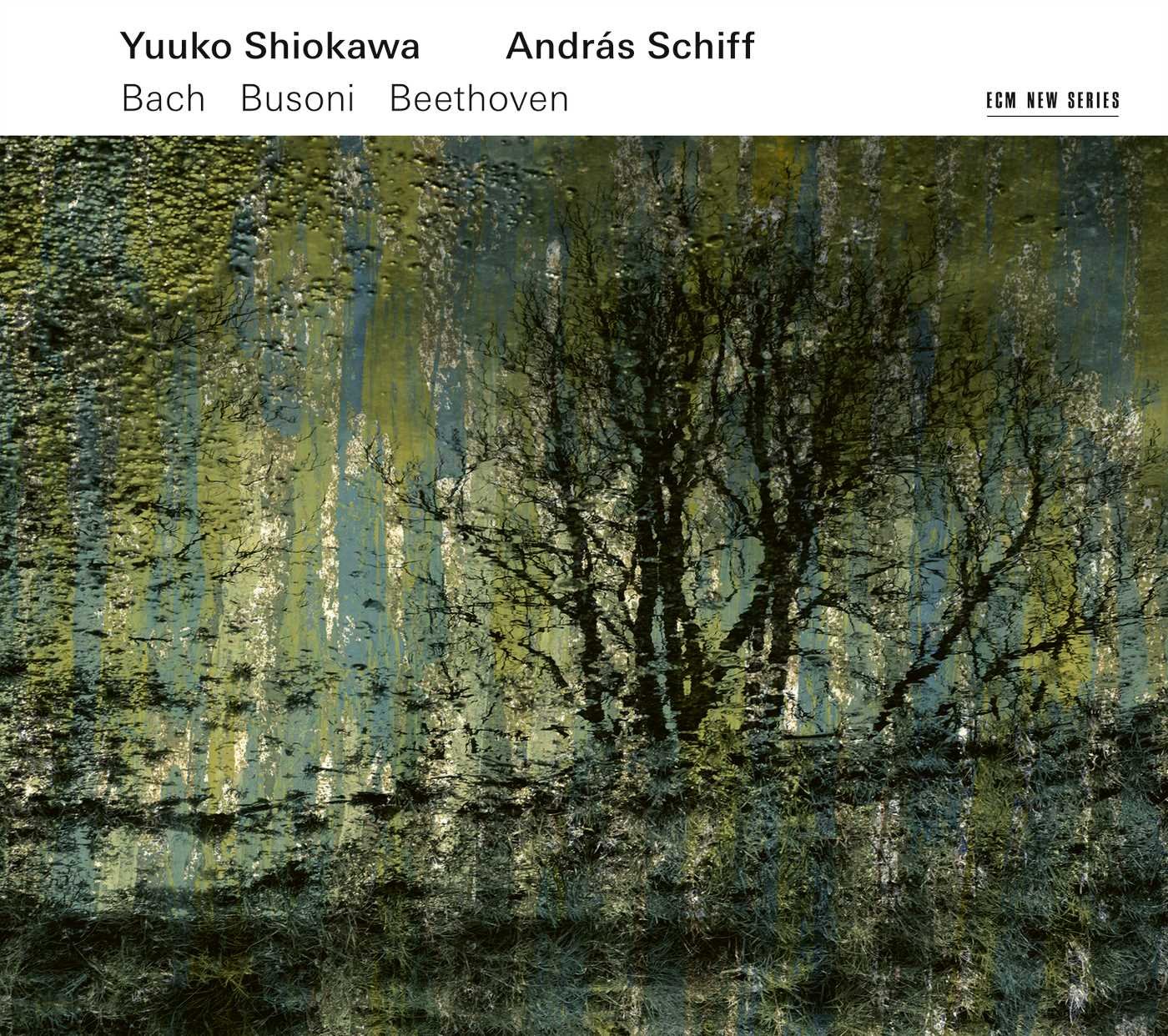
Yuuko Shiokawa/András Schiff: Bach/Busoni/Beethoven (ECM New Series 2510)

Bach Busoni Beethoven

Yuuko Shiokawa
András Schiff
Bach/Busoni/Beethoven

Yuuko Shiokawa violin
András Schiff piano
Recorded December 2016, Auditorio Stelio Molo RSI, Lugano
Engineer: Stephan Schellmann
Produced by Manfred Eicher
Release date: October 27, 2017

Seventeen years separate the first appearance of Yuuko Shiokawa and pianist András Schiff on ECM’s New Series and this long-awaited follow-up. Here they bring their intimate knowledge and experience to bear on sonatas by Johann Sebastian Bach (1685-1750), Ferruccio Busoni (1866-1924), and Ludwig van Beethoven (1770-1827). Through its sequence and execution, the program reveals as much richness of ideas within the pieces as between them.

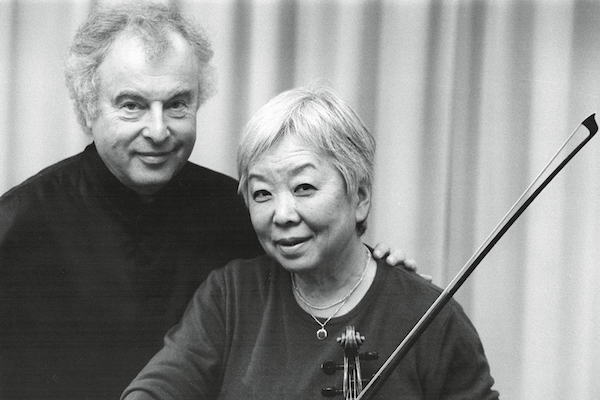
Shiokawa Schiff
(Photo credit: Barbara Klemm)

Bach’s Sonata No. 3 in E Major, BWV 1016, dating to his 1717-23 tenure as Kapellmeister at Köthen, is emblematic of a then-nascent genre, and finds both composer and interpreters ordering lines of many shapes and sizes. Schiff’s role at the keyboard is a challenging one, each hand operating independently yet with deep awareness of the other, while Shiokawa must paint with an actorly brush from first note to last. The vulnerability she brings to the opening Adagio is but one example of her ability to take something so lilting, so fragile, and render it impervious to the trampling feet of time. From there she takes us on a journey of inward focus, and by an interactive cartography traces bubbling streams to destinations of delight.

Although Busoni was more steeped in Bach than perhaps any composer before or since, one would be hard-pressed to find Baroque affinity in the first movement of his Sonata No. 2 in e minor, Op. 36a. Towering over a decidedly Beethovenian landscape, it leans toward and away from its historical precedents with fervor. Whereas single movements in the Bach were facets of a larger mosaic, each of Busoni’s sections is a sonata unto itself. The gargantuan final movement, however, is a theme and variations on the Bach chorale “Wie wohl ist mir, o Freund der Seelen, wenn ich in deiner Liebe ruh,” as it appears in wife Anna Magdalena’s Clavier-Büchlein of 1725. Busoni’s 17-minute exegesis goes from funereal to exuberant and back again. Between those worthy bookends stand two slim, insightful volumes. Where the Presto is playful yet adhesive, the somber Andante treads over shifting terrain.

In light of these fantastic excursions, Beethoven’s Sonata No. 10 in G Major comes across as non-fiction. As the composer’s last violin sonata, it holds a status all its own, and its details are organically suited to the duo. Where the trills and harmonies of its Allegro yield an enchanting ripple effect, the Adagio holds us suspended as if in need of nothing more than a confirmation of breath. A brief Scherzo scales the highest peak before trekking down into an Allegretto with a joy given life through musicians who care genuinely for everything they touch. It’s therefore difficult to listen to this recording without reminding oneself that Shiokawa and Schiff are partners in both music and life. Not only because they play so lovingly, but also because they listen to each other with rapt attention, inspiring nothing short of the same.

András Schiff: Beethoven – The Piano Sonatas (ECM New Series 2000)

Beethoven The Piano Sonatas

András Schiff
Beethoven: The Piano Sonatas

András Schiff piano
Concert recordings at Tonhalle Zürich, March 2004-May 2006
Engineer: Stephan Schellmann
Produced by Manfred Eicher
Release date: November 25, 2016

Renowned conductor and pianist Hans von Bülow (1830-1894) famously said: “Bach is the Old Testament and Beethoven the New Testament of music.” But this analogy only feels true in chronological terms. In any other aspect, the reverse would be more accurate, for while in Beethoven we encounter the judgments of a vengeful God, in Bach we feel the salvation of grace. Indeed, ECM’s New Series had been enamored with Bach for years before dipping into the canon of Beethoven, and Hungarian pianist András Schiff (previously known for his spirited renderings of Schubert, Mozart, and Bach himself) did that and more, gifting us with revelatory performances of the entire Beethoven piano sonata cycle. Totaling 32 in number, these sonatas remain the heart of the iconic composer’s oeuvre, each its own ecosystem of influence.

“Unlike with Mozart and Schubert, there are no repeated gestures in Beethoven: everything unfolds and is developed in a new aspect.” So says András Schiff of the difficulties of approaching this cycle as a whole. Of course, such progressive demands present formidable challenges to the Beethoven interpreter, who must play as if caught in the immediacy of every musical gesture. “Like picture restorers,” he goes on, “we performers have to scrape off the layers of convention, have to remove the dust and dirt, in order to reproduce the work in all its original freshness.”

To that end, Schiff boldly decided to perform each sonata in at least 15 cities before sitting down for these live recordings at Zürich’s Tonhalle, the acoustics of which seem spun directly from the piano itself. Schiff believed the immediacy of live performance was vital in bringing Beethoven to life on CD. The only exception is the final disc, recorded in the empty hall of the Reitstadel in Neumarkt, Germany. Schiff also used three pianos: a Steinway for the more dynamic pieces and two different Bösendorfers for the lyrical. In terms of sound mixing, the left hand dominates the left channel and vice versa, thereby creating a virtual piano in the ears.

Volume I: Sonatas opp. 2 and 7 (originally ECM New Series 1940/41)
Recorded March 2004, Zürich Tonhalle

Kernels of what would later be construed as Beethoven’s genius are easily gleaned from these groundbreaking first offerings. Consequently, Schiff waited for decades to ease into this material, a decision that rewards our listening most profitably. Schiff is adamant about following the interpretive clues Beethoven has left behind in his scores, taking to heart—even as he sets aside—the elisions and additions of his predecessors. He greets each sonata as a new friend, idiosyncrasies and all. Although these sonatas are hot on the heels of Mozart, in Schiff’s estimation Beethoven is prose to Mozart’s poetry. If Beethoven is synonymous with drama, then let this be the curtain-raiser to Schiff’s epic endeavor.

Sonata No. 1 f minor op. 2/1 (1793-5)
Shades of Haydn (to whom all of op. 2 is dedicated) abound, but arrive at a series of distinct solutions, both open-ended and alternatively solved. Schiff manages to draw out a dramatic exploration of themes with limited means. Dynamic control in the Menuetto is strikingly effective here, while the Prestissimo is a thrilling conclusion to this earliest sonata and already speaks of a turgid energy dying for a way out. The final bars are filled with a lush restraint that erupts into the ultimate downward trill.

Sonata No. 2 A major op. 2/2 (1794-5)
A more playful, even humorous mood dominates the op. 2/2. A sense of freedom within bounds, like a child who is limited only by imagination in terms of what can be seen and experienced under constant supervision. This sonata is a grand experiment in movement. It runs, trips, falls, and picks itself up again in its repeated attempts to regain locomotive control. This seems to be one of the most difficult of the 32 sonatas to play, if only because of the demand for sustained focus and emotive energy that plows its whimsical soil. The Allegro is a grandiose series of textures all describing the same playroom and recasts us as parents watching over the children we once were. On the one hand we are joyful toward the innocent display; on the other we mourn the loss of our interest in trivial things. This isn’t the philosophical Beethoven, but no less a contemplative one unafraid to work through his own indecision in the open forum of our scrutiny. The Scherzo sparkles here with jewel-like brilliance before tossing us like a discarded doll into a satisfying conclusion.

Sonata No. 3 C major op. 2/3 (1794-5)
A verdant and dramatic Allegro starts things off with the slightest hint of Händel to keep our ears in check. Superbly controlled runs and arpeggios make this a joyful listening experience overall. The musical equivalent of a period of rest that precedes the return leg of a long journey: we relive the joys of our destination while yearning for those of home.

Sonata No.4 E-flat major op. 7 (1796-7)
This sonata offers such a wide variety of colors that one wonders where the young Beethoven found the time to pluck them from the proverbial tree. Of the early works, this more than any other showcases Beethoven’s unique “posturing” as one looking back over a much longer life. Already he displays a grand affinity for, and subtle reinvention of, the sonata form. We end on a curiously somber note, collapsing to the ground after a futile attempt at escape.

Volume II: Sonatas opp. 10 and 13 (originally ECM New Series 1942)
Recorded November 2004, Zürich Tonhalle

Schiff’s second installment is full of surprises and reflects the superior dedication of its execution.

Sonata No. 5 c minor op. 10/1 (?1795-7)
The op. 10/1 sonata feels like running. Like all of the early sonatas, it’s always moving. Whether slowly, briskly, or at a horse’s gallop, one feels it going somewhere, even if the destination isn’t always clear (not least of all to Beethoven himself). This leaves the performer to determine said destination and to commit to a path leading there. The op. 10/1 further reveals formative intimations of Beethoven’s “concertistic” leanings. Rather than exhibiting the embryonic characteristics of a composer in his mid-twenties, the forms herein act like fully realized beings who think deeply before speaking.

Sonata No. 6 F major op. 10/2 (1796-7)
The opening Allegro establishes a one-to-one correlation between form and melodic drive. Schiff’s playing veritably jumps off the page like a script dying to be orated before an enraptured audience. Arpeggios sing with grace and dutiful restraint as the right hand dominates with subtler pleasures. A contemplative Allegretto leads into a swinging Presto with all the verve of one who believes passionately in the value of darkness. Not that this is a morbid piece; only that its nooks and crannies are deep enough to inscribe loaded variations into an otherwise dainty surface. A standout in the entire cycle. What Schiff does with it is miraculous.

Sonata No. 7 D major op. 10/3 (1797-8)
A bit statelier in feel, this sonata nevertheless rushes forth with its own power. Among the quieter sonatas, it embodies a chamber-like sensibility. And even though it may not hit you over the head with its style, it packs a delayed punch, seeping undetected under the skin, lacing our systems with subdued petulance.

Sonata No. 8 c minor op. 13 “Pathétique”
Though often seen as one of Beethoven’s more “symphonic” sonatas, here the op. 13 if anything feels “sympathetic.” The opening movement fights its way to a centered mode of understanding in its attempts to overshadow internal pain. It is consolatory, patient, even kind. Its many spontaneous shifts are never instigated without careful reassessment of their own devices. The recapitulating motif is comforting, mellifluous in its persistence. The Adagio binds us. In doing so, it avoids falling into a trap of oversentimentality, unfolding instead with the uneasy grace of human (read: mediated) emotion. The concluding Rondo and Allegro twirl with the measured rhythm of a dancer who must leave her shoes in a dusty, shadowed corner at the end of the day, but who refuses to leave the studio without first giving her all in defiance of the wall-length mirror that stands before her.

Volume III: Sonatas opp. 13, 22 and 49 (originally ECM New Series 1943)
Recorded February 2005, Zürich Tonhalle

“Already in his early sonatas,” Schiff tells us, “Beethoven is a psychologist, not only as regards the organization of the movements according to their inner logic, but also in the unity between the various movements.” Thus does the trenchant pianist bring an analytical edge to his third installment in the Beethoven cycle. Its offerings are rougher around the edges, even as they continue to be microscopic in precision.

Sonata No. 19 g minor op. 49/1 (1797?)
This sonata sets the tone for a disc that is markedly miniaturistic. The gestures are quick and painless, never lingering too long on the tongue before subsequent flavors take over.

Sonata No. 20 G major op. 49/2 (1795-6)
There’s an overt delicacy to this sonata that is strangely invirogating in light of the last volume’s “Pathétique.” In contrast to the energetic infusions required on Schiff’s part to bring it to life, the Op. 49 presents a more relaxed Beethoven, rocking us gently through the final menuetto into the op. 14/1.

Sonata No. 9 E major op. 14/1 (1798)
While this sonata and its present company are relatively easy to play, they’re not without their difficulties (though one would be hard pressed to distinguish them from the melismatic uniformity of Schiff’s effortless stylings). While this might not be one of the most memorable of sonatas overall, its lively Rondo is a highlight among them.

Sonata No. 10 G major op. 14/2 (?1799)
For all its brevity, this one is charmingly captivating. The opening Allegro ripples like a fluid stream caressing rocks rounded by centuries of erosion. The Andante plods along with an almost pompous assuredness, swaying its head from side to side as it prowls the streets for attention. The closing Scherzo is deceptively constructed, cloaking itself in the mood of a sporadic chase, a cat in search of the elusive thematic mouse until…not a pounce but a strange remorse over the killing of one’s object of entertainment.

Sonata No. 11 B flat major op. 22 (1800)
This might very well be Beethoven’s “breakout” sonata, as it marks his return to the four-movement structure he made his own. With a sort of fractured bravado, it circles an axis of motifs like a bird whose confidence gives its victims that much more false security before diving in for a meal. The Adagio practically floats on its own ineffable air, wafted ever higher with each beautifully articulated trill. A compellingly woven Minuetto prepares us for a masterful Rondo as bidirectional runs travel into two succinct and conclusive chords.

Volume IV: Sonatas opp. 26, 27 and 28 (originally ECM New Series 1944)
Recorded April 2005, Zürich Tonhalle

This disc marks the end of Beethoven’s “early” period (though Schiff is quick to point out the arbitariness of such categorical distinctions). Here we see Beethoven the character actor, the pantomime and experimenter, donning a new mask with each successive gesture.

Sonata No. 12 A-flat major op. 26
As with every sonata on this standout disc, Schiff displays the utmost patience with the material. The gentle opening is an early morning brightening into daylight: brief snatches of dreams flit across the mind, only to be lost again as we try to grasp them. The Allegro bustles with the liveliness of daily chores, while a funeral march adds a new element into the mix.

Sonata No. 13 E-flat major op. 27/1 “Quasi una fantasia”
The second movement pulses with the precise syncopation of Bach’s Well-Tempered Clavier, and is a key moment of transcendence in the collection. As affecting as it is brief, it is suitably balanced in its weight and distribution. This is followed by a plaintive Adagio and the crowning Allegro, between which Schiff exhibits the diversity of his approach as he winds up for a rousing finale.

Sonata No. 14 c-sharp minor op. 27/2 “Moonlight”
Perhaps nowhere is Beethoven’s posthumously acquired pomposity more sensitively challenged than in this, the ubiquitous “Moonlight”-Sonata (the name is not Beethoven’s, given instead by nineteenth-century German poet and music critic Ludwig Rellstab, who likened the piece to an evening view of Lake Lucerne). There are, perhaps, justifiable reasons why its opening movement has been so widely interpreted, excised from its connective tissue and upheld as a prototypical organ of its kind. Yet none of that seems to matter the moment it falls within Schiff’s purview. The rhythm is duly appropriate, never lagging while allowing for every note to speak its piece. Schiff makes a seemingly bold yet ultimately sensible move in following Beethoven’s controversial cue to depress the sustain pedal for the Adagio’s entire duration. This prescription has more often been overridden because of the modern piano’s longer sustain. Schiff’s magically realized solution seems as much a matter of his choice of instrument as of his technique. The central Allegretto is a vital hinge—“a flower between two chasms” in the words of Franz Liszt—to another recognizable burst of melodic intensity in the Presto, in which the sonata form is resurrected with ferocious efficacy.

Sonata No. 15 D major op. 28 “Pastorale”
The “Pastorale”-Sonata, with its instantly recognizable grandeur and intervallic range, marks a period in which Beethoven’s deafness was growing markedly worse. The subtitle was appended by publisher A. Cranz and should be taken with a grain of salt, lest one miss out on the contrasting dynamics of the two central movements. The Scherzo is one of Beethoven’s more charming creations and spices the mix like laughter before hurtling into a kinetic gigue and virtuosic finale.

Volume V: Sonatas opp. 31 and 53 (originally ECM New Series 1945/46)
Recorded December 2005, Zürich Tonhalle

Culled from Beethoven’s so-called “Middle Period,” challenge the heroism so often ascribed to his concurrent works (e.g., the “Eroica” Symphony). Rather, this is an introverted heroism honed in the artifice of its own self-conscious desire. Violence is shown to be futile, as bendable as the will of its practitioners.

Sonata No. 16 G major op. 31/1
Schiff characterizes this as Beethoven’s “wittiest” sonata. It also marks a shift from the classical style and indicates a composer desperate to forge his own path. At times parodic, this sonata leaves the listener with a sense of renewed vibrancy and proves that we need not always take ourselves so seriously to create animated art.

Sonata No. 17 d minor op. 31/2 “The Tempest”
Despite the dramatic implications of its subtitle (again, not the composer’s own), it is this sonata’s gorgeous Adagio that stands out and partners well with the closing Allegretto’s full sense of development and reprise. The “Tempest”-Sonata is, then, more than just turmoil. It is the sum of its parts, from the subtle and unseen to the antagonistic.

Sonata No. 18 E-flat major op. 31/3 “The Hunt”
This sonata is often noted for its jocularity, but Schiff manages peel back its veneer to expose a deeper psychology at work. Beethoven forgoes the usual ternary form in the Scherzo, thereby shading its sprightly mood with a hint of fortitude. A graver Menuetto and determined Presto bring necessary closure to its titular pastime.

Sonata No. 21 C major op. 53 (1803/4) “Waldstein”
The notorious “Waldstein”-Sonata is as economical at its center as it is expansive and epic at its edges. It is beyond programmatic, second in scope perhaps only to the “Hammerklavier.” This is a rollicking and sensory ride through pastures and mountains, rivers and snowdrifts, and all with the concentrated clarity of a composer hermetically devoted to his niche. The central Adagio is an exercise in mounting tension, whereas the final Allegretto sparkles with the effervescence of a natural spring. A particularly formidable section features a floating trill with the right hand as the left jumps quickly through its own set of hoops, all the while sandwiching a series of punctuating notes in the middle register. This precedes a long series of hills and valleys that boils into a bittersweet triumph, undercut as it is by the prospect of separation. The “Waldstein”-Sonata is kaleidoscopic, revealing new perspectives with every turn. The virtuosity here is a wonder, all the more so for Schiff’s ability to shake off romanticism and play with unwavering consistency. In doing so, he allows the variety of the piece to come through with surprising transparency.

Andante favori F major WoO 57 (1803)
This was the original second movement of the “Waldstein”-Sonata. After being criticized for its excessive length, it was (after much reflection on Beethoven’s part) switched out for the more succinct movement we have today. This little orphan survived well enough to earn the title of “Favored Andante.” It is almost a sonata in its own right, inverted and miniaturized as if for a shelf of curios.

Volume VI: Sonatas opp. 54, 57, 78, 79 and 81a (originally ECM New Series 1947)
Recorded April 2006, Zürich Tonhalle

In this sixth installment, continuing with the “middle” sonatas of Beethoven, emotions span the gamut from exuberance to anxiety. Schiff consciously places the formidable “Appassionata” second in this program, bowing to chronology over any a posteriori prestige collected along the way like so much canonic dust.

Sonata No. 22 F major op. 54 (1804)
This sonata, which Beethoven placed far higher than his ever popular “Moonlight,” ebbs and flows with a series of thoughtful ruminations and graceful attacks. The result is an accommodating piece, as brilliantly bipolar as it is unassuming—an enjoyable experiment in pastiche that seems to spit out its final thoughts like a conference presenter rushing to stay within time.

Sonata No. 23 f minor op. 57 (1804-06) “Appassionata”
A clear winner. Schiff’s playing courses like blood and with as much feel for change as one could ask for in a work for solo piano. That being said, one should not mistake Beethoven’s antics for showy musicianship. Accordingly, Schiff loosens the seams only so far before allowing the piece to dictate its own narrative trajectory. Just prior to composing this sonata, Beethoven was confronted with the irreversibility of his hearing loss, and so one might wish to see the “Appassionata” as a cry to hear rather than to be heard. Schiff finds in the octaval opening “an atmosphere of absolute danger.” Beethoven switches moods with the deftness of a seasoned quick-change artist, infused as the Allegro is with dark undertones and rhythms drawn from Scottish folk songs. The middle movement takes a very rudimentary theme and unpacks it for all it is worth. The finale is like a dirge in fast-forward, a tragic life condensed into nine minutes of fleeting youth and unrequited aspiration, and ends with a crunchy spate of frightening detonations.

Sonata No. 24 F-sharp major op. 78 (1809) “à Thérèse”
Beethoven was apparently partial to this sonata above all others. Either way, it stands as a vibrant testament to his dedicatory streak. Throughout its two-movement structure, the composer (and Schiff by extension) weaves a picturesque tapestry with essentially limited materials. The opening is filled with plenty of titillating flourishes to satisfy any type of listening while second movement nearly buckles under the weight of its profusion of ornaments, letting up just enough to maintain its integrity.

Sonata No. 25 G major op. 79 (1809)
Short and sweet is the op. 79. Its condensations, along with an undying sense of melody interspersed with unsettling mortality, make for (if you will excuse the alliteration) a pointillist portrait of playful proportions.

Sonata No. 26 E-flat major op. 81a (1809-10) “Les Adieux”
Regardless of what one wishes to make of the exact inspirations behind the programmatic titles of each movement (“The Farewell,” “The Absence,” and “The Return”), this sonata surely tells a story, albeit an elliptical one. The beauty of “Les Adieux” is its openness to interpretation: neither Beethoven nor Schiff want to impose an overarching theory onto the listener. It is a delectable and varied journey throughout which we encounter a variety of characters. In this sense, the sonata “speaks” in both whispers and shouts, relating a tale that never ceases to enthrall.

Volume VII: Sonatas opp. 90, 101 and 106 (originally ECM New Series 1948)
Recorded May 2006, Zürich Tonhalle

Continuing with its strict chronological adherence, Schiff’s seventh installment of the Beethoven cycle brings us squarely into the composer’s “Late Period.” The Sonatas opp. 90, 101, and 106 represent a turning point in Beethoven’s piano literature, blossoming with a more radical unfolding of internal conflict.

Sonata No. 27 e minor op. 90 (1814)
Characterized by Beethoven as “a contest between the head and the heart,” the op. 90 is a solitary endeavor into the hinterlands of introspection. Pastoral moments bleed into fleeting lapses of determination that quickly devolve into old habits.

Sonata No. 28 A major op. 101 (1815-17)
Where op. 90 is brooding, op. 101 is nostalgic. This sonata is one of the more romantic in the Beethoven catalog, and opens with assurance in spite of his near-total deafness (descriptive cues, such as “Somewhat lively, and with innermost sensitivity” for the selfsame movement, supersede the standard markings in order to better convey to performers how he imagined the music in his head). The sonata continues with its elegiac exploration of the past and its bearing on the present, culminating in an agitated finale.

Sonata No. 29 B-flat major op. 106 (1817-18) “Hammerklavier”
Considered by many to be the most daunting work of all piano literature, the nearly 45-minute “Hammerklavier” heaves like a gentle beast. Yet the seemingly insurmountable sonata is pulled off here with literary panache. The first movement delights with its palpability and energetic drive. The brusque Scherzo feels all the more so in the company of such towering neighbors, managing to hold its own while injecting much-needed whimsy. Next is the monumental Adagio, in which Schiff gives all the breathing room one could need in order to devour the final movement, building from a tentative Largo to an astounding fugue and coda in which each and every note gallops with equine agility.

Volume VIII: Sonatas opp. 109, 100 and 111 (originally ECM New Series 1949)
Recorded September 2007 at the Reitstadel in Neumarkt, Germany

Schiff is utterly committed to the urtext: he observes every prescription laid out before him. His approach is as constellatory as the music itself, carrying on with or without us. It is not so much timeless as it is timely and deserves at least one undivided listen in sequence, if only to absorb its messages in all their developmental glory.

In the Sonata No. 30 E major op. 109 (1820), two compact introductory statements pave the way for an intimate third movement. The music is tear-stricken and brimming with quiet resolution. The somber mood continues with the first movement of the Sonata No. 31 A-flat major op. 110 (1821) before giving way to some merciful humor in the second. The third movement is, for all its sparse distribution, a heavy lament. Though we do get some closure at the end, one senses that recovery is as ephemeral as the notes we have just heard. This sudden spurt of confidence seems a desperate slap in the face of mortality. The Sonata No. 32 c minor op. 111 (1821-22) provides a prismatic conclusion to an already multifaceted collection. In two movements, Beethoven expresses a lifetime’s worth of turbulence while managing to leave with the final proud nod of one who has won a long and fruitful argument.

Clearly, the demands presented to Beethoven interpreters are great. Not only must they play under the looming shadow of an enigma, but must also machete their way through centuries of scholarship, public dissemination, and imperialistic reputation. Schiff seems unable to escape the context of each sonata as he approaches it, even as he owns up to his modernity. His renderings have left an indelible mark on the Beethovenian pantheon. He plays as if every finger were its own pianist, offering music that demands attention not because it is Beethoven’s, but because it is ours.

(This seminal boxed ends with a disc of encores gathered from these concerts. Released also as their own album, they are reviewed separately here.)


András Schiff: Encores after Beethoven (ECM New Series 1950)

Encores after Beethoven

András Schiff
Encores after Beethoven

András Schiff piano
Concert recordings at Tonhalle Zürich, March 2004-May 2006
Engineer: Stephan Schellmann
Produced by Manfred Eicher
Release date: November 25, 2016

For this collection of encores, recorded during his cycle of the complete Beethoven piano sonatas yet never released until now, pianist András Schiff presents selections that, in his own words, “are closely related to the previously heard sonatas.” More than that, however, when taken as their own program, relationships within these pieces are as deep and meaningful as between them. Each is a satellite of the Beethovenian mothership, beaming down messages of darkness and light in kind.

The Allegro assai in e-flat minor from Schubert’s from Three Piano Pieces (D 946) introduces the disc with a synchronicity of medium and message that indeed echoes Beethoven in its grammar. With a dramaturgy perhaps only describable as oceanic, it sparkles with lunar pull. The Allegretto in c minor (D 915) that follows unfolds by means of a subtler narrative structure, spiraling in on itself, now with deliberation over desperation.

Alongside this door, Schiff opens another marked Mozart in the form of the little Gigue in G major (KV 574). This altogether exquisite piece is an Escherian staircase in sound, and serves as prelude to “Papa” Haydn’s Sonata in g minor (Hob VXI:44). That Beethoven deeply admired Haydn can be no secret after bathing in these spring waters. Schiff’s further distillation is worthy of that admiration as well, and feels as organic as the music is calculated, marrying as it does delicate restraint with robust linearity.

Were it not for the applause, Schubert’s Hungarian Melody in b minor (D 817), might be overwhelmed by the aftereffects, but as it stands inhales and exhales a full color palette in this folkish dance. Played, as written, from the heart, its charm is magnified tenfold by this performance.

Standing equally alone yet inseverable from the surrounding tissue, Beethoven’s Andante favori in F major (WoO 57), last heard on Volume V of Schiff’s magnum traversal, echoes an even more wholesome quality and shows just how completely Beethoven was able to tell a story.

How appropriate that we should end where it all began: with Bach. Between the tastefully wrought balustrade of the Menuet I and II from Partita No. 1 in B-flat major (BWV 825) and the Prelude and Fugue in b-flat minor (BWV 867) fromThe Well-Tempered Clavier, Book I, one can almost taste the dust of Bach’s architectural wonder, which in this context seems like a return to fundamentals. Bones before flesh, and breath before bones.