Johannes Brahms: Klavierstücke (ECM New Series 2730/31)

Johannes Brahms
András Schiff
Klavierstücke

András Schiff Blüthner piano
Recorded March 2021
Kammermusiksaal Hermann J. Abs
des Beethoven-Haus, Bonn
Engineer: Stephan Schellmann
Production coordination: Guido Gorna
Cover photo: Péter Nádas
Produced by Manfred Eicher
Release date: September 18, 2026

The distance between Johannes Brahms’s early and late piano music supplies the organizing principle for András Schiff’s latest addition to his ECM New Series traversal of the 19th-century German composer. Schiff begins with the long-lost Albumblatt, written when Brahms was 20 for the friendship album of Göttingen music director Arnold Wehner and later adapted for the Horn Trio, Op. 40. Youthful possibility enters a silent argument with late style, and four intervening decades press upon every note.

Schiff plays a beautifully preserved 1859 Blüthner whose warmth never becomes cosmetic and whose bass register retains an almost archaeological presence. His booklet notes unite personal reflection with close attention to Brahms’s striations, clarifying the interpretive dialogue at play throughout. The instrument extends Schiff’s intimate correspondence with Brahms across earlier ECM recordings, including the Clarinet Sonatas with Jörg Widmann and the Piano Concertos with the Orchestra of the Age of Enlightenment. His Violin Sonatas with Yuuko Shiokawa occupy another chapter. Here, the Albumblatt, marked Allegro con espressione, rocks gently beneath phrases of fluid grace. Melancholy passes through sunlit warmth, leaving consolation truer for the pain dissolved within it. Schiff shapes each phrase with the curvature of handwriting, as though the young composer’s hand still pressed against the page.

The Eight Piano Pieces, Op. 76, composed largely in 1878 after Brahms had neglected solo piano music for more than a decade, contract the dimensions of his earlier sonatas while enlarging their interiors. The opening F-sharp-minor Capriccio surges forward, tightened by a fleeting allusion to the finale of Mozart’s “Jupiter” Symphony that Schiff allows to flicker at the edge of recognition. The jocular B-minor Capriccio rearranges the floor with volatile accents; the C-sharp-minor Capriccio drives every gesture deeper into the keyboard. In the A-minor Intermezzo, an ashen chorale shelters unexpected tenderness. By the ecstatic C-major finale, exuberance carries knowledge of entropy, its brightness sharpened by everything it has survived.

The Fantasies, Op. 116, written in 1892, leave D minor and ultimately return there, each departure altering the point of origin. Schiff lends the opening Capriccio muscular clarity, preserving its contrapuntal grain, while the A-minor Intermezzo finds knowing innocence in folk inflection. The G-minor Capriccio tears open this fragile space with chopped rhythms and distant calls, its ferocity generated through fracture rather than brute force. Brahms originally conceived the central E-major Intermezzo as a nocturne, and its suspended consciousness seems to contemplate contemplation itself. The concluding D-minor Capriccio encloses a vulnerable middle within confrontational outer material.

The Intermezzi, Op. 117, inhabit an even more concentrated emotional world. Brahms associated the opening piece with a Scottish ballad in which a mother laments her absent child, and Schiff lets its rocking motion retain the gravity of that imagined voice. Comfort and grief share one pulse; the lower register answers from beneath ordinary thought. In the B-flat-minor Intermezzo, harmony erodes certainty from within as the phrases darken by degrees. Schiff allows the music freedom to breathe without turning sorrow into theater. Tragedy has been compressed beyond narrative, an ancient text reduced to scorched fragments whose missing sentences outweigh the surviving words.

With the Six Piano Pieces, Op. 118, beauty and desolation become inseparable. The celebrated A-major Intermezzo seems almost too delicate to hold, yet its slow undulation possesses immense structural strength. Schiff sustains its melodic line patiently, allowing inner voices to rise and vanish at their own pace. The vigorous G-minor Ballade, alone among Brahms’s late piano works in bearing that title, expands the dramatic perimeter without breaking the cycle’s inward concentration. By the E-flat-minor Intermezzo, descending figures burrow beneath pitch into a mineral stratum where lament existed before any creature possessed a voice.

Schiff never imposes a single idea of lateness upon this music. His Brahms can be severe or playful, with both qualities transformed by proximity to silence. The Blüthner’s colors disclose the sensual complexity within decay, with the treble carrying an especially pale radiance. Pedaling becomes controlled haunting, one sonority remaining faintly present inside the next. Musical time accumulates rather than passes. Beneath Schiff’s fingers, every chord contains a small excavation of those that preceded it.

The Four Piano Pieces, Op. 119, draw that sentiment toward its most enigmatic conclusion. The opening B-minor Intermezzo begins with descending thirds that Schoenberg praised as evidence of Brahms’s radical structural imagination. The succeeding Intermezzi expose the machinery by which memory converts loss into form, reducing expression to the weight of time bearing down upon intervals.

The concluding Rhapsody in E-flat major initially promises public confidence and heroic breadth, then gradually reveals another intention. Schiff notes the rarity of a work that begins in major and ends in minor. Such a turn overturns the old promise that struggle earns radiance, replacing triumph with a truth too lucid to require consolation. Schiff gives the closing pages a thrilling inevitability, letting five and a half minutes contain the contour of a lifetime without forcing that life into a paltry moral framework.

What begins with a young man writing in a friend’s guestbook arrives at an older man dismantling the mechanisms of arrival. Between them, the piano becomes a theory of consciousness: themes remember futures they have yet to enter, while harmonies age within seconds. Schiff makes this impossible chronology audible, joining pages separated by 40 years through one unfinished act of attention. Time becomes a manuscript written on both sides, its ink bleeding through until every beginning bears the watermark of its conclusion. Somewhere within that translucent page, the 20-year-old Brahms writes a melody for Arnold Wehner, unaware that an old man is listening from the reverse. The older Brahms answers in a minor key whose cadence seals no tomb. He addresses the past as a living stranger, entrusting us with the possibility that memory belongs less to those who have lived than to whatever, across centuries, keeps them alive.

Zehetmair Quartett: Johannes Brahms / op. 51 (ECM New Series 2765)

Zehetmair Quartett
Johannes Brahms / op. 51

Zehetmair Quartett
Thomas Zehetmair
 violin
Jakub Jakowicz violin
Ruth Killius viola
Christian Elliott violoncello
Recorded November 2021
Konzerthaus Blaibach
Engineer: Rainer Maillard
Recording supervision: Guido Gorna
Cover photo: Eberhard Ross
Produced by Manfred Eicher
Release date: October 17, 2025

After much-lauded recordings of works by Hindemith, Bartók, and Schumann, among others, the peerless Zehetmair Quartett returns to ECM to interpret Op. 51 of Johannes Brahms (1833-1897). In his liner notes for the album, Wolfgang Stähr characterizes the German composer as one who “wrote both much and little.” Cases in point are his string quartets, of which he quilled over 20 in his youth but later destroyed, leaving only the two featured on this recording, plus a third. As Brahms once related to his biographer, Max Kalbeck, “The boxes with those old manuscripts stood in Hamburg for ages. When I was there two or three years ago, I sat on the floor—entire walls were beautifully decorated with my scores, even the ceiling. I only had to lie on my back to admire my sonatas and quartets. It looked rather good, actually. But I tore it all down—better I do it than someone else!—and burned the rest along with it.” Work on these survivors began in the mid-1860s, but it was only in 1873 that his perfectionism conceded to the decision to call them complete. And so, we are left with, at best, mere intimations of what came before, shattered and reworked into collages of a mind slightly more in tune with its self-inflicted wounds.

The String Quartet No. 1 in C minor blossoms into exuberant life from the start, its gentle lead-in masking an almost volcanic energy beneath. This declamatory statement is not the setting of a tone but the breaking of it, snapping us out of a painful reverie into something more immediate—a real crisis rather than the arbitrary melancholy with which we tend to surround ourselves. The constant vacillation between urgency and resignation renders these proceedings a masterful exercise in tension and release. The sheer level of rhythmic and melodic invention is dazzling to behold, evolving into something beyond incidental. The Zhehetmair Quartett navigates every twist and turn with the precision of a film director who nevertheless allows his actors to make every scene leap from the screen.

Such heroism, however, is destined to fall, for even the romantic gestures of the second movement are not offered in hopes of fulfillment but rather in expectation of being forgotten. This undermining is what separates Brahms from the gigantry of such predecessors as Beethoven. He is uninterested in staid forms and inherited expectations. He speaks and lets his sentiments carry the day, rather than deferring to baskets with pretty little labels and easily identifiable contents.

In the third movement, a subdued yet altogether lively Allegretto, he unveils another facet of determination, all the more powerful for being caught in a web of its own making. A particularly gorgeous moment occurs when the quartet coalesces into a pizzicato dandelion, then blows its seeds far and wide. But if anything is left to wander offscreen, it is brought right back into focus with the final Allegro. Here, the camera zooms in, revealing every detail. It is a stunning conclusion that declares itself undeclarable.

While these quartets are quite violin-forward, as proven by the leading voices of Thomas Zehetmair and relative newcomer Jakub Jakowicz, violist Ruth Killius deserves admiration for providing the rudder that steers both vessels. Her sinewy strength is astonishingly present in the String Quartet No. 2 in A minor, of which the opening movement lets her sing with unbridled lyricism. The same must be said of cellist Christian Elliott, for whom this would be his last recording with the quartet before his untimely death earlier this year. His depth of color and texture is felt throughout, especially in the two central movements, where the instrument’s endurance is revealed in tonal breadth, muscular leaps of intuition, and smooth layers of binding energy.

In the finale, all signatures come to the fore, each a piece in a larger puzzle upon which light continues to fall. The violins are once again declamatory without feeling desperate, pointing instead to inspirations deeply internal and chaotic, funneled into a sound as interlocking as it is yearning to be free of its own design. Thus, the music leaves us behind, not with a sense of closure but of an ongoing trajectory, an arrow still in light. For in Brahms’s hands, drama has no fixed abode, only the upheavals of time itself, to which we all must ultimately succumb and from which, through performances such as this, we momentarily rise again.

Yuuko Shiokawa/András Schiff: Brahms/Schumann (ECM New Series 2815)

Yuuko Shiokawa
András Schiff
Brahms/Schumann

Yuuko Shiokawa violin
András Schiff piano
Recorded December 2015 (Brahms)
and January 2019 (Schumann)
Auditorio Stelio Molo RSI, Lugano
Engineer: Stephan Schellmann
Cover photo: Nadia F. Romanini
Produced by Manfred Eicher
Release date: October 11, 2024

In their second full disc for ECM New Series, violinist Yuuko Shiokawa and pianist András Schiff present two 19th-century sonatas of the highest caliber by Johannes Brahms (1833-1897) and Robert Schumann (1810-1856). The first half of the program is taken by Brahms’s Violin Sonata No. 1 in G major, op. 78. Composed in 1878, immediately after his violin concerto, it is affectionately known as the “Regenliedsonate” (Rain Sonata) for references to his two songs, “Regenlied” (Rain Song) and “Nachklang” (Lingering Sound), both gifted to Clara Schumann for her 54th birthday. We can easily share in her gratitude for finding those melodies she so cherished incorporated into a sonata of abundant riches, especially when considering that Brahms burned his early attempts at the genre. “Regenlied” opens the first and third movements, growing from the earth not as a sprout but as a fully formed tree. Like time-lapse photography, it allows us to see an entire life cycle in hindsight before we can fully grasp what is being reflected upon. Between the seamless notecraft in the violin and the piano’s dynamic underpinning, there is an orchestral sensibility at play. Despite the lively development, the outer husk is rooted in melancholy and emotional density. It whispers when it dances, shouts when it prays. The central Adagio is more funereal by contrast. As the violin works its lines from inner to outer sanctum, it never lets the wind get in the way of its grief. Meanwhile, the piano is more insistent and rouses its companion from slumber into the sharper edges of reality, leading it through every turn thereof without so much as a nick. The final stretch works through shaded pathways and hard-to-reach areas with sublime attention to detail, ending on a transcendent double stop.

Although Brahms’ great admirer Robert Schumann had never written a violin sonata, at the urging of Ferdinand David (concertmaster from the Leipzig Gewandhaus and the dedicatee of Mendelssohn’s violin concerto), he eventually relented. However, being displeased with his first attempt, he dedicated the Violin Sonata No. 2 in d minor, op. 121, to David instead. Clara and violinist Joseph Joachim gave its premiere in 1853. A massive piece in four parts, it turns the concept of “chamber music” on its head. Unlike this program’s accompanying sonata, it takes its time to mature (at 13 minutes, the opening movement alone is exactly half the length of Brahms’ entire sonata). It is also a profound litmus test of any duo’s attempts at the form, and in that respect, Schiff and Shiokawa defer to the score instead of their egos. The second movement is a soft burst of energy, giving shape to each motivic cell as if it were a brief dance to be savored before its steps are forgotten. From flowing to syncopated, we are carried through the third movement on the back of a groundswell that always keeps its shape, only enlarging and reducing before morphing into a tender staccato. The final movement is a masterclass in controlled drama that feels made for these four hands.

The sensitive playing, which gives its fullest, most heartfelt attention to every detail, is only matched by the recording. Engineer Stephan Schellmann brings a somewhat distant quality to the proceedings so as not to cloud the listener’s judgment with virtuosity. Instead, we are invited to sit in the back of the room, letting the music find us of its own volition, ready and waiting.

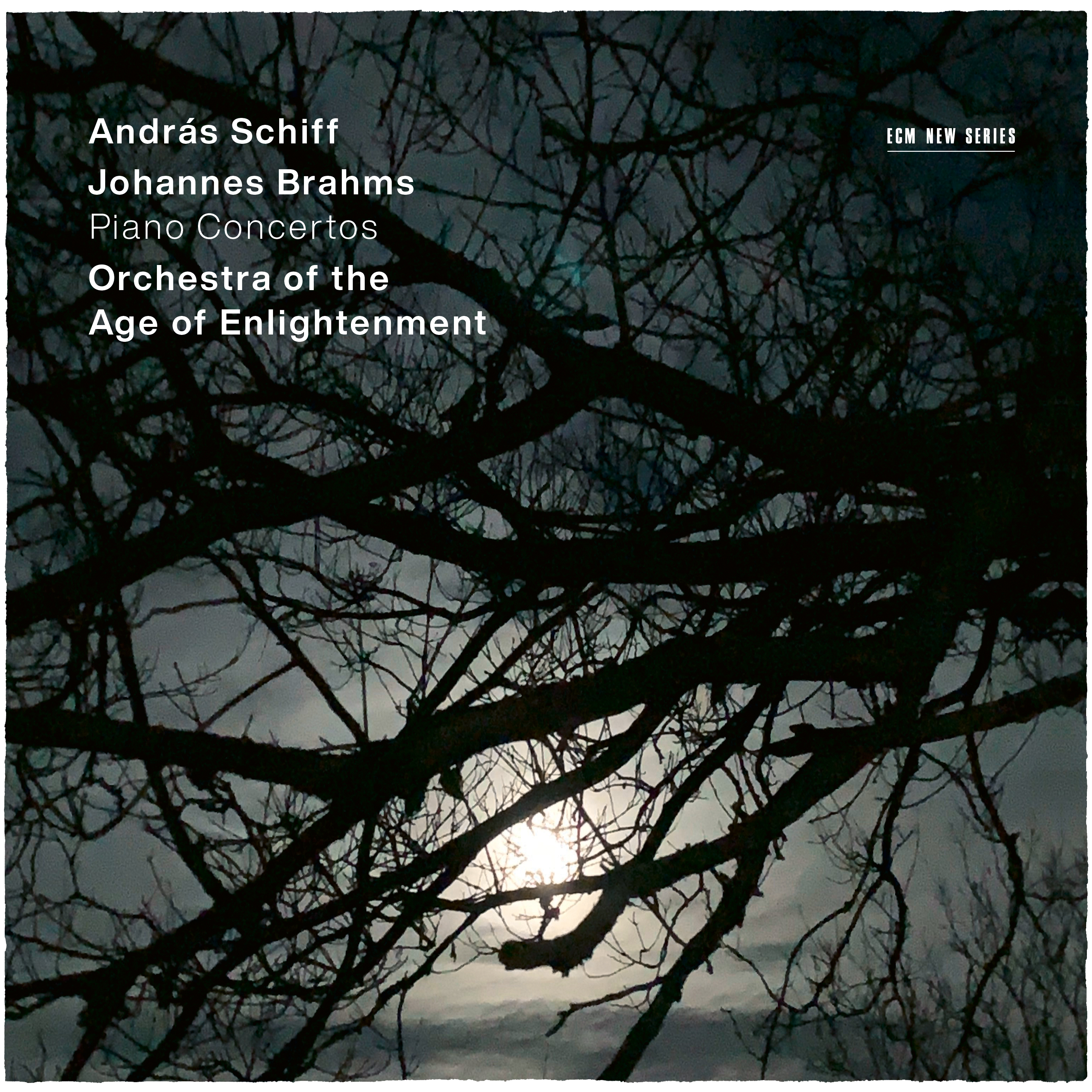
András Schiff: Brahms Piano Concertos (ECM New Series 2690/91)

András Schiff
Orchestra of the Age of Enlightenment
Johannes Brahms: Piano Concertos

András Schiff piano
Orchestra of the Age of Enlightenment
Recorded December 2019
Abbey Road Studios, London
Engineer: Stephan Schellmann
Balance engineer: John Barrett
Production coordination: Guido Gorna and Thomas Herr
Cover photo: Péter Nádas
Executive producer: Manfred Eicher
Release date: June 4, 2021

Following his 2020 release of the Brahms clarinet sonatas with Jörg Widmann, pianist András Schiff continues his exploration of this beloved composer by diving into his formidable piano concertos. With characteristic attention to detail, peeling back layers of artifice to get to the heart of what a score is trying to convey, Schiff seeks appropriate companionship in the Orchestra of the Age of Enlightenment, a period-instrument ensemble that often performs in the absence of a conductor, as it does here. Leading this entourage alongside Schiff is a Julius Blüthner grand piano built in 1859, from which he coaxes an incredible amount of resonance. Thus, he attempts “to recreate and restore the works, to cleanse and ‘detoxify’ the music, to liberate it from the burden of the—often questionable—trademarks of performing traditions.”

It was with Ludwig van Beethoven firmly in mind that Johannes Brahms (1833-1897) wrote his Concerto for Piano and Orchestra No. 1 in d minor, op. 15, even as he tried to step outside the giant’s shadow. Despite its poor initial reception, it has since grown into an experimental full-course spread in the estimation of performers and listeners alike. The opening movement betrays the piece’s transformation from sonata to symphony to concerto, bursting into being with a hit of strings and timpani. Such grandeur, however, is only temporary, as the river’s flow evens out beyond the dam’s reach. When the piano makes its entrance, it dances, carrying with it all the memories it needs to fend for itself in the wilderness. The drama returns only to break the proverbial vessel for a much-needed rebuilding in the Adagio. Brahms marked this movement “Benedictus qui venit in nomine Domini” (Blessed is he who comes in the name of the Lord) in response to the death of Robert Schumann. With unwavering emotional veracity, it shifts from dark to light and back again as unconsciously as breathing. Bringing us out of that pall is a vivacious Rondo leading the final movement’s charge. Schiff emphasizes its improvisational qualities, bringing luminous immediacy to every note.

One might not know that the Concerto for Piano and Orchestra No. 2 in B-flat major, op. 83, is notorious for being one of the most difficult in the repertoire from the pastoral flavor in which it opens. But as the piano’s rubato phrasing proceeds freely over the foundation, pizzicato strings trailing not far behind, the rhythmic complexities become increasingly apparent. The second movement represents some of Brahms’s finest writing. Schiff’s awareness of its textures testifies to his experience and maturity, thus emphasizing the time shift of strings and horns midway through—a resounding call for the future built on the technologies of the past. The wildly inventive third movement (with solo cello lines played by Luise Buchberger) is a lone wolf of expressivity leading us to the momentous Allegretto. The pianism takes striking turns, digging into the lower register before ending on a firmly resolute chord.

Schiff holds these pieces dear to his heart, as should we in being handed the gift of his interpretations.

Schiff/Widmann: Brahms Clarinet Sonatas (ECM New Series 2621)

András Schiff
Jörg Widmann
Johannes Brahms: Clarinet Sonatas

András Schiff piano
Jörg Widmann clarinet
Recorded May 2018
Historischer Reistadel, Neumarkt
Engineer: Stephan Schellmann
Cover photo: Jan Jedlička
Produced by Manfred Eicher
Release date: October 2, 2020

In the opening gestures of the Sonata in E-flat major, op. 120/2 (1894), for clarinet and piano, it’s difficult not to feel the breath of life that moved its composer, Johannes Brahms (1833-1897), to such rapture in the latter years of his life. As the second of two such sonatas and his final chamber work, it is a testimony not only to Richard Mühlfeld, the master clarinetist of his day whom Brahms called “the nightingale of the orchestra,” but also to the self-effacement with which Brahms struggled throughout his creative life. And so, when considering the enduring interpretations here by pianist András Schiff and clarinetist Jörg Widmann, one must understand that without a love for every note, the bars between them would erode. Thus, Widmann gives colorations to the breath at every turn, while Schiff understands the role of the piano in Brahms’s chamber works as more than an accompaniment, giving it the fullness of expression it requires. The second movement, a rousing Allegro appassionato, is quintessential Brahms for its controlled drama and balance of fine motor skills, all tied together with a rustic charm. The final movement works patience into the virtue of exuberance.

The Sonata in f minor, op. 120/1 (1894), is even more dynamic. After a gradual first movement, the second unravels like paint from a brush, finding favor in the final trails of each stroke. The restrained Allegretto that follows sets up a rousing Vivace, the ebullience of which dazzles the senses. Given its symphonic textures, it’s no wonder the piece lent itself so gloriously to Luciano Berio’s orchestral transcription in 1986.

Between these giants of clarinet literature are Widmann’s five Intermezzi (2010) for piano. As tributes to both Schiff (to whom it is dedicated) and Brahms, they show a modern heart in love with the blood of tradition pumping through it. The central intermezzo, at 12 minutes, digs deepest into the spirit of this emotional transference. Throughout, we encounter waking moments in an otherwise dreamlike mise-en-scène. Nevertheless, clarity abounds.

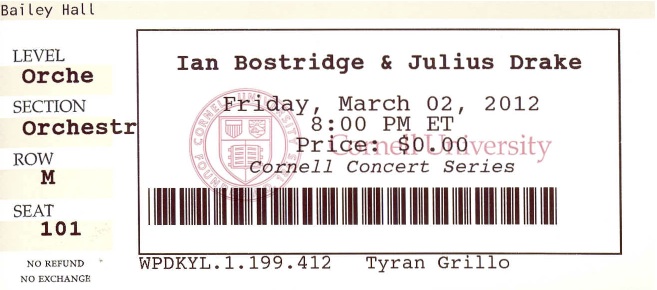
A Walk in the Magic Garden: Bostridge and Drake Bring Lieder to Bailey

Imagine yourself as the protagonist in poet Heinrich Heine’s Ich wandelte unter den Bäumen (“I wandered among the trees”). You’ve been wandering through a forest, your only companion grief over an unrequited love. Suddenly, a “little word” flittering in the trees, a simple utterance that pulls the wool of the past over your eyes. You wonder how the birds know it, why they torment you so. They sing:

“A young woman once passed by,
She sang it again and again,
And we birds snatched it up,
That lovely gold word.”

You feel the sparkle, ironic and stabbing, of every rounded syllable. You are pressed by the weight of their diction. Only then do you realize that you’ve been sitting in a concert hall with a flock very much of your kind. The voice comes not from the trees but from English tenor Ian Bostridge, who looms almost as tall as one, onstage at Cornell’s Bailey Hall.


Ian Bostridge

Although Bostridge started out as an aspiring physicist who also wrote a seminal book on witchcraft before devoting his life path to singing in 1993, his audiences would be the last to refute that his command of, and interest in, either physics or witchcraft has waned. To wit, his accompanist of choice for we fortunate Friday few was Julius Drake. An in-demand recitalist and professor at London’s Royal Academy of Music, Drake maintains an alchemical interest in Robert Schumann and in German lieder, or art songs, both of which fuse together via the composer’s setting of the poem above, one of nine by Heine in the op. 24 Liederkreis (Circle of Songs). Written in 1840, a period known as his Year of Song, the cycle bears dedication to his wife, Clara. Despite its passionate origins, the Liederkreis tends to fall by the wayside of Schumann’s monumental Dichterliebe, though one can hardly deny the mastery with which piano and voice share their creative duties in both. Schumann blends folk idioms and a flair for the programmatic, into which Bostridge and Drake pour over twenty years of collaborative experience.


Julius Drake

During this performance it was clear that for Bostridge the sounds of words are as important as their meanings. Throughout the Liederkreis and the quartet of Dichterliebe apocrypha that preceded it he fashioned a living, breathing persona that was as chameleonic as the sentiments he so punctiliously enunciated, while Drake matched his depth gesture for gesture. Both artists found themselves surpassed only by the lyricism of Schumann, whose adorations blossomed before our ears in the passions of Lehn’ deine Wang’ (“Rest your cheek”) and the sweetness of Berg’ und Burgen schaun herunter (“Mountains and castles look down”), the latter contrasting starkly with the morose Es treibt mich hin (“I’m driven this way, driven that”), the fiendish difficulties of which Bostridge navigated with apparent ease. Artistic witchcraft was also in order for Mein Wagen rollet langsam (“Slowly my carriage rolls”), during the middle stanza of which he sang an internal thought as if it were his own. Not to be outdone, Drake’s pianism cast its share of enchanting spells, as in the brightness of Morgens steh’ ich auf und frage (“Every morning I awake and ask”) and the chromatic sweeps swirling like smoke from a breeze-blown candle throughout Mit Myrten und Rosen (“With Myrtle and Roses”).


Robert and Clara Schumann

While Bostridge and Drake were obviously comfortable with Schumann, much of the evening’s treasure was buried in the relatively uncharted maps of Johannes Brahms, in whose poetics they steeped the program’s first half. With a life-affirming, if not transformative, energy Brahms’s songs made for a fitting introduction to anyone not familiar with the lieder tradition from which he is so often excluded, typically dominated as it is by Franz Schubert, Hugo Wolf, and Schumann himself. For one, he favored the words of “minor” poets—a downfall in an art built from the text up. This and his disinterest in grand cycles pegged him as something of an outsider. Yet Brahms saw no necessary correlation between great music and great poetry. Each was its own melody. As with Schumann, whom Brahms much admired, folk motifs were an important touchstone and sometimes led him boldly where his contemporaries dared not tread.


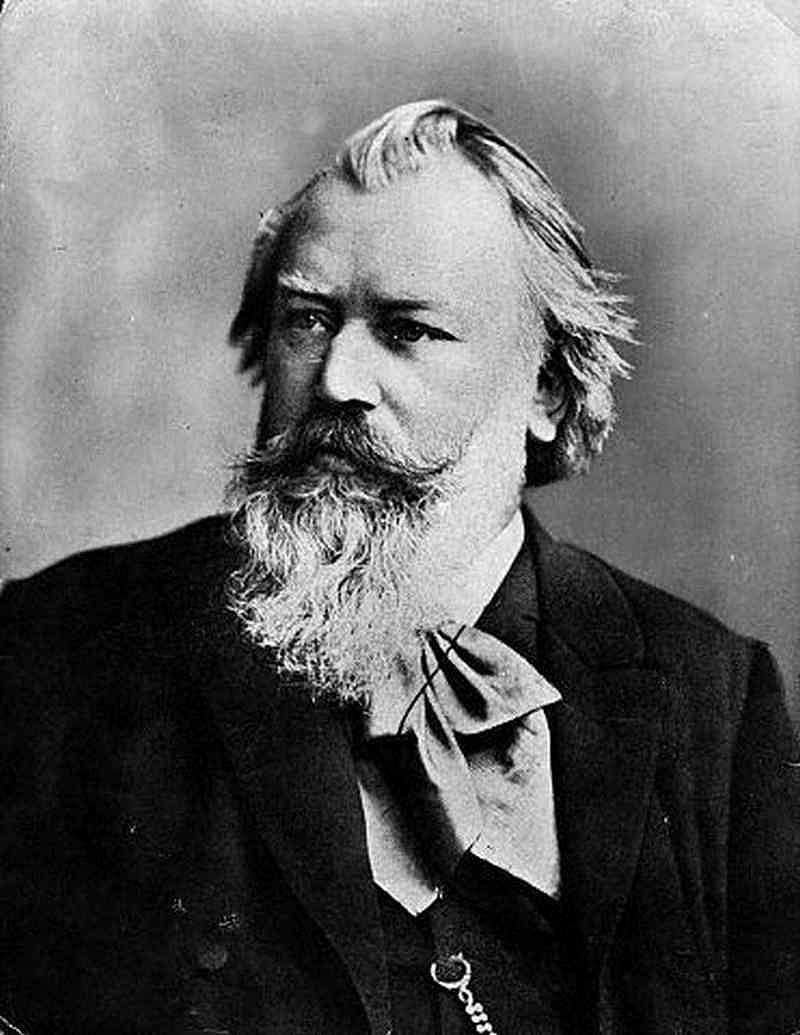
Johannes Brahms

His was, and continues to be, a music filled with worlds that don’t so much collide as pass through one another. From the mighty gales of Auf dem Kirchhofe (“In the churchyard”) and on through the Chopinesque backcloth of Der Gang zum Liebchen (“The way to the beloved”) to the raging seas in Verzagen (“Despair”), the pianism was of a vastly different order, with the result that Bostridge pushed himself to engage every facet of its relief. This resulted in an unexpected hiccup during a high reach in Geheimnis (“Secret”). Yet even this did nothing to detract from what was for this listener the most awe-inspiring song of the program (if anything, it broke a tension that threatened to sweep us away entirely), and may explain the marked determination with which he dove into the set’s most turgid waters—notably, Alte Liebe (“Old Love”) and O kühler Wald (O cool forest).

Due perhaps to Brahms’s rich keyboard writing, Drake’s interpretive nuances were most effulgently realized here. He was at once impressionistic and exacting like a carver’s tool, but always playing the words at hand. The lushness of chording in his right hand atop the rising arpeggios of his left in the concert’s opener, Es träumte mir (“I dreamed”), assured us that the best accompanists also know how to sing. Bostridge was reverently aware of this. One could see it in the way he looked into the distance between verses, as if watching the Steinway’s notes mingling with his own over the horizon. He interacted with the piano, now resting on it like a poet’s tree, now at an intense moment breaking free from its pull.

Oftentimes the more careful one is, the more conservative one becomes. In the case of these two performers, however, care seems to have bred nothing but expressive potential. In this respect Bostridge sings as might a Shakespearean actor surrender to a soliloquy—which is to say, by stepping outside the self and into the landscape of another space and time. His ego flees like the poetry from his lips, even as he shows us the vitality of the body in the singing of lieder, its centering and de-centering, its bows and cringes, and in all the winged commitment required to make every syllable fly. Drake, meanwhile, proves himself supremely attuned to every color change, and stands respectfully poised on the edge of drowning. He listens to the voice just as the voice listens to itself, intoning with the wavering realism of a reflective surface.

We return to Heine, in whose beauties we find ourselves lost:

In the magic garden wander
Two lovers, silent and alone;
The nightingales are singing,
The moon is shimmering.

So sings the now familiar voice, no longer birdlike but nonetheless profoundly arboreal. Bostridge takes us fearlessly into that garden and shapes its flora and fauna, each more magical than the last for the Midas touch of his vocal presence. Said garden is his gift to us, a place to which we can always return when remembering this night.

(See this article in its original form at the Cornell Daily Sun.)

Brahms: Sonatas for Viola and Piano (ECM New Series 1630)

Johannes Brahms
Sonatas for Viola and Piano

Kim Kashkashian viola
Robert Levin piano
Recorded November 1996, Mozart-Saal/Liederhalle, Stuttgart
Engineer: Peter Laenger
Produced by Manfred Eicher

These two sonatas, originally written for clarinet, marked the end of an intense period of depression for Brahms, during which his creative energies had all but faded. Kim Kashkashian, whose command of the viola unearths an even deeper realm of possibility in this already engaging diptych, faithfully captures the somber circumstances of its creation. In doing so, she shows that the viola is no less an instrument of breath, drawing from deep within her lungs the sheer vocal power required to carry across such arresting music.

The disc opens with the Sonata No. 2, evoking the spirit of its underlying “tragic motive” as if it were the weight of an all-consuming desire. The entire sonata, but especially the first movement, flows with what I can only call an urgent delicacy. The looser third movement makes for a more abstract statement, never seeming to settle until it is dashed off with a declamatory flourish in its concluding Allegro. As arousing as the second sonata is, the Sonata No. 1 is perhaps the more fully fleshed of the pair. The second movement is for me the most effective portion of the album. It unfurls the viola’s heart like no other recordings (excepting Kashkashian’s, of course) can. Its yearning melody moves like grass bending in the wind, expressing in its pliancy a total acceptance of emotional upheaval and the growth that upheaval fosters. Just as the Andante casts its lyrical spell, so does the final Vivace enchant with gorgeous pockets of emptiness, drawing in thick lines the journey of its own resolution.

As one would expect of Brahms, the piano writing is superb at every turn, providing Robert Levin the perfect foil by which to extol the wonders of this richly blessed composer. Once again, he and Kashkashian prove themselves to be a finely matched pair. They maintain respectable dynamic distance throughout, balancing the latter’s robust vibrato with the former’s assertive yet nuanced touch. In spite of the darkness that binds these sonatas, their rewards are nothing if not radiant.

<< Rosamunde Quartett: Webern/Shostakovich/Burian (ECM 1629 NS)
>> Arild Andersen: Hyperborean (ECM 1631
)