I’ve just written for Sequenza 21 a retrospective of ECM’s New Series in celebration of the imprint’s 30th year in 2014. Click the cover to read.


I’ve just written for Sequenza 21 a retrospective of ECM’s New Series in celebration of the imprint’s 30th year in 2014. Click the cover to read.

Kremerata Baltica
Hymns and Prayers
Gidon Kremer violin
The Kremerata Baltica
Roman Kofman conductor
Khatia Buniatishvili piano
Andrei Pushkarev vibraphone
Marija Nemanytė violin
Maxim Rysanov viola
Giedrė Dirvanauskaitė violoncello
Sofia Altunashvili voice on tape
Recorded July 2008, Pfarrkirche St. Nikolaus, Lockenhaus
Engineer: Peter Laenger
Produced by Gidon Kremer and Manfred Eicher
A recent album released of solo piano music by Stevan Kovacs Tickmayer bears the title Gaps, Absences, which best describes the music of the composer, pianist, and essayist who, born 1963 in former Yugoslavia, has since 1991 called France his home. His life as an improviser has brought him in collaboration with Fred Frith, Chris Cutler, and many others of the avant garde, while on the classical side he has enjoyed fruitful collaboration with violinist Gidon Kremer and the Kremerata Baltica, having served as composer in residence at the renowned Lockenhaus chamber music festival, where this album was recorded in 2008, and more recently at the Kremerata Baltica’s own festival in Latvia. His Eight Hymns (1986/2004), written in memory of Russian filmmaker Andrei Tarkovsky, begins a tripartite program of monumental works for various ensembles. Scored for violin, strings, vibraphone, and piano, each of Tickmayer’s hymns bears a title of calm strength. His atmospheres are deceptively minimal, at times spectral and at others hovering as mist over a lake at dawn. The instruments interlock in alternating tides and continental shelves. The piano paints evening skies as single notes break off into satellites of a deeper gravitation. The violin is a thin yet utterly present voice, an omniscient myth-keeper whose experiences of assumption, redemption, and remembrance all answer to the same voice. The vibraphone is a pinwheel moved by breath of slumber. Strings move in the draw of a paintbrush from behind a veil of ash and harmonic light. All of this ends in a flower, as fragile as it is trembling, leaving us indeed with gaps and absences of profound resonance.
Such soul-nourishing music finds like spirit by way of Giya Kancheli, who wrote his 2007 Silent Prayer in honor of Mstislav Rostropovich (for his 80th birthday) and Gidon Kremer (for his 60th). The familiar Kancheli themes crystallize in the prerecorded singing of one Sofia Altunashvili. Her pure-toned voice, carried like a feather on exhale, rings authentically for its vulnerability. It’s an unusual voice, an untrained voice, a voice unafraid of a misshapen psalm. As in the Tickmayer pieces, the violin feels thin and unchained, and puts into relief the spaciousness of strings dragging hands across water from methodical vessels. Their occasional interjects feel like proclamations from above, chances to restring the universal lyre. Still, there is a feeling of oppression to this piece, as if the sky had become weighted with death, so that the lively center almost blinds. Even more cinematic in feel than the Tickmayer, Kancheli’s hymnal cast turns wine into water in a single tracking shot.
Equally affecting, if by relatively compressed dynamic force, is César Franck’s Piano Quintet in f minor (1878/79), which occupies program center. A dramatic and chromatically ecstatic work that met with criticism at the time of its premiere, it also makes expert use of its formidable combination of instruments. What appears short and sweet by name becomes epic in performance as Kremer and his colleagues muscle their way through the first movement with heartfelt aplomb, chipping away at the music’s calcified soul as they proceed. Each drift into the major is a barrel over the waterfall of reality. The most genuine passages are the quietest. On that note, the second movement turns an elegiac frame into a window on fertile land. The legato phrasings of the final Allegro, then, are a bittersweet harvest, tempered by the promise of winter’s freeze. In anticipation of that cold, the piano holds a fire in its belly, changing from blue to orange to white as echoes return with nourished grief. For indeed, mourning is the final message of even the brightest day. The tinge of mortality knows no limits of sun.

Garth Knox
Saltarello
Garth Knox fiddle, viola, viola d’amore
Agnès Vesterman violoncello
Sylvain Lemêtre percussion
Recorded December 2009, Auditorio Radiotelevisione svizzera, Lugano
Engineer: Stephan Schellmann
Produced by Manfred Eicher
Garth Knox describes Saltarello, his second nominal disc for ECM’s New Series following 2008’s D’Amore, as “a mobile structure of musical ‘snapshots’ taken from nearly one thousand years of music.” As the former violist of the Arditti Quartet, Knox gained in-depth knowledge of music by living composers, all the while strengthening his relationship to the viola d’amore and folk-grounded fiddling, and compresses that knowledge into a roaming program. Knox has also developed his voice as a composer, as demonstrated by his Fuga libre for viola solo, which juxtaposes fiery arpeggios with moonlit pizzicato diffusions, glissandi, and harmonic overlays. This cellular approach is writ large across the album’s full breadth, which for the most part traverses centuries-old lineages. Joining Knox on his time travels are cellist Agnès Vesterman and percussionist Sylvian Lemêtre.
On the deepest end of the spectrum we encounter works of medieval masters Hildegard von Bingen and Guillaume de Machaut. The former’s lilting poetry, liturgical and solemn to its ashen core, comes out all the more authentically in the intimate setting, while the latter’s Tels rit au ma[t]in qui au soir pleure adds percussion in Sephardic spirit. Three dances from the 14th century speak further to an ancient aesthetic uncluttered by the discontents of modernity, resonating instead through the viola d’amore’s singing body. Here, too, the percussion balances luminescence opposite Knox’s originary tone. A handful of traditionals takes us into less definable territory, where Appalachian folk song and Irish fiddling meet in Black Brittany in limber arrangement with cello, and a trio of Irish tunes under the title of Pipe, harp and fiddle turns temerity into joy through a prism of bells and drums.
A dip into the font of the Baroque gives up the ghosts of Henry Purcell and Antonio Vivaldi. Where one feels steeped in downright cinematic tragedy, the other crucibles a concerto originally written for viola d’amore and orchestra down to its lead and bass lines, so that the striking geometries of each movement, from dancing to slumbering to dancing again, mold a beautiful sculpture of exuberance.
Bolstering all of this is contemporary Finnish composer Kaija Saariaho’s Vent nocturne for viola and electronics, which was written especially for Knox. The first of its two movements bears the title “Sombres miroirs” (Dark Mirrors), the second “Soupirs de l’obscur” (Breaths of the Obscure). The piece includes the composer’s own breathing, as well as the amplified sound of the bow drawn across a string, in a mood that best recalls Sofia Gubaidulina’s String Quartet No. 4. It’s a windblown reverie, opened and not merely enhanced by the technological overlay. It is sometimes restless and draws from a relatively stark palette, even as glass harmonica-like drones bleed into frame as if they were time itself. Splitting the two movements even as it binds them is John Dowland’s Flow My Tears, a song last heard under ECM auspices with words on In Darkness Let Me Dwell. It is, like the album as a unit, a prayer that looks itself in the mirror and neither smiles nor frowns, but takes in the entire face, scars and all, as something greater than the sum of its features.

Meredith Monk
Songs of Ascension
Meredith Monk & Vocal Ensemble
Ellen Fisher, Katie Geissinger, Ching Gonzalez, Meredith Monk, Bruce Rameker, Allison Sniffin voices
Bohdan Hilash woodwinds
John Hollenbeck percussion
Allison Sniffin violin
Todd Reynolds Quartet
Todd Reynolds violin
Courtney Orlando violin
Nadia Sirota viola
Ha-Yang Kim violoncello
The M6
Sasha Bogdanowitsch, Sidney Chen, Emily Eagan, Holly Nadal, Toby Newman, Peter Sciscioli voices
Montclair State University Singers
Heather J. Buchanan conductor
Recorded November 2009, Academy of Arts and Letters, New York
Engineers: James Farber and Paul Zinman
Assistants: Nelson Wong and Sean Mair
Editing engineer: Paul Zinman
Location Recording Service: SoundByte Productions Inc., New York
Mixed at Avatar Studios, New York by James Farber, Manfred Eicher, and Meredith Monk
Assistant: Akihiro Nishimura
Produced by Manfred Eicher
These pieces grew out of inspiration from poet Paul Celan, whose “Song of Ascents” suggested heavenly upward motion, and by extension a project to explore the sacrality of directions. Fortuitously, composer Meredith Monk was asked by artist Ann Hamilton to perform on site in Geyserville, California, where an eight-story tower with staircases in the shape of a double helix awaited Monk and her dedicated musicians. The beauty of the image, despite its live-giving implications, is that a helix has no up or down—or, rather, embodies both simultaneously—so that divinity comes to be expressed through suspension of the body.
As Monk’s subtlest assemblage, Songs of Ascension births a masterfully realized bioform. I use the adverb not lightly, because only mastery could stretch such a stable tightrope between being and non-being and walk between the two as easily as falling. To her vocal montage Monk adds string quartet, percussion, and woodwinds, for an amalgamated effect of such intimate proportions that the seemingly massive roster only serves to compress the music’s molecules into a galaxy of interpretation: it holds its shape by strength in numbers, an ethereal note inked in long before the earth dotted it on the then-blank score of outer space.
Indeed, one might trace an evolution of global life in the album’s embedded structures. Four seasonal “variations” and three so-called “clusters” are its spiritual campgrounds, from which sparks fling themselves into the night sky as the firewood settles. Songs are intoned and invoked, touched by percussion and overlapping strings, and moving in unison renderable only through total corporeal commitment. Gatherings and inner psalms blur into one another until the topography changes into air. Whether in the pointillism of “cloud code” or the ricocheting pings of “burn,” the topographic circles of “mapping” or the piercing meditation of “fathom,” a consistency of vision prevails. The instrumental passages are just as vocal, the vocal just as instrumental.
Songs of Ascension brings the atmosphere down to soil level. It speaks a continuity of earth and sky, the elemental composition of which draws notecraft from the farthest reaches of the universe, which happen to reside between our ears.
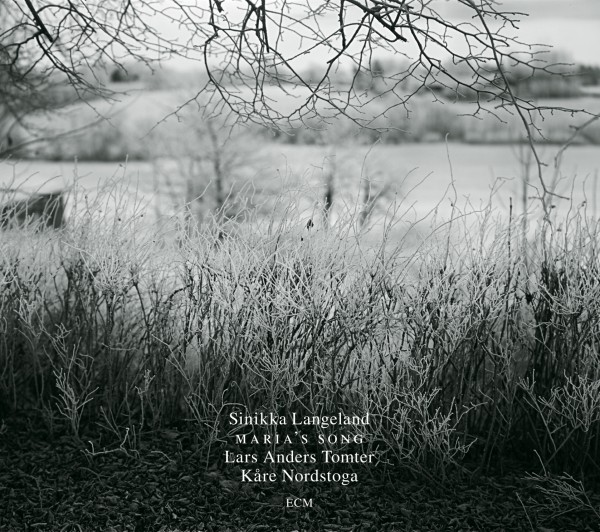
Sinikka Langeland
Maria’s Song
Sinikka Langeland voice, kantele
Lars Anders Tomter viola
Kåre Nordstoga organ
Recorded February 2008, Nidaros Cathedral, Trondheim
Engineer: Ove Berg
Editing: Ove Berg, Jean Lewis (Suite, Chaconne)
An ECM Production
ECM may be nominally dedicated to contemporary music, but Johann Sebastian Bach has been a vital touchstone in its classical recordings. Whether acting as a foil to modern works in Thomas Demenga’s multi-album traversal of the Cello Suites or as the exclusive subject of fresh interpretations by Keith Jarrett and András Schiff at the keyboard, Bach has either existed as a point of reference or as a master being reckoned with anew toward the asymptote of definitive interpretation. Only Christoph Poppen has gone a step further, weaving Bach into the work of Anton Webern (as Webern himself had done) and exploring hidden chorales of the solo violin literature. That was, until Maria’s Song, which is by far, and may always be, ECM’s profoundest reckoning with Bach.
Previously for the label, Norwegian folk singer and kantele (15-string Finnish table harp) virtuoso Sinikka Langeland had recorded Starflowers and The Land That Is Not, both of which sought to explore the shared heart of folk and jazz around the heliocenter of Langeland’s full-throated voice. This time she is joined by Lars Anders Tomter, previously of Ketil Bjørnstad’s The Light, who plays a Gasparo da Salò viola made in 1590, apparently one of the world’s finest examples of the instrument. With them is Kåre Nordstoga, playing the 30-register Baroque organ of Trondheim’s Nidaros Cathedral. Nordstoga is the principal organist at Oslo Cathedral and a Bach specialist, having performed two complete traversals of the composer’s organ music over 30 Saturday recitals in 1992 and 2000.
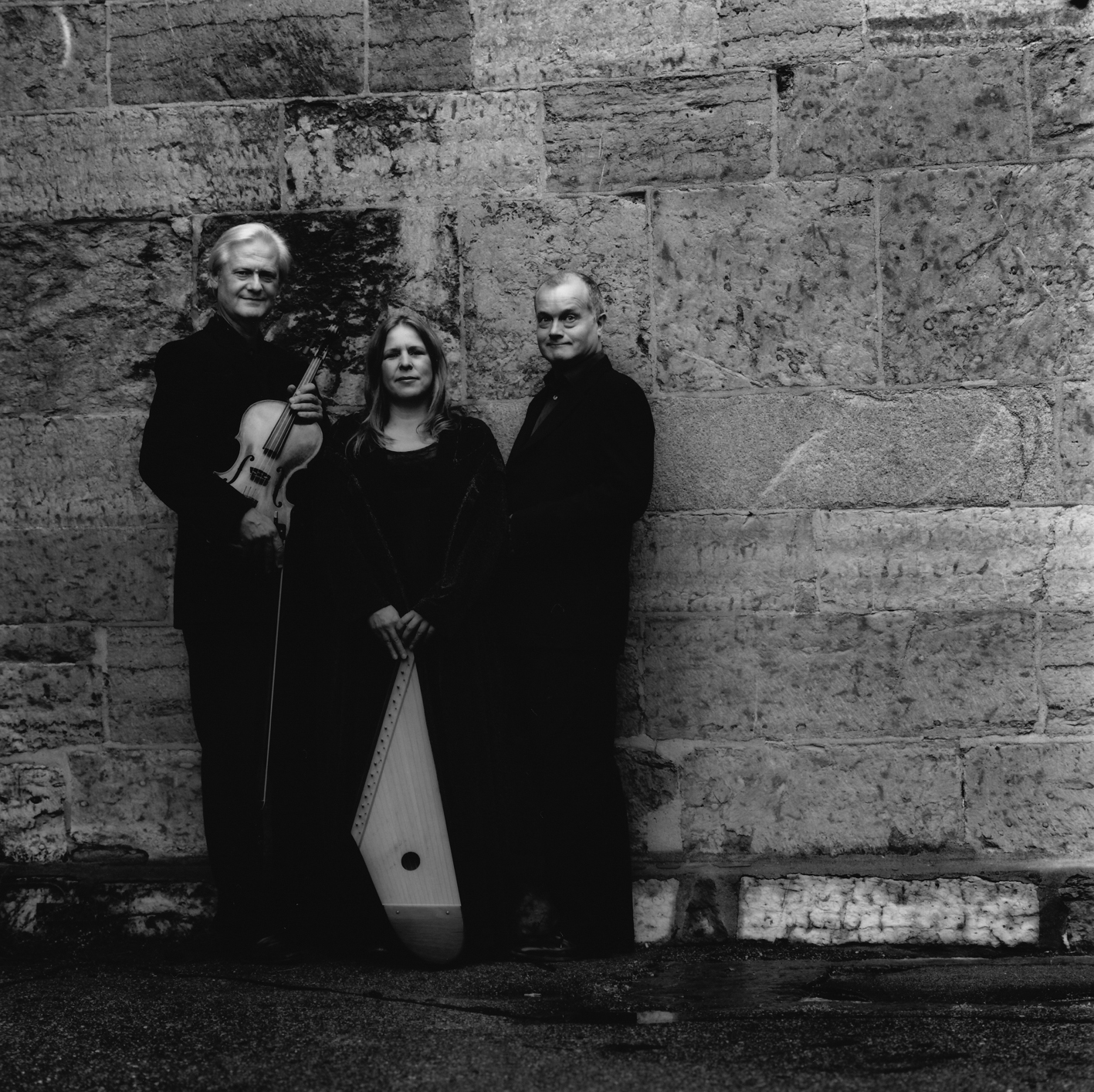
(Photo credit: Morten Krovgold)
The program is a mixture of Marian texts from Luke set to folk melodies and medieval ballads, then threaded through the loom of Bach’s hymns (and the Concerto in d minor, BWV 596) at the organ. In addition, Tomter plays viola arrangements of the Solo Cello Suite No. 1 in G major, BWV 1007 (played an octave higher) and the Chaconne from the Solo Violin Partita No. 2 in d minor, BWV 1004 (transposed to g minor). A few things make this a remarkable project. First is Langeland’s immensity of knowledge, on which she draws to assemble a program of such originality that it feels as seamless as its pairings of word and melody. Second is her voice. Possessed of a luminescent, youthful energy, her intonation makes scripture feel like a sheaf of grain distilled into something digestible by the soul. Last is the utter respect with which the musicians perform, respect that emits a sacred light of its own. And no wonder, considering that the spirit of these texts was at one time forbidden in Norway, where the Reformation of 1537 disbanded monasteries and consigned church relics and artifacts, including depictions of Mary, to state storehouses. Worship of the Virgin thus became the stuff of hidden messages and codes, and in these songs Langeland has enacted their recovery.
“Lova lova Lina” is the first encoding of Mary and, like many of Langeland’s segues throughout the disc, is sung with only the cathedral’s resonant air as accompaniment. Along with the “Ave Maria,” it reappears transformed. At times, Langeland’s fingers find their way to the kantele, both as support for the voice and as a voice unto itself. A reprise of “Lova lova Lina” is especially potent for marrying the two. Narratively inflected singing throughout makes of the shuffled program something of a passion play, in which dialogues between Heaven and Earth come to define the natural order of things. One might expect the viola to brighten Bach’s solo cello writing, when in fact it casts a deeper, more spectral shadow. The feeling is distinctly cyclical, as emphasized by the vocal surroundings, and reaches open-gated confluence in the mighty Chaconne, over which the “Ave Maria” is dutifully papered. The organ, too, sings as it speaks, lifting Langeland in “Vom Himmel kam der Engel Schar,” BWV 607 and, on its own, ascending the spiral staircase of the “Fuga sopra il Magnificat,” BWV 733 at hub of it all. Even the Concerto transcription unleashes the Holy Spirit at an intersection of past and future. As Langeland recalls in her liner notes, “While we played our way through time, the Nidaros Cathedral reflected the spiritual currents of a thousand years. The large Russian icon stared at us as we began to record. The dawn light poured through the huge rose window as we finished the night’s recording.” To be sure, we can feel all of these things…and more.

The Prague Philharmonic Choir
Bailey Hall, Cornell University
November 2, 2014
8:00 pm
Program changes can be tricky. The world-renowned Prague Philharmonic Choir singing Rachmaninoff’s Vespers, plus music by Dvořák and Janáček? Yes, please. Sadly, this was not the case when the choir came to Ithaca for Sunday night’s concert with something else in mind. Thankfully the new set list, as it were, offered plenty of delights to make up for unfulfilled expectations. The music of Czech composer Antonín Dvořák carried over by way of three works not often heard stateside. His Moravian Duets (1876), of which the sopranos and altos sang five selections to piano accompaniment, imbued Bailey Hall with a transportive, fairytale quality. Between the somber, overlapping lines of “The Maid Imprisoned” and the mélange of tones and tempi that was “The Ring,” these settings of folk poetry covered a wide and dramatic range. The Three Male Choruses on Folk Texts of 1877/78 followed, bringing contrast not only by the switch of roster, but also within the tripartite piece itself, marrying bright pianism with stark singing. With titles like “Sorrow” and “The Maiden in the Wood,” these songs engaged weighty and fleeting emotions alike, and did so with enough strength to withstand an underlying longing of epic proportion. Lastly before intermission was In Nature’s Realm. Written in 1882, it boasts some of Dvořák’s liveliest choral writing. For its five-song traversal the full choir assembled at last, underscoring the hymnal quality of “Music Descended on My Soul” and luxuriating in the echo effect of “The Rye Field”—the latter a memorable highlight, among others.
In addition to enjoying the opportunity to experience this music live, one could very much feel the cultures and places it represented. Each piece was an illustrative vignette, to be sure. Just as impressive, however, was Dvořák’s piano writing. More than mere support for the massive vocal forces, it held its own as an equal partner. Yet perhaps most enjoyable of all was principal conductor Lukáš Vasilek, whose superb direction—all of it without a master score, no less—continued on through the concert’s second half: the Liebeslieder Waltzes of Johannes Brahms. Composed 1868/69 and performed by the full choir and four-hand piano, it embodied, compared to the Dvořák, an integrated sound that was darker, more amalgamated. What the waltzes might have lacked in melodic oomph they made up for in rich choral textures, a quirky sense of humor (as in the invigoratingly stubborn “No, There’s Just No Getting Along”), and turns from alto and tenor soloists breaking the dense surroundings into smaller chunks.
The choir encored with an ethereal arrangement by Swedish composer Jan Sandström of the popular Elizabethan carol “Es ist ein Ros entsprungen,” which split the singers into two groups and showcased their ability to be as airy as they had been compact. With downright orchestral expanse and a sublime bass section to its credit, the choir showed us the true meaning of a cappella, and a lot more besides. A real treat.

Georg Friedrich Händel
Die Acht Grossen Suiten
Lisa Smirnova piano
Recorded May 2007, May-June 2008, and Feburary 2009 at Schloss Goldegg, Austria
Engineer: Jens Jamin
An ECM Production
This is not the first time that music from Georg Friedrich Händel’s Suites de Pieces pour le Clavecin (a.k.a. the “Eight Great Suites”) of 1720 has appeared on ECM. Pianist Keith Jarrett recorded for the label’s New Series imprint a selection of suites by Bach’s near contemporary in 1993, and with it endorsed an affirmative reassessment of these exceptional works. Several complete recordings have since been issued, and many more predate it on vinyl, so the press release’s claim that these pieces are “too rarely brought together on disc” is, in fact, moot. Paul Nicholson’s cycle for Hyperion, recorded on harpsichord a year after Jarrett and distinguished by its highly embellished repeats, was a notable companion. Two further accounts have been issued this year (2014) alone. The first, by Richard Egarr for Harmonia Mundi, also opts for harpsichord, while the second, by Danny Driver for Hyperion, joins this 2012 release from Vienna-based Russian pianist Lisa Smirnova as a formidable contender for piano renditions. Smirnova would seem to marry the best of those recent followers, combining Egarr’s charm and Driver’s vibrancy with idiosyncratic success.

Although Händel humbly called these pieces “lessons,” their exact purpose is unclear. Their difficulty is, however, anything but and comprises an earthly counterpart to J. S. Bach’s heavenward considerations at the keyboard. For Smirnova, it is timeless music all the same, as attested by the five years of preparation and careful study she poured into it before a single studio microphone was switched on. Just as intriguing and well considered as her performance of the suites is the order in which she plays them, beginning as she does with the Suite No. 2 F Major HWV 427. A subtle yet bold choice of introduction, it lowers us into Händel’s pond so that we might see the ripples for what they are: as beautiful disturbances brought to life by a human touch. In the latter vein, the suite highlights Smirnova’s technical prowess: her syllogistic approach to the binary Adagios, balance of fluttering trills and steady pacing in the Allegros, and exquisite pedaling throughout.
The suites are full of idiomatic variety and avoid formal suite structure altogether. Consequently, Smirnova’s immediate jump to the Suite No. 8 F Minor HWV 433 makes as much sense as the composer’s elision of a Sarabande in the same (this peculiarity also marks the set’s most Baroque Suite No. 1 A Major HWV 426, which Smirnova places second to last). Thus foregrounded, this final suite elegantly flaunts its darker, more mature wardrobe. The extraordinarily lovely Allemande exemplifies both Händel’s sensitivity as a composer and Smirnova’s as a performer, legato phrasings and all. The concluding Gigue, too, shows us her grace and her ability to be fortuitous without tripping over prosody.
The Suite No. 4 E Minor HWV 429 and Suite No. 5 E Major HWV 430 are the only consecutive pairing. The echoing beginnings and sportive finish of the one sit comfortably alongside the dreamy core of the other. Next, the Suite No. 3 D Minor HWV 428 proceeds with gusto. The fantastic keyboard coverage of its Prelude recalls the grandeur of Bach’s organ works and opens a multivalent interface toward the gargantuan Courante. Simple in design yet expansive in effect, its octave voicings in the left hand and spurring trills in the right keep the final Presto in its sights, inspiring some of the set’s most virtuosic control of dynamics. By contrast, the Suite No. 6 F Sharp Minor HWV 431 portions itself more conservatively, keeping its inner fire audible but in constant check.
Händel mixes things up yet again in the Suite No. 7 G Minor HWV 432, for which he adapts the Overture of his cantata Clori, Tirsi e Fileno HWV 96. Here Smirnova puts on the air of a harpsichordist, her style brisé lending bite to every tantalizing swerve. This fullest of the suites is a veritable summation of the whole. From the salon-like Andante to the affirmative Passacaglia, it draws on many autobiographical roots until a new tree is born. Smirnova may be just one of many leaves on its ever-growing branches, but among them holds the sun in frame, her heart glowing green against cloudless sky.
(To hear samples of Die Acht Grossen Suiten, click here.)
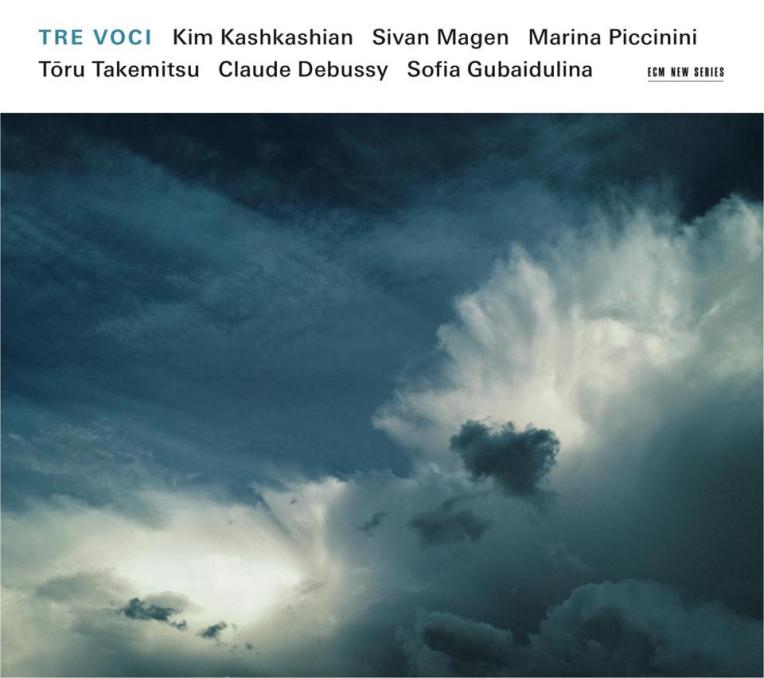
The peerless and ever-adventurous Kim Kashkashian has joined on tour this season Musicians from Marlboro. Among them are flutist Marina Piccinini and harpist Sivan Magen, the other two sides of Tre Voci, purveyors of a recent self-titled disc for ECM New Series. Click the cover below to read my exclusive Sequenza 21 report on their unforgettable performance in central New York.

Duo Gazzana
Poulenc / Walton / Dallapiccola / Schnittke / Silvestrov
Natascia Gazzana violin
Raffaella Gazzana piano
Recorded June 2013, Auditorio Radiotelevisione svizzera, Lugano
Engineer: Markus Heiland
Produced by Manfred Eicher
In 2011, pianist Raffaella Gazzana and violinist Natascia Gazzana, better known as Duo Gazzana, made a quiet, if colorful, splash with Five Pieces, their first record for ECM’s New Series imprint. Navigating a recital comprised of works by Takemitsu, Hindemith, Janáček, and Silvestrov, the Gazzana sisters, in close collaboration with producer Manfred Eicher, demonstrated an acute sense of programming, technique, and integrity. Despite the title of their debut (named for the Silvestrov composition of the same name), which contained only four pieces, Silvestrov’s Hommage à J.S.B. (2009) comprises the heart of this truly pentagonal sequel. The Ukrainian composer offers three short movements: two Andantinos and one Andante, each the band of a deeper and more nuanced spectrum. The end effect is one of suspension. Although originally written for Gidon Kremer, the Hommage is uniquely informed here by the Gazzanas’ attention to detail. “The music of Silvestrov is not difficult in terms of notes,” Raffaella tells me in a recent interview, “but it’s so particular. In a way, you have to isolate yourself from the noise of life. He’s a composer who belongs to another time, bringing these beautiful melodies, as if from the past.” Indeed, as Wolfgang Schreiber observes in his album notes, the Gazzanas share in the spirit of the music they have selected, which like them finds newness in the old. Their unwavering commitment to urtexts only serves to emphasize what is unwritten in them, thus coaxing out hidden messages and spirits.
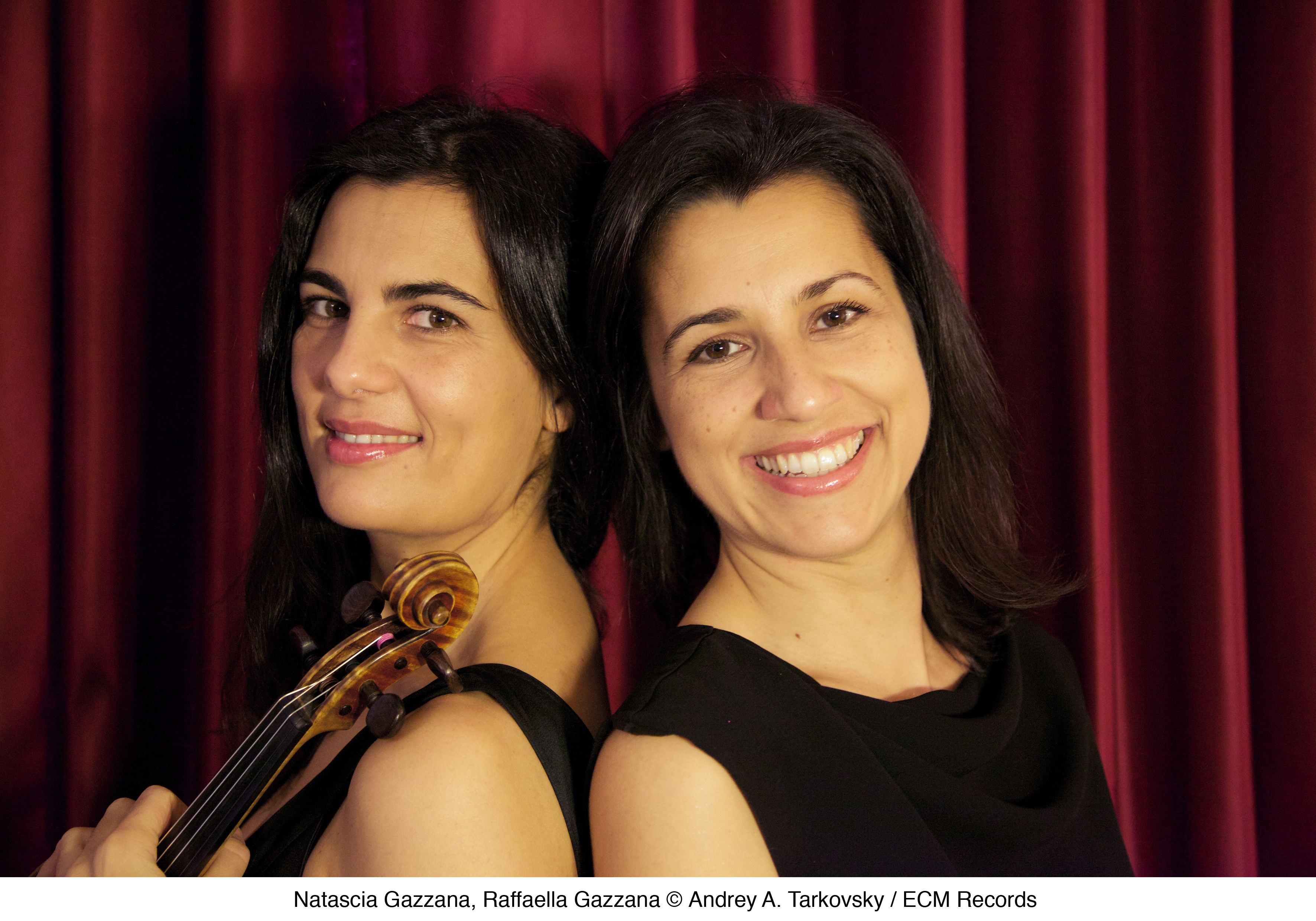
Radiating outward from the Silvestrovian center are two richer, denser works: Poulenc’s Sonate pour violon et piano (1942/43, rev. 1949) and William Walton’s Toccata for violin and piano (1922/23). Dedicated to the memory of Federico García Lorca, the Poulenc sonata is, in Raffaella’s estimation, a product of its time, as is clear in the first in third movements, designated “Allegro con fuoco” and “Presto tragico,” respectively. These are extroverted, almost flailing. Stravinsky looms large in the final, especially, but there are also—unwitting, perhaps—nods to the late Romantics and Ravel as the piece nears its enigmatic coda. “After expressing the suffering of the war,” Raffaella observes, “Poulenc wanted to finish with this dreamy catharsis. This was his character, shy but also enjoying life. He was, I think, a very elegant man, and in this sonata you can hear that.” Poulenc purists take note: the Gazzanas’ interpretation corrects mistakes left in the original French edition prepared by Max Eschig, which elides key signatures in the last page. After careful study of the facsimile, they believe to have arrived at the definitive version.
Although more obscure, Walton’s Toccata was the subject of Raffaella’s dissertation and is no less possessed of elegance. Nataschia’s opening proclamation stirs the piano’s waters with relish and fortitude, giving way to a virtuosic and starkly exuberant foray, pocked by haunting, probing depressions. Although written in the composer’s 20s, it smacks of maturity and daring-do. Raffaella: “I am always impressed by the piece’s improvisational elements. At the time he was working on it, Walton was planning a jazz suite for two pianos and orchestra. Although it never panned out, you can hear this influence throughout the Toccata. The beginning contains no tempo or bar divisions. You just have to go with it.”
Two further works draw the album’s outer circle. First is Schnittke’s Suite in the Old Style. Originally composed for two 1965 films (Adventures of a Dentist and Sport, Sport, Sport) by director Elem Klimov, Schnittke arranged these five selections for violin and piano in 1972. Its moods are crisp and compelling. Especially moving are the Minuet and the spirited Fugue. Only the final movement, marked “Pantomime,” has the surreal touches one might expect of the composer. Still, it is playful and fragile, ending with a mystery.
Tartiniana seconda (1956), by the 20th-century Italian composer Luigi Dallapiccola, concludes. Referencing Tartini, this divertimento spreads a beautiful carpet across its four Baroque-inspired movements. “This piece enjoys great popularity in Europe,” Raffaella explains, “especially in Italy. It makes exclusive use of canons, pastorale, and variations: all forms that belong to the past.” At times ponderous and lyrical, at others swirling with ornament and invention, it culminates with a set of emphatic statements from both musicians. Of all the pieces on the album, it is the most architectural. This is no coincidence: “It helps to have the score in hand when listening, because it’s as much for the ears as it is for the eyes. In the opening Pastorale, for instance the piano plays the violin’s lines exactly, but staggered and in reverse, while in the second Variation, it plays the exact reverse, bar for bar.” The Tartiniana also gives contrast to the freer forms of Walton, lending finality and flourish to this exquisite sophomore program.
Coinciding with the release of this disc was the Duo Gazzana’s North American concert premiere when, on May 2, they performed as part of 2014’s Look & Listen Festival in New York City. For this performance, they chose the Silvestrov and Poulenc pieces from the new album, and enchanted the audience with their grace, sensitivity, and mutual resonance. Hearing this music live brought home a vital point in relation to the album’s core philosophy. Because the nature of past and future is immaterial, the only true reality of this music can be the here and now of performance and listening. On this point, Raffaella has the final word: “Chamber music has ever been one of the most beautiful expressions of liberation, one that tests the ability of performers to listen to one another in dialogue. These peculiarities attract us and in our interpretations we try to emphasize them. All the study we put into these pieces is just the grammar. But grammar must be spoken to come to life. Nowadays, it’s easy to speak without caring what other people think. Chamber music ensures we never fall into that trap. Sure, there are good performers, but it’s obvious when they’re performing only for themselves. Chamber music is, quite simply, enjoyable. It’s so beautiful to share it with such a caring musical partner, and with the listener in turn. When you do something out of love, you transmit this love to others. And people can hear this.”
(See this article as it originally appeared for Sequenza 21. To hear samples of this album, click here.)
 Between Sound and Space: ECM Records and Beyond