Tigran Hamasyan: Luys i Luso (ECM 2447)

Luys i Luso

Tigran Hamasyan
Luys i Luso

Tigran Hamasyan piano, prepared piano
Yerevan State Chamber Choir
Harutyun Topikyan conductor
Recorded October 2014 at Argo Recording Studio, Yerevan
Engineer: Markus Heiland
Assistant engineer: Armen Paremuzyan
Mixed March 2015 at RSI Studio Lugano by Markus Heiland, Manfred Eicher, and Tigran Hamasyan
Produced by Manfred Eicher
U.S. release date: October 2, 2015

Luys i Luso realizes the dream of Tigran Hamasyan to build an entire album around the sacred music of Armenia. Now based in Los Angeles, the prodigious jazz pianist has held on to the melodies of his homeland with solemnity and patience for this project. The antiquity of much of the repertoire—hymns, sharakans (chants), and cantos, some of which date back to the fifth century—leaves room for improvisation, which evidence suggests has been a part of its living tradition for centuries. Hamasyan takes to this freedom like a wing to wind, using his polyphonic arrangements of monophonic melodies as runways for spontaneous flights. He has intentionally left the piano parts unwritten, so that by following only skeletal structures he is free to move about the score.
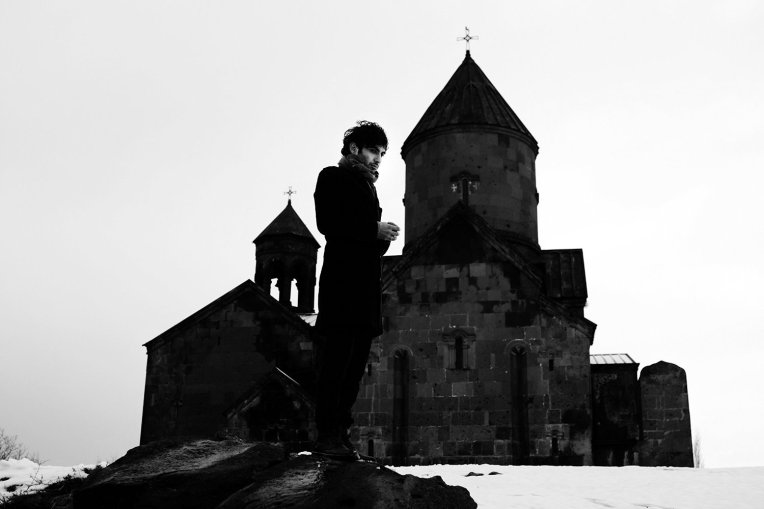
Hamasyan 1
(Photo credit: Vahan Stepanyan)

The album’s title (Light from Light) is primarily descriptive, revealing the process of pulling out an interpretive glow from contemporary compositions, and from the older ones embers of bygone devotions. It also signals themes of variation in a program built around multiple incarnations of the core melodies. The preludinal “Ov Zarmanali” (Oh this Amazing and Great Mystery) by 12th-century catholicos and composer Grigor G. Pahlavuni, for example, illuminates the listener’s ears first through a solo piano treatment, like snow falling from the branches of a godly tree, and later in the album in a veritable river of voices. The Yerevan State Chamber Choir’s balance of raw technique and rhythmic precision indicates a vulnerability diminished by numbers. Hamasyan’s pianism takes on a regular role here, sounding its arpeggios with veracity. The modal changes speak to something deeper than beauty, to the heart within it darkened by neglect. Midway through the singers fade and leave the piano to move jazzily through their afterimages, only to return like objects of worship polished smooth over centuries of devotion. “Sirt im Sasani” (My Heart is Trembling!), a canticle by 13th-century canonical writer Mkhitar Ayrivanetsi (c. 1230-1297) also reveals its mercies through two iterations, the second of which is a piano variation of Trinitarian dimension, while the first professes faith through the distant mechanisms of exile. Bass soloist Seiran Avagyan renders a flower of textual identity shedding petals in favor of bodiless light.
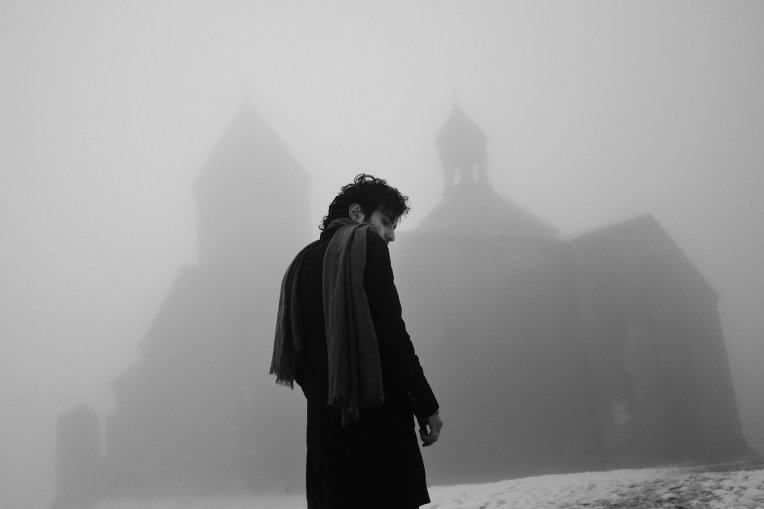
Hamasyan 2
(Photo credit: Vahan Stepanyan)

No such project would be complete without Komitas (1869-1935), because of whose efforts much of Armenia’s sacred music has been preserved. His “Hayrapetakan Maghterg” (Patriarchal Ode), a hymnal request to be heard and absolved, takes three forms. In two Hamasyan-only versions, the pianist attends to the words between notes. He is keenly aware of these spaces and gathers strength through their collective presence. Like the pages of a thumb-worn Bible, its gilding has faded through absorption, finding in its choral life a treasure of grace and, in soprano soloist Jenni Nazaryan, a dove clutching sprigs of gratitude. From Komitas’s Armenian Holy Mass we encounter two sections, “Surb Astvats” (Holy God) and “Orhnyal e Astvats” (Blessed is God), each based on melodies from the seventh century. Where the former is driven by forward-thinking improvisation, the latter looks backward by sampling tenor Armenak Shahmuradyan. This 1912 archival recording, made in Paris in the presence of Komitas, defines the palette from which the choir draws its colors over a century later.

Medieval theologian and hymnologist Mesrop Mashtots (c. 362-440) is represented in two chants and a canticle for Fasting Days. The first of these, “Ankanim araji Qo” (I Kneel Before You), is where the choir makes its album entrance—or should I say “in-trance,” for such is its state of being. Therein, singers descend to the bottoms of their linguistic wells, making dervish circles until the shadows are cleansed. Each is a powerful statement of redemption, of the will to drown in transgression so that one might be reborn into sobriety.

For the singly rendered, Hamasyan offers two cantos of the Resurrection, both chanted during Divine Liturgy. “Nor Tsaghik” (New Flower) by Nerses Shnorhali (c. 1102-1173) strikes difference through its use of prepared piano, at which Hamasyan uncovers hidden voices behind the voices, while “Havoun Havoun” (The Bird, the Bird was Awake) by Grigor Narekatsi (c. 951-1003) pairs soprano and piano in the name of faith. Nazaryan’s lone singing barely grazes the belly of the nearest cloud until the nourishment of Heaven comes raining forth, leaving us to drink in what we can.

Those who would write off this recording on the sole basis of its description—Do we really, they might say, need another jazz musician improvising over a vocal ensemble?—may be pleasantly surprised at the level of integration achieved on Luys i Luso. Like Misha Alperin, Hamasyan recognizes the dedication of knowledge required to mesh with equally disciplined singers. Whether broken or healed, each of his selections embodies the fragmentary nature of things as a path to wholeness. The sheer love pouring from that wholeness is proof of concept.

An unexpected masterpiece, and one of ECM’s most astonishing in years.

(To hear samples of Luys i Luso, please click here. Further information about the project is available here.)

Giya Kancheli: Chiaroscuro (ECM New Series 2442)

2442 X

Giya Kancheli
Chiaroscuro

Gidon Kremer violin
Patricia Kopatchinskaja violin
Kremerata Baltica
Recorded December 2014 at Lithuanian National Radio and Television, Vilnius
Engineers: Vilius Keras and Aleksandra Suchova
Mixing and mastering at Emil Berliner Studios, Berlin by Rainer Maillard, Manfred Eicher, and Vilius Keras
Produced by Manfred Eicher
U.S. release date: November 6, 2015

“Despite the world’s obvious achievement, our planet is still torn by bloody contradictions. And no progress in artistic activity can withstand the destructive force that easily cancels the fragile process of construction. (…) I write for myself, without having any illusions that ‘beauty will save the world.’”
–Giya Kancheli

The words of a composer-in-exile who lives so deeply inside time that he creates outside of it. Kancheli speaks them not in the interest of putting forth a mission statement, but to assess the measure of his art against the metric of history, the last century of which has birthed some of its brightest galaxies and darkest nebulae. In the context of his personal astronomy, Kancheli seeks out vestiges of indifference in a world built on denial of the same. On this disc you will find no healing but the honesty of a mixed spirit. Surely, the music not only abides by such sentiments but also thrives on their shadows.

The 2010 title composition, first in a program of two, is scored for violin and chamber orchestra. Despite its perennial format, it reads neither like a concerto nor a tone poem, but rather a procession led by one who follows his own invisible nature. The feeling of inseparability is strong as these figures—nodes in a pathway of nerves—bond and separate. The bass drum rumble that opens their 23 prosaic minutes of communication signals the subterranean heart of it all, which by virtue of the shimmering strings that follow sews its raiment anew. As in the music of Valentin Silvestrov, the piano here adopts a commentary role. Its very involvement reveals an internal expanse rivaled in scope among his previous works perhaps only by Trauerfarbenes Land.

Violinist Gidon Kremer and his Kremerata Baltica handle every note with the admiration of a curator. Kancheli opines humbly about the musicians’ contributions and recognizes that the simplicity of his thematic moon shines by the light of many suns. In this recording, he dubs Kremer the “true author” of Chiaroscuro and he himself its “co-author.” The level of integration and respect achieved from both is something to behold with awe. Likewise, the distance and birdlike liquidity of Kremer’s high notes in the final phase.

Kancheli and Friends

At a slightly longer duration of 25 minutes, Twilight (2004) is scored for two violins and chamber orchestra. Kremer is joined by protégé Patricia Kopatchinskaja, last heard on ECM playing the music of Galina Ustvolskaya. Although it is Kancheli’s first piece for this instrumentation, and written at Kremer’s behest, it will feel familiar to the Kancheli initiate. Inspired by a row of poplar trees outside his Antwerp studio, whose significance became clear to him after a brush with death, it treats life as a gift twice given. The addition of a second leading voice emphasizes this metaphor and changes the landscape considerably, collapsing the former procession into a molecule of new rotations. Merest hints of Kancheli’s past thematic staples whisper through the overgrowth, speaking through the photosynthesis of the present. Interrelationships of soloists and orchestra are gnarled and rooted, each pouring out from the last in the manner of a divided cell. Melodies and atmospheric changes occur with such aching force that it is all one can do to keep the skeleton from trembling.

Twilight abounds in prismatic effects. Like an enhanced chamber music, it magnifies the immediacy of smaller forces with implications of unwritten futures. A direct emotional line takes shape from motif to motif until a naked mystery prevails. Kancheli is therefore correct in his self-assessment: This is not an album in which to seek sanctuary. That being said, one may discern a ray or two in the bleakness of its canvas, for to the interpreters’ authorship must be added the listener’s own.

As is always the case with the Kancheli experience, moments of apparent eruption are in fact the opposite. Nowhere truer than in this program, where the occasional outburst is, if anything, an “inburst,” pushing the focal point ever farther toward forgetting. Cavernous engineering thus allows the orchestra’s solitude to come spilling out in consumption of tension. We do well to see these dynamic affordances, like album’s title, as variations on a grander theme—in this case of mortality, and the parentheses that are its beginning and end.

Kancheli’s most important recording since Exil.

(To hear samples of Chiaroscuro, please click here.)

Live Report: András Schiff at Carnegie Hall

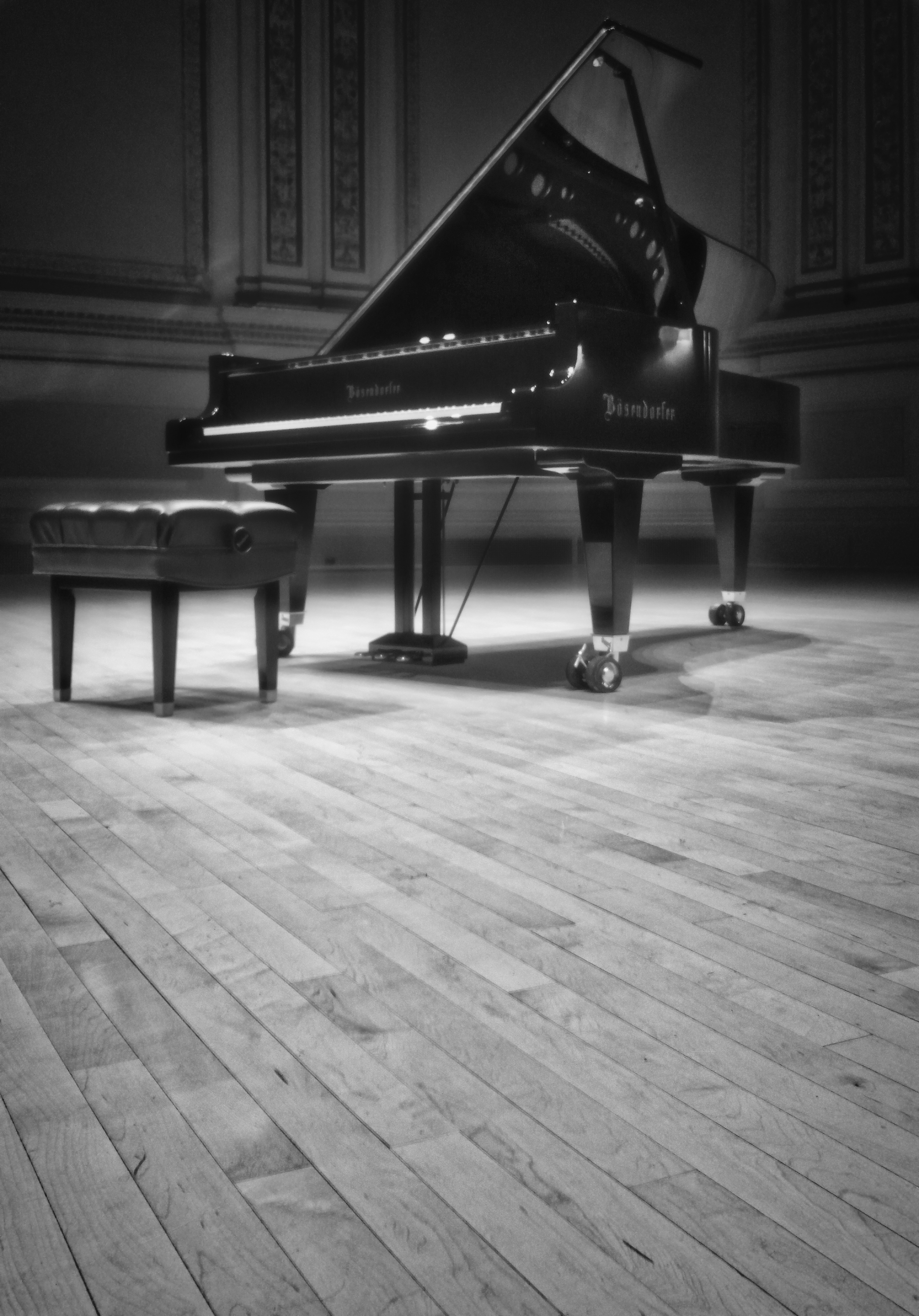
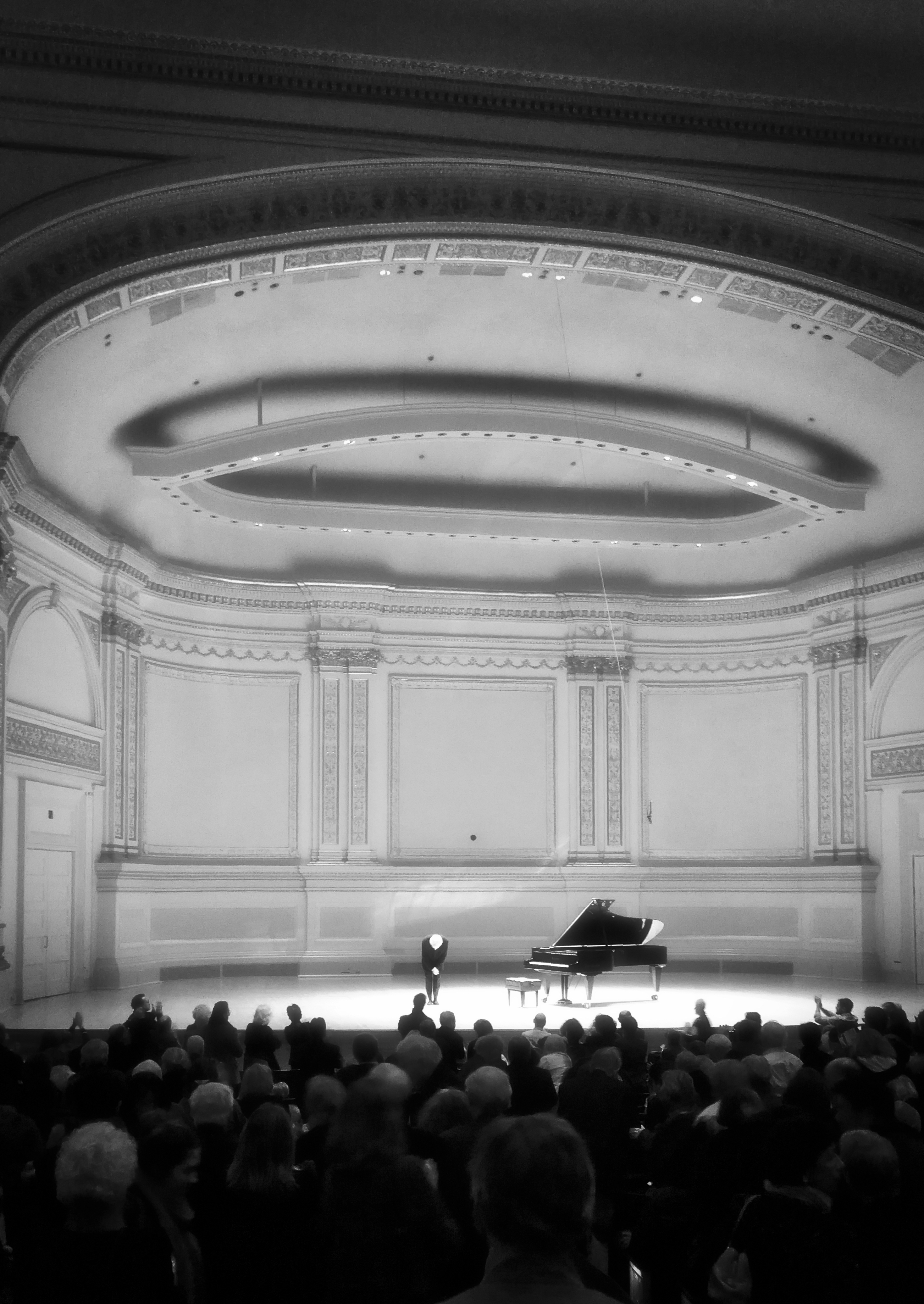
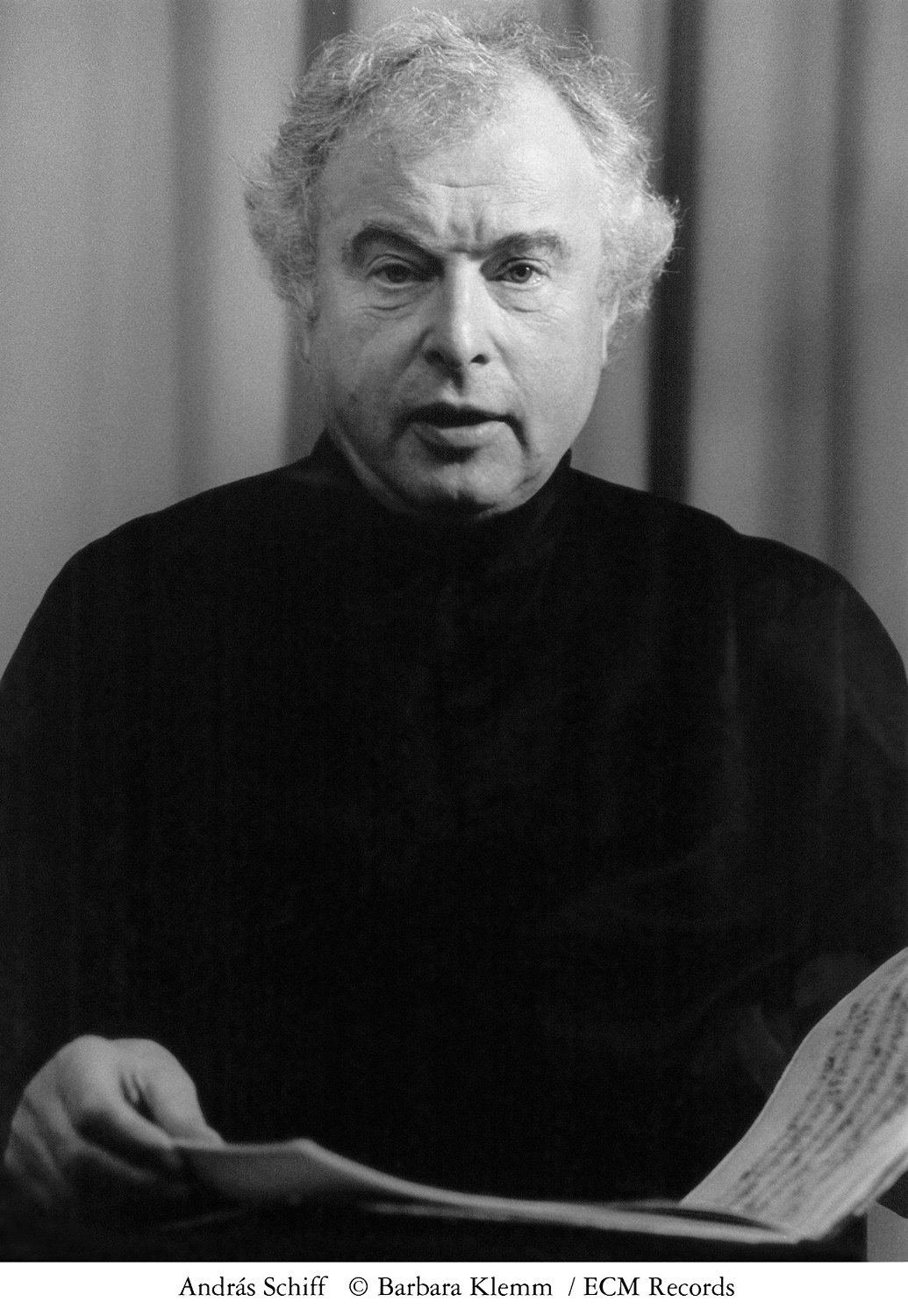
Pianist András Schiff is a genius. By that I don’t mean to describe an artist of exceptional talent, which nevertheless Schiff proved himself to be with his appearance at Carnegie Hall on 30 October 2015. I intend the original Latin meaning of “generative power” or “inborn nature,” by which his playing was duly possessed. This embodied approach to performance has become clearest since his tenure with ECM started in 1997. Schiff’s latest for the label is an all-Schubert recital spanning two discs and culminating, as did the Carnegie performance, in the Piano Sonata in B-flat Major of 1828. Whereas the album documents his reckoning with a Viennese fortepiano built that same decade, an instrument of concave power that shores up the Schubertian temple against any resistance of preconceptions, for this appearance only the convexity of a Bösendorfer would do. For him these qualities have never been opposite but complementary, as was clear when he sounded Schubert’s ominous trill. But let us, like Schiff, save the best for last.

Schiff piano

In addition to its sublime musicianship, Friday’s concert sported a masterful program, sequencing the final piano sonatas of Haydn, Beethoven, Mozart and dear, ill-fated Schubert, in that order. Schiff finessed his way through Haydn’s picture-perfect Sonata in E-flat Major (1794) like a skilled orator: No gesture or utterance was wasted. His Adagio was all the more barren for being surrounded by two leafier branches, neither of which shed a single trident in the gusts of Beethoven’s Sonata No. 32 in C Minor (1821/22). The latter came only after Schiff had hunched over the keys, as if in prayer, to gather himself. Equal parts brush and chisel, its curious, two-movement structure revealed the independence of Schiff’s fingers, and the composer’s in turn for treating repeats as opportunities for self-discovery and, in the dolorous latter half, holistic expression. The coda nevertheless resounded with affirmation of life.

Had it not been sandwiched between two heavyweights, Mozart’s Sonata in D Major (1789) might have seemed like poor casting. But its placement after intermission was refreshing. Although a subpar sonata, one that inlaid its frame at the expense of a clear scene within it, its technical flourishes emitted from Schiff’s fingers with seaward force. Thus cleansed by lack of challenge, we could navigate Schubert’s winding paths, tenderized to receive their shadows. Schiff opened the sonata like a thumb-worn book and read it aloud to the audience with burrowing grandeur. Despite its length, the first movement was eclipsed by Schiff’s restrained handling of it, which assured that the impact of the final Allegro rung true. Between them were a passionate Andante, in which he barely touched the keys as his left hand arced back and forth over the right, and a sunnier Scherzo. Throughout, Schiff was always moving ahead with the future in mind and all the necessary construction materials at his fingertips.

Just as the Goldberg Variations belong to Glenn Gould, so too does Schubert to Schiff. All the more appropriate that he should end the concert with the second of two encores, playing the Aria from Bach’s masterwork. In his handling it became an open lattice, if not also the vine creeping up it, dreaming of its own birth from seed and soil. Before that we were treated to Schumann’s rarely performed Geistervariationen (Ghost Variations) in E-flat Major, featured on Schiff’s 2011 ECM recording of the same name. Although written on the brink of madness, it was as lucid as all else, and showed Schiff as, more than anything, one of the great listeners to ever grace the Carnegie stage. That he played it all from memory would have seemed amazing had it not felt so inevitable.

Schiff bow

(See the article as it originally appeared in The Cornell Daily Sun.)

John Potter: Amores Pasados (ECM New Series 2441)

2441 X

John Potter
Amores Pasados

John Potter voice
Anna Maria Firman voice, Hardanger fiddle
Ariel Abramovich lute
Jacob Heringman lute
Recorded November 2014 at Rainbow Studio, Oslo
Engineer: Jan Erik Kongshaug
Produced by Manfred Eicher
U.S. release date: July 17, 2015

In his liner note to Amores Pasados, former Hilliard Ensemble tenor John Potter puts forth the notion that perhaps the wall between popular song and so-called art song, which even just a century ago were one and the same, is an arbitrary one. Such is the contradiction behind his latest project, as inevitable as it is unusual. In a musical climate where singers shackled by marketing to particular genres branch out into others at their peril—a climate in which “world music” still rings like a derogatory term for non-professional, non-western curiosities—it may be difficult to conceive of a time when melodies we take for granted as part of the classical soundscape were once “popular,” belonging as much to the theatrical stage as to the troubadour’s lips. Contrary to the pop songs of the 20th century, by which the roles of lyricist and composer have all too often ridden divergent streams of commodity, songs once fell fully within the purview of laypeople at a time when notions of artistic integrity had yet to hammer a wedge between “professionals” and “amateurs.” This dynamic would now seem to have undergone a dramatic reversal via singing competition shows like The Voice, but even there the purpose is to produce the next generation of underdogs, whose underlying ambition is to buy into the professionalism they seek, often at the expense of at least one vital organ of their creative bodies. They must be the complete package: looking and acting the part into which they will be groomed if they are to succeed beyond the ephemeral glory that makes them visible. Amores Pasados, then, represents a rare—and all the more so for being successful—attempt to blur the lines between the old and the new, performing modern folksongs with an antique spirit and older songs afresh, along with more recent balladry by pop/rock legends John Paul Jones (bassist of Led Zeppelin), Tony Banks (keyboardist of Genesis), and Sting.

Amores portrait

The arrangements are Potter’s own, and find a choice companion in Swedish soprano Anna Maria Friman. Friman’s journey as part of the vocal ensemble Trio Mediaeval has since 2001 graced ECM with a series of eclectic recordings, all under the mentorship of Potter himself, and so their rapport is duly felt here. Joining them are lutenists Ariel Abramovich and Jacob Heringman, making for a multi-national roster.

The album’s first three songs comprise its titular suite, featuring Spanish Golden Age poetry set to music by Jones. It begins with the full quartet in “Al son de los arroyuelos.” As Potter and Friman harmonize over interlocking lutes, it’s clear that a new age of song has begun. The haunting “No dormiá,” for its part, has what Potter calls an “Arvo Pärt-like sparseness” which “defies categorisation of any sort,” and indeed reminiscent of the Estonian composer is its organic evolution from single-note chants to polyphonic blossoming. These give depth to a droning horizon, brushing in trees, mountains, and setting sun. Should it fall under any generic label, let it be: haunting. “So ell encina” finishes the triptych with a relay of understated power between the two singers.

Much of the album is, however, clearly in the tradition of that most famous purveyor of Elizabethan love songs, John Dowland (1563-1626). And while his music is nowhere to be found here (leave that to Potter’s earlier Dowland Project, also well documented on ECM), Dowland looms large, especially in this album’s closer, “Bury me deep in the greenwood,” by Sting. Sting’s 25-year obsession with Dowland led him to take up the lute and to release the Dowland-centered Songs from the Labyrinth on Deutsche Grammophon in 2006. Although “Bury me deep” is commercial in origin, having originally been written for director Ridley Scott’s 2010 reboot Robin Hood, it best captures the spirit of its influences through an exquisite sensitivity of both melody and lyric, being the only of the modern songs herein in which both come from the same pen.

For context we are presented with three specimens by Dowland contemporary Thomas Campion (1567-1620). “Follow thy fair sun” and “The cypress curtain of the night” are both heard in their original versions, and again with new music by Banks. The former glide off the tongue of Friman (what a joy to hear her as a solo artist), whose shaping of imagery is as evocative as the verses themselves. “Oft have I sighed” completes the Campion tour with quintessential languishing. As for Banks’s “Follow” and “Cypress,” they express the balance of self-loathing and -resolution of the original lyrics through soulful composing. The second song, with its lilting changes and Potter’s melodious diction, is especially memorable for its arpeggios (recalling the Prelude of Bach’s first cello suite) and unexpected ending.

Also unexpected are the chord changes of two early 20th-century songs: “Sleep,” with words by John Fletcher (1579-1625) and music by Peter Warlock (1884-1930), and “Oh fair enough are sky and plain” with words by A. E. Housman (1859-1936) and music by E. J. Moeran (1894-1950). Both work seemingly within the Dowland frame, but color outside the lines like the roots of a tree that grows wherever it will. Moeran’s is the most surreal of the album, sprouting leaves in winter and dropping them in spring.

Two versions of “In nomine,” the lone surviving composition of one Picforth, beyond whose 16th-century flourishing hardly anything is known, regale with their circularity and Celtic knot structure. Each is something of a palate cleanser for the ear, a baptism by hearth after the rain along the way.

To the seasoned ear, the distinction between older and newer songs will be rather obvious. This does nothing to undermine the integrity of the project. If anything, it strengthens that integrity, because the goal here is not to disguise itself as the past by way of compositional pantomime, but to own up to the trends of the present while paying respects to what has informed it. Whichever direction it may ultimately choose in the listener’s mind, one can hardly walk away from Amores Pasados without feeling its communal heartbeat. And perhaps this is the album’s truest goal—namely, to invite all who wish to sing, regardless of elitist approval, to enjoy the gift of creation (and creating) together, yielding a unity of voices across all lines drawn.

(To hear samples of Amores Parados, click here.)

András Schiff: Franz Schubert (ECM New Series 2425/26)

Franz Schubert

András Schiff
Franz Schubert

András Schiff piano
Recorded July 2014, Kammermusiksaal H. J. Abs, Beethoven-Haus, Bonn
Engineer: Stephan Schellmann
Production coordination: Guido Gorna
Tuning and technical assistance: Georg F. Senn
Executive producer: Manfred Eicher
U.S. release date: 2 June 2015

While András Schiff has reinforced the worthiness of Bach and Beethoven at the piano over a sprawl of recordings for ECM’s New Series, he has also carved out a hallowed space for the music of Franz Schubert, beginning in 2000 with a recording of the C-major Fantasies and now deepened with this composer-titled collection. In his liner text, “Confessions of a Convert,” Schiff discusses the transition to “authenticity” via historically minded performance, a movement that popularized use of period instruments and, ironically enough, the newness they brought to canonical repertoires. “There is an astonishing wealth of old keyboard instruments hidden in museums, foundations and private collections, many of them in prime condition,” he writes, speaking after his transformation from skepticism to advocacy. “Getting to know them is essential for the student, the scholar, the musician: it is a condition sine qua non. Playing on fortepianos—and on clavichords—should be compulsory for all pianists. Their diversity is amazing.” Even more amazing is the diversity of Schiff’s willingness and ability to adapt to these changing colors, to treat each as having equal value in the keyboard spectrum. For this recording he plays a fortepiano, built by Franz Brodmann in Vienna around 1820, which Schiff has owned since 2010. Attentive listeners will recognize it as the very one employed for the second version of the pianist’s Diabelli traversal, also for ECM. Once again, engineer Stephan Schellmann underscores the intimate life of this instrument.

Schiff

The Sonata Nos. 18 in G major and 21 in B-flat major serve as centerpieces. An overall translucence pervades the first, and the opening movement, marked “Molto moderato e cantabile,” gains purchase by the fortepiano’s immediacy, which ensures that even the greatest leaps never forget where they came from. Schubert’s propensity for quietude is on full display, contrasting fragile highs with muddier lows. And while Schiff’s Brodmann might at first seem better suited to the Andante, it proves itself to be just as capable pulling off the half-tucked rolls of the Minuet. And the concluding Allegretto? Let’s just say that, if the sound, in combination with Schiff’s artful handling of it, hasn’t won you over by this point, then the album just might not be for you.

The Sonata in B-flat major, widely considered to be the pinnacle of Schubert’s writing for piano, feels not so much new as renewed, given access to muscles it might not otherwise exercise on a modern grand. If the G-major Sonata felt at best quasi-Beethovenian, then this one begs a more genuine comparison. From the low trills that interrupt with periodic hints of foreboding in the first movement to the flexion of the final Allegro, there’s more than enough for the comparatist to savor. Nowhere else, with the possible exception of the Four Impromptus (op. 142), is the fortepiano’s potential so evident. The seesawing between minor and major in the Andante and the spirited undercurrents of the Scherzo, and all the subtleties required to make those dynamics felt, come naturally to the instrument, which I daresay adds a boldness all its own by virtue of its focus.

Schiff’s reckoning of the op. 142 proves there’s still much to discover in these robust pieces. Each impromptu has its own charm, but the second, an Allegretto in A-flat major, proves the need for a tactful performer. Schiff balances its understated seeking with immediacy, all the while through his pacing lifting the music beyond an exercise in mere pathos. Some of the most dramatic moments of the album can be found here, barely eking out over the captivations of the Andante that follows it to round out the center.

Even in the shade of these gargantuan sonatas, the popular Moments musicaux hold their ground. In Schiff’s handling, they come across with spontaneity and breadth. Each has its own captivation, but the Andantino in A-flat major is a most remarkable vehicle for the fortepiano’s middle register. By the final movement, these beauties are swimming in fresh disclosures.

Not to be outdone, however, are two chosen miniatures. The Ungarische Melodie (Hungarian Melody) in b minor introduces the program with evocative subtlety, while the Allegretto in c minor, written for the departure of a friend, populates more spacious melodic tenements. Both contain a wealth of emotional pigments. Between the azure flash of a dramatic pause and the rusty ochre of hindsight, not a single piece piece of the puzzle feels out of place.

If this is your first time encountering Schubert’s piano works, it may just become a reference recording. If you come to it with familiarity, especially by way of Schiff’s nine-course feast on Decca, then you will want to keep it for comparison and discovery with all the rest. And to be sure, even putting aside questions of instrument, this recording is by nature historically informed, because it is itself history in the making.

(To hear samples of Franz Schubert, please click here.)

Wolfgang Rihm: ET LUX (ECM New Series 2404)

Et Lux

Wolfgang Rihm
ET LUX

Huelgas Ensemble
Minguet Quartett
Paul Van Nevel director
Recorded February 2014, Augustinus Muziekcentrum, Antwerpen
Engineer: Markus Heiland
Mixed January 2015 in Lugano by Markus Heiland and Manfred Eicher
Produced by Manfred Eicher
U.S. release date: 2 June 2015

ET LUX is an hour-long composition for vocal ensemble and string quartet (2009) by Wolfgang Rihm that situates fragments of the Latin Requiem Mass in cells of sustained chords and spectral wanderlust. Although originally written with the Hilliard Ensemble and Arditti Quartet in mind, the performance here is in more than capable hands. The Minguet Quartett, approved interpreters of the composer’s string quartets, and the Huelgas Ensemble (which doubles the scored voices to eight) illuminate every fiber of this tapestry like sunlight through a castle window.

For a composer so prolific (with over 400 works to his name), it’s only natural that again Rihm should cast once glance backward for every two forward, ending up suspended somewhere between the poles of question and answer, and proving them to be the event horizons of an arbitrary dichotomy. It is music that neither invites nor rejects, but places the listener (and composer) in a space where choices are the only true materiality. Hence the cellular nature of the piece, in which selective phrases serve as requiems unto themselves.

As Paul Griffiths observes in the album’s liner text, “What we have here is not music remembered but music remembering.” Attribution of such sentience to notes on a page is no metaphorical trick. It speaks, on the surface, to the music’s body of antiquity and clothing of modernity, and beyond that to their entanglement among the bramble of performance and the flourishing of listening. In the manner of Alexander Knaifel, the instruments sing as much as the human voices. This, of course, requires a human touch. Still, the inner life of ET LUX is not provided but enhanced by that touch.

The keyword, in both the writing and the playing, is “tactile,” as if both forces were bound by flesh and spirit alike. The quartet breathes, close to silence yet pregnant with words all the same, bringing its own voices to bear upon the passage of time. Each instrument must treat the space as it is treated: as an element of malformed crystal, whose light exists only for as long as it is uttered to be. The effect is such that, even when punctuating the darkness with spikes of pizzicato flash, harmonies merely disperse and regroup, taking on semblance of something newborn.

An astonishing amount of variety pervades a work so slow-moving yet which bypasses pathos toward the development of deep, if sometimes tense, relationships. Moments approaching beauty are inevitably peeled away from expectation, leaving us to reckon with a more true-to-life distortion of textual fantasy. Instead of treating the Mass as a poem or liturgical given, it retraces shards of it until each is self-reckoning. The mystery of faith becomes a reflection of itself.

As the piece goes on, the dynamic between voices and strings becomes mutually divergent, at once developing inward and outward. A prayerful mode gives way to fire, and further to snowy textures. Pulses emerge, morph, and overlap, but disclose little of their intentions. The clearest answer, then, is in the dark, sublime ending; a movement into new beginning, but in which direction is left open to interpretation.

Keller Quartett: Cantante e tranquillo (ECM New Series 2324)

Cantante e tranquillo

Keller Quartett
Cantante e tranquillo

Keller Quartett
András Keller violin
János Pilz/Zsófia Környei violin
Zoltán Gál viola
Ottó Kertész/Judit Szabó violoncello
Alexei Lubimov piano
Recorded 1995-2012
Casino Zögernitz, Vienna
Stadttheater Eichstätt
Radiostudio DRS, Zürich
Engineer: Peter Laenger
Mastered by Christoph Stickel at MSM Studios, München
Produced by Manfred Eicher
U.S. release date: 2 June 2015

Cantante e tranquillo grew out of a conversation between producer Manfred Eicher and violinist András Keller, who envisioned an album of slower sections divorced from longer works. In true ECM fashion, this idea developed into a project all its own, framing previous recordings of Knaifel, Schnittke, Ligeti, and Bach by the renowned Keller Quartett with newly recorded selections from Beethoven’s opuses 130 and 135, and between them shorter pieces by Kurtág. The result is not a compilation but a sculpted entity with shape and sentience.

The concept alone is haunting enough; more so in execution, as ghostly appearances begin to sing once the third movement of Ludwig van Beethoven’s F-major quartet (from which the album gets its name) whispers into life. This rustling of the heart, slowed to feverish pathos and drawn as a brush across absorbent paper, embodies a yearning that, over the course of its awakening, resolves into a style of slumber in which the depth of life is surpassed only by that of death. Unlike the Adagio from the quartet in B-flat major, in inhales rather than exhales, holding all it can before expiring.

György Kurtág is known for his ability to pack surprising amounts of information into minute forms, but the Kellers give us examples of pieces that, despite their characteristic brevity, are spacious and expansive. At times parabolic (cf. the Officium breve in memoriam Andreæ Szervánszky), at others misty (Flowers We Are – for Miyako), and at still others pulsing like a geographic lay line (Aus der Ferne V), his music has no need to seek anything because it is starting point and destination all in one. The final movement of György Ligeti’s String Quartet No. 2, by contrast, sprouts in leaf-like structures that tremble to the rhythms of nervous winds. Unlike Narcissus, its reflection is being constantly disturbed, so that the illusion of a second self never clarifies. By yet further contrast, the stillness implied by “An Autumn Evening” (from Alexander Knaifel’s In Air Clear and Unseen), along with the Moderato pastorale of Alfred Schnittke’s Piano Quintet, breathes with lucidity. The latter’s pianism filters an unrequited dance which, like something out of a Tolstoy novel, twists until it bleeds music.

Anchoring all of this are two selections from one of the Keller Quartett’s finest recordings: Die Kunst der Fuge. Johann Sebastian Bach’s final masterwork is alluded to twice in the program, cycling between gradients of lost and found before ultimately falling in love with exile. A variation of Beethoven’s “Cantante” closes the circle with urgent, pregnant emotion, outlining a keyhole that only shadow can unlock to access the light beyond it.

Listening to this album is like watching the moon rise: if you focus on it long enough, you begin to detect its movement through the sky as if it had a mind of its own. Haunting, yes, but then again this music has no ghost to give up. It has one only to acquire.

(To hear samples of Cantante e tranquillo, click here.)

Hans Abrahamsen: Schnee

Schnee

All Heaven and Earth
Flowered white obliterate…
Snow…unceasing snow
–Kajiwara Hashin (1864-?)

Written between 2006 and 2008 as five two-part canons and three intermezzi, Schnee grew out of Danish composer Hans Abrahamsen’s engagement with Bach. Commissioned by the ensemble recherche, who performs it for this Winter & Winter Music Edition (and what more appropriate label?), this vast, feathery piece withstands its composer’s own comparison to the structures of an Escher print. Such ambiguity of foreground and background, at once both and neither, makes it an all-encompassing experience. Like the recording itself, it reaches for us even as it occupies a world of its own making.

Despite the sparseness of Abrahamsen’s scoring, to say little of his nominal allegiance to the so-called “New Simplicity” movement, it would be deceptive to call him a minimalist. If anything, he is a maximalist, maximizing as he does the depth of effects possible through bare means. Unlike the music of, say, Alexander Knaifel, you won’t find yourself drifting through, but rather pervaded by, incarnate atmosphere.

Describing the music itself is as futile as describing the snow it is meant to evoke. First and foremost, it creates a tactile climate, not least of all through the placement of its instrumental forces. Two trios—one of strings, the other of woodwinds—occupy stages right and left, respectively, with a piano behind each and percussion tables at their center. It’s an arrangement that recalls the meticulousness of Karlheinz Stockhausen, only here it is meant to transform space, but become space. In this sense it is not some metaphorical re-creation of wintry landscape, but snow of a fashion all its own, replete with self-generated season.

Despite their placement, the pianos occupy a harmonic center, while the strings and cor anglais have been detuned to nearly imperceptible intervals of alterity. The caution with which bowed instruments are for the most part played yields indeterminate overtones with lives all their own, thus providing organic contrast to the regularity of their patterns on paper. The pianos move more waywardly, grabbing hold of congruities at the ends of phrases with hands of flame.

Abrahamsen’s snow isn’t always white. Sometimes it takes on the colors of sunset and other times a paler hue. Neither are his snowflakes always frail descenders, subject instead to a variety of physical actions. Whether being scraped off the bottom of a boot or alighting upon a metal roof, together they lay a path into a place where dreams reside. All of this dispersion and coagulation, a persistent binary of unblemished skin and ashen muscle, builds to premonitory levels of dynamism in an environment that you do not touch but which touches you—a cognizant sprawl in which every cell knows its place.

The writing for flute is particularly affecting, becoming more diffusive as its role intensifies. With each successive canon, layers of reflection build to peak levels of mystery, erupting with a blush of sun through the fragmented lungs of the fourth canon. The shortest intermezzo then leads to the shortest pair of canons. Fragile and sparse, each the mirror image of the other, they allow an eternity to step through on finite legs.

Quicksilver: Fantasticus

MFA43883_Digipak_slitpocket.eps

Those among my regular readers who admire the work of Stephen Stubbs, John Holloway, and Rolf Lislevand as documented on ECM’s New Series will want to cast their ears on this assortment of Baroque gems from the independent Acis label. Plying their gifts are violinists Robert Mealy and Julie Andrijeski, trombonist Greg Ingles, dulcianist Dominic Teresi, viola da gambist David Morris, keyboardist Avi Stein (on harpsichord and organ), and Charles Weaver on theorbo and guitar. Known collectively as Quicksilver, they bring a formidable admixture of panache and musicological erudition to everything they touch, engaging the discerning listener with the alacrity of their programming.

Although billed as “Extravagant and Virtuosic Music of the German Seventeenth Century,” the present program approaches these monolithic adjectives in ways more nuanced than one might expect. The album’s title refers to the “Stylus Fantasticus,” which in the experimental tradition of the Italians (think Farina, Fontana, Castello, etc.) brought a cellular, wayward brand of composing into vogue. In this instance, however, “extravagance” connotes not grandiosity but inward qualities at play. The music offered here is focused and stays true to where it wants to go. As for virtuosity, it is less a matter of technical flourish than of balancing and controlling emotion, of keeping even the most challenging motif always within frame.

Although pieces by better known composers are sure highlights—the g-minor Prelude and G-major Sonata by Dieterich Buxtehude (1637-1707) for their urgent, sparkling counterpoint and the Polnische Scakpfeiffen of Johann Schmeltzer (c.1623-1680) for its vibrant upsweep—the generous helping of sonatas by Matthias Weckmann (1616-1674) and Antonio Bertali (1605-1669) is by no means anything to balk at. The former’s acrobatically inflected Sonata no.9 à 4 delineates complementary qualities in each instrument, while each of the latter’s three chosen selections, and especially the Sonata à 3 in d minor, blends courtly and bucolic sentiments with nary a seam within earshot. Bertali’s Sonata no.10 is another lively delight, which, in being hollow-boned, is best suited for its edgier chromatism.

Other pieces showcase the musicians as much as their composers of interest. A sonata by Johann Kaspar Kerll (1627-1693) emphasizes the conversational relationship between the violins, another by Andreas Oswald (1634-1665) the dulcian’s melodic potential and keen interactions with trombone, and an anonymous Ciaconna the shadings of Quicksilver’s basso continuo. This leaves only the Canzona in C major, no.21 of Johannes Vierdanck (1605-1646), which gathers wood and strings in concert with Biber-like exuberance, shuffling atmospheres like a deck of cards dealt into a royal flush with every hand.