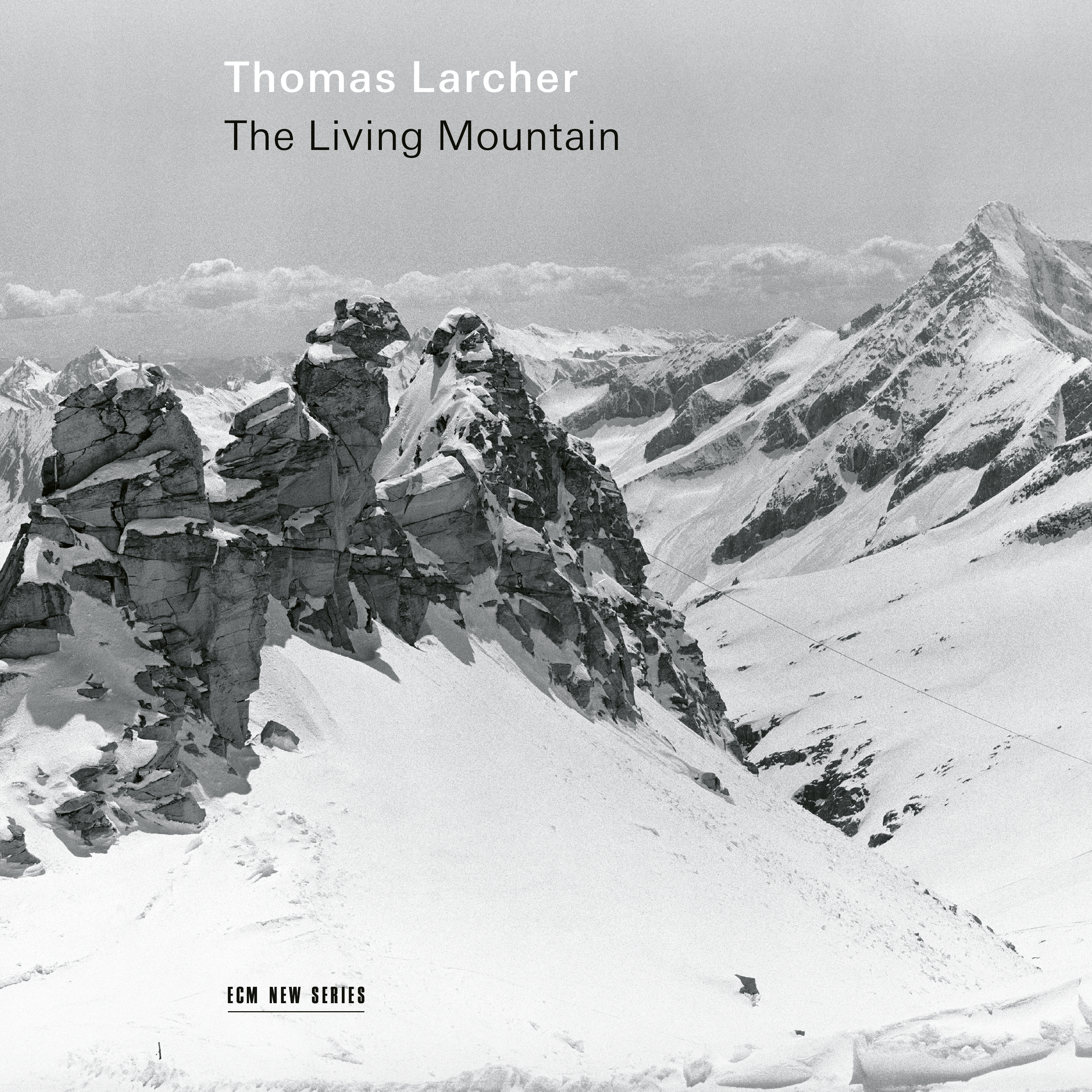
Thomas Larcher: The living Mountain (ECM New Series 2723)

Thomas Larcher
The Living Mountain

Sarah Aristidou soprano
Alisa Weilerstein violoncello
Aaron Pilsan piano
Luka Juhart accordion
André Schuen baritone
Daniel Heide piano
Münchener Kammerorchester
Clemens Schuldt
 conductor
The Living Mountain Ouroboros
recorded June 2021
Bavaria Musikstudios, München
Unerzählt
recorded May 2022
Gemeindezentrum Weerberg
Engineer: Christoph Franke
Cover photo: Awoiska van der Molen
Produced by Manfred Eicher
Release date: October 6, 2023

“At first, mad to recover the tang of height, I made always for
the summits, and would not take time to explore the recesses.”
–Nan Shepherd

The Living Mountain is the fourth ECM New Series album dedicated to the work of Thomas Larcher, whose previous programs have proven the Austrian composer to be, much like his mentor Heinz Holliger, a human magnifying glass. His attention to detail grows only more precise as his instrumental forces increase. Meanwhile, the chamber works unfurl in grand (but never grandiose) imaginings of times and places that we would never experience except through the filter of his awareness of the past. The eponymous song cycle for soprano and ensemble is a particularly vibrant example. Composed between 2019 and 2020, it sets selections from the memoir by Scottish poet Nan Shepherd, whose own penchant for highlighting the intimate in the vast suits Larcher’s sensibilities hand in glove.

From an introductory heartbeat, the landscape pulses with the music of blood flow, visceral and true. Larcher articulates this anatomy with surgical precision on his way to Part II, where we feel ourselves on the verge of falling over. That sense of vertigo—at once glorious and terrifying—sweeps through every crevice. Singer Sarah Aristidou expresses Shepherd’s words as if they were her own. Whether in brief expulsions of accordion breath or the hammering of piano strings, the diurnal reigns supreme. The final movement’s evocation of snow, as sparkling and wind-roused as it is blinding, runs down the text’s spinal cord.

At the other end of this proverbial tunnel is another song cycle, Unerzählt (2019-20), this one for baritone and piano based on the poetry of W.G. Sebald. These vignettes turn stills into moving pictures. Moods range from the programmatic (e.g., “Die roten Flecken,” which evokes the red spots on Jupiter in dramatic fashion, and the prepared piano rattlings of “Wenn die Blitze herabfuhren”) and the morose (“Am 8.Mai 1927”) to the contemplative (“Gleich einem Hund”) and painterly (“Blaues Gras”). One highlight is “Es heißt daß Napoleon,” from which we get this wry piece of historical revisionism:

They say
that Napoleon
was colorblind
& blood for him
was as green as
grass

The delicacy of Larcher’s setting brilliantly toes the line between mockery and empathy. Another standout is the final song, “So wird, wenn der Sehnerv zeerreißt”:

And so, when the optic nerve
is torn, the silent airspace
turns as white as the snow
on the Alps.

Thus reconnected to the snowy expanse in which we began, we can take strange comfort in its inhospitable nature—which, in the end, makes us all the more human. Pianist André Schuen and baritone Daniel Heide mesh beautifully, allowing bell-like sonorities to percolate through deeper gravel.

Stretching out the darkness between these is Ouroboros (2015). Cellist Alisa Weilerstein and the Munich Chamber Orchestra navigate three movements, opening with a dance of slow-motion detections. Despite the nominal instrumentation, the piano plays a vital moderating role in this relationship. Neither call nor response, theirs is a symbiosis that implies an eternal path to nothingness. The tempestuous middle movement deals in fear with a squealing, unrelenting grind. The conclusion reveals an ethereal balancing act, Weilerstein reaching the most pristine high notes I’ve heard on a cello in a long time before a frenzied crackle of fire and ash consumes itself. As the flame goes out, it moans one last time, just before comprehension and death become one and the same.

Alexander Knaifel: Chapter Eight (ECM New Series 2637)

Alexander Knaifel
Chapter Eight

Patrick Demenga violoncello
State Choir Latvija
Riga Cathedral Boys Choir
Youth Choir Kam
ēr
Andres Mustonen
 conductor
Concert recording, March 2009
Jesuitenkirche Luzern
Engineer: Charles Suter
Assistant Engineers: Urs Dürr, Ruedi Wild
Executive Producer (SRF): Rolf Grolimund
Cover: Eberhard Ross
Co-production ECM Records/Radio SRF 2 Kulture
Release date: March 14, 2025

Set me as a seal upon thine heart, as a seal upon thine arm: for love is strong as death; jealousy is cruel as the grave: the coals thereof are coals of fire, which hath a most vehement flame.
–Song of Songs 8:6

The music of Alexander Knaifel (1943-2024) is a chain of lakes in the ECM New Series landscape. In this latest release, consisting of the slow-motion embrace that is Chapter Eight (1992/93), we encounter his setting of the eighth chapter of the Song of Songs. Conceived as a “community prayer,” it places a cello (played here by Patrick Demenga) at the center of three choirs arranged crosswise in a cathedral, itself listed among the instrumentation in the score.

Demenga is the welcomer whose song leads the way as the voices emerge from the wood- and stonework of the space itself, where human hands have left behind forms we can hear, see, and touch. Such tactility is at the heart of everything Knaifel composed. By stretching words and images to their breaking point, he showed how fragile our relationship to sound really is. For that reason alone, we should not be surprised that Chapter Eight is not a straightforward rendering of its source text, as verses are reordered, and not every one is accounted for. Some are also repeated (verse 1 appears six times, verse 6 appears five times, etc.), and by the time we get to the last of the piece’s 32 stanzas, we are reduced to fragments thereof. In that reduction, however, lies the key to understanding the truth we are being given: Scripture is nothing without its orality. And so, by favoring these far-reaching suspensions in his choral writing, the composer is redefining transcendence not as overcoming of the physical but as a manifestation of the liminal. The world seems to stop spinning, the clouds are no longer moving, and the sun is held in its dial. Through it all, the cello is a thread pulled through a veil not of our own making.

Although the passionate dialogue of Song of Songs is often read as a metaphor between the Jewish and Gentile churches at a time when Christ’s reconciliation had yet to be born out through the new covenant, Knaifel goes one layer deeper to highlight such tensions in every believing heart. While the cello and choirs become more unified in vision, they turn rapture into capture, whereby the body-solvent spirit is held gently in place by God’s plan. The repeated verses remind us that we must never leave others behind in our spiritual walk and that salvation is never ultimately about the self but is a means of glorifying the one who bestows it. The lover’s jealousy, therefore, is that of a God who hopes that all of us might lay our heads in his bosom. We feel this when Demenga’s bow falls from its perch (high notes like lasers through the mind) and scrapes the bottom of its fleshly allegiances (low notes like rusty chains through the heart). The singers move methodically, each syllable becoming a verse unto itself, the roles of call and response gradually reversing.

Thus, the pace of time becomes distorted, like seeing the world through a window down which drips a quiet rain. The storm is the language of faith, a test of our immaterial resolve against the material. And when we fail, we are ready to be lifted again and remade in the image of what we are meant for. And as these forces meet in the middle, they stand at the intersection of all things, whispering, “The unfinished statement is where life begins.”

This is music you can leave on to exist on its own terms until it becomes a part of the architecture you call home.

Gidon Kremer: Songs of Fate (ECM New Series 2745)

Gidon Kremer
Songs of Fate

Gidon Kremer violin
Vida Miknevičiūtė soprano
Magdalena Ceple violoncello
Andrei Pushkarev vibraphone
Kremerata Baltica
Weinberg/Kuprevičius
Recorded July 2019
Plokštelių studija, Vilnius
Engineers: Vilius Keras and Aleksandra Kerienė
Šerkšnytė/Jančevskis
Concert recording July 2022
Pfarrkirche, Lockenhaus
Engineer: Peter Laenger
Cover photo: Thomas Wunsch
Album produced by Manfred Eicher
Release date: January 19, 2024

The word fate comes from the Proto-Indo-European root meaning “to speak, tell, say.” In its Latinate forms, it took on the nuance of that which was spoken by the divine. Both senses give us doorways into the present disc, in which Gidom Kremer leads his Kremerata Baltica through the works of Mieczysław Weinberg (1919-1996) by way of living composers from the Baltic states. “This program,” Kremer notes, not coincidentally, “is meant to speak to everybody, reminding us of tragic fates along the way and that we each have a ‘voice’ that deserves to be heard and listened to.” In his brilliant liner notes, Wolfgang Sandner speaks of Kremer as an artist of multiple voices, having a “Jewish first name, German surname, Swedish ancestors, Latvian birthplace, three mother tongues, a love of Russian culture, and an imposed Soviet socialization.” And yet, these categories, he observes, dissolve the moment we utter them, for they are creatively inferior to the music that constantly defines (and redefines) the violinist and conductor’s sense of self.

For the past decade, Kremer has been a fervent champion for Weinberg via ECM (see, most recently, his traversal of the solo violin sonatas). Now, he reveals more obscure works by the Polish composer whose fragmentary yet coherent identity mirrors the interpreter’s own. From the dream-laden Nocturne (1948/49), arranged by Andrei Pushkarev for violin and string orchestra, to the dancing Kujawiak (1952) for violin and orchestra, a tapestry of sounds and textures blesses the ears. Between them are the tempered joys of Aria, op. 9 (1942), for string quartet, and three selections from Jewish Songs, op. 13 (1943), for soprano and string orchestra, on Yiddish poems by Yitskhok Leybush Peretz. The latter, originally published as Children’s Songs to avoid Soviet detection during the war, constitute a moving picture of thought, life, and action translated through the weakness of the flesh. Soprano Vida Miknevičiūtė navigates their pathways—by turns folkish and dramatic—as a needle in the dark.

Giedrius Kuprevičius (*1944) yields an equally substantial sequence bookended by two movements from his chamber symphony, The Star of David. The Postlude thereof is a duet between Miknevičiūtė and Kremer, in which David’s mourning for Saul and Jonathan funnels itself into introspection, connecting and gathering the soul. Between them are two refractions of the Kaddish, or Jewish prayer for the dead. In both, the mood implodes even as the heart struggles to contain every last molecule of sadness.

Before all this, we begin with the tremors of This too shall pass (2021) for violin, violoncello, vibraphone and string orchestra by Raminta Šerkšnytė (*1975). In listening (and we mustlisten) to Kremer’s lone voice emerging from an expanse that threatens to swallow us whole, we find cellist Magdalena Ceple joining not as an ally or hero but as a fellow questioner, one who throws kindling of doubt into the fireplace of mortality. Vibraphonist Andrei Pushkarev speaks of snow at first but soon reveals the language to be that of ice, thin and prone to breaking should one dare to overstep. By the time the orchestra shines its light, Kremer’s recitative has already laid bare the foundations of a story dislocated by memory. The world tries desperately to lock it into place, but it refuses—not through violent resistance but through the peace that comes from knowing who one is.

Concluding this fiercely intimate mosaic is Lignum (2017) by Jēkabs Jančevskis (*1992). Scored for string orchestra, svilpaunieki (ocarinas), chimes and wind chimes, it bids us to listen again, no longer to the instruments themselves but to the materials of which they are made. The violin’s dissonant entrance is the friction of leaves in an orchestral forest. Much like Erkki-Sven Tüür’s architectonics, Jančevskis looks to nature as a source of internal dialogue. As chimes grace our periphery just beyond the treeline, he reminds us that every word lost to the wind has a place to return to.

Evgueni Galperine: Theory of Becoming (ECM New Series 2744)

Evgueni Galperine
Theory of Becoming

Evgueni Galperine electronics, sampling
Sergei Nakariakov trumpet
Sébastien Hurtaud violoncello
Maria Vasyukova voice
Recorded 2021/21, Studio EGP, Paris
Engineer: Aymeric Létoquart
Mixed November 2021, Les Studios de la Seine, Paris
by Evgueni Galperine, Manfred Eicher, and Aymeric Létoquart
Cover painting: Lorenzo Recio
Album produced by Manfred Eicher
Release date: October 21, 2022

If a composer is an author, then Evgueni Galperine is one who allows characters, actions, and places to speak themselves into logical corners, then breaks those corners to let the vacuum of space have a say. Based in Paris since 1990, the Russian/Ukrainian composer cites the language of cinema as his creative crucible. His first project in that regard was Andrey Zvyagintsev’s Loveless, a soundtrack he wrote sight unseen. (ECM listeners may remember another Zvyagintsev film, The Return, and its music by Andrey Dergatchev.) In the present program, Galperine tears his mise-en-scène from the pages of life itself. Whether reworking prerecorded material or responding to instruments in the moment, this “augmented reality of acoustic instruments” connects events of importance in his life. Aided by the contributions of Sergei Nakariakov (trumpet), Sébastien Hurtaud (cello), and Maria Vasyukova (voice), he breaks the electro-acoustic mold as he defines it, careful not to step on any shards left by the process to regard the partial reflections they offer.

Much of the work is personal, giving us glimpses into the experiences that have shaped his movements in the world. The most poignant is “This Town Will Burn Before Dawn,” for which Galperine imagined himself combing through the rubble of a destroyed futuristic city. “This simple idea took on a whole new meaning with the invasion of Ukraine,” he says, “the land of my father and of my childhood.” And while hope is found, it is unreachable. A cello stretches its arms but finds no contact in return, only an imagining of light amid ringing bells. Like “Soudain, le vide” later in the album, it is a requiem as much for the living as the dead. The flesh, it seems to whisper, is inseparable from shadow. “Oumuamua, Space Wanderings” is a more ambitious but no less intimate self-examination. Inspired by the oblong asteroid that enchanted the world with possibilities of interstellar contact in 2017, it writes its origin story with a Jon Hassell-esque morphology, nestled in an overlay of bright digital signatures and a seeking spirit.

With other influences ranging from Claude Debussy and Dmitri Shostakovich to György Ligeti and Arvo Pärt, a listening mind is clearly at work. Having such a list at hand prompts me to seek other paths of connection. The bellowing of low horns in “Cold Front” evokes the dawn-kissed expanse of Hans Zimmer, while the trumpet of “After The Storm” exhales like the foggy tropes of Ingram Marshall. To be sure, the high strings and beautiful dreams of “La lettre d’un disparu” make for an easy parallel with Pärt’s Tabula rasa. But they also bring me back to my first encounter with Three Pieces in the Olden Style by Henryk Górecki. If anything, my deep kinship with the Polish composer’s broad oeuvre rings truest for me throughout Theory of Becoming. I feel it in the translucent veil of “Kaddish” and the unrelenting textures of “The Wheel Has Come Full Circle”—not simply in terms of structure but in Galperine’s sense of time. It’s like he stretched out Old Polish Music thin enough to see the sun through without letting it rip, giving us a diffuse lens through which to regard the precariousness of our existence.

Even when the inspirations are of a more imaginative persuasion, they feel no less real. A childlike wonder reigns supreme in “Don’t Tell.” This melange of whistling, percussive clicks, trembling strings, and celesta is a record spinning backward. It cradles a flute like a newborn sibling, ending in a unified song of well-being. Lastly, “Loplop im Wald” refers to the magical bird solely capable of traversing Max Ernst’s mysterious painted forests. Tenser and moonlit, its Morse code trails ever outward into a calling of escape, hoping nature won’t come crashing down on itself before the journey can be completed.

With such a profoundly familiar sense of imagination to regard, we are left with only ourselves as companions, conversing until we implode as sound itself.

Valentin Silvestrov: Maidan (ECM New Series 2359)

Valentin Silvestrov
Maidan

Kjiv Chamber Choir
Mykola Hobdych 
conductor
Recorded 2016
St. Michael’s Cathedral, Kjiv
Engineer: Andrij Mokrystkij
Cover photo: private collection
Recording produced by Kjiv Choir Productions
Release date: September 30, 2022

At the core of German existentialist Martin Heidegger’s philosophy was a concept he called “thrownness” (Geworfenheit). Although he meant it to express the uncontrollable immanence of being born into a specific time and place, it has since taken on connotations of suffering and hardship, without which life would never be defined. On Maidan, Valentin Silvestrov’s third all-choral program for ECM New Series, we witness the composer thrown from his private spiritual light into secular shadow.

Sung once again by the Kjiv Chamber Choir under the conduction of Mykola Hobdych, Silvestrov’s writing takes on a political layer he never wished it to have. The title refers to the “Euromaidan,” or the “Revolution of Dignity,” as it is known in Ukraine, signaling the government’s refusal to associate itself with the European Union in 2014 and a precursor to Russia’s invasion on February 24, 2022. Witnessing these events unfold, Silvestrov, then 84, took solace in song. With the alarm bells of St. Michael’s Cathedral sounding a rare alarm in the background, he reclothed the naked body of nationalism with verses from Ukrainian poet Taras Shevchenko (1814-1861) and liturgical texts.

The album’s bulk is reserved for Maidan 2014, a “cycle of cycles,” which melts the words of the Ukrainian national anthem (penned by Pavlo Chubynsky) into five different molds. Its opening proclamation—“Ukraine’s freedom has not yet perished, nor has her glory…”—takes on more of its intended meaning than ever, crying in the wilderness against the onslaught of a regime surrounding itself in self-fulfilling icons.

In response to such inflations of power, much of what fleshes out the remaining spaces is scriptural in origin. “Give Rest, O Christ, to Thy Servants,” for example, speaks with the voice of the Savior on the cross, who forgave his enemies as he died by their hand. We feel surrounded by the spears of those who would deem him a blasphemer and usurper of authority. Individual singers and choir mirror this dynamic, balancing the alto-led vigil of “The Lord’s Prayer” with the Belarusian folk song-inspired “Lullaby.” These embody the same contradiction of “Lacrimosa,” which awaits a blessed hope in the thorns of a world without it. Like the soloist in “Holy God,” giving praise, honor, and glory to the one on high, they understand that no evil can ultimately overcome the power of faith. Even the wordless “Elegy” makes its deference palpable.

Few composers articulate silence with sound (and vice versa) like Silvestrov, as demonstrated by three collections from 2014 (Four Songs), 2015 (Triptych), and 2016 (Diptych). These settings of Shevchenko range from robust (“The Might Dnieper”) and reproachful (“Come to Your Senses”) to fable-like (“A Cherry Orchard by the House”) and altruistic (“To Little Mariana”), reaching their darkest resignations in “My Testament,” in which the narrator requests, “When I am dead, bury me / In my beloved Ukraine.” Thus, the music suggests that wickedness in high places is truer than we care to admit.

Since Silvestrov now sees the world as Maidan, releasing this music to a wider audience feels appropriate. No longer is it chained to the narrow vision of a particular historical moment but rather the delicate swan song of something dying in all of us lest we fail to have room for hope when the chance arises. “After all,” he says, “the louder the mortars and canons roar, the softer the music becomes.” Therefore, his goal is not to evoke the chaos of war; he is a shield for peace, standing his ground in its storm.

Heiner Goebbels: A House of Call (ECM New Series 2728/29)

Heiner Goebbels
A House of Call – My Imaginary Notebook

Ensemble Modern Orchestra
Vimbayi Kaziboni conductor
Recorded September 2021
by Bayerischer Rundfunk
Prinzregententheater, München
Engineer: Clemens Deller
Recording engineer: Gerhard Gruber
Mixed and mastered by Clemens Deller, Heiner Goebbels, and Gerhard Gruber
Cover photo: Gérald Minkoff
Executive producer: Manfred Eicher
Release date: August 26, 2022

With A House of Call, Heiner Goebbels peels back his most significant layer of multimedia music for the stage. This self-styled “imaginary notebook” incorporates archival recordings of prayers, songs, and other speech acts into dialogic relationships with a full orchestra. Much of what we hear is old and anonymous, barely hanging by a thread of preservation and never imaginable in a concert setting. And yet, here it all is, wired together like some elaborate lie detector of our shared past, pinging with increasing frequency to signal every denial of complicity by proxy. Tempting as it might be to view such a project through an archaeological or ethnographic lens, to do so would strengthen the very contradictions it wishes to dilute in its reckonings of time and place. “The music is a direct response to the complexity and roughness of the voices,” says Goebbels in his liner note, pointing also to the radiance thereof against the opacity of present traumas.

Across four thematic assemblages, the Ensemble Modern Orchestra, under the direction of Vimbayi Kaziboni, draws upon an intimate relationship with Goebbels to bring his vision of death to life. Part I, “Stein Schere Papier” (Rock Paper Scissors), cites Pierre Boulez’s orchestral work Répons as foundation, magnifying its call-and-response principle with glimpses of Goebbels’s art rock band Cassiber from the same period (the early 1980s). The initial stirrings of a privileged crowd indicate the biological venues we often fail to maintain. The instrumental colors are fluid, attentive to detail, and indicative of various styles pouring from many portals at once. The story of Sisyphus, as retold in Heiner Müller’s “Immer den gleichen Stein” (Always the same stone), wraps the orchestra in a chameleonic skin. And as the street noise of a Berlin building site from 2017 stirs up a vortex of unread manifestos, faded newspapers, and other detritus, we begin to treat all words as fair game.

Part II, “Grain de la voix,” borrows from the Roland Barthes essay of the same name, in which the French philosopher asserted the power of language to shield oneself against the glare of mortality. Ghosts from the Caucasus region open their lungs, strings trembling beneath the surface as a violin leaps in sporadic response. Thus, the hypocrisy of destroying the questions of culture to answer them is outed. When more modern recordings, like that of Iranian musician Hamidreza Nourbaksh intoning Rumi from 2010, reveal themselves, they take on a volition that blinds the orchestra’s feeble attempts at imitation. The juxtaposition is critically self-aware, a score written in scars. The evocation of Komitas and Armenian soprano Zabelle Panosian hints at the spiritual planes being razed in addition to the physical, as scrutinized in Part III, “Wax and Violence.” The title refers to the wax cylinders weaponized by pseudoscientific ideologues whose voracious appetite for the “exotic” was only the beginning of their consumption. In particular, Hans Lichtenecker’s xenophobic aural documents of the very people German soldiers would later destroy through genocide pull us by the ears. A recording of school children in the Namibian village of Berseba is even more haunting and spawns a big-band catharsis—if falsely so called, for what do we have to be released from by comparison? The effect is even stronger in the laments and incantations of Part IV, “When Words Gone,” wherein Amazon rituals conducted in lost languages blend into lines from one of Samuel Becket’s last texts amid digital whispers.

The danger of all this is reading the wrong kind of sorrow into everyone we hear. We latch on to familiar names like life preservers, forgetting that the nameless have been speaking truth all along. And so, while it would be easy to call this the pinnacle of Goebbels’s work, it might be more appropriate to see it as his valley of the shadow of death. We walk through it, guided by hands unseen, in faith that hope awaits us on the other side. But to get there, we must be willing to face the hostile forces of collective memory, thick with the mud of misunderstanding.

Maacha Deubner: Bessonnitsa

Soprano Maacha Deubner, whose voice has graced such masterpieces as Giya Kancheli’s Exil, folds her operatic pleats into the tapestry of the KAPmodern-Ensemble in a program of latter-day chamber music. Bessonnitsa is Russian for “insomnia” and points both to an overarching theme and to Valentin Silvestrov’s eponymous piece for soprano and piano. Reminiscent of Francis Poulenc’s songs, it is the album’s crown jewel. Its flowing sense of time and evocation is like a storm turning into ocean and touching the shore with its final breath. One can also trace a line of continuity between this and Edison Denisov’s At the Turning Point for soprano and piano (1979), a set of temporally brief yet spiritually far-reaching evocations of flesh and word in a self-shadowing mode. Deubner navigates them as one might tell the story of their life.

Sofia Gubaidulina’s Brief an die Dichterin Rimma Dalos for soprano and violoncello (1985) begins with the solo voice, floating yet carrying the weight of a monument carved in time. “My soul is a Sphinx,” she sings as if to give that monument a name, setting the immaterial self upon an altar of ruins and unfinished verses. The words come from writer Rimma Dalos, whose texts have also been lovingly set by Hungarian composer György Kurtág. Gubaidulina’s approach, however, is never so compact, as proven by the solo cello commentary that follows.

Most of the pieces here belong to the mind and heart of Elena Firsova, for whom the poetry of Ossip Mandelstam (1891-1938) is a touchstone. Sorrows (Tristia II), op. 145 (2013) carries over the same scoring from Gubaudulina’s contribution and bears a dedication to Deubner. The music is at once a reflection of and counterpoint to the poetry, which looks deep into the night to uncover its many layers of shadow:

Who knows, when the word ‘departure’ is spoken
what kind of separation is at hand.

Such words point not to dialogue but to prayers walking parallel paths. They can see but not hear each other, ever caught in cycles of pain and healing.

In Towards the Starlight for soprano and string quartet (2017), receiving its world premiere recording, we have a different side of Mandelstam. Whereas in Sorrows he praised the uninterrupted life, now we get:

I hate the starlight’s
monotonous spectrum.

Such is the duality of consciousness. In the second movement, “How slow the horses go,” we encounter a more sorrowful glow. The poet sees things he cannot see, speaks of things that have no voice. Cello and soprano engage in subliminal communication as delicate pizzicato and high strains give way to flowers of darkness. In the final movement, lyrical self-deprecation:

To read only children’s books,
To cherish only children’s thoughts.

Yet another facet of Mandelstam catches the light of From the Voronezh Notebooks, op. 121 (2009). This cantata, also for soprano and string quartet, moves into organic textures following a nervous prelude. From the raindrops dripping from leaves in “Greens” and the pouncing delicacy of “A Cat” to the frantic trajectories of “In the Sky” and the final “Madness,” fear is never far behind. Deubner expresses these states of mind with lucid projection.

Peppered among Firsova’s more substantial assemblies are three monologues, of which Starry Flute, op. 56 (1992) is the most intimate. Dedicated to the late Aurèle Nicolet, it captures the brilliant flutist’s penchant for extended techniques, each of which naturally extends the breath. Sustained notes float as if made of vapor (and indeed, that is what our life can only be), so that by the end, we are left in stasis with memories of those enchantments now wilting in the hot sun of reality.

Taking account of these works in the aggregate, I am inclined to treat them as a face seen from different angles of light. It smiles and frowns, sleeps and awakes, screams and whispers, showing us that the continuity between states of mind is where our existence is defined.

Heinz Holliger: Lunea (ECM New Series 2622)

Heinz Holliger
Lunea

Christian Gerhaher baritone
Julian Banse soprano
Ivan Ludlow baritone
Sarah Maria Sun soprano
Annette Schönmüller soprano
Philharmonia Zürich
Basler Madrigalisten

Heinz Holliger conductor
Recorded live March 2018
Opernhaus Zürich
Recording producer and editing: Andreas Werner
Recording engineer: Stefan Hächler
Assistant engineers: Alice Fischer and Philip Erdin
Cover sketches by Heinz Holliger / photo by Thomas Wunsch
Executive producer: Manfred Eicher
Co-production of ECM Records/Opera Zurich/SRF 2 Kultur
Release date: April 22, 2022

I am my own echo, but one eternally rigid and pinned down.
An echo nailed to the rock.

Heinz Holliger’s Lunea, described by the Swiss composer as his “dream opera,” grew out of a song cycle of the same name for baritone and piano. By 2017, Holliger had reworked it into its present form for the stage. Based on the demise of Nikolaus Lenau (1802-1850), who scribbled down outbursts during his years in an asylum, Lunea anagrams his name as a way of illuminating his poetic psychosis, thus hinting at the linguistic fragmentations we will encounter. As noted by baritone Christian Gerhaher, who seems born to sing this role: “Holliger presents these attempts on the part of the stricken poet to record his indescribable yet exquisitely traversed suffering—frightful and vivid experiences incapable of being communicated to another being.” And yet, communicate he does through a characteristically exquisite ear for nuance.

Whether by instinct or design, all of the artists of Holliger’s incidental interest, from Friedrich Hölderlin to Robert Schumann, are bound by the tattered thread of mental illness. His willingness to give them a mouthpiece through the score, of which language is a key instrument, finds a willing accomplice in Händl Klaus, whose libretto contextualizes 23 “leaves” in a space without linear order. Holliger’s approach to the text is microscopic in spirit but grand in scope. And yet, as Roman Brotbeck observes, “[N]othing is blurred; everything is as clear as glass and laid out by Holliger with maximum lucidity.” 

Holliger and Klaus pieced the opera together through fragments written on paper slips, glued with phrases (both musical and oral-motor) into shape. In doing so, they sought to resolve each sentence (or even word within it) through interpretation. If any plot can be discerned in all of this, it is embodied in the character of Lenau himself, whose cogent coterie of family members and acquaintances populates a bare environment like projections of his many sides. Lenau’s alter ego is Anton Xaver Schurz (1794-1859), a constant companion throughout his illness who also married his sister and published a nearly 800-page biography of Lenau in 1855. The women in Lenau’s life, including Sophie von Löwenthal (a platonic lover), Marie Behrends (his fiancée), and sister Therese, lend worldliness (if not also wordiness) to his isolation.

Holliger’s love for speech abounds, as when he incorporates the character of Justinus Kerner, a physician and close friend who, in 1850 (the year of Lenau’s death) began making what he called “klecksographs”—inkblot pictures mirrored by folding pieces of paper into symmetrical images. Following this, the opera is symmetrically arranged around the stroke Lenau experienced in September 29, 1844. Long before that, the opening speaks is as if through a layer of rice paper. Low reeds and an intoning chorus give way to Lenau’s amorous deteriorations. This is the asylum, a space in which the mind has free reign even as the body is contained. Such is the contradiction of operatic space: a stage that delineates mise-en-scène while opening our hearts to its inner flames. Holliger understands this in both the most traditional and postmodern sense.

For Lenau, “Man is a beachcomber at the sea of eternity,” and so might we call the instruments, among which the violin, cimbalom (Hungarian dulcimer), and bassoon move as characters in their own right. Each slices mortality at a different angle, offering us unrepeatable cross-sections of emotional sediment. As waves of utterances and choral echoes navigate the scrapheap of a broken mind, we are privy to glimpses of recovery and tension in kind. Some of the most profound moments are shared between Lenau and Sophie. Their wordless breathing in the Fourth Leaf palpitates the ears. And it is Sophie who, in Leaf Nine, brings the most hopeful beauties into focus. Such respite is brief and occasional, as in the skyward harmonies of the Sixth Leaf, whereas the most powerful interruptions (such as that by Sophie again in the Eleventh Leaf) make the morbid grays and charcoals of the opera’s fulcrum that much more morose.

In one key scene, played out in the Fourteenth Leaf, Lenau leaps from the window in desperation before bowing the violin in a cathartic dance of healing. What follows from here to the end is a reversion into childhood (Fifteenth Leaf) before solitary madness sets in. Turning as a revolving door from one state of mind to another, the chorus voices the multiplicity of his demise. The final part is a gravelly expression of death borders that burrows into the reptilian brain.

While Lunea is a chain of intimate fascinations as only Holliger can link, it is best appreciated with the booklet in hand, ready to absorb the fragments at hand and assemble them into your own whole. Its brilliance comes to life through the heartbeat of its concepts. Then again, the disorientation of not knowing where our ears might land next is appropriate enough when scrutinizing a mind that might never have demanded more. Hence the significance of Gerhaher being the only singer who doesn’t perform multiple rolls, at once emphasizing Lenau’s splintered cognizance and his insistence on maintaining an identity through it all. For a man who saw the moon as “a luminous, drifting tomb,” death was, perhaps, the only certainty.

Tigran Mansurian: Con anima (ECM New Series 2687)

Tigran Mansurian
Con anima

Varty Manouelian violin
Boris Allakhverdyan clarinet
Michael Kaufman violoncello
Steven Vanhauwaert piano
Kim Kashkashian viola
Tatevik Mokatsian piano
Movses Pogossian violin
Teng Li viola
Karen Ouzounian violoncello
Recorded January-April 2019
Evelyn and Mo Ostin Music Center
of the UCLA Herb Alpert School of Music, Los Angeles
Recording engineer: Benjamin Maas
Cover photo: Jean-Christophe Béchet
Mastering: Christoph Stickel
Executive producer: Manfred Eicher
Release date: November 6, 2020

Although “refined” has taken on elitist nuances over the years, Armenian composer Tigran Mansurian cuts to the root by following the true etymology of the word as a return to purity. In this all-chamber program, conceived as an 80th birthday gift by violinist Movses Pogossian and violist Kim Kashkashian, Mansurian’s combination of Armenian and European influences, sacred and secular alike, changes form as if viewed through a kaleidoscope turned in methodical wonder.

In the Agnus Dei of 2006, interpreted here by violinist Varty Manouelian, clarinetist Boris Allakhverdyan, cellist Michael Kaufman, and pianist Steven Vanhauwaert, one can almost feel his presence in the room. The simultaneous awareness of separation and overlap in the composing and the performing allows listeners to take the opening movement in many ways: as a mirror or opaque surface, liquid or solid, past or future. The clarinet is the glue that binds this scripture, the strings dialects, and the piano keys the pages they call home. The second movement indicates stirrings within, cradling dark exultation, while the third movement barely exceeds a whisper. As in the sonic architecture of Alexander Knaifel, the instruments humble themselves at the feet of the Spirit.

The Sonata da Chiesa (2015) bears a dedication to the priest and composer Komitas Vardapet (1869-1935), whose quiet legacy has permeated a range of previous ECM recordings, not least of all Mansurian’s own. In the hands of Kashkashian and pianist Tatevik Mokatsian, the first movement suspends itself before writhing with historical awareness. Kashkashian’s sincerity and Mokatsian’s energetic approach to even the most delicate gestures draws two lines of flight that gradually become one in the second movement. Like hope and reality, they are distant until something sacred finds commonality in them.

The title piece (2006-2007) is scored for two violins (Pogossian and Manouelian), violas (Kashkashian and Teng Li), and cellos (Karen Ouzounian and Kaufman). Being a meditation on Shostakovich’s String Quartet No. 13, the viola is of liturgical importance. Incredibly, the higher the tones, the darker the sky grows over its catharsis. Next are the String Trio (2008) and String Quartet No. 3 (1993). If Con anima was closer in mood to Shostakovich, the trio is closer in form, moving ever closer to the shaded drawl of its final movement, while the quartet assumes an inverted progression from subterranean fields to aboveground terrains. Finally, Die Tänzerin for violin and viola (2014) shines a light on Armenian folk dance, bringing Bartók to mind.

As convenient as the above comparisons may be, they do nothing to capture the atmosphere of this music. Mansurian, by self-characterization, creates a crossroads of speech and silence that cannot necessarily be articulated by either. Given the honesty and truth with which he fills his cup, not every question he poses demands an answer. Searching without finding becomes its own gift in a world hell-bent on exploiting destinations.