Tigran Mansurian: Con anima (ECM New Series 2687)

Tigran Mansurian
Con anima

Varty Manouelian violin
Boris Allakhverdyan clarinet
Michael Kaufman violoncello
Steven Vanhauwaert piano
Kim Kashkashian viola
Tatevik Mokatsian piano
Movses Pogossian violin
Teng Li viola
Karen Ouzounian violoncello
Recorded January-April 2019
Evelyn and Mo Ostin Music Center
of the UCLA Herb Alpert School of Music, Los Angeles
Recording engineer: Benjamin Maas
Cover photo: Jean-Christophe Béchet
Mastering: Christoph Stickel
Executive producer: Manfred Eicher
Release date: November 6, 2020

Although “refined” has taken on elitist nuances over the years, Armenian composer Tigran Mansurian cuts to the root by following the true etymology of the word as a return to purity. In this all-chamber program, conceived as an 80th birthday gift by violinist Movses Pogossian and violist Kim Kashkashian, Mansurian’s combination of Armenian and European influences, sacred and secular alike, changes form as if viewed through a kaleidoscope turned in methodical wonder.

In the Agnus Dei of 2006, interpreted here by violinist Varty Manouelian, clarinetist Boris Allakhverdyan, cellist Michael Kaufman, and pianist Steven Vanhauwaert, one can almost feel his presence in the room. The simultaneous awareness of separation and overlap in the composing and the performing allows listeners to take the opening movement in many ways: as a mirror or opaque surface, liquid or solid, past or future. The clarinet is the glue that binds this scripture, the strings dialects, and the piano keys the pages they call home. The second movement indicates stirrings within, cradling dark exultation, while the third movement barely exceeds a whisper. As in the sonic architecture of Alexander Knaifel, the instruments humble themselves at the feet of the Spirit.

The Sonata da Chiesa (2015) bears a dedication to the priest and composer Komitas Vardapet (1869-1935), whose quiet legacy has permeated a range of previous ECM recordings, not least of all Mansurian’s own. In the hands of Kashkashian and pianist Tatevik Mokatsian, the first movement suspends itself before writhing with historical awareness. Kashkashian’s sincerity and Mokatsian’s energetic approach to even the most delicate gestures draws two lines of flight that gradually become one in the second movement. Like hope and reality, they are distant until something sacred finds commonality in them.

The title piece (2006-2007) is scored for two violins (Pogossian and Manouelian), violas (Kashkashian and Teng Li), and cellos (Karen Ouzounian and Kaufman). Being a meditation on Shostakovich’s String Quartet No. 13, the viola is of liturgical importance. Incredibly, the higher the tones, the darker the sky grows over its catharsis. Next are the String Trio (2008) and String Quartet No. 3 (1993). If Con anima was closer in mood to Shostakovich, the trio is closer in form, moving ever closer to the shaded drawl of its final movement, while the quartet assumes an inverted progression from subterranean fields to aboveground terrains. Finally, Die Tänzerin for violin and viola (2014) shines a light on Armenian folk dance, bringing Bartók to mind.

As convenient as the above comparisons may be, they do nothing to capture the atmosphere of this music. Mansurian, by self-characterization, creates a crossroads of speech and silence that cannot necessarily be articulated by either. Given the honesty and truth with which he fills his cup, not every question he poses demands an answer. Searching without finding becomes its own gift in a world hell-bent on exploiting destinations.

Erkki-Sven Tüür: Lost Prayers (ECM New Series 2666)

Erkki-Sven Tüür
Lost Prayers

Harry Traksmann violin
Leho Karin violoncello
Marrit Gerretz-Traksmann piano
Tanja Tetzlaff violoncello
Signum Quartett
Florian Donderer
 violin
Annette Walther violin
Xandi van Dijk viola
Thomas Schmitz violoncello
Recorded April 2019 at Sendesaal Bremen
Engineer: Christophe Franke
Cover photo: Thomas Wunsch
Executive producer: Manfred Eicher
Release date: November 13, 2020

Ye ask, and receive not, because ye ask amiss, that ye may consume it upon your lusts.
–James 4:3

Since debuting on ECM’s New Series in 1996 with the inimitable Crystallisatio, the humanity of Erkki-Sven Tüür has revealed itself through score after score in search of a purer distillation of his uniquely “vectorial” approach to composition. With Lost Prayers, his first chamber-only program for the label, he may have found his clearest alloy yet in the grander scheme of elements that informs his far-reaching spirit. No stranger to meshing contradictory elements into coherent wholes without capitulating to monolithic dogma, striking a path between mathematical precision and organic flow, he taps into something familiar that allows us to bypass the pleasantries of getting-to-know-you conversation, going straight into dialogues of faith, reason, and love.

Violinist Harry Traksmann, cellist Leho Karin, and pianist Marrit Gerretz-Traksmann embrace Fata Morgana (2002) as a child in need of comfort. The opening violin arpeggios and piano chords over crunchy cello double stops work into a controlled frenzy, indicative of an inner turmoil such as only a fresher soul could lay bare. As molecules join and separate, time loses all shape. Refrains, each a return to self before disembodiment resumes, stand out for their subtlety. Leaping gestures are quickly sublimated by quicksand motifs, pulling the listener into subterranean spaces where notes cease to matter, giving way instead to textural authority. The ending tremors hint more at glory than physical compromise. And while something about this piece leaves me feeling homesick, the same musicians close with a sense of family in Lichttürme (2017), a veritable lighthouse in sound. The violin is the glassy lens through which its glow is magnified, the cello the tower housing it, and the piano a tickle of awareness in the sailor’s cerebral cortex.

Between those poles, violinist Florian Donderer and cellist Tanja Tetzlaff chart points of continuity between night and day in Synergie (2010) before the Signum Quartett’s sensitive rendition of the String Quartet No. 2 (2012), from which this album gets its name. Like a conversation between epochs, it shifts from empathetic and coherent to cross-wired and fragmentary, its answers only becoming clear when taken in the aggregate. At its loudest moments, the notecraft soars; at its quietest, it scuttles along the ground toward agitations of light. 

Tüür’s music is never content with endings. It dwells not in our bodies but in the natural materials our bodies partake of, harvest, and transform. Even as the instruments dip themselves in a font of inspiration, the water’s surface has been sprinkled with the lycopodium of honest self-reflection, leaving them dry. This is Revelation as Genesis: the potter’s vessel of our century broken into pieces and refashioned in the image of revival.

Konstantia Gourzi: Anájikon (ECM New Series 2545)

Konstantia Gourzi
Anájikon

Nils Mönkemeyer viola
William Youn piano
Lucerne Academy Orchestra
Konstantia Gourzi conductor
Minguet Quartett
Ulrich Isfort violin
Annette Reisinger violin
Aroa Sorin viola
Matthias Diener violoncello
Ny-él
Concert recording, August 21, 2016, KKL Lucerne,
by SRF Schweizer Radio und Fernsehen,
in collaboration with Lucerne Festival
Engineer: Moritz Wetter
Hommage à Mozart and Anájikon
Recorded March 2018, University of Performing Arts Munich
Engineer: Peter Laenger
Cover photo: Thomas Philios
Produced by Manfred Eicher
Release date: April 30, 2021

These all died in faith, not having received the promises, but having seen them afar off, and were persuaded of them, and embraced them, and confessed that they were strangers and pilgrims on the earth.
–Hebrews 11:13

When searching the scriptures for truth, one is said to be guided by the Holy Spirit. Similarly, when listening to the music of Greek composer Konstantia Gourzi, one is shepherded by the vibrations it produces. Like the Israelites wandering in the desert for 40 years, we who receive these melodies remember the taste of manna but, with enough faith, look past the murmuring toward not only the promised land but also the assurance of someday coming face to face with the one who blessed it. In light of faith, “the substance of things hoped for, the evidence of things not seen” (Hebrews 11:1), we know that recognizing the value of audible art requires giving up the colonial notion of tangibility in favor of metaphysical awareness. Hence, the theme of angels in Gourzi’s work, here and elsewhere, which, as Paul Griffiths writes in his liner notes, “seems appropriate for a composer whose work is frequently interrogative.” In a world where answers are longed for as rain among draught-stricken farmers, questions might seem like the last thing anyone wants, but without them we would simply recycle the same tired doctrine. In musical terms, there would be no rests to allow the performers room to breathe.

Gourzi, however, deeply appreciates that every piece of music she composes is a landscape with its own topography, inhabitants, and history. And so, regarding the title of her opus 56, Hommage à Mozart (2014), one could be forgiven for expecting a piece filled with (or at least built around) quotations and recognizable motifs. For as many reasons as there are movements, it unravels two knots for each that it ties, by the end loosing myriad possibilities of flight. First, the viola sings as if for no other reason than to hear itself beyond the reach of a towering monolith so distant that even the tip of its shadow is no longer visible. The piano is the parchment to its ink, which renders a flowering garden in shades of gray. Second, its forest of trees provides ample hiding space for children who don’t wish to be found, reminding us of what it felt like to want to disappear before we knew in whose image we were created. Third, in the wake of a storm, damp foliage offers a scene of organic intimacy. A flutter of the bow indicates an animal shaking off the dew and jumping into the river for a nocturnal swim. So begins a snaking trajectory in which the wonders of slumber tremble in anticipation of waking.

Waking is precisely what we encounter in Ny-él, Two Angels in the White Garden for orchestra, op. 65 (2015/16). What begins with Biblical themes—its first three movements bearing the titles “Eviction,” “Exodus,” and “Longing”—ends in the mystical encounter of “The White Garden.” Thus removed from bondage, hearts and minds wander into speculation even as a chosen generation finds its home. Along the way, the aforementioned lead-ins explore percussion-heavy bursts of clarity, the piano dimpling the sands with its passage in a distinctly cinematic atmosphere that turns orientalism on its head and spins it like a top until its colors blend into one. There are still mysteries to be found here, lingering in the air, in the trees, and among the bushes. Shades of Bedřich Smetana invite fractal conversations. Block chords rise with insistence, silhouetted against a cloud-streaked sky as they march toward us without ever reaching out for contact.

The program ends with Gourzi’s String Quartet No. 3, op. 61 (2015). Under the title Anájikon, The Angel in the Blue Garden, it culminates in a triptych within a triptych. Where the first two parts, “The Blue Rose” and “The Blue Bird,” skim away layer beneath layer of watery surface, showing that the air inhaled through every f-hole is transformed upon exhalation, “The Blue Moon” implies a story in every crater and meteoric scar. Throughout, gestures in the violins give way to a flowing undercurrent in the viola and cello without ever feeling the need to divide them. They are at once parallel and intertwined. (Occasionally, the viola pokes its eyes above water, if only for a brief survey of the quartet’s travels.) Like a huntress in the night, pizzicato footsteps speak of careful survival. Dreams are kept at bay but close at hand, as yet invisible. The eyes continue to hold their awareness through the cages of their lashes. They hope to spot a candle in a window, but no such respite is forthcoming. Instead, they hang their lids from the stars, knowing they will no longer be needed in the life to come.

Cyrillus Kreek: The Suspended Harp of Babel (ECM New Series 2620)

2620 X

Cyrillus Kreek
The Suspended Harp of Babel

Vox Clamantis
Jaan-Eik Tulve conductor
Marco Ambrosini, Angela Ambrosini nyckelharpa
Anna-Liisa Eller kannel
Recorded April 2018, Transfiguration Church, Tallinn
Engineer: Margo Kõlar
Recording supervision: Helena Tulve
Produced by Manfred Eicher
Release date: May 8, 2020

By the rivers of Babylon, there we sat down, yea, we wept, when we remembered Zion. We hanged our harps upon the willows in the midst thereof. For there they that carried us away captive required of us a song; and they that wasted us required of us mirth, saying, Sing us one of the songs of Zion. How shall we sing the LORD’S song in a strange land?
Psalm 137:1-4

Cyrillus Kreek (1889-1962) is the latest member to be welcomed into ECM’s congregation of Estonian composers, and on this album we encounter a program of his choral music. Though a teacher by trade, Kreek spent decades transcribing nearly 1300 folk songs, three quarters of which he arranged for choir. These settings comprised a choral touchstone in Estonia and inspired such composers as Veljo Tormis and Tõnu Kõrvits in their own creative pursuits. Interpreted by Vox Clamantis and guided by director Jaan-Eik Tulve, these pieces constitute a worthy introduction for listeners outside Estonia to a composer who dedicated his life to the revitalization of local cultures. Joining these voices are Marco and Angela Ambrosini (nyckelharpa) and Anna-Liisa Eller (kannel), whose preludes, postludes, and intertextual commentaries render just enough connective tissue to channel our attention into the meaning of every word we hear.

The tender clarity of Kreek’s style lends itself authentically to the album’s many folk hymns, thus establishing a sacred baseline for all else that surrounds. Structures vary from the dancelike Mu süda, ärka üles (Awake, my heart) to the supplicating Kui suur on meie vaesus (Whilst great is our poverty), from the flowing Kes Jumalat nii laseb teha (He, who lets God prevail) to the prophetic Ma tulen taevast ülevelt (From heaven above to earth I come), in which the nyckelharpa shines through verses like the light of Bethlehem’s star. To my ears, however, the most powerful of these is Jakobi unenägu (Jacob’s dream), an Estonian runic song from Kanepi parish that moves through visions of crucifixion and lamentations of persecution by way of two solo voices: one singing, the other chanting in prayer. Such division mirrors the battle of flesh and spirit that every believer knows all too well. It also transitions into the Psalmnody of Kreek’s Õhtune jumalateenistus (Orthodox Vespers), from which two blessings are offered. His combined treatments of Psalms 135 and 136 show both his ability to restructure texts with humility of consideration and to compose by inspiration.

Beyond the Vespers, other Psalms emanate from his scores with supernatural purpose. The album’s title can be pieced together between the lilting hallelujahs of Paabeli jõgede kaldail (By the rivers of Babylon), thus hinting at God’s infinite nature through its picturing of the ephemeral. Another wonder to be cherished herein is Issand, ma hüüan Su poole (Lord, I cry unto Thee), a deep dive into Psalm 141 that enhances the folly of David’s doubting heart. As through the ache of Kiida, mu hing, Issandat (Bless the Lord, my soul) and the women’s voices of Päeval ei pea päikene (The sun shall not smite thee), images are born with an apparent age: a universe without precedent destined to prove the existence of eternity.

After the lively yet reflective Viimane tants (The last dance) from the Ambrosinis, we end with another Estonian hymn, Oh Jeesus, sinu valu (O Jesus, Thy pain), along with the song Dame, vostre doulz viaire by Guillaume de Machaut of 14th-century France. While the latter may seem an unexpected suffix in theory, in practice it is seamless. Moving backward, as if to remind us that time has neither beginning nor end, it pictures death, burial, and resurrection by the most fundamental element of them all: breath.

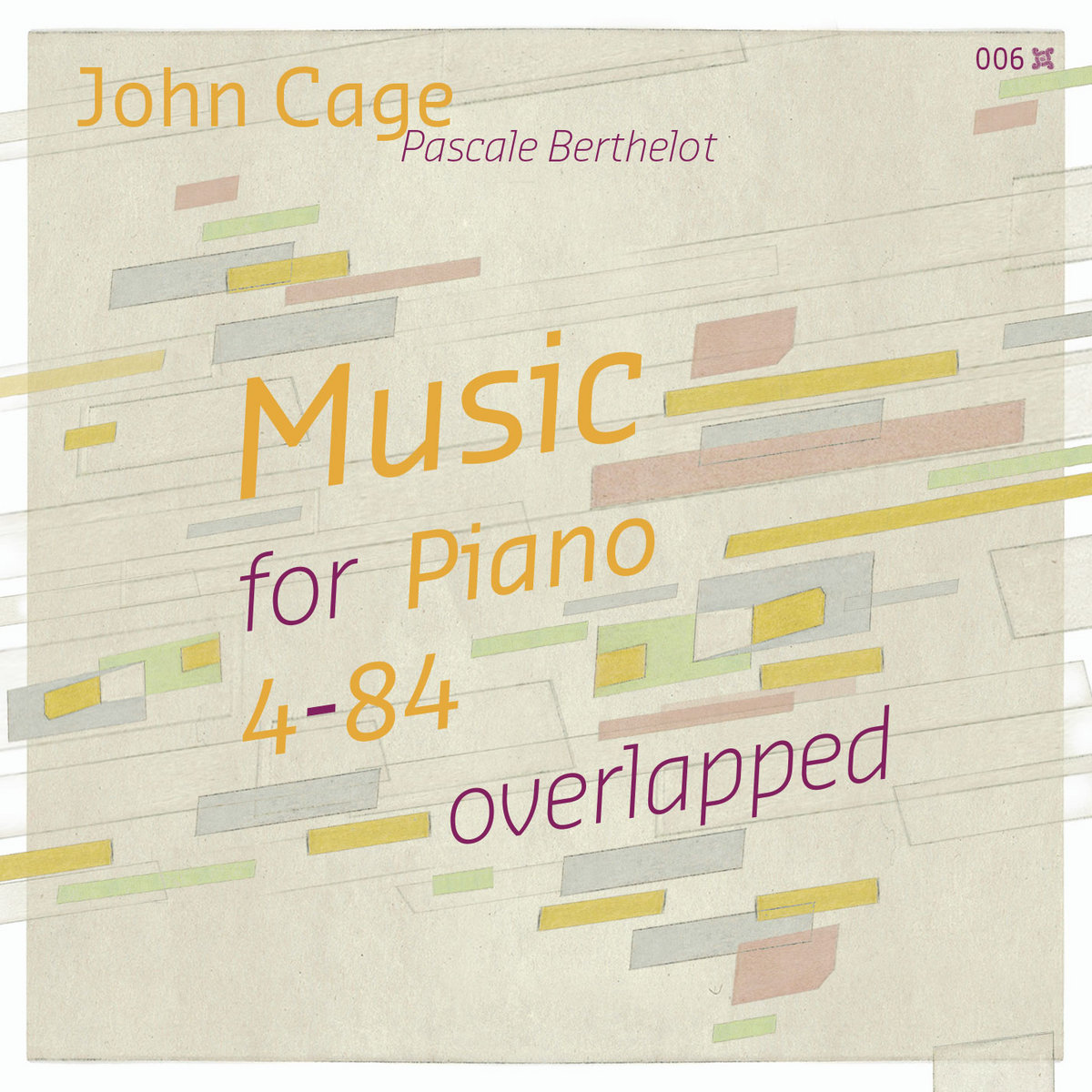
John Cage: Music for Piano 4-84 Overlapped (YAN.006)

06_Cover

John Cage
Music for Piano 4-84 Overlapped

Pascale Berthelot piano
Recorded and mixed 2017 by Gérard de Haro at Studios La Buissonne
Mastered by Anaëlle Marsollier
Piano technician: Alain Massonneau
Produced by Marc Thouvenot & La Buissonne
Release date: May 24, 2018

What if I ask thirty-two questions?
What if I stop asking now and then?
Will that make things clear?
Is communication something made clear?
What is communication?
–John Cage, “Communication”

In her third intersection with the CUICATL sublabel, pianist Pascale Berthelot offers something truly unique in John Cage’s Music for Piano. Composed between 1952 and 1962 through a series of chance operations, Music for Piano grew into a set of 85 pieces. Numbers 4-84 took on a life of their own as incidental soundtrack for dancer Merce Cunningham’s 1953 Solo Suite in Space and Time, and these are presented in an unprecedented way: superimposed and played as one. Because Music for Piano indeed plays with notions of space and time—stretching, deconstructing, unraveling them as quantum material—it makes an ideal sort of sense in this collective reiteration.

Suggestions in the score were yielded by natural imperfections in the paper, where Cage decided to make a mark, thus freeing something that might otherwise have remained locked away in its planar prison. This fundamental action—of treating something noticeable as a rupture into sound production—gave emptiness to substance and substance to emptiness. In so doing, he proved the fallacy of silence altogether.

Despite the overlap (if not also because of it), an intense subtlety prevails. And because the notation is already so bare, the result is far from chaotic. It is, rather, like gazing upon a starry sky and hearing it for the first time. The deeper one goes into Berthelot’s performance, the more the piano sheds its associations as a center-stage instrument. Rather, in being plucked, strummed, depressed, and knocked from the inside out, it opens itself like a dictionary. Flipping through it as one would spin a globe and land a finger for want of random travel, Berthelot links one word after another until vocabularies, sentences, and paragraphs emerge. In reading them back to us, he fixes a narrative as such and allows us to wield it as a text. The beauty of it all is that we may cut a piece from anywhere along its trajectory and roll it out into another story altogether.

This recording is a gift that keeps on giving. A must for admirers of Cage, and for anyone who believes that music is something that should feel you, not the other way around.

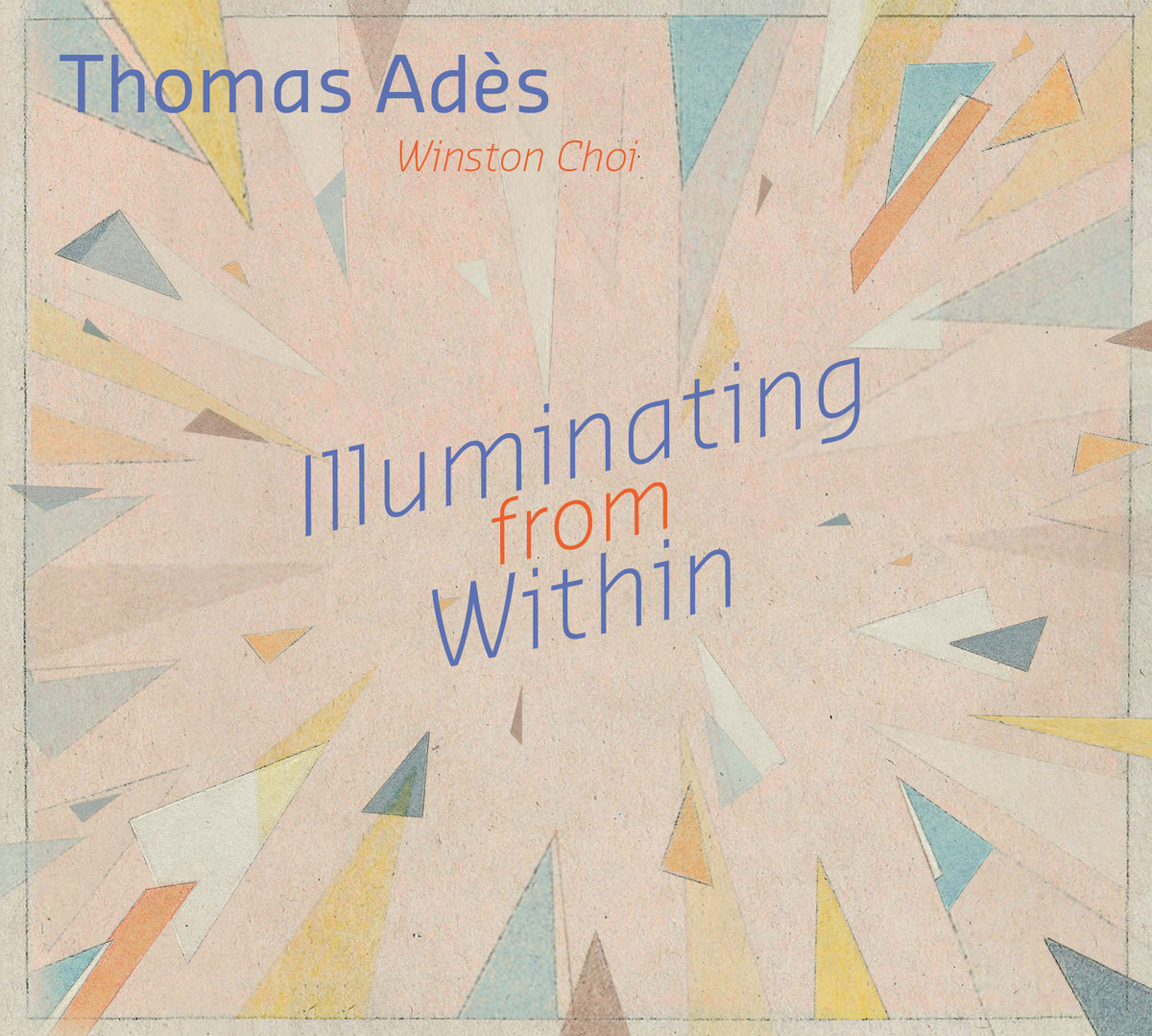
Thomas Adès: Illuminating from Within (YAN.005)

05_Cover

Thomas Adès
Illuminating from Within

Winston Choi piano
Recorded 2015 by Nicolas Baillard at Studios La Buissonne
Produced by Marc Thouvenot & La Buissonne
Release date: October 30, 2015

If ever there was a composer who worked in light, it would be Thomas Adès. As the subject of this recital by Canadian pianist Winston Choi, he comes across as someone interested not so much in the metaphysical as the metaphorical. Traced Overhead (1995/96), for one, takes its inspiration from the iconography of angels, and in drawing that connection molds transcendence and ascension as motifs worthy of articulation at the keyboard. Such heavenly associations, however, remind us of flesh’s sinful tendencies and of the material world that keeps its desires running smoothly. As two relatively shorter movements shift into a protracted third, in which the scratch of thorns blood-lets a sacred disembodiment, the dichotomy of inner/outer ceases to be real. The Three Mazurkas (2009) that follow are brimming with detail. Originally written for Emanuel Ax and tipping their shared hat to Chopin, they showcase a full integration of sound, color, and environment even as dance steps are obscured through the filter of personal expression.

Thrift (A Cliff Tower) (2012) begins a chain of standalone works. Its roiling textures, viewed (and heard) as if from a precipice, are an appropriate prelude to Darknesse Visible (1992). This nervous translation of John Dowland’s “In darkness let me dwell” is strangely bright. The end result is no longer a song but something else entirely. Still Sorrowing (1992), also rooted in Dowland, lights a decidedly nocturnal stove. Muted strings and plant-like forms grow in honest profusion. All of which makes the Concert Paraphrase (2009) feel like a masochistic slap. This free transcription of Adès’s first opera, Powder Her Face, is dramatic, halting, and intensely physical. Between fiercely lyrical asides and gently tumultuous arias it strings tightropes of Weimar-era cabaret, romanticism, and fantasy. More real than anything, for nothing is real without a little makeup to offset the truth.

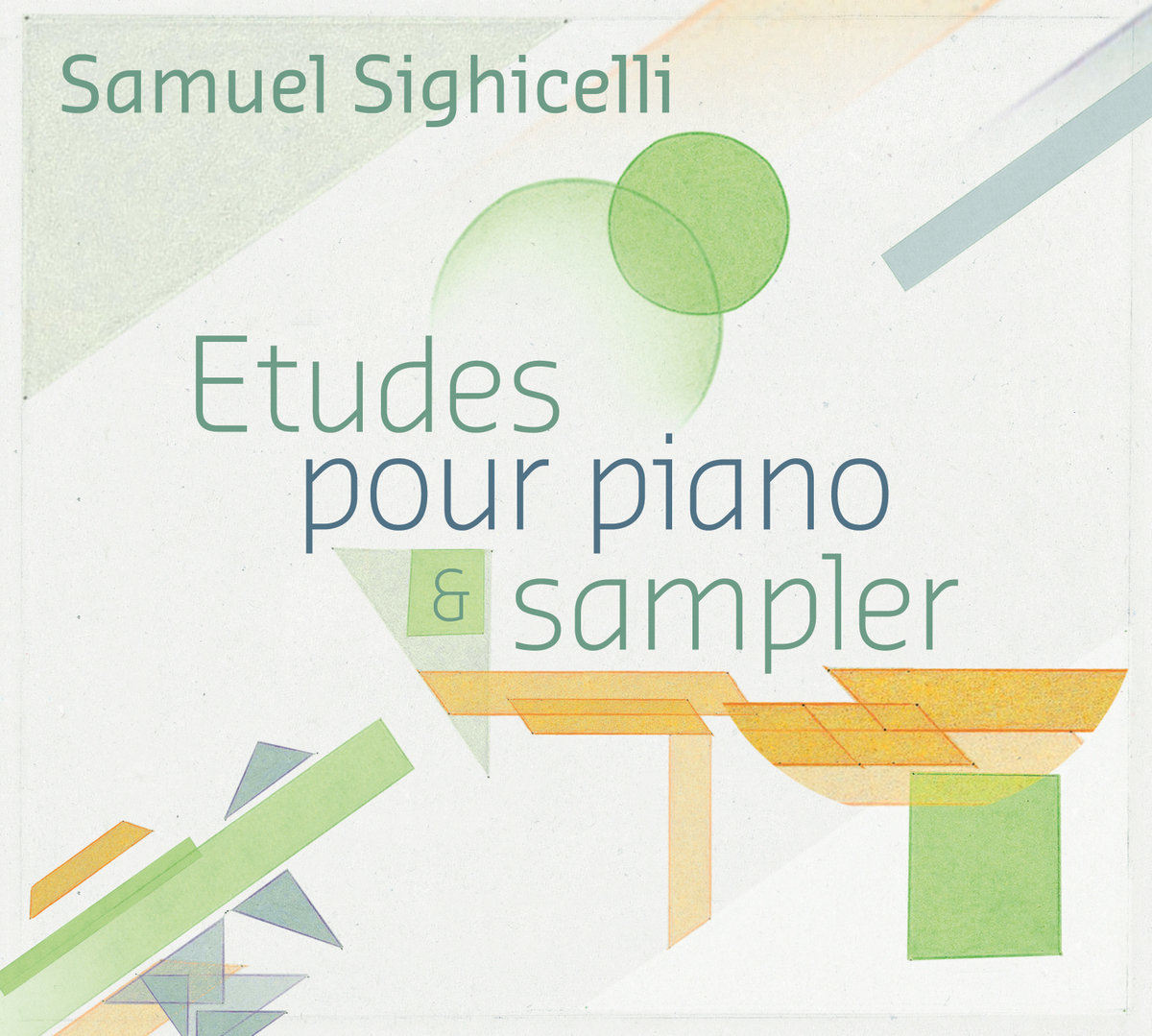
Samuel Sighicelli: Etudes pour piano & sampler (YAN.004)

04_Cover

Samuel Sighicelli
Etudes pour piano & sampler

Samuel Sighicelli piano, electronics
Recorded October 6-8, 2014 by Gérard de Haro at Studios La Buissonne
Mastered by Nicolas Baillard
Produced by Marc Thouvenot & La Buissonne
Release date: February 28, 2017

Pianist Samuel Sighicelli, known to La Buissonne Label listeners as a key member of Caravaggio, presents what this album’s press release calls a “bionic piano.” More than an amalgamation of flesh, metal, and wood, it is a meta-compositional tool. Sighicelli started this project by recording improvisations at home on the piano, treating curated selections therefrom as seeds for heavily constructed pieces. From this a series of 12. Though originally intended for two loudspeakers, he reworked them for live performance using digital sampling, thus allowing him to invoke the prerecorded material via electronic keyboard.

“Signes/Course” combines elliptical motifs with splashes of cold water, string treatments, and backward glances. If such descriptions feel vague, it is only because the music is so precise, and to capture it in like manner risks limiting its interpretive possibilities. So begins a psychological character study of psychology itself. The mix of submarine signals and deserted expanse that is “Carcasse dans la neige” haunts the brain. Upon hearing it, we immediately realize we lack the necessary equipment to interpret the pattern as a message. Instead, we flounder in our need for communication: isolated, undiscerned, voiceless. Those pulses continue to echo across the waters of our conscious mind in “L’horizon comme vouloir,” even as they find purchase in the piano’s physical body.

The more these pieces evolve, the more the sampler becomes integrated into the piano itself, as if it were hybridizing with the very instrument from which it emerge. Along the way, we are exposed to sound bites of human voice (“Édifices”), sinister ruptures (“Brèches”), sacred spaces (“Monolithe”), futuristic body scans (“Départ dans le bruit neuf”), and even the lull of cricket song (“L’âge du faire”). And when the keys sing to us from within minimal clothing, as in “Dernier regard” and “Presque l’aube,” the effect is startling. It is akin to being sonically operated on to disentangle us from an incursion of microscopic entities, each wielding a knife so small that every slash is felt only in dreams.

Daniel D’Adamo/Thierry Blondeau: Plier-Déplier (YAN.003)

03_Cover

Daniel D’Adamo
Thierry Blondeau
Plier-Déplier

Béla Quartet
Julien Dieudegard
violin
Frédéric Aurier violin
Julian Boutin viola
Luc Dedreuil violoncello
Recorded, edited, and mixed in 2012 by Gérard de Haro at Studios La Buissonne
Mastered by Nicolas Baillard
Steinway prepared by Alain Massonneau
Produced by Marc Thouvenot & La Buissonne
Release date: November 19, 2013

Plier-Déplier (Folding and Unfolding) is the title piece, jointly composed by Daniel D’Adamo and Thierry Blondeau, of this fascinating program of string quartet music. Played with astonishing (meta)physical accuracy by the Béla Quartet, it comes across as three-dimensional and tangible. Prerecorded snippets allow insight into the preparatory elements of these constructions. Some are distant, others intimately close. Such extremes give credence to the between-ness of things, just as the rising and setting of the sun confirms our allegiance to the day. Though nearly all of these 19 pieces average two minutes in length, there’s a sense of expansion at play from one to the next. Silence is as much employed for its notecraft as scored action. Calling these vignettes therefore feels grossly inaccurate, as they are no less narrow in scope than a haiku. So-called extended techniques become the norm, while traditional bowing serves to insist on the contrivances of measured speech, directed emotion, and impositions of time. In the present context, urgency of clarity becomes a disruption to the comforts of a given instrument’s tessitura, stretching the limits of possibility as naturally as blinking. Implications abound in the creak of a tuning peg, the scrape of an un-vocalized string. Contrasts of breezes and gales coexist in a fluttering storm, while harmonics resound like sirens of the heart, coaxing themselves to shore.

Blondeau and D’Adamo each offer a solitary composition as postlude. Where the former’s Last Week-End on Mars evokes air raids and space travel, using electronics to enhance the vagaries of time, the latter’s Découper – petite passacaille touches the edges of its own vocabulary—not with the tongue but with the fingertips. The quartet’s delicacy, interspersed with forthright expulsions of air, gives a taste of the meal that never reaches this proverbial table. Instead, it leaves us to ponder the empty plate before us as if it were our own life, scarred by years of silverware and unthinking consumption.

Ivan Fedele: Musica della luce (YAN.002)

02_Cover

Ivan Fedele
Musica della luce

Pascale Berthelot piano
Recorded in 2012 by Gérard de Haro at Studios La Buissonne
Edited, mixed, and mastered by Nicolas Baillard
Steinway prepared by Alain Massonneau
Produced by Marc Thouvenot & La Buissonne
Release date: November 19, 2013

The pianistic literature of Ivan Fedele is the subject of this recital by Pascale Berthelot, which follows her CUICATL debut. The program opens with the Italian composer’s Études boréales (1990). Meant to evoke the icy climate of Finland, it requires the performer to dig into the keyboard like a mountain climber might ascend by means of a pick. Such sharp attacks are resolutely luminescent, while the slower sections are murmurings of shadow. Internal resonances are beautifully enhanced in the third and fifth etudes, as if in a frozen cave exhaling its own voices across the valleys. The harmonics of the fourth are the tones of icicles falling from their state of overhang.

Études australes (2002/03) shifts to warmer, more forgiving spaces. Subtitles of individual etudes (Tierra del fuego, Cape Horn, etc.) suggest polar geographies but also the genera (e.g., Aptenodytes) and species of birds who inhabit them. With no pedal indications to lead the way, Berthelot is left to interpret the duration of every note cluster as if it were its own hybrid, jumping from sparkling cliffs into oceanic depths.

The Toccata (1983, 1988) is an ode to the composer’s own youth and the revelry of practicing at the piano. That feeling of repetition, of evolution and involvement, is omnipresent. Insistence and flowery ornamentation go “all in” throughout this fascinating and unabashedly honest music.

Cadenze is a set of nine aphorisms composed over a 25-year period (1983-2008). Though short, they practically insist on lingering long after being uttered. Thus, the markings of each are as much linguistic as environmental. Some particularly striking examples are numbers III (a psychic rush), VI (a dance that never gets off the ground), and VIII (a lullaby for DNA).

Nachtmusik (2008) concludes with a piano-only section from the longer Deu notturni con figura, itself for piano and electric piano. As the most brooding narrative at hand, it pulls itself through a thick emotional transference, ever aware of its age.

Fedele’s oeuvre is a collective study of contrasts in the same planetary body. Just as the Earth’s axis suggests two tilts—one toward the sun and the other away from it—it balances light and dark, warmth and cold, art and science. This is neither a treatise or a manifesto, but a short story collection rolled into a ball and kneaded until its words are no longer distinguishable.