Morton Feldman: Triadic Memories (YAN.001)

01_Cover

Morton Feldman
Triadic Memories

Pascale Berthelot piano
Recorded and mixed in 2009 by Gérard de Haro at Studios La Buissonne
Mastered by Nicolas Baillard
Steinway prepared by Alain Massonneau
Produced by Marc Thouvenot & La Buissonne
Release date: November 19, 2013

Around fifty solo piano pieces are attributed to composer Morton Feldman (1926-1987), whose relationship with the instrument was like that of light to prism. This studio recital by Pascale Berthelot, recorded in 2009 by Gérard de Haro at La Buissonne, marks the inaugural release in the studio’s CUICATL imprint, dedicated to documenting world-class performances of contemporary classical material.

Triadic Memories, written for Japanese pianist Aki Takahashi in 1981, is a cartography not only of triads and memories as self-contained entities but also of the ways in which each informs the other. Arpeggiated chords mark ephemeral borders; motifs are recycled and transformed. Every shade comprises a vocabulary of solitary travel. In the words of Feldman himself: “In this regularity (though there are slight gradations of tempo) there is a suggestion that what we hear is functional and directional, but we soon realize that this is an illusion; a bit like walking the streets of Berlin—where all the buildings look alike, even if they’re not.” Thus, Feldman’s interest in duration over rhythm (or, as Louis Goldstein puts it, “[h]is concern with how a musical composition sounds, rather than how it is made”) takes precedence, just as one’s footsteps might give the illusion of regularity yet, upon closer scrutiny, reveal endless possibilities. Like a child learning how to walk yet whose comportment speaks of an innate knowledge passed down genetically, cosmically, from body to body (if not soul to soul), Triadic Memories recalibrates the parameters of our attention span until we no longer feel present in ourselves. And just as we are about to get stuck, we find our equilibrium restored, over and over, until only beauty remains to show for our passage.

One of the missions of CUICATL is to include pieces appropriate for conservatory students to learn and play. In this case, it is Feldman’s Piano Piece of 1952. Despite its more rigid structure and shorter duration, it feels less welcoming than Triadic Memories. Premiered by David Tudor in 1959, it has been rarely recorded since. Its score suggests not melodies but organisms. These we can hold as one might hold a newborn and watch them grow in a space where the air shapes itself as a sentient, physical substance. This is character of Feldman’s music: its willingness to let contradictions speak as the fully formed individuals they are rather than stand before the court of our scrutiny as selves divided between prosecution and defense.

Ketil Bjørnstad: A passion for John Donne (ECM 2394)

2394-front

Ketil Bjørnstad
A passion for John Donne

Håkon Kornstad tenor saxophone, flute, voice
Ketil Bjørnstad piano
Birger Mistereggen percussion
Oslo Chamber Choir
Håkon Daniel Nystedt
conductor
Recorded live March 2012, Sofienberg Kirke, Oslo
at the Oslo International Church Music Festival
Engineer: Jan Erik Kongshaug
An ECM Production
Release date: October 24, 2014

Batter my heart, three-personed God; for, you
As yet but knock, breathe, shine, and seek to men;
That I may rise, and stand, o’erthrow me, and bend
Your force to break, blow, burn, and make me new.

Pianist and composer Ketil Bjørnstad has sailed some of ECM’s purest waters. Yet while many of those journeys have been instrumental, he has with increasing frequency turned to the human voice as a candle from which to exude a melodic glow. True to metaphor, much of 2008’s The Light represented a major engagement with English poet John Donne (1572-1631), whose verses are the backbone of the present recording. Written for the Oslo International Church Festival and given its premiere in March of 2012 (the very performance heard here), Bjørnstad’s A passion for John Donne features Håkon Kornstad (tenor saxophone, flute, voice) in his ECM debut alongside percussionist Birger Mistereggen, the Oslo Chamber Choir under the direction of Håkon Daniel Nystedt, and the composer himself at the keyboard.

An Introitus gradates this hymnal piece into existence with a gong before piano and choir pull back the curtain of night to reveal a dawn-lit choral arrangement of “Thou hast made me.” As Kornstad’s tenor weaves through the undergrowth of these self-reflective intonations, unfolding one wordless implications after another, a silent heart of reverence is illuminated. Kornstad also sings, lending sanctity to “A fever” and “Farewell to love” as Bjørnstad shelters him like a church would a believer.

The writing for choir is sweeping yet intimate, most notably in “Death, be not proud” and “A nocturnal upon St. Lucy’s Day, being the shortest day,” the latter an atmospherically rich tapestry of waning moons and withdrawn souls. “A valediction, forbidden mourning” is another memorable passage, its use of marimba laying a supple path for Kornstad’s reed and voice to wander.

Each poem enacts a laser-focused concentration of mortality, distilling years of life into single words and phrases. This scriptural quality lends itself well to the piece’s concept as a “passion,” which by virtue of its promises of everlasting life through the doorways of death and love gives rise to a grander meaning in the texts. Like the benediction for incorruptible blood with which it ends, its prayerful mold feels more ripe than ever to be filled with our submissive will.

Konstantia Gourzi: Music for piano and string quartet (ECM New Series 2309)

Gourzi

Konstantia Gourzi
Music for piano and string quartet

Lorenda Ramou piano
Ensemble Coriolis
Heather Cottrell
violin
Susanne Pietsch violin
Klaus-Peter Werani viola
Hanno Simons violoncello
Recorded July 2012, Himmelfahrtskirche, Munich
Engineer: Stephan Schellmann
Produced by Manfred Eicher
Release date: October 10, 2014

Greek composer Konstantia Gourzi’s approach to time plus ECM’s approach to space equals the most whole of sonic numbers. Said whole consists of intimate minutiae, each the corner of a photograph otherwise hidden by the downturned palm of history. The transubstantiation of Eine kleine Geschichte, op. 25 (2005) for solo piano epitomizes this feeling of obscurity. Notes fall neither like rain nor like teardrops, but more like a maple copter in slow motion, yearning for the touch of soil. After such a liminal experience, the opening proclamation of the String Quartet No. 2, op. 33/2 (2007) indeed feels like a bear hug of gravity. Titled P-ILION, neun fragmente einer ewigkeit (the latter meaning “nine fragments of eternity”), it is a fitting description of the molecules that inform Gourzi’s atmospheres. A powerful river in which to drop one’s ears like stones, its currents teem with reminiscences and fantasies alike. Whether groveling in a heavenly day or dancing in a pagan night, the sheer breadth of evocation herein is staggering. As the cloth of familiarity frays at the shards of stories yet to be told, this piece elicits a lyricism so deep that it can only end where it began. Moods are darker in the String Quartet No. 1, op. 19 (2004). Bearing the title Israel, it begins with the mortal urgency of Henryk Górecki and the playfulness of Claude Debussy before morphing into a lone voice, orphaned but for its spiritual genealogies traceable back to Abraham’s near-sacrifice.

The program gives us a cross-section of Gourzi’s writing for piano. From the seven miniatures that make up „noch fürcht’ ich”, op. 8 (1993), an early opus that is her first for the instrument alone, to the similarly aphoristic Klavierstücke I-V, op.24 (2004) and the eclectic Aiolos Wind, op. 41 (2010), we encounter jazz, folklore, and hypermodern cartographies. The moment we find something to hold on to, it slips away and offers a substitute made of an entirely different material. When piano and string quartet combine in Vibrato 1, op. 38 (2009/10) and Vibrato 2, op. 38 (2010), Gourzi creates the soundtrack to a tracking shot, one footstep at a time.

I cannot fathom how this album slipped past my radar for so long. Though of only recent discovery, it has already earned a top spot among my favorite New Series discs. And while these compositions may sit comfortably beside those of György Kurtág and Helmut Lachenmann, there’s something distinct about Gourzi that is to be found not in her last name but in her first. Konstantia, which means “steadfastness,” is precisely the quality of which her music is possessed, moving ever forward as a way of polishing us like mirrors held up to the past.

James Ilgenfritz: You Scream A Rapid Language

YSARL

Bassist/composer James Ilgenfritz is rare for running lines of transfusion between jazz and classical bodies while keeping them equally alive. In that spirit, he presents this chamber program of formidable subtlety and feeling that travels comfortably between (and beyond) genres.

The combinations of instruments provide constant fascination, starting with the pairing of violin (Pauline Kim Harris) and double-pedal bass drum (Alex Cohen) in Terminal Affirmative. By turns primal and futuristic, this music frays the edges of such contradictions to the point of unity. It’s worth noting that this piece is based on observations of Ovid, who emphasized the power of water droplets to erode stone over time as an organic illustration of persistence. This philosophy seeps into everything that follows, but especially in Apophenia III: The Index. This trio for piano (Kathleen Supové), guitar (James Moore) and violin (Jennifer Choi), based on a short story by J. G. Ballard, asks the musicians to build a grander narrative out of through-composed fragments. Thus, what first seem to be aphorisms take on a coherence all their own.

Apophenia IV: A Bell In Every Finger sets poetry by the late Steve Dalachinsky (on Muhal Richard Abrams and Cecil Taylor, no less) for baritone (Thomas Buckner), piano (Joseph Kubera), percussion (William Winant) and Ilgenfritz himself. Buckner lends his falsetto to this garden of delights and darkness, contrasting hauntingly with the album’s masterstroke: How To Talk To Your Children About Not Looking At The Eclipse. Here flutist Margaret Lancaster breaks down breath to its most linguistically pure elements and makes them sing.

Tempting as it is to call this album intermittently assaultive, it is perhaps better described as possessed of a fierce intimacy. As in the concluding Fanfares For Modest Accomplishments for two violins (Pauline Kim Harris and Conrad Harris), it uses brevity to bring our attention to expanse. Such dichotomies are difficult to maintain, but these musicians do just that with unwavering strength.

(This review originally appeared in the April 2020 issue of The New York City Jazz Record, a full PDF of which is available here.)

Heinz Holliger/György Kurtág: Zwiegespräche (ECM New Series 2665)

Zwiegespräche.jpg

Heinz Holliger
György Kurtág
Zwiegespräche

Heinz Holliger oboe, English horn, piano
Marie-Lise Schüpbach English horn, oboe
Sarah Wegener soprano
Enresto Molinari bass clarinet, contrabass clarinet
Philippe Jaccottet recitation
Recorded June 2018, Radiostudio DRS Zürich
Engineer: Andreas Werner
Philippe Jaccottet was recorded August 2017
in Grignan by Nicolas Baillard, Studios La Buissonne
Executive producer: Manfred Eicher
Release date: May 24, 2019

Swifts turn in the heights of the air;
higher still turn the invisible stars.
When day withdraws to the ends of the earth
their fires shine on a dark expanse of sand.
–Philippe Jaccottet

If it comes as no surprise that Heinz Holliger and György Kurtág, perennial names in the ECM New Series roster, studied composition under Sándor Veress (cf. ECM 1555), then neither should the inevitability of blending their artistry in one of the most seamless programs to grace the imprint in recent years. Holliger, for his part, found a kindred spirit in Kurtág from day one: “Every note he writes is essential; there is never an idea of small talk…of wanting to please somebody or an audience.” The overarching title Zwiegespräche (“dialogues”) accurately describes the music. For indeed, when their works are placed side by side, a distinctly conversational rapport grows. These dialogues, however, extend beyond the composers themselves and into realms of texts, other musicians, and spaces of interpretation, so that in the listener’s walk from one end to the other, it becomes difficult to tell where Holliger’s terrains end and Kurtág’s begin.

If both are melodic composers, a memorial heart distinguishes a significant portion of Kurtág’s output. Most poignant in that regard is his …Ein Brief aus der Ferne an Ursula (2014) for oboe solo. Written just days before the death of Holliger’s wife Ursula (see, e.g., Lieder ohne Worte), it’s a loving tribute that wants to dance but instead curls into itself. The follow-up …für Heinz… (2014) is scored for piano, left hand, thus symbolizing Ursula’s absence. Its dissonances rest in brief catharsis.

A brighter pairing finds itself represented in both composers’ settings of the same text by 17th-century mystic and poet Angelus Silesius. Dating from 2010, they feature soprano in the leading role. Where Holliger adds oboe, English horn, and bass clarinet, Kurtág pairs the voice with English horn only. Holliger’s version was written while in hospital, where he challenged himself to write a madrigal each day during his recovery. Kurtág’s likewise pulls on inner filaments of mortality.

A standout of the album is Holliger’s Berceuse pour M. (2015), performed on English horn by his pupil Marie-Lise Schüpbach. Like her teacher, Schüpbach displays immaculate breath control and a balance of light and shadow. Holliger’s interpretations of seven poems by Philippe Jaccottet are equally moving. Each is read by the poet himself, and the words, written beneath corresponding notes in the score, are matched by oboe and English horn in extractions of hidden messages. The piercing altissimo of “Dans l’étendue…” and vocal inflections of “Je marche…” are especially visceral. Even the programmatic touches of “Oiseaux” feel more than reactive: they are cocreators in an extra-linguistic process.

Back in Kurtág’s world, a sequence of dedicatory aphorisms unfurls. Of these, the most naked are those written for contrabass clarinet solo. Schatten makes delicate use of key clicks and barest breath, and Kroó György in memoriam, written for radio editor and music critic György Kroó, rarely transcends a whisper. At more than six minutes, the latter feels like a novel compared to the short stories that surround it. The Hommage à Elliott Carter (for English horn and contrabass clarinet) and In Nomine – all-ongherese (Damjanich emlékkö) for English horn solo are vibrantly noteworthy as well.

Holliger finishes with his solo oboe Sonate. Composed in 1956/57 and revised in 1999, it is recorded for the first time here, after 63 years of sitting on paper since he penned it for Veress’s composition class. In it we can hear Veress’s influence on the younger composer, if not also Holliger’s on the older. From the leaping Präludium to the virtuosic Finale, ponderance of nature outweighs the nature of ponderance, leaving us with nothing short of a masterpiece.

We live in a world of motion and distance.
The heart flies from tree to bird,
from bird to distant star,
from star to love; and love grows
in the quiet house, turning and working,
servant of thought, a lamp held in one hand.

Reto Bieri and Meta4: Quasi morendo (ECM New Series 2557)

Quasi morendo.jpg

Reto Bieri and Meta4
Quasi morendo

Reto Bieri clarinet
Meta4
Antti Tikkanen violin
Minna Pensola violin
Atte Kilpeläinen viola
Tomas Djupsjöbacka violoncello
Recorded November 2016, RSI Studio Zürich
Engineer: Peter Laenger
Produced by Manfred Eicher
Release date: May 10, 2019

When clarinetist Reto Bieri made his solo ECM debut with Contrechant, Salvatore Sciarrino’s Let Me Die Before I Wake (1982) was the most memorable piece of that program. Here, its unaccompanied wonders make a welcome reappearance, inciting an altogether different journey through works of Johannes Brahms and Gérard Pesson. Sciarrino’s sense of color is downright prismatic, separating the white light of breath into its constituent spectrum through deft use of multiphonic and overtone techniques. There is a tenderness to this music’s unfolding, the occasional outburst from which feels somehow delicate, as if the materiality of it all were but a blip on the listener’s dreaming radar. Bieri himself would be the first to agree on the enigma of it all: “How the sounds come about in this piece,” he says, “is a mystery even to me.” That air of separation between knowledge and production, catalyst and effect, is at once tangible and immaterial. For while Bieri has total control over the sounds emitted by his clarinet, there’s that same daunting sense of physics found in Heinz Holliger’s 1971 Studie über Mehrklänge for oboe (documented by the composer himself on ECM 1340).

Brahms’s Quintet in b minor, Op. 115, finds Bieri in the dynamic company of the Meta4 String Quartet, themselves making an ECM debut. Written in 1891, after Brahms had already decided to retire from composing yet opened that door again when clarinetist Richard Mühlfeld came knocking, this masterwork is what Roman Brotbeck in this album’s liner essay calls “a swan song.” It is, he goes on to write, “freer, more idyllic, less ‘controlled’ than Brahms’s earlier chamber music, but is in fact one of his most strictly constructed compositions.” The opening Allegro is an exercise in dark exuberance, clarinet playing the role of voice among the voiceless. There is lyricism, robust anatomy, and fortitude of reasoning at work in every thematic shift. The following Adagio sees itself reflected in the opening mirror, tracing memories of younger days with fingers dipped in sunlight, but always returning to a baseline of melancholy resignation. The Andantino seems to cradle the most happiness in these shadows, and somewhat recalls the third movement of Brahms’s First Symphony with its subdued pastoralism. The final movement takes all the self-regard that preceded it and turns it into moving images. Like a cinema that predates its own technology, it flows across the screen of the mind in glorious performance.

Pesson’s Nebenstück (1988), what Brotbeck calls “an estranged instrumentation, or rather arrangement, for clarinet and string quartet of the ballade for piano, Op. 10 No. 4, that Brahms composed in 1854,” takes a decidedly internal approach to homage. With a frailty that rivals even the Sciarrino, it speaks in a shaded and subliminal language while peeling back layers of awareness graspable only behind closed eyes, as if the very sight of things would interrupt its grammar with unnecessary punctuation. A brilliant gesture of continuity in summary of a wonderous recital.

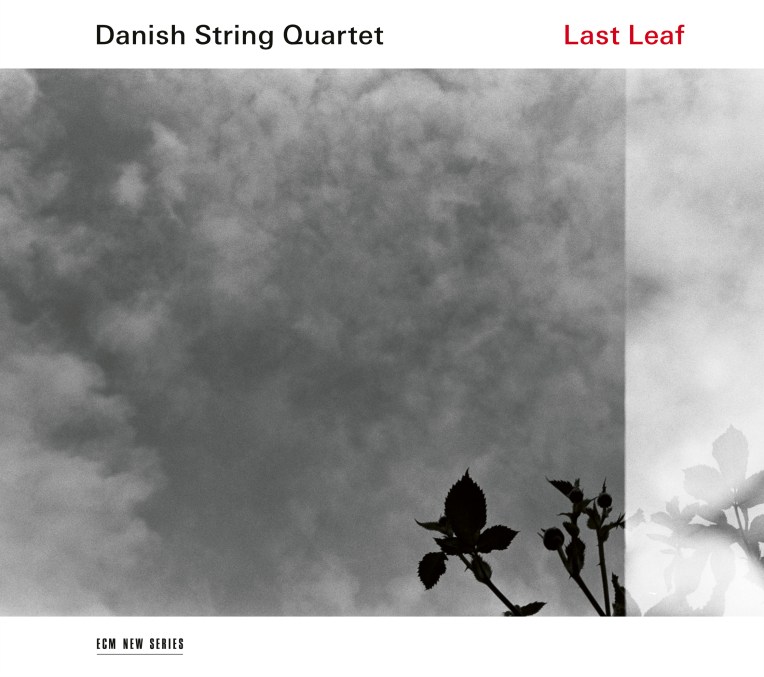
Danish String Quartet: Last Leaf (ECM New Series 2550)

2550 X

Danish String Quartet
Last Leaf

Rune Tonsgaard Sørensen violin, harmonium, piano, glockenspiel
Frederik Øland violin
Asbjørn Nørgaard viola
Fredrik Schøyen Sjölin violoncello
Recorded January 2017, The KirstenKjær Museum, Frøstrup
Engineer: Markus Heiland
Mixed June 2017 at Tritonus Studio, Stuttgart, by Rone Tonsgaard Sørensen, Manfred Eicher, and Markus Heiland (engineer)
Produced by the Danish String Quartet
Executive producer: Manfred Eicher
Release date: September 22, 2017

After an intimately electrifying 2016 ECM debut, the Danish String Quartet follow with this program of original arrangements so well suited to the source material that if their collective heart were a moon, it would be full and bright in the night sky of their creativity. The album’s seed is the Danish Christmas hymn “Now found is the fairest of roses.” First published by poet-theologist H. A. Brorson in 1732, it’s played as if in slow motion and captures the musicians in a film of artful restraint. That the tune concludes rather than begins the sequence is indicative of an underlying philosophy at play, in which stars regress back to their gaseous birth, mere wisps of galactic thought rendered sentient by the incubator of time.

At the other end of the spectrum is “Despair not, o heart.” This Lutheran funeral hymn, first notated in 1517, adds the elegiac cast of a harmonium, and with it the feeling of the open sea unraveled in “Shore.” Written by the quartet’s cellist, Fredrik Schøyen Sjölin, this self-described “folk fantasy” evokes sand and tide while also tracking the footprints left behind and washed away along its canvas. It finds later parallel in Sjölin’s “Naja’s Waltz,” a heartfelt piece of latticework that feels like a gift from father to daughter, and “Intermezzo,” a beautiful segue into “Shine you no more,” by lead violinist Rune Tonsgaard Sørensen. A reel partly inspired by John Dowland’s “Flow My Tears,” it moves kaleidoscopically and jigs its way across the grasslands.

Much of the liminal material at hand is Danish in origin, including the graceful “Minuet No. 60” from a 1760s collection of folk melodies transcribed by Rasmus Storm. Coordinated to the point of feeling untethered by convention, it moves as dancers in their prime. The song “Hur var du i aftes så sildig” (Where were you last night so late), from the same collection, treats pizzicato like a series of semantic puzzle pieces. Other highlights from this geographical focus are “The Dromer,” a so-called English dance collected by the Bast Brothers between 1763-1782, and “Æ Rømeser,” an example of the dance form known as the “sønderhoning,” unique to the southern Danish island village of Sønderho. Slow and sure, but transitioning into a more forthright sway, it grounds the listener as a prerequisite for leaving the earth behind.

Further travels take the quartet from the Swedish traditional “Polska from Dorotea,” attributed to fiddler Johan August Andersson (1866-1902) and filled with luscious interplay from the violin and the Faroese mythology of “Stædelil” to the astonishing sonorities of “Unst Boat Song,” an old Norse song from the Shetland Islands, and “Fastän,” a contemporary Swedish polska by Eva Sæther that ends with a trail of piano.

Regardless of origin, the quartet plays these all with such grace, attention to color, and scenic integrity, that where they’re going is never in question. In their handling, the last leaf becomes the first of another in a cycle of decay and burgeoning life, for which they are humble interpreters. We, in turn, are humbled to witness their unfurling.

Steve Reich: The ECM Recordings (ECM 2540-42)

Steve Reich

Steve Reich
The ECM Recordings

Recorded 1976-1981
Release date: September 30, 2016

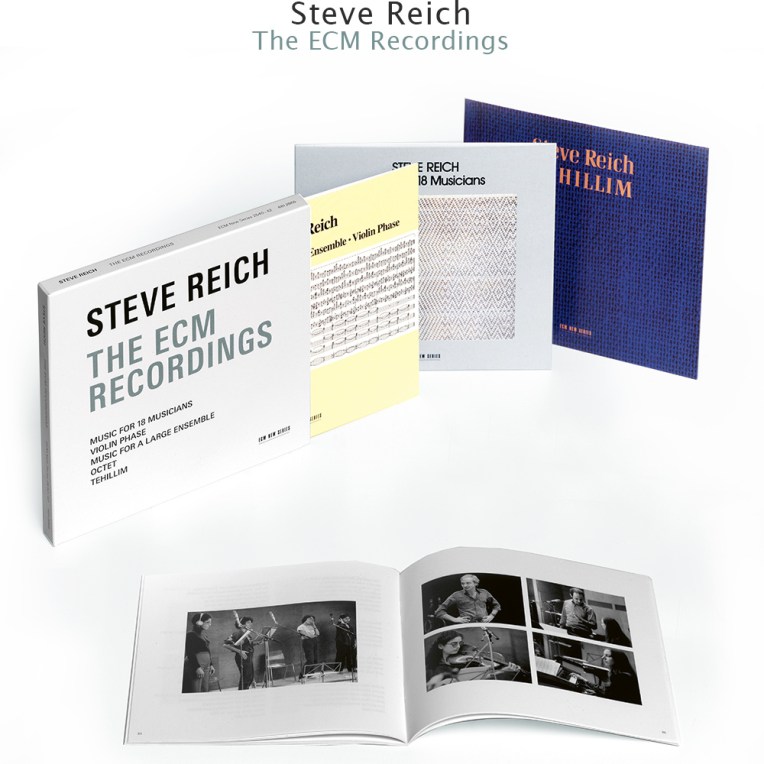
Steve Reich creates more than music; he renders his sound so systematically as to make it seem organic. Like the frond of a fern or the edge of a tide’s diurnal crawl, it reveals internal order upon inspection, working its fractal splendor at the most intimate of listening levels. At their heart, Reich’s compositions are precisely that: aggregates of base elements working toward a larger conveyance of meaning. Their pulse is their nervous system, insisting on linear paths in a tangle of mortal spirals. But as Paul Griffiths notes in his booklet essay for this essential boxed set, Steve Reich struggled to find a recording home, despite a few standalone releases on other labels, and the fact that by this time he was in his forties and had established himself as a musician and composer of international renown. Part of the problem was how to market it. It wasn’t quite or just classical, but a unique amalgam drawn as much from rock music as West African drumming. And while Deutsche Grammophon had made a recording of Music for 18 Musicians in Paris, it wasn’t until ECM head Manfred Eicher heard it that it saw the light of day. “It spoke to the time,” Griffiths goes on, “and to some extent it still speaks of that time, when the Vietnam War was recently over and in most western countries a social revolution had been accomplished under pressure from below. It speaks of optimism and harmony and drive and progress.”
Reich ECM 3D

Whatever their political, social, or geographic connections, the three albums collected here are as historical in scope as they are in ECM’s preservation. With barest means—the primordial contact of living flesh on dead—Reich and his cadre of dedicated musicians offer a three-dimensional experience unlike any other. And while it’s easy to differentiate the intimate details between each recording, hearing them under a single banner reveals powerful interrelationships and dialogues in service of a growing aesthetic. From the unhidden methodologies of Music for 18 Musicians to the numerological mysteries of Tehillim, one finds a spectrum of emotional receivers flipped on in glorious succession.
Music for 18 Musicians

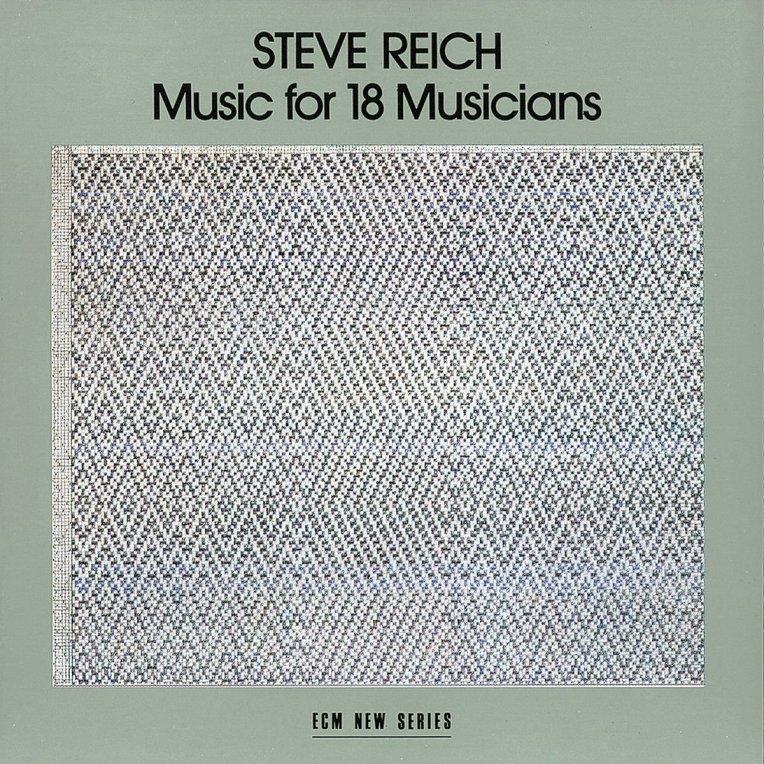
Music for 18 Musicians (ECM New Series 1129)

Shem Guibbory violin
Ken Ishii cello
Elizabeth Arnold voice
Rebecca Armstrong voice
Pamela Fraley voice
Nurit Tilles piano
Steve Chambers piano
Larry Karush piano, maracas
Gary Schall marimba, maracas
Bob Becker marimba, xylophone
Russ Hartenberger marimba, xylophone
Glen Velez marimba, xylophone
James Preiss metallophone, piano
Steve Reich piano, marimba
David Van Tieghem marimba, xylophone, piano
Virgil Blackwell clarinet, bass clarinet
Richard Cohen clarinet, bass clarinet
Jay Clayton voice, piano
Recorded 1976, Studio des Dames, Paris
Recording engineer: Klaus Hiemann
Mixing: Rudolph Werner, Klaus Hiemann, and Steve Reich
Produced by Rudolph Werner

Music for 18 Musicians makes no efforts to obscure the methods behind its construction. It shows us mysteries never notated. The piece is scored for violin, cello, 2 clarinets doubling bass clarinet, 4 women’s voices, 4 pianos, 3 marimbas, 2 xylophones and metallophone (vibraphone with no motor). With his characteristic attention to detail, Reich utilizes these instruments not necessarily for their evocativeness, but for the varied ways in which their timbres can be blended in a nearly hour-long wash of sound. Movements herein are at once linear and multidirectional. Reich’s notecraft commits to its own agenda while grafting on to many others along the way.

It all begins with a living metronome of piano and mallet instruments before a chorus of breaths (via throat and woodwinds) convenes. The interweaving of these strands reinforces the compositional density, like marrow and nerves attaching themselves to a spinal c(h)ord of aural design. Indeed, what develops is one active body of which instruments are the genetic code. And while vocal utterances function as extensions of manufactured instruments, they lend fragility to the underlying spirit at hand. They rise and fall, slowly replaced by clarinets as if one and the same.

Sudden changes in rhythm serve to reconfigure our attention to the intervention of the composer’s hand: just as we are being lulled into a sense of perpetuity, akin to a natural cycle studied from afar, we are reminded of listening to a human creation. This awareness invites us to share in its re-creation through the act of listening. Like much of Reich’s music, Music for 18 Musicians is nothing if not accommodating. Rather than patronize or proselytize, it bares its bones. This brackets Music for 18 Musicians off from much of the histrionic art music in vogue at the time of its creation (1974-76).

The recording quality of this album is ideally suited to its subject matter. A sense of “clusteredness” prevails, such that the performers never stray too far from the nexus of their unity, while also providing just enough breathing room (performers’ lung capacities determine the length of sonic pulses throughout) for individual elements to shine. Most of the mixing, as it were, is done live by the musicians themselves, and requires attentiveness on the part of the engineer to highlight that interplay without overpowering the core.

<< Jack DeJohnette: New Directions (ECM 1128)
>> Azimuth: The Touchstone (ECM 1130)

… . …
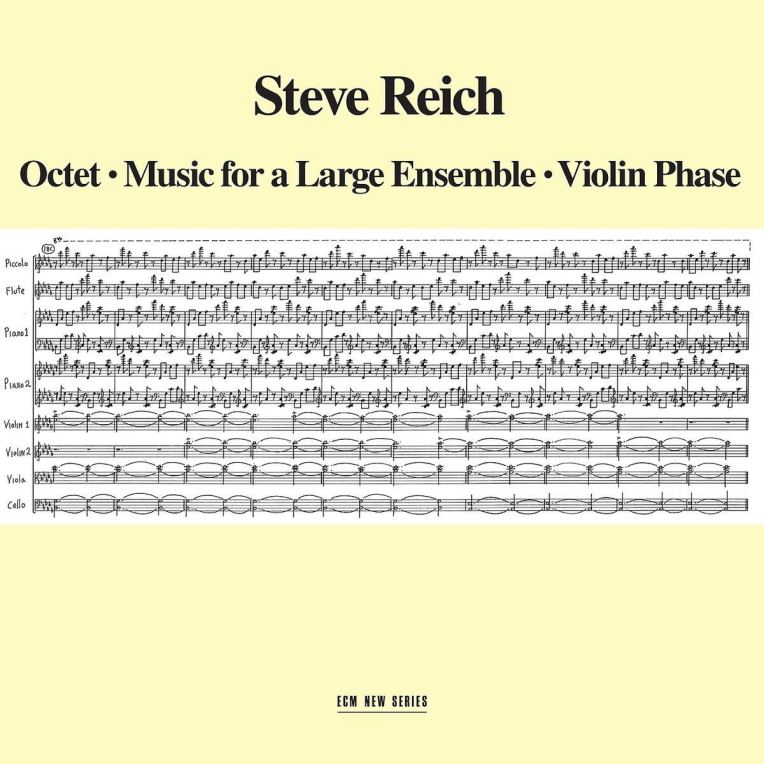
Reich Octet etc

Octet / Music for a Large Ensemble / Violin Phase (ECM New Series 1168)

Russ Hartenberger marimba
Glen Velez marimba
Gary Schall marimba
Richard Schwarz marimba
Bob Becker xylophone
David Van Tieghem xylophone
James Preiss vibraphone
Nurit Tilles piano
Edmund Niemann piano
Larry Karush piano
Steve Reich piano
Jay Clayton voice
Elizabeth Arnold voice
Shem Guibbory violin
Robert Chausow violin
Ruth Siegler viola
Claire Bergmann viola
Chris Finckel cello
Michael Finckel cello
Lewis Paer bass
Judith Sugarman basse
Virgil Blackwell clarinet
Richard Cohen clarinet
Mort Silver flute
Ed Joffe soprano saxophone
Vincent Gnojek soprano saxophones
Douglas Hedwig trumpet
Marshall Farr trumpet
James Hamlin trumpet
James Dooley trumpet
Music for a Large Ensemble / Octet
Recorded February 1980 at Columbia Recording Studios, New York
Recording engineer: Martin Wieland
Violin Phase
Recorded March 1980 at Tonstudio Bauer, Ludwigsburg
Recording engineer: Martin Wieland
Mixing: Manfred Eicher, Martin Wieland, and Steve Reich
Produced by Manfred Eicher

Have you ever repeated a word over and over again until it loses meaning? Cognitive science calls this “semantic satiation.” Now imagine that someone could do the same thing for instruments and you’ll have a clear idea of the power of a Steve Reich composition. In this selection of three longer examples, we get exactly that: an unraveling of music’s linguistic shapes, transformed from within.

The instruments in Music for a Large Ensemble fit into a vast sequence of aural DNA, as logical as it is mystifying. Every voice is given ample space in a piece that, while densely layered, is as airy and fractally ordered as a puff of windblown dandelion. Strings waver with the unrelenting heat of a desert sun, horns ebb and flow in a brassy wash of equilibrium, and a vibraphone rings out like magic over all. Although the music moves mechanically, its texture is organic. This earthiness is maintained in Violin Phase, which consists of a repeated motif that, as with all of Reich’s “phase” pieces, is knocked just slightly out of alignment by the doubling voice, like two turn signals rhythmically staggering and realigning. This is the most localized of Reich’s phases, clearly rooted in the bluegrass fiddling tradition. The violin grinds like sand, small particles swirling and separating yet holding fast to some invisible predictability. After two such strikingly different pieces, the Octet somehow comes across as the most intimate. The inclusion of wind instruments, in particular the clarinet and flute, adds a crystalline contrast, leading to a glorious and sudden silence.

Albums like this and Music for 18 Musicians will easily make one lose track of time. Both are tessellations in sound, each image shifting through time and space like an Escher print, so that what begins as a diamond ends up a bird in flight. Naturally, the precision required to play Reich’s music is a feat in and of itself. That such a synergistic cast of musicians could arise out of the work of one composer is by all accounts spectacular, and when so lovingly recorded their cumulative effect is heightened. This is music that finds its expansiveness internally, charting the waters of our biological oceans until we come to our beginnings anew.

<< Art Ensemble of Chicago: Full Force (ECM 1167)
>> Jan Garbarek/Kjell Johnsen: Aftenland (ECM 1169)

… . …
Tehillim

Tehillm (ECM New Series 1215)

Pamela Wood voice
Cheryl Bensman voice
Rebecca Armstrong voice
Jay Clayton voice
Bob Becker percussion
Russ Hartenberger percussion
Garry Kvistad percussion
Steve Reich percussion
Gary Schall percussion
Glen Velez percussion
Virgil Blackwell clarinet, flute
Mort Silver clarinet, piccolo
Vivian Burdick oboe
Ellen Bardekoff English horn
Edmund Niemann electric organ
Nurit Tilles electric organ
Shem Guibbory violin
Robert Chausow violin
Ruth Siegler viola
Chris Finckel cello
Lewis Paer bass
George Manahan conductor
Recorded October 1981 at Tonstudio Bauer, Ludwigsburg
Recording engineer: Martin Wieland
Mixing: Manfred Eicher, Martin Wieland, and Steve Reich
Produced by Manfred Eicher

Human languages are contrived, insofar as they have undergone extensive sociopolitical reshaping. In Steve Reich’s Tehillim, however, words take on a self-sustaining feel, deeply rooted in the nutrient-rich soil of the composer’s instrumental configuration, and serve to dictate the flow of a seminal shift in American “minimalism.” Being the first document of this new path in Reich’s personal and professional development, this recording matches an endearing trepidation to every practiced gesture. This music, says Reich, may be “heard as traditional and new at the same time,” as it was both a way for him to explore his Jewish roots while weaving a fresh brand of secularism into the many liturgical threads at his back. At just under 30 minutes, Tehillimis a fleeting unraveling of that very fabric.
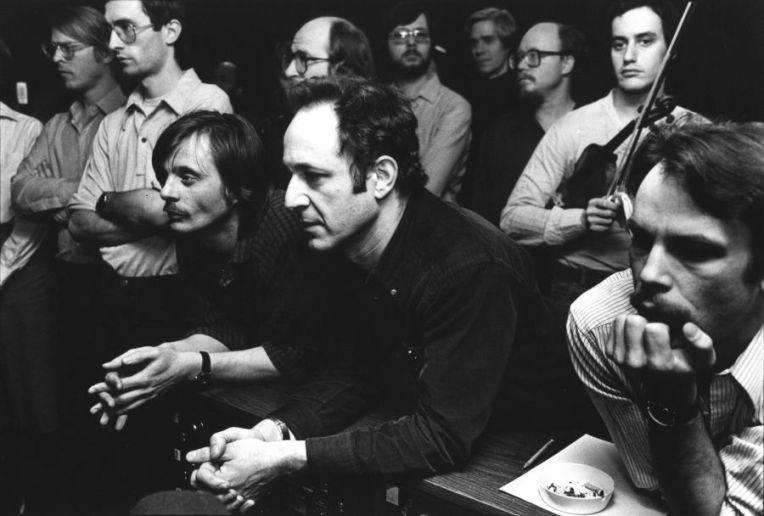
Eicher Reich
(Photo credit: Deborah Feingold)

Tehillim, meaning “praises” and referring to the Hebrew Book of Psalms from which it borrows its texts, is more than a remarkable work. It is also a work of remarks. The scoring is built around a core of drum and clapping before introducing a female voice doubled by clarinet. This opens into a series of four-part canons against a backdrop of electric organs and maraca. Each melodic line—human and instrumental alike—moves distinctly, unaffected by the trappings of vibrato or other flourishes, as an imitative counterpoint works its way into the smoke of this short-burning votive candle. Part II carries the women’s voices into higher elevations in which the passage of time is marked by a light interplay of drums. Part III is the slowest of the four, ebbing and flowing with a breath’s involuntary precision. Like the most engaging of Gavin Bryars’s ensemble pieces, this section pulses with the quiet splendor of a deep-sea organism. The final part opens our eyes again to sunlight. With the barest assortment of auditory keys, it unlocks just enough doors to usher us into a more personal understanding of exultation. It can be no coincidence, then, that the derivation of the title—Hey, Lamed, Lamed (HLL)—also forms the root for “hallelujah.” And so, when the hallelujahs that close the piece spring up like so much plant life, they seem inevitable. Tehillim is the Tree of Life feeding off itself, bathing in the spores of the Word made flesh.

Despite having turned this triangle around in the inner ear more times than can be counted, I discover something new every time: proof positive that calling it “minimalism” is unfair both to Reich and to the ones among whom he makes these demanding journeys. Thankfully, all we need to join them is a mind prepared to receive every shift of terrain with humility and a body in which to house it.

<< James Newton: Axum (ECM 1214)
>> Pat Metheny Group: Offramp (ECM 1216)

Mieczysław Weinberg: Chamber Symphonies / Piano Quintet (ECM New Series 2538/39)


Weinberg Chamber Symphonies

Mieczysław Weinberg
Chamber Symphonies / Piano Quintet

Kremerata Baltica
Gidon Kremer principal violin
Andrei Pushkarev timpani, triangle, percussion
Yulianna Avdeeva piano
Džeraldas Bidva violin
Dainius Puodžiukas violin
Santa Vižine viola
Giedrė Dirvanauskaitė violoncello
Mate Bekavac clarinet
Mirga Gražinytė-Tyla conductor (Chamber Symphony No. 4)
Chamber Symphonies Nos. 1-3
Recorded live June 13, 2015 at Musikverein Wien
Piano Quintet, Chamber Symphony No. 4
Recorded June 9/10, 2015 at Latvian Radio Studio, Riga
Tonmeister: Vilius Keras, Aleksandra Kerienė
Engineer: Varis Kurmins (Riga)
Mastering by Christoph Stickel, Manfred Eicher at MSM Studio, München
Album produced by Manfred Eicher
Release date: January 13, 2017

Following his first examination of Mieczysław Weinberg (1919-1996), violinist Gidon Kremer returns with his eponymous ensemble for another album devoted to the Polish-born Soviet composer. “No other composer has entered my own and Kremerata Baltica’s repertoire with such intensity,” writes Kremer in a liner note for the album, citing the four chamber symphonies recorded here as his finest examples. Despite Weinberg’s penchant for chamber music, if not also because of it, in these pieces one finds heartbreaking intimacy.

The Chamber Symphony No. 3, op. 151 (1990), loosely transcribed from his String Quartet No. 5, opens the program’s descending first half. The string orchestra for which it is scored opens in the mode of Lento with such clarity that it feels like a mirror in which every listener is reflected in high definition. Its tactility of history finds purchase wherever it can, clawing its way slowly into the inner ear, where it nests like a dying bird. Its afterlife is marked Allegro molto, lively yet underlined by melancholy, shifting into a tutti passage of chords that teeters on the brink of decay. The Adagio that follows is Weinberg’s default state of mind, giving itself over to thoughts of fog and shadows. The cello arising from shimmering violins gifts us one of the great solos of modern music. Lastly, the Andantino, a macabre dance interspersed with surprising Baroque textures utters a transfixing farewell.

This piece and its predecessor come from a time when Weinberg was fading into obscurity. Sick and isolated, he could only watch as his friends died or emigrated beyond his reach. Still, works like these continued to be premiered and touch the lives of those fortunate as we to hear them.

Chamber Symphonies Nos. 2 and 1 are further reworkings of string quartets and both supplement new movements in their reiterated forms. The Chamber Symphony No. 2, op. 147 (1987) adds to the orchestral milieu a pounding timpani, and with it a layer of storm. It circles, dances, and flirts with romanticism even as it transcends boundaries with the ease of breathing. The second movement shifts from lacey dance to exuberant outpouring, capped by a solo violin that also figures centrally in the final Andante. The strings are gnarled like tree roots, only some of which are visible aboveground. The Chamber Symphony No. 1, op. 145 (1986) closes out the first disc, balancing the Tchaikovsky-esque textures of its first movement with the final Presto’s full-on desperation, treading the edges of collapse between them with a strange mixture of glee and fear. Although no timpani is to be heard, it may just be the most percussive of the symphonies.

The Piano Quintet, op. 18 was composed in 1944, a year into Weinberg’s settlement in Moscow, where he would spend the remainder of his life, following a harrowing escape from the Nazis in 1941. By influence of Shostakovich, it takes a five-movement structure, and is presently arranged for piano, string orchestra and percussion by Andrei Pushkarev and Gidon Kremer. The gentlest of persuasions eases us into its sound-world, brittle enough to snap at the merest hint of impropriety. In the interest of its protection, Kremer and company lend it an evenness that never ruptures, except at choice moments of catharsis. That said, there’s very little in the way of redemption. In its place are the anxieties of its faster movements, which in their headlong rushes of detail reveal many possible outs, none of which are taken until the mighty Largo that follows. Over its 14-minute duration, as much urgency as recall feeds into the final movement. Appropriately designated Allegro agitato, the latter mocks the army of time.

Last is the Chamber Symphony No. 4, op. 153 (1992). Scored for clarinet, triangle and string orchestra, and bearing dedication to composer Boris Chaykovsky as a gesture of reconciliation to their waning friendship, it was to be Weinberg’s final completed work. Its opening Lento is his crowning achievement. Here, as in all subsequent movements, the clarinet flows as if through the prism of a traumatized yet resolute soul. The second movement, a fierce Allegro molto, treats the clarinet as a voice among voices, a representative of its community, vying for attention in the push and shove of a politically overwhelmed life. Again, a cello figures sagaciously at the end, tracing wisdom born of conflict. The Adagio is another patient stroke of genius, drawn like an ink-laden brush until every last drop is elicited. The final Andantino is a ballet without dancers in which microtonal plies are front and center before collapsing into a funereal drone.

If Shostakovich, with whom he was a close friend, can be said to be pathos, then Weinberg is the pathos of that pathos. Kremer’s focus on this music is therefore more than a recovery effort, but a philosophical resurrection. Under his direction, the music leads itself, and in that spirit walks crosswise with regard to every expectation, head bowed and hand dashing across the page before the flesh expires.