Frode Haltli accordion Trondheim Soloists Arditti Quartet
Irvine Arditti violin Ashot Sarkissjan violin Ralf Ehlers viola Lucas Fels violoncello
Recorded October and November 2014, Selbu Kirke, Norway
Engineer: Sean Lewis
Mastering: Manfred Eicher and Christoph Stickel
Executive producer: Manfred Eicher
Release date: August 26, 2016
AIRmarks a classical return to ECM for Norwegian accordion player Frode Haltli, who now, as on his label debut, offers a program centered around the music of Danish composer Bent Sørensen. For that album’s title piece, Looking on Darkness, Haltli was required to rethink his approach to the instrument in search of softer dynamics and bent pitches, and deepens those quasi-linguistic impulses here.
Sørensen provides the album’s frame tale. It is Pain Flowing Down Slowly on a White Wall (2010), written for solo accordion and string orchestra, feels vulnerable to something beyond grasp of flesh and time. Despite a lack of footholds, if not also because of said lack, the accordion takes on a winged materiality, destined to never touch solid ground. The relationship between it and the strings demonstrates Haltli’s own views on chamber music, of which he writes: “It demands fellow musicians who really listen, and who can move flexibly and playfully between various levels in the music according to what the music is telling you—not musicians who constantly need to be in front.” Indeed, “soloist” becomes a reductive term in the present context, favoring instead a larger whole. Movements of great distance share breathing room with dreams of proximity in a constantly shifting topography, as if the very earth were struggling to hold its shape. And so, when the string players at last trade bows for melodicas, it comes across—ironically enough—as an act of solidarity. Like Sigrid’s Lullaby (2010), adapted for solo accordion from a nocturne, it dips a hand into the font of time and swirls until all colors blend into one.
Between those two poles stretch the telephone wires of another Dane I expect (and hope) to hear more of on ECM: Hans Abrahamsen. His Air (2006) for solo accordion (2006) not only yields the album’s title but more importantly its spirit. A haunting experience that’s difficult to imagine in anyone’s hands but Haltli’s, it narrates texture and space with autobiographical assurance. Its molecules move so slightly, so continuously, as to appear still. Air is also something of a palindrome, beginning and ending in a wash of chords, while in the middle revealing a dance that returns to dust as quickly as it is born from it. And while the instrumental forces of Three Little Nocturnes (2005) for string quartet and accordion feel much more distinct than on Sørensen’s sound-world, they are deeply harmonized in rhythm, each inhaling the other as deeply as it can before the final exhale.
Haltli’s assessment of Abrahamsen’s music, of which he observes, “Not one note is accidental,” applies to the album in its entirety. Not only because these pieces are capturable on paper, but also because they treat that paper as the skin of an individual life.
Philharmonisches Staatsorchester Hamburg Marlis Petersen soprano Thomas E. Bauer baritone Gabriel Böer boy soprano Jonna Plathe child narrator Baris Özden child narrator Iveta Apkalna organ Chor der Hamburgischen Staatsoper
Audi Jugendchorakadamie
Hamburger Alsterspatzen
Kent Nagano conductor
Concert recording by NDR from the opening of the Hamburg Elbphilharmonie on January 13, 2017
Tonmeister: Hans-Michael Kissing
Engineer: Dominik Blech
Editing, mix, and mastering: Carl Talbot and Anne-Marie Sylvestre (engineer)
A NDR Production
Release date: October 5, 2018
Let our book of debts be cancell’d! Reconcile the total world! E’en the dead shall live in heaven! Brothers, drink and all agree,
Every sin shall be forgiven,
Hell forever cease to be. –Friedrich Schiller
Written to inaugurate Hamburg’s new Elbphilharmonie concert hall in January of 2017, Jörg Widmann’s massive oratorio for soloists, choirs, organ and orchestra was inspired by the architecture of the hall itself. The composer recalls his reaction upon seeing the unfinished building for the first time: “From the outside the building resembles a ship… To me the interior looked like the hold of a ship, an Ark. It breathes the spirit of democracy!” From that initial epiphany followed a work that seeks to encapsulate the thrust of Continental history while parrying its trajectory via politically savvy retrospection.
Sadly enough, despite the obvious amount of heartfelt effort that went into this performance, there’s a certain emptiness to its presentation, not least of all in the fact that no English translations of the libretto are included in the CD booklet. This is an unfortunate omission. We know that Widmann has sewn together writings by Claudius, Klabund, Heine, Sloterdijk, Andersen, Brentano, Schiller, Francis of Assisi, Nietzsche, Schmmelpfennig, Thomas of Celano, and Michelangelo, as well as the German folk collection Des Knaben Wunderhorn, the Latin Mass for the Dead, and the Bible itself. Without the otherwise excellent liner notes by Dieter Rexroth, the grander scope of what Widmann is doing textually would likely be lost on non-German speakers.
To be sure, however, some fascinating musical dramaturgy awaits the adventurous listener willing to surmount the linguistic barrier, and what few clues we are given are just enough to let the finer nuances get swept away in the experience. The warped blasts of organ and choral surges in “Sintflut” (The Flood) are especially thrilling, and provide strange respite from the text-heavy surroundings. Inclusive of the opening section, “Fiat Lux” (Let there be light), two child narrators link the even broader brushstrokes of creation leading to the repainted canvas of the Flood. Between respirations, voices shift in tectonic frictions of flesh and spirit. Whether spoken or sung, whispered or shouted, each utterance is an open doorway into the fractured nature of time. In this milieu, words seem to act as buoys and anchors alike, while baritone soloist Thomas E. Bauer embodies the oratorio’s titular vessel struggling against raging waves.
Emerging from these troubled waters is the volcano of “Die Liebe” (Love), wherein bubbles the molten sentiments of the Song of Songs, even as a poem by Michelangelo asserts its three-dimensional dominance. The lovers—of which soprano Marlis Petersen’s renderings are alive with virtue and desire—find synchronicity only toward the end of their respective journeys, as if mocking the destination of a tested faith. For as soon as those travelers lock step, the ground falls from beneath their feet in the apocalyptic “Dies irae.” Beneath those voices, whose incongruence bursts through Schiller’s unused “Ode to Joy” verses like water from a broken dam, a visceral percussive landscape splits Hell wide open.
“Dona nobis pacem” pushes the Catholic liturgy against a litany of technological obsessions, chanted by children’s choir as if in defiance of the modern world’s rituals, both sacred and profane, so that when boy soprano Gabriel Böer cuts through the din like a shooting star of reason, it’s with a sharpness more effective than any blade, honed as it is on a metaphysical stone of hope in a higher power.
“Love not sleep, lest thou come to poverty; open thine eyes, and thou shalt be satisfied with bread.”
–Proverbs 20:13
Savina Yannatou voice Alexandros Botinis violoncello Stella Gadedi flute Vangelis Christopoulos oboe Yannis Evangelatos bassoon Dinos Hadjiiordanou accordion Aris Dimitriadis mandolin Maria Bildea harp Eleni Karaindrou piano Sokratis Sinopoulos Constantinople lyra, lute Nikos Paraoulakis ney Stefanos Dorbarakis kanonaki Giorgos Kontoyannis percussion, Cretan lyra String Orchestra Argyro Seira concertmaster
Recorded October 2017 and January 2018 at Studio Sierra, Athens
Recording engineer: Giorgos Karyotis
Edited and mixed September 2018 by Manfred Eicher and Giorgos Karyotis
Produced by Manfred Eicher
Release date: January 25, 2019
“Why little birdy don’t you sing
As you used to sing before?
Oh, how could I,
They had my wings severed.”
In her eleventh album for ECM, Greek composer Eleni Karaindrou gifts us with some of her most poignant music yet. Poignant because, on a political level, it intersects with issues deeply relevant to today’s social climate and, while on a personal level shifting from the Theo Angelopoulos era that quietly ushered her artistry into global imagination.
Music for the play Tous des oiseaux by Lebanese-Canadian writer Wajdi Mouawad is subject of the album’s first half. As is characteristic of Karaindrou, it’s more than incidental but a living part of the dramaturgical landscape. And despite a wide array of instruments, including string orchestra, lyra, kanonaki, oboe, harp, flute, accordion, and cello, the mood is as intimate as it should be for a play centering on the love shared between an Arab American and a German-born Jew. The latter’s Zionist father, David, despite his anger over the relationship, must deal with the revelation of his own Palestinian birth, thereby sending him into a vicious spiral of identity politics.
The drone in which opener “The Wind of War” rests is an accurate representation of that spiritual unrest, the symbolic backdrop against which this story unfolds. As with any history, if you zoom back, it seems to unify in texture. But get close enough to regard individual lives within it, and suddenly conflicts of human error become obvious. Vocalist Savina Yannatou, familiar to ECM listeners as a bandleader in her own right, sings wordlessly, here as also in “Encounter” and “The Impossible Journey”—a voice still voiceless, because it is heard from afar. Even in Yannatou’s unaccompanied “Lament,” a 13th-century Greek song, she cannot pull words from their graves. As one of three solos, along with “Towards the Unknown” for flute and “Je ne me consolerai jamais” for cello, it consigns the fate of an entire people, grazed by breath and weaponry of chance.
In “The Dark Secret” and “David’s Dream,” both for string orchestra, individuals vie subtly for attention, but are drowned by collective trauma. Time becomes timeless, a variation on a theme, just familiar enough to feel real yet off-kilter enough to illuminate mysteries of waking life. “The Confession” adds to that milieu the beat of a drum: reality calling. Like the intersection of oboe and harp in “Why?” or the lyra, ney, and kanonaki of “Between Two Worlds,” it’s a dance without ground. A love divided by self.
Music for Iranian auteur Payman Maadi’s film Bomb, A Love Story constitutes the second half. As the first film Karaindrou has scored since Angelopoulos’s death, it’s a bittersweet milestone. Using the Israeli-Palestinian conflict to set in motion its narrative of self-searching, the film shows us not only that the personal is political, but also that the political is personal. Karaindrou’s soundtrack mirrors that philosophy by foregrounding the bassoon of Yannis Evangelatos, whose instrument—a marginal one in the woodwind family—echoes the marginality of the film’s characters. In this instance, the orchestra serves as omniscient narrator, sending shimmers of hope through “Love Theme,” in which the oboe of Vangelis Christopoulos and the piano of Karaindrou herself fall into shadow: dreams never realized. If not for that, “The Waltz of Hope” might not come across so much as a fantasy and “Lonely Lives” as truth. Further sentiments of travel (“Mitra’s Theme – Walking in Tehran”) and innocence (“Love’s First Call”) touch and part across maps of indifference. Which is why in the “Reconciliation Theme” we find the most instruments deployed at once, recalling the richness of Angelopoulos’s character studies. Only now that mist has been lifted, exposing figures whose every feature cries with vivid detail.
Vox Clamantis Jaan-Eik Tulve artistic director and conductor Mari Poll violin Johanna Vahermägi viola Heikko Remmel double bass Taavo Remmel double bass Robert Staak lute Toomas Vavilov clarinet Susanne Doll organ
Recorded September 2013 and 2014 at Tallinn Transfiguration Church Veni Creator recorded June 2007 at Dome Church of St. Nicholas of Haapsalu
Engineer: Igor Kirkwood, Margo Kõlar (Veni Creator) Recording supervision: Helena Tulve
Mastering: Manfred Eicher and Christoph Stickel at MSM Studios München
Executive producer: Manfred Eicher
Release date: September 9, 2016
For now we see through a glass, darkly; but then face to face: now I know in part; but then shall I know even as also I am known. –1 Corinthians 13:12
While in Capernaum, Jesus is invited into the house of Simon the Pharisee. There, a woman, identified in the Scriptures only as “a sinner,” approaches Jesus with an alabaster box of ointment. Much to the astonishment of the house, she washes his feet with her tears, wipes them with her hair, and anoints them. When confronted by Simon about his acceptance of this act, Jesus replies by pointing out the fact that Simon offered no water for his feet or ointment for his head: “Her sins,” he says of the woman, “which are many, are forgiven; for she loved much: but to whom little is forgiven, the same loveth little.” This episode, recorded in the Gospel of Luke 7:36-50 and arranged for choir by Arvo Pärt as And One of the Pharisees (1992), is the spiritual center of a new program dedicated to the Estonian composer. Not only for its illustration of salvation through faith, but also because it serves as a loose metaphor for sacred music today. Like that sinner, Pärt washes our ears against the verbal abrasions of pharisaic intellect, his offerings thus denounced by “wisdom” of the popular yet confirmed by the Holy Spirit. In the present setting, countertenor Mikk Dede provides a vulnerable personification of Simon, while baritone Taniel Kirikal balances the equation as our humbling Savior.
Although Pharisees comes later in the sequence, its seeds are already being watered in the opening title work, The Deer’s Cry (2007). Drawing on the words of St. Patrick, it is a meditation on God’s omnipresence. Here, as in the other a cappella prayers that follow, including the Alleluia-Tropus (2008/10) and Habitare fratres in unum (2012), compact structures embody quiet resolution. Each is a link in a chain of infinite being, a harmonization of flesh and spirit through the Word, touched by graces of which we are unworthy.
Longtime Pärt listeners will notice echoes of the familiar, such as Virgencita(2012), which is eerily reminiscent of Psalom (1985/91), and a version of Summafor four voices, wherein the circle of this seminal 1977 piece is squared. Gebet nach dem Kanon (1997), from the Kanon Pokajanen, is a child wandering in search of purity, only to find himself crying in a world of corruption, his voice ignored by all except the Father whose hand shields him from brimstone. Da pacem Domine (2004/06), too, reads differently from previous ECM appearances. Where the latter felt like a telescope, now it is a microscope.
Rounding out this journey are three works for voices and chamber instruments. In Von Angesicht zu Angesicht (2005), scored for soprano, male choir, clarinet, viola and double bass, said instruments evoke the trembling fear that is the beginning of all wisdom. Pärt takes a lived understanding of that precept by following the rhythms of Biblical recitation. Veni Creator (2006), for mixed choir and organ, hovers on the brink of transfiguration and is one of his most haunting compositions. Sei gelobt, du Baum (2007), for male choir, violin, lute and double bass, is another textual wonder. Its words, by Viivi Luik, praise the tree for its wood, by which violins and organs might be built for His glory, each note released therefrom a spore returning to its creator.
Despite, if not also because, Pärt’s marked shift over the years from inner to outer, there’s an ethic of sharing in these shorter pieces. Now that his music is known worldwide, one tastes in it something grander left for listeners to decide, a piece of a mosaic that can only be completed when all us take the time to see it being made up of us all. That such profundity comes across so directly is testament to Vox Clamantis and director Jaan-Eik Tulve’s willingness to let everything speak for itself.
PRISM Quartet Timothy McAllister soprano saxophone Robert Young alto saxophone Matthew Levy tenor saxophone Taimur Sullivan baritone saxophone The Crossing Donald Nally conductor John Grecia piano The Fifth Century was recorded July 2014 at Gould Hall, Curtis Institute of Music, Philadelphia Two Love Songs was recorded June 2015 at Saint Paul’s Episcopal Church, Philadelphia
Engineers: Andreas K. Meyer and Paul Vazquez (Digital Mission Audio Services)
An ECM Production
Release date: November 18, 2016
A shepherd, soldier, and divine, A judge, a courtier, and a king, Priest, angel, prophet, oracle, did shine At once when he did sing. Philosopher and poet too
Did in his melody appear; All these in him did please the view Of those that did his heavenly music hear: And every drop that from his flowing quill Came down, did all the world with nectar fill. –Thomas Traherne
Before this 2016 release, the last ECM New Series album dedicated solely to composer Gavin Bryars was the 1994 masterpiece Vita Nova. What both discs lack in temporal proximity, however, they make up for in philosophical overlap.
Thomas Traherne’s Centuries of Meditations, written in the 17th century, yields the 2014 title composition. Scored for choir and saxophone quartet, this setting of a long-unknown English theologian distills what he calls the “essence of God” from glorious creation. The fifth and final century of Traherne’s mystical treatise examines relationships between finite bodies and infinite space, knowledge and ignorance, intimacy and grandeur: dichotomies Bryars has explored in And So Ended Kant’s Traveling In This World (1997) and Glorious Hill (1988), among others. The combination of reeds and voices is as seamless as it is variegated, leaving behind a trail so distinct as to feel antique. That said, the saxophone quartet is subdued in its presence and function, serving as guide rather than commentator, and reaching peak integration in the fifth of seven sections. Performed by the PRISM Quartet and The Crossing, under the direction of Donald Nally, these motifs carry enough weight to exist on their own yet cohere like a sacred text in which is wasted not a single word. While the poetry is rich throughout, the first lines of section III epitomizes the spirit of the piece: “Infinity of space is like a painter’s table, prepared for the ground and field of those colours that are to be laid thereon.” This echoes a theme laid out in the opening of Centuries proper: “An empty book is like an Infant’s Soul, in which anything may be written. It is capable of all things, but containeth nothing.” Bryars evokes this very sense of purity corrupted by flesh in his harmonies, which remind us that dissonance can be beautiful when interpretation is treated as an act of humility rather than pride. And in that humility Bryars, like Traherne, finds joy.
Alongside this cathedral stand the smaller Two Love Songs. These 2010 settings for female choir of sonnets by Petrarch, a personal favorite of the composer, draw a dotted line between the Italian madrigal tradition and the melodic vibrancy of the language itself, which shimmers in the second song, “Solo et pensoso.” Here soloists Kelly Ann Bixby, Karen Blanchard, and Rebecca Siler arise like relics from a receding ocean in a world run dry with passion for want of transfiguration.
Kim Kashkashian viola Lera Auerbach piano
Recorded October 2013, Radio Studio DRS, Zürich
Engineer: Peter Laenger
Produced by Manfred Eicher
Release date: September 30, 2016
The 24 Preludes, Op. 34, of Dmitri Shostakovich (1906-1975), not to be confused with his 24 Preludes and Fugues, Op. 87, comprise the first half of this fascinating diptych. Transcribed for viola and piano in 2010 by Russian composer Lera Auerbach (b. 1973), and rendered by Auerbach at the keyboard with Kim Kashkashian on the viola, the resulting forest of sound is one into which the listener is immediately dropped via chromatic parachute. The tone is familiar, comforting, and wise, dreaming in its C major cradle like the foundation of the world. Although there are certainly jagged choreographies to be savored (e.g., Nos. 5 in D major, 9 in E major, and 18 in F minor) such as only Shostakovich could have devised, a deeply felt sense of humor balances the spectrum in Nos. 6 (B minor), 9 (E major), and 15 (D-flat major). Kashkashian’s uncanny connection to her instrument is resolutely expressed in the lyrical turns of No. 7 (A major) and 17 (A-flat major). Yet whether marching through the thicker settlements of Nos. 13 (F-sharp major) and 14 (E-flat minor) or dancing joyfully in 24 (D minor), she keeps her ears as open as possible to opportunities of freedom.
Drawing out lines of articulation from within the piano’s own vocabulary and grafting them onto the viola is no small task, given their divergence of material articulation, and Auerbach has accomplished something subtle and wonderful with respect to her source. Highlights in this regard include the Prelude No. 21 in B-flat major, which holds its ground in the cross-current of interpretation, and 23 in F major, wherein Kashkashian’s pliant tone and color blossom remarkably well.
Our forward-leaning duo follows with the Auerbach composition from which this album gets its name. Written in 2013 and dedicated to Kashkashian, it shows an intimate understanding of the viola’s internal vocabulary. In an interview with NHK Television in Tokyo, excerpts of which are included in the CD booklet, Kashkashian describes the title as referring to “some knowledge that we have, which we may not necessarily verbalize or rationalize. This knowledge allows us to see the truth, to be guided, to seek answers.” Thus, Auerbach walks between knowing and unknowing, favoring pregnant questions over barren answers. Like the viola itself, it exists comfortably in a liminal space. Above all, it is a transfiguration of thoughts into notecraft. The first movement, marked “Advenio”(meaning “to arrive at”), defines itself in real time, content in the narrative potential of every moment. Its pauses speak volumes while its utterances waste no breath of meaning. The second movement, “Cinis” (“ashes”), treats darkness as tenderness, lifting tears from the face they cling to like decals in search of order. Its implications, almost fully formed, hang from the viola’s guttural dips and falsetto highs. “Postremo” (“at last”) embodies a thematic impatience as if trying to become the very object of its own desire. Through a linguistic approach to tempi, it unfurls a mosaic of neural pathways, as does the fourth and final movement, “Adempte” (“to rescue”), which indeed brings salvific understandings to bear upon karmic falsehoods. Like a pyramid carved in negative space, it embraces geometry as a way of life—a sensibility perhaps informed by Auerbach’s experience as a sculptor. Either way, she understands music’s physical consequences.
Directed and filmed by Dorian Supin Release date: October 12, 2012
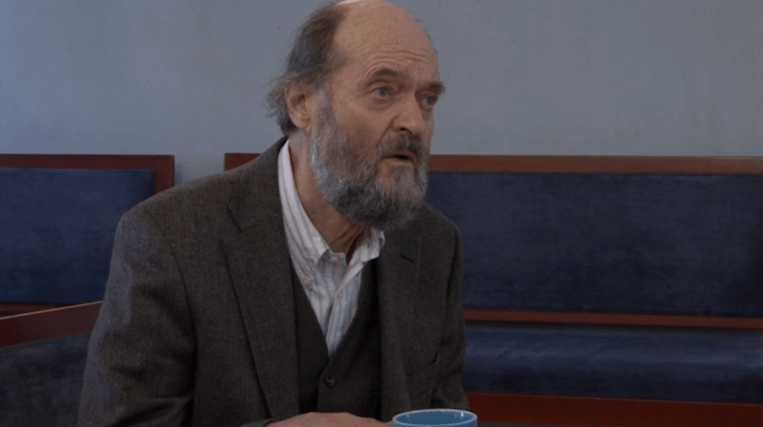
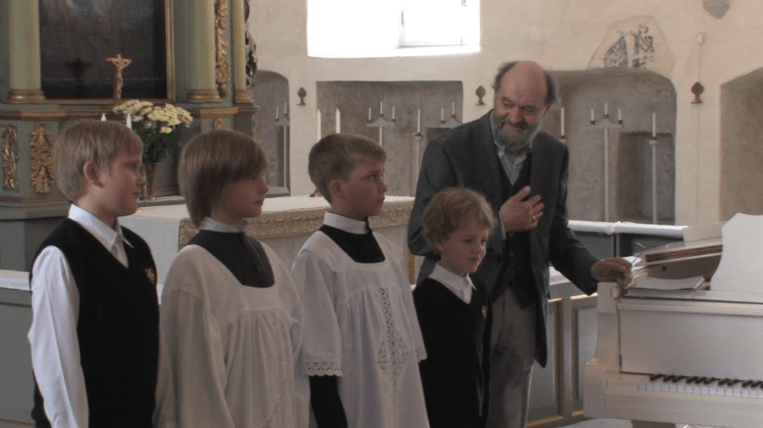
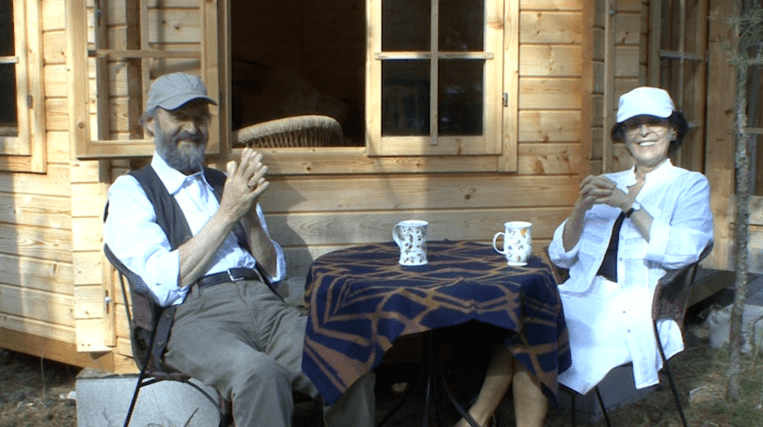
In 2011, the Old Town Music School of Collegium Educationis Revaliae and the International Arvo Pärt Centre put on a student concert of Pärt’s music at St Michael’s Church in Tallinn. Playing Pärt documents both this historic performance and the rehearsals leading up to it, supplemented by interviews with the composer and his wife, Nora.
Said concert is a charming, in-depth survey of Pärt’s legacy, and of the beauty that gives it resonance. Many pieces on the program will be familiar to ECM listeners: organ works Trivium and Pari Intervallo (the latter arranged here for four guitars), Da Pacem Domine (arranged for four recorders), and the solemn Für Alina are standouts among them. Spiegel im Spiegel, for its balance of tension and prayer, is another. Throughout, a quiet respect prevails by way of a “local” feeling that cannot be replicated in the international concert hall. These melodies, however familiar, paint even more direct lines to the heart when so endearingly performed. Like fragrances in sound, they waft through the senses, following ancient channels of memory even while forging new ones.
Delightful surprises abound. First and foremost are “The Cycle of Four Easy Dances,” from the 1959 collection Music for Children’s Theatre, including the rarely heard “Butterflies” and the evocative “Dance of the Ducklings,” replete with dissonant splashes of webbed feet. Just as alluring is “I’m Already Big,” a children’s song composed when Pärt was a student. The focus on youth feels as poignant as it does inevitable, and makes indelible impressions in such choral settings as Veni Creator (a 2006 commission from the German Bishops’ Conference), Bogoróditse Djévo (a 1990 commission from Cambridge King’s College Choir, based on a Church Slavonic hymn to the Virgin Mary), and Vater Unser (composed in 2005 and based on a German translation of the Lord’s Prayer), for which the composer at the piano accompanies a quartet of singers.
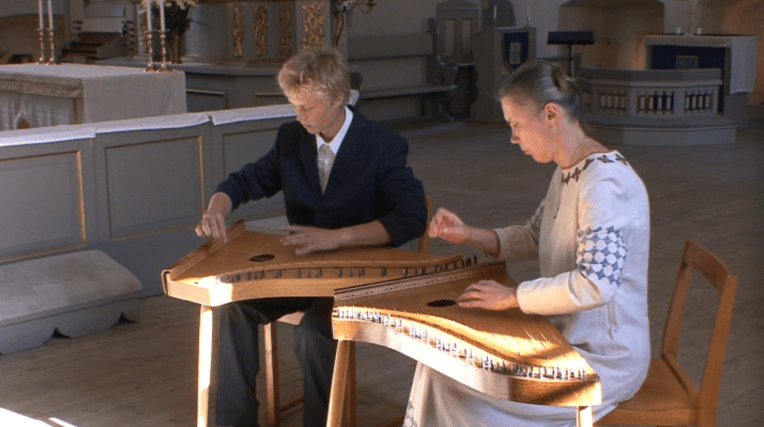
Other highlights are Ukuaru Waltz, originally composed for the film Ukauru (1973, dir. Leid Laius) and performed on two chromatic kannels (plucked zithers), the aleatoric Diagramme (Pärt’s opus 11), and Variations for the Healing of Arinushka, a solo piano piece composed in 1977 while daughter Ariina was recovering from an appendix operation. Trepidations and hope of light breathe through every note.
Yet it’s in the rehearsals where Pärt’s humilities come out in full attendance. More than providing insight into the mind of a world-renowned composer, they reveal the soul of a man whose entire concept of art is nothing without faith in eternity. He understands the quality of sound, and the beauty of it being played with heart. If anything, and for that very reason, he’s more demanding of the children’s pieces, which in all their etudinal simplicity allow the interpreter’s soul to resound. During a rehearsal of “Butterflies,” for instance, he says, “It’s essential for the music to have some kind of secret. That’s the case of the butterfly as well. It’s a mysterious creature.” For him, the rudiment is sacred.
His music has materiality, and he treats it accordingly. Whether stressing the positions of a pianist’s hands while playing Für Alina or chiding himself for inclusion of inappropriate dynamics in the original score to “Dance of the Ducklings” (upon hearing which, he exclaims, “A beautiful piece. Did I compose it?”), he upholds the value of any given moment to shape something unexpected, personal, and true.
We encounter echoes of this philosophy in his conversations with Nora. In these, the subject of the interpreter is a red thread, pulling at questions of authority versus idiosyncrasy, and concluding that one must be both strong and gentle in order to play music with genuine feeling. “It has to be born in the soul of the interpreter,” he says, for in the body thereof is something concrete and in the metaphysical thereof is something ineffable. “The composer,” he goes on to say, “can learn a lot from the interpreter.” Most musicians, Nora agrees, are unresponsive to this suggestion. It’s like trying to explain how the sun shines. Hardship, Pärt adds, helps people understand this. Children notice it, too. Hence, the concert. They are straightforward, avers Nora, whereas professionals are contending with “a thousand different traditions.” Innocence allows performers to take notes seriously. She further likens music to the optical effect of two binocular images merging into one, a simile I would extend to the listener’s relationship to what’s being heard. Countless motifs out there are waiting to blend into our own. Let this film be a reminder of our openness to the spiritually healthiest ones.
I’ve just posted a review of Elliott Sharp’s fantastic The Boreal for Sequenza 21. Sharp is a towering figure in the New York underground and a formidable composer. This is one of his finest releases to date, and includes liner notes by cellist Frances-Marie Uitti. Click the cover to discover!
Remember thy creator before the silver cord be loosed, or the golden bowl be broken or the pitcher shattered at the fountain or the wheel broken at the well. Then shall the dust return to the earth as it was and the spirit shall return unto God who gave it. –Kirill, Andrei Rublev
Bernard Oglesby is a quiet crafter. He works his trade like a night boatman, oaring creative waters with a carriage of intuition that can only come with repetition. More than the realization of experience, such action translates into the experience of realization. It can be no surprise, then, that Oglesby should cite “The Ontology of the Photographic Image” as a cornerstone of his personal expression. To one who works across media, André Bazin’s seminal 1960 essay addresses a core truth of representation that resonates through his principled output. “It is perhaps the interrelationship of past, present, and future,” explains Oglesby, “that best characterizes my underlying philosophy and it is in Bazin that I find the clearest indicator for my whole practice: that of the ‘mummy complex,’ where time is slowed and preserved through a process of embalming—or, in my case, recording—in order to transcend death.” His relationship, as of any artist, to acts of transcendence is not one of seeking and achievement, but rather of bloodletting and enmeshment. For to see the self as fallible is to necessitate unfolding into light itself.
Alongside his establishment in the fields of photography and painting, Oglesby has submerged his hands in currents of filmmaking and music. In some ways, his films are more musical than they are visual, while his music is decidedly filmic. His 2011 Mandrel, for instance, is on the surface a detail-oriented montage of foundry workers’ tasks shot in crisp black and white. But it is the incidental rhythms of said tasks that make its composition such a fine one for the senses.
The relationship between his imagistic and sonic practices is, I daresay, indivisible. “I am convinced that music is the most visual of all art forms,” Oglesby agrees, “and by its nature, nonhierarchical in its direct ability to connect with people on many personal and social levels. It was with Andrei Tarkovsky’s Andrei Rublev and the score by Vyacheslav Ovchinnikov that I began to experience and understand just how life-changing the relationship between visual art and music could be.” Yet where Tarkovsky sought to show through that classic film the artist as a hub of worldly creation, Oglesby in his own compositions is concerned with the spokes emanating from it. Like rays to a sun, each can be traced to a generative source.
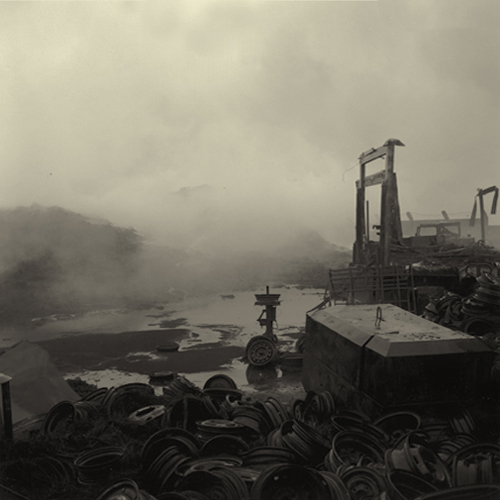
Without End (Levenshulme, 2003) Silver Gelatin Print
Mapping his musical evolution is a likeminded task and finds the young Oglesby seeking priesthood at a Franciscan monastery, where a different path was revealed to him on the cusp of retreat: “I left to become a church window designer,” he recalls, “before attending art school, where I failed my degree. It’s clear now that music formed a very important subconscious role and experience for me, as I come from a musical background with many of my forefathers and current family involved as musicians, singers, and producers.” Despite the constant evidence of music at home, and skipping over the obvious recovery from his nominal “failure,” Oglesby showed no direct interest in music early on. Film soundtracks, however, had what he terms a “deep and permanent register” in his growth as a listener, the scores of James Bernard and Bernard Herrmann being held in his highest esteem. Since then, his ears have subsisted on a contemplative diet of Frédéric Chopin, Valentin Silvestrov, and G. I. Gurdjieff. It is to the latter we might draw the darkest vein of kinship, wherein pulses a notecraft as vivid as his painted photographs.
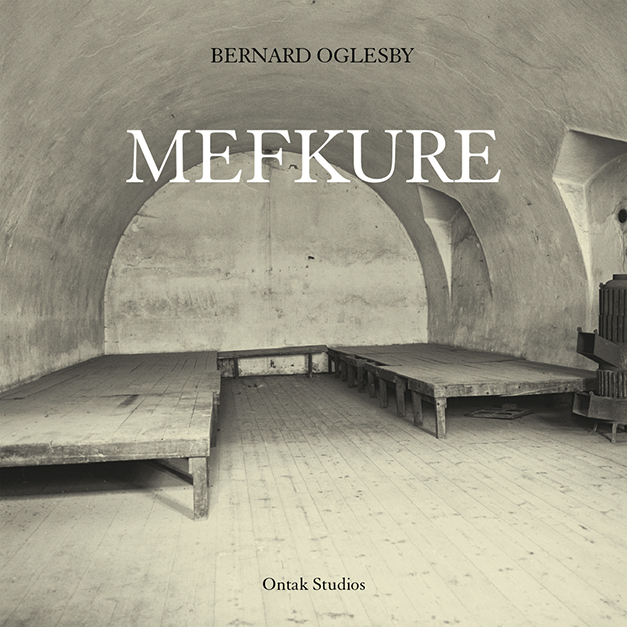
“Writing music does not come easily or naturally to me. My hand was forced as a composer, as I found the process of working with other composers extremely difficult and unproductive. A film project I was working on about the sinking of the ship Mefkure required a score to be written and produced. Unfortunately the composer for the project had very different ideas regarding the score and we constantly banged heads. At the time the production team dared me to write the score, so I did. It took 18 months locked in my studio. I approached the task as a novice and initially began learning to use a keyboard as an immediate point of entry into writing and composition. Quickly apparent was a disconnect between my practice as a visual artist and a composer, and the only way for me to reconcile this dislocation was to embrace music solely as a visual language. At this revelatory point my approach to music composition changed, as I no longer looked to the traditional structures of score writing and began to create a visual code to which I could assign sound, expression, pitch, and percussion. Since my early experiments with the Mefkure score, I have established a working method that involves extensive research centered around each project. This research includes making sound recordings, collecting stories, making short films, taking photographs, then using this material and mute boards to map out the form and context of each composition.”
Mefkure (2012) was actually the second in a trilogy built around the words of Ovidiu Nimigean (b. 1962), to whose poetry Oglesby was introduced while making a short film about Romanian immigrants digging for scrap metal just to get by: “Principally, it is his ability to invest descriptive fact with deep emotional content about the strain of death and dislocation,” says Oglesby of the Romanian writer. The minimal nature of the music is like the pitch to every gaseous ball of sentiment and finds its genesis in the forested pathos of Departe (2012).
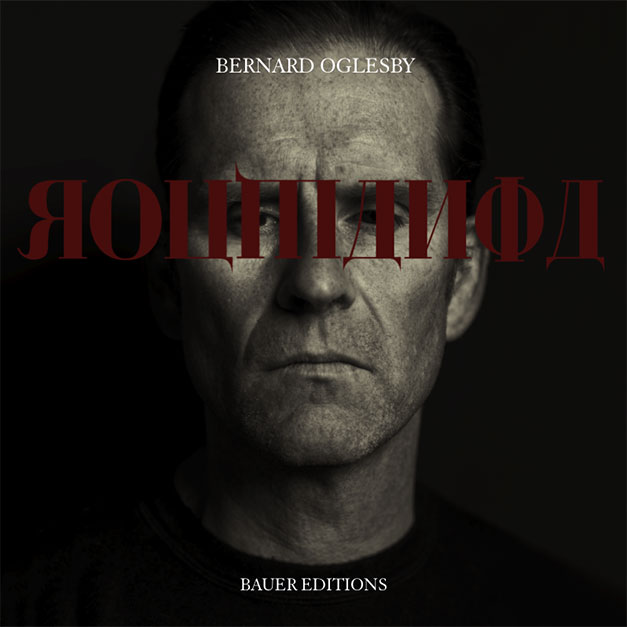
Side projects such as Torah (2013), a collection of solo piano works paralleling Erik Satie’s The Gymnopédies, and Jannah (2013), a suite for string quartet and keyboard written around the concept of original sin, followed, each appearing like an inexplicable line in a fingernail and representing a major leap inward toward the realization of compositional identity. Over the progress of that identity, Oglesby is still unresolved: “What I am clear about, however, is that those early unconscious moments, as a child, were seminal in priming me for my current creative output.” To be sure, the formative albums feel like a hermit’s sketches, their primary audience a congregation of shadows along cave walls. But with the 2015 release Roumania he has yielded a finished painting. For the composer, it “represents a moment of pure clarity, when all the elements of gestation, encompassing 15 years, come together and speak with elegance, economy, and stillness about slow time and its moral implication. The earlier, fledgling works had more of a narrative structure and graphic framework as I began to explore and test my theories about the relationship between image and sound.” The present recording furthermore completes the Nimigean trilogy.
Roumania is as much a musical construction as conversation, in this instance of and with the beloved “Ballad” for violin and piano by Romanian composer Ciprian Porumbescu (1853-1883). The original work engages the doina, a traditional improvisational form with Arabic roots. The mood of the doina is contextually dependent, and takes on devotional textures in Oglesby’s reimagining. The album’s heart pumps in a fair share of its nourishment from pieces for solo piano and prepared twin pianos scattered throughout. The musicians in question, Anton Heart and Marracha Ward, approach the playing with as much solemnity as went into the writing. At once long-tailed and close enough to hear it breathe, the music drags chains of heavy memory as it washes its own skin and hangs it to dry in a wind of reflection. There is a mental substance to its labor, which finds grayest acumen in “The 4th Way,” the title of which makes reference to Gurdjieff’s anti-institutional path to spiritual awakening. Its pigments are notes incarnate, as are those of “In Deep Silence,” which like Arvo Pärt’s Spiegel im Spiegel speaks to the untethered mind.
Roumania also makes use of field recordings. Originally taken as research for the aforementioned Mefkure but shelved for a film that never materialized, they were gathered by the composer and Janez Hovec in the lower Carpathians and Black Sea. Their addition triangulates the axes of sound and image with that of space. Lapping waves (“Night Roumania”) disguise the piano as rocky shoreline, while cries of birds (“The Black Gulls”) dislocate us from the light of dawn. Like a Theo Angelopoulos film or Eleni Karaindrou soundtrack thereof, these environments sing for time, out of time, and with a strength that cares little for numbers. In “He who loves and leaves,” vocalist Mija Aleksiss and cellist Ontak Ayer join Ward at the keyboard to mark the waters of trauma with multiple voices, each a buoy signal of vivid light.
Two pieces—“Laegan” and “From Abroad”—feature the otherworld of spoken word. In the first, Romanian poet Ana Blandiana, who is responsible for introducing Oglesby to Nimigean, reads concavely, as if her language were a cinematic fade. The piano blends into view, while holding on to the rhythms and patterns of that speech. It strikes up a chord, a dance past midnight, a melancholy that lingers whenever one can’t sleep for the dead. The second is Nimigean himself, whose lo-fi aesthetics breed hi-fi effects. He steps through a door, taking the listener outside of all clothing and shelter, until the only language left is that of breath without song.









 Between Sound and Space: ECM Records and Beyond