

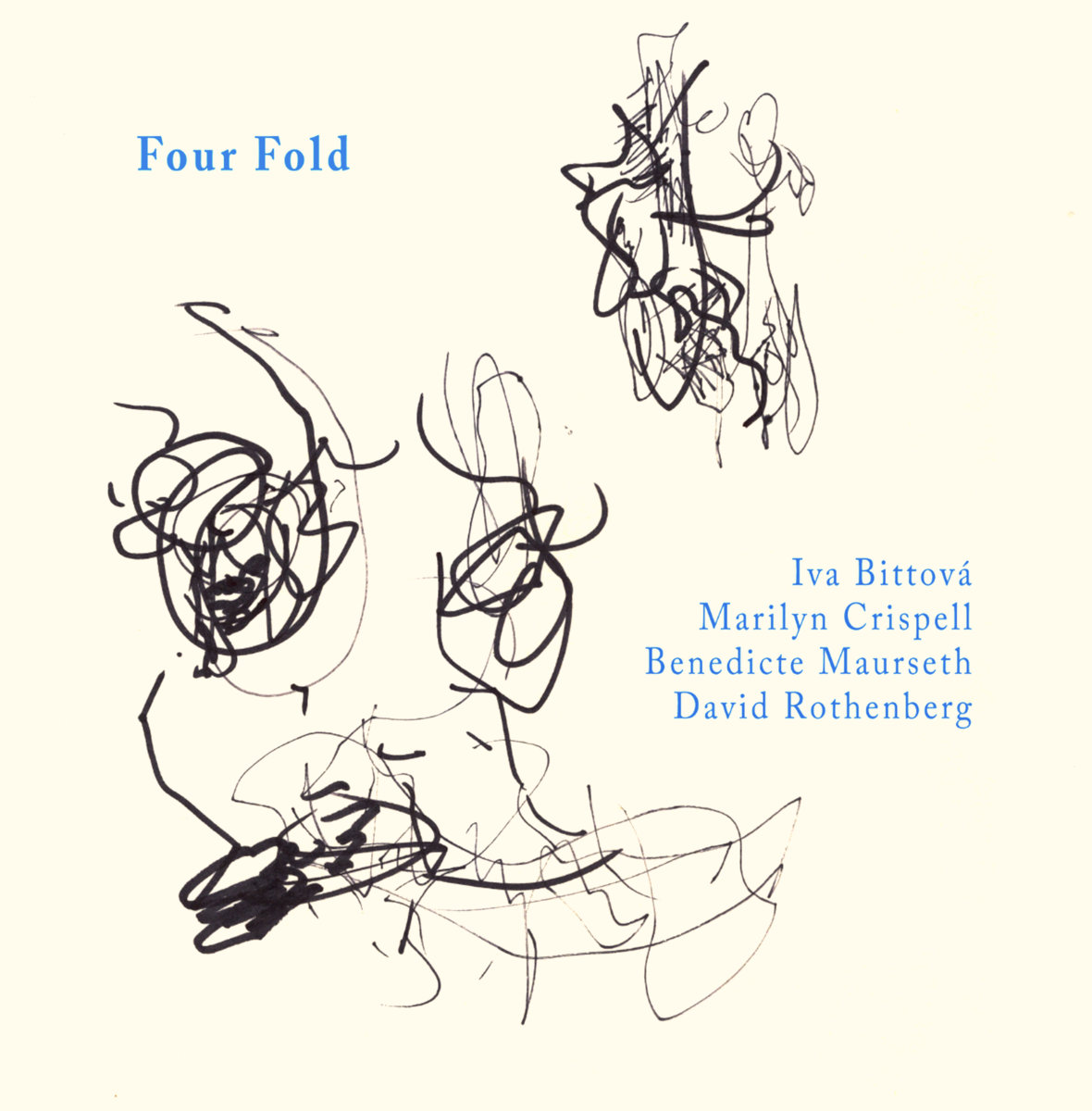
Bittová/Crispell/Maurseth/Rothenberg: Four Fold

An important aesthetic principle in ikebana, the Japanese art of flower arranging, is known as ma: the interval, the pause that holds all gestures in balance. This recording lives within that interval. Each sound is a petal in still air, its meaning found not in arrival but in suspension.

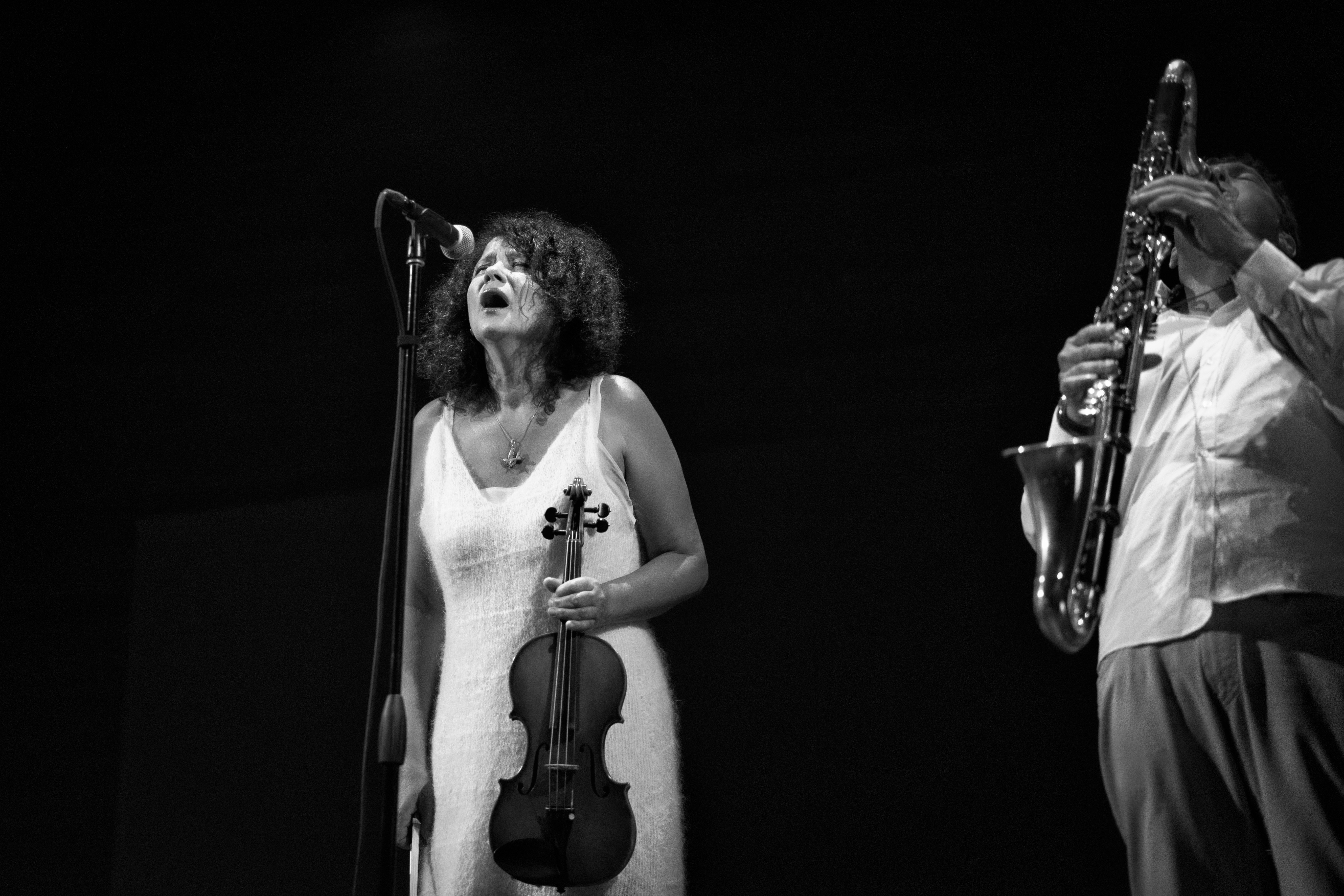
The album’s story begins at Banlieues Bleues in Paris, 2018. There, pianist Marilyn Crispell, Hardanger fiddle player Benedicte Maurseth, and reedist David Rothenberg gathered to explore the early birdsong transcriptions of Olivier Messiaen. In these notations, the wildness of the natural world first touched paper before it was tamed by harmony. A year later, Iva Bittová was added to the mix, her voice bridging word and weather.

Together, the quartet steps into the fragile terrain between music and its memory. What emerges, through years of subsequent reflection and patient shaping, feels less composed than revealed: a series of conversations with the unseen.

The first notes are a line drawn thin. Piano and clarinet trace its contour, a horizon trembling at the edge of being. From within that tremor, a voice unfurls, and the world begins its slow Folding. The fiddle answers from another time, its tone flecked with age and dust. The players seem to move by intuition, mapping silence the way birds adapt to wind: by feel, not by sight. What takes shape is not melody but the suggestion of one, a phrase on the verge of being spoken.

From the residue of that stillness, Ashlight begins to appear, pale and flickering, illumination born of what has burned away. Maurseth’s bow draws the dawn into being while Crispell drops her chords into water. Each tone contains its own echo. It neither advances nor repeats but hovers, luminous and uncertain, as if listening for its own reflection. Gradually, the instruments find each other in motion. Piano, fiddle, and bass clarinet circle in slow orbit, their lines folding inward and out again like geological strata. Hence Syncline, the meeting of two curves beneath the surface. Their rhythm is not one of time but of breath, a tide sensed more than counted. When Bittová enters, she brings something remembered rather than sung, a folk melody that the earth itself might hum when no one is listening.

In the wake of that convergence comes a retreat into intimacy. Fingers pluck at strings, keys whisper, tones barely formed—what the group calls Know No No, a study in almost-saying. Here, we behold a spiderweb of gestures catching the small debris of thought. A faint rustle passes through: the shimmer of Ruffle, where light and water trade reflections. The bow glides near silence, and the piano answers in small ripples, as if repeating the same idea in a different language. One senses communication without intention, like wind tracing reeds. And then, a sudden brightness opens the room, the solemn turning toward play.

The music leans into Anticline, the upward curve that follows a descent. Rothenberg’s clarinet teases, while Bittová answers in bursts of speech remembered from a dream. The ascetic finds her smile; the ritual learns to dance. It is here that the human reenters the sacred through joy. The air thickens again as if preparing for transformation. Out of the mix rise real-world signatures in Magpie, Moth. Rothenberg weaves them into the ensemble as if greeting long-lost kin. His bass clarinet decodes the nocturnal death’s head hawk moth, his seljefløyte joins the Australian magpie’s bright cry in an ecology of listening. The others respond in turn: piano breathing like wind through branches, Bittová’s voice flickering between the human and the elemental. For a moment, it is impossible to tell what is performed and what simply exists.

Out of this communion comes darkness. Crispell’s piano turns inward, each chord heavy and deliberate, the sound of thought imploding in sequence. Maurseth’s fiddle flashes briefly, a line of copper in shadow, and the piece known as Crinkle unfolds as an elegy for what has been touched and passed through. Here, absence finds its form, but the descent softens. From the quiet grows a song that seems to belong to no one, a Soft Fall through the air. Bittová sings as though speaking to the trees; the others move with her, their tones fragile as breath. There is no drama, only continuity, the sense that nature has momentarily found its human voice. The later pieces exist on the border of dissolution.

In Opposite of Time, the instruments scrape, sigh, and wander, seeking an equilibrium beyond rhythm, beyond structure. Here, the quartet listens not to one another but through one another. What follows is both release and return. The clarinet exhales, the piano sends a faint shimmer into the distance, and the fiddle carries us outward into Unfolding, a final gesture that feels less like an ending than an opening. A tune dissolves into the horizon, its players into the air.

When the last vibration fades, it becomes clear that this project was never about birds, nor about interpretation, but about presence: the act of being still enough to hear the world think. It is a study in attention, how breath becomes tone, how tone becomes silence, how silence, when held long enough, begins to sing.

Four Fold is currently available digitally on Bandcamp and will be on all streaming sites as of November 21, 2025.
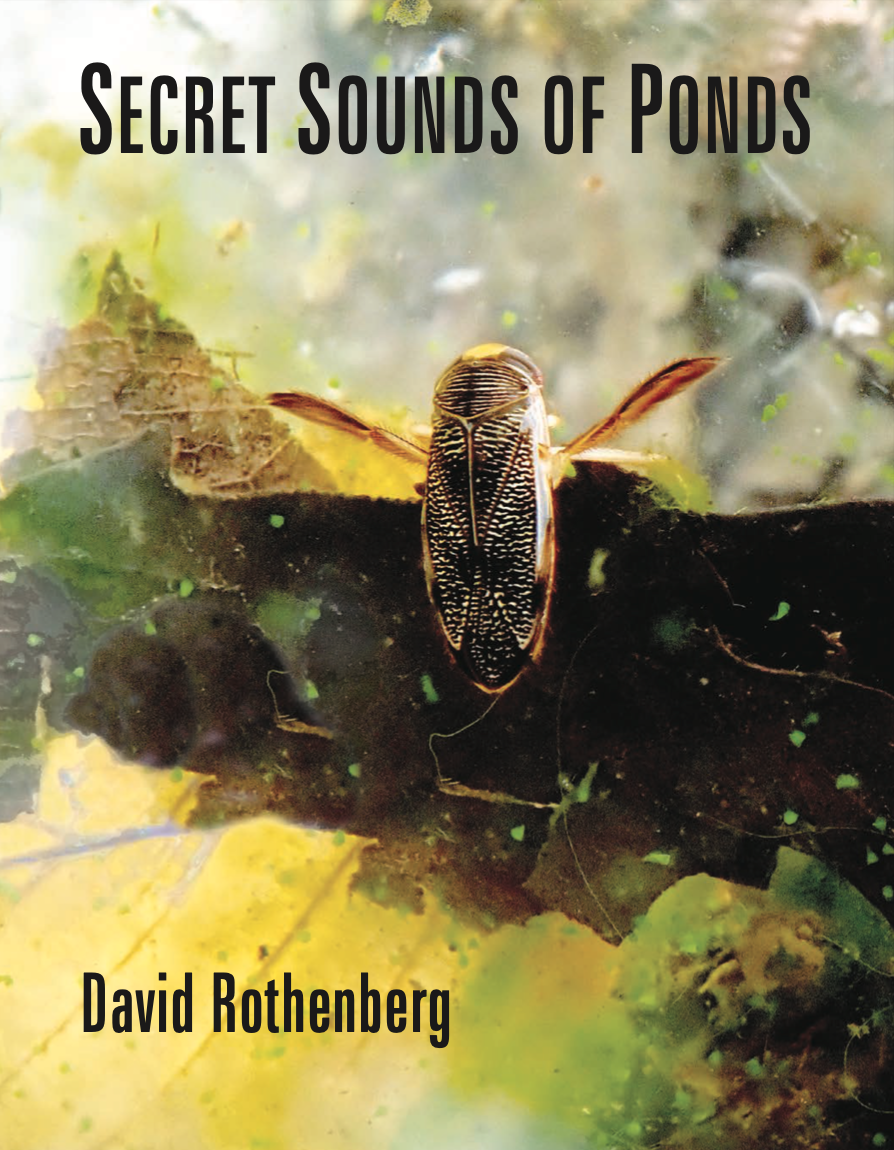
David Rothenberg: Secret Sounds of Ponds (Book Review)

“The pond is the teacher, underwater lies the source.”
–David Rothenberg

Near the apartment complex I once called home, before I migrated to my present dwelling, a pond would awaken each night in amphibious utterances. Frogs, crickets, and invisible choir members released a polyphony of chirrups and croaks that spilled into the humid dark. It was alluring enough that I found myself inventing post-meridian errands just to step outside and listen. I remember how the air trembled with that sound, neither wild nor domestic, a liminal language that both invited and eluded comprehension. I never tried to categorize it then; it was enough to be absorbed. What struck me most was its irregularity, a music without time signatures, and yet, the longer I listened, the more I could discern the soloists from within, the deliberate from the accidental. What I did not realize, however, was that this was only the surface of a deeper, secret orchestra playing just beneath my feet.

It was during the stillness of the pandemic that musician, philosopher, educator, and animal collaborator David Rothenberg turned his own attention downward. He found that ponds, those apparently placid mirrors of sky and branch, are paradoxical entities: tranquil to the eye, yet pulsing with invisible sound. Above the water, a hush. Below, a thicket of sonic life. But how does one hear through liquid? Rothenberg, already attuned to the songs of whales, found his usual instruments inadequate. He commissioned a hydrophone capable not merely of recording but of touching sound, translating the tactile shimmer of aquatic vibration into something audible. In doing so, he discovered not merely a pond but a pulse, a murmuring node within the living organism of the planet. In this submerged language, he recognized that the world itself is always breathing, whispering, and improvising at the edge of consciousness. The recordings discussed and contextualized in Secret Sounds of Ponds feel like a revelation, a form of listening that brushes the hair of the mind, a continuous and organic ASMR channel that one can tune into and out of at will.

Yet the music is not only animal. The flora, too, contribute their delicate speech: plants releasing oxygen bubbles as miniature offerings, each a syllable in an ancient conversation. “The plants keep time,” Rothenberg notes, “and the beasts carry a tune.” One hears this and realizes how naïve our auditory hierarchies have been. We’ve long believed that sound belongs to the realm of motion, of bodies and breath. Yet here are rooted beings, singing through photosynthesis, metronomes of life itself.

Rothenberg reminds us that “even in this century where everything seems possible, morphable, changeable, hearable, findable at a moment’s thought, there are still sounds around us… immediate sounds that we still don’t know.” If we are ignorant of our surroundings, perhaps we are equally ignorant of our origins. We imagine that knowing where we are going requires understanding where we’ve come from, yet Rothenberg suggests the opposite: that both the departure and destination are wrapped in the same sonic fog. Thus, we meet the limits of our perception and the possibility that such limits are spiritual. The indistinguishable becomes indistinguishably beautiful. Insect, fish, turtle, plant: all’s fair in love and pond life.

This mode of listening is not a science but a humility. It compels us to ask impossible questions. If technology must translate these frequencies for us, were we ever meant to hear them? When we call this music, do we consecrate or colonize it? Is it communion or interference? Somewhere, I imagine, John Cage laughs from the beyond, his silence perforated by the croak of a frog.

“For all the millions of hours we have spent together with animals,” Rothenberg observes, “we still cannot speak with them.” The task, then, is not to translate but to collaborate, to become co-musicians in a score that predates our language. Sound may have no intention, no recipient, and yet we crave both. We are instruments yearning for meaning, resonating for a moment before fading into the dissonance of time. Listening, as Rothenberg reminds us, “reveals things alive before we can claim them.” This is the ethical heart of the project: listening not to possess but to participate. Without that transformation, we remain voyeurs; with it, we become apprentices in the grammar of existence, learning not to compose but to decompose, to take apart what our words have wrongly fused.

I think here of Bashō’s immortal haiku, in D.T. Suzuki’s translation:

Into the ancient pond
A frog jumps
Water’s sound!

It is easy to romanticize this image, to see it as a vignette of simplicity. Yet the poem’s true profundity lies in its inversion: the pond, not the frog, is the voice; the frog merely the activator, the finger on the cosmic key. That the frog is jumping into a pond is never in doubt, yet translators have long struggled to articulate that final sound—“splash,” “plop,” “water-note,” “kerplunk”—but perhaps that indeterminacy is the point. The sound eludes capture because it was never meant to be caught. Like Rothenberg’s recordings, made accessible via QR codes throughout the book or online in album form as Secret Songs of Ponds, it dwells in the space between articulation and silence, between perception and being.

Hence the human impulse to name: to label every ripple and rustle—scratching, blipping, bubbling, warbling—as if taxonomy were intimacy. Rothenberg resists that impulse by layering his own clarinet into the watery mix, joining a chorus rather than leading it. His collaborations with Ilgın Deniz Akseloğlu, whose deconstructive poetry conjures an invented language of resonance rather than reference, push this further. Her contributions hover like dreams, vocal fragments rising from the mire of the unconscious. Listening to “I Still Don’t Get How Distance Works,” one feels time dissolving; her voice becomes an echo of the pond itself, diffused and omnipresent.

In other tracks, Rothenberg’s clarinet drifts like an inquisitive creature among the bubbles and squeaks—curious, reverent, never dominant. I am reminded of Ornette Coleman’s philosophy of sound as motion through possibility: music as exploration, not arrival. Elsewhere, the pond alone is permitted to speak, recalling early electronic composers like Ilhan Mimaroglu, who inverted futurism into introspection, aiming their microphones inward to locate the primordial hum within us all.

Most of all, I think of Akifumi Nakajima, a.k.a. Aube, whose sonic investigations of fire, air, blood, and brain waves sought the inner pulse of matter itself. To engage with Secret Sounds of Ponds is to place a stethoscope against the earth’s waterlogged chest and hear it crackle. Rothenberg confesses, “I don’t play with the pond, but the pond plays with me.” That inversion, again, is key. The artist becomes the instrument, the listener the medium. This is not music about nature; it is nature using us to make itself known.

There is a sacred vertigo in such encounters. What begins as fascination turns toward reverence, even dread, as one senses the immensity of what vibrates beneath the apparent stillness of the world. Ponds, like temples, are mirrors of our incomprehension. They draw us inward until we see that to listen is to surrender.

And so, whenever I pass a pond now, I find myself wondering not merely what lives there, but where it came from. Science offers its explanations of erosion, accumulation, and equilibrium, but the heart refuses to hear them. The mind insists on something older, more mysterious: that the earth itself opened a small mouth to breathe, and we, by accident or grace, happened to hear it.

Live Report: David Rothenberg and Friends at the Brooklyn Botanic Garden

On 21 June 2016, clarinetist David Rothenberg, cellist Hank Roberts, accordionist Lucie Vítková, and guitarist Charlie Rauh played a concert at an unlikely time (5 a.m.) with (given the hour) a less unlikely orchestra: a dawn chorus of birds at the Brooklyn Botanic Garden. In the waxing light of a cloud-obscured sunrise, trees vibrated with winged singers: the primary constant among otherwise spontaneous contributions by human accompanists. If the latter’s utterances seemed random and responsive, it was only because the former’s were so ordered and communicative—though if the performance sought anything, it was to ensure these two currents of sound production became as indistinguishable as possible.

DSC06150

The patter on leaves of a passing shower was its own sort of twittering as Rothenberg and friends shed the skins of their respective training in favor of an unencumbered style of play(ing). As the human quartet eased its way into the soundscape, a catbird joined in from a nearby bough. Though the creature’s body was as hidden as its song was naked, a thread of continuity drew itself between Rothenberg’s reed and that rogue throat, enacting a form of nostalgia that must surely have captured our ancestors long before the technology required to tell their stories was conceivable. Of said technology Rothenberg has been an artful proponent, as proven by his tactful use of an iPad preloaded with birdcalls summonable at will.

DSC06152

While each musician was in fullest support of the others, Vítková’s microscopy added much to the feel of the entire event. Whether playing the accordion, a string attached to a can, or a hichiriki (Japanese oboe), her colors meshed particularly well with Rothenberg’s. Roberts meanwhile flitted in and out of frame with his sensitive array of pizzicato and arco textures. The arpeggios by which he opened the second of two improvisations were especially moving, pointing as they did back to the magic already around us. This half of the performance was jazzier in flavor, for it manifested the interspecies blues pumping through the heart of it all. Rauh, for his part, was the most painterly of the ensemble, rendering broader scenes into which the other three might dot in their figures and villages. More than anyone, he fed on the visual aspect of the setting, attuned to the sunlight as it gained sway over fading drizzle.

DSC06155

If music predates us, it also postdates us. It is the proverbial cradle in which our brief existence raises a few melodic cries before returning to eternal slumber. And in the harmony of this experience, at least, one knew that circles of life can and do pop up when least expected, and that such opportunities are to be savored whenever they arise. This music was, therefore, not so much conversation as conservation, a chance to blur the lines between literal and metaphorical flights toward an integrated whole of which those gathered were the smallest particles.

David Rothenberg & Korhan Erel: Berlin Bülbül

Berlin Bülbül

David Rothenberg, familiar to ECM listeners through his fascinating duo album with Marilyn Crispell, has constructed one of the most idiosyncratic vessels in which to sail the waters of improvised music. He excels at expanding his own terms to suit an ever-changing roster of natural musicians. The German field recording label Gruenrekorder is the host for this rather different collaboration, which combines Rothenberg’s clarinets with Turkish sound artist Korhan Erel on computer and iPad, along with nightingales fed live from the parks of Berlin. Anyone who has followed Rothenberg’s career will know of his mythical explorations of bird song in the book Why Birds Sing and its accompanying CD. More recently he has done the same with whales and insects, but the birds have been a regular point of return.

The liner notes of Berlin Bülbül (the second word being Turkish for “nightingale”) riff off these birds’ distinct ways of singing, which mirror jazz tactics in their abilities to lead, respond, and interpolate. The album is peppered with four live tracks, which through varied levels of construction proceed to tie as much as they unravel. This sense of push and pull, most vivid in such illustratively titled pieces as “Dark with Birds and Frogs,” leads to a fleshy palette of interspecies interaction and epitomizes the porosity of music as a communicative act. Rothenberg’s ability to manifest the intangible is perhaps uncanny at first, yet more organic the more one hears it, while the details of Erel’s live samplings, the rustle of human conversation, distant sirens and other errata of the city’s soundscape cinch a cord of continuity around them. As for the birds, chirpy and reaching down to microscopic levels of resonance, they are the champions of cohabitation, each more sagacious—yet whimsical!—than the last.

The magic circle of birds and breaths, looped back in on themselves in digital ellipses, is what this album is all about. And even in the studio, their spells bear fruit. Whether lurking in the John Surman-esque bass clarinet of “A Long Note’s Invisible Beam” and “Nachtigall Imbiss” or the clicks and wing-flutters of “Unearthly Untaught Strain” and “Her Pipe in Growth of Riper Days,” the overall texture is of swamp grass and urban concrete, of trees and asphalt rolled into one gorgeous mess of songs. Erel’s manipulations only enhance this effect by revealing the inner life of Rothenberg’s extroversions, and vice versa. And while these pieces may feel like vignettes, they are lives in miniature—full troves of existence with beginnings, middles, and ends. The granulations of “Omnibus” are just as insightful as the larger brushstrokes of “From That Moonlit Cedar What a Burst,” in which even deeper rhythms externalize. But, like the bluesy reverie of “Interfused Upon the Silentness,” it always ends in the sky, riding a purple cloud of thought into another dawn.

Marilyn Crispell/David Rothenberg: One Dark Night I Left My Silent House (ECM 2089)


One Dark Night I Left My Silent House

Marilyn Crispell piano, soundboard, percussion
David Rothenberg bass clarinet, clarinet
Recorded March 2008 by Chris Andersen at Nevessa Production, Woodstock
Produced by Marilyn Crispell and David Rothenberg

In the dark I the bird can pretend, in light I am overdoing it,
pretending to be what I’m not, like art, like imagination.
–David Rothenberg, Always the Mountains

Having only been familiar with David Rothenberg through my own interest in animal studies, which had already led me to his unique book Why Birds Sing, imagine my delight when his name showed up on the latest release from my favorite label—and alongside one of its most singular talents, no less. His meditative improvisations with Marilyn Crispell have produced one of the most delightful surprises of 2010.

This album is fluid yet abstract, often devoid of melodic traction, but is bound by a certain poignancy that I find utterly engaging. Take, for example, “Stay, Stray,” which begins with airy chords but quickly turns introspective, even regretful, but is nevertheless boldly committed to its indeterminate purpose. Goal-oriented is what this music most certainly is not. Rather, it surrenders to the dynamics of the moment, to the gravity of performance, and to the possibilities of material interaction. In the latter vein, a number of tracks feature Crispell playing an old upright piano soundboard, from which she elicits a playful metallic accompaniment. It is part of her attempt, in Rothenberg’s words, to “get away from the keyboard, more into the realm of pure sound.” In tracks like “Still Life With Woodpeckers,” these sounds are blatantly foregrounded, while in others they linger like ghosts. “The Way Of The Pure Sound (for Joe Maneri)” begins with low-blown notes, sounding almost like a didgeridoo, and walks its line faithfully over Crispell’s exploratory ruminations on the very innards of her chosen instrument. “Tsering” lies somewhere between the two, featuring strings plucked with the fingertips and a few carefully placed notes on the keyboard proper. The unspoken communication between the two musicians is always clear, especially in “What Birds Sing,” “Companion: Silence,” and “Owl Moon.” Even in the more adventurous moments found in “The Hawk And The Mouse,” “Motmot,” “Grosbeak,” and “Snow Suddenly Stopping Without Notice” maintain a mutual delicacy that binds them as a whole. And it’s hard not to be won over by the frailty of “Evocation,” which sets the album adrift on a most dreamlike reverie.

Despite the nocturnal imagery implied by its title and cover art, One Dark Night fills my imagination with summer. The opening “Invocation” in particular drips like molasses in sunlight, evoking a hot and humid environment, somewhere rich in agriculture. The piano is like a planted seed, resting quietly in the soil, and the clarinet its first shoots, caressed by the wind, fed by the rain, and pulled from silence by the unblinking eye of the sun. Rothenberg always seems to be putting on a severe frown, like that of a tragedy mask—which is to say his sound is carefully sculpted and symbolic of a long dramatic history. His approach is rooted in nature and survival and rests comfortably on the organic foundation Crispell so lovingly provides. Both of them seem to grasp every ribbon of sound and to blindly follow wherever it might lead. If anywhere, this is where the darkness comes in, forging through that blindness a light of one’s own making, a certain sense of being that is internally of the night, even as it basks in the nourishing glare of its harvest. This may not be the most versatile music, but I think for the right mood and occasion it captures something that cannot be expressed any other way.