

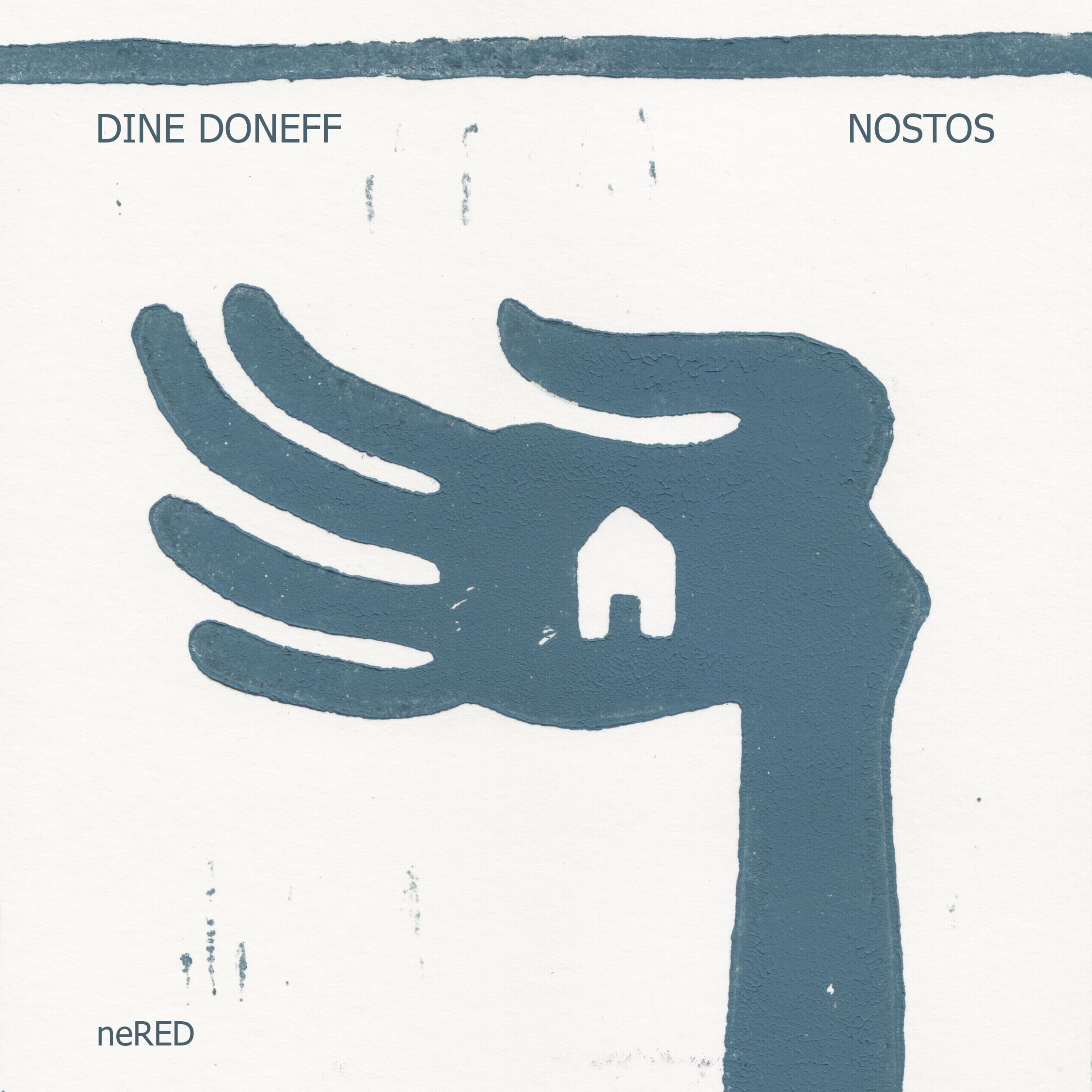
Dine Doneff double bass, percussion, lute, classical guitar, tambura, voice
Takis Farazis piano, accordion, voice
Sokratis Sinopoulos lyra
Dimos Dimitriadis flute, saxophone
Dany Hayes trumpet
Melina Kana voice
Maria Thoidou voice
Takis Kanelos drums
Manos Achalinotopoulos clarinet
Dimitris Chalkias clarinet
Dimitris Christidis trumpet
Nikos Kollias Tantsis trombone
Pantelis Benetatos piano
Nikos Sidirokastritis drums
Michalis Siganidis double bass
Recording Engineer: Yannis Tsambazis
Polytropon Studio, Thessaloniki – November 1995
Dany Hayes was recorded in Silverbold Studios, New York (1996)
Work Arranger: Dine Doneff
Cover: Fotini Potamia
Mastering: Chris Hadjistamou, Athens Mastering
First release by LYRA (Athens) June 1999
Producer: Dine Doneff
Nostos marks the opening chapter in a trilogy that has since come to define the mature voice of multi-instrumentalist and composer Dine Doneff. First released in 1999 on the Athens-based LYRA label and later rehomed by Doneff’s own neRED imprint, it is a recording that reveals more of itself with each return. Its thematic concerns, tonal palette, and ethical orientation radiate forward through Rousilvo and culminate in Doudoule. In hindsight, this debut installment feels less like a preface than a generative source.
Its title announces the central concept of return, understood not simply as physical homecoming but as a confrontation with memory, loss, and belonging. Doneff shapes this idea across two broad arcs spanning nine pieces, tracing a passage from encounter to separation and from outward motion toward interior reckoning. In doing so, the recording situates itself within the continuum of world music not as a stylistic mosaic but as a lived conversation, where Balkan, Eastern Mediterranean, jazz, and modal traditions coexist without hierarchy or pastiche.
The opening sequence begins with a spare invocation. A solitary lute establishes an atmosphere of distance and ancestry, carrying a gravity that binds the personal to the collective. From this threshold emerges an intimate convergence of timbres rather than a declarative statement. Doneff’s percussion entwines with the lyra of Sokratis Sinopoulos, while Takis Farazis’s piano follows a parallel route, at times aligning, at times drifting away. Melina Kana’s wordless vocal presence introduces warmth without tethering expression to language. What surfaces here is not certainty, but a shared willingness to move together even as divergence remains inevitable.
As the record broadens, its physical presence becomes more pronounced. Rhythms drawn from tabla and hand percussion root the sound in bodily motion, while winds and brass stretch the frame outward. The flute of Dimos Dimitriadis and the trumpet of Dany Hayes sweep across a textured accordion field shaped by Farazis, until abstraction gives way to something tactile and immediate. The audible stamp of Doneff’s boots on the studio floor, joined by voices and clapping, anchors the performance in lived space. This is tradition not preserved in frame, but reanimated through breath, movement, and communal energy.
That sense of shared experience crests in the dance-centered passages. Supported by Doneff alongside drummer Takis Kanelos, a gathering of horns and reeds conjures a celebration that feels simultaneously rooted and unbounded. Dimitriadis on saxophone and Manos Achalinotopoulos on clarinet take spirited turns as extensions of a collective pulse.
As expected, the trajectory turns toward parting. The midpoint recognizes separation as a necessary counterbalance to union. When the latter half of the program begins, attention shifts inward. With Nikos Sidirokastritis on drums and Doneff on bass, restraint and equilibrium come to the fore, favoring coexistence over confrontation. The ensuing voyage unfolds with patience, introduced by a fragile, minor-key piano figure. Brass and saxophone gain strength through persistence rather than force, their lines etched like accumulated experience into the terrain. Farazis’s solo, supported by Sidirokastritis’s tactile rhythmic foundation, arrives with a sense of earned reflection.
The closing stretch resists easy resolution. Interlaced basses, voice, piano, and accordion form a slow, shadowed progression that edges toward closure even as it slips away. Maria Thoidou’s vocal presence hovers between lament and affirmation, acknowledging that return is never a simple reversal. What follows is an uncertain space where meaning remains unsettled.
The final gesture stands alone, with Farazis at the piano. In a brief span, the closing piece compresses entire lives into touch and resonance. It suggests solitude without despair, remembrance without sentimentality. If Nostos offers a lesson, it is that return does not restore what has vanished, nor does it annul distance traveled. Instead, it proposes a way of carrying lived experience forward.
Within the wider terrain of world music, Nostos already signals Doneff’s refusal to exoticize tradition or flatten difference. His evolution as a composer and performer begins here with an ethic of attention, treating sound as a site of encounter rather than assertion. The recording does not argue for unity as sameness or identity as enclosure. It gestures toward something quieter and more enduring: that belonging is shaped through movement, through departure as much as arrival, and through the humility to return altered. In that sense, Nostos remains deliberately open-ended, continuing to resonate wherever listeners recognize themselves in its unfolding path.

 Between Sound and Space: ECM Records and Beyond