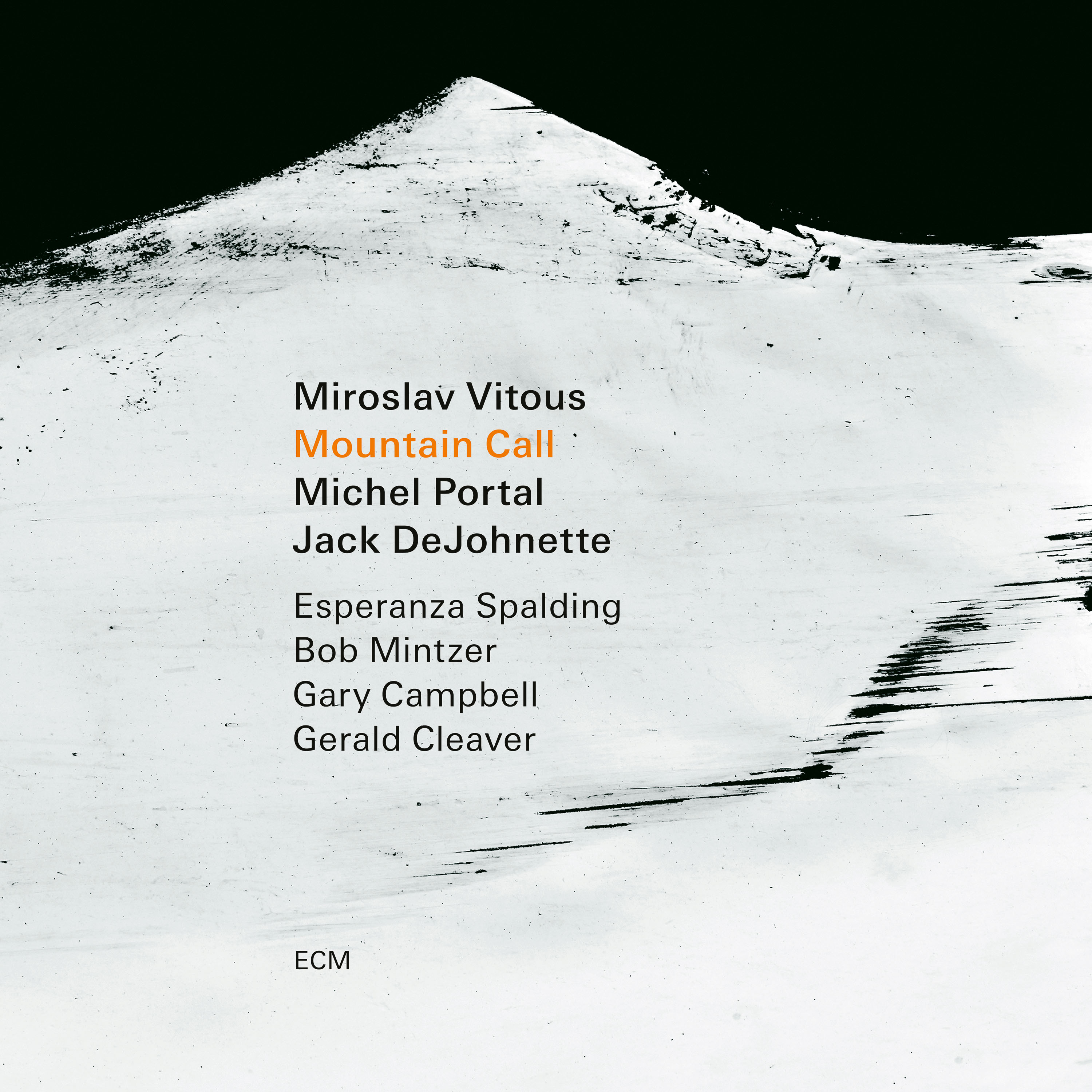
Michel Portal clarinet, bass clarinet Miroslav Vitous double bass Jack DeJohnette drums Esperanza Spalding voice Bob Mintzer bass clarinet Gary Campbell soprano and tenor saxophones Gerald Cleaver drums Members of Czech National Symphony Orchestra Recorded 2003-2010 at Universal Syncopation Studios, Prague by Miroslav Vitous Cover photo: Thomas Wunsch Produced by Miroslav Vitous and Manfred Eicher Release date: March 27, 2026
Mountain Call marks the end of a decade-long wait since the last ECM leader date from Miroslav Vitous, who presents us with a program of duets and small ensembles. Recorded between 2003 and 2010, the result is a broad portrait in detailed brushstrokes, showcasing his talents as composer, improviser, and arranger.
The opening tracks with reed virtuoso Michel Portal, who was last heard alongside the Czech bassist on 2009’s Remembering Weather Report, unfold somewhere between what is remembered and what has yet to be. “New Energy” emerges already in motion, clarinet and bass entwining in lines that bend across uneven terrain. It carries a strange familiarity, the sensation of hearing something long forgotten yet intimately known.
“Second Touch” introduces movement of a different kind, a dance grounded in continuation. Modal currents ripple beneath the surface, tinged with distant geographies, suggesting lands both real and imagined. The two instruments circle each other with a quiet understanding, travelers who have never met yet share the same destination etched somewhere on their hearts. Lines coil and uncoil, never colliding, always converging.
By the time “Unexpected Solutions” arrives, rhythm begins to pulse more insistently, Vitous drawing percussive language from the body of his instrument while Portal deepens his tone into something almost primal. The feeling is grounded and tactile. Confidence emerges here through direction, a sense that the journey requires no explanation.
That latent need for propulsion finds its answer in “Tribal Dance,” a brief yet luminous duet with Jack DeJohnette. Knowing this performance lands among DeJohnette’s final released statements lends the piece an unspoken gravity. Each cymbal touch lingers as a fading footprint, implying both immediacy and permanence. The brevity sharpens its impact, a final glance exchanged between companions before diverging paths.
The subsequent duets with Portal on bass clarinet drift inward, their abstraction guiding a descent. These pieces fill quiet spaces between landmarks, where reflection takes precedence over motion. From this interiority emerges “Epilog,” a work that expands outward while retaining its core. The orchestral sampling transforms Vitous’s voice into a chorus of selves layered across time.
With “Evolution,” the landscape widens dramatically. Joined by Bob Mintzer and the Czech National Symphony Orchestra, Vitous constructs a triptych of transformations. Strings tremble with distant force, while timpani resonate with deep structural weight beneath the surface. The music unfolds with cinematic inevitability, guided by forces that seem larger than the individuals involved. Within this expanse, the dialogue between Vitous and DeJohnette remains the axis around which everything turns (so much so that everything else feels peripheral).
“Rhapsody” introduces the voice of Esperanza Spalding, whose presence alters the album’s emotional temperature. Her singing carries intimacy and radiance, inhabiting the music from within. Vitous’s compositional touch becomes painterly here, each gesture placed with care yet open to reinterpretation. “Africa” pulses with a soulful urgency, a call that feels both personal and collective, while the closing “Lullaby” compresses an entire day’s passage into a fleeting moment, light folding into shadow with quiet inevitability.
These two larger-scale pieces are framed by duets with Portal on bass clarinet. “Delusion” pushes the mechanics of improvisation. Here, melody becomes a question, one that both musicians address in fleeting alignments that dissolve as quickly as they form. The title track concludes the journey with a return to the elemental. Vitous’s bow draws out tones that are forthright and resonant, the instrument revealing its own hidden history. There is no ornament here, no excess, only the raw exchange of sound and intent. Each phrase feels necessary, each silence earned.
These are musicians who understand that sound is produced and received in equal measure, shaped by what lies between intention and perception. Thus, the true subject of Mountain Call concerns the strange continuity that binds time together. Old paths travel with us, reconfigured with each step. Beginnings carry traces of what came before, endings open toward what cannot yet be named. Somewhere between stasis and motion, identity loosens its grip, and in that loosening, something wider than self begins to listen back.
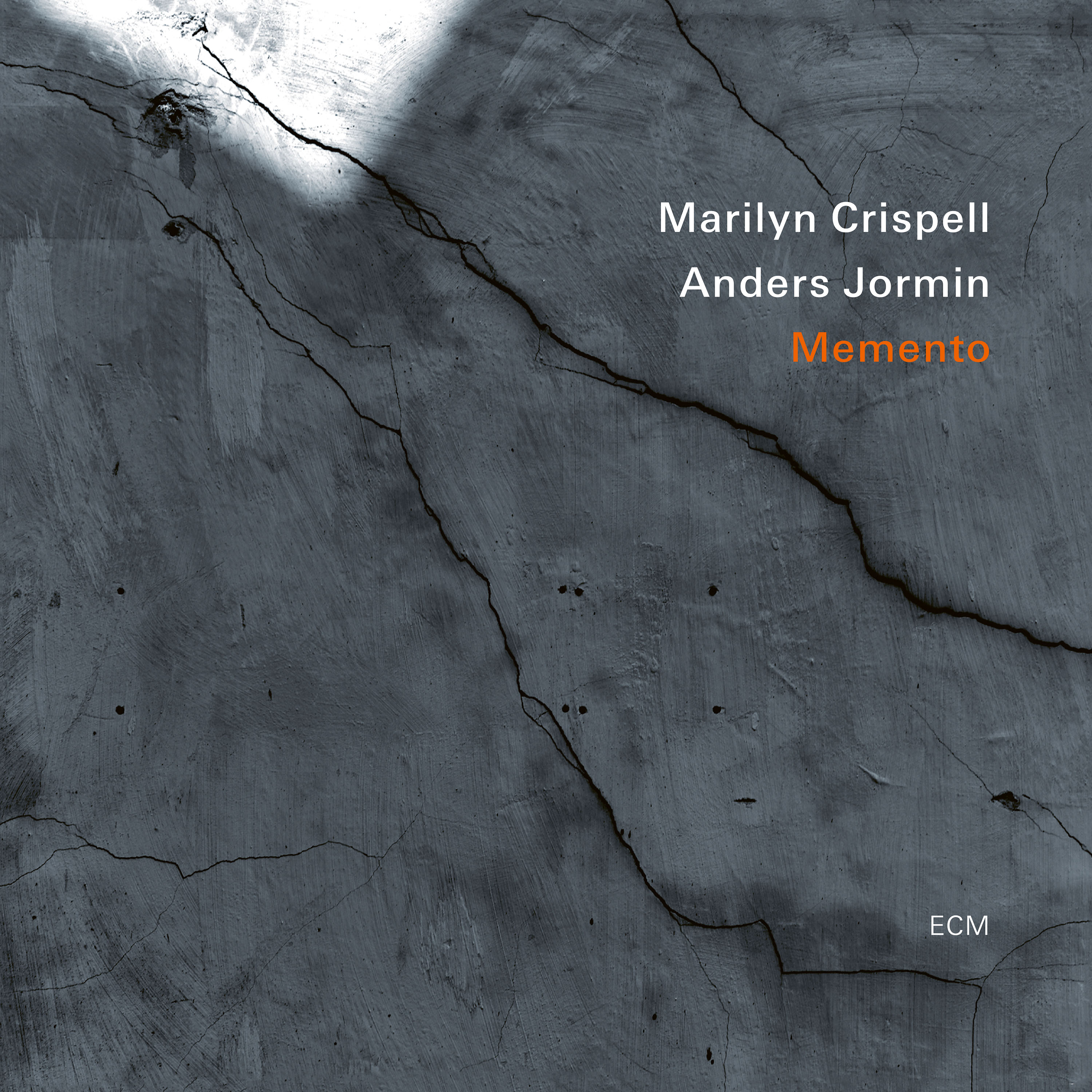
Marilyn Crispell piano Anders Jormin double bass Recorded July 2025 Auditorio Stelio Molo RSI, Lugano Engineer: Stefano Amerio Cover photo: Thomas Wunsch Produced by Manfred Eicher Release date: March 20, 2026
Memento arrives with quiet poetry, the kind that settles into the human heart of its own volition. In this first duo encounter between Marilyn Crispell and Anders Jormin, collaboration feels secondary to recognition, as if two long-circling orbits have finally aligned. Both artists carry histories that run through the ECM tapestry, yet what unfolds here feels more essential than lineage or style.
The opening sequence of improvisations awakens the album with a fragile sense of recall. Each gesture conveys the hesitancy of memory surfacing, not fully formed, yet insistent. A tender gravity settles over these exchanges, one that avoids declaration and favors suggestion. Crispell’s piano hovers at the edge of articulation, tracing lines that seem both discovered and surrendered, while Jormin’s bass responds with near-instinctive sensitivity. Their interplay unfolds like a language stripped to its essence, where every note feels earned, released only when it can no longer remain unspoken. Even moments of lightness retain a delicate restraint, a shared understanding that silence is an equal partner in the unfolding.
As the album deepens, this sensitivity becomes its guiding principle, especially in its treatment of memory. The pieces shift and refract, less like fixed compositions than terrains revisited under changing skies. Jormin’s “Three Shades of a House” embodies this quiet transformation. Its dual incarnations feel like glimpses through different windows of the same interior. The “Morning” version carries a tentative warmth, while the “Evening” rendering withdraws into solitude, its contours softened by introspection. Time alters not only the surface of the music but its inner weight, revealing how experience reshapes even the most familiar forms.
The album also gestures outward, though always through an inward gaze. “The Beach at Newquay” evokes place through atmosphere rather than description, a coastline suggested in fragments of tone and texture. Jormin’s bass releases distant calls that dissolve before they can settle, while Crispell’s piano glides like shifting light across water. The scene feels steeped in night yet illuminated from within.
What binds Memento together is its understanding of relationships as living presences, shaped as much by absence as by proximity. Crispell’s compositions, especially “Song” and the title piece, carry a clarity that resists sentimentality while remaining deeply felt. Affection moves through these works with a measured grace, tempered by the knowledge that connection always harbors the answer to its own vanishing. Jormin responds with a tone that approaches the human voice. Together, they form a grammar of care that finds strength in vulnerability, itself a source of resonance.
By the time “Dragonfly” emerges, the album has settled into something less like a sequence and more like a state of being. Crispell’s elegy for Gary Peacock allows the past to move freely within the present. The closing moments feel like a gentle release, a soft shift in the air. What remains is something akin to a shadow that no longer belongs to an object. It suggests a world where presence is always in the process of becoming something else, where even disappearance holds authorship.
Mark Turner tenor saxophone Jason Palmer trumpet Joe Martin double bass Jonathan Pinson drums Recorded April 2024 at Studios La Buissonne Engineer: Gérard de Haro Mastering: Nicolas Baillard and Christoph Stickel Cover photo: Max Franosch Produced by Manfred Eicher Release date: March 13, 2026
Following in the footsteps of 2022’s Return from the Stars, which found saxophonist Mark Turner gazing past the horizon of earthly jazz into a more cosmic register, his quartet with trumpeter Jason Palmer, bassist Joe Martin, and drummer Jonathan Pinson returns with the aptly titled Patternmaster. If its predecessor charted a voyage outward, this record feels like the mapping of constellations discovered along the way. Lines weave and bob with adroit precision while maintaining a pliant freedom that lets the occasional jab of surprise land with force. Turner and Palmer operate as simpatico melodic leads, their phrases joining and separating like a quasar whose pulse cannot be predicted but somehow feels inevitable. Turner has long been a paragon of control in tone, technical craft, and compositional balance. Yet something in these performances carries the gravity of accumulated time. The music speaks with an elder’s clarity without surrendering its curiosity. One hears not only mastery but also a widening orbit of possibility.
The album’s title reaches outward into literature through the first book of science fiction writer Octavia E. Butler’s Patternist series, a saga in which telepaths form intricate networks of shared consciousness. Butler imagined communities linked by invisible threads of perception, individuals whose thoughts reverberate through an unseen lattice of awareness. Her fiction often asked difficult questions about power, responsibility, and the fragile architectures that bind societies together. Turner’s quartet mirrors that speculative vision through sound. Each musician senses the others before the note fully arrives, improvisation functioning as a kind of musical telepathy. Melodies propagate through the ensemble like signals traveling through Butler’s imagined psychic web. Turner also gestures toward Wayne Shorter, whose own compositions often seemed to arise from dimensions beyond surface-level perception. In that lineage, Patternmasterproposes jazz as a field of relational intelligence. Ideas migrate from instrument to instrument, forming configurations that only exist because several minds are listening at once.
The title track makes that premise audible from its opening measures. A buoyant groove sets the stage while the horns present their theme with geometric clarity, every interval placed like a star plotted on a navigational chart. The rhythm section hums beneath them with gravitational assurance. The piece casts the listener’s gaze skyward toward something outer-spatial, yet its deeper pull leads inward. The connection it suggests cannot be quantified in apparent magnitude or spectral analysis. It registers in a quieter register of experience, the realm where recognition occurs before language intervenes.
From there, the bass monologue that opens “Trece Ocho” arrives like a lone satellite sending its first transmissions home. Joe Martin traces thoughtful arcs through silence, as though recording data that must still be interpreted. The tune unfolds in stages of perception, moving gradually from solitary voice to collective emergence. Each solo alters the musical environment that follows. Turner’s improvisation resembles an elegant algorithm, cascading through possibilities with luminous logic. Palmer answers with lines that tighten the weave, bringing a sharper contour to the harmonic field. Just when the music appears to settle into contemplative quiet, it erupts in a radiant final flare. Martin’s arco passages slice across the ensemble grain with exquisite articulation, a supernova of sound that briefly illuminates every corner of the quartet’s shared cosmos.
“It Very Well May Be” ventures furthest into the unknown. The groove leans toward the future with persuasive momentum, as though propelled by engines still being invented. Pinson and Martin ignite the rhythmic atmosphere with an intensity that feels both grounded and volatile. Palmer’s trumpet thrives in that oxygen, stretching its phrases with expressive daring while Turner threads agile countercurrents through the harmonic stream. Martin’s solo cools the embers and tends the kindling anew. His dialogue with Pinson’s cymbals suggests two lungs breathing through a single body of rhythm. In the wake of such combustion, “Lehman’s Lair,” named for saxophonist Steve Lehman, relaxes the tempo slightly while preserving its inner electricity. The musicians exchange impulses with the ease of charged particles colliding inside an invisible chamber. Stardust seems to enter the room, settling gently across the architecture of the tune.
“The Happiest Man On Earth” reveals another dimension of the quartet’s sensitivity. Its slow burn unfolds with patient grace, motifs drifting into alignment like planets discovering a shared orbit. Turner and Palmer circle one another with remarkable courtesy. Each phrase opens space for the other to extend its wingspan. Nothing intrudes upon the song’s unfolding. What emerges instead is a profound sense of trust, a musical atmosphere where melody can breathe without hurry.
This mood prepares the way for “Supersister,” a composition that longtime listeners may recall from Turner’s 2009 Fly Trio recording Sky & Country. Here, the piece expands into a sprawling landscape exceeding 12 minutes, with ample terrain to explore. Martin and Pinson construct intricate tessellations that support the horns’ luminous harmonies. Pinson’s extended solo deserves special mention, proliferating as it does with a kind of microbial brilliance, rhythms multiplying and mutating before being gathered back into the bloodstream. The effect resembles a cellular organism discovering new forms of life within itself. Each section of the tune carries its own perspective, its own microcosm of meaning. By the end, those fragments cohere into something larger than the sum of their parts. Martin’s bass returns to cradle the central rhythmic flame, leaving traces of abstraction that gradually resolve into a calm and congruent landing.
The result of all this suggests that patterns govern more than melody or rhythm. They shape the ways minds encounter one another, the ways attention moves through time, the ways imagination stitches together distant points of experience. Perhaps that is the quiet lesson at play. The universe may be vast beyond comprehension, yet meaning arises wherever perception forms a network. A few listeners in a room. Four musicians in conversation. Vibrations in air that momentarily align. From such fleeting constellations, whole worlds become thinkable.
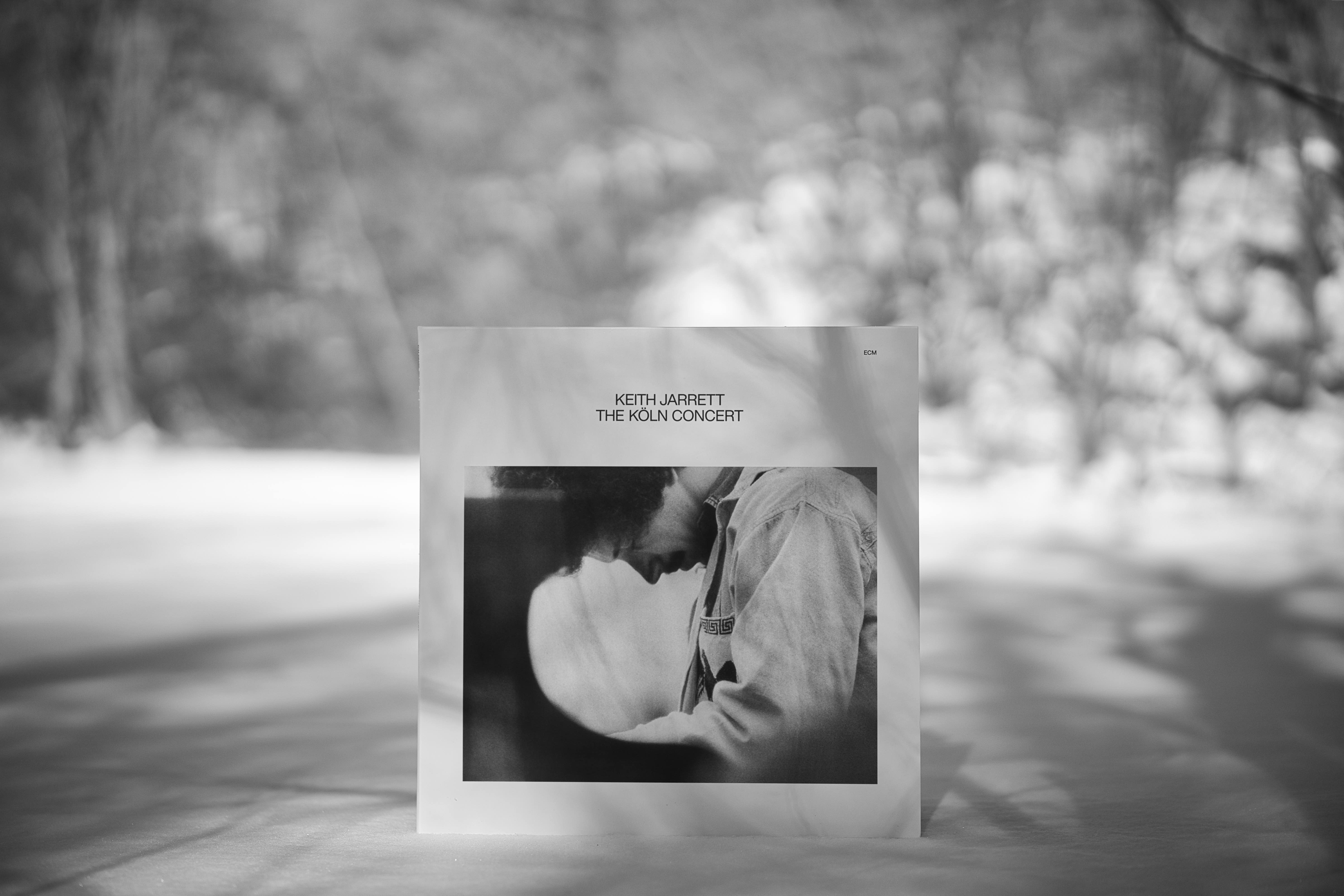
On December 12, 2025, ECM released a 50th anniversary edition of pianist Keith Jarrett’s The Köln Concert, returning one of the most unlikely landmarks in recorded music to the present age. Half a century after its first appearance in 1975, the recording remains the best-selling solo piano album in history and a resilient beacon within the ECM catalogue, an improvisation captured under circumstances so fragile that its survival feels almost miraculous. But the deeper significance of the reissue lies elsewhere. It invites listeners back to the site of a transformation. What once seemed like a fleeting document of a single evening now feels closer to a permanent warm front in the cultural atmosphere. The music continues to circulate through time, condensing into private revelations whenever someone lowers the needle or presses play.
The legend surrounding the performance is familiar. Jarrett arrived in Cologne exhausted from touring. The piano provided for the concert was smaller than expected and in poor condition, with weak bass notes and uneven action. The hour was late. But the constraints became an engine. Jarrett reshaped his approach in response to these limitations, leaning toward the middle register, carving rhythmic patterns that could carry the music forward without relying on the instrument’s wounded depths. What followed, then, was a sustained act of adaptation, a musician turning difficulty into propulsion. The result has since become one of the most widely heard recordings in jazz, classical crossover, and improvised music, though it belongs comfortably to none of those categories.
In a new essay for the edition, German journalist Thomas Steinfeld recalls how there was little to distinguish the concerts surrounding the famed Köln performance and that all of them were “an expression of a will toward aesthetic emancipation.” United under that humble, if not humbling, banner was Jarrett’s commitment to improvised-only concerts, which allowed for the fullness of nothingness to make itself heard in real time. Each evening began with an empty field and ended with a configuration that had not existed before the first note. And yet, what emerged in the confines of the Cologne Opera House on that fateful date of January 24, 1975 seemed to cut out a new eyehole in the mask of history through which a new perspective on what was achievable at the piano was revealed in a way that perhaps no musician has before or since.
Steinfeld is quick to caution us against the gravitational pull of myth. This concert was one night within a longer tour and within a longer life of music. To isolate it too completely risks freezing Jarrett in a single pose, as though the artist were merely the vessel for this one improbable event. In truth, the Köln performance was a turning point along a broader arc that led to the monumental Sun Bear Concerts, whose vast landscapes of improvisation would extend Jarrett’s language even further. What we hear in Cologne is therefore not a conclusion but a threshold, the moment when one door swings open and the wind of possibility pours through.
There is something timeless about this music precisely because it is so firmly entrenched in time, documented on tape but composed in air. The opening of Part I arrives already in motion, like a river glimpsed from a bridge rather than a spring discovered at its source. Phrases rise and fall with the tentative confidence of a bird learning the currents of the sky. The melody circles overhead, close enough that its shadow passes over us. Jarrett’s left hand begins with the quiet determination of a traveler testing unfamiliar ground. A rhythm forms beneath the surface, hesitant at first, then increasingly sure of its own footsteps.
Before long, the music finds a pulse that seems older than the instrument itself. The piano becomes a breathing creature. Harmonic light flickers across the surface while deeper currents move beneath. When the famous vamp emerges just after the seven-minute mark, it feels like a clearing in the forest where everything suddenly gathers.
Yet any sense of grandeur refuses to settle into monumentality. Jarrett dismantles the structure almost as soon as it rises, examining it from within, turning it gently in the light like an object whose inner workings remain mysterious. The music behaves as a living cell. We witness its movement, its expansion, its ability to replicate feeling from one listener to another. Its mechanisms remain hidden. The effect spreads nonetheless.
The expansive final passage of Part I, with its thick block chords and surging textures, greets the listener not as a goodbye but as a hello.
Part IIa begins with a different temperament. What began as an aerial survey of the imagination now feels grounded in the body. A rhythmic pattern settles in with irresistible buoyancy. One hears the echo of gospel, the sway of folk dance, the bright elasticity of American vernacular music filtering through Jarrett’s internal vocabulary. The audience’s energy becomes part of the current. The music dances, stumbles briefly into contemplation, then rises again with renewed vitality.
This trajectory feels inevitable, as though following a path that had always existed beneath the floorboards of the hall. The music quiets into reflection before lifting itself once more with a blues-tinged warmth. Jarrett’s playing here carries the sensation of a traveler pausing beside a river before continuing onward.
Part IIb deepens the inward pull. The left hand coils into a spiraling figure that suggests a single direction of travel. Not outward but inward. Each repetition tightens the circle until the music finds an opening at its center. From there it rises into a fierce, sunlit expanse. The harmony burns with an almost desert brightness. One senses the pianist squinting into that light, moving forward despite the glare.
Such bravery animates the entire performance. Improvisation always contains the possibility of failure. Here that risk becomes the music’s secret fuel, as each phrase steps onto uncertain ground and finds footing just in time.
Part IIc arrives like a quiet epilogue whispered after the main story has ended. Its intimacy carries a gentle radiance. The closing gestures resemble a warm hand on the shoulder, a kiss on the cheek of a wanderer about to continue down the road. What remains is a small bundle of warmth carried forward into whatever lies ahead.
It’s easy to forget that Jarrett’s performance began just before midnight, after the opera audience had already departed and the city had slipped into a quieter rhythm. Jarrett stepped onto the stage at precisely that hour when the imagination becomes receptive to rarer signals. Perhaps this is why the music radiates with such unusual clarity. Under those conditions, suspended between today and tomorrow, even the smallest musical gesture appeared luminous.
All of which leads back to the peculiar solitude at the center of the recording. A lone pianist sits before a flawed instrument and invents an entire landscape from nothing. No bandmates share the burden. No written score provides direction. The artist listens to the room, to the objects at his disposal, to the faint murmurs of possibility that hover just beyond hearing. Music emerges like mist from a valley floor.
As is evident from my first attempt to describe this music in mere human language, the recording eludes definitive characterization. Words are the cloudy sky into which it has soared over the years. However, what language fails to capture finds perfect expression in sound. The piano speaks with a fluency that criticism can only admire from a distance.
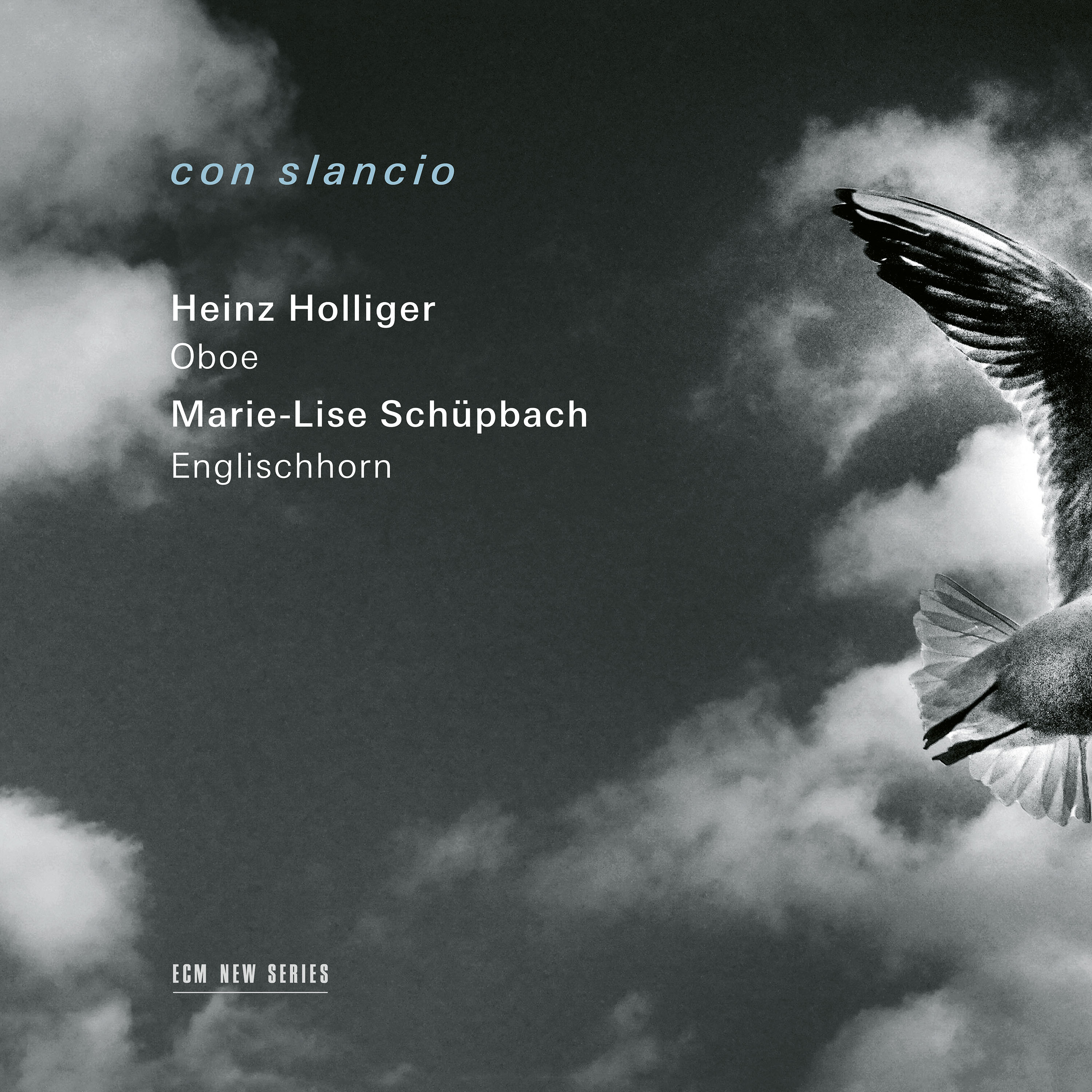
Heinz Holliger oboe, English horn, Sprechstimme Marie-Lise Schüpbach English horn, oboe Recorded July/August 2020 Radiostudio DRS Zürich Engineer: Andreas Werner Cover photo: Jean-Marc Dellac An ECM Production Release date: February 6, 2026
“I don’t want to communicate something definite, something concrete. I find music entirely unsuited for that.” –Heinz Holliger
This latest recording for ECM New Series by Heinz Holliger and Marie-Lise Schüpbach, who last appeared together on 2019’s Zwiegespräche, feels less like a recital than an extended meditation on the tremor that precedes orality. Across its span, the oboe becomes a site where language approaches, falters, and reconstitutes itself. Holliger’s return to composing for the instrument after decades of reticence gives the album its emotional and philosophical axis. In the booklet interview with Michael Kunkel, he speaks of Klangrede, a kind of sonic declamation in which music thinks aloud without becoming discourse. Rhythm for him is not a law but a mood. “Only in strict moments do I use a rigid framework,” he admits, “otherwise, I simply can’t bear it.” One hears in this a deeper suspicion of any language that hardens into doctrine. Music, he insists, is abused when reduced to a message. There is no lesson here, only a soul seeking its acoustical climate. With the oboe, that climate is paradoxical, what he calls “speaking with a closed mouth.” The entire program plays with this idea, as if testing how much meaning can survive in the face of a written score.
Holliger’s own con slancio from 2018 opens the project like a gasp before a sentence. Played by him alone, it begins with a leaping gesture that keeps missing its metrical footing. Fluttering figures scatter upward into brief star-flecks of multiphonics before dissolving into a luminous fade. Rather than announcing a theme, the piece performs hesitation itself. This sense of suspended utterance returns in his Ständchen für Rosemarie, where the English horn spars with its own desire to communicate, turning inward midway to reveal dreams that feel both candid and concealed. The two duo pieces from 2019, Spiegel – LIED and LIED mit Gegenüber (contr’air), place melody inside a hall of distorting mirrors. In the first, microtonal inflections make each phrase mishear itself, whereas the second builds nested dialogues in which the instruments appear to listen to their own thoughts while voicing them. The later works Fangis (fang mich) and à deux – Adieu, both from 2020, entwine play and specter, quick verbal-like exchanges interrupted by haunted multiphonics that sound like syllables losing their jobs.
Around these pieces gathers a constellation of works written for Holliger over decades, each treating the oboe as a dialect in danger of dissolving. Toshio Hosokawa’s Musubi from 2019, for oboe and English horn, knots the two players together only to let them unravel again. The instruments align in heart yet retain separate bodies, inventing a private grammar of crane-like calls that shed purpose precisely by insisting on it. As articulation softens, the music sinks into a subliminal murmuring. Jürg Wyttenbach’s Sonate für Oboe solo from 1961 is an entire idiom compressed into four movements. The opening juxtaposes public proclamation with whispered aside, while the second turns inward like a language translating itself into secrecy. The third becomes a virtuosic thicket in which Holliger’s upper register fractures into glittering particles before the epilogue lets the instrument split its tongue into a dance that evaporates into silence.
Jacques Wildberger’s Rondeau für Oboe solo from 1962 begins with disarming lightness, a kind of conversational sparkle that slowly acquires gravity. Higher registers awaken like excited vowels, yet beneath them lingers the anxiety that too much thought can make flight impossible. György Kurtág’s con slancio, largamente from 2019, played on English horn, answers this with austere brevity. An opening octave plunges downward into the instrument’s dark interior, brushing past a fleeting memory of Bach before collapsing into aphorism, and aphorism into an empty shell. Rudolf Kelterborn’s Duett für Oboe und Englischhorn from 2017 initially speaks in whispers but soon weaves an intricate web of gestures, a conversation that proves restraint can be the most baroque form of eloquence.
Finally, Robert Suter’s Oh Boe für Oboe solo from 1999 becomes the album’s most openly linguistic experiment. Holliger adds Sprechstimme for this recording, a personal gloss absent from the score. The spoken fragments stumble between playfulness and severity, nonsense and revelation, as if caught in a productive net of aphasia. Directions trip, recombine, and disintegrate, scattering meaning across the floor for the listener to collect, knowing that some syllables will forever be missing.
Taken together, these pieces create a cartography of inaudibility. Breath functions as syntax, timbre as grammar, silence as punctuation. The oboe emerges not merely as an instrument but as a fragile throat, perpetually on the brink of forgetting how to talk and therefore speaking all the more urgently. Music here does not replace language, nor does language dominate music. Instead, both hover in a trembling middle space where saying and sounding keep mistranslating each other.
By the album’s close, one senses that meaning survives only by remaining porous. Every phrase feels as though it might dissolve before finishing itself, and that very instability is what keeps it alive. Speech does not end in sound, sound does not end in speech. They circle one another like letters afraid of becoming words.
Aline Frazão vocals Live Maria Roggen vocals Michael Schiefel vocals Héloïse Lefebvre violin Susanne Paul violoncello Julia Hülsmann piano Eva Kruse double bass Eva Klesse drums Recorded September 2023 Hansa Studio, Berlin Engineer: Nanni Johansson Cover design: Sascha Kleis An ECM Production
Following a lineage of quartet formations, including 2025’s Under The Surface, Julia Hülsmann now opens the doors wide and lets the air rush in. With bassist Eva Kruse and drummer Eva Klesse anchoring the pulse, and the strings of violinist Héloïse Lefebvre and cellist Susanne Paul adding tensile grace, Hülsmann’s piano becomes both compass and hearth. The true masterstroke, however, is the inclusion of three voices, each bearing a distinct history and hue. Aline Frazão, Live Maria Roggen, and Michael Schiefel do not merely sing atop the arrangements. They inhabit them, converse with them, and occasionally conspire against them, for the greater good of surprise.
The album begins with an invocation. “Coisário De Imagens,” drawn from the songwriting partnership of Rosanna & Zélia, brings warmth and motion. This is music that knows how to smile without grinning. Brushed drums sway, the strings shimmer with purpose, and Aline Frazão’s voice carries the tune with organic ease. The groove settles into the body quickly, yet it never stagnates. As voices pull back, cello and piano exchange signatures like old friends swapping secrets, revealing the song’s interior logic with a quiet confidence. Thus, the listener is ushered into a world whose colors feel freshly mixed.
Frazão remains a guiding presence on two Hülsmann settings, each offering a turn of the emotional prism. “Sleep,” based on Emily Dickinson’s meditation on rest and repose, dims the lights and invites reflection. Day and night are no longer opposites here but gradients, each shade carrying its own emotional charge. The ensemble responds with restraint and intent, carving space for a bass solo that speaks with an unguarded eloquence. Hülsmann follows, her piano widening the horizon, patient yet searching, as though mapping the distance between thought and feeling. “Hora Azul,” with lyrics by Frazão herself, deepens the inward gaze. This is a song of attention, of moments caught before they slip through the cracks. A steady piano figure and gently strained strings hold the listener in place, ensuring that the insight offered does not vanish with the final chord.
Michael Schiefel arrives like a flash of theatrical lighting. On Ani DiFranco’s “Up, Up, Up, Up, Up, Up,” he revives the song from its 90s origins and gives it a new passport. Familiar contours remain, but the emotional terrain has shifted. Schiefel’s voice leans into vulnerability and abrasion in equal measure, allowing feeling to fray at the edges. A violin solo spices the mix, proving that nostalgia need not be stale. Hülsmann’s setting of “You Come Back” (with words by Margaret Atwood) sharpens the focus further. A geometric vamp populates the dance floor, and Schiefel’s diction slices cleanly through expectation, revealing scenes of emotional negotiation and unsettled bonds as energy accumulates. On “Iskele,” Schiefel contributes his own composition, rich with understated drama and a quiet electric charge. Morning and night coexist here, possibility balanced against reflection. His presence recalls the particular sort of art song and theatrical jazz that distinguishes Michael Mantler’s work, lending the album an added layer of dramaturgy.
Live Maria Roggen brings a Scandinavian clarity and a gift for storytelling that feels both intimate and expansive. “Felicia’s Song” unfolds like a memory allowed to speak for itself, uncorrected and unpolished. The instrumental center glows with Hülsmann’s melodic assurance, her piano both narrator and witness. “Moonfish Dance” lifts the tempo, introduced by playful pizzicato that clears the stage for Roggen’s imagery. There is a gentle tilt toward the surreal, a reminder that wonder thrives when routine loosens its grip. On “Walkside,” Roggen’s lyrics meet the bandleader’s music in a tender alliance. The tune rocks with a soft inevitability, carrying reflections on time, travel, and promises bent but not broken. Loss and repair intermingle, and the song trusts the listener to hold both in equal measure.
The album’s heartbeat arrives with “TicToc,” Hülsmann’s inspired setting of E. E. Cummings. Here, whimsy becomes discipline. Multiple voices articulate a spoken refrain with crystalline precision, honoring Cummings’s playful defiance of linguistic order.
By the time the final notes fade, the scope of the project comes fully into view. This is not simply a collection of songs but a carefully plotted journey, one that treats collaboration as a way of life rather than logistics. Hülsmann has assembled a community of voices and instruments that dialogue and dream together. The album listens as much as it speaks, and in doing so, it achieves a rare sense of scale. It feels lived in, thought through, and generously offered. What lingers is not just melody or craft, but the sense of having traveled somewhere expansive, a place where time, language, and sound conspire to remind us how large music can be when it refuses to stay in its lane.
Björn Meyer 6-string electric bass Recorded September 2024 Bavaria Musikstudios, München Engineer: Michael Hinreiner Cover photo: Jan Kricke Produced by Manfred Eicher
In the wake of 2017’s Provenance, Björn Meyer widens his territorial reach on the six-string electric bass with a second solo album that feels less concerned with claiming ground than with listening for its contours. His ever-deepening attunement to space and the forms that allow it to exist becomes the true subject here, and his skills are offered not as a display of mastery but as the slow emergence of a language still discovering its grammar. What might initially register as post-production illusion reveals itself, upon closer attention, to be articulated in real time through a deft choreography of live effects. Magnets prepare the instrument for unfamiliar conversations, finger tapping redraws its internal architecture, and entire washes of sound are permitted to overtake the listener in search of calm.
The album opens with its title track, setting a narrative in motion while refusing to pin it down. Each encounter reshapes the story, rearranging its implications without altering its essence. A fuzzy tone carries a gentle spirit within it, one that moves the way sediment drifts and resettles after a glass of wine has been swirled. Notes surface in reverse order, establishing a tonal context in which the debris of this slow-motion tornado can be articulated through pointillism. The resulting shape and flavor recall Steve Reich’s Electric Counterpoint, though here the patterning feels provisional, animated by a restless urge to stray just as readily as it returns. Deeper strums and higher callings exchange roles, and the sky above the music darkens by degrees, one shade at a time.
As the climate of “Hiver” briefly brightens the scene, it emits a particular quality of light, the muted radiance that arrives under an overcast sky on the verge of snowfall. In this moment, it becomes clear that the narrative forming across the album is inward-facing. This is not the documentation of a journey so much as the journey undertaken by the one who documents. When the echoing bird calls of “Drift” begin to tug at the soul, they do not ask for permission. Direction is accepted without resistance, and the listener seeps further into the flow of time, less a passenger than a dissolving witness. “Gravity” resists the comfort of arrival altogether, suspending any promise of destination in favor of an elliptical song that bends back on itself. Meyer’s guitaristic approach draws a rose’s worth of texture and fragrance from the bass, unfolding petal by petal until only the stem remains. In “Motion,” it becomes a receiver tuned to a distant transmission. Subtle glitches and pulses trace the heartbeat of another time, and when that signal falls silent, only an echo remains to confirm it ever existed.
With “On Hope,” fluttering wings and a tactile fuselage lend lift to the album’s vessel, suggesting ascent without insisting upon it. Just as the cusp seems within reach, a malfunction intervenes, pulling everything back into the improvisational clang and hum of “Rewired.” The interruption does not feel punitive but necessary, a reminder that flight depends on friction as much as flow. When the circuitry is restored and life resumes its forward momentum, “Magnétique” extends the promise of repair. Its circular motifs and palpable sense of contact arrive as a blessing to worn ears, sound reconnecting with touch. That promise finds its fulfillment in “Nesodden,” which lowers itself not into sleep but into a state of awakening, discovering tenderness in the act of becoming and allowing that discovery to stand on its own.
This music reaches us only after its initial blaze has already passed, its transient glory having dispersed into silence somewhere beyond our reach. What remains is not absence but residue, an ember glow that warms the present without explaining itself. To listen is to accept that distance, to recognize that meaning does not diminish as it travels, and to sit quietly with the feeling that something vast has chosen, briefly and generously, to make itself known.
Craig Taborn piano, keyboard, electronics Tomeka Reid violoncello Ches Smith drums, vibraphone, percussion, electronics Recorded January 2024 Firehouse 12, New Haven Engineer: Nick Lloyd Mixed by Craig Taborn, Manfred Eicher, and Michael Hinreiner (engineer) Bavaria Musikstudios, München, July 2025 Cover photo: Thomas Wunsch Album produced by Manfred Eicher Release date: January 16, 2026
After beguiling audiences during their 2025 German tour in anticipation of the album at hand, pianist Craig Taborn, cellist Tomeka Reid, and percussionist Ches Smith align their trio for ECM’s first release of 2026. The title, Dream Archives, frames the music in the most charming of contradictions. Does it propose a vault where dreams can be stored, catalogued, and retrieved at will, filed away under emotional subject headings? Or does it imply that dreams themselves function as archives, containing versions of ourselves we would never dare to perform while awake? The answer seems to flicker between both states, never settling, always indexing something just out of reach.
The opening lines of “Coordinates For The Absent” lean toward the former interpretation through their careful laying down of intent. Subtle electronic signals hang in the air, suspended as if awaiting authorization, and the piece offers itself as a puzzle box of possibility, one that opens only when the correct sequence of ambient gestures is entered. Each removal reveals another chamber until a nexus of musicianship appears that feels parthenogenetic. What unfolds is a system waking up, blinking itself into awareness.
From this tender pile of ashes rises “Feeding Maps To The Fire,” a phoenix song rendered with turn-on-a-dime precision and lightning-fast cognition. Reid circles the square, squaring the circle even, granting Taborn and Smith a territory they can claim equally with hands and feet. Her transitions from declaration to sublimation arrive with uncanny grace, functioning as a single conductive wire of intention that transmits thought across the studio in real time. Direction is fed directly into combustion here, and nothing burns without learning something new about its own heat.
“Dream Archive” opens with Smith on vibraphone doubling Taborn while Reid recalibrates the internal circuitry with a quiet furiosity that hums beneath the surface. Some of the session’s most intimate connections are forged in this space. An intelligent system comes online, discovering its cellular reality one line of musical code at a time. Still, the music never forgets the hand that writes the algorithm. There is a constant searching for connections that only breath, skin, and intention can provide. Motifs bend themselves into a twisted ballad before being pushed off a cliff, tumbling across jagged terrain, landing improbably intact, scuffed but smiling.
“Enchant” turns the night sky inside out and offers it as a writable surface, a palimpsest of the heart rendered in constellation and groove. Reid’s ostinato summons further digital traces, as though the hairs of her bow were the threads to which these signals cling, pulled magnetically toward a pulse that knows how to moonwalk away from expectation.
Set within this sea of Taborn originals are pieces by two of his guiding lights. Geri Allen’s “When Kabuya Dances” blossoms with the utmost delicacy, unfolding as a textile woven from shadow and intention. It searches for illumination in Taborn’s pianism and finds it as Reid and Smith combine their energies into ground, horizon, and sky. A stomping denouement introduces phenomenally geometric trio work, Reid on pizzicato assuming the role of bassist while Smith’s drumming speaks in joyful, articulated angles. The music smiles openly here, happiness not hinted at but announced, stamped, and joyfully notarized.
Paul Motian’s “Mumbo Jumbo” continues that spirit of play, revealing a compositional singularity in which Taborn clearly recognizes a kindred mind. Its angular melody opens the door to some of the trio’s most delicately adventurous exchanges. The tune carries a faint echo of Tchaikovsky’s “Dance of the Sugar Plum Fairy,” refracted through beat poetry, stripped of words, and filtered back into breath and wood and skin. Smith’s use of gong and timpani lends a ceremonial grandeur that never tips into pretension, offering Reid a tender surface upon which to draw her confident, decisive lines.
Ultimately, the dreamlike quality of Dream Archives does not arise from its unpredictability, nor from the way it renders the surreal inevitable. It emerges instead from the album’s theatrical intelligence. These performances understand that dreaming is an act, one that requires commitment, timing, and a willingness to forget oneself mid-gesture. The trio performs with the concentration of method actors who never break character because the character is the moment itself. In doing so, they blur the line between performer and listener, pulling us into their private syntax of meaning.
By the album’s close, the archive no longer feels like a place of storage but a living institution, one that rewrites itself each time it is entered. The dreams here are not preserved so much as rehearsed, practiced until they become fluent. When the final notes fade, it feels less as though the music has ended than as though we have woken up holding fragments we cannot fully explain. These are the kinds of dreams that follow you into daylight, that annotate your memory without permission, that insist on being remembered even as they refuse full recall. In that sense, we are reminded of how to keep dreaming with our eyes open, filing experience under wonder, and leaving the cabinet unlocked.
“I can imagine the New Series in the form of a journey: there is a route mapped out, but it is open to contingency; it does not insist on the shortest or most direct road. It allows for detours that might lead into totally different areas from the original plan.” –Manfred Eicher
There exists a particular sensibility in recorded music that refuses spectacle, distrusts haste, and listens for what emerges only when attention is sustained. It is an ethos built on patience, on the belief that sound is not merely an event but an environment and that listening is as much a moral as an aesthetic act. Within this sensibility, music is not asked to announce itself loudly or justify its presence through novelty or authority. Instead, it is allowed to exist in a state of becoming. The Compendium at hand arises from this worldview. It does not rush to explain or persuade. It invites the reader into a space where time slows, where artistic intent is inseparable from restraint, and where the deepest meanings are often carried by what is nearly imperceptible.
Producer Manfred Eicher understands classical music not as a fixed inheritance but as a living terrain shaped by memory, silence, and risk. It softens the rigid hierarchies that separate genres, eras, and disciplines, favoring instead a continuity that flows between medieval chant and contemporary composition, between written score and spontaneous intuition, between the concert hall and the solitary act of listening. The guiding conviction is that music’s truth lies not in classification but in presence. How a note is played, how a phrase is allowed to decay, how a recording captures air, distance, and stillness matters more than the lineage of the material itself. The book emerges as an artifact of this conviction, shaped by the same attention to space, texture, and inwardness that has long defined the sound world it chronicles. It stands not as a monument but as a threshold, inviting readers into a cinematic way of hearing.
To situate this volume properly requires a widening of perspective, an understanding of how recorded classical music has historically been framed and mediated. For much of the 20th century, the dominant classical record labels functioned as custodians of authority. Houses such as Deutsche Grammophon, Decca, and Philips constructed a sonic canon through monumental interpretations, star conductors, and a reverence for definitive statements. Their achievements were immense and lasting, yet their aesthetic tended toward the architectural. Performances were designed to stand as reference points, recordings as polished monuments to permanence, history rendered stable and self-assured.
Against this backdrop, the New Series emerged not in opposition but in quiet divergence. Under the wider umbrella of ECM Records, it proposed a fundamentally different relationship between music, performer, and listener. Classical music was no longer approached as a preserved inheritance to be polished and displayed but as a living continuum, shaped by fragility, curiosity, and permeability. The New Series allowed sound to be influenced by poetry, film, sacred ritual, folk memory, and contemporary abstraction without anxiety over category or lineage. It invited unfamiliar accents into familiar forms and treated unfamiliar forms with the same care traditionally reserved for the canon.
The Compendium mirrors this orientation with remarkable fidelity. Its structure resists hierarchy, favoring proximity over ranking, conversation over proclamation. Rather than reinforcing the idea of repertoire as a fixed body of works to be mastered, it presents classical music as an ongoing exchange among composers, performers, and listeners across time and geography. Each page represents a frame in a larger, evolving montage. In doing so, the book articulates a philosophy that classical music remains most vital when it is allowed to remain unfinished, receptive, and alive.
At the center of this vision stands Eicher, not as a figure of authority in the conventional sense but as a listener whose curatorial instinct has quietly reshaped the conditions under which music comes into being. His words from a 1986 interview provide more than an epigraph for this review. They function as its axis. When he describes the New Series as a journey with a mapped route that remains open to contingency, he gestures toward an understanding of artistic practice that values deviation as deeply as intention. Progress is not measured by efficiency or arrival but by attentiveness to what reveals itself along the way, detours the very means through which meaning is discovered.
This conception of music as an exploratory act underlies every page of this volume. One senses its affinities with interior monologues, the long take in cinema, the negative space of modern painting, and the instinctive pacing of the stage. Music, in this framework, does not exist in isolation. It absorbs light, text, gesture, and silence, allowing each to subtly alter its contour. The Compendium reflects this sensibility without didacticism. It does not attempt to persuade through argument or analysis. Its structure mirrors the listening experience the New Series has long cultivated, where coherence arises gradually, and conviction emerges not from assertion but from accumulated attention.
The journey begins, with a sense of inevitability rather than chronology, in Arvo Pärt. His music, austere yet luminous, does more than inaugurate the New Series. It establishes a gravity field around which much of what follows seems to orbit. Pärt’s work reintroduced stillness as a radical force in modern music, restoring silence as something charged with ethical and spiritual weight. Thus, the label’s deeper preoccupations with time, devotion, and resonance come into focus.
From there, the book proceeds composer by composer, each chapter opening onto a distinct interior landscape while remaining visibly connected to a larger constellation. Figures such as György Kurtág, Giya Kancheli, Tigran Mansurian, Valentin Silvestrov, Alexander Knaifel, and Veljo Tormis are presented not as representatives of national schools or stylistic movements but as participants in a shared inquiry into memory, loss, and the fragility of form. Many of these composers write music that feels as though it is listening backward, attentive to echoes of vanishing traditions, while remaining unmistakably contemporary. Their work often proceeds by subtraction rather than accumulation, trusting sparse gestures, broken phrases, and restrained dynamics to carry emotional and historical weight.
Taken together, these composers suggest an alternative modernism, one less concerned with rupture or provocation than with remembrance and inwardness. Their music asks how history survives in sound, how trauma, exile, and cultural erosion might be transmuted into quiet persistence. The Compendium allows these affinities to emerge organically, without forcing comparison, inviting the reader to sense the shared temperature of their work over technical minutiae.
The scope widens further with composers whose practices actively dissolve the boundaries between genres and disciplines. Heinz Holliger and Heiner Goebbels bring to the New Series a heightened theatrical and literary awareness, where music becomes inseparable from text, gesture, and spatial experience. Their contributions underscore the label’s openness to works that exist as events rather than objects. In a different but equally expansive way, Meredith Monk articulates an aesthetic grounded in directness, purity, asymmetry, and transparency. Her music, born of the physicality of the voice and the ceremony of performance, seems to distill the label’s approach into human breath and movement, reminding us that experimentation need not sacrifice intimacy.
Alongside these figures stand composers such as Gavin Bryars, Erkki-Sven Tüür, Thomas Larcher, Dobrinka Tabakova, and Eleni Karaindrou, whose work stands slightly askew from prevailing trends. Their music is neither doctrinaire nor opportunistic. It operates according to an inner necessity, attentive to lyricism, atmosphere, and emotional clarity without yielding to sentimentality. The New Series has provided a home for such voices precisely because it values conviction over conformity, allowing composers to develop long arcs of work free from the pressures of fashion or institutional expectations.
The presence of each is deepened by carefully chosen quotations reflecting on the act of composition itself, paired with portrait photographs and images from recording sessions. These reveal the human conditions under which their creations come into being, the solitude, concentration, doubt, and patience required to bring sound into focus. One senses the rehearsal room, the studio, the long hours of listening and adjustment. In this way, the book affirms one of its central truths: that modern music, at its most vital, is not an abstract system but a lived practice, shaped by time, attention, and the enduring vulnerability of those who make it.
Equally vital to this story are the performers, whose interpretations run through the New Series in quiet refrain. They are not presented as virtuoso personalities imposing themselves upon the music but as mediators who allow its inner logic to speak with clarity and force. Their artistry lies in restraint as much as command.
Artists such as Gidon Kremer, András Schiff, and Kim Kashkashian exemplify this ethic through an almost ascetic devotion to sound itself. Their performances are marked by transparency of texture and a shedding of rhetorical excess, allowing even the most fragile or fragmentary music to retain its integrity. In the case of Keith Jarrett, whose presence bridges the worlds of improvisation and composed music, the New Series reveals how attentiveness can dissolve distinctions between genres, bringing the same intensity of listening to both the written score and being in the moment. Conductors such as Dennis Russell Davies further extend this approach, shaping large forms with a sensitivity to balance and pacing that privileges inner coherence over outward drama.
The ensemble performances documented in the Compendium deepen this perspective. Groups like The Hilliard Ensemble and Trio Mediaeval bring centuries-old repertoire into dialogue with contemporary composition, revealing unexpected continuities across time through their vocal blend and disciplined stillness. The Danish String Quartet exemplifies how chamber music, when approached with collective intelligence and trust, can achieve a rare balance of precision and vulnerability. In these performances, risk is not theatrical but structural, emerging from the willingness to expose the music’s quietest tensions.
Together, these musicians embody the New Series ideal, where lucidity replaces polish and attentiveness supplants display. Their work suggests that, at its highest level, performance is morally shaped. The Compendium honors them not as interpreters of a fixed tradition but as active participants in a living one, reminding us that the future of classical music depends as much on how it is experienced in the moment as on the notes preserved on the page.
As a physical object, the Compendium embodies the visual and tactile intelligence that has long distinguished ECM’s aesthetic. Its design speaks in a measured voice, austere yet quietly radiant, disciplined without austerity for its own sake. White space is not an absence but a field of attention. Typography, sequencing, and image placement appear calibrated to slow the reader’s pace, encouraging a form of engagement that mirrors the label’s decades-long listening habits. One does not skim this book. One dwells within it, returning to pages as one might return to a recording, attentive to shifts of mood and emphasis that only reveal themselves over time.
In this way, the book becomes an extension of the recordings themselves, another site where listening is shaped by care. It aligns with an idea of art that does not rush to occupy the foreground but waits for the reader or listener to meet it halfway. The reward for this patience is depth, not as density of information but as depth of presence.
In the end, ECM New Series: A Compendium stands as far more than an anniversary publication or institutional summation. It is a sustained meditation on how classical music might remain fully alive in the present without forfeiting its inwardness or historical gravity. By expanding the very conditions under which music is performed, recorded, and heard, the New Series has quietly altered the expectations surrounding classical sound. It has shown that innovation need not announce itself loudly, that progress can unfold through refinement, patience, and a deepening of attention.
This book captures that achievement with a humility that feels inseparable from its subject. It neither proclaims a legacy nor attempts to fix it in place. Instead, it reflects a way of thinking about music as a continuing conversation with time, one that values listening as an act of openness rather than mastery. Like enduring works of literature and art, the New Series does not seek to dominate history or escape it. It listens to it, answers it, and leaves space for what has yet to arrive.



 Between Sound and Space: ECM Records and Beyond