Keith Jarrett: Bordeaux Concert (ECM 2740)

Keith Jarrett
Bordeaux Concert

Keith Jarrett piano
Recorded live July 6, 2016
at Auditorium, Opéra National, Bordeaux
Producer: Keith Jarrett
Engineer: Martin Pearson
Mastering: Christoph Stickel
Cover photo: Max Franosch
Executive producer: Manfred Eicher
Release date: October 14, 2022

Every new release of a Keith Jarrett recording activates something old—ancient, if you will. By this, I mean to suggest that his immaterial approach to a resolutely material instrument invites us to appreciate the synergy of being and non-being. To experience his notecraft, whether in person or via ECM’s relentless charting of his footsteps, is to understand that a physical body is required to interpret even abstract realities. And in the 13-part odyssey we have here, we encounter one of the most spiritual gifts to take flight from Jarrett’s fingertips.

From the same tour that brought such wonders to light as Munich 2016 and Budapest Concert comes this July 6th performance at the Auditorium de l’Opéra National de Bordeaux. In this spontaneous mosaic of waves and dissolutions thereof, he articulates an ocean’s worth of expanse. If Part I can be said to burst forth as if in need of being heard after a long silence, Part XIII intones the whisper of low tide. Between them, he unleashes a rhapsodic account of muscle and morality.

Flexibility is central to these pieces in the making, nowhere more so than in Part III. This breath of fresh balladic air is road music for the heart. There’s something painfully final about it, a tearful evocation of mortal ends. It also passes on hope to those left behind. Occasional dissonances hint at bittersweetness, always returning to the foreground with bits of the past polished and placed carefully on an altar for the future.

So begins a grand sequence of somber inner visions. Without ever losing sight of a certain playfulness of childhood (as in the spiral staircase of Part V), he navigates hymnal block chords (Part VI) and savory vamps with grace. Crooning his way through the valley, he ensures that beauty never becomes an idol. For while the lyrical fulcrum of Part VII, for example, veers into sunlight, Jarrett is quick to don the shades of Part VIII, bringing temperance such as only the blues can claim.

But if the feeling of farewell peaks in Part XII, it’s only because the destination is nearer than our point of departure. In such moments, we step outside of time, wearing it like a coat. We can reach into any pocket and pull out an episode of our lives, slicing away at infinity like a doctor in search of a cure.

Ralph Alessi Quartet: It’s Always Now (ECM 2722)

Ralph Alessi Quartet
It’s Always Now

Ralph Alessi trumpet
Florian Weber piano
Bänz Oester double bass
Gerry Hemingway drums
Recorded June 2021, ArteSuono Studio, Udine
Engineer: Stefano Amerio
Mixed December 2022 at Radiostudio RSI, Lugano by Manfred Eicher and Stefano Amerio
Cover: Fidel Sclavo
Produced by Manfred Eicher
Release date: March 17, 2023

Trumpeter Ralph Alessi returns to ECM with his fourth leader date for the label, this time with a newly minted European quartet that reflects his relocation to Switzerland in 2020. Alongside Florian Weber (piano), Bänz Oester (bass), and Gerry Hemingway (drums), he carves out a vivid baker’s dozen of original material.

“Hypnagogic” not only sets a tone but also establishes the album’s heart, the veins and arteries of which are traced with anatomical faithfulness by Alessi and Weber. It’s one of a handful of duo turns (including the subcutaneous title track) building on their nearly 20-year relationship as sonic allies. Abstract yet comforting, their dialogues feel like waking from a dream yet holding on to its fading tendrils. The effect is such that when the light of “Migratory Party” reveals a rhythm section trailing an even longer history, the band’s ability to balance independent voices and melismatic intermingling reigns supreme.

Both as musician and composer, Alessi creates constant washes of color. Whether in the groovier strains of “Residue” (a fantastic testimony of Oester’s talents) or in the nocturnal urbanism of “The Shadow Side” and “Diagonal Lady,” he navigates every moment as a director would a scene of actors improvising within a loose script. The latter two tunes have a three-dimensional feel that yields the album’s deepest magic.

When at its most forthright (“His Hopes, His Fears, His Tears” and “Everything Mirrors Everything”), the band swings forward and backward rather than side to side, while the dramatic resolution of “Hanging by a Thread” leads perfectly to the concluding “Tumbleweed,” bringing us back to where it all began.

(This review originally appeared in the April 2023 issue of The New York City Jazz Record, a full PDF of which is available here.)

Enrico Rava/Fred Hersch: The Song Is You (ECM 2746)

Enrico Rava
Fred Hersch
The Song Is You

Enrico Rava flugelhorn
Fred Hersch piano
Recorded November 2021
Auditorio Stelio Molo RSI, Lugano
Engineer: Stefano Amerio
Cover: Fidel Sclavo
Produced by Manfred Eicher
Release date: September 9, 2022

Pianist Fred Hersch makes his ECM debut in intimately grand fashion with maestro Enrico Rava on flugelhorn. Their meeting at Lugano’s Auditorio Stelio Molo RSI yields some of the most effortless jazz you’ll likely hear this year. Hersch’s opening embrace eases us into Antônio Carlos Jobim’s “Retrato em Branco e Preto” as if the set could open no other way, fanning expository poetry in place of lantern flame. An old-town quality prevails, navigating cobblestone streets on tiptoe yet never losing its footing.

Contrary to immediate expectation, this is followed by a free improvisation, which tempers the familiar with new shades of meaning. George Bassman’s “I’m Getting Sentimental Over You” gets a delicate and rhythmically endearing treatment, while the title track by Jerome Kern is enigmatically transformed into a crystalline snowdrift of memory. Thelonious Monk’s “Misterioso” walks a fine line between dream and reality, giving way to artful abstractions that reveal two minds with lifetimes more to say, as do the originals that precede it. Whereas “Child’s Song” (Hersch) conveys innocence with a nostalgic, summery feel that harks to yesteryears, “The Trial” (Rava) renders an entanglement of spiral staircases and other modern architectural details. All of this leaves Hersch alone with “’Round Midnight,” floating into the promise of a new day, uncertain though it may be.

These musicians achieve the extraordinary by sounding like one unit without sacrificing their voices. They dance as few know how, unfolding a love letter one page at a time until only a wax seal seems appropriate to protect its contents from the sun’s bleaching touch.

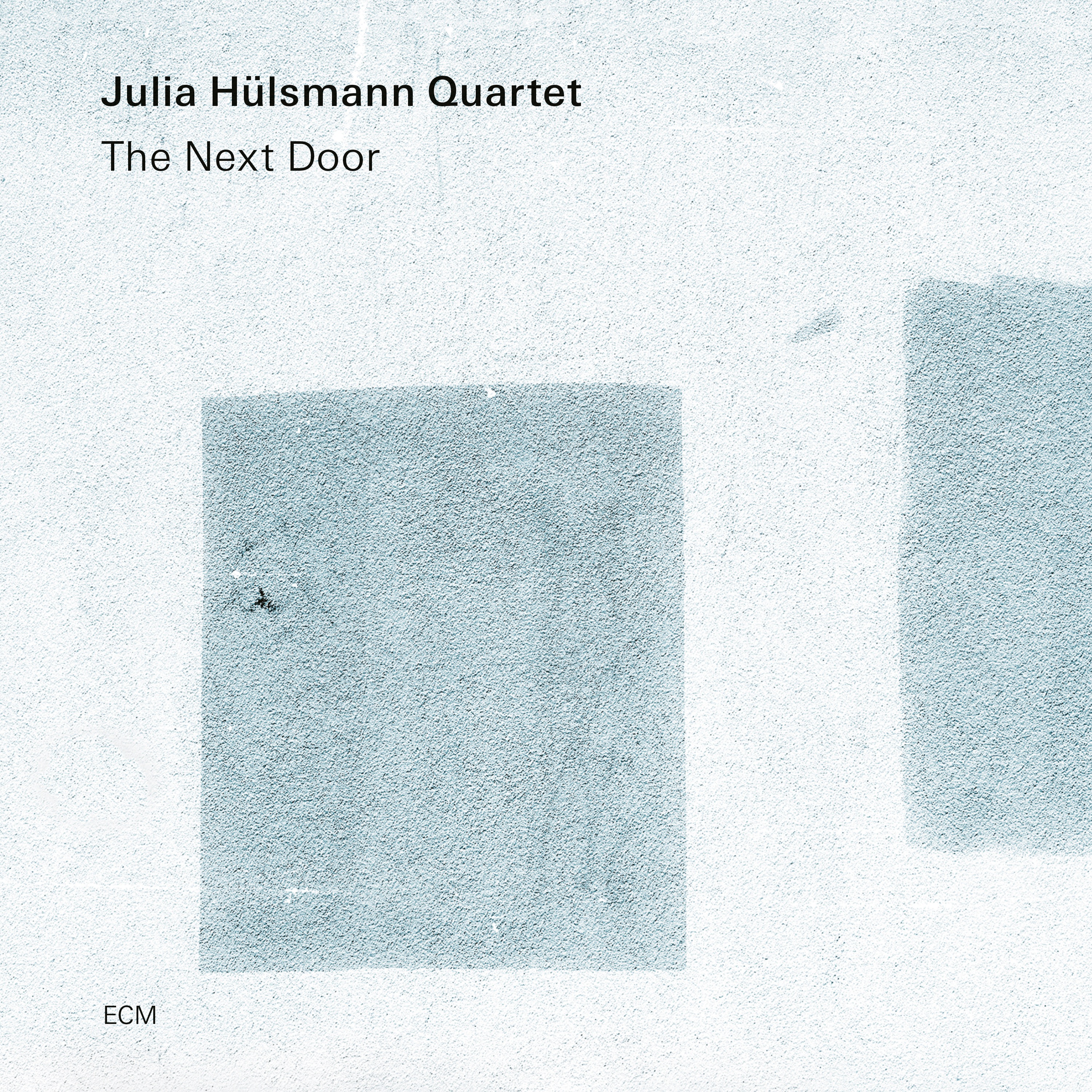
Julia Hülsmann Quartet: The Next Door (ECM 2759)

Julia Hülsmann Quartet
The Next Door

Uli Kempendorff tenor saxophone
Julia Hülsmann piano
Marc Muellbauer double bass
Heinrich Köbberling drums
Recorded March 2022
Studio La Buissonne, Pernes-les-Fontaines
Engineer: Gérard de Haro
Mastering: Nicolas Baillard
Cover photo: Thomas Wunsch
Produced by Thomas Herr
Release date: August 26, 2022

Although Julia Hülsmann has crafted a hearty sequence of trio records for ECM, including 2017’s Sooner and Later, there has always been something even more intimate and honed about her quartet with tenor saxophonist Uli Kempendorff, bassist Marc Muellbauer, and drummer Heinrich Köbberling, as is refreshingly obvious throughout “Empty Hands,” in which Hülsmann throws notes like petals onto the waters of life to see where they might flow. As they did on this album’s predecessor, Not Far From Here, these effortlessly attuned musicians navigate her sound with familial affinity. After “Made Of Wood” deconstructs the introductory mood, a melodic breeze wafts over the keys, carrying over into “Jetzt Noch Nicht.” Taking two forms—initially as a duet with Kempendorff, later as a swinging outing for all four—it delicately offsets tracks like “Fluid,” an emblematic realization of their capabilities that rejoices in the ongoing moment.

Muellbauer contributes three originals with a more geometric approach to time and harmony. In his “Polychrome,” the piano is a wavering shadow, the saxophone a refraction of light stepping sideways past us, while in “Wasp At The Window,” a locomotive whimsy ensues. The landscape outside our window remains the same, but its description changes along the way. Hülsmann’s ability to carry so much cargo in so fine a mesh is marvelous. Kempendorff and Köbberling offer a tune apiece. The former’s “Open Up” balances emotiveness and restraint, and the latter’s “Post Post Post” is a standout for its liminal expressivity.

No Hülsmann set would be complete without an ode to the popular canon, and her reading of Prince’s “Sometimes It Snows In April” is no exception. With charming comfort, it promises hope at the end of a long and harmful tunnel that none of us saw coming.

Paul Giger: ars moriendi (ECM New Series 2756)

Paul Giger
ars moriendi

Paul Giger violin, violino d’amore
Marie-Louise Dähler harpsichord, chest organ
Pudi Lehmann gongs, percussion
Franz Vitzthum alto
Carmina Quartett
Matthias Enderle violin
Susanne Frank violin
Wendy Champney viola
Stephan Goerner violoncello
Recorded January 2015
Chiesa Bianca, Maloja
Engineer: Peter Laenger
Guggisberglied was recorded 2021 in Walenstadt
Cover photo: Jan Kricke
An ECM Production
Release date: August 26, 2022

The music of Paul Giger became a part of my blood when I first encountered 1989’s Chartres. Not since J. S. Bach’s Sonatas and Partitas had I understood just how architecturally robust the violin could be, to say little of 1993’s Schattenwelt, which introduced his violino d’amore, a custom instrument with five main and six sympathetic strings. If those early albums were temples of the spirit, then ars moriendi is a waystation of the flesh—if not vice versa. The ambiguity of such distinctions gives the album a timeless charge. Across the pages of its cavernous imaginings, Giger writes a real-time scripture of inspiration, building on echoes of lives before and since.

His mythologically tinged Guggisberglied, reinterpreting a popular Swiss folk song of unrequited love and the life one gives up in its name, follows a tracking shot of the human form, shifting in varying degrees of inevitability between innocence and decay. Cradled by the hush of flowing water, what we once saw as shadows are now the shadows of shadows. Such subtlety of framing and placement of subjects is possible only in one whose mind works as a camera. Giger looks within from without, the tones of other cultures beating his drum. The violin body is a percussive force, a multitracked orchestra of emotional instruments. Giger also plucks the lower strings in qanun fashion. Currents of molecular awareness caress the riverbank, praying for a peaceful transition into lifelessness.

The latter sentiment connects to the overarching title. “In the late Middle Ages,” explains Giger in a liner note, “a literary genre of devotional books illustrated with woodcuts flourished under the name ‘ars moriendi.’ They gave instructions on how to ‘die well.’ The purpose of this tradition was to attune the soul to the ‘art of dying’ in order to save it for eternity. Music is also an ars moriendi, an exercise in the ‘becoming’ of a note, of ‘being’ in sound and of ‘passing’ into silence—or into an inner reverberation.” These concepts refer to a triptych of Tyrolean painter Giovanni Segantini, subject of the eponymous documentary by Christian Labhart, for which Giger wrote the music. Selections from that soundtrack take up much of the present album, including three stages of Agony. In the company of percussionist Pudi Lehmann (gongs, singing bowls, frame drum, and conch shell), keyboardist Marie-Louise Dähler (harpsichord and chest organ), and the Carmina Quartett, he builds a tower of wonder one layer of stone at a time until time itself is suspended. As ice dissolves into water and further into steam, the violino d’amore opens light to reveal its individual colors, loosening the bonds of the material within the immaterial through the inherent art of refraction. Zäuerli mit Migrationshintergrund is rooted in the Swiss yodel, harking to 1991’s Alpstein, albeit in far subtler clothing.

Transcriptions of Bach carry over from the film, including two for violin and harpsichord (the choral prelude “Ich ruf’ zu dir, Herr Jesu Christ” and the Largo from the Sonata No. 4 in c minor), angling the mirror of our lives into a cell of collective memory where melodies play on repeat. There is also “Erbarme dich” from the St. Matthew Passion, as sung by alto Franz Vitzthum in a breathtaking arrangement for violin, chest organ, and strings. Vitzthum’s beauties culminate in Giger’s Altus solo II, stitching ground to sky with threads of silver. In the harpsichord’s tactile light, a mournful catharsis takes shape. Like M. C. Escher’s Rind, it suggests a face. Whether forming, unraveling, or holding its own against a patchwork of clouds, its eyes remain fixed on memory.

Heiner Goebbels: A House of Call (ECM New Series 2728/29)

Heiner Goebbels
A House of Call – My Imaginary Notebook

Ensemble Modern Orchestra
Vimbayi Kaziboni conductor
Recorded September 2021
by Bayerischer Rundfunk
Prinzregententheater, München
Engineer: Clemens Deller
Recording engineer: Gerhard Gruber
Mixed and mastered by Clemens Deller, Heiner Goebbels, and Gerhard Gruber
Cover photo: Gérald Minkoff
Executive producer: Manfred Eicher
Release date: August 26, 2022

With A House of Call, Heiner Goebbels peels back his most significant layer of multimedia music for the stage. This self-styled “imaginary notebook” incorporates archival recordings of prayers, songs, and other speech acts into dialogic relationships with a full orchestra. Much of what we hear is old and anonymous, barely hanging by a thread of preservation and never imaginable in a concert setting. And yet, here it all is, wired together like some elaborate lie detector of our shared past, pinging with increasing frequency to signal every denial of complicity by proxy. Tempting as it might be to view such a project through an archaeological or ethnographic lens, to do so would strengthen the very contradictions it wishes to dilute in its reckonings of time and place. “The music is a direct response to the complexity and roughness of the voices,” says Goebbels in his liner note, pointing also to the radiance thereof against the opacity of present traumas.

Across four thematic assemblages, the Ensemble Modern Orchestra, under the direction of Vimbayi Kaziboni, draws upon an intimate relationship with Goebbels to bring his vision of death to life. Part I, “Stein Schere Papier” (Rock Paper Scissors), cites Pierre Boulez’s orchestral work Répons as foundation, magnifying its call-and-response principle with glimpses of Goebbels’s art rock band Cassiber from the same period (the early 1980s). The initial stirrings of a privileged crowd indicate the biological venues we often fail to maintain. The instrumental colors are fluid, attentive to detail, and indicative of various styles pouring from many portals at once. The story of Sisyphus, as retold in Heiner Müller’s “Immer den gleichen Stein” (Always the same stone), wraps the orchestra in a chameleonic skin. And as the street noise of a Berlin building site from 2017 stirs up a vortex of unread manifestos, faded newspapers, and other detritus, we begin to treat all words as fair game.

Part II, “Grain de la voix,” borrows from the Roland Barthes essay of the same name, in which the French philosopher asserted the power of language to shield oneself against the glare of mortality. Ghosts from the Caucasus region open their lungs, strings trembling beneath the surface as a violin leaps in sporadic response. Thus, the hypocrisy of destroying the questions of culture to answer them is outed. When more modern recordings, like that of Iranian musician Hamidreza Nourbaksh intoning Rumi from 2010, reveal themselves, they take on a volition that blinds the orchestra’s feeble attempts at imitation. The juxtaposition is critically self-aware, a score written in scars. The evocation of Komitas and Armenian soprano Zabelle Panosian hints at the spiritual planes being razed in addition to the physical, as scrutinized in Part III, “Wax and Violence.” The title refers to the wax cylinders weaponized by pseudoscientific ideologues whose voracious appetite for the “exotic” was only the beginning of their consumption. In particular, Hans Lichtenecker’s xenophobic aural documents of the very people German soldiers would later destroy through genocide pull us by the ears. A recording of school children in the Namibian village of Berseba is even more haunting and spawns a big-band catharsis—if falsely so called, for what do we have to be released from by comparison? The effect is even stronger in the laments and incantations of Part IV, “When Words Gone,” wherein Amazon rituals conducted in lost languages blend into lines from one of Samuel Becket’s last texts amid digital whispers.

The danger of all this is reading the wrong kind of sorrow into everyone we hear. We latch on to familiar names like life preservers, forgetting that the nameless have been speaking truth all along. And so, while it would be easy to call this the pinnacle of Goebbels’s work, it might be more appropriate to see it as his valley of the shadow of death. We walk through it, guided by hands unseen, in faith that hope awaits us on the other side. But to get there, we must be willing to face the hostile forces of collective memory, thick with the mud of misunderstanding.

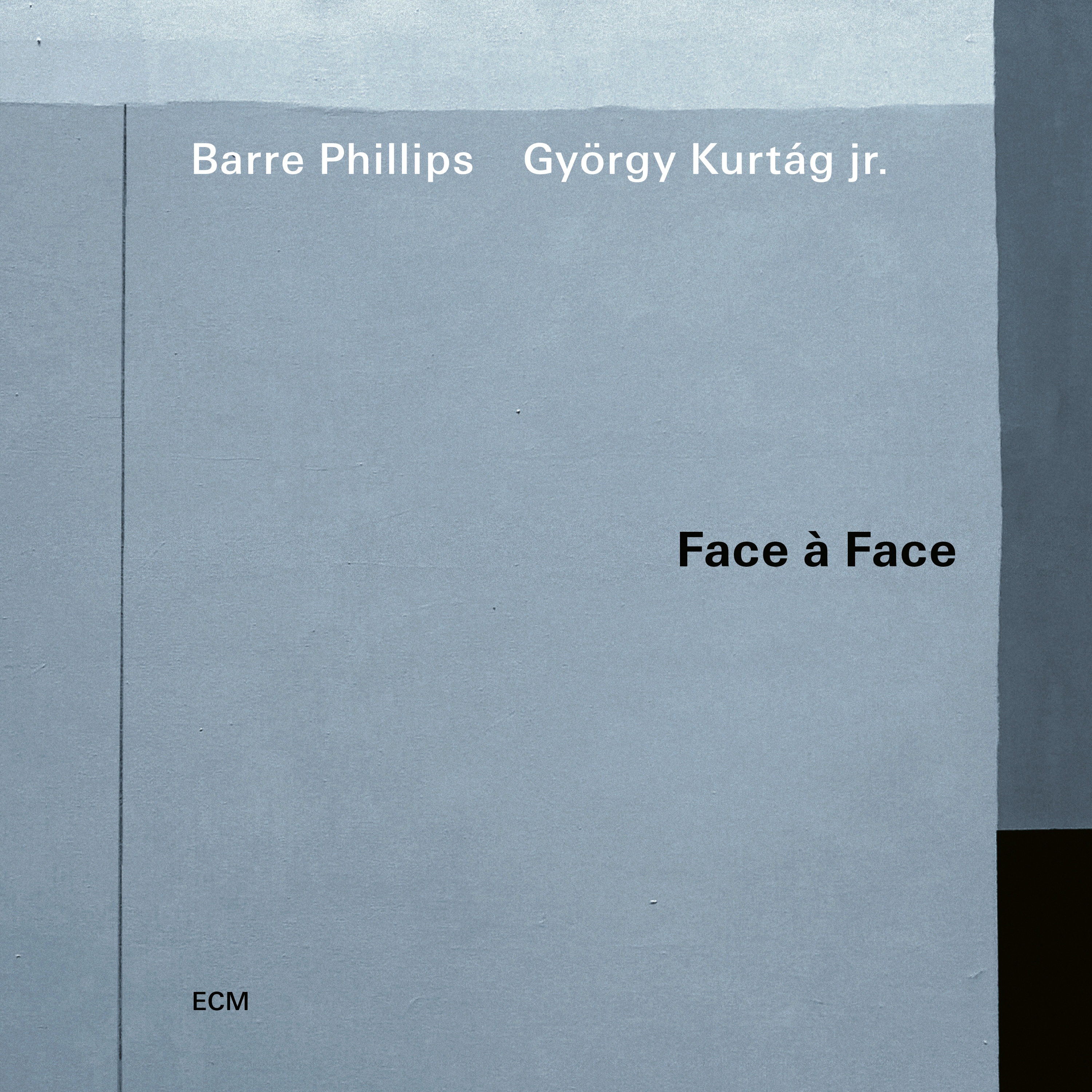
Barre Phillips/György Kurtág jr.: Face à Face (ECM 2735)

Barre Phillips
György Kurtág jr.
Face à Face

Barre Phillips double bass
György Kurtág jr. live electronics
Recording/mixing:
September 2020 – September 2021
Studios La Buissonne, Pernes-les-Fontaines
by Gérard de Haro, Manfred Eicher,
György Kurtág jr., and Barre Phillips
Mastering: Nicolas Baillard
Cover: Fidel Sclavo
Produced by Manfred Eicher
Release date: August 19, 2022

Although Barre Phillips and György Kurtág jr., respective virtuosos of the double bass and electronics, first collaborated by chance, one might not know it by the interlacing qualities of Face à Face. Each artist translates the other’s language in a borderless loop of communication, so that by the end we are one step closer to sharing their lexicon.

They begin in subterranean space, listening as if with the tympanal organs of a beetle to the stirrings of labyrinth makers. And maybe they never plant feet aboveground, more content to abandon the light for other forms of perception. Despite hints of the outside world in the sampled drums of “Two By Two” and the kalimba of “Across The Aisle,” our flesh always feels caught by something we cannot readily touch except in thought. Still, a feeling of tactility reigns.

The briefest excursions never reach two minutes, while the longest ones exceed only four. Among the latter, “Chosen Spindle” travels into backlit caves of memory, where seemingly infinite regressions flirt with the here and now.

Phillips is a sage of the bow, turning harmonies into shaded reveries that speak of decades leading to their emergence. In “Extended Circumstances,” he sings with mythical electricity in folds of cricket-like chatter. His pizzicato, too, moves vocally through the refractions of “Ruptured Air.” Kurtág plays his instrument (a practically biomechanical array of synthesizers and digital percussion) as a physical appendage, never letting go even when placing a shushing finger in the foreground. “Sharpen Your Eyes” is a remarkable example of his structural sensibilities, artfully suited to the bassist’s renderings of space. Their deepest integration takes form in the ironically titled “Stand Alone,” wherein mitochondrial anthems resound. Even “Forest Shouts” speaks in quiet streams of thought, each ripple extending a hand to pull us upstream to where it all began.

If asked to compare this to another album, I might nominate Heiner Goebbels’s Stifters Dinge, to which this may be heard as an electronic counterpart. Both are dreams awaiting visitors.

New Reviews for Shfl

I have been graciously asked to contribute capsule reviews (of 100 words or less) to Shfl, a phenomenal music recommendation tool for exploring old favorites and making new discoveries across genres. If you want to read my thoughts on key ECM albums in shorter bursts, check out my first wave of 100 reviews here, and the second of 25 here.

Follow me on Twitter for the latest updates, as I’ll be posting new batches there every Friday over the coming weeks. Never stop listening!

Special Announcement!

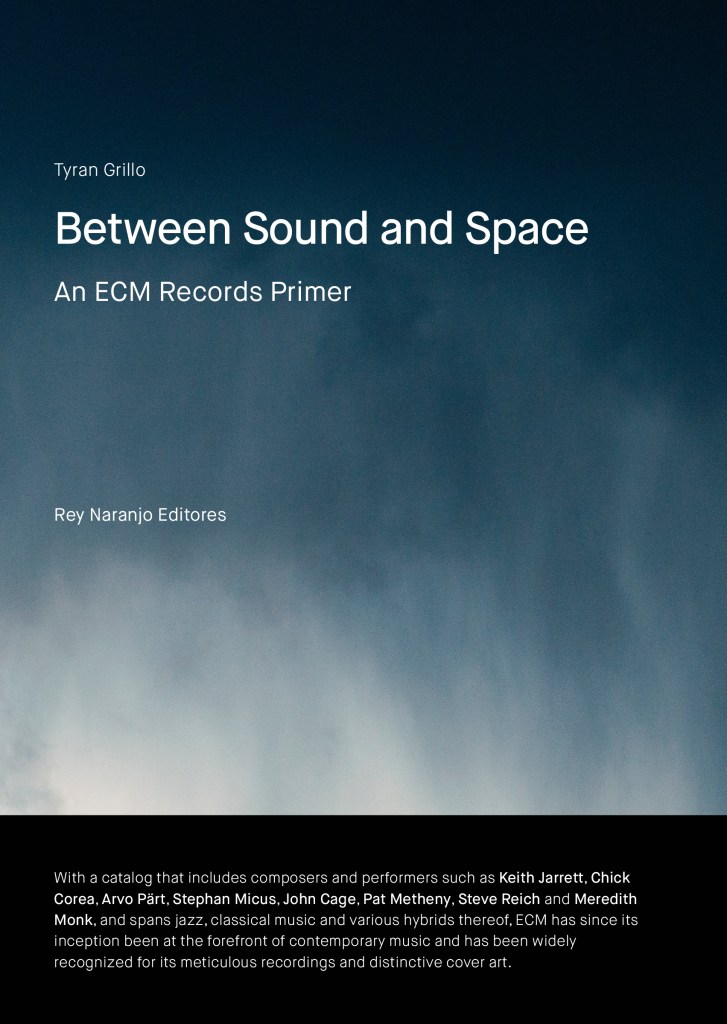
I am thrilled to announce that my book, Between Sound and Space: An ECM Records Primer, is at last available on Amazon! Those of you who have followed me for any portion of this journey know how much love, time, and care I’ve put into this project, and I hope the book, like the blog after which it was named, will lead listeners to many discoveries and hidden gems in the label’s ever-deepening catalogue. Click on the cover below to order yours while they last, and thank you, as always, for reading.