Steve Tibbetts: Northern Song (ECM 1218)

1218 X

Steve Tibbetts
Northern Song

Steve Tibbetts guitars, kalimba, tape loops
Marc Anderson congas, bongos, percussion
Recorded October 26-28, 1981, at Talent Studio, Oslo
Engineer: Jan Erik Kongshaug
Produced by Manfred Eicher

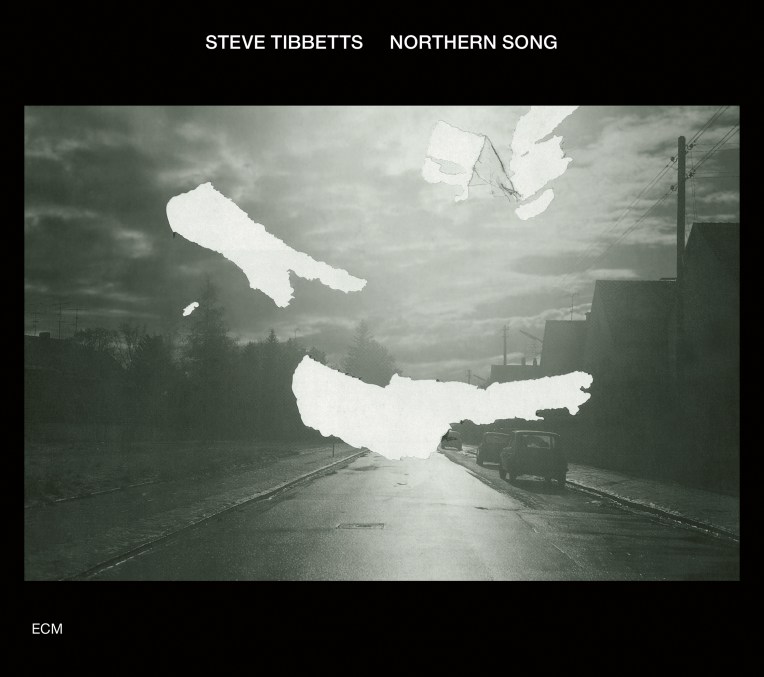
With Nothern Song, Steve Tibbetts made his ECM debut and introduced listeners to what remains one of the label’s most enchanting, if slowly unfolding, maps. The cover seems to tell us everything: silhouettes of islands superimposed on the journey that takes us to them, as if the dream of arrival were potent enough to burn itself across the rearview mirror of our lives. Tibbetts leaves a trail of quiet footprints easily obscured by “The Big Wind,” yet whose direction is not so easily forgotten. With circumpolar affinity and a sensitivity that is for all intents historical, Tibbetts traces the borders of our lives in “Form.” His shimmering guitar finds spirit in Marc Anderson’s verdant whispers. “Walking” continues in very much the same vein, only this time with a more pronounced wash of 12-string steel that eventually lifts us into an “Aerial View.” And because so much of the Northern Song experience is above ground, we are able to slip more intensely into the meditations of “Nine Doors / Breathing Space,” throughout which strings creak like an old house, if not an old body.

Tibbetts lavishes his instruments with respect, strumming them as he might harps of glacial light. In them we hear diaries, voices, and ideas that need never completed to say everything they need to say. And every delicate application of Anderson’s percussion carries us deeper into the overgrowth before we emerge, forever changed, in the dwindling sunlight. This album is an ocean, and we the birds who range its waters.

<< Ulrich Lask: Lask (ECM 1217)
>> David Darling: Cycles (ECM 1219)

Ulrich Lask: Lask (ECM 1217)

ECM 1217

Ulrich Lask
Lask

Ulrich Lask alto saxophone, synthesizer
Meinolf Bauschulte drums
Maggie Nicols voice
Recorded November 1981 at Tonstudio Bauer, Ludwigsburg
Engineer: Martin Wieland

“Not many people see the wisdom in madness.”

Take a little Mr. Bungle, mix in some Elliot Sharp, add a dash of Claudia Phillips, and you may just get something akin to this strikingly outlandish rarity from 1982. The voice of Maggie Nicols is the solder that holds everything together, while Ulrich Lask’s laser-like sax and labored synth weave an industrial spell at every turn of the set’s assembly line. The bubbly electronics of “Drain Brain” spray-paint the malaise of a post-punk modernity, where duties and obligations engage one another in a rather debilitating tango with the children’s rhyme “Rain, rain, go away.” Our core confrontations are laid out on the dissecting table of the “Tattooed Lady,” whose multiphonic screams burrow into the urban web of ignorance that clothes us in prescription. This brings us to the album’s reigning highlight. “Kidnapped” is a tongue-in-cheek yet visceral autobiographical experiment about woman who is snatched away for the sole purpose of recording “that new-fangled…funny music with a beat” in ECM’s Ludwigsburg studio. Lask manages to keep pace with the boggling skitters and saxophonic squeals of Nicols, who stretches these enchantments well into “Should We, Geanie?” This speculative exercise in authoritarianism looks at social relations through a glass darkly as neither catalysts nor inhibitions, but rather as tattered newspapers stuffed into the human dichotomy, exploitable only through the vocal act. Thus does the stormy narrative of “Unknown Realms” transform maternity into ancestral longing. Here, the landscape is treated like an entity, a plane where inception is breathlessness, breathlessness is signal, and signal is song. Walking hand in hand with the “Poor Child,” we find a klezmer-like essay on worldly power and the lone citizen just trying to make ends meet on a puddle-splashed street corner. But when we pull our pockets out to cartoonish lengths, we find, as prophesied in “Too Much – Not Enough,” that the generative force of all meaning is its very emptiness.

Lask might seem like an anomaly in the ECM catalog, when really it stays true to the label’s ever-adventurous spirit. Dementia as the new art, or art as the new dementia? You decide.

<< Pat Metheny Group: Offramp (ECM 1216)
>> Steve Tibbetts: Northern Song (ECM 1218)

Pat Metheny Group: Offramp (ECM 1216)

Pat Metheny Group
Offramp

Pat Metheny guitar, guitar synthesizer
Lyle Mays keyboards
Steve Rodby basses
Nana Vasconcelos percussion, berimbau, voice
Dan Gottlieb drums
Recorded October 1981 at Power Station, New York
Engineers: Jan Erik Kongshaug and Gragg Lunsford
Produced by Manfred Eicher

When I was a freshman in high school, our science teacher brought us outside one day to observe a partial solar eclipse. Though he had set up a telescope, provided us with special glasses, and prepared a lecture, my eyes were glued to the ground. As anyone who has experienced a solar eclipse knows, the sun’s light pocks the shadows like Swiss cheese, splashing the earth with countless little crescents of a half-eaten sun.


Eclipse shadows (photo source: Ketchum family blog)

Every note of Pat Metheny’s heavenly soloing on Offramp is its own crescent. His is a talent spun from sunlight, and one that might damage the eyes were its full force to be unleashed at once. Thankfully, we need no special equipment but our own ears to appreciate the intensities he brings to this immortal PMG date, which after the global reach of As Falls Wichita… expanded the compositional and technical prowess of Metheny and keyboardist Lyle Mays to deeper, more serpentine caverns of experimentation.

The Synclavier-enhanced calls of “Barcarole” are the album’s birth cries, each a punctilious footstep into the greater semantic complexities of “Are You Going With Me?” This smooth ride through sun-kissed plains drips with the tears of an unrecoverable past, Metheny’s guitar bellowing like a human trumpet keening at the speed of travel. “Eighteen” inoculates the proceedings with the livewire exuberance in which these musicians so deeply excel. Metheny is light on his feet and infinitely careful about his twists and turns, infusing each with that unmistakable audible grin. Dan Gottlieb kicks up a dust storm in the title song, which also features Metheny in one of his wildest excursions yet. Fractured pianism, an explosive glockenspiel, and Steve Rodby’s fantastic ground lines paint just the right ambiance to allow Metheny to uncork a bottle of some unrepeatable tincture that he seems to have been saving for this very occasion. After this flip and a half, “James” comes across as an acrobatics of its own kind, gracing our cochlea with heartwarming electricity, leaving the wispy skies of “The Bat Part 2” as our only postcard.

Yet all of the above combined barely tickles the underbelly of “Au Lait,” which still stands as Metheny’s most perfect statement. Though something of a carnivalesque on the surface, complete with rolling snare and haunting vocals courtesy of Vasconcelos, one also feels sung to of something far more serious. Whatever that might be, we experience it in real time, every wordless call a way station to where it all began. Metheny is as transcendent as he will ever be, each swing more harmonic than the last over the Joe Hisaishi-like touches from Mays. Oracular and airborne, this is a space we never wish to leave. And on the inside, it never does.

Metheny is a skillful writer who, with heart in place of pen, takes a kernel of an idea and draws every imaginable root before starting in on the leaves. Like a solar eclipse, such music comes all too rarely in any given generation. The beauty of Offramp is that it always feels like the first time. Is your turn signal on yet?

<< Steve Reich: Tehillim (ECM 1215 NS)
>> Ulrich Lask: Lask (ECM 1217)

Heinz Holliger: Induuchlen (ECM New Series 2201)


Heinz Holliger
Induuchlen

Anna Maria Bacher recitation
Albert Streich recitation
Sylvia Nopper soprano
Kai Wessel countertenor
Olivier Darbellay horn
Matthias Würsch percussion
Swiss Chamber Soloists
Heinz Holliger conductor
Recorded 2007-2010
Engineer: Andreas Werner
Produced by Manfred Eicher

Ever since the star-covered Scardanelli-Zyklus found its way into my life, Heinz Holliger’s increasingly fractal compositions have been a vital part of my personal development. As a teenager, I felt such an intense connection to the early ECM Holliger releases that I used an online message board (back when such things were novel) as a venue to proclaim Holliger as one of the most important composers of the century. I was immediately met with a smattering of criticism, of which one comment remains lodged in my mind: “Though Holliger is a talented musician and, I admit, an interesting composer, I don’t think his colleagues or family members would ever consider him ‘important.’” In my youthful naïveté, I accepted this contention and shied away from mine. And yet now, some fifteen years later, I find my initial reactions being confirmed by critics and friends, all of whom have long recognized the significance of his multifarious deeds. I relate this anecdote not to underscore my prophetic abilities, nonexistent as they are, but only to direct the listener’s attention to the depth of Holliger’s output and the uncanny ways it has of getting under our skin over time.

This is an album of many things: silence and half-language, shadow and movement, liminality and articulation. Through a technique that Holliger calls “vocal masking,” potentially straightforward motives are turned in on themselves, such that by the end our memories speak not in solos but in delicate aftershocks. Continuing the composer’s interest in marginal voices begun in such works as Beiseit is Puneigä. Reading like a well-compressed Scardanelli dissected under a microscope, it begins with the Walser-German poetry of Anna Maria Bacher (recited by Bacher herself) followed by Holliger’s spidery and biologically attuned settings thereof. In the absence of English translations, these pieces are left for the rest of us to emote on their own terms. And perhaps this is for the best, as Holliger has always seemed to approach a given text from the inside looking out, such that we need never concern ourselves with the arbitrary contours of its many surfaces. Either way, in them one can hear the cellular approach of his craft, an approach that seems as interested in unpacking language as it is in dismantling it. One hears this especially in the rattles and hums of the Zwischenspielen, each a wondrous division of spatial relationships that is incidental only to itself. Rotating through a series of watery reflections (“Wen mu plangät), earthly contacts (“Hêif!”), and reverberations (“Der Toot”), images stick out with the quiet interruption of a rock protruding from the glassy sheet of a waterfall. Within each rests the lock to a key.

Albert Streich’s poem “Induuchlen,” also prefaced from the author’s lips, provides a verbal runway into the soaring title piece for countertenor and natural horn. Holliger’s work gains facets the more its performers are reduced in number, and here one finds a wealth of such demands. Yet these are handled with such grace that one might think the results were entirely improvised. The countertenor is asked not only to plumb the depths of his baritone register, but even to step beyond them into some uncanny quotidian realm of, I daresay, Wagnerian anxiety, for indeed the music’s deepest secrets are, not unlike the sword in Die Walküre, fully visible yet can only be dislodged with the attendant promise of self-destruction. Here is a matrix of auditory gravel in which tremolos gasp, where overlays misalign, and from which arises a golem who seeks clouds more than land.

Embracing these throated reliefs is a frame of chamber works. Toronto-Exercises speaks in aphasic mumblings, which is to say in a vocabulary at once molecular, somnambulate, and exquisite. Scrapings, flaps, shivers, and overtones carve a broken chain of stone through this gorgeous little quatrain of forested sounds, while the fractured virtuosity of the percussive Ma’mounia deciphers its own fingerprints one vein at a time, releasing the screams and helical motives squirming therein.

Holliger’s is the music of a soul in search of those intricate gifts that enliven our bodies and minds. It is highly idiosyncratic and yet speaks of a wide-reaching science. For the sake of analogy, one might say he sits comfortably between Lachenmann and Kurtág, singing through the sometimes haunting immediacy of the former while holding close the latter’s appreciation for the miniature. In doing so, he gives us a medium of the anti-essence, wherein breathes only the potential for quiet rupture. He speaks more than any other composer I know, and yet never proselytizes.

Like an Italo Calvino novel, this music ladles over us a pathos we have long forgotten and through which we only now find a chance to embrace anew.

James Newton: Axum (ECM 1214)

ECM 1214

James Newton
Axum

James Newton flutes
Recorded August 1981 at Tonstudio Bauer, Ludwigsburg
Engineer: Martin Wieland
Produced by Manfred Eicher

Composer, flutist, and conductor James Newton is about as renaissance as renaissance men get. Currently a professor in the Department of Ethnomusicology at UCLA, Newton seems always to be looking for ways to expand his knowledge. And while his command of repertoires may be staggering, a humble primacy of the body has ever been at the heart of his activities. Breath, movement, and time trace zones of sonic blossoming in his music, to the point where one cannot help but visualize the bodywork of his many recorded performances. Out of a discography going on 60 albums, we might point to 1982’s Axum, his only for ECM, as a seed. Its fantastic range of colors comes together in an enduring piece of sonic archaeology.

Half of the album is drawn from overdubbed territories, where bass and alto flutes share the air with their concert cousin. Within the first minute of “The Dabtara,” we already get a sense of Newton’s idiomatic breadth, as flickers of modern jazz blend into a backdrop of medieval piping. Thus does Newton find unity in division. Among the more mirthful turns is “Addis Abada,” which sounds like some form of worship through which one breaks from the self on the way to belonging. Another turn of the kaleidoscope brings into focus the title track, a veritable symphony of multiphonic splendor. “The Neser,” however, is the most accomplished here. With a Debussean elegance fringed in shadow, Newton hangs every melodic intention in the air like some vast ornamental mobile turned by forces unknown.

The five solo pieces constitute more than just the other half of Axum. Rather, they stick to the palate in a pleasing mingling of flavors. Utilizing a wealth of extended techniques and saturnine divinations, Newton is at one moment descriptive (“Mälak ’Uqabe”) and self-multiplying (“Choir”), at another lithe (“Feeling”) and intensely personal (“Susenyos And Werzelya”). The album’s prismatic center is found in the gnarled pathways of “Solomon, Chief Of Wise Man.” Here, we find ourselves face to face with distant calls that are, while ancestral, undeniably of the future. We listen to these sounds from the confines of our privacy, be they circumscribed by headphones and wires or by the larger spaces of our homes. Yet in doing so we find a broader path along which to place our feet. This is this sense of transit that Newton brings, each flutter charged by a nascent realization awakening of daybreak. Even as it shrugs off the blanket of night, it cannot help but see itself reflected in the mirroring sky, where only memories dance in lieu of lived experience. Keeping one eye on the past, these meditations walk sideways, hoping that we might do the same…on our own time.

<< Steve Kuhn Quartet: Last Year’s Waltz (ECM 1213)
>> Steve Reich: Tehillim (ECM 1215 NS)

Steve Kuhn Quartet: Last Year’s Waltz (ECM 1213)

ECM 1213

Steve Kuhn Quartet
Last Year’s Waltz

Steve Kuhn piano
Sheila Jordan voice
Bob Moses drums
Harvie Swartz bass
Recorded live, April 1981, at Fat Tuesday’s, New York City
Engineer: David Baker
Produced by Robert Hurwitz

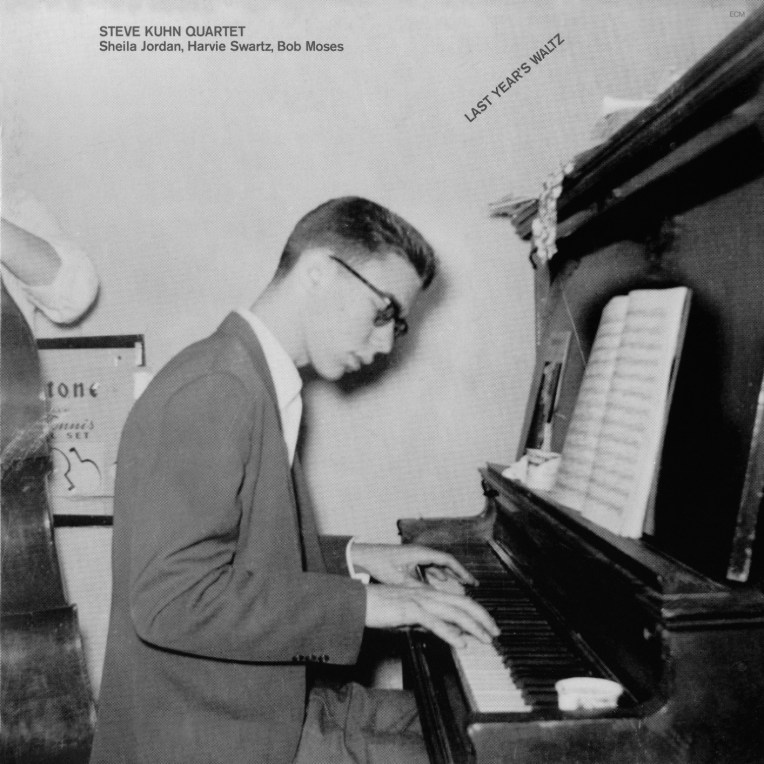
Last Year’s Waltz has everything a great live jazz album should: a present feel, gobs of atmosphere, and, oh yeah, Sheila Jordan. Right off the bat, interplay from Bob Moses and Harvie Swartz kicks us into wakefulness in “Turn To Gold.” Gilded by Kuhn’s indeed alchemical but always punctual pianism, this dose of smoothness is sure to please. Kuhn brings a montuno flavor to “The Drinking Song,” which is deepened by Jordan’s diaristic musings, both expository and speculative, and boasts enough woops from her band mates to keep our blood at a constant boil. The title track is a languid trickle that quickly crackles into a melodious and cinematic punch bowl. The key to unlocking the set’s inner secrets is “The Fruit Fly,” which, in both title and execution, evokes Chick Corea’s blissful optimism. Downright wondrous pianism and omnipotent drumming make this the instrumental standout (the solo piano “Medley” runs a close second). Kuhn works his magic through “The Feeling Within,” weaving a luxurious carpet for Jordan’s vocal footsteps. Two standards—a decidedly upbeat rendition of “I Remember You” and the virtuosic scat-fest that is “Confirmation”—and the bittersweet yet crowd-pleasing tune “The City Of Dallas” (Steve Swallow) complete this living portrait of a group in its prime. As the recording fades, members of the crowd shout, “More!”

I second that.

Not only does Last Year’s Waltz show us Jordan at her best, but its explosive energy and archival importance make it by far Kuhn’s finest quartet joint of the 80s. A reissue is a must.

<< Art Ensemble of Chicago: Urban Bushmen (ECM 1211/12)
>> James Newton: Axum (ECM 1214)

Johann Sebastian Bach: Ich hatte viel Bekümmernis (ECM New Series 2229)

Johann Sebastian Bach
Ich hatte viel Bekümmernis

Heinz Holliger oboe
Erich Höbarth violin, direction
Camerata Bern
Recorded December 20-22, 2010
Radiostudio Zürich
Engineer: Andreas Werner
Produced by Manfred Eicher

Of
a tree, of one.
Yes, of it too. And of the woods around it. Of the woods
Untrodden, of the
thought they grew from, as sound
and half-sound and changed sound and terminal sound…
–Paul Celan, “And with the Book from Tarussa” (trans. Pierre Joris)

On October 4th, within an hour of having listened to this album for the first time, I went out for lunch, when I noticed a peculiar sight. There, sitting at an outdoor table, was a hermetic figure with a Monarch butterfly resting on his outstretched hand. How could I not engage him in a conversation? The man, I soon found out, was Rolfe Sokol, a local fixture in Ithaca, New York for over a decade and one of the most sought-after violin teachers in the area. Rolfe had saved the injured butterfly after spotting her on the side of the road. During her recovery from two crimped legs and a damaged wing, she hardly left him. As Rolfe animatedly informed me, drawing his story as he might a bow, the butterfly spent most of her time on his shoulder or perched on a finger, living off the sugar water he provided. When she had recovered enough to make short flights, he took her to the park, where she greeted strangers but always returned.

Rolfe and I inevitably turned to topics musical. After being regaled with stories of some of my favorite violinists and composers, I asked if he was familiar with ECM Records and with Heinz Holliger’s latest Bach recording. Though the answer was no on both counts, he did tell me how the butterfly reacted most positively, fluttering her wings and “stamping” her forelegs, whenever he or his students played Bach. Upon hearing this, I immediately asked for Rolfe’s address and later sent him a copy of Ich hatte viel Bekümmernis to aid in the butterfly’s recovery, for the title—which translates to “I had much affliction”—seemed appropriate for one in a stage of healing. It is in that spirit of rejuvenation that I discuss the music at hand.

Rolfe’s butterfly

With his usual blend of humility and cogency, Holliger gives us in his liner notes an informed account of these recordings, which together represent a pastiche of reconstructions, arrangements, and restorations from, to recapitulate his quoting of Hegel, the “fury of disappearance” that so befell much of Bach’s oboe literature. Such unrecoverable shadows will have cast themselves over many a Baroque enthusiast and so bear no redrawing here. In any case, after listening to this recording almost once per day since receiving it so kindly from a faraway friend, I have become as intrigued by where its beauties are going as by where they came from.

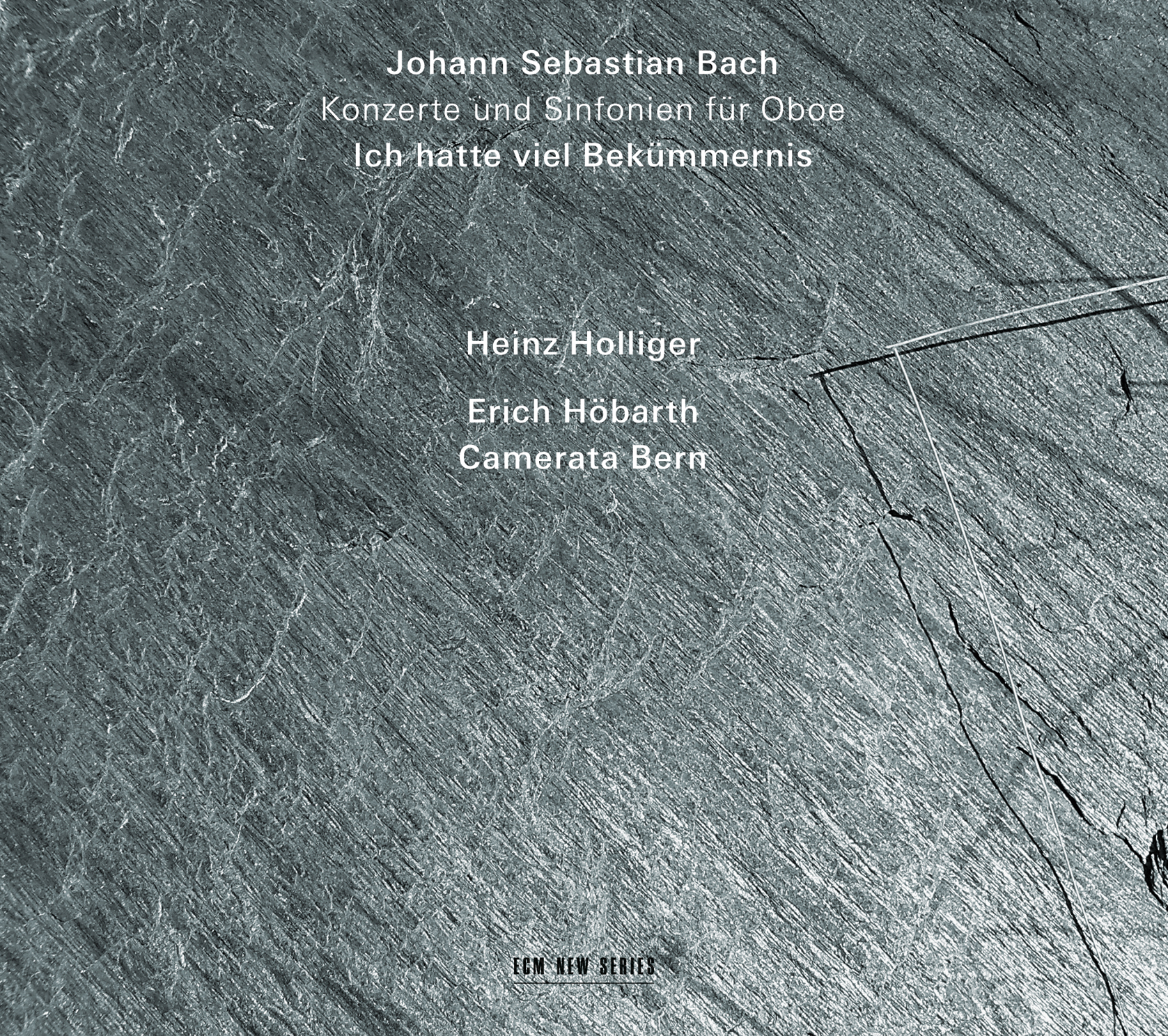
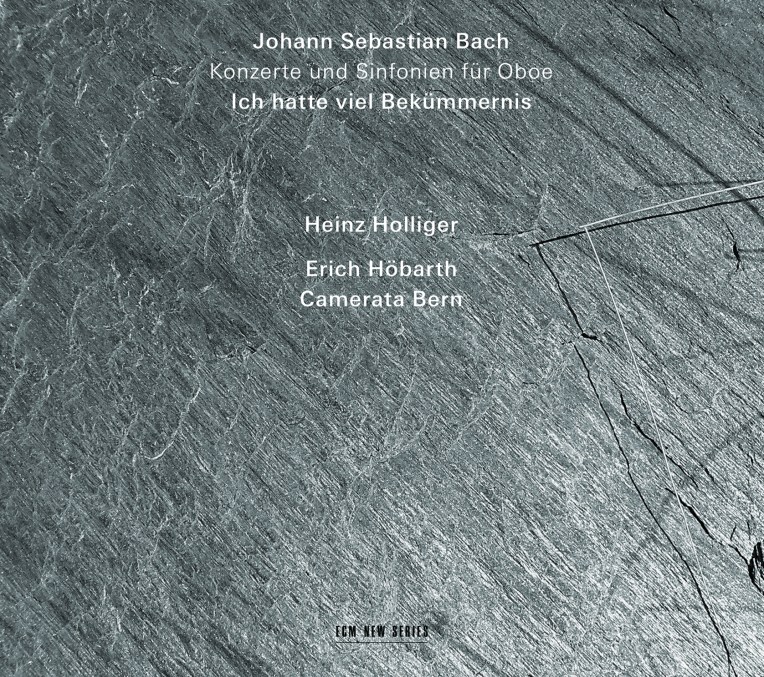
Holliger’s latest for ECM is so rich it’s almost unhealthy. Three sinfonia introductions, two from among Bach’s cantatas and one from an Easter Oratorio, form its crux. Some music simply stills us, and the darkening swells of “Ich hatte viel Bekümmernis” (BWV 21) constitute such music. Holliger and violinist Erich Höbarth intertwine like birds in slow motion, each leaving a trail of something forgotten, blazing across the sky in a slow-moving fire, by which only one’s fate can be written, ever out of reach but always readable in the light of divine countenance. But where my description may be overblown, Holliger’s technique never is, always held in check by a profound reserve that allows the music to flourish on its own terms. Bach’s mournful reflection sings with a palpable retrograde, and from its first draw pulls the center of our being toward that of some unnamable other.

Of the four concertos offered here, the c-minor for oboe, violin, strings and basso continuo (BWV 1060) is the most humbling. Joined front-stage by the nimble fingerwork of Höbarth, Holliger details a multivalent sound palette. And in the d-minor (BMV 1059) his legato phrasings explore parts of the surrounding orchestral architecture that most oboists would neglect to see, let alone articulate. The slow, waltz-like quality of the Adagio is an especially profound wind-up for the heavenward lob of the Presto that concludes. Holliger looks even more inwardly in the A-major concerto (BWV 1055). Here, he luxuriates in the subtle turns of phrase and moments of tension that seem to stretch between orchestra and soloist and dance across water with every trill. And then there is Bach’s reworking of an Alessandro Marcello concerto, which glistens with poised ornamentations. A lively dance in the Presto percolates with bewitching charm as Holliger populates every interstice with his inextinguishable passion.

As one who believes the assembled performers to be a virtually uncriticizable combination, I risk redundancy in praising their results as a scintillating tour de force of tempo, timbre, and above all vocality. In light of the already wondrous 1982 recordings of BMV 1055 and 1059 on Philips with the Academy of St. Martin-in-the-Fields (back during the latter’s hyphenated golden age), this could never be anything less than superlative in its complementary light.
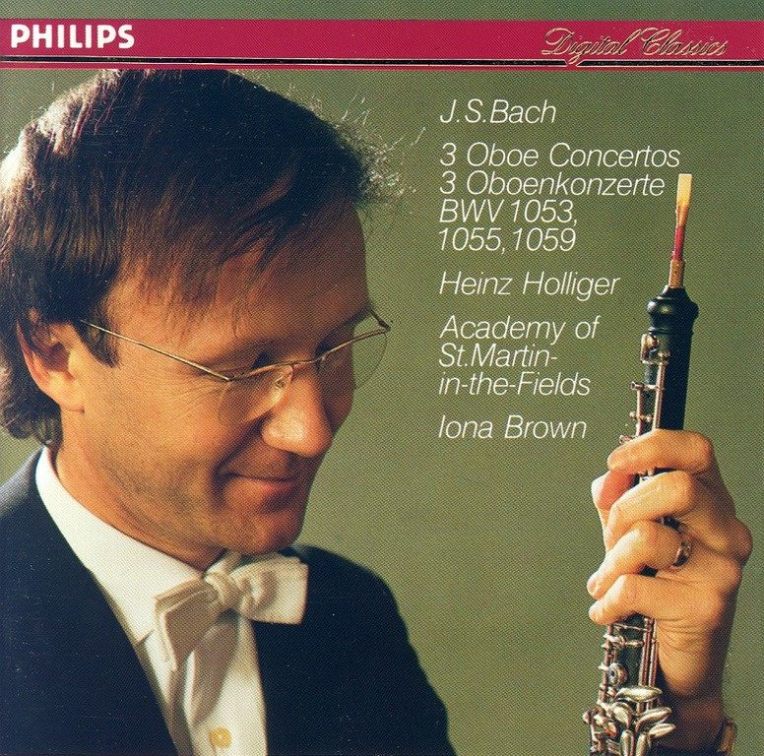
Yet one notices also the striking differences between the two. ECM’s recording, while bright, explores this music’s deeper colors, balancing the swirls of refinished wood with an expertly miked continuo. Holliger’s playing has rarely sounded so earthy, so focused on its ephemeral task. These are not reimaginings but reawakenings. And while tempted, I hesitate to use the term “benchmark recording,” as it would speak of its interpretive possibilities as having been branded in time, checked off on the never-ending tick sheet of Bach recordings.

It is also tempting, following Hans-Klaus Jungheinrich, to think that “all roads lead back to Bach.” Yet rather than see Bach as the endpoint to a musical funnel that cuts across histories and geographies, we might better witness the avatar of a composer whose gestures of humility brought to fruition a sense of openness. We do well to resist painting Bach as a Universalist. In search of a alternate analogy, I return to the butterfly. Monarchs are known for their annual 2500-mile migration. Contrary to popular belief, no single pair of wings survives the entire journey. In essence, the group is a kaleidoscope of constant regeneration that returns a different entity from when it left. Like those roving splashes of black and burnt orange, Bach’s music itself travels in a constant state of regeneration, such that every fresh performance, every pair of ears newly enchanted, spreads its own venation of appreciation.

Two weeks ago I ran into Rolfe for the first time since our initial meeting, only to discover that his lepidopteran companion had not survived the cooling Ithaca climate in time to hear this album, but that when he received it he did play it for her. And so, in the interest of continuing this chain of memorial, which began with the death of Bach’s favored pupil (fresh in the composer’s mind when penning the titular sinfonia) and which is linked by Holliger’s loving dedications to the memories of his brother, Eric, and friend Gabriel Bürgin, if you ever find yourself in possession of this jewel of an album I hope you might also take a moment to remember Rolfe’s butterfly, who I like to imagine now rests contentedly on Bach’s shoulder, her proboscis no longer necessary for the music of the spheres that will forever sustain her.


Lester Bowie: The Great Pretender (ECM 1209)

Lester Bowie
The Great Pretender

Lester Bowie trumpet
Hamiet Bluiett baritone saxophone
Donald Smith piano, organ
Fred Williams basses
Phillip Wilson drums
Fontella Bass vocal
David Peaston vocal
Recorded June 1981 at Tonstudio Bauer, Ludwigsburg
Engineer: Martin Wieland
Produced by Manfred Eicher

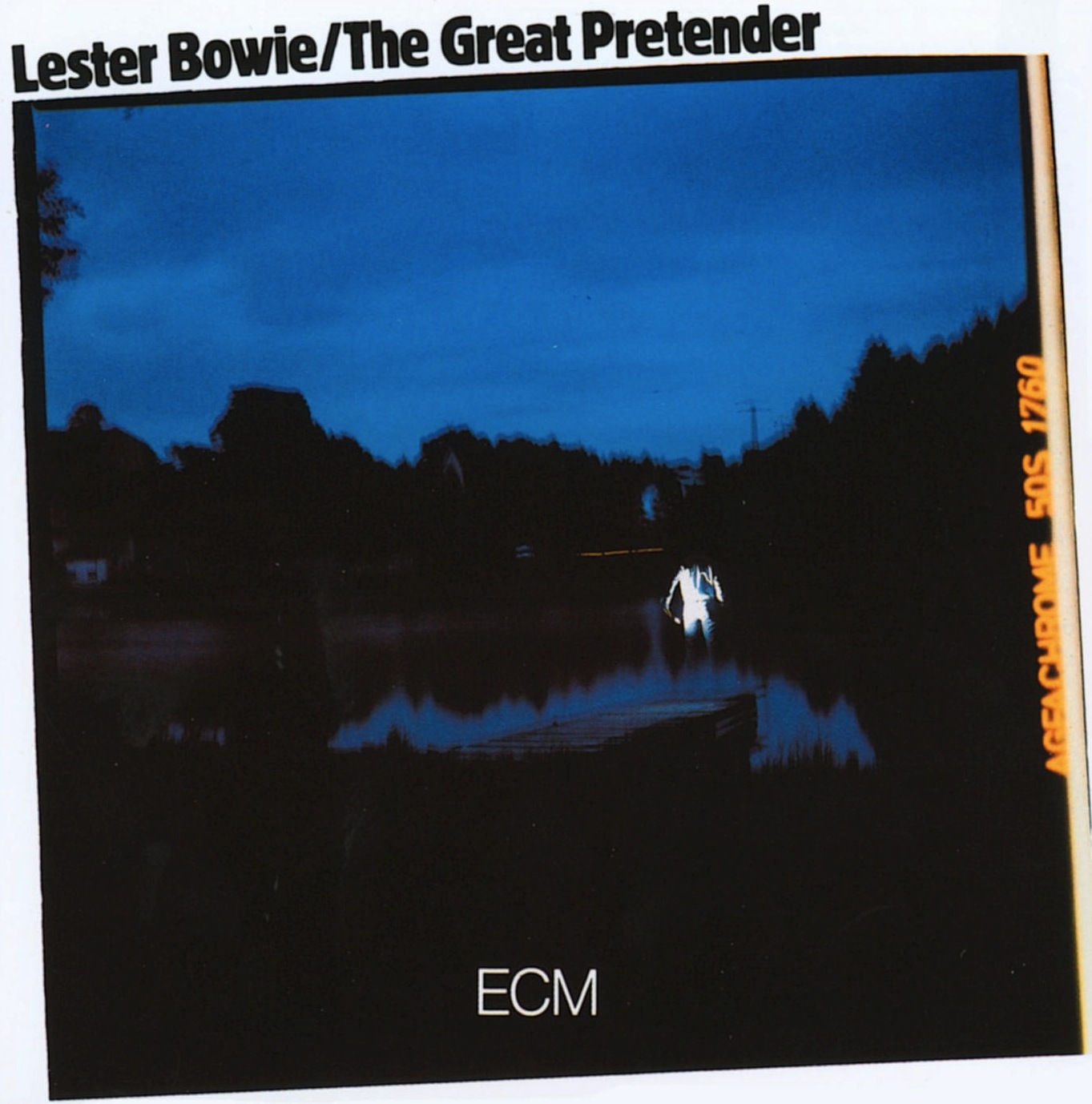
The title cut on Lester Bowie’s The Great Pretender comes of course from The Platters, the influential vocal group whose other hits, “Only You” and “The Magic Touch,” catapulted the group’s success through the rock n’ roll charts of the 1950s. Bowie’s investment in popular music’s connections to jazz set him a world apart. Second perhaps only to 1978’s The 5th Power, his debut for ECM as leader works wonders with its namesake. Where the original opens with quiet fortitude, this massive 17-minute rendition does so even more, the pianism of Donald Smith breathing a soulful mist upon a landscape that sometimes swirls with unanticipated gales. Fontella Bass and David Peaston are our doo-wop backups, their presence making the music that much more phenomenal. From Hamiet Bluiette’s heady baritone solo to the swampy rhythm section, Bowie has plenty of gum to chew in his horn.

No Bowie experience is complete without an inoculation of whimsy, and this we get in his rendition of “It’s Howdy Doody Time.” Phillip Wilson’s bright snare and Bowie’s fluttering elaborations share the air with Smith’s long slides. These morph into an evocative Fender Rhodes in “When The Doom (Moon) Comes Over The Mountain,” a wild chase backed by Fred Williams’s popping electric bass and the late-night sprawl of Bowie’s blatting. What begins as an overused Latin riff in “Rio Negroes” quickly transforms into a foray of architectural proportions secured by solid improvisational beams. Rich bass lines and rim-work carry us out in style. “Rose Drop” again looks through a glass playfully, only this time with a deeper drop. The tinkling of toy piano sparkles in Bowie’s waning sunlight, overflowing with half-remembered sentiments, each a photograph pasted in a scrapbook like no other.

Lester Bowie is like the moon. His is a field that waxes and wanes, haunting us with intimations of a distinct face, even as it harbors a dark side that we never get to see, except through the grace of studio technology, which allows us a glimpse the deeper intimations of his craft. We get this most readily in “Oh, How The Ghost Sings,” which from the evocative title to its flawless execution rings with the after-effects of a temple bell, the actual striking of which we never hear, and ends on a protracted, distant wail.

The material on The Great Pretender is all great and lacks a single pretender, and has been deservedly consecrated among ECM’s Touchtones.

<< Lande/Samuels/McCandless: Skylight (ECM 1208)
>> Gary Peacock: Voice from the Past – PARADIGM (ECM 1210)

Lande/Samuels/McCandless: Skylight (ECM 1208)

ECM 1208

Skylight

Paul McCandless soprano saxophone, English horn, oboe, bass clarinet, wood flute
Art Lande piano, percussion
David Samuels vibraharp, marimba, percussion
Recorded May, 1981 at Tonstudio Bauer, Ludwigsburg
Engineer: Martin Wieland
Produced by Manfred Eicher

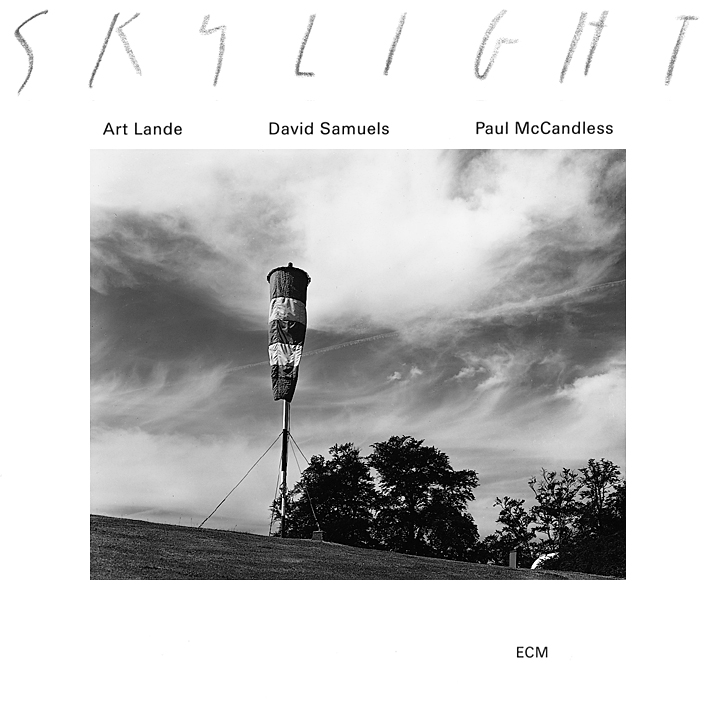
As one of the finest mallet players of his generation, Dave Samuels has treaded a wide and multifarious path. From Double Image (his gorgeous project with David Friedman) to the exciting territories of his work with the Caribbean Jazz Project (some of the best Latin jazz around), not to mention his fruitful years with Spyro Gyra, Samuels brings a signature delicacy to his playing that is comforting and domestic. His first two intersections with ECM, Dawn and Gallery, are both sadly out of print but make a flowing trilogy of sorts with 1981’s Skylight, which thankfully is still available and marks his last appearance on the label. Joined by one-and-onlys Art Lande and Paul McCandless, Samuels shows us his compositional brilliance in the airy title cut. Not to be outdone, Lande and McCandless offer two tunes apiece. Lande’s territories are more contradictory in their energies, at once twilit and dripping with morning dew, and undeniably engaging. The reed work of McCandless is awesome in its quiet power, particularly in his “Willow,” which closes the album in unified pleasure. Two improvisations round out this overlooked effort. The loamy tales of a bass clarinet thread every monochromatic turn of “Duck In A Colourful Blanket (For Here),” while the interludinal “Ente (To Go)” stands as one of the most effective pieces to employ a thumb piano I’ve heard in a long time.

While the album’s title may refer to an architectural feature, here one encounters its meteorological meaning (“the diffuse light from the sky, scattered by air molecules, as distinguished from the direct radiation from the sun”) in full. With a blend of joy and sorrow that is imaginative but never gaudy, this singular trio session shows us that, even in a darkening day there is music to be discovered.

<< Ralph Towner/John Abercrombie: Five Years Later (ECM 1207)
>> Lester Bowie: The Great Pretender (ECM 1209)