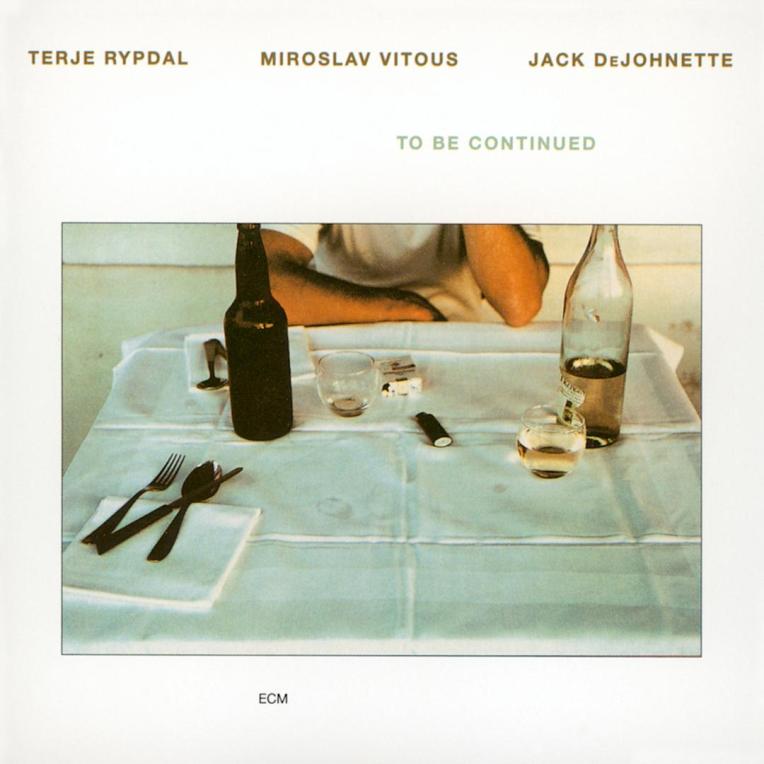
Rypdal/Vitous/DeJohnette: To Be Continued (ECM 1192)

ECM 1192

To Be Continued

Terje Rypdal electronic guitars, flute
Miroslav Vitous acoustic and electric bass, piano
Jack DeJohnette drums, voice
Recorded January 1981 at Talent Studio, Oslo
Engineer: Jan Erik Kongshaug
Produced by Manfred Eicher

Nearly three years after their first collaboration, Terje Rypdal, Miroslav Vitous, and Jack DeJohnette unwrapped the ghostly sunset that is To Be Continued. The most spine-tingling moments therein thrive at half the speed of life. The intensities of “Maya” must be heard to be believed, for in them we see the night sky in negative image. Likeminded pulchritude prevails in “Topplue, Votter & Skjerf” (Hat, Gloves & Scarf), easily one of Rypdal’s most awesome committed to disc. His hands fade as soon as they are laid, leaving only the trace by which he elicits every note.

Don’t be mistaken, however, in thinking this is another lazy morning session. Rather, it dances to the tune of DeJohnette’s propulsion in “Mountain In The Clouds,” to say nothing of Vitous’s fanciful colors in the title track. For “This Morning” in particular, crosshatched by electric bass and flute, DeJohnette seems to want to draw the others into more finely grained conversations, only to get pixilated versions thereof. Yet these unformed images allow us to supply our own dreams, so that by the time we reach the haunting “Uncomposed Appendix,” in which he sings with and through his piano, we are already converted.

Though the album is brimming with sharp production and electronically enhanced instruments, there is something purely elemental about it. Its stew of metal, wood, and air wafts like the scent of plane trees in summer and leaves a taste of copper in the mouth.

<< John Abercrombie Quartet: M (ECM 1191)
>> Surman/DeJohnette: The Amazing Adventures Of Simon Simon (ECM 1193)

Pat Metheny & Lyle Mays: As Falls Wichita, So Falls Wichita Falls (ECM 1190)

Pat Metheny
Lyle Mays
As Falls Wichita, So Falls Wichita Falls

Lyle Mays piano, synthesizer, organ, autoharp
Pat Metheny electric and acoustic 6- and 12-string guitars, bass
Nana Vasconcelos berimbau, percussion, drums, vocals
Recorded September 1980 at Talent Studio, Oslo
Engineer: Jan Erik Kongshaug
Produced by Manfred Eicher

Listening to any Pat Metheny album for the first time is like finding a long-forgotten photograph, interleaved in a dusty book marked to the brim with the marginalia of a past life. And just when one thinks that feeling might dull over time, Metheny whittles from the vast block of wood that is his genius a masterpiece like As Falls Wichita, So Falls Wichita Falls, on and through which the Missouri-born guitarist begins to expand his reach to “global” proportions. His Instrument—with a capital “I”—and his playing of it define supernovas of emotional distance in the most compact lines. From these he unspools spectrums upon spectrums.

Where many of his albums might open with a shout of joy, a heavy acoustic rhythm, or a sweeping grandeur, the 20-minute title track’s genesis lies in the ambience of a field recording. We hear a crowd, a voice chanting taals, the rasp of shakers. Thus (dis)located, Metheny begins to map this human web through the drone of Lyle Mays. Only then, from thunderous rumblings, does his slack guitar take our hand and lead us through the crowds. With a drum machine at his side, Nana Vasconcelos clothes us in local colors. The electronic accents and attentive sense of evocation evoke Steve Tibbetts as the band coalesces into a shimmering, autoharp-laden catharsis. Riding a leviathan of strings, a voice recites numbers, as if in code. With the sounds of children at play still in our ears, the upbeat “Ozark” crests into the wave of extroverted Americana that is Metheny’s standby. Mays at the keys makes this stage, gliding effortlessly along a landscape tessellated by a rainbow of impressions. “September Fifteenth” is as intimate as the last is expansive, a prayer for Bill Evans, who left us on the selfsame date while the album was in session. The pianism of Mays (for whom Evans was a formative influence) could hardly be more fitting. To be sure, it glitters like the rest, only this time with the beads of falling tears. The title of “It’s For You” lends delight to the cover montage. If its colorful combination of sounds is meant to brighten our mood after the mournful turn that precedes it, then it certainly does the trick. Metheny’s signature electric traces in silhouette every footprint leading into the mystical shores of “Estupenda Graça,” where he sketches for us a more diffuse version of street on which we began.

Some have remarked on the “regrettable” cover art and the title that brands it, but I for one believe it to accurately illustrate Metheny’s process. Making or receiving a phone call is a form of travel in itself, for those precious moments of communication seem to collapse the two spaces that both speakers inhabit. And which of us has not, when experiencing something sonically profound, held up a phone so that the person on the other end could get some sense of the experience? “It’s For You” isn’t just a catchy phrase; it’s a thank you for the listener.

<< Jack DeJohnette’s Special Edition: Tin Can Alley (ECM 1189)
>> John Abercrombie Quartet: M (ECM 1191)

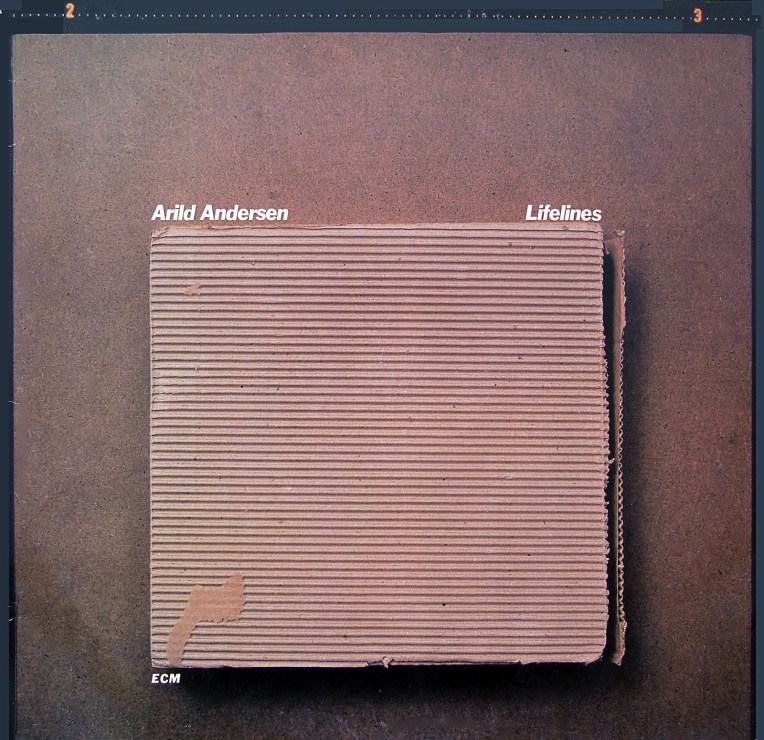
Arild Andersen: Lifelines (ECM 1188)

ECM 1188

Arild Andersen
Lifelines

Arild Andersen double bass
Kenny Wheeler fluegelhorn, cornet
Steve Dobrogosz piano
Paul Motian drums
Recorded July 1980 at Talent Studio, Oslo
Engineer: Jan Erik Kongshaug
Produced by Manfred Eicher

After an explosive introduction, Arild Andersen’s Lifelines kicks us like a soccer ball down the field of “Cameron,” where we are intercepted by Steve Dobrogosz’s swirling keys. Into this hammered storm, Andersen drops his bass, keeping us centered in this staggering opener. And staggering this album most certainly is, resting on a fine edge of airtight cohesion and loosened seams. We find more of the same in the loveliness of “Dear Kenny” and in “A Song I Used To Play,” both teetering on a line drawn to Andersen’s careful scale. Even the ballads seem to flirt with a great precipice. Falling from the haloed clouds of “Prelude” and into the depths of the two-part title piece, we find ourselves smack dab in Enrico Rava territory. The album’s highlight comes in the form of “Landloper,” a 50-second bass solo that sparks the inner fire of “Predawn.” In keeping with his penchant for optimistic endings, Andersen gives us “Anew.” Paul Motian is delightfully frenetic here and matched by Dobrogosz’s erratic song, veiled only by the sustain pedal’s illusory veneer.

What moves me most about Andersen’s approach to the bass is his ability to hold onto a quiet heart even at his most ecstatic moments. Like ECM’s other great veteran, Charlie Haden, he always keeps himself firmly rooted in the melody. Wheeler and Motian prove loyal allies, regaling us like wizened elders with tales of old. The real star of this date, however, is Dobrogosz. In his only ECM appearance, the American-born pianist (now a longtime resident of Stockholm) seems as if he could expound for hours upon every motif and never repeat himself. He is the kindling that keeps this music burning, slow-roasting it to irresistible succulence.

<< Rainer Brüninghaus: Freigeweht (ECM 1187)
>> Jack DeJohnette’s Special Edition: Tin Can Alley (ECM 1189)

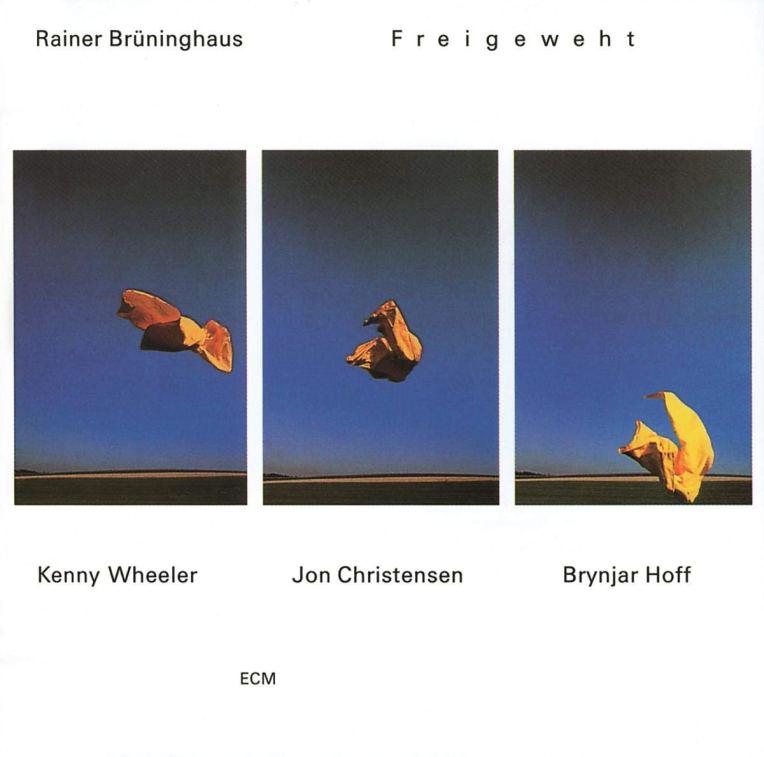
Rainer Brüninghaus: Freigeweht (ECM 1187)

ECM 1187

Rainer Brüninghaus
Freigeweht

Rainer Brüninghaus piano, synthesizer
Kenny Wheeler fluegelhorn
Jon Christensen drums
Brynjar Hoff oboe, English horn
Recorded August 1980 at Talent Studio, Oslo
Engineer: Jan Erik Kongshaug
Produced by Manfred Eicher

After bringing his Midas touch to the projects of Eberhard Weber, it was only a matter of time before Rainer Brüninghaus would be given an opportunity to lead, and did so at last to soaring effect on Freigeweht (Set Free by the Wind) with a group of sympathetic musicians and a compositional aptitude to match. Over the space of six fairly extended pieces, we find the keyboardist in many facets. Whether it’s sharing rhythmic savvy with Kenny Wheeler in “Stufen” (Steps) or swapping runes with Brynjar Hoff on English horn in “Die Flüsse hinauf” (Upstream), his hands abide in every blissful moment. Brüninghaus also makes orchestral use of synthesizers, especially in the airborne “Spielraum” (Elbow Room) and “Radspuren” (Wheel Marks). Wheeler’s chromatic soloing throughout only underscores the feeling of flight, even as a rolling pianism cascades as if down the throat of a thirsty deity. Hoff’s oboe shares the ghostly body of “Täuschung der Luft” (Air Illusion) with a mounting drone, reborn in the sequenced arpeggios of the title track, on which we end. The oboe’s magic abounds, married to its surroundings by Wheeler’s irresistible binding force. As widely cast as Brüninghaus’s net is, the interactions with Jon Christensen delineate his art in clearest relief. These alone are the album’s DNA.

Admirers of Tim Story will find much to please the ears here, as well as be delighted by the gilded edges of improvisatory bliss that only ECM can bring. This is intensely imagistic music that is tangible enough to hold and lose ourselves in slumber.

<< Eberhard Weber Colours: Little Movements (ECM 1186)
>> Arild Andersen: Lifelines (ECM 1188)

Miroslav Vitous Group: s/t (ECM 1185)

1185 X

Miroslav Vitous Group

Miroslav Vitous bass
John Surman soprano and baritone saxophones, bass clarinet
Kenny Kirkland piano
Jon Christensen drums
Recorded July 1980 at Talent Studio, Oslo
Engineer: Jan Erik Kongshaug
Produced by Manfred Eicher

This grouping finds Miroslav Vitous in the company of fine musicians, whose idiosyncratic strengths manage to avoid conflict for an unusually engaging, if inconsistent, set. The Czech bassist’s opening tune, “When Face Gets Pale” grasps the tail of a strong melodic serpent, riding through tall grasses and intermittent sunlight. Along with the lively, Arild Andersen-like lead, we are treated to the animations of Kenny Kirkland at the keys—a sound so burnished that the squeal into being of John Surman’s baritone becomes a rupture to be cherished. A fine place to start. Yet unlike many ECM albums, which begin enigmatically before launching into more patently composed material, this is the other half of that swinging door, starting with a full-on group-oriented sound and unraveling itself inside the freer improvisational architecture of “Second Meeting” (and, later, of “Interplay”). Here, bass clarinet is front and center and plays patty-cake with the rhythm section amid some bubbling pianism. Of the latter, we get more in the Kirkland original, “Inner Peace.” Between bass volleys and fluid gestures, Surman’s throaty baritone again paints its corroded beauty across the sky. Everything Surman touches is beautified, and in his one compositional contribution, “Number Six,” we find the album’s most enchanting cartographies. His soprano grabs hold and never lets go for the duration of its wailing journey, while also giving Kirkland plenty of bounce for a swan dive. Vitous, meanwhile, shows just how nimble he can be in “Gears,” while in “Eagle” his classical training comes forth in fluid arco lines.

Though seemingly at odds with critics, and understandably so for its few false steps, this out-of-printer is still solid. By no means essential, but neither one to pass up should the opportunity present itself.

<< Gary Burton Quartet: Easy As Pie (ECM 1184)
>> Eberhard Weber Colours: Little Movements (ECM 1186)

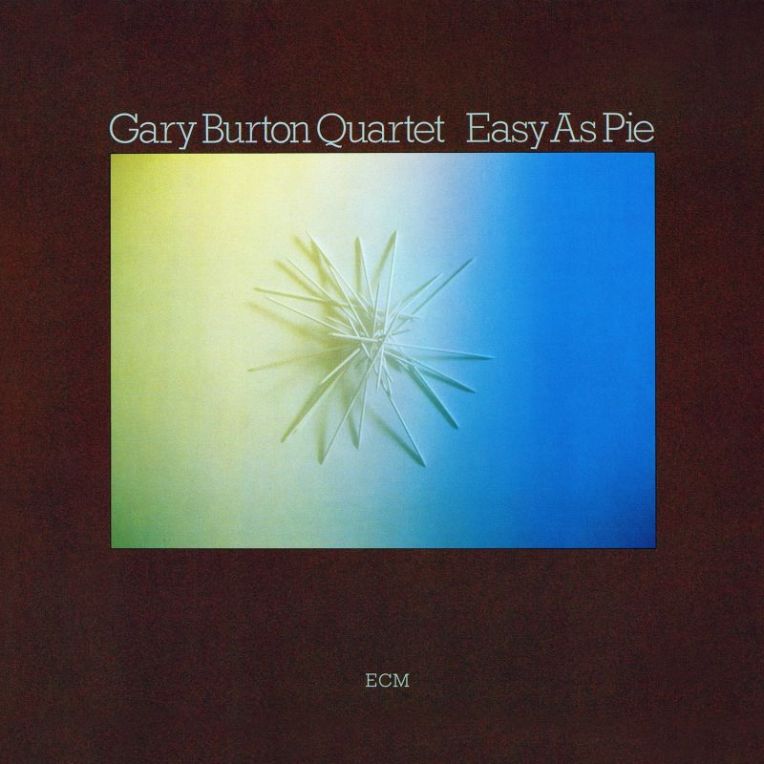
Gary Burton Quartet: Easy As Pie (ECM 1184)

ECM 1184

The Gary Burton Quartet
Easy As Pie

Gary Burton vibraharp
Jim Odgren alto saxophone
Steve Swallow bass
Mike Hyman drums
Recorded June 1980 at Tonstudio Bauer, Ludwigsburg
Engineer: Martin Wieland
Produced by Manfred Eicher

Gary Burton’s involvement in any project guarantees smoothness and melodic robustness, and Easy As Pie is no less promising than one would expect from the mallet master. As the title may imply, the results are generally laid back, but ever virtuosic. From the first licks of “Reactionary Tango” (Carla Bley) we get a taste of the banquet about to be laid before us. Jim Odgren shines on reeds the pages of this developing story, snipping from them a string of paper dolls. As one is swept away by the strains of “Summer Band Camp” (Mick Goodrick)—a fantastic piece that first appeared on the composer’s In Pas(s)ing—one notices just how integral Odgren is to the overall sound. “Blame It On My Youth” (Oscar Levant) is emblematic of what Burton does so well, capturing moments and memories as if in snapshots of living sound. In this solo piece, he sews that feeling of nostalgia into every motivic cell of activity. And further in “Isfahan” (Strayhorn/Ellington), a smoky ballad with plenty of shadow in which to luxuriate unseen, Burton turns that shadow into liquid gold in the throes of his soloing. Just so this joint doesn’t weigh us down with too much dark energy, two Chick Corea tunes, “Tweek” and “Stardancer,” give us plenty of beat to chew on and highlight Steve Swallow’s unstoppable groove. Between the kaleidoscopic drum solo from Mike Hyman and Odgren’s storybook endings, there is more than enough color to go around.

The members of Burton’s quartet work like kilned clay, which must be scored before being fit together to survive the heat with which it is imbibed. If this is dinner jazz, then prepare to be stuffed.

<< Corea/Burton: In Concert, Zürich, October 28, 1979 (ECM 1182/83)
>> Miroslav Vitous Group: s/t (ECM 1185)

Pat Metheny: 80/81 (ECM 1180/81)

Pat Metheny
80/81

Pat Metheny guitar
Charlie Haden bass
Jack DeJohnette drums
Dewey Redman tenor saxophone
Michael Brecker tenor saxophone
Recorded May 26-29, 1980 at Talent Studio, Oslo
Engineer: Jan Erik Kongshaug
Produced by Manfred Eicher

With 80/81, Pat Metheny took one step closer to his dream of working with The Prophet of Freedom (a dream he finally achieved with 1985’s Song X), and what better company than Coleman alumni Charlie Haden and Dewey Redman, both fresh off the boat of Keith Jarrett’s newly defunct American Quartet and both welcome additions to the extended Metheny family. Along with the technical mastery of reedman Mike Brecker and drummer Jack DeJohnette, plus a dash of post-bop spice, the result was this still-fresh sonic concoction. The atmospheres of the opening “Two Folk Songs” invite us with that expansive pastoralism so characteristic of Metheny. This makes Brecker’s highly trained yet raw stylings all the more marked, bringing as they do a sense of presence that explodes into a million pieces. Metheny’s benign sound catches at the threshold of perfection with every turn of phrase, allowing Brecker fiery bursts of abandon. DeJohnette throws on a log or two with his rocketing solo, while Haden wipes the slate clean with shadings of his own. Metheny shows off his unparalleled command of two-string harmonies, fading on a lightly skipping snare. This feeling of perpetual motion lingers throughout the title track. Content in sharing the revelry, Metheny relays to Redman who, though he may not fly as high, emits no less intensity in his groove. “The Bat” gives us a minor-keyed shadow of “I’ll be Home for Christmas” before diving headfirst into Coleman’s “Turnaround.” This trio setting boasts inventive melodies and a plunking solo from Haden. “Open” is, suitably enough, the freest track on the album, emboldened by trade-offs between Redman and Brecker, while “Pretty Scattered” dances more lithely with John Abercrombie-like exuberance. A ringing high from Metheny laser-etches this track into our memory. Balladry abounds in “Every Day (I Thank You),” one of his most gorgeous ever committed to disc. This is music that grins even as we grin, and shines through the darkest cloud of a Midwestern storm. Metheny ends alone with “Goin’ Ahead.” This breath-catching piece works its farewell into our hearts with every suspended note, effortlessly walking the beaten path of all those souls who have traveled before, so that those yet to be born might know where they come from, and to where they might return.

Like much of what Metheny produces, 80/81 is wide open in two ways. First in its far-reaching vision, and second it its willingness to embrace the listener. Like a dolly zoom, he enacts an illusion of simultaneous recession and approach, lit like a fuse that leads not to an explosion, but to more fuse.

<< Bengt Berger: Bitter Funeral Beer (ECM 1179)
>> Corea/Burton: In Concert, Zürich, October 28, 1979 (ECM 1182/83)

Bengt Berger: Bitter Funeral Beer (ECM 1179)

ECM 1179

Bengt Berger
Bitter Funeral Beer

Bengt Berger ko-gyil (Lo Birifor funeral xylophone)
Don Cherry pocket trumpet
Jörgen Adolfsson violin, sopranino, soprano and alto saxophones
Tord Bengtsson violin, electric guitar
Anita Livstrand voice, bells, axatse (rattle)
Recorded January 1981 at Decibel Studios, Stockholm
Engineer: Thomas Gabrielsson
Produced by Manfred Eicher and Bengt Berger

Swedish percussionist Bengt Berger’s deep interest in Ghanaian folk music and Don Cherry’s wayfaring trumpet inform every moment of this stunning record, one of a handful in ECM’s back catalogue to be digitally unearthed, not unlike the site on the cover. In contrast to many likeminded projects since, which seek to augment the “indigenous” with the “ingenious,” in the dregs of Berger’s we encounter something all too rare in the world music market: unforced sincerity. Take, for instance, the song that forms the Kundalini spine of the title track. The eclectic listener will recognize it as the sampled hook in “Hypnoculture” by Tears for Fears frontman Roland Orzabal. While in the latter it adds a touch of the “exotic” where really it isn’t needed (to Orzabal’s credit, the song is, like all on the solo album on which it appears, a sketch of ideas and not meant to be taken as a definitive statement on anything), here it thrives in an utterly organic assemblage. The addition of thumb piano and rooted drumming heighten the sense of immediacy that pervades the album, and not even the reeds of Jörgen Adolfsson feel out of place. The ululations of vocalist Anita Livstrand hit the psyche like the paroxysms of Mary Margaret O’Hara in Morrissey’s “November Spawned a Monster.” The acutely percussive “Blekete” is a walkabout into a land that is as corporeal as it is immaterial. Cherry is the brightest ember in the hearth that is “Chetu,” which continues the trance. The Fela Kuti-like drive of “Tongsi” beckons us with open arms before leaving us in the care of “Darafo.” This funereal dance begins with more pronounced instrumentalism, presenting us not with a mystery to be untangled, but rather a clear set of variables to be re-tangled into the mystery from which they came. The infectious soloing tightens into a record scratch of ecstasy, leaving only the ever-present beat to navigate the inevitable fade.

As with the work of CODONA, Bitter Funeral Beer epitomizes ECM’s pioneering approach to the world music idiom. Integration is the keyword here, collectivity its modus operandi. Each voice is well-fermented, so that one always gets the feeling of listening to a field recording and not a piece of studio trickery. This is music that accepts us as we are and allows us the opposite of escapism: a pure awareness of the cavernous self that defines the open channels of our communities.

One of ECM’s absolute finest and a window into the label’s evolution toward a sound-world without borders. As bitter as this beer is, one sip is all you’ll need to convince yourself that the cup must be drained.

<< Barre Phillips: Music By… (ECM 1178)
>> Pat Metheny: 80/81 (ECM 1180/81)

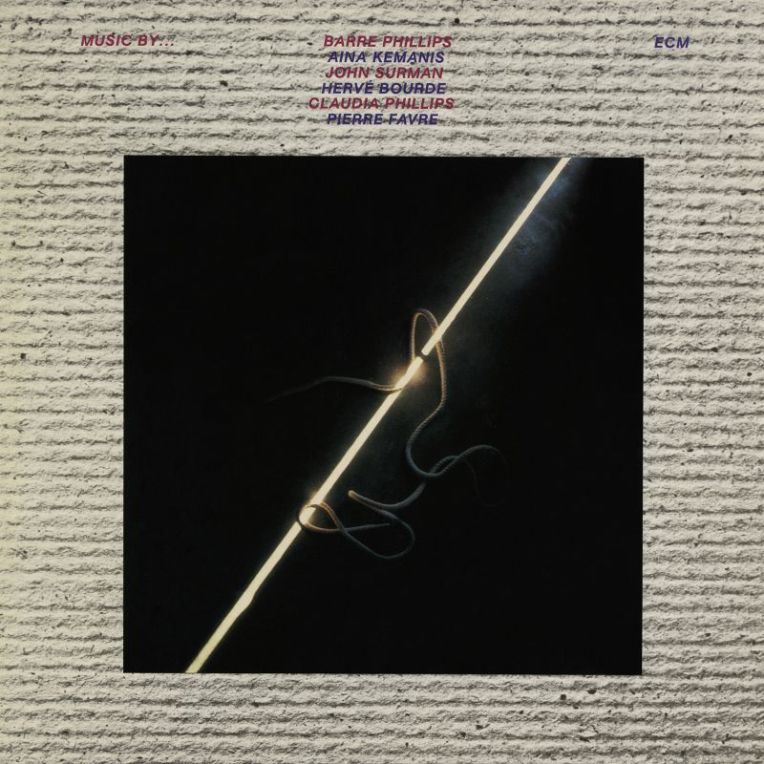
Barre Phillips: Music By… (ECM 1178)

ECM 1178

Barre Phillips
Music By…

Barre Phillips bass
Aina Kemanis voice
John Surman soprano and baritone saxophones, bass clarinet
Herve Bourde alto and tenor saxophones, flutes
Claudia Phillips voice
Pierre Favre drums, percussion
Recorded May 1980 at Tonstudio Bauer, Ludwigsburg
Engineer: Martin Wieland
Produced by Manfred Eicher

Long before Twitter was a microblogging phenomenon, it was the name of the first cut on this out-of-print gem from Barre Phillips. Thankfully, there is nothing micro about it. Driven by train-like syncopation from drums and bass clarinet, this attention-grabbing burst of virtuosity introduces us to the bubbling acrobatics of daughter Claudia Phillips, a vocalist whose career as chanteuse found a niche in France in the 80s. Her sometimes-manic instincts are swept down the stream of Aina Kemanis, the voice of Journal Violone II. Together they form a magic triangle with John Surman’s own sinewy lines. With such exuberance and glottal depth as Claudia displays here, one can hardly keep one’s ears focused on anything but her brilliance. Her siren-like spindles prove to be a guiding force in the more freely improvised “Angleswaite” and, with Kemanis, trace fluid arcs in “Elvid Kursong” and drop like spores in “Pirthrite.” The latter is a bizarrely martial excursion that is at once march and requiem, made all the more so through the liquid alto of Herve Bourde. These facets contract into a single plane in “Longview.” Here, Claudia comes to life in a bubbling stutter, soon overtaken by Bourde’s tenor, left of center. “Entai” and “Double Treble” sound like an ice-skating bass and clarinet struggling for balance over a warping record, compressing the album into more rudimentary ciphers.

This is yet another fascinating cell in the stained glass window that is Barre Phillips, capturing both the thrill and pain of modernism and those quiet moments, few and far between, where the soul kisses the brow of alienation. The content is brought to fervent life by an impassioned participation that frolics at the intersection of speech and song. As a longtime fan of the Cocteau Twins and Elizabeth Fraser’s voice that drives it, I have sometimes wondered what she might have sounded like had she made an ECM album. With Music By… we begin to approach one possible answer.

<< Walcott/Cherry/Vasconcelos: CODONA 2 (ECM 1177)
>> Bengt Berger: Bitter Funeral Beer (ECM 1179)