Kim Kashkashian: Neharót (ECM New Series 2065)


Neharót

Kim Kashkashian viola
Münchener Kammerorchester
Alexander Liebreich conductor
Boston Modern Orchestra Project
Gil Rose conductor
Kuss Quartett
Recorded between 2006 and 2008 in the USA, Poland, and Germany
Engineers: Peter Laenger, Lech Dudzik, Gabriela Blicharz, Joel Gordon, John Newton, Blanton Alspaugh
Produced by Manfred Eicher

Neharót Neharót (2006/7) for viola solo, accordion, percussion, two string ensembles and tape by Israeli composer Betty Olivero opens a haunting album from violist Kim Kashkashian. It is a slow awakening—not into light, but into twilight—and swells with the wounds of fresh tragedy. Kashkashian arrives as if by wind and with the raw imperfection of an unpreened bird. The tone and feeling are not unlike that of John Tavener’s The Protecting Veil at its tensest moments. The strings roil like turgid waters in which eddy the relics of an unseen war. Two women’s voices reach into the storm with tendrils of mimicry. This call and response blossoms into a profound moment of rupture, at which point the orchestra and percussion spill over one another. Fragments of the audible past come through as snatches of Monteverdi quoted from his Orpheus and eighth book of madrigals. These recycled motifs are like a dream that quickly consumes itself before waking again. The viola rises in their place, seeming to run around frantically in search of the voices that so enlivened it. When they are nowhere to be found, the outcast wallows in the hopes that nightfall will be her cloak. But then the voices come back: the viola prostrates itself, fearing to expend the ancestral legacy it breathes. It wants nothing more than to offer gratitude, but can only contort itself into a vowel of need.

After such a profoundly draining journey, the three Armenian selections that follow are a welcome rest, though one not without its internal travels. Tigran Mansurian gives us his Tagh for the Funeral of the Lord for viola and percussion, Three Arias (Sung out the window facing Mount Ararat) (2008), and Oror, a lullaby by Komitas (1869-1935) arranged and performed here by Mansurian at the piano. The “tagh” is an ancient Armenian song, and Mansurian’s breathes with organic vitality. Its lament echoes across cold plains, the percussion a mere accent to the viola-driven melody. The Three Arias are essentially a series of orchestral swells with viola interludes, an audio essay of the music’s own origins and possible futures. The viola acts like a lens over a film sheet, trying to find the one picture that most clearly articulates something that can only be remembered through image, but that can only be musically described. The viola struggles with an unseen force in spite of its orchestral inheritance. A dazzling ending is made all the more so for the effort required of us to get there. And this is precisely what the piece is about: seeking out those moments that, in a life remembered, also define that life most clearly. Mansurian’s interludes are like the passage between two days, a conduit between continents and cultures, a subtle diaspora of sound.

And so, by the time we return to Israel in Eitan Steinberg’s Rava Deravin (2003) for viola and string quartet (the tile means “Favor of Favors”), we feel more fully prepared for any and all emotional obstacles. The piece was originally scored for voice and a mixed chamber ensemble, but was transcribed as the current version at Kashkashian’s behest; hence the accordion-like opening harmonics that speak of bellowed breath. Yet even before the music begins, the instrumentation tells us so much about what we are about to hear. We know the viola soloist has a second self, a ghost presence amid its accompanying quartet, and yet here it is at once extracted and embedded in its periphery, singing with its own voice even while knowing it has been long aligned with the larger organism behind it. When the quartet takes a more syncopated stance, we never lose sight of the abstract milieu in which it is situated. The viola must resign itself to self-division, and toward the end it squeals and scatters snake-like through tall grasses of harmonics. The music dies not by lowering itself in volume, but by pushing us away so gradually that by the time we notice the music has gone, we are already too far away to catch up with it.

Were the orchestra to be analogized as body, the viola would most certainly be the throat, for the vibrations of song rattle its chambers more than those of any other. In this respect, Kashkashian has given more lucid breath to this recording than to any other she has made. She only seems to get better with every draw of her bow, and her dedication once again remains paramount. This is a cohesive program of some of the most original music to come out of ECM in a long time. Not to be missed.

Keith Jarrett: Tokyo Solo (ECM 5501)

Keith Jarrett
Tokyo Solo

Keith Jarrett piano
Recorded October 30, 2002, Metropolitan Festival Hall, Tokyo
Directed by Kanama Kawachi

Over a career spanning nearly 70 recordings for ECM alone, Keith Jarrett has established himself as one of the world’s most inimitable and revered musicians. We marvel at his music-making, at his technical prowess and innovation, but rarely do we get to experience the physiological creativity so vital to what he does. For this concert, Jarrett’s 150th in Japan, the one and only has given us a primary source in video form, a clearer glimpse into the complexity of his craft. On the surface Jarrett is a lone pianist whose humble frame elicits some of the more towering improvisations one is ever likely to hear, and here we get to see what lies beyond that surface to the fiery core that sustains him. As he quietly takes the stage the house lights dim to circumscribe the piano, leaving Jarrett and his instrument suspended in darkness.

He blows on his hands and draws an abstract veil over our eyes and ears. What we hear is serial, boastful yet self-deprecating, and, while not entirely accessible, betrays total commitment to a challenging trajectory. Jarrett works his way through a dense cloud of notes, as if searching for the perfect one, which he finds and intones as his face contorts in mimicry of the depths plied with every repetition.

This instigates an ecstatic passage of finger pedaling, which eventually brings Jarrett to the piano’s outermost reaches. He plays a single high and low tone together before returning to the center, as if he were gently embracing every note available to him before singling out a privileged few.

We then enter the most emotional portion of the concert. Jarrett cannot help but sing along, as much in deference as we are to the sounds flowing through him. At this point we come to realize that the opening jumble was nothing more than a search for any fragment he might be able to expand into a larger narrative, and that this is the tale we are about to hear. As Jarrett begins the next section, someone claps. He stops and listens carefully before scrapping everything in favor of a new idea. What follows is an agitated catharsis that gradually beats itself into a more elegiac shape. So ends Part 1.

Part 2 is more like what we have come to expect from a Jarrett solo concert: protracted, pastoral bliss. With lips puckered and brow furrowed, Jarrett dives headfirst into a quiet maelstrom of beauty, precursor to a grinding tangent that stops as suddenly as it develops. In spite of the serious approach he manifests in his performance style, Jarrett is not without his lighter moments. He even flirts with the audience’s attentions at one point during the concert. He has just played a delicate high note to close an epic improvisation. Applause begins, but he signals silence, only to play that same note a final time. He smiles and says, “That’s it.”

From this laughter he emerges with a brilliant cascade to close. Not wanting to leave his audience without something familiar, he returns to the stage for three encores: Danny Boy, Old Man River (Jerome Kern), and Don’t Worry ‘Bout Me (Art Tatum/Count Basie)—all of them pulled off with unparalleled intuition.

Those wanting to get more out of the Keith Jarrett experience need look no further than this DVD. The camerawork and recording are simple and direct, capturing the full range of expressions and contortions at Jarret’s disposal, and the crisp sound ensures that we hear every surrender. Jarrett shows a profound respect for what he plays, be it a standard or something composed on the spot. The image of his spotlit piano is the perfect metaphor: the musical alchemist toiling over his crucibles while his admirers fall awestruck into shadow. That being said, it’s easy for us to over-romanticize Jarrett’s process, to wonder where he goes when he improvises with such fluidity. Thankfully in Tokyo Solo we no longer need to wonder, for in a performance such as this we share the same space.

Sarah Leonard/Christopher Bowers-Broadbent: Górecki/Satie/Milhaud/Bryars (ECM New Series 1495)

Górecki/Satie/Milhaud/Bryars

Sarah Leonard soprano
Christopher Bowers-Broadbent organ
Recorded June 1992, Hofkirche Luzern
Engineer: Peter Laenger
Produced by Manfred Eicher

Not many record labels would produce, let alone conceive of, an album consisting mainly of works for soprano and organ. I am glad to say that ECM did not back away from such a challenge, and in the process left one of its most indelible musical marks on the classical landscape. Of the four composers represented here Bryars is the only ECM mainstay, but he is in fine company indeed.

Henryk Górecki’s O Domina Nostra (1982-1985/90), conceived as an apostrophe to the Black Madonna of Jasna Góra, emerges from and recedes into a profound stasis. An earthly low pedal D on the organ is paired with triads descending from the cosmos, leaving us caught in the middle. Our only guide is the bare text and the voice that articulates it:

O Domina nostra
Claromontana
Victoriosa
Regina nostra Maria
Sancta Maria ora pro nobis

Oh, our Lady
Of the Bright Mount,
Victorious
Our Queen, Mary
Holy Mary, pray for us

Amid this murky swirl a soprano scours her lowest range, trying to pull herself from the depths of some unnamable crisis. She proclaims her joy in faith, as if each new utterance might touch a hope that its predecessors failed to reach. She returns to the opening invocation, closing on a supplicative “O Domina.”

The epic Messe des Pauvres (1895), or Mass for the Poor, by Erik Satie is, like much of the composer’s paradoxical output, both representative of the eclecticism for which he is known and something of an anomaly. According to Wilfrid Mellers’s liner notes, early on in his compositional career Satie “sought to reintegrate the disintegrated materials of tradition by juxtaposing fragments of melody and chord-sequences without obvious relation to one another or to development.” Thus do we get the Messes des Pauvres, a piece rooted in plainchant, sans the theological overload such a comparison might imply. Normally the organ is accompanied by unison voices, but forgoes them here. The piece rarely lingers, as if the four limbs required of its performance were seeking a point of unity through which to gain access to something far more mystical. Yet the piece also questions the mystical, and with a levity that indulges our skepticism. The music is wrought with such beautiful indecisiveness that moments of resolution seem intrusive. Only when the organ bares its teeth midway through is the power of this indecision fully realized. The heavy feet of an overarching sarcastic glory trample even the fluted reverie that follows.

The diptych of miniatures that is Darius Milhaud’s Prélude I/II (1942) is charmingly rustic and prepares us for the masterpiece that awaits us. The lead melodies are like the ramblings of shepherds, whose carefree desires can only go so far before the flock disperses beyond containment. The rhythms move like a human figure, as graceful as they are imperfect.

Which brings us to this album’s pièce de résistance: Gavin Bryars’s The Black River (1991). The text, culled from Jules Verne’s Twenty Thousand Leagues Under the Sea, is told from the viewpoint of Professor Aronnax as he describes the many underwater life forms that escort the mighty Nautilus through a vast underwater current from which the piece gets its name. Bryars successfully makes of this passage a world unto itself, one not subterranean but submerged. A languid introduction from the organ opens our ears to the soprano’s entrance as she propels herself through a subdued tour de force of intonation, melody, and atmosphere. The melody sustains itself through a constantly shifting mosaic of moods, in which recapitulation is found only in the organ at the end.

Sarah Leonard sings with rare beauty, and her rich voice is laced with a nasal quality that burrows into the very marrow of the listener’s bones. Her high note in The Black River sends shivers down the spine (and do keep an ear out for the haunting overtone she unwittingly produces at the 13:18 mark in the same piece). Christopher Bowers-Broadbent is the perfect foil, eliciting from the organ a delicacy I have heard nowhere else. This will always be one of my most beloved New Series recordings.

<< Messiaen: Méditations Sur Le Mystère De La Sainte Trinité (ECM 1494 NS)
>> Aparis: Despite the fire-fighters’ efforts… (ECM 1496)

Bach: Das Wohltemperierte Klavier, Bücher I & II – Jarrett (ECM New Series 1362/63 & 1433/34)

Keith Jarrett never ceases to astound me: not because of his chameleonic ability to shift between jazz and classical music, but by the sheer passion and commitment he brings to both. On these recordings of Bach’s The Well-Tempered Clavier, Jarrett proves himself to be a more than consummate classical performer. That being said, I don’t think Jarrett is out to “prove” anything here. Neither does he seem interested in laying to rest—despite critiquing others’ approaches, particularly Glenn Gould’s, in his liner notes—the ongoing debate of authenticity regarding the interpretation of Bach (and if you ask me, perhaps not even Bach ever played Bach “authentically,” tailoring as he did his keys and tempi to the occasion). What Jarrett does seem interested in is taking his ego out of the equation as much as possible. And while one cannot, of course, completely disavow a performer’s presence, this presence can be intrusive and overblown all the same. For what it’s worth, Jarrett toes the line between restraint and levity, humbly approaching the music from below rather than attacking it from above. Essentially a series of preludes and fugues written for keyboard students and enthusiasts, The Well-Tempered Clavier consists of generally short pieces, each its own microcosm of energy and ideas. Jarrett opts for a no-frills approach, though he has made a bold decision in recording the first book on piano and the second on harpsichord. Nevertheless, whatever novelty there is of “Jarrett playing Bach” wears off quickly, allowing the listener to focus on the music rather than dissect the performance thereof. Quite simply, this is a singular talent playing music by a singular composer.

ECM 1362_63

Johann Sebastian Bach
Das Wohltemperierte Klavier, Buch I (ECM New Series 1362/63)

Keith Jarrett piano
Recorded February 1987
Engineer: Martin Wieland
Produced by Manfred Eicher

Book I opens with one of the most significant musical utterances of the Bach catalogue: the Prelude and Fugue in C major (Gould’s recording of which was deployed into space on the Voyager Golden Record). Jarrett plays these with a strong sense of forward motion that sets the tone for a beautifully articulated journey through every major and minor key of the chromatic scale. Jarrett excels in the faster movements, of which notable examples are the G major and B-flat major Preludes, as well as the Fugue in E minor. But he shows an equal aptitude for those quieter moments, able to switch from sprightly (Prelude and Fugue in F major) to ponderous (Prelude and Fugue in F minor) in one fell swoop. Other gems in the latter vein include the C-sharp major Prelude, to which Jarrett brings a flowing pace that is fast enough to excite while also allowing the notes to breathe; the languid C-sharp minor Fugue; the sensitively handled E-flat major Fugue; the E-flat minor Prelude with its dexterous simplicity and emotive ritard; and the intimate A-flat major Fugue. Throughout Book I, Jarrett revels in his love for rhythm and a relatively bare aesthetic. The sound quality is accordingly muted, the piano recorded as if it were a harpsichord. Jarrett takes time with his trills, and while some might disagree with his pedal choices, for the most part they add a welcome splash of color.

<< Keith Jarrett Trio: Still Live (ECM 1360/61)
>> Tamia/Pierre Favre: de la nuit … le jour (ECM 1364 NS)

… . …

ECM 1433_34

Johann Sebastian Bach
Das Wohltemperierte Klavier, Buch II (ECM New Series 1433/34)

Keith Jarrett harpsichord
Recorded May 1990
Engineer: Peter Laenger
Produced by Manfred Eicher

Book II ushers in an entirely different sound when the piano is abandoned for harpsichord. Jarrett’s choice to do so may seem arbitrary, but I like to think it was more deeply thought out. On the surface Book I is more elegiac and perhaps therefore amenable to a pianistic performance. Book II, however, offers more in the way of the grinding syncopations and dance-like diversions more often associated with the instrument for which it was written. Where the piano seems an expansive medium, the harpsichord is a supremely tactile one that arrests us with its plucked immediacy, and the relay from one to the other gives us the luxury of both worlds, as it were. From the dazzling C-sharp major Prelude to the lush F minor Fugue, Book II is replete with gorgeous moments. The C-sharp minor Fugue is another wonderfully syncopated affair with jarring half-turns and unexpected phrasing. The harpsichord holds its own here in a variety of moods, ranging from vivacious (Prelude in D minor) and stately (E-flat major and A minor Fugues) to perpetual (E minor and A major Fugues,; Prelude in G major) and resplendent (Fugue in G major), while the final B minor Fugue caps things off with a rousing flourish.

<< Anouar Brahem: Barzakh (ECM 1432)
>> Arild Andersen: Sagn (ECM 1435)

… . …

At every moment during the 4+ hours it takes to get through The Well-Tempered Clavier, Jarrett allows the music into his heart and releases it verbatim. He exercises little dominance over the score and follows it as closely as he can. Where some interpreters turn these purely didactic exercises into showpieces, Jarrett lets them stretch their limbs and remain comfortable where they are. Oddly enough, the fact that Jarrett had already been playing Bach for 22 years before recording Book I, and the harpsichord for nine before recording Book II, has done little to staunch the flood of insults thrown his way for even attempting such a feat. Yet I find much of the criticism leveled against him to be rather self-defeating. “He’s so pretentious,” people say, “trying to establish himself as a serious classical pianist when everyone knows he’s a jazz musician,” but then in the same breath call him out for not taking a more avant-garde approach to the canon. What these hypocrisies fail to acknowledge is the kindred spirit Jarrett brings to one of the most monumental works in Western art music. We do well to remember that Bach was also a master of improvisation and that his skills as such were at the heart of his comparably prolific output. I, for one, have heard many recordings of The Well-Tempered Clavier, and would never resort to calling any of them bad, uninspired, or somehow incorrect, for what and where is the “original” interpretation to which they might be compared? Regardless of whether or not one cares for what Jarrett has done with Bach, his utter devotion to the music at hand reduces the debate to a simple matter of preference over quality. And so, when Jarrett proclaims that “This music doesn’t need my help,” I propose that we take him seriously. What this music does need is our help, which we can offer by setting aside our own pretensions and listening with open minds.

Robin Kenyatta: Girl From Martinique (ECM 1008)

1008

Robin Kenyatta
Girl From Martinique

Robin Kenyatta flute, alto saxophone, percussion
Wolfgang Dauner Clavinet, piano
Arild Andersen bass
Fred Braceful drums
Recorded October 30, 1970 at Tonstudio Bauer, Ludwigsburg
Engineers: Kurt Rapp and Karl-Hermann Hinderer
Produced by Manfred Eicher
Release date: March 15, 1971

One night, after a gig in Harlem, a budding saxophonist by the name of Robin Kenyatta was approached by none other than Bill Dixon, who expressed an admiration for the young reedman’s skills and would soon introduce him to the likes of John Coltrane. Thus began a colorful and fascinating career that intersected with ECM for this album alone. The currently out-of-print Girl From Martinique shows Kenyatta at his most experimental, and the results are a mixed bag. The title track is the weakest, laden as it is with a hackneyed “psychedelic” reverb, though Kenyatta’s flute skills are in fine form here and are a joy to hear. So much so that I would have been happier listening to him play unaccompanied, perhaps in a more naturally resonant space. And while the piece does come into its own in the home stretch, it feels like too little too late. Thankfully, “Blues For Your Mama” is more straightforward with its heavy Clav bassline, priming a killer sax solo. “Thank You Jesus” sounds like a gospeller’s good dream turned bad, spicing things up with such brilliant chaos during the fadeout that one wonders where the session continued to travel after the mixing knob was turned down. The Caribbean-flavored “We’ll Be So Happy” is groovy and understated, a beautiful track that might easily have been extended to fill the entire album with no loss of interest. Kenyatta returns to the flute as an echoing Clav leads out with a mystical touch.

Kenyatta, who passed away in 2004 at the age of 62, was a standout player in the 1970s free jazz scene, and his intuition and improvisatory chops are in full evidence here. Yet in some ways this recording leaves something to be desired. The dated electronics and paltry arrangements question the need for support in its first half. The album is overproduced and, while archivally significant, shows a label (and a musician) still trying to find its voice. That all being said, the album grows with every listen as its nuances come to the fore, and rewards the patience put into it. Anyone without access to the original vinyl may want to check out Stompin’ at the Savoy (1974) or the funk-infused Gypsy Man (1972) for a taste of Kenyatta’s more commercially successful (and thereby more readily available) projects before plunking down a few bills for this blast from the past.

<< Jan Garbarek Quartet: Afric Pepperbird (ECM 1007)
>> Corea/Holland/Altschul: A.R.C. (ECM 1009)

Werner Pirchner: EU (ECM New Series 1314/15)

ECM 1314_15

Werner Pirchner
EU

Werner Pirchner accordion, bass-vibes, voice
Ernst Kovacic solo-violine
Kurt Neuhauser cathedral organ
The Vienna Wind Soloists
Vienna Brass Quintet Prisma
Recorded 1984-1986, Tonstudio Ströher, Innsbruck; Vienna; Tirol; Lend
Engineer: Hanno Ströher
Produced by Manfred Eicher

Werner Pirchner (1940-2001) is not a name likely to be well known outside of his native Austria. A multi-instrumentalist with strong jazz roots, Pirchner devoted much energy in the latter part of his life to strict composition, leaving behind an oeuvre of 130 works. This double album, one of the earliest in ECM’s New Series, is a delightful potpourri and a charming record of a unique musical career.

The Sonate Vom Rauhen Leben (Sonata of a Harsh Life) features the composer on the accordion. The music is mysterious, like folk music from afar. Pirchner’s playing is elegiac, highly descriptive, and paints with dense strokes. Loneliness mounts with each section, as if the music were resigned to live and die for itself. Streichquartett Für Bläserquintett (String Quartet for Wind Quintet) balances playful abstraction with comic determination, harrumphing its way through a slideshow of waltzes and tongue-in-cheek adventures. All the more satirical given that Pirchner uses a Tyrolean slave song as its thematic core. The music sounds like a wind section without orchestra, so vast is its implied periphery. Next is Good News From The Ziller Valley, a three-part jig for solo violin that abounds in microtonal harmonies. This is followed by the pointillist Kammer-Symphonie “Soirée Tyrolienne”, a programmatic exposition that sounds like it belongs in a ballet or stage production. Do You Know Emperor Joe is a series of delightfully syncopated vignettes for brass ensemble. This pieces bears its dedication to “Joseph II., the only monarch with the nickname ‘Menschenfreund’ and to Fritz v. Herzmanovsky-Orlando, author of ‘Kaiser Joseph and the Station-Master’s Daughter.’” The audience in this live recording is in stitches and seems to be enjoying itself thoroughly, making us wonder what we missed by not having been there. The mood changes with Two War-& Peace-Choirs, the first of which sounds like something out of Meredith Monk’s vocal world, while the second revels more overtly in the feel of its text—especially in its trilled Rs—and ends with a humorous “Amen” from a deep bass. This is appropriately followed by Kleine Messe Um “C” Für Den Lieben Gott, a dirge for solo organ that seems to pick up on a grander scale where the accordion left off at the album’s intimate beginnings. We end with the brilliant Solo Sonata for Bass-Vibes, played to perfection again by our composer.

It’s hard to know what of make of EU. On the one hand it’s a fascinating cross-section of a very idiosyncratic composer. Pirchner’s innovative approach is apparent at every turn and escorts his listeners through an amusement park of moods. On the other hand some of the pieces do drag on a bit, making sustained interest an occasional issue. Pirchner embodies a unique paradox: where some minimalist composers take repetitive motives and make them sound highly varied, he somehow takes a wide variety of musical elements and makes them sound repetitive. At its best moments Pirchner’s music is uninhibited and just plain fun; at its worst it feels ultimately insubstantial, like an afternoon nap cut short. That being said, the music is also fraught with pauses, leaving much time for listeners to ponder the implications of what they’re hearing. Pirchner’s skills are particularly obvious in the shorter pieces, his bass-vibes sonata the clear standout in this regard. Part III of the selfsame sonata is a stroke of genius matched by an equal level of performance. And speaking of performance, the musicianship, tuning, and recording quality throughout are positively superb.

As I bask in the whimsy of EU for this review, a summer thunderstorm unleashes its ominous fury over my roof, providing a stark contrast to the delightful sounds in my ears. This seems like just the sort of irony that Pirchner would appreciate, one that milks the unpredictability of life for all it’s worth and says in response, “Yeah, I can work with that.”

Incidentally, for a wonderful rumination on Pirchner and his music, check out Stephen Smoliar’s post at The Rehearsal Studio.

<< Miroslav Vitous: Emergence (ECM 1312)
>> Kim Kashkashian/Robert Levin: Elegies (ECM 1316 NS)

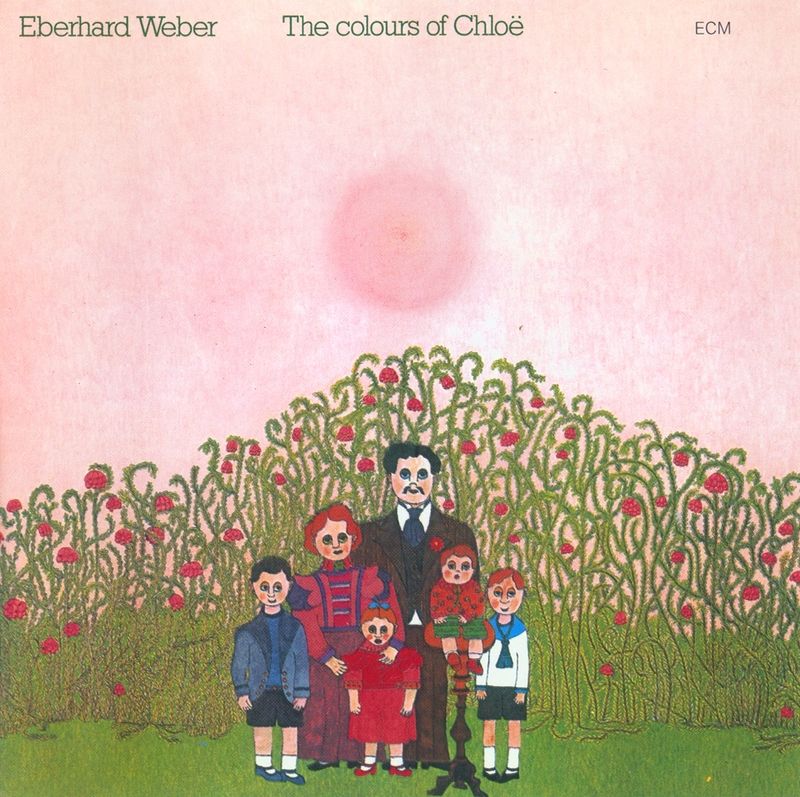
Eberhard Weber: The Colours Of Chloë (ECM 1042)

Eberhard Weber
The Colours of Chloë

Eberhard Weber bass, cello, ocarina
Rainer Brüninghaus piano, synthesizer
Peter Giger drums, percussion
Ralf Hübner drums
Ack van Rooyen fluegelhorn
Cellos of the Südfunk Symphony Orchestra Stuttgart
Recorded December 1973 at Tonstudio Bauer, Ludwigsburg
Engineers: K. Rapp and M. Wieland
Produced by Manfred Eicher

Listening to an Eberhard Weber album, one can always count on an immersive experience. This is especially true in his first as frontman. From its enigmatic title and charming cover to its fine musicianship and well-conceived instrumentation, The Colours of Chloë remains an ECM classic and may just be the perfect introductory album for those looking to know why the label was so influential even in its infancy. In a span of 4 compositions and 10 times as many minutes Weber produces a veritable mélange of flavors, textures, and, of course, colors. On that note, “More Colours” gives us just that as Weber’s bass cuts a slow swath of orchestral goodness. The title track features an ethereal ocarina* that swirls into a resplendent piano solo from longtime Weber collaborator Rainer Brüninghaus. “An Evening With Vincent van Ritz” draws from the same palette as the first track, but soon breaks into a run with some inspired drumming and a stellar fluegelhorn solo by Ack van Rooyen, while “No Motion Picture” reprises the spacey feel of the title track and shows Weber at his most profound. Not to be forgotten, Brüninghaus also has some breathing room here and provides some of the more transcendent moments in this all-too-brief journey.

Although a glance at the cover art or lineup may not exactly cry “Jazz!” Weber knows where he and his instrument stand. The music is firmly rooted in the genre’s orthodox structural standby: i.e., a solid thematic framework with plenty of room for improvisation along the way. While compositionally astute, Weber’s greatest strength is his “eye” for sound. His feel for blending instruments is highly idiosyncratic and backed by an obvious passion for music-making. His distinctive combination of bass, piano, percussion, horns, and strings is such that no one instrument or group is ever dominant for too long. Each musician is only as good as his altruism toward the ensemble as a whole. That being said, one cannot help but marvel at Weber’s signature sound at the heart of it all, or at his uncanny playing that walks the line between affirmation and mourning. This album is not to be missed.

*Thanks to Rasmus Sylvester Bryder for this correction.

<< Jan Garbarek: Witchi-Tai-To (ECM 1041)
>> Bennie Maupin: The Jewel In The Lotus (ECM 1043)

Keith Jarrett/Charlie Haden: Jasmine (ECM 2165)

Keith Jarrett
Charlie Haden
Jasmine

Keith Jarrett piano
Charlie Haden double-bass
Recorded March 2007 at Cavelight Studio
Mastered at MSM Studios
Produced by Keith Jarrett and Manfred Eicher

“This is spontaneous music made on the spot without any preparation save our dedication throughout our lives that we won’t accept as a substitute. These are great love songs played by players who are trying, mostly, to keep the message intact. I hope you can hear it the way we did.”
–Keith Jarrett

We sometimes think that the older we get, the more complicated we become, and that in our complexity we have more ammunition with which to defend our individuality in a dying world. This album proves that maturity is about filtering out all that distracts us from being who we are and finding just the right melody, taking comfort in the method over the message. The title of the first track, “For All We Know,” says it all. That two musicians, walking such different paths, can come together and create something so powerfully understated, so viscerally unfettered, is a testament to the creative potential of knowledge and the gift of life that allows it. Recorded in Jarrett’s home studio, this is more than just The Melody At Night, With You with an added bass. It is a heartfelt meditation on the philosophy of experience, a direct statement regarding the lives of its performers. This album might as well be called “Jazzmine,” for that’s exactly what it is: a mine of tried-and-true standards, each plucked carefully from the surrounding rock and arranged in a row of sparkling gems.

The album is generally mellow, but always effective. Tracks like “Where Can I Go Without You” brim with soulful introspection. Others like “One Day I’ll Fly Away,” “I’m Gonna Laugh You Right Out,” and “Goodbye” talk of resignation, filling our cup with unkept promises in the hopes that one final showing will make up for all of them. It is a bittersweet sadness, born from the pain that comes with loving someone who is too far away to requite, much less know of, that same love. “Body and Soul” strikes a delicate balance between recollection and regret and just grazes the edges of dissonance, giving certain traction to the tune. Jarrett sings as he spins a subtle energy. In this track we also get the most unmitigated bass solo, Jarrett merely providing the punctuation marks to Haden’s poetry. “No Moon At All” is more upbeat, a touch more joyful. And yet we come to realize this joy has been lost upon us with the passing of time. Haden’s solo here revels in the simple things that bring it melodic joy. Perhaps not coincidentally, this is one of the shorter tracks, further reminding us that our happiest moments are also the most fleeting. Last but far from least is “Don’t Ever Leave Me,” a comforting ballad that closes the album in near silence.

Over thirty years in the making, Jasmine was already a classic before Jarrett and Haden ever stepped into the studio to record it. It is as if the music had already existed and our dynamic duo merely needed to catch up with it. As Jarrett observes, Haden singularly embodies a “dichotomy between control and letting it go,” laying down righteous melodies that at once support and lead the way. Haden’s renderings are supremely gentle, the subtlest retouches on an already masterful painting. His solos go down easy like good advice, while Jarrett’s gorgeous supporting chords put that advice into action. Jarrett himself adopts a more autobiographical approach that manifests itself in a uniquely laid-back passion. He displays an intuitive sense of rhythm in the left hand, and with his right weaves variegated threads through the four-stringed loom of Haden’s bass. This mesh produces an unmatched synergy: take one variable away and you are left with an unsolvable equation.

The album jacket could hardly express more visually the magic that resides within its sleeve. Each rectangle, separate but also sharing the same line, is like the life of its respective musician. Neither is perfectly straight at the edges; a life drawn in freehand, as all lives are. There is an eternity contained in each, and yet for an indeterminate amount of time these two lives intersect, and from that overlap comes music so transparent that only its borders remain clear. For the musicians those borders are their instruments. Heavy and tangible, they respond only to the touch of those who know them best. For the listener those borders are the song titles, each telling a different side of the same story.

This is an album in the past tense, every sound a memory caught in the branches of our curiosity. Jarrett and Haden would seem to prize nostalgia above all—not by putting it on a pedestal, but by laying it at the pedestal’s feet. And while each track essentially follows the same format—i.e., a democratic entrance, a piano introduction followed by adlibbing, and solos from Haden and Jarrett before the two equalize—the formula never grows tedious, if only because its subtle negotiations speak volumes of an invisible history. And that is exactly the point. They’re not trying to break new ground here, but to see what can still be built upon the old ground before it disappears. And why not, for their materials are still resilient, pliant, and reliable. Listen to Jasmine for its quiet charm, for the way it sings without words, for the tireless care it embodies, but above all listen to discover just how honest music can be. Jarrett puts it best when he says: “An ecstatic moment in music is worth the lifetime of mastery that goes into it, because it can be shared.” How fortunate we are to be on the receiving end.

Paul Bley with Gary Peacock (ECM 1003)

1003

Paul Bley Trio
Paul Bley with Gary Peacock

Paul Bley piano
Gary Peacock bass
Paul Motian drums
Billy Elgart drums
Recorded 1964 and 1968 in New York
Produced by “ECM”
Release date: December 1, 1970

From the moment “Blues” lights the fuse, we’re rocketing through this magnificently swinging album. Pianist Paul Bley proves his comfort in Ornette Coleman territory, easing his way through a series of dexterous detours. His original “Getting Started” follows up with a ballad, its brushed drums giving off a grainy feel, desolate yet comforting. Peacock’s soloing is eager and ever so slightly askew. “When Will The Blues Leave” (Coleman) is a more syncopated affair. Brushes defer to drumsticks, adding delicate punch to the overall sound. Even Bley cannot restrain joyful cries as the mood intensifies. “Long Ago And Far Away” (Jerome Kern) moves forward with locomotive purpose and finds Peacock in an exuberant mood. “Moor” exhibits his soloing and composing, as refreshing as they are restless. “Gary” (Annette Peacock) is a lonely catharsis forged in bass and piano. The bassing here is somber, as if contemplating a jump from a high precipice. When the piano returns, it’s not to pull the bass downward but keep it from falling over. Bley’s own “Big Foot” is a rip-roaring good time. One can feel the lovingness of its creation. Finally, “Albert’s Love Theme” (Annette Peacock) presents us with a new direction as the trio goes its separate ways.

Bley is on point, Peacock hopping with vivacious confidence, as drummer Paul Motian brushes and rat-a-tat-tats his way through five of the eight cuts (the remaining three feature Billy Elgart in his place). The recording, made in 1963 (Motian session) and 1969 (Elgart session), has a classic trebly overlay yet is highly detailed. It’s a listening experience that suggests new focus every time. For this review, it’s Peacock who captures my attention. His fondness for higher registers punches holes in the music and allows the wind to flow through. Considering the time and place this album was cut, and the jigsaw of its talents, it practically recommends itself.

<< Just Music: s/t (ECM 1002)
>> Marion Brown: Afternoon Of A Georgia Faun (ECM 1004)