Pat Metheny: Works

Metheny

Pat Metheny
Works
Release date: April 1, 1984

On the crowded cruise ship of unmatched talents that is ECM, Pat Metheny deserves a first-class suite. The prodigious guitarist cut teeth with Gary Burton, making his first label appearance on Dreams So Real, and recording that same month (December of 1975) what would become the splash heard around the musical world that was Bright Size Life. This compilation, however, jumps over that leader debut into his last two watershed moments of the 1970s. The first of these is “Sueño Con México” (New Chautauqua, 1979). Its combination of acoustic guitars and electric bass is about as close to the original cover photograph’s open road as one can imagine. Without a care (or a car) in sight, Metheny plays his way through patchwork fields, each with its own character and color, and which by their counterpoint suggest a collective song. The second, “(Cross The) Heartland,” represents the Pat Metheny Group’s sophomore album, 1979’s American Garage. This dream team of Lyle Mays (keyboards), Mark Egan (bass), and Dan Gottlieb (drums) renders every change of scenery with utmost clarity. Metheny plays with squint-eyed brilliance, riding an underlying current that never lets up until the end. Thus, the title feels less descriptive than prescriptive: a bidding to step outside everyday bounds and see some history for yourself.

Our ride takes us through later PMG intersections, including the title track of 1983’s Travels and “James” from 1982’s Offramp. Both find bassist Steve Rodby replacing Egan for an especially distant sound. From moonlight to sunlight, this overnight diptych spotlights Mays’s ability to spin progressive ropes from traditional filaments. On “It’s For You” (As Falls Wichita, So Falls Wichita Falls, 1981), he and Metheny join percussionist Nana Vasconcelos, who also lets his singing voice carry forth: a melodic backbone built to withstand any flexing of key change and forward motion. Rounding out this “Works” entry are two selections from 1980’s 80/81. Alongside Mike Brecker on tenor saxophone, Charlie Haden on bass, Jack DeJohnette on drums, the parenthetical wonder of “Every Day (I Thank You)” opens Metheny’s 12-string like a loom to narrative weaving. By contrast, “Goin’ Ahead” is a congregation of multitracked Methenys that distills the essence of his formative years. Brilliant, evocative, and timeless.

Metheny captures all of this and more as a camera takes in light, turning moments into lasting memories to be treasured time and time again.

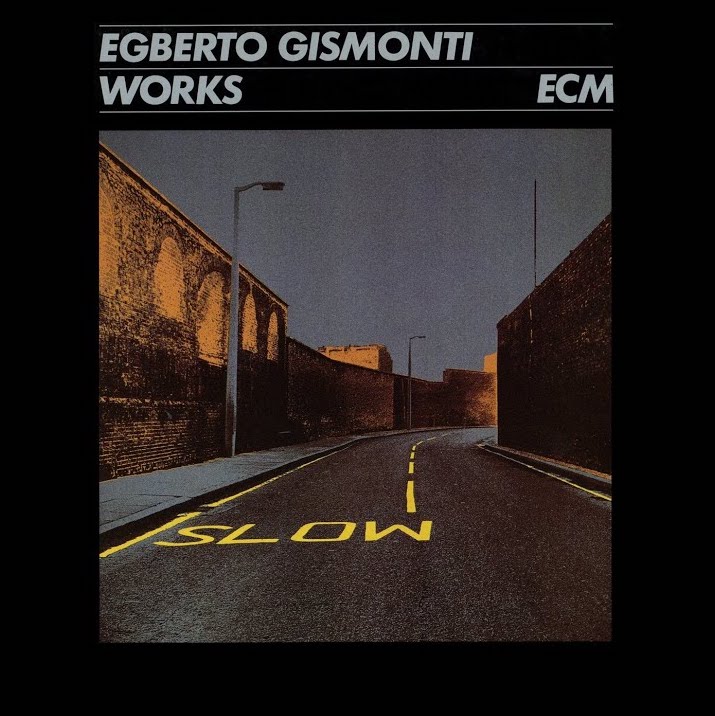
Egberto Gismonti: Works

Gismonti

Egberto Gismonti
Works
Release date: April 1, 1984

Egberto Gismonti is a force so enormous that ECM grandfathered his own label, CARMO, under its wing to archive much of his older material, as well as that of the younger musicians interpreting it still today. But to these ears his finest recordings have always intersected with ECM proper, and the late 1970s/early 1980s defined a golden age in this regard. Producer Manfred Eicher had a way of bringing out an inner peace in Gismonti’s frantic guitar playing and likewise enhancing something rough and ready in his sweeping pianism. It was therefore inevitable that such a sizable body of work would be faithfully abridged in his own “Works” compilation.

“Lôro” is one of two tunes from 1981’s Sanfona to find their worthy place in the mix. Impeccably recorded and performed, this jewel is one of Gismonti’s most precious on record and features the talents of his Academia De Danças band. Exemplifying the sound of both its era and its composer, its instrumentation, engineering, and execution glow in ECM’s resonant chamber aesthetic. “Maracatu” is another pianistic vehicle for Gismonti, whose rolling waves crash onto shore in the last rays of a setting sun. From here we jump back three years to Sol Do Meio Dia, a session shared with Nana Vasconcelos on percussion and Collin Walcott on tabla. Gismonti’s custom 8-string guitar is resolutely beat-driven throughout “Raga,” in which he experiments with harmonics and dissonances until only purest fusion remains.

“Magico” pays tribute to the 1980 album of the same name. This peerless trio with bassist Charlie Haden and saxophonist Jan Garbarek was the living definition of lockstep. As the latter two musicians embrace the space with hands of extremes, Gismonti solos over himself in a brilliant division into multiple voices. But nowhere does his ability clarify itself so resolutely than on his 1979 Solo, from which two tracks are excised. “Ciranda Nordestina” is a look inward through lenses of piano and bells, and is another stunning construction. “Salvador” returns to his 8-string guitar for a piece of remembrance. It is the musical realization that physical locations change just like those who inhabit them and can never go back to the way they used to be. We might flip (or click) through their histories, but the only way to know what things once were is to unbury them with things yet to be.

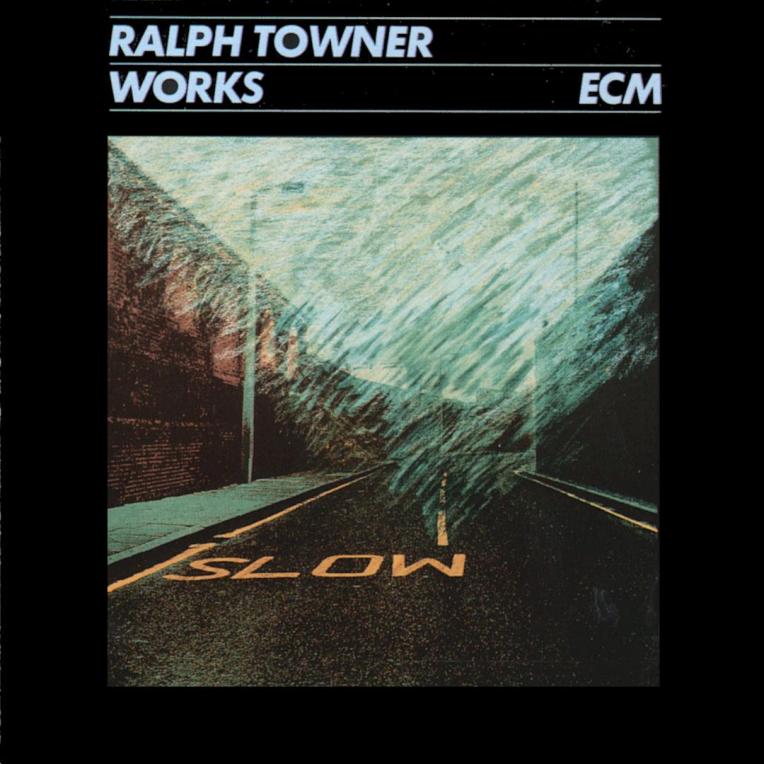
Ralph Towner: Works

Towner

Ralph Towner
Works
Release date: April 1, 1984

Guitarist Ralph Towner, like saxophonist Jan Garbarek (with whom he often collaborated during this formative phase), is one of ECM’s perennial talents and set a precedent for the label unlike any other on Solstice. Over the decades, the 1975 classic has acquired even more integrity than it exhibited when first released. “Oceanus” opens both it and this sensitively curated compilation, combining forces with Eberhard Weber, Jon Christensen, and Garbarek himself. It is perhaps the only logical first step with which to begin any foray into Towner’s universe. Weber’s cello, in combination with his plucked bass backbone, is an enchantment in and of itself, and elevates Towner’s resonating strings to nearly the same level as Garbarek’s tenor. Christensen’s sunlit cymbals complete the image. “Nimbus” finds Towner adding his piano to the mix. A patient intro unleashes the band’s total effect, Weber treading exuberantly across Christensen’s passionate soil.

The second album to be referenced is 1983’s Blue Sun, a solo effort from which two selections are presented. The title track features Towner on piano, Prophet 5 synthesizer, and percussion, alongside his trusted 12-string, for a nostalgic Polaroid that develops before our very ears. This is music that moves us, because it is movement in and of itself. “The Prince And The Sage” recalibrates the array to Prophet 5 and classical guitar only. Tracing a parabola over cities, villages, and waterways, it blends tastefully and in a way that would be unrepeatable with today’s ingredients.

Last we have two tracks from 1979’s Old Friends, New Friends. “New Moon” features Kenny Wheeler (trumpet and flugelhorn), David Darling (cello), Eddie Gomez (bass), and Michael DiPasqua (drums and percussion). If anything, it’s a memorable vehicle for Wheeler, who soars over landless expanse. “Beneath The Evening Sky” makes another reduction, this time to Towner’s 12-string and Darling’s cello. The latter unfolds a string quartet’s worth of backing in this deeply psychological character study.

And while there is some gold unmined in this collection, especially with regard to my all-time favorite Towner album, Solo Concert, there’s enough here to both satiate the hungry ear and inspire exploration for more.

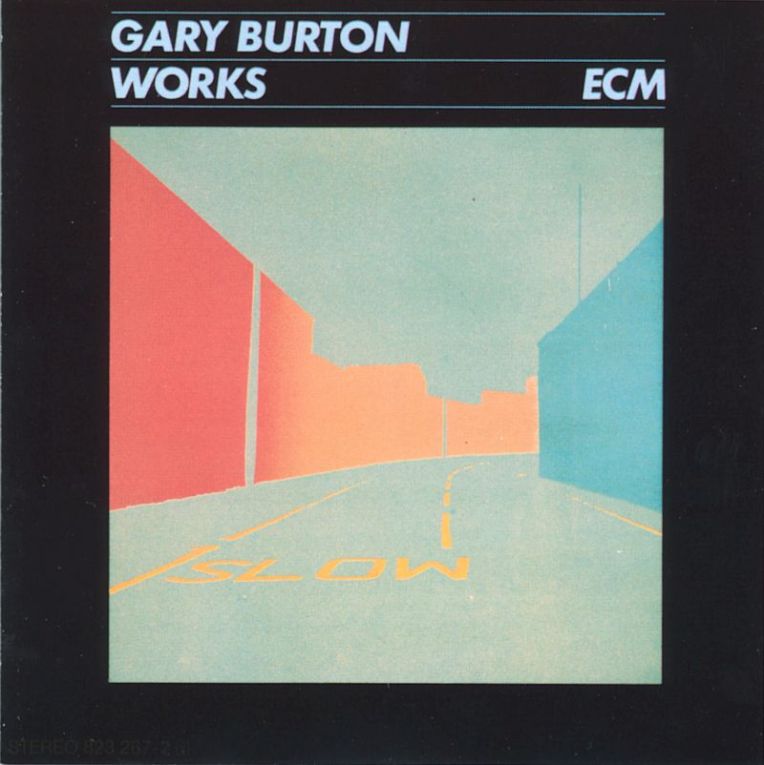
Gary Burton: Works

Burton

Gary Burton
Works
Release date: April 1, 1984

Vibraphonist Gary Burton, one of the defining voices of ECM’s formative years, is worthily honored in this second “Works” series installment. His contributions as virtuoso and interpreter of the instrument are unparalleled, and on ECM both aspects of his career found ample space in which to flourish. This particular era of the 1970s, which followed his RCA blitz, showed him also to be a musician of great patience, as on The New Quartet. The 1973 classic dropped him into a studio with guitarist Mick Goodrick, bassist Abraham Laboriel, and drummer Harry Blazer for a set as gorgeously played as it was conceived. From it we are treated to Keith Jarrett’s “Coral,” of which every spindly leaf is accounted for, and Carla Bley’s “Olhos De Gato,” which waters a groove that is laid back but never subdued. Those chamber sensibilities give way to more luscious details in “Vox Humana,” another Bley tune that references 1976’s quintet outing, Dreams So Real.

While Burton was quick to expound at length on any given theme, he also gave his bandmates room to breathe. This was especially true of 1974’s Ring, for which the quintet was augmented by bassist Eberhard Weber. From that album we are afforded “Tunnel Of Love.” Burton’s pitch-bending adds a degree of physicality to this nostalgic slice of life by Michael Gibbs. The third of 1974’s Seven Songs For Quartet And Chamber Orchestra is another master class in delayed gratification and defers to the bassing of Steve Swallow.

The remainder of this compilation features the deeper integrations of Burton’s duo projects. His highest achievement in this regard, 1973’s Crystal Silence, pairs him with pianist Chick Corea. The track chosen to represent it, “Desert Air,” is a springboard for some of the most virtuosic finishing of sentences one is likely to encounter in such a collaboration. Another duo project with Ralph Towner, 1975’s Matchbook, yields the title track, in which percussive impulses from the guitarist clear the road for an unimpeded ride over flatlands. And on “Chelsea Bells” and “Domino Biscuit” (Hotel Hello, 1975), both by Swallow, the composer joins Burton on piano with touches both anthemic and gospel-esque. All of which leaves us with an abridged version of an oeuvre steeped in timeless energy. A gift that keeps on giving, decades later.

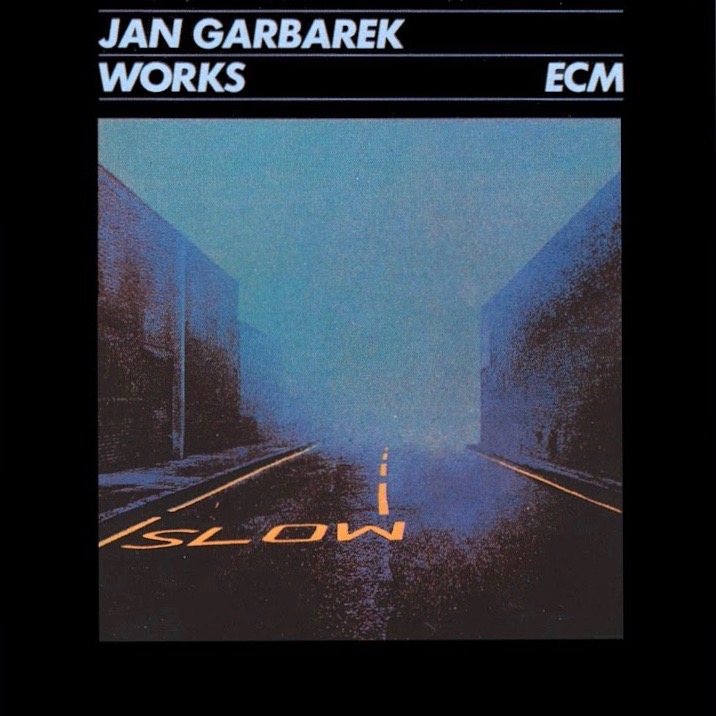
Jan Garbarek: Works

Garbarek

Jan Garbarek
Works
Release date: April 1, 1984

The “Works” series of ECM compilations began in 1984 to celebrate the label’s 15th anniversary, as it prepared to open a new chapter with its classically focused New Series imprint later that same year. It makes sense that Norwegian saxophonist and composer Jan Garbarek should be the subject of this first installment, as he defined not only the sound of ECM throughout the 1970s but also of a jazz scene that was relatively unknown outside its own borders until producer Manfred Eicher committed himself to the vision of broadening its wingspan.

Garbarek has taken on many roles throughout ECM’s now 50-year history, and even at this early stage had defined some key faces of his creative persona. In “Folk Song,” from 1981’s Folk Songs with guitarist Egberto Gismonti and bassist Charlie Haden, we find ourselves in the company of Garbarek the griot. With a telepathy as powerful as that of remembrance, the trio’s music transports us into ourselves. If Haden and Gismonti are shadow and light, respectively, then Garbarek is the one who wanders the valley between them, drawing a horizon wherever the sky will hold pigment. This is the spirit of Garbarek’s playing at all times: an itinerant yet grounded soul who understands the way of things to be carved in experience.

We also encounter Garbarek the sailor. In “Passing” (Places, 1978), he shares a vessel with John Taylor on organ, Bill Connors on guitar, and Jack DeJohnette on drums. With circadian rhythms and steady passage, marked like a fishing net by Connors’s acoustic wisdom, the quartet catches wind purposefully forward. And in “Svevende” (Dansere, 1976), inhaling brine and waves with Bobo Stenson on piano, Palle Danielsson on bass, and Jon Christensen on drums, Garbarek evokes sirens of both the mythical and preventative kind. Another track from Dansere, “Skrik & Hyl,” reveals a shepherd, now climbing a mountain with Danielsson alone. Sounding a call to the ether itself, Garbarek tends to his melodic flock without fear. Responding to said call are Terje Rypdal on guitar, Arild Andersen on bass, and Christensen again on drums in “Beast Of Kommodo” (Afric Pepperbird, 1970). This early build, from ECM’s seventh release, features guttural expression in a tactile setting. And in “Viddene” (Dis, 1977), his soprano meshing with the 12-string guitar of Ralph Towner over a windharp drone, he jumps from the cliff as one who looks down upon landscapes instead of up from them.

Finally, Garbarek the mystic welcomes us into internal spaces. In “Selje” (Triptykon, 1973), he turns to flute in the presence of Andersen, along with Edward Vesala on percussion, for an incantation of light. And in “Snipp, Snapp, Snute” (Eventyr, 1981), his flute is joined by Nana Vasconcelos on percussion, moving with the tide of biographical change.

Throughout these tunes, and regardless of focus, Garbarek activates thoughts of ancestors in the most undeniable terms: through sound. Vibrations thus activate us at the very core, stirring molecules of the heart with messages and songs. And while most compilers might use individual tracks to tell a larger story, Eicher has put together this sequence to show how that larger story feeds the individual.

Keith Jarrett @ 75

In celebration of Keith Jarrett’s 75th birthday, ECM has gifted listeners with two very special albums. The first is a teaser encore from the upcoming Live from Budapest album, slated for a Fall 2020 release. In anticipation of what is sure to be a worthy live document, we encounter the beautiful suspensions of “Answer Me,” in which Jarrett molds the piano in loving clay.

front-answer-me-keith-jarrett

Despite being recorded not too long ago (July 3, 2016 to be precise), it sings to us from a distance, held up to the ear like a conch shell in which the past of another has been sheltered from the ravages of time. And yet, the more we listen back on these memories, the more they become folded into our own, as if they had been living inside us all along. This is what Jarrett at his best can achieve: whether spontaneously improvising or digging deep into the tried and true, he makes it all feel so inevitable. The music has always been there, waiting to be drawn out by the right pair of hands. And whose hands could be more effective than his to articulate a melody in the language of sunlight through breeze-shaken leaves.

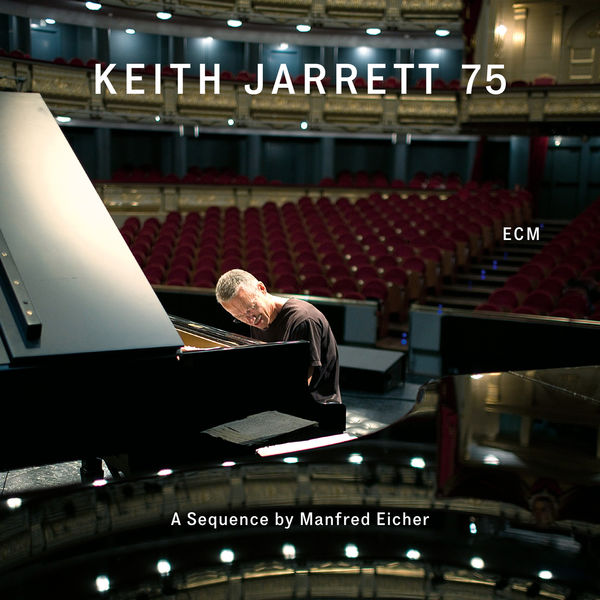
The second, and more substantial, present is Keith Jarrett 75, a sequence of five tracks curated by producer Manfred Eicher himself. Opening with the churned butter of “Never Let Me Go” (Standards, Vol. 2), it flows in stride with the passage of time. Perennial partners Gary Peacock and Jack DeJohnette are more than a rhythm section, but organs of the same body returning home after a long sojourn. In Jarrett’s vocalizations we hear the ache of it all, pooling like rain in cupped flowers, flung into the air by Peacock’s organic solo. And speaking of solo, we transition into that very territory with Part VII of Creation. In this rolling wave of spirit, sentient waters and thoughtless continents meet to share their silences.

ME Sequence

Another jump in time and mood warps us to Jarrett’s European quartet with saxophonist Jan Garbarek, bassist Palle Danielsson, and drummer Jon Christensen. Together, they unpack the largest cargo from the oceanic vessel that is “Personal Mountains.” A prototypical example of forward motion in music, it sustains inspiration from start to finish, Garbarek gilding the edges of Jarrett’s eyes, themselves closed in surrender. A shuffle of the deck brings us to the landmark duo record Jasmine with bassist Charlie Haden for a gently swinging take on “No Moon At All.” As sweet as it is sincere, it touches the soul with inspiration. Last but not least is “Flying Pt. 1” from Changes. A glorious soar through skies where wingtips catch clouds and leave melodic trails in their wake, it opens Jarrett’s inimitable trio like a book of truisms and waits for us to catch up with the confirmation of experience. The more exciting the music gets, the more we understand the power of harmony at altitudes beyond the audible.

Bley/Sheppard/Swallow: Life Goes On (ECM 2669)

2669 X

Carla Bley piano
Andy Sheppard tenor and soprano saxophones
Steve Swallow bass
Recorded May 2019, Auditorio Stelio Molo RSI, Lugano
Engineer: Stefano Amerio
Produced by Manfred Eicher
Release date: February 14, 2020

For its third ECM outing, pianist Carla Bley’s trio with saxophonist Andy Sheppard and bassist Steve Swallow mixes up an antidote for these times of uncertainty and quarantine. The title suite is the first of three comprising the program. Given that “Life Goes On” came out of a recent brush with illness, it’s fitting that Bley should begin in the dark whimsy of the blues. Her left hand plows fertile soil before leaving Sheppard and Swallow to sow their thematic crop. Years of experience and collaboration funnel into Swallow’s intimate rapport with Bley and into Sheppard’s unforced, spiritual playing. The latter, whether breathing through tenor or soprano, takes two steps forward for every retreat.

A sardonic humor assumes center stage in the three-part “Beautiful Telephones.” The title, quoting a certain leader of the free world, speaks of dire political circumstances, which, like the dial tone of a nation on hold, keeps us hopeful for something that may never come. The central movement reveals some of the deepest conversations and finds Sheppard in an especially soulful mood. The jagged finish is about as astute a commentary as one could pen on the current state of things without words.

The trio saves its most lyrical for last in “Copycat”, which holds a candle to some neglected parts of the human condition. There’s so much beauty in the opening “After You” that only the vessel of the playful title section is big enough to contain it. Setting a tongue in every cheek, it coaxes us with a promise of better times.

Holding it all together is an almost photorealistic approach to life. Like the score pages above Bley’s face on the cover, time feels suspended at just the right moment to reveal a smile of hope beneath it all.

(This review originally appeared in the May 2020 issue of The New York City Jazz Record, a full PDF of which is available here.)

Interview: Keith Jarrett conducted by Timothy Hill

KJ front

This ultra-rare promotional CD from 1994 contains an interview with Keith Jarrett conducted by Timothy Hill. Much of the interview is spent discussing the backstory and recording circumstances of At The Deer Head Inn, Jarrett’s phenomenal live album with bassist Gary Peacock and drummer Paul Motian, and Bridge Of Light, a program of classical music composed by Jarrett.

When Jarrett first encountered the Deer Head Inn itself, it was the only place of its kind in Pennsylvania Dutch Country, where jazz wasn’t exactly on the hearts and minds of communities far more concerned with everyday practicalities. Jarrett was living in Allentown, where jazz was limited to generic rooms at best. Deer Head was far enough away that he wasn’t really aware of it until he got his first regular gig there, playing drums for local pianist (and Jarret’s personal friend) Johnny Coates. “I learned a lot about what not to do twice,” he recalls of those early gigging days, long before the piano became his forte. After two summers of grabbing the Deer Head by its antlers, sitting in sometimes on guitar (which, incidentally, earned him an invitation from Stan Getz to play in a Calypso band), he left that part of his history behind to dive headlong into his career as a pianist. By the time the Deer Head gig materialized, he hadn’t played there as pianist for nearly three decades.

Many elements came together for that performance to make it what it was. First, the venue was a “piano room” in the truest sense, a place of intimate construction that practically begged for Jarrett’s song. Second was the fact that drummer Jack DeJohnette, his trio go-to, was unable to make it, leading Motian to fill in at the last minute. Third was the “behavior and concentration” of everyone involved—a rapt attention he attributes at least in part to Motian’s involvement. When things come together like that, following a natural flow without depending on “large things,” as he puts it, magic is born.

Jarrett further bows to a certain magic in the recording itself. He mentions the “crucial little keys” of how a player is feeling, and how technology may struggle to capture those details in such a beautiful way. In this case, however, they shine through with utmost clarity, including the vocal exclamations for which he is (in)famously known. “I should’ve written them a thank you note,” he quips, speaking of Peacock and Motian, who he makes a point of noting added their own whoops of excitement in the heat of the moment. “If I’m going to be the culprit, let it be all three of us.” The conversation turns naturally to the tune “Chandra” (included along with “It’s Easy To Remember” at the end of this CD), which Jarrett praises for Motian’s avoidance of sticks altogether. Where any drummer would start with brushes and switch to the punctuation of sticks, Motian’s continuous brushing spoke directly to Jarrett’s heart: “This is what we’ve got now. This is what it is. And it put me in another place, where the expectations were not the same as they would be every time you play.” Thus did Motian pull everyone into the center of things.

At around the time that Bridge Of Light was coming together, he was already working on a commission from Japan to write the Adagio for oboe and string orchestra featured on the album. When told there would be time left in the program, his thoughts turned to the Elegy he was writing for his Hungarian grandmother. Taking such an active role in directing that recording was, for him, like “being in charge of a country,” whereas Deer Head was like “being not in charge and knowing it would be okay.” Such polar, yet parallel, opposites would seem to define his career. At Deer Head, for example, there wasn’t any music until it was played, whereas in a classical setting, anxieties toward perfection ran high. Classical musicians, he avers, should be less obsessed over playing the same music better than anyone else and more concerned about being themselves enough not to care, allowing the music to “bloom for itself” instead. And if blooming is what it’s all about, then Bridge (from which the Adagio and the “Dance” of Jarrett’s violin sonata are also included here) is a veritable field of life.

“You don’t have to be emphatic when you’re doing something beautiful,” says Jarrett of the creative process. “If you emphasize the beauty of something, you might step on it.” And while one might easily flag this statement for hypocrisy, spoken as it is by someone who can stretch a concert staple like “Autumn Leaves” to well over 20 minutes, there’s a sense that Jarrett is always saying what needs to be said and, accordingly, wasting no notes whenever he’s “on.” As he observes of jazz: “It would be as though you were to write poetry in more than one language at a time…and make it somehow into a coherent language of its own.”

As interesting as the above insights are, at best I would say this rarity has value only as an archival curiosity for the Jarrett completist, though it’s always fascinating to hear him speak of his own work. Either way, the objects of this discussion tell more of their past, present, and future than even he could, and perhaps our journey to find and experience them is the strongest bridge of all.


20004-2-cd

David Byrne: Music for The Knee Plays

25022-front-3

David Byrne
Music from The Knee Plays

Garnett Brown trombone
Ray Brown trumpet
David Byrne vocals
Pete Christlieb saxophone
Rich Cooper trumpet
Ernie Fields baritone saxophone
Chuck Findley trumpet
Bill Green baritone saxophone
Bobbye Hall percussion
Dana Hughes trombone
Paul Humphrey drums
Jackie Keslo saxophone
Harry Kim trumpet
Don Myrick saxophone
Nolan Smith trumpet
David Stout trombone
Phil Teil trombone
Ernie Watts saxophone
Fred Wesley trombone
David Blumberg conductor
Recorded:
One On One Studio, North Hollywood, April 4, 1984
Engineer: Mark Wolfson
Studio Sound Recorders, North Hollywood, April 5 & 6, 1984
Engineer: Joel Moss
Mixed at RPM Studio, December 8-17, 1984
Originally Mastered at Sterling Sound, NY
Produced by David Byrne

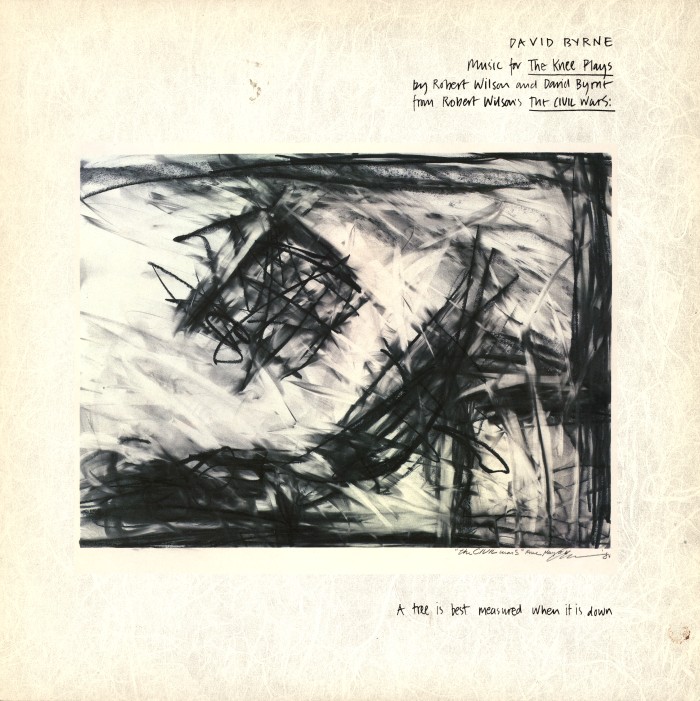
A tree is best measured when it is down.

This 1985 release, a rare one for ECM, comes from the fertile mind of Talking Heads frontman David Byrne. Originally intended as incidental music for Robert Wilson’s grand opera The CIVIL warS, to be played while actors and crew prepared set between acts, these brass-heavy arrangements of traditional tunes, folded into a rich batter of original compositions and spoken word, take their inspiration from the Dirty Dozen Brass Band of New Orleans and have since come to constitute a standalone work in their own right.

“Tree (Today Is An Important Occasion)” sets the tone for a journey of horns and voice that is as even-tempered as it is dramatically sincere. This postmodern dirge for the otherwise voiceless intersections of body and materials that govern our lives is perhaps even more relevant now than when it was written. Colors and fashion, each linked to specific emotions and personality traits, roll through the mind like an art gallery disassembled and thrown. As possibilities of self-expression are donned and discarded like replaceable skins, we are left to determine our own subjectivity in the onslaught of objective pretense we call our daily lives. The mélange effect of worlds colliding is dazzling in the moment yet darkly tinged in the remembering.

“The Sound Of Business” is a detailed assessment of our work-obsessed culture. Its uncanny chain of images contrasts the bustle of everyday life with the slow-motion fantasies struggling for air beneath its surface. “Social Studies” pulls away another mask to reveal the colonial scaffolding of well-to-do urbanites. Through deconstruction of knowledge-seeking privilege and the impulse to study that which does not belong to us, it puts our desire to live vicariously under a sonic microscope.

Byrne’s voice is a powerfully understated element. With consistent, even-tempered brilliance, he speaks matter-of-factly about large ideas (and hugely about the mundane), such that the very notion of importance stands on its head until it passes out. Even in his absence, the effect remains. Among the instrumentals he helped arrange, “Theadora Is Dozing” is a particularly enchanting tessellation of brass and percussion, while his own “Admiral Perry” is another standout for its evocative cast, as is the haunting “Winter.”

“In The Future” is quintessential Byrne, and imagines a time when sameness is the norm and norms are all the same. Like an intimate shadow of his timeless “Once in a Lifetime,” this crushing indictment of individualism shows us the horrors of an age when everybody becomes like everybody else. And so, ending in the comforts of the opener’s reprise, we realize that wheels are all there are, and that we, the ephemeral rats running nowhere within them, might one day destroy each other until there’s nothing left.