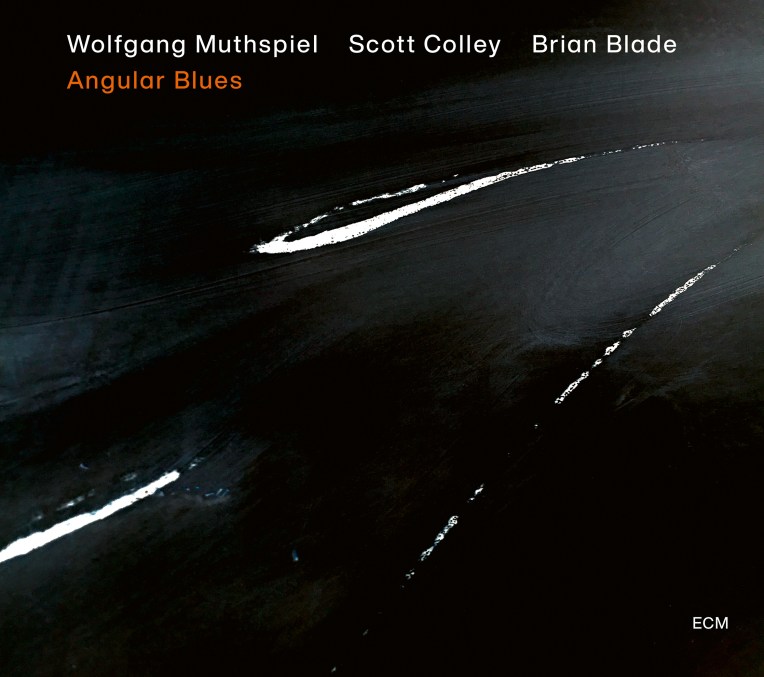
Wolfgang Muthspiel: Angular Blues (ECM 2655)

2655 X

Wolfgang Muthspiel
Angular Blues

Wolfgang Muthspiel guitar
Scott Colley double bass
Brian Blade drums
Recorded August 2018 at Studio Dede, Tokyo
Engineer: Shinya Matsushita
Assistants: Yuki Ito and Akihito Yoshikawa
Mixed at Studios La Buissonne by Manfred Eicher, Wolfgang Muthspiel, and Gérard de Haro (engineer)
Mastering: Nicolas Baillard
Album produced by Manfred Eicher
Release date: March 20, 2020

On Angular Blues, Wolfgang Muthspiel revives the format of his 2016 ECM leader debut. Rejoined by drummer Brian Blade yet inviting bassist Scott Colley in place of Larry Grenadier, the Austrian guitarist serves a full course of originals with a couple of surprises added to taste. The members of this trio share what Muthspiel calls a “love of song” and perhaps no more succinct a term could so accurately describe their rapport. Longtime listeners won’t be surprised that Muthspiel has brought together players who understand the value of space: how to shape it, to be sure, but more importantly how to let oneself be shaped by it in kind.

The narrative impulses of the opener, “Wondering,” harness the flexibility of Muthspiel’s acoustic playing, which in this context meshes with bass while kissed cymbals draw the z-axis of a three-dimensional sound. Moods cycle between gentility and insistence and shades between. The title track is aptly named for revealing a delicately virtuosic side to the energies at hand. “Hüttengriffe” follows with a soft-hewn anthem.

The remaining tunes find Muthspiel plugged-in, jumping into the amorphous body of his electric guitar. In “Camino” he is equally at home, his fingers free to engage in metaphysical play. As a thinly veiled tribute to the late John Abercrombie—not only in style but also in the way Muthspiel drafts his solo—it’s a highlight that deserves close listening. Others include “Kanon in 6/8,” which shows the trio at its deepest level of synergy (it’s also offset by the digitally enhanced “Solo Kanon in 5/4”), and bebop-influenced “Ride.” Two standards fill in the gaps. Where Cole Porter’s “Everything I Love” moves vertically, “I’ll Remember April” ends this worthy set on a horizontal plane.

(This review originally appeared in the April 2020 issue of The New York City Jazz Record, a full PDF of which is available here.)

ECM Book Now Available Worldwide!

I am thrilled to announce that my book, Between Sound and Space: An ECM Records Primer, is now officially available for purchase!

Colombian publisher Rey Naranjo and I spent years putting this together, and we truly believe it will enrich the experiences of all ECM listeners. Get yours now while you can, as it is destined to become a collector’s item.

Click the picture below to be redirected to the publisher’s website, where you’ll find more information, including a book trailer, and a link to order via PayPal. The price is set at $40, which includes shipping to anywhere in the world.

Looking forward to your thoughts on this labor of love.

Cover copy


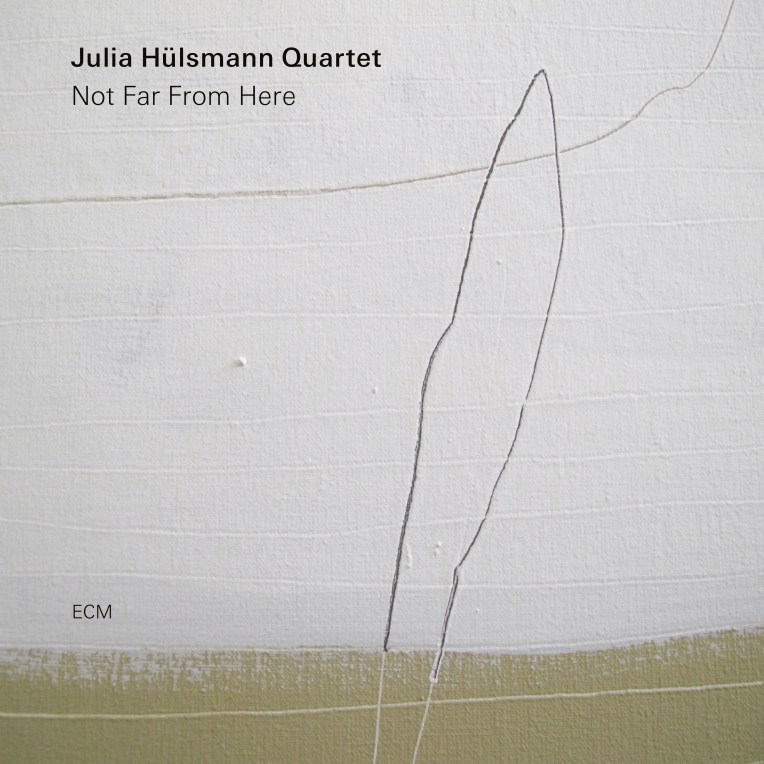
Julia Hülsmann Quartet: Not Far From Here (ECM 2664)

Not Far From Here.jpg

Julia Hülsmann Quartet
Not Far From Here

Uli Kempendorff tenor saxophone
Julia Hülsmann piano
Marc Muellbauer double bass
Heinrich Köbberling drums
Recorded March 2019, Studios La Buissonne, Pernes-les-Fontaines
Engineer: Gérard de Haro
Mastering: Nicolas Baillard
Produced by Thomas Herr
Release date: November 1, 2019

Fans of pianist Julia Hülsmann’s work will find familiar flavors enhanced by the unique spice of tenor saxophonist Uli Kempendorff being added to her long-running ensemble. He’s most vividly showcased on “Le Mistral,” one of two tunes contributed by bassist Marc Muellbauer. What begins with a quiet stirring develops into a freely interlocking sound—one honed by years of experience and held together by the band’s open-ended circuitry.

The poetry of Kempendorff’s playing is forthcoming, and the same holds true of his writing, even as “Einschub” is harmonized enigmatically. Most of the composing credits, though, go to Hülsmann. From the opening caress of “The Art Of Failing” to the masterful “No Game,” she treats every instrument as a vital ligament of the same appendage, pointing and flexing to the rhythms of emotional desire. With the tenderness of morning light gaining slow but steady purchase on the corner of a bedroom window, she follows a natural order of things.

Drummer Heinrich Köbberling throws a couple of his own coins into the proverbial fountain, including “Colibri 65,” which furthers the bandleader’s apparent mission of summoning placid, distinct airs.

The set is upheld by two versions of “This Is Not America,” a song written by David Bowie in collaboration with Pat Metheny and Lyle Mays. With broken nostalgia, it winds a melodic tangle from which escape is an easy but deeply unattractive option.

(This review originally appeared in the February 2020 issue of DownBeat magazine.)

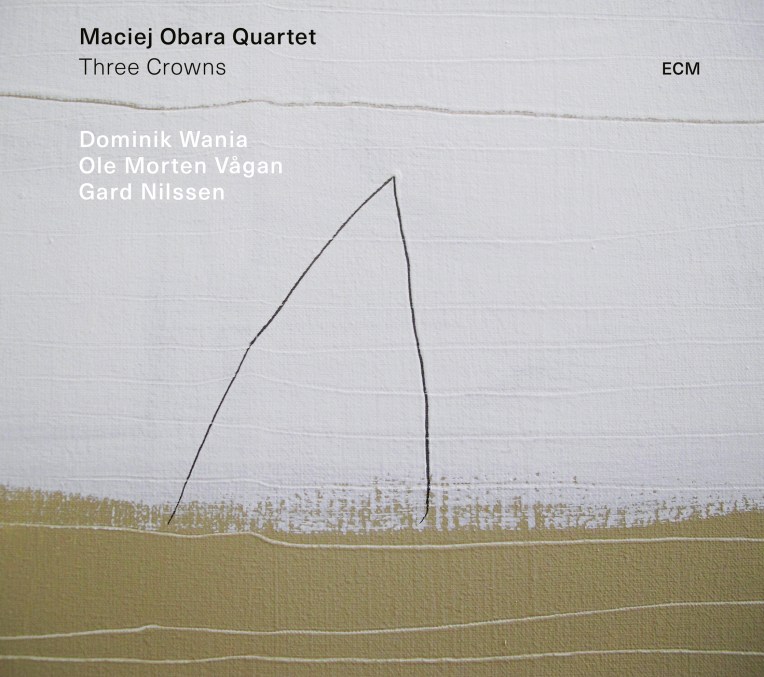
Maciej Obara Quartet: Three Crowns (ECM 2662)

Three Crowns.jpg

Maciej Obara Quartet
Three Crowns

Maciej Obara alto saxophone
Dominik Wania piano
Ole Morten Vågan double bass
Gard Nilssen drums
Recorded March 2019, Studios La Buissonne, Pernes-les-Fontaines
Engineer: Gérard de Haro
Mastering: Nicolas Baillard
Produced by Steve Lake
Release date: October 25, 2019

After their 2017 ECM debut, Unloved, Polish saxophonist Maciej Obara and his quartet make their return with Three Crowns. In addition to six new tunes from the bandleader, the album features improvisational renderings of music by one of the most significant composers of the 20th century: Henryk Mikołaj Górecki (1933–2010). Though Górecki’s work has been subjected to improvisational treatments before, these renditions bear special distinction for being sanctioned by his family, whom Obara came to know while living in Katowice, where the composer once was based. The first Górecki interpretation, “Three Pieces In Old Style,” is so beautifully reimagined that it sounds as if it’s emanating from another world. Pianist Dominik Wania opens in a deeply respectful mood, allowing Obara’s incisive tone to keen overhead, while bassist Ole Morten Vågan and drummer Gard Nilssen roam a rain-kissed landscape below.

“Blue Skies For Andy” is among the stronger Obara originals—not only for its melodic strength but also its patience. It has a classic sound that feels warm to the ears, as precise as it is free. Other highlights range from the savvy urbanism of “Smoggy People,” notable for Wania’s postmodern swing, to the more geometric “Glow,” which recalls the tightly knotted compositions of fellow altoist Tim Berne. Obara’s bandmates grow in real time, though nowhere so maturely as on “Mr. S,” an homage to trumpeter Tomasz Stańko that rolls in on a wave of melancholy and sunshine in equal measure. Like the title track, it’s flexible and always attached to something pure and knowable. There is no mystery here. Only life.

(This article originally appeared in the January 2020 issue of DownBeat magazine.)

Synchronicity (Part 2)

In 2010, I embarked on a life-changing journey through the entire ECM catalogue. Five years later, I reached synchronicity when I reviewed every album on the ECM, ECM New Series, and JAPO imprints. In the wake of that milestone, my attentions were pulled in many different directions, as I was simultaneously raising a new family, earning a Ph.D., teaching, publishing as both author and translator, sharpening my skills as a traveling music journalist and photographer, and pivoting into newfound spiritual awakenings. Consequently, my ability to keep step with ECM’s unflagging release schedule—which now averages one new album per week—waned in the light of these and other commitments. And so, imagine my (lack of) surprise when, upon deciding to resume this project in earnest, I realized that I had fallen behind by about 200 albums. On this, the 14th day of November 2019, I can humbly say that synchronicity has been restored. Whether by coincidence or unconscious design, just as my final “catch-up” release in 2015 was Keith Jarrett’s Creation, this time around it happens to be Jarrett’s Munich 2016, released only two weeks ago. The significance will hardly be lost on you, my dear readers. And how fortuitous, too, that I should arrive at this point in the heart of ECM’s 50th anniversary. Going forward, I aim to be your go-to source for the most up-to-date reviews and will be unveiling a few surprises, so stay tuned. The extent of my gratitude may just be bigger than the influence of the label to which I offer it. My deepest thanks to you for continuing to share it with me.

Keith Jarrett: Munich 2016 (ECM 2667/68)

2667|68 X

Keith Jarrett
Munich 2016

Keith Jarrett piano
Recorded live July 16, 2016
at Philharmonic Hall, Munich
Producer: Keith Jarrett
Engineer: Martin Pearson
Mastering: Christoph Stickel
Executive producer: Manfred Eicher
Release date: November 1, 2019

The more I listen to Keith Jarrett’s improvised concerts, the more I shy away from the adjective “solo” to describe them. Not because I live under a delusion that it isn’t just him translating energies that 99.99 percent of us could only hope to detect, but because each iteration of this asymptotic journey at the piano reminds me of the ghost of yet another former self who goes on playing in an alternate reality even after he lifts his hands and takes a bow amid the applause of this one.

Throughout this two-disc recording, which documents a July 16th performance in the city and year of its title, Jarrett unveils 12 numbered sculptures of possibility, each more freestanding than the last. Not that the path between them is linear. What begins in Part I—the set’s longest, just shy of 14 minutes—as a many-tentacled deep sea creature has by Part III already morphed into a landbound shepherd. The latter’s hymnal qualities light a gospel fire in the underground railroad lantern of Part IV before dissolving into the child’s dream that is Part V.

Part VI marks another change of face, uniting questions of mountains above with answers of valleys below. The contortions of Parts VII, IX, and XII are ages between, giving way to meditations in which un-pressed keys speak as truthfully as their contacted neighbors. Few are so profound in this regard as Part XI, of which a certain air of finality is only as permanent as the wind on which it’s written. It whispers as an antidote to the shouting match that has become our lives.

In light of all this, we get a trinity of shades in Jarrett’s choice of encores. In “Answer Me, My Love,” he embraces the past as if it were a dying future. In “It’s A Lonesome Old Town,” he embraces the present as if it were the only hope of peace. And in “Somewhere Over The Rainbow,” he lets go of all three states of mind, knowing that honesty of expression is the only wave we can catch to keep him visible as he follows one horizon in search of the next.