Printed Memories…

On 10 February 2010, I began this blog with the goal of reviewing every album issued by ECM Records proper and its New Series imprint. Four years ago, I achieved said goal. Within hours of announcing this milestone, I was approached by Raúl Zea of Rey Naranjo, a publisher of fine books based in Bogotá, Colombia. As it turned out, Raúl was a huge ECM fan and had been reading my blog from almost the beginning. His proposal: To publish a book of selected reviews. My answer: When can we start? Fast-forward to 27 April 2019, and I found myself boarding an airplane bound for the annual Bogotá International Book Fair (a.k.a. FILBo) to hold the volume in my hands at last and present its contents to fans and newcomers alike over the course of five days.

DSC03244-Edit

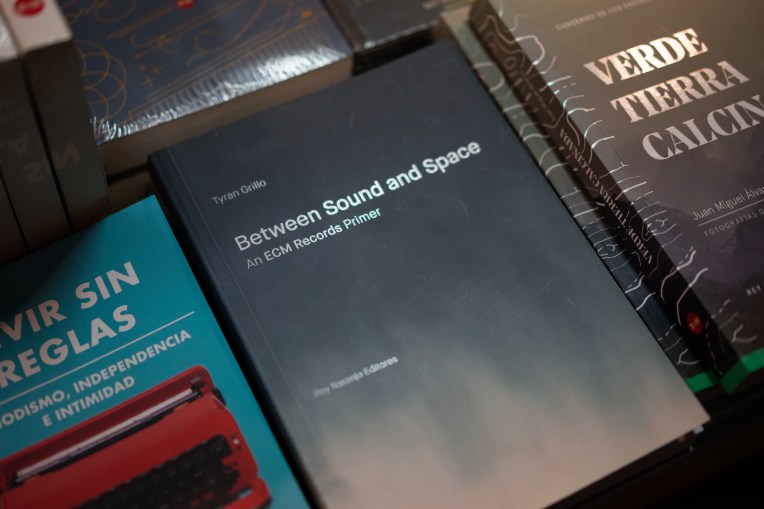
As the book evolved into its present form as Between Sound and Space: An ECM Records Primer, my editors and I felt it necessary to marshal the reviews to speak to a variety of audiences. True to its designation as a “primer,” it is first and foremost intended as a doorway into the label’s manifold wonders. For that reason, inclusion of such classics as The Köln Concertwas absolutely necessary. On the other hand, I wanted to highlight albums that even seasoned listeners might have overlooked. Out of those two extremes emerged 100 specially curated and recrafted essays, rounded out by a smattering of personal favorites: a journey through ECM’s ongoing history that I hope will inspire readers in new directions of listening.

This slideshow requires JavaScript.

Upon arriving at my hotel, I was draped with my FILBo credentials and guided to my publisher’s table. Yet before I could even marvel at a product years in the making, I had to take in the sheer scale of the fair and its throngs of passionate attendees—many of whom, I would discover the next morning, would be lined down the block three hours before opening time.

DSC03352

As I waded through cliques of voracious readers, I at last came face to face with the editor who had made this trip a reality, and with the work of art he and the Rey Naranjo team had labored to print in time for this event.

DSC03214

After a round of introductions, and a sampling of local cuisine (including my first bowl of ajiaco), I was ready to succumb to the toll of travel knowing that my love letter to a life-changing record label now had a life of its own.
DSC03209

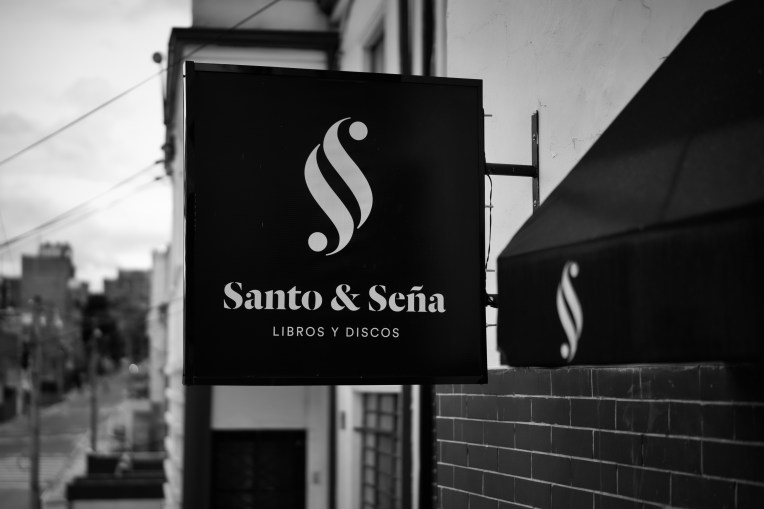
The next few days were a promotional whirlwind, including two interviews for Colombian radio, two book talks, an interview with The Bogotá Post, and a video shoot at my publisher’s bookstore, Santo & Seña, for an upcoming crowdfunding campaign in anticipation of the book’s international version (to be released in early 2020). While it was exciting to be the center of so much attention, I also knew that none of it would have taken place without the vital music that had brought me into that center to begin with. Being able to share my knowledge with ECM fans in another country felt like the first step toward a larger conversation that I can only hope my book will provoke and sustain in the future.
DSC03256-Edit

Before leaving the city, I rode a cable car to the top of Monserrate, where Bogotá’s wider embrace became at last apparent.

DSC03310

The long stairway to the very top was a sobering reminder that no journey is possible without the steps required to bring its destination into view. And, like the gradations of mountain and concrete that bid me farewell, nothing we do is possible without the input of untold lives, laboring through cycles of sun and moon until our blessings are indistinguishable from all others.

DSC03321-Edit

For those blessings, I would especially like to thank Raúl Zea and John Naranjo for believing in me from day one, Andrea Salgado for the gracious invitation, Aurélie Radé for navigating the complexities of airline politics, Dulce María Ramos for coordinating interviews and rushing me to every venue on time, Luisa Martínez for her gentle kindness (and the flower), Guillermo Concha and Liladhar Pendse for proving that strangers should never stay that way for long, Juan Carlos Garay and David Roa for enlightening conversations in front of vastly different audiences, and the interpreters, including Ale Bernal, who rendered those conversations into Spanish under tight circumstances.

Bill Frisell/Thomas Morgan: Epistrophy (ECM 2626)

Epistrophy

Epistrophy

Bill Frisell guitar
Thomas Morgan double bass
Recorded live at the Village Vanguard, New York, March 2016
Engineers: James A. Farber and Paul Zinman
Assistant engineers: Own Mulholland and Jim Mattingly, SoundByte Productions Inc., New York
Mixing at Avatar Studios, New York, December 2016: James A. Farber, Manfred Eicher, Bill Frisell, and Thomas Morgan
Produced by Manfred Eicher
Release date: April 12, 2019

Recorded live at The Village Vanguard in March 2016, Epistrophy continues where the conversation between guitarist Bill Frisell and bassist Thomas Morgan left off on Small Town. In the hands of this duo, a song like “All In Fun” assumes a double meaning. While the pair indeed are enjoying this musical experience, they bring an unforced profundity to the occasion. This tune in particular has what only can be described as a dark buoyancy, a feeling of bobbing along evening waters.

A nod to the folk song “Wildwood Flower” introduces “Save The Last Dance For Me,” which in this context takes on a magical realism. Liberated from their popular associations, tensions emerge in melodic symmetry. Played as lovingly as one could imagine, Paul Motian’s “Mumbo Jumbo” finds Frisell tastefully augmenting Morgan’s psychosomatic filter. The James Bond theme “You Only Live Twice” also gets a heartfelt makeover, its machismo now a quieter drama. And Billy Strayhorn’s “Lush Life” emerges from a series of still images, each further detailing the narrative. The title track and “Pannonica,” both from the Thelonioius Monk songbook, are the set’s core, each a reflection of the other: The former’s sprightly charm and linear paths pair beautifully with the latter’s eddying contemplations. The traditional “Red River Valley” is another key passage of synergy that seems tailor-made for these musicians. Like the Frank Sinatra hit “In The Wee Small Hours Of The Morning” that closes, it activates what is tru- est and purest within them, and in us for being privy to their dialogue.

(This article originally appeared in the June 2019 issue of DownBeat.)

Special Announcement

Cover copy

I am humbled and pleased to announce that my book on ECM is finally coming out this week. Between Sound and Space: An ECM Records Primer is to be published by Rey+Naranjo in a first edition available only to the South American market, then as a global edition early next year (preorders will be available soon).

I have been graciously invited to present two talks at the Bogotá International Book Fair. My first talk will be “ECM Records: Listen, Watch and Remain Silent,” to be given this Sunday, April 28. The second will be “The Collector as Historian,” to be given on April 30th. Please attend and introduce yourself if you’re in the Bogotá area!

More to follow.

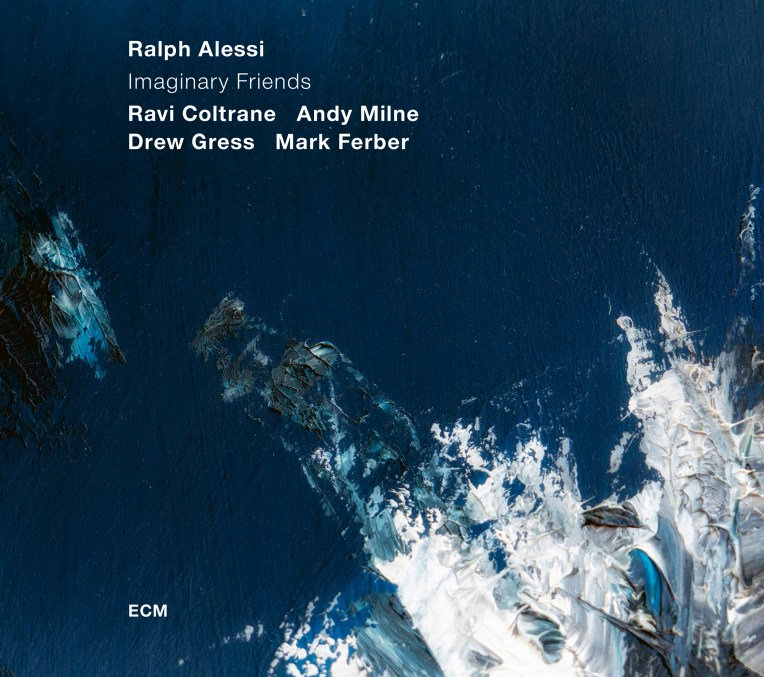
Ralph Alessi: Imaginary Friends (ECM 2629)

2629 X

Ralph Alessi
Imaginary Friends

Ralph Alessi trumpet
Ravi Coltrane tenor saxophone, sopranino
Andy Milne piano
Drew Gress double bass
Mark Ferber drums
Recorded May 2018, Studios La Buissonne, Pernes-les-Fontaines
Engineer: Nicolas Baillard
Produced by Manfred Eicher
Release date: February 1, 2019

Imaginary Friends marks an ECM threepeat for trumpeter Ralph Alessi. His connectivity with Ravi Coltrane (mostly on tenor saxophone), pianist Andy Milne, bassist Drew Gress and drummer Mark Ferber glows throughout nine originals, of which “Iram Issela” is the heartfelt introduction. Dedicated to Alessi’s daughter (the title is her name spelled backward), it meshes trumpet and piano without a hint of coercion. Coltrane lays low, letting the waves carry him where they will. Alessi’s friendship with him, going back to their student days at the California Institute of the Arts, resonates, as well as in the title track and “Oxide,” one of Alessi’s most exquisite compositions.

Their horns seem to have minds of their own. As free to roam as they are to harmonize, either can take the helm at any given moment, leading to exciting listening. Reflective turns like “Pittance” are all about the trumpet’s emotive powers while “Improper Authorities” allows Coltrane enough room to pave a highway over the rhythm section’s solid roadbed. “Melee” is another compositional masterstroke, which recalls the jigsaw approach of labelmate Tim Berne yet takes on fresh distinction by dint of a calligraphic sopranino. All of this and more funnel into “Good Boy,” a tender quietus.

Most impressive is the relentless spirit of invention. With an average track length of about seven minutes, each tune is a feast for the ears. Indeed, there’s something downright edible about this session, scrumptious from first bite to last and in that proverbial sense dishes out one of the most savory records of the year so far.

(This review originally appeared in the April 2019 issue of The New York City Jazz Record, a full PDF of which is available here.)

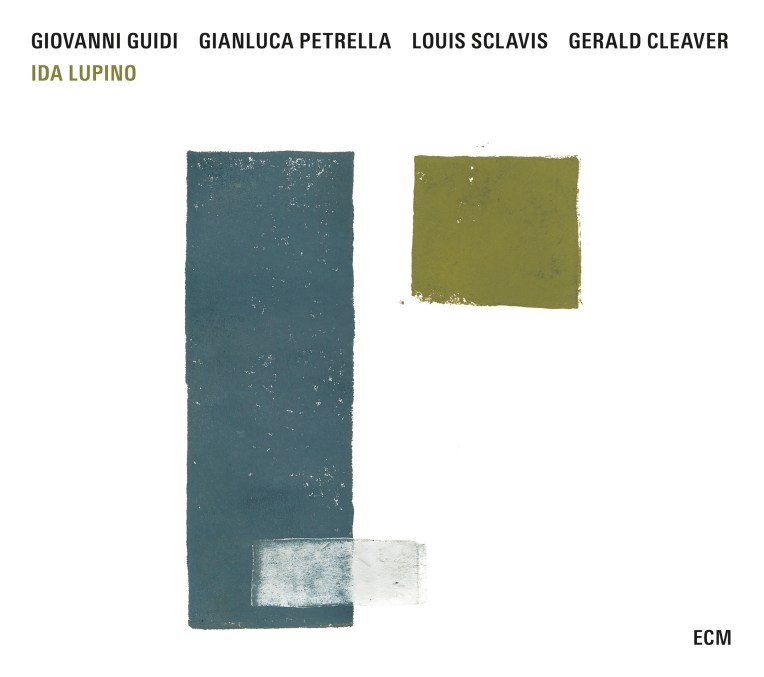
Guidi/Petrella/Sclavis/Cleaver: Ida Lupino (ECM 2462)

2462 X

Ida Lupino

Giovanni Guidi piano
Gianluca Petrella trombone
Louis Sclavis clarinet, bass clarinet
Gerald Cleaver drums
Recorded February 2015, Auditorio Stelio Molo RSI, Lugano
Engineer: Stefano Amerio
Produced by Manfred Eicher
Release date: September 2, 2016

Since making his ECM leader debut with 2013’s City of Broken Dreams, Italian pianist Giovanni Guidi has paved a new path with every release. For Ida Lupino, he convenes Enrico Rava bandmate and virtuoso trombone player Gianluca Petrella, clarinetist Louis Sclavis, and drummer Gerald Cleaver for a set built almost entirely on improvisation. Two exceptions are the album’s eponymous tune by Carla Bley, which here receives an ode-like treatment in celebration of its composer’s 80th birthday, and “Per I Morti Di Reggio Emilia,” a song written by Fausto Amodei in memory of demonstrators who fell victim to police violence on July 7, 1960. The latter’s guttural trombone and persistent cymbals rekindle those political fires as warmth against the frigid climate in which we now find ourselves.

At the heart of this session are Guidi and Petrella, who among the quartet share the longest working relationship. Their spotlight shines brightest in “Gato!” This nearly 10-minute narrative reveals itself one sentence at a time, toeing a line drawn by cymbals with dialogic abandon, before ending in a lullaby of piano. This same combination begins the album in “What We Talk About When We Talk About Love” and ends it in the tactile stumble of “The Gam Scorpions.” Notable for its subtle shadings is “Hard Walk,” throughout which Petrella focuses on breathing over notecraft as primary method of communication. He and Guidi row their most fascinating waters, however, in “Fidel Slow” and “Zweig.” These distinctly three-dimensional duets write their own dictionary as they go.

Sclavis’s reed work, as always, abounds with invention. Whether roaming the desert of “Just Tell Me Who It Was” with plenty of groovy water to spare or exchanging bon mots with Petrella in the witty “Jeronimo,” he treats virtuosity like breathing. Further highlights include the fibrillated “No More Calypso?” and “Things We Never Planned.” The latter might as well have been the title track, showcasing as it does the band’s willingness to go wherever the music leads. Guided by intuition alone, they make no effort to understand anything but the moment, eschewing concrete rhythms for liquid assets.

An altogether worthwhile peek into minds that always seem to be expanding into the next motif before the current one is finished.

Mats Eilertsen: And Then Comes The Night (ECM 2619)

2619 X

Mats Eilertsen
And Then Comes The Night

Harmen Fraanje piano
Mats Eilertsen double bass
Thomas Strønen drums
Recorded May 2018, Auditorio Stelio Molo RSI, Lugano
Engineer: Stefano Amerio
Produced by Manfred Eicher
Release date: February 1, 2019

A feeling of transcendence occurs the moment Harmen Fraanje’s pianism wraps its arms around you in “22,” the introduction to bassist Mats Eilertsen’s And Then Comes The Night. And as the brushes of drummer Thomas Strønen complete the triangle, you find yourself being ushered through a portal unlike any other to a space where harmony whispers between every air molecule. That this tune—one of Eilertsen’s—also closes the album in variation is testament to the circularity of life, the very dust from which melodies arise and to which they must return.

The spontaneous creations of “Perpetum” and “Then Comes The Night” yield the most intimate moments of the session. Whether in the former’s subterranean percussion and arco bassing or the latter’s angular pianism, passion exudes from the pores of this music’s skin. This is by no stretch of the imagination a group in search of a groove or means to convey it, but rather, as in the Fraanje-penned “Albatross” and “Soften,” concerns itself with memories in the making. The piano/bass duets of “After The Rain” and “Solace” underscore the necessity of climate in their evocation of wind and stillness. In both, comfort is achieved by virtue of awareness alone. This is playing that relies on faith to shield its feet from burning sands and frozen tundra alike.

In Eilertsen’s own “Sirens” and “The Void,” mosaics dissolve into watercolor and vice versa. Each is a window into the other, flush to the touch yet visually dimorphous in contrast, and the second in particular cradles the most nocturnal of bass solos.

Although this album represents a decade of R&D in the trio’s laboratory, and follows two appearances on the Hubro label, you might just feel a genesis at play, reaching tendril after tendril from darkness into light, until galaxies are drawn together into one amorphous whole, spinning quietly if for no other reason than to hear itself sing.

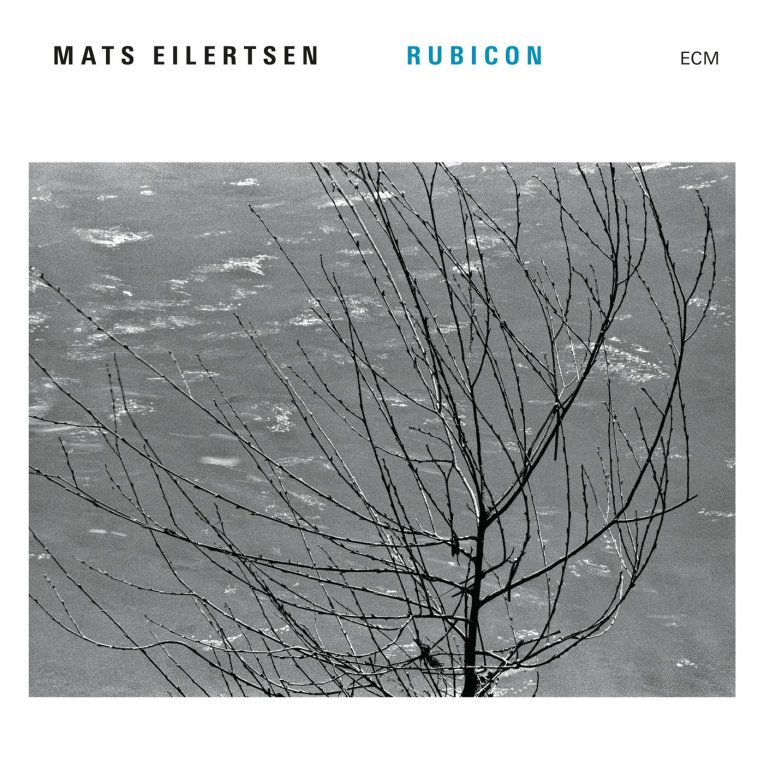
Mats Eilertsen: Rubicon (ECM 2469)

Rubicon

Mats Eilertsen
Rubicon

Trygve Seim tenor and soprano saxophones
Eirik Hegdal soprano and baritone saxophones, clarinet, bass clarinet
Thomas T Dahl guitar
Rob Waring marimba, vibraphone
Harmen Fraanje piano, Fender Rhodes
Mats Eilertsen double bass
Olavi Louhivuori drums
Recorded May 2015 at Rainbow Studio, Oslo
Engineer: Jan Erik Kongshaug
Produced by Manfred Eicher
Release date: July 29, 2016

The result of a VossaJazz Festival commission by Trude Storheim in April of 2014, Rubicon presents bassist and longtime ECM sideman Mats Eilertsen as a leader in his own right. At its core is Eilertsen’s Skydive Trio with guitarist Thomas T Dahl and drummer Olavi Louhivuori. To that nexus he adds saxophonists Eirik Hegdal and Trygve Seim, pianist Harmen Fraanje, and vibraphonist Rob Waring for an eminently integrated atmosphere.

The album ends where others would begin: with an “Introitus” of inward proportions. This trio for bass clarinet, bass, and marimba reconfigures finality as an open door, turning the very idea of a destination in on itself until the journey becomes self-fulfilling. “Wood and Water” explores freely improvised territory with the same combination of instruments in the set’s emotional zenith.

Particular musicians lend sanctity to the unplanned. Fraanje projects his cinematic monologue “Cross the Creek,” while Dahl treads meteorically across the expanse of “BluBlue” without ever looking down. “Balky” and “Lago” highlight the reed players, building towering intimacies from base elements at one moment, while at the next slicking city streets with late-night rain.

These attentive bandmates find deepest traction when working together, for unity is the wellspring of their integrity. We find it in the opening “Canto,” a roving suite of sun and shade from which Seim and Hegdal draw out hidden voices; in “March,” which unfurls its shimmering wingspan by way of vibraphone and guitar; and in “September,” which rewrites its own grammar as it goes along. In each of these scenes, sentiments are pulled as if by horse carriage toward spontaneous horizons.

Through it all, Eilertsen is an undeniable force, bearing his lyrical ache on a pillow of total respect for creation and the opportunity to share it.

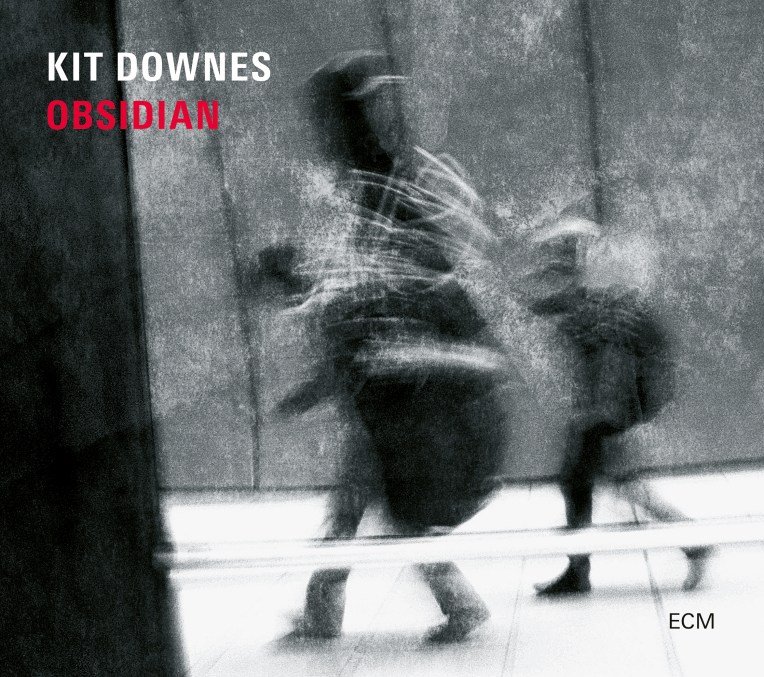
Kit Downes: Obsidian (ECM 2559)

2559 X

Kit Downes
Obsidian

Kit Downes organs
Tom Challenger tenor saxophone (on “Modern Gods”)
Recorded November 2016 at St. John, Snape, Suffolk
Union Chapel, London
Engineer: Alex Bonney
Produced by Sun Chung
Release date: January 19, 2018

Performed on three different organs across the UK, Obsidian chronicles the spatial and temporal travels of keyboardist Kit Downes. Were this album to be turned into a book, it would require a tooled leather cover and hand-sewn binding to do even partial justice to all the care gone into its narrative. Each instrument thus embodies its own backstory, the mechanisms of which become clear not only in the intimately engineered recording but also in the interactions catalyzed by Downes’s gestural storytelling.

That said, the floating arpeggios and leading lines of “Kings,” our first leg of this journey, actualize their images not by pen but by palette knife, treading across canvas as if it were a horizontal path turned upward in defiance of gravity. Despite this perspectival flip, however, the music feels weighted by the contrary motions of its performer, who balances forces of suggestion with spontaneous deference. One imagines a boy running over hills in search of any other destiny than the one chosen for him, yet leaving an audible path so that even the blind might find him should he ever get lost. Such feelings of liberation are only intensified in a multilayered rendition of the folksong “Black Is The Colour.”

Not all in this world of hardened lava, however, is spoken in earthly tones. In “Rings Of Saturn,” Downes awakens the pipes like an intergalactic shō, and from their arousal turns outer space into inner reality, while in “Flying Foxes” he reroutes wordless carriages of animality into every unfolding theme, as in the avian hymnody of “The Gift” (written by father Paul Downes).

“Seeing Things” practices what it preaches through a more pointillist doctrine. Its marginalia gild a scripture explored more deeply in “Modern Gods.” Here the saxophone of Tom Challenger inhales from the organ even as it exhales something back into it. With a fleeting sense of form, it scales from shadow into burning triumph.

“The Bone Gambler,” as the program’s most evocative, couldn’t be more appropriately titled. With sincerity of pitch and mood, it wraps its arms around a room so beautifully timeworn that one could almost expect Tom Waits to walk in at any moment and start rasping his soul. Through the window of that same room, we gaze out upon the waters of “Ruth’s Song For The Sea” and “Last Leviathan,” elegies both. With a sincerity that can only have resulted from years of hammering on an anvil of love, these finely wrought talismans warn of continental vagaries, offering in their place a chance to sail away in boats of our own fleshly making.

Obsidian is the musical equivalent of following behind Lucy Pevensie as she escapes her war-torn world through the wardrobe to find refuge awaiting her snow-cushioned step. Let this be your doorway into something equally salvific.

Tord Gustavsen: What was said (ECM 2465)

What was said

Tord Gustavsen
What was said

Tord Gustavsen piano, electronics, synth bass
Simin Tander voice
Jarle Vespestad drums
Recorded April 2015 at Rainbow Studio, Oslo
Engineer: Jan Erik Kongshaug
Produced by Manfred Eicher
Release date: January 29, 2016

After leaving behind the phosphorescent crumbs of his era-defining trio recordings, Norwegian pianist Tord Gustavsen returns to ECM’s forest path alongside drummer Jarle Vespestad and holding a fresher lantern lit by German-Afghan vocalist Simin Tander. Gustavsen expands his palette, adding electronics and synth bass to the mix, while Tander renders her voice with lyrical and improvisational force. Taking the hymns of Gustavsen’s childhood as foundation, he and Tander enlisted the help of Afghan poet B. Hamsaaya to translate them into Pashto before balancing them with Rumi in the freer English translations of Coleman Barks. The verbal archive of Rumi-inspired American writer Kenneth Rexroth was also mined for jewels to be set in the yielding silver of the present arrangements. On that latter note, Rexroth’s “I Refuse” comes across as the album’s spiritual culmination, standing firm against the tide of history even as it imbibes itself on forgotten knowledge. Tander’s rendering thereof illustrates a life cycle of its own worth: from the pupa of suggestion to the chrysalis of accountability and finally a winged emergence of liberation.

Like fog resolving into a discernible landscape, the verses chosen for this program strip away layers of hardship to reveal the light of hope buried within. This is especially true of the Rumi selections. In “Your Grief,” Gustavsen’s melody unwraps the Sufi poet’s observational acumen as a lover would a seam of clothing, revealing not a physical but a spiritual body in which beats a heart of ephemeral loss. “What Was Said To The Rose” is a another sonic blush of whispered thoughts and corporeal singing, while “The Source Of Now” employs gentle brushwork—both literally in Vespestad’s playing and metaphorically in the sentiments—and all of it connected by an aquatic singing style.

What was seen

That the Norwegian hymns feel as integrated as they do is testament not only to the musicians but also to a shared continuity. “I See You” is thus more than an ode to our heavenly Mother and Father, but a locket of understanding that houses Tander’s voice as an earthly relic. Her subtle adlibbing is as tangible as stained glass, and equally mosaiced. The piano intro of “A Castle In Heaven” evokes that other spiritual stalwart of ECM—G. I. Gurdjieff—by clearing away ancient paths of virtue. Starting with the vigil-like awareness of “Journey Of Life” and finishing in the shaded alcove of “Sweet Melting Afterglow,” a veritable church of sound opens its pews to any and all who would bend a knee between them.

Even the album’s instrumental turns feel syntactical. Both the tender duo of Gustavsen and Vespestad that is “The Way You Play My Heart” and the playful awakening of “Rull” realize that speech is nothing without music, and vice versa. And so, what was said is also what was sung, pushed like air through lungs, throat, and mouth to turn the very ether into writing paper and our ears into eyes reading every word as if it were our last.