

I’m currently embarking on a little project, for which I am compiling my “Top 100” ECM reviews to date. Whether you’ve been following my blog for five years or five days, I trust that you will have some favorite reviews of mine. It would be of great help to me if you could list those reviews that you feel are most effective at capturing the spirit of the music, as well as those that led you to new and meaningful discoveries, by leaving a comment to this post. Thank you!
ECM Records
Robin Williamson review for RootsWorld
My latest review for RootsWorld online magazine is of Robin Williamson’s fourth ECM album, Trusting In the Rising Light. The review includes an interview with producer Steve Lake and song samples. A highlight of Robin’s astonishing output. Click the cover to discover.

Looking forward…
Although I’ve reached a major milestone here at between sound and space, there’s little time to rest on my laurels. ECM will be releasing five albums stateside on June 2, so look out for those reviews soon, along with reviews of a few European-only releases, including Cyminology’s latest, Phoenix. I’m also preparing a small batch of articles and live reviews (among them, a stellar performance by Sheila Jordan with the Steve Kuhn Trio at Birdland) for All About Jazz. I will link to those as they appear.
Thanks to a new friend, I will soon be introducing a new “Rarities” category, diving into the most obscure ECM items on the planet. On a related note, I will be turning my attention back to the JAPO catalogue as well and hope to finish reviewing it within the year. In addition, I will be catching up on my reviews of ECM-related books, DVDs, and other such materials along the way.
Keith Jarrett: Creation (ECM 2450)

Keith Jarrett
Creation
Keith Jarrett piano
Produced by Keith Jarrett
Recorded April, May, June and July 2014
Engineers: Martin Pearson and Ryu Kawashima (Tokyo)
Mastered at MSM Studios by Christoph Stickel and Manfred Eicher
Executive Producer: Manfred Eicher
Keith Jarrett’s second of two recordings released in 2015 is his most recent vintage, and a first in his discography for being a compilation of solo improvisations handpicked by the pianist from concerts in Toronto, Tokyo, Paris, and Rome the year before. As with all of the best solo recordings, this one develops patiently and with a sense of something so grandiose yet so intimate—the universe in a drop of ocean—that it’s all one can do to stay afloat in the sheer expanse of it all. Then again, Jarrett offers these pieces with such solemnity that we cannot help but feel invited to share in their rituals as equal partners.

Part I opens in deepest pulse, notes circling around one another like magnets that cannot decide whether they are polar complements or opposites. During the unfolding, it becomes clear that Jarrett was ready to pick up right where he left off on Rio, unraveling time through heart and fingers. The plodding nature of its construction does nothing to obscure a filament of light, which is then singled out by the nostalgic purview of Part II. In a promotional interview with NPR’s Rachel Martin, one of a few marking his 70th birthday, Jarrett stressed his new role as producer: the creation of Creation was indeed his first attempt at sequencing. Once he had settled on the first track, this second one followed, and so on. If the emerging narrative feels intentional, it’s only because it has a will of its own.
Lyricism reigns in Part III, which sounds like every ballad you’ve never heard. Its clarity is also its mystery. That such a fully formed openness could crawl out of any human being is astonishing to consider—that is, unless you count the birth of a child, which may just be the only wonder in this world to surpass it. Part IV nourishes this theme of growth from infancy, tracing as it does the wide-eyed expression of new parenthood even as it prunes back the shadowy branches of mortality sprouting foliage overhead. As so often happens when these emotions become too concentrated to keep inside, Jarrett’s voice makes its tender emergences. “It’s potential limitlessness,” he says in the aforementioned interview of that singing. “My main job is listening.” And rightly so, for we may feel him listening as intently as we are to Part V, which helicopters to the ground like a flurry of maple seeds in summer before wiling away the heat under the shade of a less threatening tree. Impressions of the prairie, of undying wilderness and civilization in kind, intermingle with anthemic signatures until the piano seems an open font.
Part VI marks a turning point in the program from the merely soulful to the fully sacred. Its every hue is captured with archaeological precision before it is set free. As the album’s widest vista, it encompasses the fewest impulses, and only magnifies them to the point of such scope that they feel more populous than they are. Every rolling hill becomes a puff of dandelion before us, the dream of a gentle giant with no harm in its past…or future. Part VII chooses one path among many and follows it as far as it will go. The river’s flow of its desperation is strangely tempered by solitude and leads to the angular way station of Part VIII. Here the slumber is more fitful, but nevertheless unbroken by violence. Indeed, peace is the order of the day in the final Part IX, which by virtue of its placement is destined to speak in the language of departure.
With such an extensive archive as yet unrendered, one may no longer speak of “classics” in the plural when referencing Keith Jarrett’s output. It’s all part of one ongoing song to which our attention is as mandatory as breathing.
(To hear samples of Creation, click here.)
Keith Jarrett: Barber/Bartók (ECM New Series 2445)

Keith Jarrett
Barber/Bartók
Keith Jarrett piano
Rundfunk-Sinfonieorchester Saarbrücken
Dennis Russell Davies conductor
New Japan Philharmonic Orchestra
Kazuyoshi Akiyama conductor
Samuel Barber
Concert recording, June 3, 1984 at Congresshalle, Saarbrücken
Engineer: Helmut Fackler
Balance engineer: Helmut David
Béla Bartók
Concert recording, January 30, 1985 at Kan’i Hoken Hall, Tokyo, as part of Tokyo Music Joy Festival
Engineer: unknown
Concert promoter: Toshinari Koinuma
Mastered at MSM Studios by Christoph Stickel
Executive producer: Manfred Eicher
It’s tempting to trace overlaps between Keith Jarrett’s roles as a “classical” and “jazz” musician, but in this archival treasure I for once see the importance of their differences. It is precisely because Jarrett is so well versed, and indebted, to both spheres of influence that he seems to recognize the divergent types of rigor involved. In less uncertain terms: to merely conflate one with the other shortchanges both in the process. Hearing these recordings, now three decades old, we can be sure that many things have changed in the pianist’s approach to style and timbre just as we can be sure that whatever indefinable flame sustains him burns as brightly now as it did then.
What we have here are two recordings—one made in Germany in 1984, the other in Japan in 1985—of piano concertos and an additional encore of improvisation. Beyond that, however, we have a statement of almost divine purpose from a musician who listens to everything before he plays.

The Piano Concerto of Samuel Barber (1910-1981) is first on the program and finds Jarrett fronting the Rundfunk-Sinfonienorchester Saarbrücken under the direction of Dennis Russell Davies. Davies is a natural fit, having previously conducted Jarrett on record as composer (see Ritual) and, more than a decade after this recording was reeled, as the featured soloist of Mozart’s own concertos. Written between 1960 and 1962, Barber’s earned him a second Pulitzer Prize and is largely considered to be among his masterworks. The sheer variety of the first movement alone tells us so. The introductory solo might seem spontaneous were it not for the first orchestra hit soon thereafter. Jarrett’s rhythmic acuity is in such fine form that the other instruments almost feel ornamental. The second movement more pastoral, and Jarrett plays it with such flowing intuition that again it sounds like his own creation. Here the very personality of the piano, through Barber’s writing, takes shape, like an infant growing to young adulthood in the span of five minutes. The final movement begins as if through a mysterious screen before stoking its hearth to roaring flame. More pronounced brass and percussion make it a captivating one, even if those faunal winds do creep around the occasional corner with indications of less complicated sojourns. Rousing rhythms from both soloist and orchestra trade places at a moment’s notice, leaving us spellbound.
It’s perhaps no coincidence that Barber’s only piano concerto should be paired with the third of Béla Bartók (1881-1945), as soloist John Browning, who premiered the Barber in 1962, ranked it alongside the very same as a crowning achievement of the genre in the 20th-century. Bartók wrote his in the final year of his life, after having fled to America in the wake of World War II. Jarrett likewise renders it here far from home (in Tokyo, that is) with the New Japan Philharmonic Orchestra under Kazuyoshi Akiyama. The first movement is more soaring than the Barber, filled with minuscule nooks in which to store our fascinations. The denser textures and more overtly “pianistic” writing allow for great variation at the keyboard. Jarrett responds with that trademark touch, building punctuation marks into paragraphs and paragraphs into full narratives. The second movement, though graver, nevertheless achieves crystalline form. Among Bartók’s most profound pieces of writing, its strings emerge like sunrays at dawn. Jarrett coaxes the orchestra, even as it coaxes him, creating a feedback loop of lyrical unfolding. He attends with a patience that is noticeable even in the most percussively inflected portions. An unresolved ending anticipates the finale, a movement of such fitness that it practically leaps away from the musicians of its own accord. Through windswept strings, Hungarian folk dance motifs, and purposeful drama, Jarrett handles that final ascent with finesse.
Following this performance, Jarrett improvised a piece that has since taken the name “Tokyo Encore—Nothing But A Dream.” It’s a balladic jewel that diffuses the energy of the Bartók even while enhancing it, for here is a heart that respects not only the beauty of art, but more importantly the art of beauty, handling both as if they were of the same substance. Anyone else might bungle it, but Jarrett gives it such a genuine connection that we are reminded of his many gifts, not least of all those given to listeners fortunate enough to see their lives overlap with his.
(To hear samples of Barber/Bartók, click here.)
Mathias Eick: Midwest (ECM 2410)
Mathias Eick
Midwest
Mathias Eick trumpet
Gjermund Larsen violin
Jon Balke piano
Mats Eilertsen double bass
Helge Norbakken percussion
Recorded May 2014 at Rainbow Studio, Oslo
Engineer: Jan Erik Kongshaug
Produced by Manfred Eicher
So many of ECM’s finest trumpeters also happen to be skilled travelers. Tomasz Stanko and Enrico Rava in particular have hopped the globe in search of inspiration, life experience, and musical expansion. Yet few, among the possible exceptions of Nils Petter Molvær and Per Jørgensen, have gone so deeply inward and emerged with such painstaking lyricism as Mathias Eick. Midwest was inspired by a North American tour, during which time Eick recalls feeling very homesick: “Then we reached the area called the Rural Midwest and I suddenly had the strange feeling that I was home. It occurred to me that some of the early settlers must have felt this way, when they looked at the rich soil of the plains and saw that this was wonderful land for farming. Parts of the Midwest remind me strongly of parts of Norway including the southeast of Norway where I grew up.” Even with this, and the migratory tunes that comprise this album, in mind, the journey on which we are led is far more psychic than geographic. Joining his caravan are violinist Gjermund Larsen (last heard on the Christian Wallumrød Ensemble’s Outstairs), pianist Jon Balke, bassist Mats Eilertsen, and percussionist Helge Norbakken: a continent unto themselves.

The word “lyrical” gets rehashed a lot to distinguish jazz that is “pretty” versus that which is “raw.” Yet no rule says that the two must be exclusive. In fact, Eick has forged just such an alloy on this album, and you can hear it in everything from his tone to his soulful interactions in and among the band. Eick has clearly worked hard to establish an identity on the trumpet, because we can hear it the moment he sounds his first note. In this vein the title track pans us into the emotional thick of things, blessing the land with the gentle rain of cymbals and the tilling of piano. Eick and Larsen set an album precedent by way of their give and take, threading the ether with a sound so lucid it’s almost dreamy. Larsen’s folk inflections do, in fact, make Midwest as much of what it is as its bandleader. Their harmonizing in “Hem” is just one example of this successful blend. The latter tune further epitomizes the sheer magnification of detail that has overlaid Eick’s playing and composing since his leader debut, The Door. More than ever, he is like the master photographer, who puts his eyeglass to every questionable grain and tinkers behind the scenes to get just the right emulsion before presenting the finished, developed image. That said, his pictures are often moving than still. Much of this movement can be found in either the emotional journeys at hand (cf. “March”) or in the contributions of individual musicians. Eilertsen pulses through “At Sea” like the power of recollection incarnate in one of two more straightforward thematic vehicles. The other, “Dakota,” also emphasizes the wonderment and space Balke brings to the palette, while Norbakken sends harmonic minnows into the periphery.
“Lost” is, along with the title tune, an emblematic one. Its evocation of slippage across space and time heightens Eick’s apparent dislocation even as it deepens his newfound connections to faraway soil. A lovely solo from Balke, nestled in a reed-bed of cymbals and bass, adds to the feeling. So, too, does “November,” by which we arrive at the bittersweet yet inevitable farewell, a taking stock of things learned and gained, those things long left behind and others soon to be, and still others waiting for return. It is the realization that the pleasure of going home is always darkened by the sadness of departure.
If Eick has so far crafted a distinct melodic solar system on ECM, Midwest is a galaxy unto itself. Fresh, spiraled, and classic to the core, it’s sure to be one of the label’s most enduring statements of all time.
(To hear samples of Midwest, click here.)
Jormin/Willemark/Nakagawa: Trees Of Light (ECM 2406)

Lena Willemark voice, fiddle and viola
Anders Jormin double bass
Karin Nakagawa 25-string koto
Recorded May 2013, Konstepidemin, Göteborg
Engineer: Johannes Lundberg
Executive producer: Manfred Eicher
Angels
Childangels
Opportunities come with the rainbow
and the children
Sing to us
so our hearts come back to us!
Anders Jormin returns to ECM with yet another surprising blend of multi-genre elements. The Swedish bassist welcomes folksinger Lena Willemark and, in her ECM debut, virtuoso of the 25-string koto Karin Nakagawa in settings and improvisations around Willemark’s poetry, sung in her native Älvdals dialect. Jormin has always been one for self-reinvention, and on Trees Of Light he has stepped into some of his most ambitious territory yet. Not because of any sense of scope (although the trio does evoke some rather expansive scenery), but because the import of every gesture is magnified in such an intimate setting.
Yet it’s Willemark, absent from the label since Jormin’s 2004 In winds, in light, who crafts the center of the current project. Her words and melodies inform every song of the program, with the sole exception of Jormin’s instrumental “Hirajoshi.” The latter piece’s title refers to the hirajōshi mode of pentatonic (plus semi-tonal) tuning in which it is played and foregrounds the koto’s dry-wing rasp, percussive accents, and open field. When Nakagawa sweeps her hands over its waters as Willemark’s viola and Jormin’s arco bass sing their way into union, the trio captures something ancient in its hands.
Around this wordless center flows a veritable ecosystem of dreams, recollections, and impressions. It’s not simply that jazz, Swedish folk, and traditional Japanese music are melding into something new. Rather, it’s that they are speaking to one another in the interest of honest friendship. Both the title and music of “Krippainggler” (If you listen) best exemplify this philosophy, as each musician occupies her or his place. Where Willemark’s voice is like the reed and Jormin’s bass is the riverbed, Nakagawa draws the waterline between them in a song of angels and resuscitation of life forces.

Pairings occur naturally throughout. Nakagawa and Jormin sometimes beckon their vocal traveling companion as if she were the sun itself, while at others koto and voice share ululations and whispers. Spotlight moments also abound, as when Nakagawa proves her improvising strengths in “Urbanus” or Willemark sings alone on “Minni” (Memories), an arresting segment of horizon. Whatever the mood, the listener can be sure to feel it wholeheartedly. “Ogadh Dett” (Your eye), for one, opens with a bass solo that is muscular yet somehow gentle, giving way as it does to the koto’s fairytale strains and taking lyric comfort in the warmth of unbroken regard. “Uoruo” (Worry), for another, walks the way of sorrow as if it were the clearest path of all.
And perhaps there is some truth here: that which leaves the deepest scar is also the easiest to follow, so that even when we are dancing, as in the title track or the “Slingerpolska” (Winding polska), somewhere in the back of our minds we know that we will end up alone, and all the stronger for it.
I am still standing where I left me
I walk on as another
See that the earth is still there
Still there
That I must remember
I have loved
(To hear samples of Trees Of Light, click here.)
Gary Peacock Trio: Now This (ECM 2428)

Gary Peacock Trio
Now This
Marc Copland piano
Gary Peacock double bass
Joey Baron drums
Recorded July 2014 at Rainbow Studio, Oslo
Engineer: Jan Erik Kongshaug
Produced by Manfred Eicher
After decades of sharing a legendary board with Keith Jarrett and Jack DeJohnette, bassist of bassists Gary Peacock rides a choice wave of his own with pianist Marc Copland and drummer Joey Baron. Now in his 80th year, Peacock needs no introduction except to those who’ve been living with their hands over their ears. He’s the pioneer of a lyrical and dynamically inflected style, a consummate player who knows no boundaries of expression, and, let us not forget, an influential composer to boot. The latter point finds appropriate stress on Now This, which nestles a few featherless tunes among the fully plumed.

(Photo credit: Eliott Peacock)
Perennial classics such as “Moor,” which here achievements the wonderment of renewal, and “Gaia,” which opens the set, confirm the breadth of Peacock’s abilities. Copland’s lyricism is a most welcome addition to their unfolding, peering into the heart of this music and making it crystalline. Yet the unforced feeling of emergence is shared by all, perceivable in a glint off Baron’s cymbals and in Peacock’s own forthright intimacy. Even at his most cautious, as in “Shadows,” the bassist is so sure of where he is going. Not because he sees the end in sight, but because he knows he will always arrive where he is meant to arrive. It’s one thing to trust your bandmates so wholeheartedly; quite another to trust yourself. Such commitment is a lifetime in the making.
“Christa” melts like a candy in the summer sun and finds Peacock humming through his instrument like someone newly in love. There’s also “Vignette,” a set highlight—not least of all for Copland’s beautification. The pianist’s elucidations are such that it’s all one can do to fend off surrender. That being said, his two composition credits elicit some of the most balanced playing on the record. Between the eddying, watercolor world of “And Now” and the slippery “Noh Blues,” there’s much to savor in the currency of their exchange. Baron, for his part, contributes one in turn: “Esprit de Muse.” What begins as an enigmatic tune, however, gains traction midway through and rides the rails into some concentrated swing. Another gem comes by way of Scott LaFaro’s well-polished “Gloria’s Step.” Lithe and limber as ever, Peacock navigates its familiar corridors with eyes closed and heart open, while Copland and Baron provide equally percussive support into interlocking bliss.
As epitomized by “Requiem,” last of the Peacock originals and of the set as a whole, Now This is marked by the sheer maturity of its players. To be sure, so long as you walk into this album without expectations of dramatic flourishes, you will walk out of it with something much longer-lasting: grace.
(To hear samples of Now This, click here.)
Savina Yannatou & Primavera en Salonico: Songs of Thessaloniki (ECM 2398)
Savina Yannatou
Primavera en Salonico
Songs of Thessaloniki
Savina Yannatou voice
Kostas Vomvolos qanun, accordion
Yannis Alexandris oud, guitar
Kyriakos Gouventas violin
Harris Lambrakis nay
Michalis Siganidis double bass
Kostas Theodorou percussion
Recorded February 2014 at Sierra Studios, Athens
Engineers: Yiorgos Kariotis and Yannis Paxevanis
Produced by Manfred Eicher
Songs of Thessaloniki marks the fourth appearance of Greek singer Savina Yannatou and her second-nature ensemble Primavera en Salonico. Characterized by the artists as “canvases for our imagination to create contemporary narratives on old myths,” the songs gathered here make for an appropriately multicultural portrait of Thessaloniki, a city where Orient and Occident have long blended at a crossroads of actions, peoples, and politics—a city, incidentally, Yannatou’s band calls home. Most importantly for the purposes documented here, it was a place where music could always be heard and can now be heard again.
When the first strains of “Apolitikion Agiou Dimitriou” caress your ear— strings, bellows, and lungs yielding Yannatou’s lullaby out of time— you may just feel at home as well. As a Greek hymn of St. Demetrius, patron saint of Thessaloniki, it paints a door deepest blue and welcomes us as we are. Ironically enough, and with exception of this hymn (and its instrumental variation which concludes the album), the Greek material on this album is tepid by comparison to its extra-cultural counterparts, even as it draws vital connective tissue between the same.
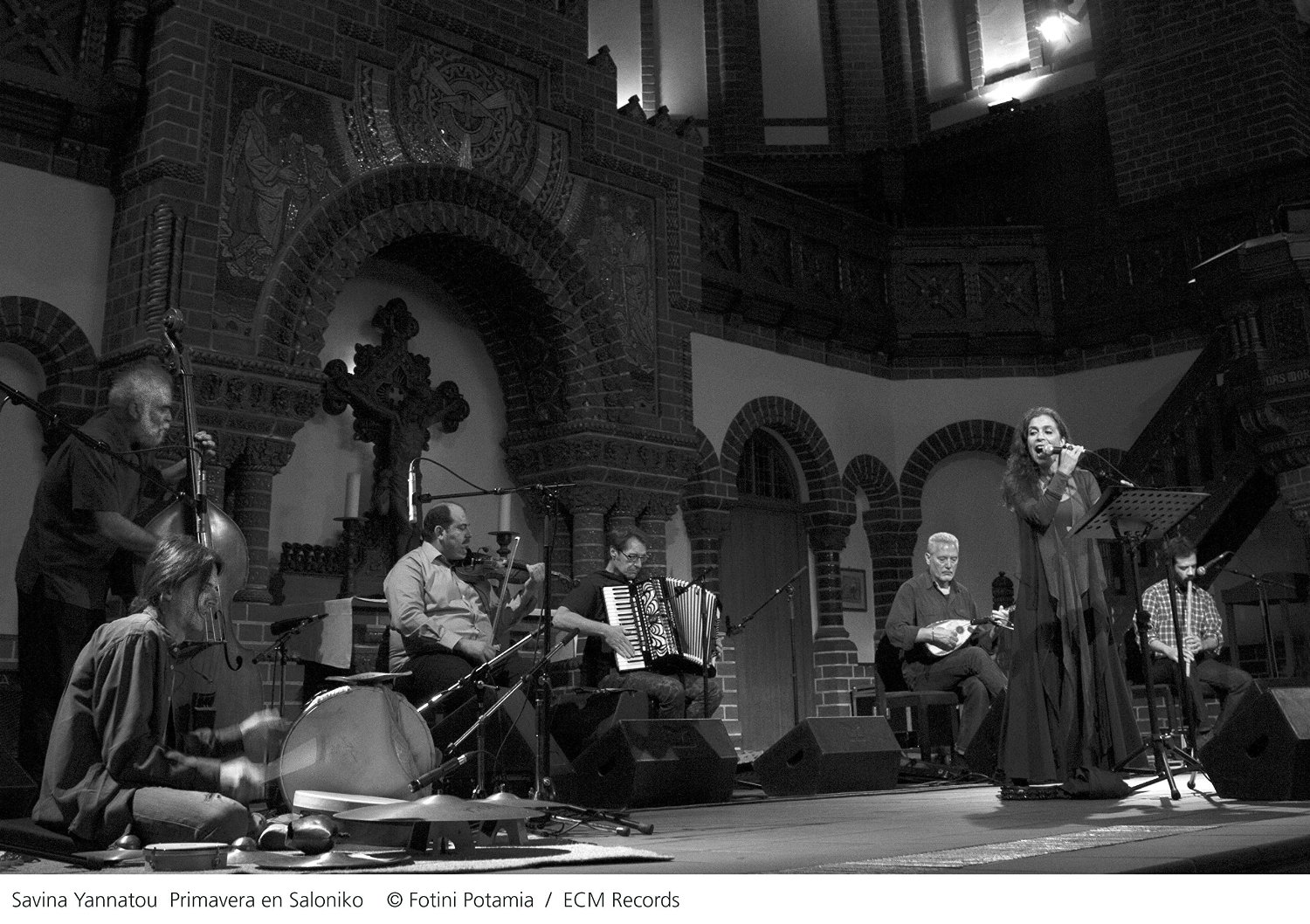
Thessaloniki’s historical influx of Sephardic Jews (Thessaloniki was, in fact, once known as the “Jerusalem of the Balkans”) is reflected in a formidable assortment. These songs especially reflect the arranging skills of Kostas Vomvolos, who also plays accordion and qanun throughout the recording. Yannatou’s chameleonic abilities have rarely sounded so organic as they do here. Whether in the childlike whispers of “A la scola del Allianza” or the qanun-accompanied “Una muchacha en Selanica,” she finds rawness of emotion in the simplest phrase and, by contrast, treads ever so lightly on danger—as in “La cantiga del fuego,” which tells of a great fire that swept the city in 1917.
More intense theatrics wait in the wings of “Dimo is Solum hodeshe,” a Bulgarian example that finds accordion, violin, and nay in artful concert. Two Turkish tunes, one as hymn and the other as folksong, give further context to Yannatou’s intrepid singing. In “Iptidadan yol sorarsan,” voice and nay practically become one, Yannatou sounding more like the flute, and vice versa, while halting rhythms and surreal beauties in the violin make “Çalin Davullari” a standout sojourn. There’s even an Irish folksong, “Salonika,” which dances, tongue-in-cheek, in the midst of war.
Yet few moments can approach the mastery of “Inchu Bingyole mdar?” and “Qele-qele,” both collected by the great Armenian composer Komitas. In both, the oud makes grander statements of purpose as it sweeps away the sand at Yannatou’s feet, allowing her to process into the distance, where, like the ancient Serbian tree of “Jelena Solun Devojko,” she stands until she dispels specters of violent pasts by virtue of her keening ways.
(To hear samples of Songs of Thessaloniki, click here.)
 Between Sound and Space: ECM Records and Beyond