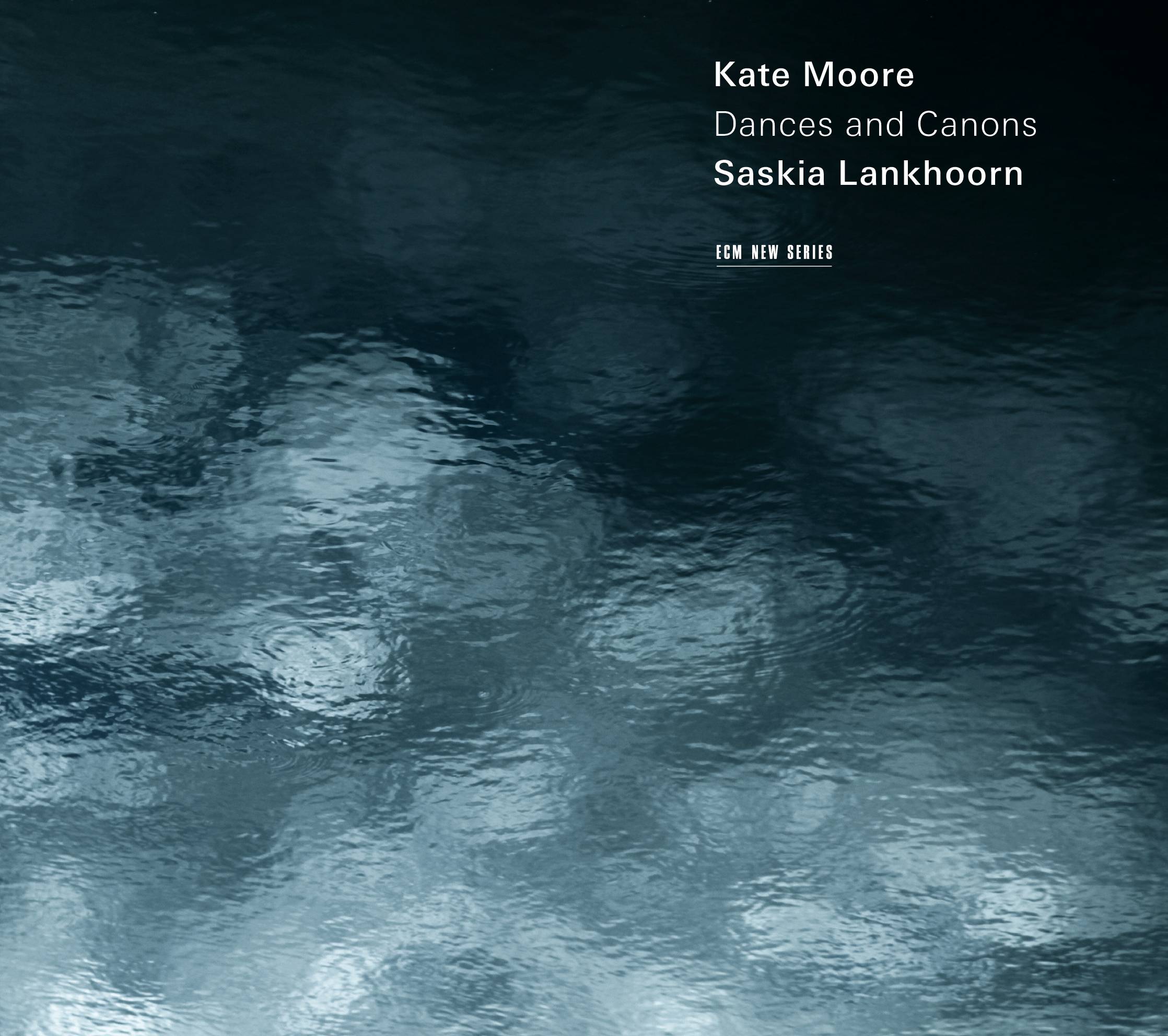
Kate Moore: Dances and Canons (ECM New Series 2344)

Dances and Canons

Kate Moore
Dances and Canons

Kate Moore composer
Saskia Lankhoorn piano
Recorded April 2013, Auditorio Radiotelevisione svizzera, Lugano
Engineer: Markus Heiland
Produced by Manfred Eicher

The music of composer Kate Moore is a hybrid of hybrids. It channels the inner fire of things that must someday turn to ash, and coaxes from this realization one intensely melodic conflagration after another. Born in England but raised in Australia, Moore cites the latter’s open landscapes as having permanently hued her artistic paintbrush. Moore’s longtime interpreter is pianist Saskia Lankhoorn, who debuts both herself and the composer to ECM’s hallowed New Series family.

Even though Moore professes no allegiance to minimalism—and rightly so, for her politics could hardly be more different—fans of the genre’s stalwarts are sure to take distinct pleasure in this program. Furthermore, taking the opening solo piano piece Spin Bird as an example, we find a natural wonderment present in, say, the seminal Philip Glass. Yet where Glass might attend to the overarching philosophical questions of a Koyaanisqatsi or a Satyagraha, Moore is more interested in the under-arching gesture, a cupping of water in all its microscopic glory. In this respect, Stories For Ocean Shells, also for solo piano, is like two hands interlocking: despite being of the same organism, each has characteristics that distinguish it from the other, with whom it only partners occasionally in a world designed to separate them through material engagement. Only through immaterial actions do they come together in a temporarily unbroken circuit of meditation and profound thinking. Every microtonal harmony is a puff of spore, every melodic spiral singing as if sung in the manner of a falling leaf. The result is a music that gazes on its own reflection and sees insight into the self as insight into all selves. And so, what might seem a mere chain of arpeggios in theory is in practice a downright sacred unfolding of time signatures, which can only be notated through the act of speech and bodily interpretation. Lankhoorn is fully adapted to bringing all of this out, and more.
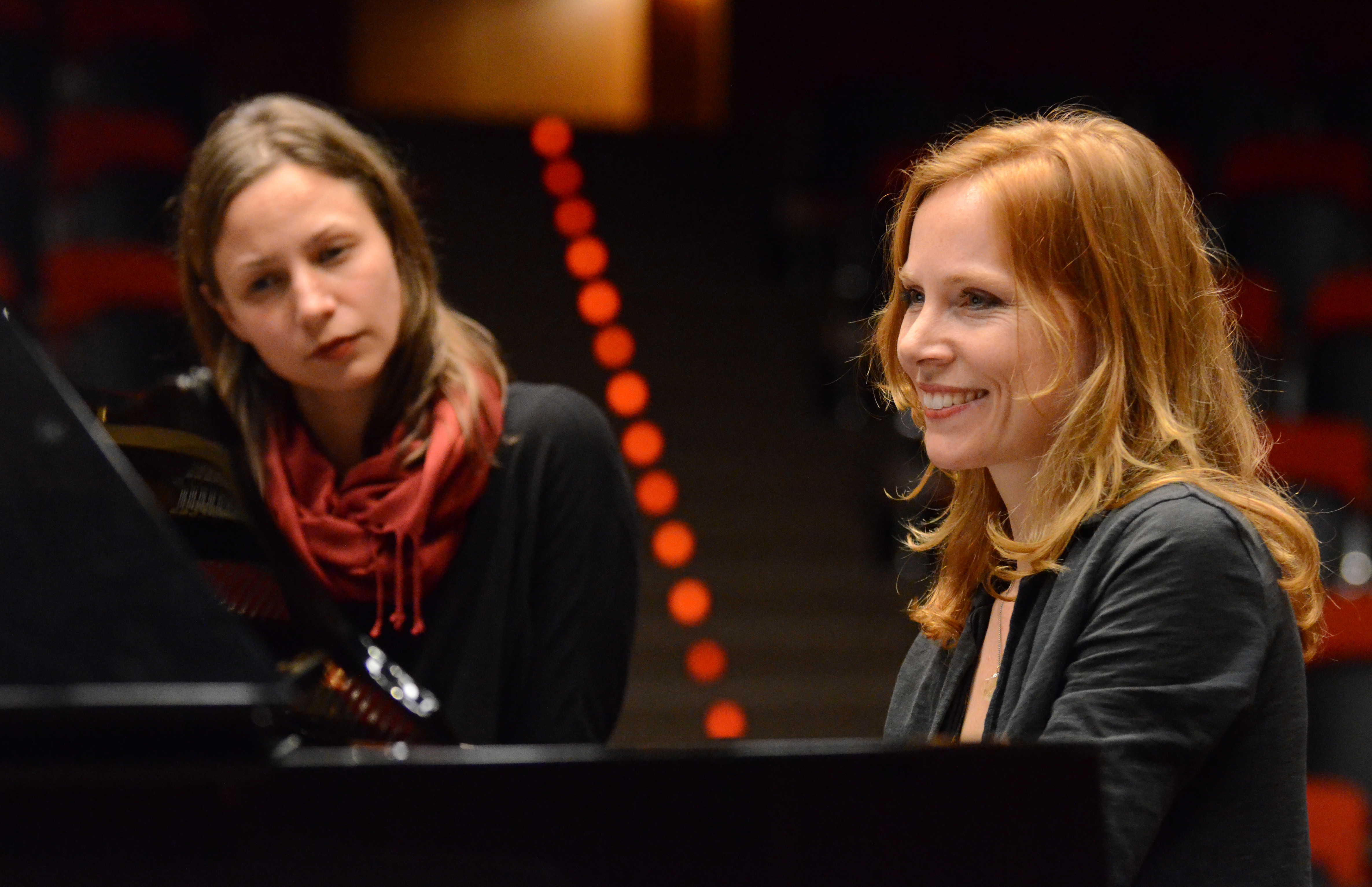
KM
(Photo credit: Dániel Vass)

But if The Body Is An Ear takes its inspiration from the writings of Sufi mystic Hazrat Inayat Khan (as it does), then it also takes inspiration from that which cannot be written (as it should). The rhizomatic pulse of its two pianos is so translucent that the instruments bleed through one another until there is but one between them. The transitions are resolutely beautiful—from smoothness to pointillism, from connectivity to individuality, from river to ocean—but hearing them as we do from the level of the molecule, we recognize that even beauty needs emptiness to survive. In this light, Canon is the intermediary between coalescence and dissolution. Magnified now to four pianos, Moore’s forces begin with a rounded dance of solitude and finish in a thought spiral. As the newest piece of the program, brought to the studio as it was in still-raw form, its gradualness begs a contemplative spirit and rewards the patient listener with presence of mind.

From the above descriptions, it would seem as if Moore’s is an ephemeral realm. This it might very well be, though no more than anything in this world already is. It’s also physical. The spine of Zomer (for solo piano) is glass-boned, its nerves of light sending their messages in occasional, quiet bursts, while Joy (also solo) grows heavier with every iterative cycle of its unfolding. Like the emotion itself, it is sometimes messy, at other times supremely ordered, and prone to exhaustion. The ultimate (for being fundamental) distillation of all this is Sensitive Spot for “multiple pianos,” meaning the musician must play against recordings of herself, trying to match them as closely as possible. Quick and almost nervous, it reinforces itself like a flower becoming lost in its own fragrance.

Landhoorn performs Sensitive Spot:

The closing reprise of Spin Bird, then, feels less like such. Rather, it is a leap farther inward to a place where only you, dear listener, and I may travel, untethered and free to roam.

(To hear samples of Dances and Canons, click here.)

David Torn: only sky (ECM 2433)

only sky

David Torn
only sky

David Torn guitar, electric oud
Recorded February 2014 at the EMPAC Concert Hall, Troy, NY and Cell Labs, NY
Engineer: D. James Goodwin
Assistant engineer: Steve McLaughlin
Produced by David Torn
Executive producer: Manfred Eicher

The solo artist is never alone. David Torn therefore can only speak of improvisation as a form of “self-hypnosis” or “secular meditation,” acknowledging either way the role of an alternate self or spatial reality to give context to his outpourings. Having passed through the filters of wide-ranging genres, including seminal appearances on ECM, the elusive yet ever-productive guitarist returns with a set of spontaneously composed pieces: just he, himself, and I.

It’s difficult to place Torn in any particular tradition based on one recording alone, but listening to only sky it’s easy to see how his influence has crept into the younger generation of guitar-oriented smiths—in particular James Plotkin, Tim Hecker, and Christian Fennesz—and how Torn continues to enrich the wider landscape by means of a style that is more personal than ever. Each piece on only sky develops as it will, treading wherever feet may land and without fear of erasure, if only because erasure was the purpose for its invention.

DT

Influences from the other direction may feel warranted here and there, not least of all in the Bill Frisell-like desolation of “spoke with folks.” Tearing off chunks from its quilted prairie as the starts of new memories, Torn elicits electronic tics from the feedback loop of his instrument, reminding that what we hear occurs at the level of intervention between body-spaces and thought-technologies. Even the smoother title track sounds at points like Buckethead at his most lyrical. But beneath all this associative skin flows a blood type with few potential donors. Torn’s ability to breathe through the guitar is certainly in a league of its own, and here his thoughtful pauses and expectorations both flow back into themselves, diving into the awkwardness of a first swim with all the love in the world.

In accordance with their evocatively open-ended titles, few of the album’s individual tracks are consistent in either mood or construction. The opening “at least there was nothing” sets a precedent for just this sort of unraveling. What begins in an expansive drone morphs into an errorful stream of purpose, which nevertheless sees little need to define itself in such terms. The contours imply something soft, aerodynamic. But then, the guitar grows spindles, as if waiting to snare a lightning bug, and this it seems to do the moment Torn picks up an electric oud and directs its itinerant voice into the sunlight. Similarly, “I could almost see the room” eases in by way of ambience, only to reveal that its quietude is a matter of distance and not temperament. At the helm, Torn’s guitar sputters from the notes stuck in its throat, each level of dislodging painstakingly recorded for posterity. Even “a goddamned specific unbalance” turns straightforward picking into a numerical sequence of hysterical motherboards.

Some moments, such as the twisted smiles of “ok, shorty,” bleed with omniscience. Others, such as the speech patterns of “reaching barely, sparely fraught,” exist at standstills of communication by the fascination of their own pulses. The cryptic “so much that” seems more like a continuation of itself, flushed with so much warmth that it must keel over and sing before succumbing to the past tense. This leaves only one standing: the seemingly more abstract but in reality most forthrightly singing piece of circuit bending known as “was a cave there…” Through its removal of wires, this masterful act of surgery amplifies the swan song of each precordial snap in a requiem for biological determinism. A crowd gathers in the lungs, writing its manifesto of escape bit by immeasurable but in those spaces between breaths. And when at last they breach contract by emanating through a scream, the body realizes that its fundamental error was symbiosis, no longer taken for granted as it inhales the mounting swarm of resistance and subsumes itself to a greater cause in the final tone.

Torn is part of the natural order of the airborne, the bottom end of a power chord that dips out of sight just before it can be consumed. His guitar is a choir, formless yet undeniably material, coaxing from the very earth particles of resonance. It is the crosshair within a crosshair, aimed at itself for the purpose not of annihilation but of undoing. In this enmeshment of noise and solace, the benefits of experience are in the details. Like pareidolia, the psychological phenomenon that predisposes us to seeing images in the clouds or moon, this music invites us to read it as we will. Yet the more we do so, the more the music reads shapes into us in return. It’s all so beautifully uncomfortable that it might just never leave you once it finds a way in.

(To hear samples of only sky, click here.)

Jack DeJohnette: Made In Chicago (ECM 2392)

2392 X

Jack DeJohnette
Made In Chicago

Henry Threadgill alto saxophone, bass flute
Roscoe Mitchell alto, soprano and sopranino saxophones, bass recorder, Baroque flute
Muhal Richard Abrams piano
Larry Gray double bass, cello
Jack DeJohnette drums
Produced by Dave Love and Jack DeJohnette
Recording engineer: Martin Walters
Assistant engineers: Jeremiah Nave and Daniel Santiago
Recorded live August 29, 2013 at the Pritzker Pavilion Millennium Park Chicago at the 35th Annual Chicago Jazz Festival
Sponsored by Chicago’s Department of Cultural Affairs & Special Events
Programming in part by the Jazz Institute of Chicago
Tour manager: Ken Jablonski
Mixed at Avatar Studio, New York by Manfred Eicher, Jack DeJohnette, and James A. Farber (engineer)
Mastered at MSM Studios, München, by Christoph Stickel
Executive producer: Manfred Eicher

As the story goes, when legendary drummer Jack DeJohnette was named a National Endowment for the Arts Jazz Master and given carte blanche to perform at the Chicago Jazz Festival in 2013, he immediately thought of his old jam buddies from the early 1960s, the founding sessions of which had led to the Association for the Advancement of Creative Musicians (AACM), whose most hallowed disciples formed the Art Ensemble of Chicago, resolutely documented on ECM. As Roscoe Mitchell recalls, “Every time I get together with musicians from the AACM it’s like we are just picking up from wherever we left off.” To be sure, the conversation between reedmen Henry Threadgill and Roscoe Mitchell, pianist Muhal Richard Abrams, bassist Larry Gray, and DeJohnette himself feels like it’s been going on forever. Despite the fact that these musicians had never recorded before as a quintet, much less played as one, it feels as if they have been plowing through ether on its way to the cosmos all along, and that we can count ourselves fortunate for catching even a snippet of their time on this planet. As if in service of this analogy, the recording is very present in relation to the musicians, while the crowd cheers like some distant panel of stars whose appreciation arrives light-years after the fact.

Made in the Streets of Chicago

Mitchell—who plays alto, soprano, and sopranino saxophones, bass recorder, and Baroque flute—offers two substantial originals to the stage. “Chant” cracks the concert’s outer shell with a sacred tap. From raw, arpeggiated materials it constructs a body from the ground up and, by addition of instruments, imbues it with consciousness. Likewise, every member knows his place in the larger symphony of his setup. DeJohnette pays off his timbral dues with handfuls of Benjamins, especially in his dialoguing with Mitchell, while Threadgill touches off more angular lines of flight. Gray meanwhile appears, stealthily at first but with increasing conviction, to be the psychological impetus behind it all. But it’s Abrams whose torrent of ideas seems most organic. Like a healing energy itself in want of healing, he plays the all-important trickster as Threadgill curls his fist in staunch refusal of suspension. Thus do we return to the center of the spiral, only to find another waiting to be sung. The aptly titled “This” reveals an adjacent facet, fronting Baroque recorder and Threadgill’s bass flute in an excursion of astute reflectivity. Abrams again proves vital to the physical nature of this sound, his pianism attaining downright Beethovenian proportions.

The bandleader’s “Museum Of Time” fuels the Abrams fire. Spanning a gamut from whirlwind to delicacy, its touch provides spatial reference for the reeds and a still larger context for the slippery groove in which DeJohnette and Gray find themselves. Threadgill’s “Leave Don’t Go Away” flips this approach, beginning in interlocking fashion before spawning a lone piano with a mind of its own. Bass and drums jive their way into frame, while sopranino nears bursting from the strength of its inner poetics. And then there is “Jack 5” by Abrams himself. Light cymbals clear the air before late-night sounds ground an alto and all the soulful things it has to say. DeJohnette then takes the reigns and builds his steed one muscle at a time, each part mutually independent of motion.

As the MC of the evening, DeJohnette extols the spirit of brotherly love on which all such jazz must feed. It’s a love you can feel when the band jumps into a spontaneously improvised encore titled “Ten Minutes,” which actually clocks in at just over six. Abrams checks a pulse, reeds exchange powerful mutations, DeJohnette and Gray ride the middle line: these become the markers of giving in. Mitchell saves his best for last this time around, his mind reveling in its own synapsial wanderlust.

A masterpiece? Please. This is more than a piece. It’s mastery incarnate.

(To hear samples of Made In Chicago, you may watch the EPK above or click here.)

Jakob Bro: Gefion (ECM 2381)

Gefion

Jakob Bro
Gefion

Jakob Bro guitar
Thomas Morgan double bass
Jon Christensen drums
Recorded November 2013 at Rainbow Studio, Oslo
Engineer: Jan Erik Kongshaug
Produced by Manfred Eicher

After playing with Tomasz Stanko on Dark Eyes and, before that, less conspicuously a part of the Paul Motian Band on Garden of Eden, Danish guitarist Jakob Bro reaches a milestone with his first ECM leader date. For this auspicious recording event, one could hardly ask for finer support than Thomas Morgan and Jon Christensen. Morgan stands as one of the most versatile bassists of his time, as borne out on a number of diverse projects for the label, whose fans will of course need no introduction to Christensen. Bro cites the drummer’s sound as a formative inspiration, and one can hear the joy of sharing the art of jazz with someone whose contributions to the same he so adores. After premiering at the 2012 Copenhagen Jazz Festival, this intergenerational trio stepped into Oslo’s Rainbow Studio to document after only a year’s worth of refinement. The end result sounds like 10.

Bro Trio

At nearly 11 minutes in duration, the title opener may be the longest of the set, but it is neither longwinded nor overwhelming. Rather, its spacy guitar is a fire in winter you don’t want to leave. Christensen’s cymbals awaken in the light of dawn, eyes still carrying afterimages of the night. Beyond this, Bro takes his first steps from the cabin into the open forest. Morgan’s bass follows suit, leading us to belief we are in for a long hike. But then something magical happens as the view now goes aerial. A clear Bill Frisell influence reigns in this transition, mellifluous and spun from open sky. The band traces a spectral parabola from one glade to the next, until every animal trap along the way has been disabled and burned to ash. And it is to ash we return at the album’s straightforwardly titled “Ending,” which at just under three minutes is its shortest. Still, looping arpeggios and tactile strums give it a fullness of structure, fading out on the moonwalk with which the album began.

As if to stretch this metaphor, “And They All Came Marching Out Of The Woods” finds Bro opening up a little more in tandem with Morgan’s flexible backbone. His guitar shines like a prism at a laser’s touch, until individual notes split into spectrums, but not before we dive into the streets of “Copenhagen.” Or is it into the water gently lapping the city’s harbors? This would seem to be the image evoked by Bro’s understated motifs. Or might it also be the sky above? For is it not the realm from which Bro drops a rope ladder for his bandmates to climb?

In thinking of the sky over Copenhagen, I find my thoughts turning to Gefion herself, a Norse goddess of land and plowing immortalized in the famous fountain I photographed during a trip in March of 2015:

Gefion Fountain

With her whip in hand she pushes her oxen through the land, but does so without need for virtuosity or flourish. Rather, like Bro, she sees music in the work itself.

Other references point to the heavily arpeggiated solo compositions of guitarist Jeff Pearce, a prime example being the ghostly nocturne of “Oktober,” and in “White” to the slow-motion streamers of a Motian ballad. Bro navigates both with the surety of a hiker in his favorite woods, one who knows every tree so well that he needn’t bother trying to account for them all. He leaves—no pun intended—that task to his sensitive support team, a rhythm section that foregoes rhythm toward an environmental approach. But urbanity, we soon realize, is never far behind, as we squint into the glare of “Lyskaster” (Searchlight). This can only be an ode to travel, for it embodies the constant balance, known to any itinerant, between missing what you love and craving what you have yet to love. “Airport Poem,” on the other hand, is an exercise in capture, of layover and tedium, Christensen’s barest presence only adding to that feeling of suspension.

Bro is a breath of fresh air for eschewing the trappings of technical virtuosity and instead plowing the far more challenging field of atmospheric integrity. His playing is so rich, in fact, that Gefion at times feels more like a solo album. This is not to insult the contributions of Morgan and Christensen, but to praise them for understanding that every white square needs a black one to keep it company, and that in the cosmos of any one of them exists far too many pieces to fit on one chessboard anyway.

In closing, it’s worth noting that Gefion bears dedication to Ib Skovgaard. The late jazz journalist and radio producer, who died in early January at the age of 67, was a tireless champion of improvised music in his native Denmark and a particularly stalwart supporter of Bro and his generation. With this knowledge in mind, we do well to see the album as the closing of one circle of appreciation by way of opening many others in its place. Here’s hoping you’ll be one of them.

(To hear samples of Gefion, click here.)

Sinikka Langeland: The half-finished heaven (ECM 2377)

2377 X

Sinikka Langeland
The half-finished heaven

Sinikka Langeland kantele, vocals
Lars Anders Tomter viola
Trygve Seim tenor saxophone
Markku Ounaskari percussion
Recorded January 2013 at Rainbow Studio, Oslo
Engineer: Jan Erik Kongshaug
Produced by Manfred Eicher

Sinikka Langeland is that rare artist whose albums feel as if they’ve always been with us, only it takes the divine intervention of recording them to make them perceivable in this dimension. As a virtuoso of the kantele, a Finnish table harp of the psaltery family, she is unparalleled. As a singer and composer, likewise. Yet beyond her physiological understanding of the relationship between text and arrangement, beyond her sonic woodblock printing of an ancient yet personal mythology, it is her willingness to grow into new territory with every project that makes her visions feel so ingrained. And in that respect she continues her rainbow chase toward the achievement of a settled style, freshening the colors of that spectrum by virtue of her very own.

SL

Langeland owes her evolution in part to the respect of collaborating musicians, whom over the years have grown and changed as the seasons. Out of previous ECM sessions she retains, from Maria’s Song (one of her most unexpected and shatteringly magnetic creations), violist Lars Anders Tomter and, from The Land That Is Not, saxophonist Trygve Seim and percussionist Markku Ounaskari. The idea for this album had been brewing since her debut with the label, after which producer Manfred Eicher suggested a solo kantele outing with minimal singing. The half-finished heaven is the compromise: a program of mostly instrumentals from which three songs rise like spruce trees against a listening sky.

The words come from Nobel Prize-winner Tomas Tranströmer, whose naturalist poetry also gives the album its name. The instrumental set-up of the title song feels like sitting down for a meal with someone you can only hope to see again. The sting of finality in the air is as strong as the drink at your lips as you try to focus on the good memories, which come marching through to the beat of Ounaskari’s snare. There is an intensely cinematic quality to the scene before Langeland silences the cameras with her vocal truth. “Each man is a half-open door,” she sings, “leading to a room for everyone,” and with that single statement the world awakens to the possibility of enjoying the God-given light in peace with others.

In captivation of rising arpeggios from the kantele, “The light streams in” unfolds far less checkered table cloths of expectation:

Outside the window, the long beast of spring
the transparent dragon of sunlight
rushes past like an endless
suburban train—we never got a glimpse of its head.

Langeland’s music is inherently attuned to just this sort of spatial and temporal mixture. Every touch of her instrument thus produces an observational moment, bending notes like branches aching with fruit. Ensnared as they are by sunlight so intense that it “makes the statues blink,” Tomter’s grave double stops drag arms along a wasted earth once filled with beautiful mourning yet which is now only mournfully beautiful. And just over the album’s central cusp is “The tree and the sky,” which at surface level links its titular metaphor to us and nature, while at the biological level erasing any distinction between the two. The viola moves like that tree, an Ent-like presence living out of time but in deep connection to all things material. Langeland’s (bene)diction here is a fairytale come to life for those who will believe it.

In the absences of words, we gain knowledge of absences. Throughout the opening “Hare rune,” for instance, we may notice that Ounaskari’s forested drum speaks as much to the effect of branches as to the sky feathered between them. Even the kantele—in this case, a 15-string version—twirls its ribbons of mercury to draw attention to the resulting chain of circles. Seim’s breathy tenor, meanwhile, sounds like an animal horn blown from a great distance, so that by the time it reaches us it is barely clinging to its note. “The blue tit’s spring song” is another 15-stringed tune, one that features goblet drum for a distinctly brighter sound.

With the additional exception of “Hymn to the fly,” a miniature played on 10 strings, the rest of the album features the 39-string concert kantele, which like a piano is equipped with a sustain pedal that allows for longer decay. Such capabilities of resonance enhance “The white burden,” an old piece from 1978 now making its first appearance on record, but more so the album’s faunal illustrations. Whether trailing feathers in “The woodcock’s flight” and “Caw of the crane” or reveling with “The magical bird” (modeled after a traditional polsdans from Finnskogen), each plucked string is hollow-boned and attuned to any change in wind direction. As in the delightful “Animal miniatures,” we may feel the way of every flit and burrowing.

To hear Langeland, be it through strings or song, is to be healed and know the way of holistic music. Like the ancient materia medica, her runic ways turn plants into cures and animals into protections. She is by no exaggeration a living treasure, and this may just be her most invaluable relic yet.

(To hear samples of The half-finished heaven, click here.)

Giovanni Guidi Trio: This Is The Day (ECM 2403)

This Is The Day

Giovanni Guidi Trio
This Is The Day

Giovanni Guidi piano
Thomas Morgan double bass
João Lobo drums
Recorded April 2014, Auditorio Stelio Molo RSI, Lugano
Engineer: Stefano Amerio
Produced by Manfred Eicher

When Italian pianist Giovanni Guidi, American bassist Thomas Morgan, and Portuguese drummer João Lobo made their ECM debut as a trio with City of Broken Dreams, they quietly shrugged off the trend of splash-making entrances. What they produced instead nearly took me aback with a lyricism not heard, I dare say, since Paul Motian at the peak of his invention. The style was, at the same time, very much its own and begged many contemplative returns to understand the breadth of its purview. Now, on This Is The Day, Guidi and his cohorts again tend a field of largely original soil, leaving twelve meticulously tilled rows for a harvest of 74 glorious minutes.

GG

The aching lyricism of “Trilly” (including its later variation) hits the chest in slow motion. Guidi’s pianism is assuredly delicate from the start: every note knows its place. And yet, while his craft may be the heart of everything, its beats are nothing without mind and body, and these his rhythm section most healthily provides. Be it through Lobo’s thoughtful traction in “Carried Away” or Morgan’s lucidity of expression in “Game Of Silence,” they further the trio’s mission of lifting every rock in places torn to their foundations by strife, salvaging whatever melodic material they can in the hopes of reuniting it with the original owners. Whereas in the first album there was little time for rebuilding, here the band is constantly separating and fitting architectural elements together. Through intensive understatement, each member’s contributions are translucent enough to let the others show through.

Also showing through are the band’s heightened powers of illustration. The plucked piano strings and pointillist accompaniment thereof are only the beginning of “The Cobweb,” which builds to an almost frantic density. Despite its brevity and abstraction (most of the surrounding tracks are melodic and of sizable duration), it holds a wealth of information and, like a web, trembles at even the most peripheral movement. This, along with the rubato poetics of “The Debate” and the sporadic “Migration,” comprise the freest portions of the set. Guidi makes it all sound effortless by never giving in to the drama of verticality. Even the cosmically good melodizing of “Where They’d Lived,” the album’s master ballad, rests on a hammock between skyscrapers, so content in the danger that it wears fear like a blanket. Behind closed eyes, Guidi’s dreams sound like “The Night It Rained Forever,” a boat ride through drone and mist that resolves into shores both empty and alive.

Only three tracks bear non-leader credit. Lobo’s “Baiiia” is a nuanced construction of cymbals and drums, of which tracings from piano and bass build to a tidal finish, while the standards “Quizas Quizas Quizas” (penned by Cuban songwriter Osvaldo Farrés and made famous by Nat King Cole) and “I’m Through With Love” recall Tord Gustavsen’s likeminded trio in its finest hour. As songs without words, they have so much more to say than with. At their departure, the currents of a thousand rivers converge into one, sending us on our way toward the hope of a thousand more.

A modern classic before a single note was laid down.

(To hear samples of This Is The Day, you may watch the EPK above or click here.)

Speaking for Apollo: Peter Rühmkorf on ECM

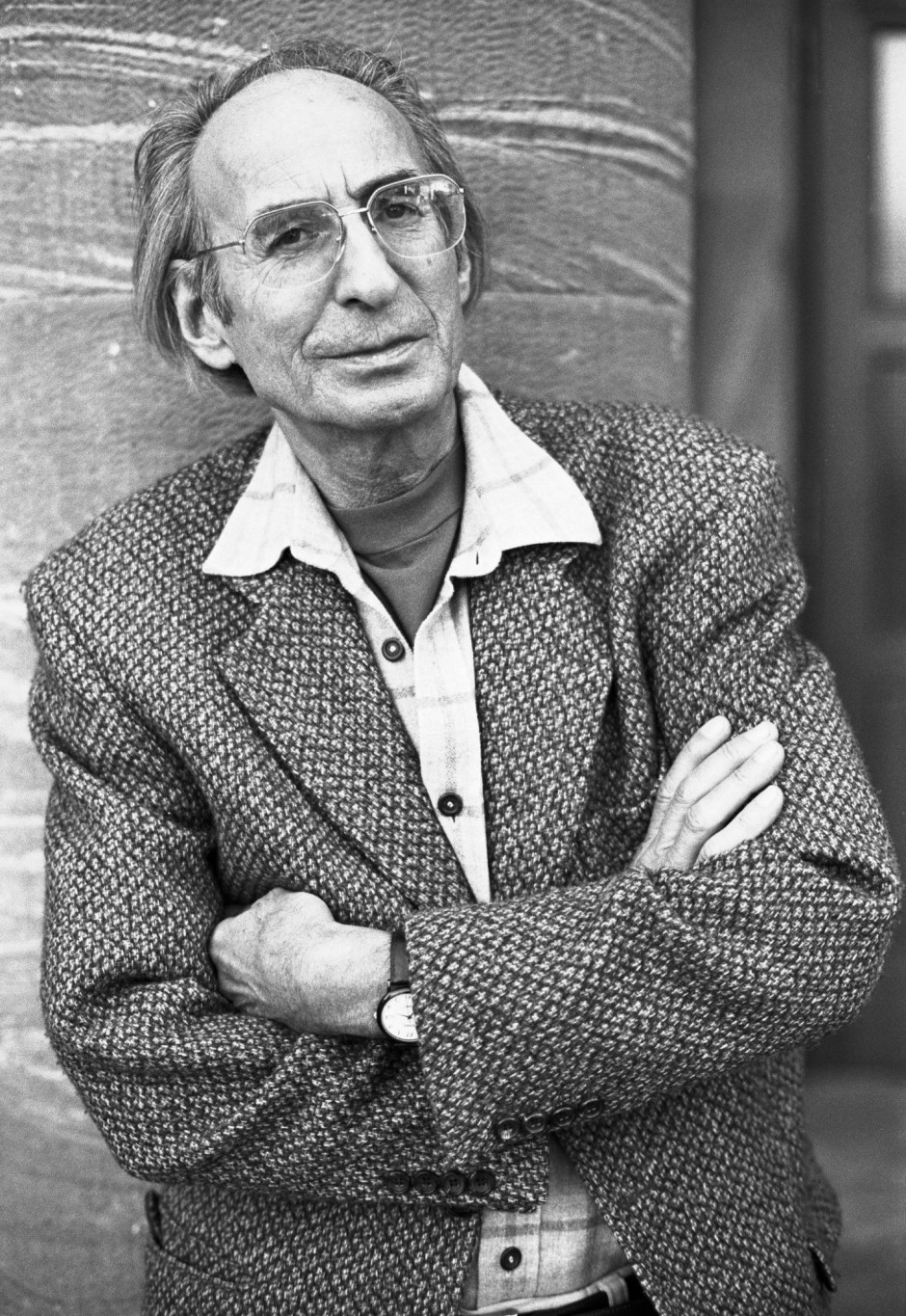
PR

Peter Rühmkorf (1929-2008) was among the most influential postwar writers of his native Germany, winning every major literary prize for his prolific output of essays, poetry, plays, and prose. Yet despite having given spoken performances on stage with pianist Michael Naura and vibraphonist Wolfgang Schlüter for over three decades, his only appearances on record in such a configuration were captured via two rare ECM “SP” albums from the late seventies. I was beyond fortunate to be offered these two albums off the shelves while visiting label headquarters for the first time in Munich, and the die-hard fan will want to seek them out. Going beyond mere sound structure or program music, Rühmkorf was rather looking for something harmonious between the spheres of language and sound production, and on these long-out-of-printers I think got rather close to that ideal.

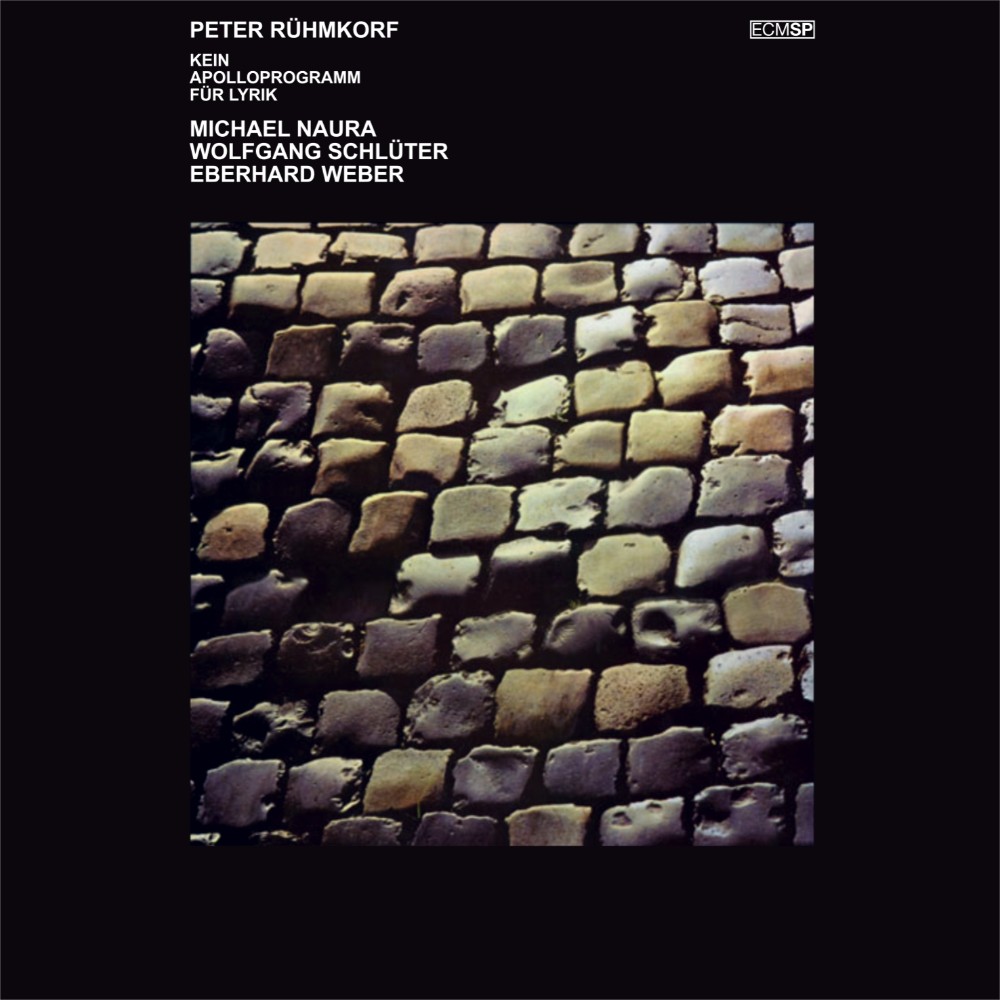
Apolloprogramm

Kein Apolloprogramm Für Lyrik (ECM 2305 801 SP)

Peter Rühmkorf voice
Michael Naura piano
Wolfgang Schlüter vibraphone, marimba
Eberhard Weber bass, cello
Recorded August 1976, Tonstudio Bauer, Ludwigsburg
Engineer: Martin Wieland
Produced by Manfred Eicher

The title of this first long out-of-print relic translates to “No Apollo Program for Poetry,” and indicates Rühmkorf’s interest in going beyond mere sound structure or program music. Rather, he was looking for something harmonious between the spheres of language and sound production, and here I think he was approaching that ideal. Rühmkorf further professes a downright biological need for poetry and skirts, in his darkly effervescent way, the line between emancipation and integration.

As with most of ECM’s speech acts, this one will be of little poetic use to those who don’t understand German. It should, however, be of immense value to the label’s fans for its musicianship. In addition to a rare early appearance by bassist Eberhard Weber (who also plays cello on one track), one is treated to some fine playing from Naura and Schlüter. Aside from two short tracks of Rühmkorf alone, the album is brimming with attractive makings of music. The trio activity of “Tagebuch” (Diary) establishes a grand, theatrical sort of precision with minimal means. Weber is robust and elastic as ever, sometimes climbing his way into the center and at others laying down club jazz atmospheres with Naura at the keys and playing us out on a bed of velvet.

For the most part, the playing is so illustrative that translations are hardly needed. “Hochseil” (Tightrope), for instance, balances Rühmkorf on a lone marimba that also carves helixes of reverberant post-production, while Weber’s percussiveness in “Zirkus” (Circus) builds like the tension of a trapeze act. And, whether steeped in the balladry of “Meine Stelle Am Himmel” (My Point In The Sky) or gilded by the flanged cello of “Elegie,” the poet rides an arpeggio of new horizons, only to culminate in the deeper finality of “Komm Raus!” (Come Out!).

Phönix

Phönix Voran (ECM 2305 802 SP)

Peter Rühmkorf voice
Michael Naura piano
Leszek Zadlo saxophone, flute
Wolfgang Schlüter vibraphone
Recorded March 1978, Tonstudio Bauer, Ludwigsburg
Engineer: Martin Wieland
Produced by Thomas Stöwsand

Whereas on the previous album Rühmkorf stressed the importance of pathos with an air of resigned unrest, on Phönix Voran (Phoenix Preview) he chews the fat of inner strength in closer quarters. Adding to that claustrophobia—even as he installs a window view—is Polish musician Leszek Zadlo, who replaces Weber’s bass with saxophones and flute throughout, and to astonishingly cinematic effect.

Rühmkorf’s ever-practical enunciation cracks open the piano and vibes like an egg, thereby releasing the soft yolk of Zadlo’s flute in a cradle of light and shadow. This combination, a sparkling one, works again on the freely improvised “Selbstportrait” (Self-portrait), which inhabits its own unsettled text with an increasingly kaleidoscopic gravidity. The flute lastly appears as Rühmkorf’s only partner in the aesthetically beat poetry-inflected “Allein Ist Nicht Genug” (Alone Is Not Enough).

Elsewhere, the saxophone takes precedence of sound and space. The opening reed tones of “Auf Einen Alten Klang” (An Old Sound), pure and singing, find natural traction in the Naura/Schlüter nexus, then dance freely as Rühmkorf works his narrative labor into a material image. Zadlo and Naura share one duet in “Paradise Regained” for a vivid portrait of night. Yet the fullness of the project’s vision is best realized by the entire band. Highlights in this regard include the deliciously titled “Ich Butter Meinen Toast Von Beiden Seiten” (I Butter My Toast On Both Sides), a lovely track with the wherewithal to hold its prose like nourishment in the belly, and the sweeter onomatopoeia of “Impromptu.” And as finality lands again in the bustling farewell of “Tagelied,” we begin to realize that perhaps it is the voice that accompanies the music, not the other way around.

While it might not always seem so in the thick of things, in hindsight the connections between speech and instruments are to be found not in meanings but in shapes. Naura’s music, which comprises the backbone of both sets, already has such a solid narrative arc that Rühmkorf is an intuitive fit to manifest its dips and climbs. Gems, these are.

Maria Pia De Vito, et al.: Il Pergolese (ECM 2340)

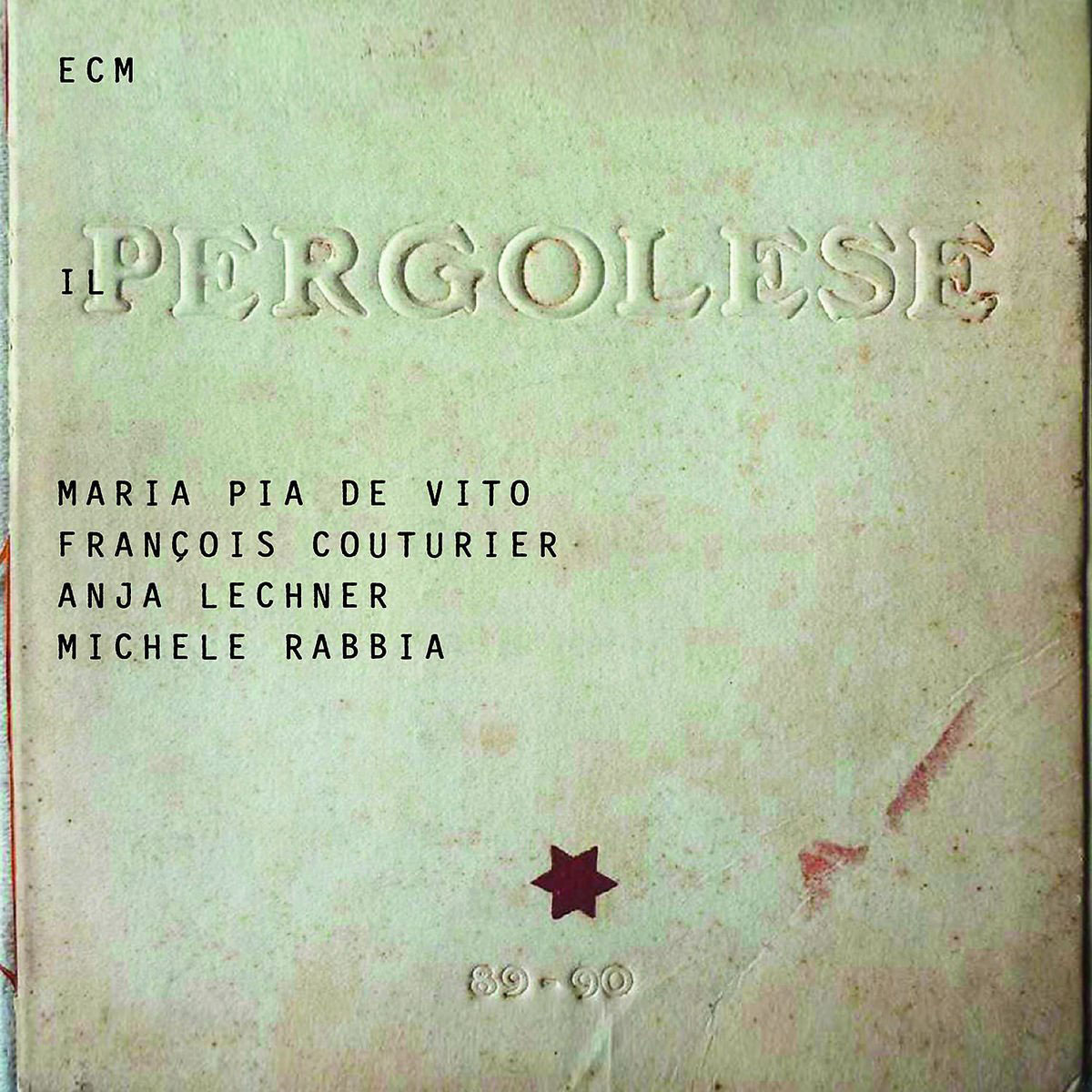
Il Pergolese

Il Pergolese

Maria Pia De Vito voice
François Couturier piano
Anja Lechner violoncello
Michele Rabbia percussion, electronics
Recorded December 2012, Auditorio Radiotelevisione svizzera, Lugano
Engineer: Stefano Amerio
Produced by Manfred Eicher

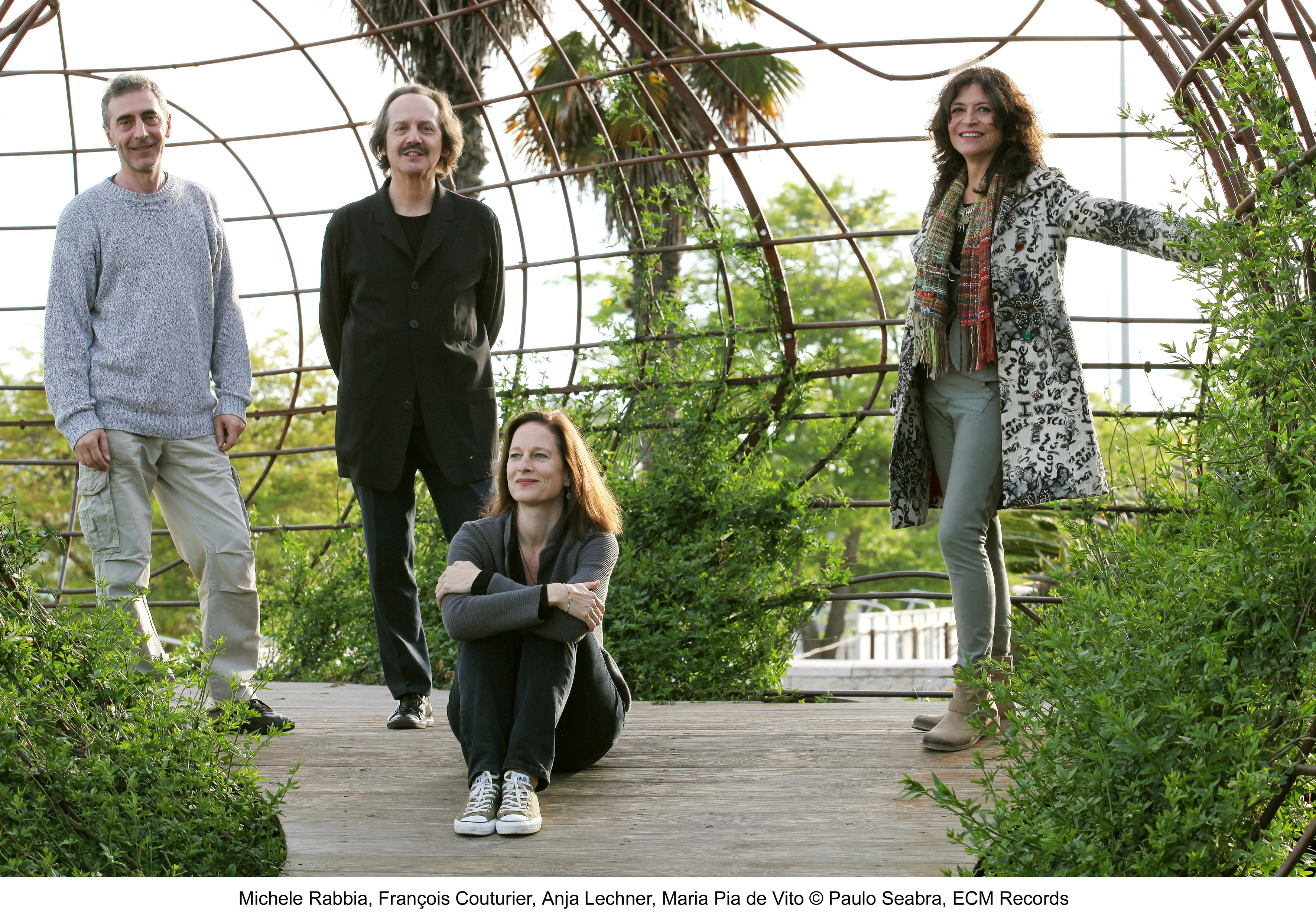
The life of Giovani Battista Pergolesi (1710-1736), cut tragically short at age 26 by tuberculosis, nevertheless made an immeasurable impact on the world of Baroque music and, as evidenced here, beyond. Already a successful opera composer by his mid-20s, Pergolesi would leave behind his final work, the Stabat Mater of 1736, on his deathbed. As Il Pergolese, singer Maria Pia De Vito, pianist François Couturier, cellist Anja Lechner, and percussionist Michele Rabbia have responded to the Italian composer by modernizing him at a crossroads of jazz, folk, and improvisation, De Vito going so far as to translate texts from the Stabat Mater into Neapolitan. The latter move yields pieces by Couturier inspired by that same masterpiece. His “Amen,” like the album as a whole, treats the development process as a precious use of time: only after Rabbia’s airbrushed percussion and additional electronics take hold do the darkly rolling piano and forlorn nightingale of cello share a canvas. The affirmation itself fluoresces under De Vito’s care before carrying over into Couturier’s jazzily inflected chords, by which he sets up Pergolesi’s processional “Fac Ut Portem.” De Vito rides the ocean waves of its drama, craving sunlight but drinking only storm. She then dips back into the Marian text with “Dolente.” Resonant percussion and birdlike vocals give Couturier the space to lull us into the song proper for a lachrymose yet, by virtue of the Neapolitan language’s delectable syllabic flavor, somehow blissful repose.

IP

From Pergolesi’s first comic opera Lo frate ’nnamorato (The Brother in Love) come two arias. The achingly lyrical “Ogne pena cchiù spietata” rests on a bed of piano and cello. Into this gorgeous scene steps De Vito like another Maria—Farantouri, that is—but with a little more maple mixed into her oak. Even after she fades, traces linger on as Lechner and Couturier are joined by Rabbia’s tapped hand drums. “Chi disse ca la femmena,” on the other hand, is a more straightforward melody that turns into folkdance and best explores the band’s rhythmic possibilities. A similar carpet of development unrolls itself down the corridor the “Sinfonia for violoncello,” which holds its own in a landscape of shifting tectonics. With archaeological care and glass tools, Rabbia chips away at Lechner’s caged pizzicati as if they were relics in need of recognition. That they most certainly get in the return of Couturier, who with an empathic analysis tells the backstory of their unearthing. And as Lechner’s bow sings its arco song, it resuscitates a Baroque heart to a calm yet glorious rhythm. “Tre giorni son che Nina,” a wildly popular song of the Italian Baroque attributed to Pergolesi, is another thing of beauty. It opens in raindrops before Lechner puts bow to string and follows a river breached from a dam of mortality.

Some freely improvised tracks round out the program. “Fremente” winds itself around De Vito, whose bubbling lines run wild in the realm of possibility, while “In compagnia d’amore I” and its sequel evoke Luciano Berio’s Visage and a voiceless chasm, respectively. Whatever their guise, the musicians of Il Pergolese pose their emotional statuary in accordance with the moment at hand, turning everything they touch into intimate theater, with De Vito as the heart, and the trio as the soul.

(To hear samples of Il Pergolese, you may watch the EPK above or click here.)

Dans les arbres: Canopée (ECM 2278)

Canopée

Dans les arbres
Canopée

Xavier Charles clarinet, harmonica
Ivar Grydeland electric guitar, banjo, sruti box
Christian Wallumrød prepared piano, harmonium
Ingar Zach gran cassa, percussion
Recorded June 2010 at Biermannsgården and April 2011 at Cafeteatret, Oslo
Engineer: Thomas Hukkelberg
Produced by Dans les arbres

If you were to look only at the musicians and their instruments on paper, the music of Dans les arbres would not likely ooze into your mind as it does once you hear it. Xavier Charles’s clarinet indicates classical foundations, while the harmonica next to his name might imply a more itinerant spirit. Ivar Grydeland’s electric guitar and (prepared) banjo reveal a natural born picker, but the sruti box (an Indian drone instrument bellowed like the harmonium) reaches farther afield. Christian Wallumrød will be the most familiar name to ECM listeners. Anyone in possession of his albums will have a leg up on what to expect and find nothing out of the ordinary to see a harmonium also at his fingertips. Finally, percussionist Ingar Zach stands out for listing the gran cassa (orchestral bass drum) as his primary instrument. And indeed, its cavernous thrum is a foundational voice throughout the quartet’s second ECM spelunk.

In my review of the first, self-titled Dans les arbres album, I compared their sound to that of the short-lived Japanese outfit Nijiumu, whose elusive Era of Sad Wings remains the pinnacle of such freely improvised work. This album approaches that ideal even more closely.

With such kindred track titles as “La Fumée” (Smoke), “L’Émanation” (The Emanation), and “L’Immatériel” (The Immaterial), it would seem to make little sense attempting to parse that which cannot be parsed. In this resonant gong-space, we are surrounded by creaking toy chests. Their keyholes burn with shadow and are wonders to behold in the attic light. Downstairs pacing betrays the parents of children who have hidden themselves so long that they have become part of the house. Bells and bowls and other glowing things float like tones of the inner ear made manifest in the form of dust particles and the wings of dead moths. Deep drones and breathy harmonics share only what they embrace, while the in-betweens reach from their wombs, only to withdraw just before making contact with the outside world. Their lungs open as would any book, of which each brachial page swims with adverbs. Hints of machinery linger, but their pathogens are quickly neutralized by the system.

All that said, some of the most intangible cognates (e.g., “La Vapeur” and “L’Éther) name the album’s most tactile creations. In these we discover a heavier mortality at work, as if by means of an intimate machine, of which gears serve as bones and time the marrow that sponges them. Whether by the clarinet’s guttural awakenings or the bass drum’s deepest moon phase, the aqueducts of ancient cities are somehow resurrected only so that they might speak once more before dying, leaving only the metallic drip of virtue to show for their channeling. Like the spaces of “La Transparence” (Transparency), they are pregnant with afterthoughts in such a way that all internal things become external and vice versa, starving the illusion that there was ever a distinction in the first place.

(To hear samples of Canopée, click here.)