Kurtág/Ligeti: Music for Viola (ECM New Series 2240)

Kashkashian KL

Kurtág/Ligeti
Music for Viola

Kim Kashkashian viola
Recorded May 2011 at Propstei St. Gerold
Engineer: Peter Laenger
Produced by Manfred Eicher

Two Györgys, Kurtág and Ligeti, are subjects of violist Kim Kashkashian’s adventurous solo program—“adventurous” because the music steps bravely out into the open, absorbing the elements as they come: wind, water, earth, fire, and air, but also mineral, animal, and vegetable. The end result begins an experience which, if handled with time and care, is sure to grow with the listener in ways only the most intimate albums can.
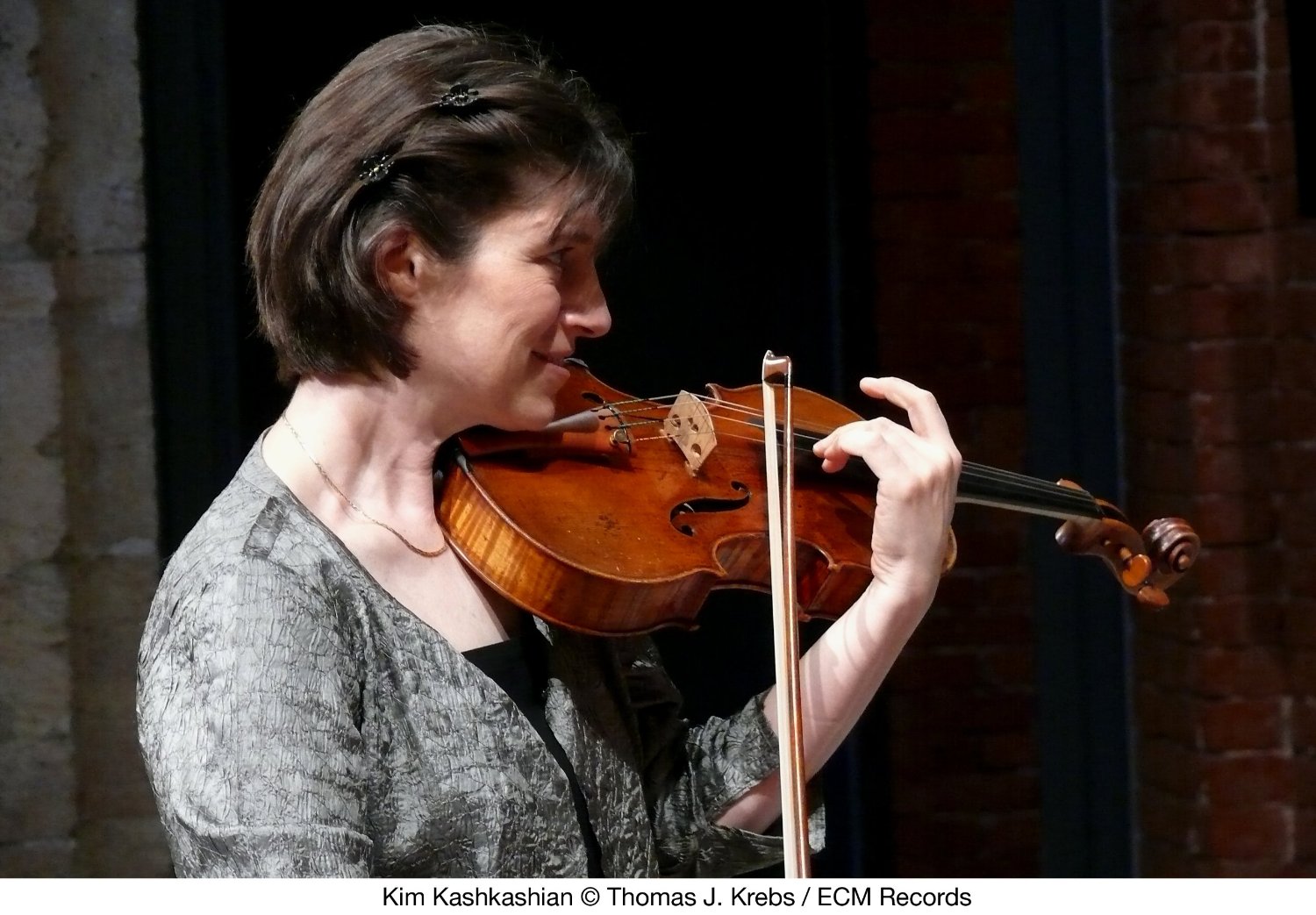
Kashkashian

Kurtág’s Signs, Games and Messages is an ongoing project begun in 1989. Instigated by the composer’s usual insistence on note integrity, these pieces divide like cells in a colony toward a body that will likely never walk upright. It is, rather, content to slither and percolate into mental corners both dark and delightful. Though characterized as a master miniaturist, Kurtág is more the scientist whose microscopy reveals terrains not audible to the naked ear without intervention of ink and staves. Bound to an honest, exploratory spirit, Kurtág charms in the purest sense of the word, combining thought and action through a system of articulation that is only magnified by Kashkashian’s dynamic readings thereof.

An introductory “In Nomine” widens the scope of possibilities from the earliest stirrings. It slides and swivels like a Rubik’s cube without a solution but which finds language hidden in every manipulation. The pieces that follow don’t so much have beginnings and endings as they do openings and closings. This gives them a three-dimensionality, forged at the intersection of an inner space the musician might enter, an outer space from which she might shut herself away, and a sense of time that meshes the two. Details emerge in literary fashion—which is to say, by the scrawl of a writer’s instrument. The most frenetic passages swirl behind closed eyes, manifesting in their destined form before emerging on the open page. The notion of the solo performer as one who interacts as much with herself as with the music finds itself multiply confirmed by a tactility that only Kashkashian can bring to her instrument. Even at points of least resistance, she remains aware of the skin at hand, scars and all.

That Kurtág and Ligeti were lifelong friends may not be so obvious based on their compositional output alone, but through this recording one may locate an affinity that goes beyond the mere juxtaposition of their works. For while Ligeti’s masterful Sonata for viola solo (1991-1994) would seem a more constructed organism, its veins guide a likeminded bloodstream between inhale and exhale. The opening “Hora lungă,” modeled after a traditional lament, is played exclusively on the viola’s C string. Kashkashian deftly handles the timbral subtleties required to bring it to life. She bends notes at the cusp of their chromatic defaults, warping them like the convex surface tension of a fully filled glass. After the candle’s flicker that is “Loop,” the ashen “Facsar” revisits the psychological vessel in which the sonata began, only now with the addition of double stop harmonies and thus a feeling of ceremonial craftsmanship. The fourth movement, marked “Prestissimo con sordino,” is an energetic afterimage, but also preludes the fifth movement, a “Lamento” that works muscles of mystery in the finish before the final “Chaconne chromatique” parts the darkness to reveal a lantern’s glow. Though tense and sinuous, it feeds its own melancholy by taking a step forward to contain the shadows.

This album’s earning of a Grammy Award for Best Classical Instrumental Solo is proof enough of the wonders of its performance, program, and production. But neither award nor accolade can express Kashkashian’s embodied art better than the recording itself. It’s a truth that comes out only in the listening, so that even these words, as I write them, turn to smoke in the firelight of experiencing it for yourself.

(To hear samples of Music for Viola, click here.)

The Gurdjieff Folk Instruments Ensemble: Music of Georges I. Gurdjieff (ECM 2236)

GFIE

The Gurdjieff Folk Instruments Ensemble
Music of Georges I. Gurdjieff

Emmanuel Hovhannisyan duduk
Avag Margaryan blul
Armen Ayvazyan kamancha
Aram Nikoghosyan oud
Levon Torosyan oud
Meri Vardanyan kanon
Vladimir Papikyan santur
Davit Avagyan tar
Mesrop Khalatyan dap, dhol
Armen Yeganyan saz
Reza Nesimi tombak
Harutyun Chkolyan duduk
Tigran Karapetyan duduk
Artur Atoyan dam duduk
Levon Eskenian director
Recorded November and December 2008 at Teryan Studio, Public Radio of Armenia, Yerevan
Recording producer: Levon Eskenian
Engineers: Armen Yeganyan and Khatchig Khatchadourian
Mastered by ECM at MSM Studio, Munich
Album produced by Manfred Eicher

The music of esoteric spiritual teacher G. I. Gurdjieff has been a lucid, if sporadic, touchstone of ECM set lists since Sacred Hymns, released in 1980. Keith Jarrett’s solo album was an appropriate place to begin such an association, as Gurdjieff’s inner melodies were made available to the outer world through the piano transcriptions of his student, Russian composer Thomas de Hartmann. Music was an integral part of Gurdjieff’s teachings, and much of his oeuvre of over 300 pieces came from a place unknown. The energy of his melodies molded the skeleton of its own sacred geometry, and to have an entire ensemble of musicians dedicating their musical lives to casting its patterns across the oceans is a gift, pure and simple.

On a mission of his own to nuance this romantic vision is Levon Eskenian, whose program draws from Gurdjieff’s experiences in lands where the instruments of this ensemble would have been heard in context, singing of the earth even while soaring above it. Eskenian and his talented musicians thus shine Gurdjieff’s light through the prism of the traditions he would have encountered as an itinerant (anti-)ascetic. There is an unmitigated sensibility at work in their extraction of the Armenian, Greek, Arabic, Kurdish, Assyrian, and Caucasian sources Eskenian heard echoing in Gurdjieff’s music. At last, we can experience them in interlocking contrast.

Four pieces link to cellist Anja Lechner and pianist Vassilis Tsabropoulos’s Chants, Hymns and Dances, the 2004 album which took Gurdjieff as starting point for improvisational pathways. Excepting the brightly inflected “Bayaty,” the present versions put the Armenian double-reed duduk at the center of the picture. The “Chant from a Holy Book” places three duduk alongside a single oud. Structured as a tagh, or Armenian sacred song, its cantabile enchantment opens the program at dusk. In comparison to the previously recorded reading, this one suspends itself, rendering the oud a current of wind beneath feathers. “Duduki” adds to this instrumental configuration the dap, or Persian frame drum. With such flexible tension in tow, the melody coheres by way of a mournful finality, even as it extends back toward infancy. Four duduk and one dap form the evocative palette of “Assyrian Women Mourners,” which is as cleansing as it is heart-wrenching.

Some tunes ply the trade of ancient dances. Two selections from Gurdjieff’s Asian Songs and Rhythms explore the ensemble’s percussive capabilities to the fullest. Combining Armenian motifs and spontaneous creation, they allow insight into the meta-level of it all: We can hear Eskenian hearing Gurdjieff hearing something in the world. Others, like the “Caucasian Dance,” draw from a rainbowed palette, relaying ecstatic flights and contemplative landings. Elsewhere, as in the “Sayyid Chant and Dance No. 10,” amalgamations of Greek, Sephardic, and Andalusian influences abound. In these compressions, the receiving body becomes a sheet of paper folded until its resistance as a single molecule can no longer be doubled.

The most transformative moments are reserved for the Kurdish tunes: a “Shepherd Melody,” played on instruments used by shepherds, and the “Atarnakh, Kurd Song,” which traverses continents in single bounds yet with a quiet dignity that feels as effortless as a cloud. At the heart of all this stands a “Prayer” played solo on the kanon zither. By its sounding a nameless portal opens, through which the hesitation of spiritual experience flees into the darkest corners of the mind.

In the album’s booklet, composer Tigran Mansurian describes a silence at the core of this music. Indeed, it moves to what Gurdjieff called the “swing of thought,” that unquantifiable rhythm by which flesh and spirit dance their eternal dance. These sounds are shadows of those movements, and in them is the key to a door, behind which glows the solace of another key.

(To hear samples of Music of Georges I. Gurdjieff, click here.)

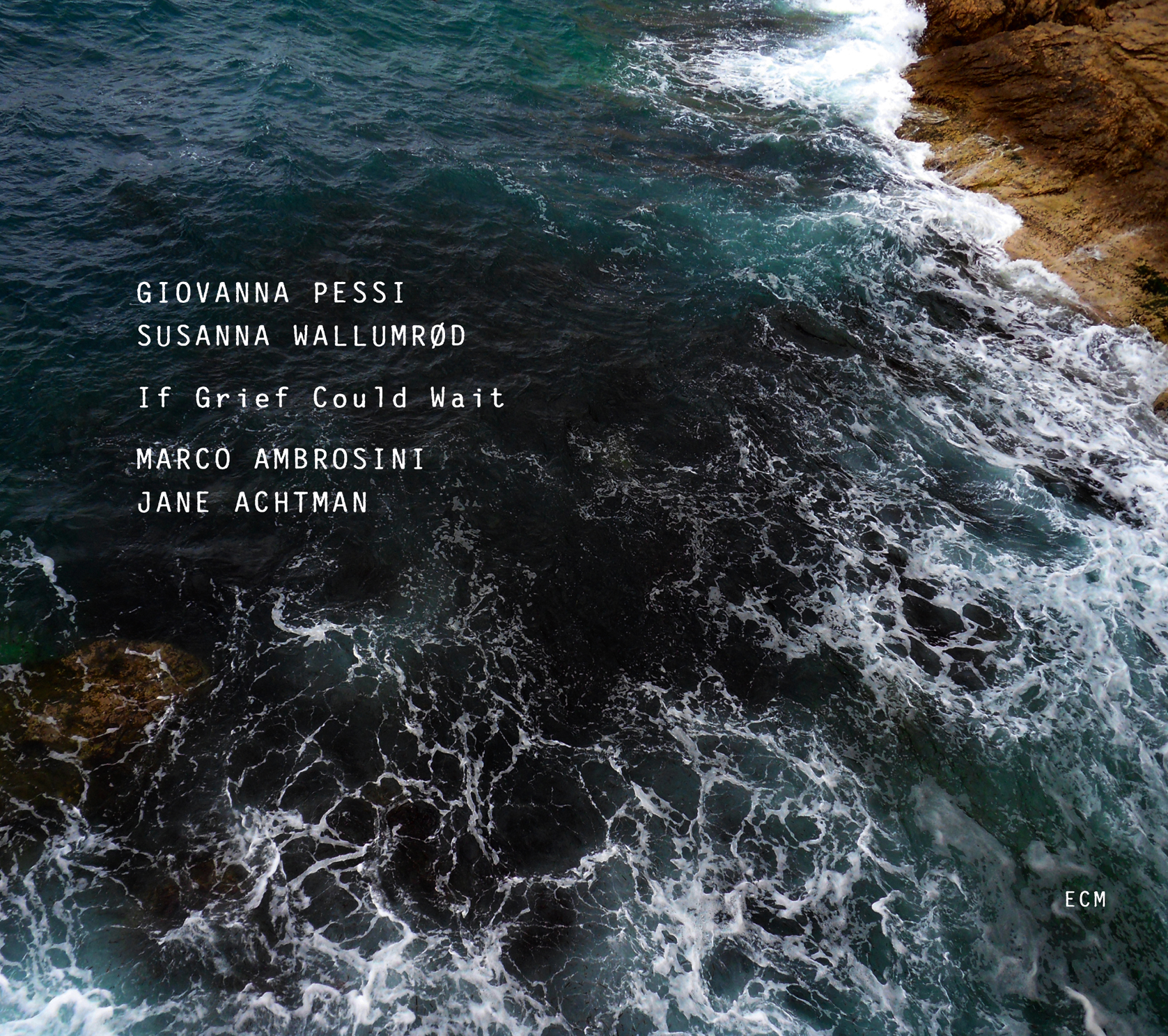
Giovanna Pessi/Susanna Wallumrød: If Grief Could Wait (ECM 2226)

If Grief Could Wait

Giovanna Pessi
Susanna Wallumrød
If Grief Could Wait

Giovanna Pessi baroque harp
Susanna Wallumrød voice
Jane Achtman viola da gamba
Marco Ambrosini nyckelharpa
Recorded November 2010, Auditorio Radiotelevisione svizzera, Lugano
Engineer: Stefano Amerio
Produced by Manfred Eicher

Music for a while
Shall all your cares beguile…

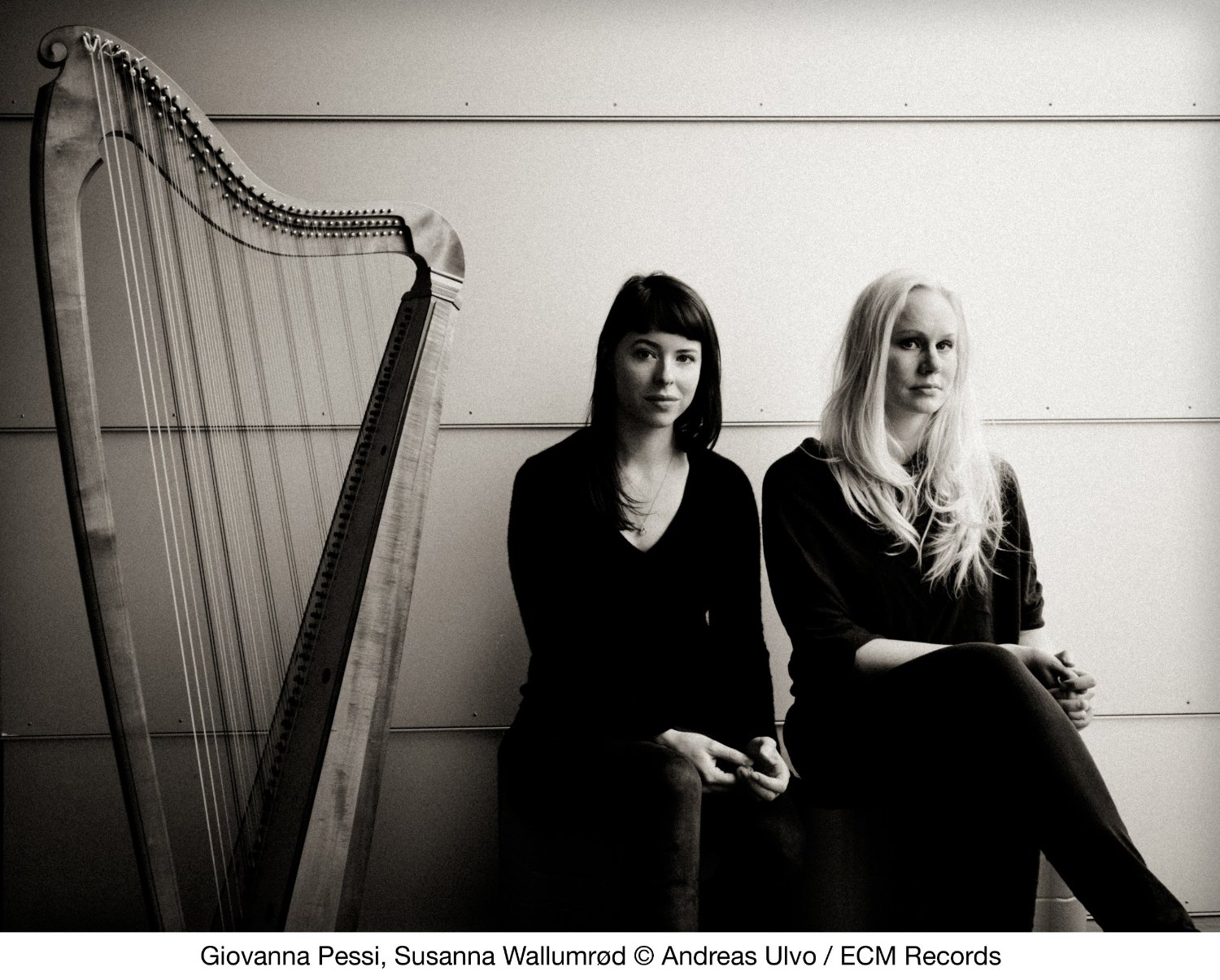
Harpist Giovanna Pessi and vocalist Susanna Wallumrød join forces with Jane Achtman on viola da gamba and Marco Ambrosini on the nyckelharpa (Swedish keyed fiddle). The songs of Henry Purcell (1659-1695), Leonard Cohen (80 years old at the time of this review), Nick Drake (1948-1974), and Wallumrød herself are subjects of this unforgettable disc. Drawing on the early music assemblage to which she so artfully contributed in Rolf Lislevand’s Diminuito, but also the genre-breaking experiments of Christian Wallumrød (through whom she met the pianist’s younger sister, Susanna), Pessi describes without words as much as Wallumrød with. Together, they open rear doors into vintage houses, rummaging through dust-covered artifacts until the spirit of each becomes obvious. Only then do they press RECORD.

Portrait of Grief

Among the Purcell selections are references to his opera The Fairy-Queen (“The Plaint”), his incidental The Theater of Music (“If Grief Has Any Pow’r To Kill” and “O Solitude”) and Oedipus (“Music For A While”), and the anthemic Harmonia Sacra (“An Evening Hymn”). Through all of these runs a plaintive thread from which is hung ornaments that sound as spontaneous as they do plucked from the pond of antiquity in which they originated. Despite exploring the most resilient themes of song—death and love—their enchantment feels fresh by virtue of Stefano Amerio’s engineering, which cuts the harp’s glitter with shadow and spikes pools in forest glades with melancholy.

Of Cohen’s craft, which might seem unlikely company were it not for the similarly forested landscapes, we encounter two examples. Pessi and Wallumrød expand “Who By Fire” from its two-and-a-half-minute appearance on the 1974 album New Skin for the Old Ceremony—incidentally, a suitable descriptor for the present album’s reworking of the past—to a four-minute prayer (Cohen, too, tended to play the song for longer durations in live settings). The song’s morbid list of deaths, barely removed from its religious roots in the Unetanneh Tokef of Jewish liturgy, cuts an especially intimate silhouette. “You Know Who I Am” reaches back further to Cohen’s second album, Songs from a Room, released in 1969. Its poetry embraces a rare combination of vulnerability and fortitude that glistens as it beckons and turns the planets like elements of a larger-than-life mobile. All the more so for being so lovingly recreated here.

It is through such passion that Wallumrød the singer can be superseded only by Wallumrød the composer. Her rustic “The Forester” travels diagonally across fairy realms. Like an Arthur Rackham illustration come to life, it takes shape in leaves and brambles, flowing dresses and birdlike bodies. Her refrain of “Who are you?” explores curiosities of interaction much akin to Cohen’s. “Hangout,” too, reveals a songwriter keenly aware of spaces in which nature comes down like a mist and descends on those who breathe it in, so that they might exhale a language of dissolution.

Finally, Drake’s “Which Will,” off the tragically short-lived singer’s final album, Pink Moon (1972), is the flipside to “Who By Fire.” Its agile, seeking lyricism yearns for love in brighter places. As with the smattering of Purcell instrumentals that rounds out this disc, it cages dancing airs and sunrises within the cold hands of experience.

If Grief Could Wait is a must-have for fans of John Potter’s Dowland Project, and for those who appreciate the art of song, magnified.

(To hear samples of If Grief Could Wait, click here.)

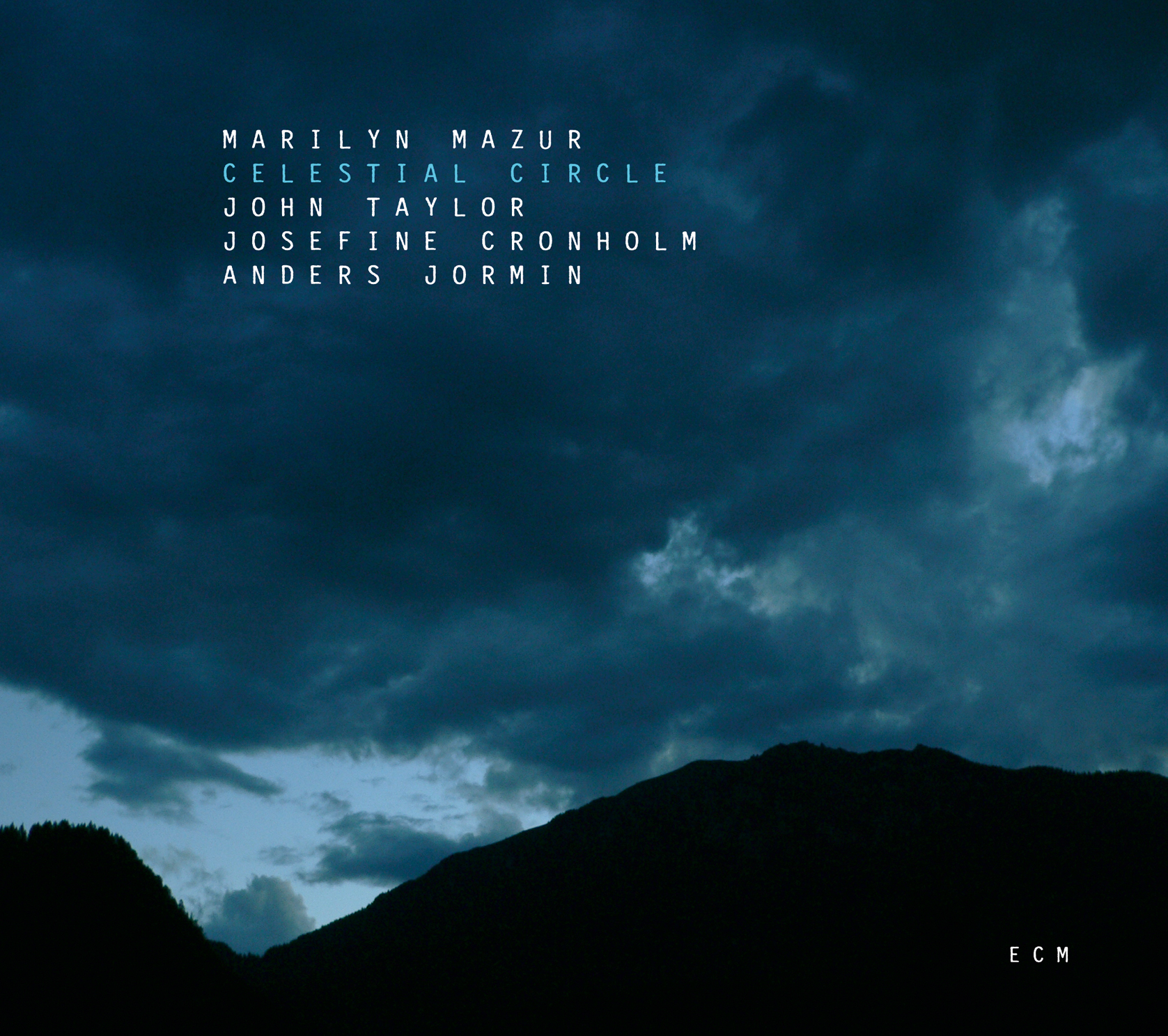
Marilyn Mazur: Celestial Circle (ECM 2228)

Celestial Circle

Marilyn Mazur
Celestial Circle

Marilyn Mazur drums, percussion, voice
John Taylor piano
Josefine Cronholm voice
Anders Jormin double-bass
Recorded December 2010 at Rainbow Studio, Oslo
Engineer: Jan Erik Kongshaug
Produced by Manfred Eicher

Under the guidance of percussionist Marilyn Mazur, Celestial Circle cinches a wealth of continental influences by resonances and rivers. The group is trio-plus, with pianist John Taylor and bassist Anders Jormin forming the core unit and Swedish jazz vocalist Josefine Cronholm pouring her magic at selective intervals. Of the latter, “Your Eyes” (with words by Cronholm and music by Taylor) and the Mazur original “Antilope Arabesque” feature straight-from-the-heart singing and cinematic atmospheres. Both paint acres of forest, through which Jormin dances and Mazur adds characteristic splashes as she plays among, around, and through her bandmates. Confirming the arboreal theme, “Among The Trees” (another Mazur original) imagines a landscape of swans and sunlight. Wordless vocals linger here and there, stretching canvas for Taylor’s brushwork in “Temple Chorus,” cradling the ritual punctuations of “Drumrite,” and scatting delicately across the propulsive “Kildevaeld.”

In addition to its sparkling variety, the music on Celestial Circle dives headlong into the subtle art of evocation. “Winterspell,” with words and music again by Mazur, casts its painterly nets via Taylor’s snowfall and Mazur’s icicles before Cronholm articulates a single word. Here the trio breaks free for a spell of its own before ending in sun-kissed freeze. Mazur sews the seams at every turn. Whether duetting with Taylor in “Secret Crystals” or with Jormin in the flowing “Oceanique,” or even doing nothing more than caressing a gong by her lonesome in “Transcending,” she wields every instrument like a palette, to which invites the listener to add any hues that may come.

(To hear samples of Celestial Circle, click here.)

Arianna Savall & Petter Udland Johansen: Hirundo Maris (ECM New Series 2227)

Hirundo Maris

Arianna Savall
Petter Udland Johansen
Hirundo Maris – Chants du Sud et du Nord

Arianna Savall voice, gothic harp, Italian triple harp
Petter Udland Johansen voice, hardingfele, mandolin
Sveinung Lilleheier guitar, dobro, voice
Miquel Àngel Cordero double-bass, voice
David Mayoral percussion, voice
Recorded January 2011 at Propstei St. Gerold
Engineer: Markus Heiland
Produced by Manfred Eicher

I fell in love by night, by moonlight beguiled.
If ever again I fall in love, let it be in the broad light of day.

Hirundo Maris is a landmark achievement on at least two counts. First, it literally marks land on either side of the North Seas, the currents of which linked Vikings, Catalans, Scots, and Sephardic Jews by lines of exploration and cultural exchange. Second, it spotlights the voice of Arianna Savall in ways that so recall her mother, Montserrat Figueras, with especial affection. Savall in fact dedicates this album to Figueras’s memory, to the “voice that sang to me and accompanied me from my very first heartbeat.” It’s a poignant undercurrent that might easily slip by the digital downloader without a CD booklet in hand, but one that imbues this sometimes-surprising bouquet of song with that much more generosity.

Fronting a seamless “jam band” aesthetic, the core duo of Savall (also a masterful harpist) and Petter Udland Johansen (singer, fiddler, mandolin player) elicits a seamless mash-up of early music and folk influences. In the latter vein, Johansen offers traditional songs from the tundra. With spotlight thrown on his lyrical voice, he helms their passage with troubadourian intuition. A handful of Norwegian examples boasts the consummate balladry of an unconsummated love in “Om kvelden” (In the Evening) and the dancing strains of “Ormen Lange” (The Long Serpent), which details the building of a great ship by the same name (a mood and image paralleled in Johansen’s bare rendition of the Scottish folk song “The Water Is Wide”). Other notables flower beneath overcast skies. There’s the sad tale of Bendik, who loves the king’s daughter, Årolilja, and is ordered to be killed when he is found out. In this song, Johansen’s ashen fiddling gives way to piercing, constellatory light as he trades verses with Savall in a complementary atmosphere. There’s also the “Trollmors vuggesang” (Mother Troll’s Lullaby), a Swedish children’s song by Margit Holmberg (1912-1989), in which the protagonist sings nonsense syllables to her eleven little trolls.

Throughout the program, these two gorgeous voices are joined by guitarist Sveinung Lilleheier, bassist Miquel Àngel Cordero, and percussionist David Mayoral, whose presence is felt in evocations from the mainland. Five traditional Catalan tunes highlight the syllogistic “El mestre” (The Schoolmaster), the liltingly harmonized “Josep i Maria” (Joseph and Mary), and artisanship of “El mariner” (The Sailor). The latter tells of a maid who sits embroidering by the sea. When she runs out of silk, a sailor lures her aboard with promises of more. He sings her to sleep. She awakes, only to discover he is the son of England’s king and means to marry her. With its synthetic ocean waves and tactile harping, it is the album’s most evocative song. Also evocative is the “Tarantela” by 17th-century Spanish harpist Lucas Ruiz de Ribayaz. The crispness of Savall’s rendition only emphasizes its lustrous antiquity.

Savall’s craftwork comes into greater focus in her original tune “Le Chant des étoiles,” which joins her harp in a sparkling instrumental of plucks and plumes. Johansen also contributes an original: the enchanting “Penselstrøk” (Brushstroke). “The dream is lost in a moment of joy,” he sings, “and for you it could be the last.” And with those words, he cloaks the sun in dusk. The collection rounds out with three Sephardic traditionals, including “Buenas noches” (Sweet Nights), which shines with steel-string inflections, and “Morena me llaman” (Dark One, They Call Me), another song of ship and sail. This genre favorite receives a downtrodden treatment here, replete with sparse instrumental reflections throughout.

Although this very special album bears the subtitle “Songs from the South and North,” by its end one feels the futility of mortal instruments to gauge directions across time. It is, instead, a chronicle not of geographies per se but of the transitions between them.

(To hear samples of Hirundo Maris, click here.)

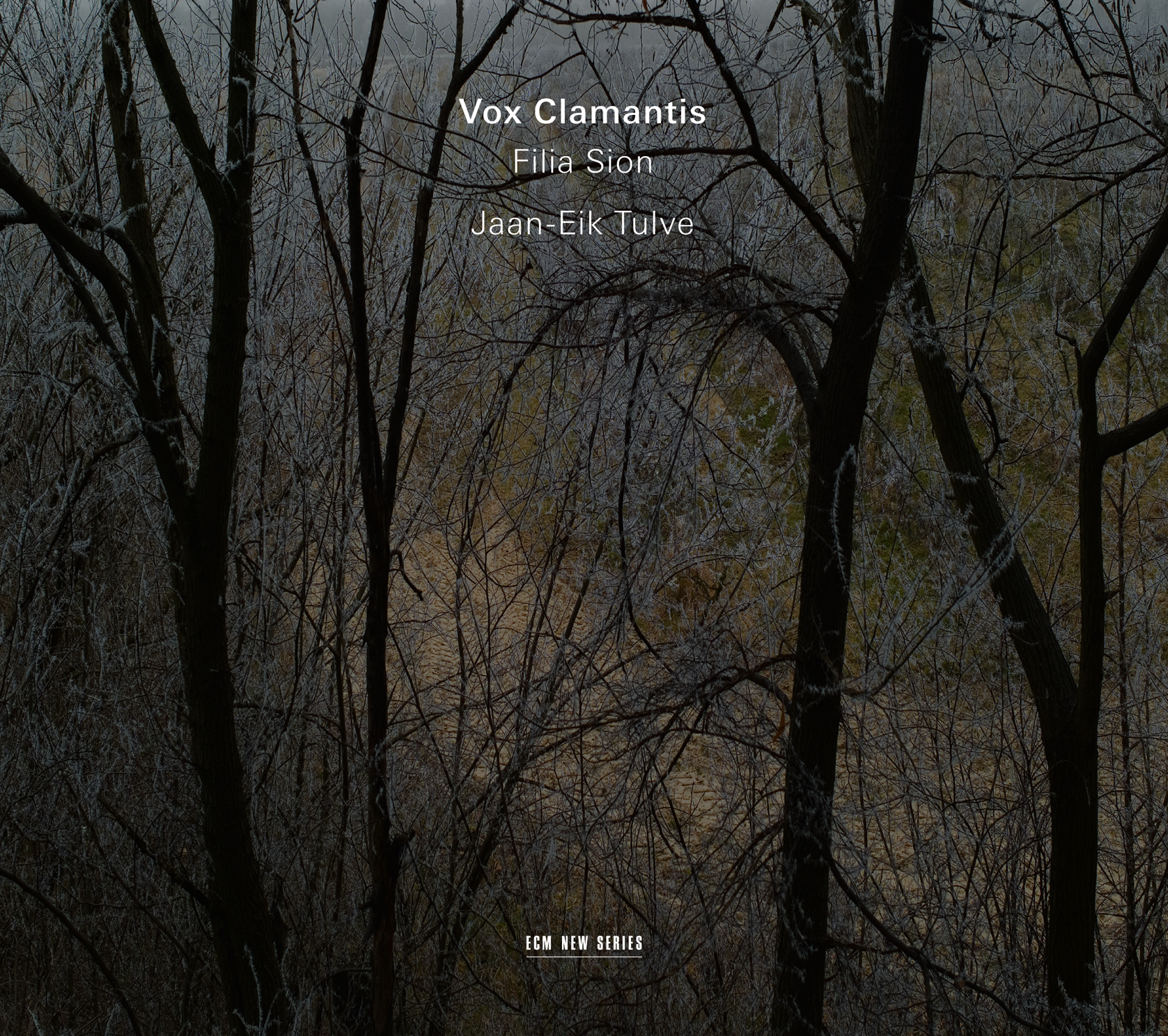
Vox Clamantis: Filia Sion (ECM New Series 2244)

Filia Sion

Vox Clamantis
Filia Sion

Vox Clamantis
Jaan-Eik Tulve conductor
Recorded September 2010, Dome Church of St. Nicholas, Haapsalu
Engineer: Igor Kirkwood
Editing: Margo Kõlar
Recording supervision: Helena Tulve
Executive producer: Manfred Eicher

O wisest Virgin,
where art thou going in this deepest red of dawn?

Estonian vocal ensemble Vox Clamantis shares its passion for Gregorian chant in an album dedicated to the Daughter of Zion. Directed by Jaan-Eik Tulve (husband of composer Helena), who sees precise blending as the foundation for purposeful singing, Vox Clamantis adds subtlest gold leafing to the program’s Marian repertoire. Remarkable in this regard is the use of overtone singing, an unlikely technique begotten through the spirit of improvisation during rehearsal. It is employed to glorious effect in two 12th-century pieces by Magister Perotinus and Hildegard von Bingen. As the twin hearts of the album, they shine with the depth of conception, mysterious and divine.

Polyphonous textures are only occasional throughout the program, appearing noticeably in the “Rex virginum,” which comes from the 13th-century Codex Las Huelgas of Spain. Cycling between two-part harmonies and plainchant, its timbral cast magnifies sanctity with sanctity. The motet “O Maria”—from another codex (from Montpellier) of the same period—gilds kindred geometry, while the tenors of “Prelustri elucentia” (by Petrus Wilhelmi de Grudencz, c1400-c1480) bind linearly, like the ligament of a spiritual body. The album’s final piece, a Jewish chant from Cochin entitled “Ma navu,” comes as a revelation that flows from chest to sky through c(h)ords of light.

Most of the album is rooted in plainsong, and few ensembles extol its unifying force with the grace of Vox Clamantis. The thickness of the monophonic pieces, and these performances of them, is such that polyphony would seem an overwhelming embellishment. Rather than muddy the waters, the singers clarify them, moving antiphonally between solo and tutti passages. Each chant feels torn from a book of shadows, so that it might be inscribed with light. This record comes long after a wave of chant albums that flooded the New Age market in the mid- to late 1990s. Unlike those transients, the present disc is set fully in its proper context. Its heartfelt prayer is for circularity: ashes to ashes, voice to voice.

The people of the nations that lay in darkness
rise up at the joy of so renowned a birth.

Eleni Karaindrou: Concert in Athens (ECM New Series 2220)

Concert in Athens

Eleni Karaindrou
Concert in Athens

Eleni Karaindrou piano
Kim Kashkashian viola
Jan Garbarek tenor saxophone
Vangelis Christopoulos oboe
Camerata Orchestra Alexandros Myrat conductor
Concert production: The Athens Concert Hall
Recorded live November 19, 2010 at Megaron Hall (Hall of the Friends of Music), Athens
Recording engineer: Nikos Espialidis
Editing/assistants: Bobby Blazoudakis, Peter DePian, Alex Aretaios, and George Mathioudakis
Mixed and edited March 2012 by Manfred Eicher and Nikos Espialidis
Produced by Manfred Eicher

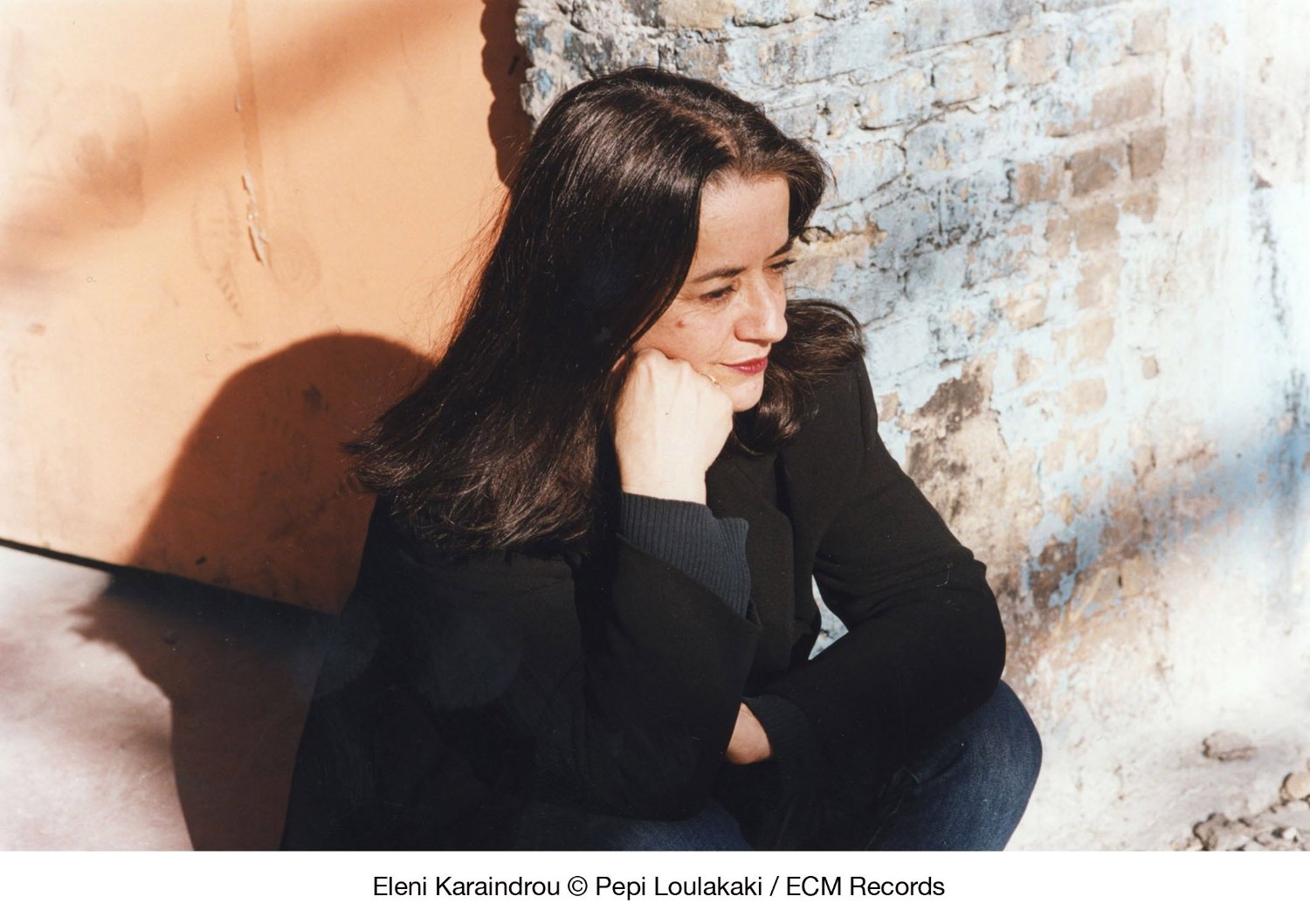
Eleni Karaindrou’s 10th album for ECM frames the self-taught Greek composer as the subject of worthy tribute in a second live conspectus for the label. Five years have passed since the recording of Elegy of the Uprooting, also captured at Megaron Hall in Athens, and the depth of her soundings has only intensified in that period. While that former performance made obvious her intimate working relationship with late filmmaker Theo Angelopoulos by way of a large projection screen at stage rear, here the music is its own actor. Differences between the two programs are striking, with emphasis now on Karaindrou’s incidental music for theatre. Directions also play out in the featured soloists: violist Kim Kashkashian and saxophonist Jan Garbarek. Kashkashian was instrumental—in the most literal sense—in exposing international listeners to Karaindrou’s sound on the highly successful Ulysses’ Gaze . Like that perennial soundtrack, Concert in Athens is a way station on her distinctive compositional path. Garbarek makes for an equally fine companion, his salted tone tessellating every motif it embraces.

Eleni

Garbarek oversees the most brooding portions of the concert, which opens and closes with his flute-like tenoring in “Requiem for Willy Loman” and its variation. This piece, from Death of a Salesman, suspends its mournful souls like laundry without bodies to wrap. It’s a tender circle, within which further theatrical connections abound. Whether unlocking dramatic awakenings in “Invocation” (Who’s Afraid of Virginia Woolf) or matching the sway of windblown branch in “Tom’s Theme” (The Glass Menagerie), Garbarek holds these melodies to be self-evident. The same is true for the consummate “Adagio for Saxophone,” the inward spiral of which traces the album’s endearing highlight.

Kashkashian, for her part, sails closer to the coast, skirting the rim of darkness beyond the lighthouse’s purview. The strings reveal her singing patina in “Closed Roads” as if it were a jewel clasped in silver. With just a sweep of her bow, she evokes a tug of war between flesh and horizon that finds resolution only in the “Dance” from Ulysses’ Gaze. As an agent of memory, she emotes without mitigation, standing out even among the trio settings of “Laura’s Waltz” (with orchestral accompaniment) and “After Memory” (without). The latter’s braiding with Garbarek and oboist Vangelis Christopoulos is another of the performance’s focal points.

Karaindrou herself sits at the piano, laying the groundwork for much of the activity surrounding these themes. Her solo from Eternity and a Day comes second in the program, a hinge for every door thereafter. Other cinematic intersections include Landscape in the Mist and Dust of Time. In these, tension becomes an organic material, a bed of soil as ocean. On that note, there is a textuality to both this music and its sources that finds confirmation in four pieces inspired by M. Karagatsis’s novel Number Ten. Of these, “Waltz of Rain” unfolds most nostalgically, affirming yet again why Karaindrou’s oeuvre is as enduring as the relics of her homeland.

(To hear samples of Concert in Athens, click here.)

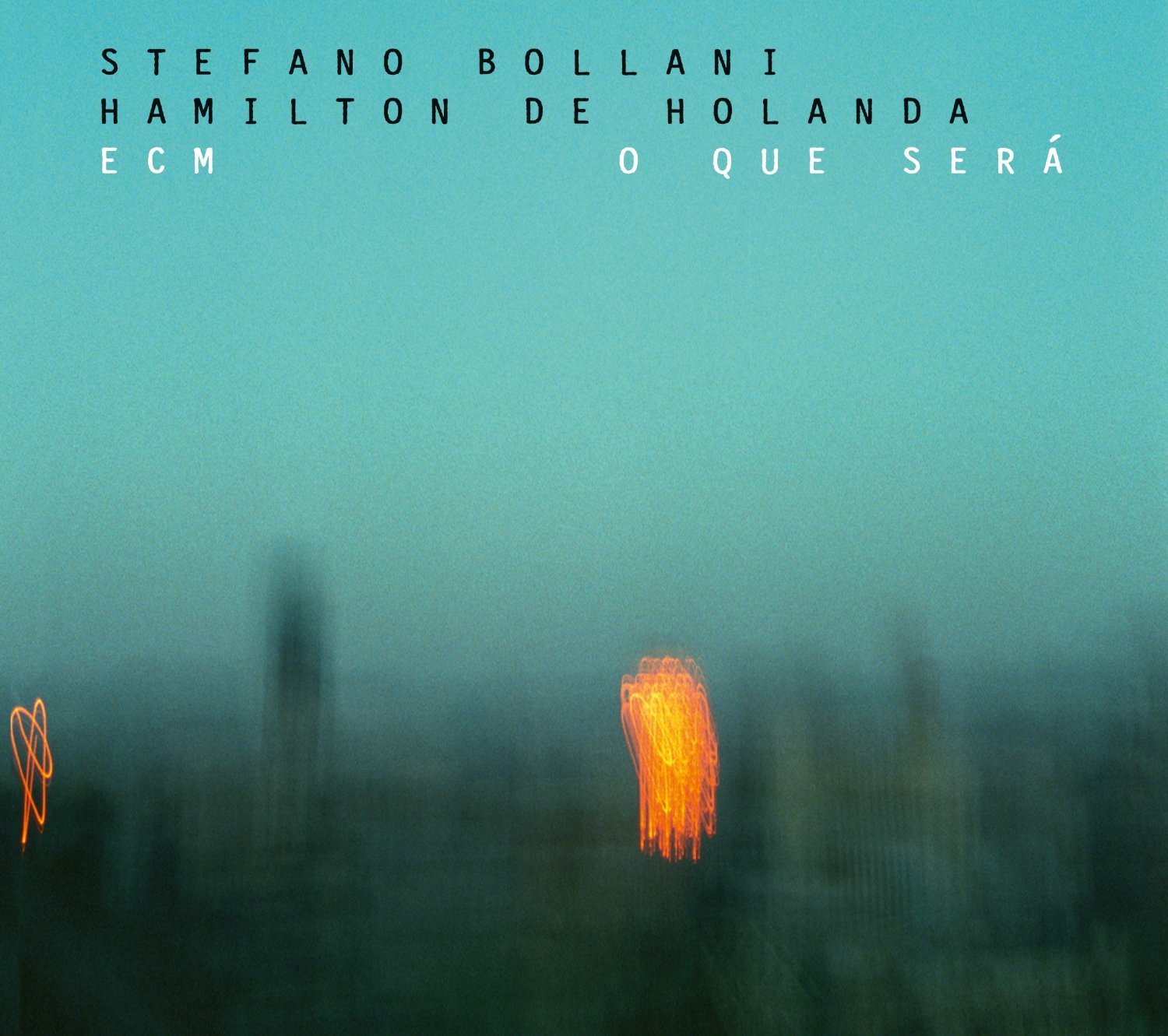
Stefano Bollani/Hamilton de Holanda: O que será (ECM 2332)

O que será

Stefano Bollani
Hamilton de Holanda
O que será

Stefano Bollani piano
Hamilton de Holanda bandolim
Recorded live August 17, 2012 at Jazz Middelheim, Antwerp by VRT-Vlaamse Radio en Televisie
Engineers: Walter de Niel and Johan Favoreel
Mixed at Rainbow Studio, Oslo by Jan Erik Kongshaug, Roberto Lioli, and Stefano Bollani
Album produced by Manfred Eicher

Since first sharing a stage together at a 2009 music festival in northern Italy, Italian pianist Stefano Bollani and Brazilian bandolim (10-string mandolin) maestro Hamilton de Holanda have met frequently as a duo. In this, their first full live album, they expand their commitment to beauteous improvisation in an electric atmosphere bound by faith in the moment. While not such a surprise in terms of programming—Bollani has, after all, extolled his passion for Brazilian music on Orvieto, and elsewhere—the album sparkles with ingenuity.

Bollani and de Holanda

In his pointillist fervor, Bollani has an obvious affinity for Chick Corea and Scott Joplin, while de Holanda’s playing dovetails Django Reinhardt and Egberto Gismonti at their best. These are a mere few of the many influences one might read into the notecraft of these consummate virtuosos, to say nothing of the great composers whose timeless melodies fly from their fingers. That said, the verdant, sparkling relays of Bollani’s “Il barbone di Siviglia” and the crystalline wanderings of de Holanda’s “Caprichos de Espanha” hold their own alongside classics from Astor Piazzolla (“Oblivión”), Antonio Carlos Jobim (“Luiza”), and Pixinguinha (“Rosa”). In their capable hands, such timeworns are fresh as summer while the originals feel like folk songs torn from the pages of a shared past. Across the board, de Holanda’s picking is restless but never overbearing. Bollani in the meantime emotes assuredly, caressingly, and all with a smile like the setting sun.

Two tracks of strikingly different character epitomize the duo at its most attuned. De Holanda dominates the ins and outs of “Guarda che luna” (Gualtiero Malgoni/Bruno Pallesi), in which his impassioned singing inspires cheers and laughter from the audience. A memorable relay as he switches to muted comping beneath Bollani’s flights of fancy adds oomph to their pristine musicality. Even more engaging is “Canto de Ossanha” (Baden Powell/Vinicius de Moraes), which becomes a rhythmic master class in controlled tension. The feeling of progression here is so vivid, it’s practically uncontainable. And yet, contain it the musicians do by means of their joyful, flared unity.

A smattering of lyrical tunes rounds out the set. Between the lush, balladic opener “Beatriz” (Edu Lobo, Chico Buarque) and the vivacious “Apanhei-te Cavaquinho” (Ernesto Nazareth) that closes, Bollani and de Holanda become increasingly more like each other, reflections of anticipation and follow-through. Like the title track (also by Buarque), their enchantment comes about in the exuberances for which no score has a means of notation. Rarely has a duo been this exciting, and results of this fortuitous encounter rank easily among ECM’s top 10 for the new millennium.

(To hear samples of O que será, click here.)


Reto Bieri: Contrechant (ECM New Series 2209)

Contrechant

Reto Bieri
Contrechant
Music for clarinet solo

Reto Bieri clarinet
Recorded September 2010, Propstei St. Gerold
Engineer: Peter Laenger
Produced by Manfred Eicher

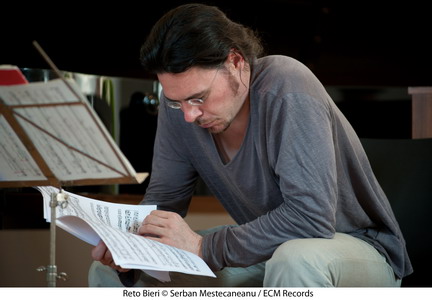
Within the ECM New Series sub-catalogue of solo recordings, the label debut of Reto Bieri stands out for impeccable selection and technical prowess. The Swiss clarinetist studied at Basel’s Academy of Music and at the Juilliard School before embarking on a solo career in collaboration with new and established composers alike, and the fruits of those efforts are bursting from their skins on Contrechant. Luciano Berio is the only featured composer with whom Bieri did not work in preparing for this album, and his 1983 Lied opens the program with its cantabile, legato phrasings. Aside from establishing something of a theme (in his liner text, Paul Griffiths notes among these pieces an affinity for song), the meticulousness of Bieri’s approach to the instrument sets a precedent for mood and timing. At his fingertips—each a hand unto itself—the deceptive simplicity of Berio’s spatial grammar feels omnipresent.

Likewise omnipresent are the grammars of Salvatore Sciarrino and Heinz Holliger. Both composers make illustrative use of multiphonics and formidable extended playing. The former’s 1982 Let me die before I wake reveals a matrix of overtones so rich that the addition of any other instrument would be an intrusion. Its artisan quality seems to plane away its own surface until underlying patterns are revealed. The album’s title piece comes from Holliger. Composed in 2007, it strikes a characteristic balance between darkness and whimsy. Each vignette therein is a window both into itself and into the whole. Across a range of transcendent voicings, it steps through a spectral door in the five-minute epilogue. Holliger’s Rechant (2008) bears dedication to the late Swiss clarinetist Thomas Friedli, with whom Bieri briefly studied. Despite its kindred telemetry of action and reaction, of interpretation and extrapolation, a lighter footprint makes it a song of more internal measures.

Bieri

The title of Elliott Carter’s Gra means “to play” in Polish and was written in 1993 to commemorate Witold Lutosławski’s 80th birthday. With its leaping figures and exacting breath control, it is a virtuosic feast, to be sure. Beyond that, its youthful pilot light flickers with verve. Péter Eötvös’s Derwischtanz (1993/2001), on the other hand, travels upward rather than inward, shuffling staircases before falling like an autumn leaf with no purpose but to decay. The latter piece pairs well with Lightshadow-trembling (1993) by Gergely Vajda, a student of Eötvös whose embodiment of title feels like a narrative too restless to contain.

This is, in the end, what connects all of the above: an uncontainable feeling to be experienced.

(To hear samples of Contrechant, click here.)