Keith Jarrett: Paris/London – Testament (ECM 2130-32)

Testament

Keith Jarrett
Paris/London – Testament

Keith Jarrett piano
Recorded in concert
November 26, 2008 at Salle Pleyel, Paris
December 1, 2008 at Royal Festival Hall, London
Producer: Keith Jarrett
Engineer: Martin Pearson
Executive producer: Manfred Eicher

“Communication is all. Being is all.”
–Keith Jarrett

Since the release of his endlessly influential live record The Köln Concert, Keith Jarrett has done more than any other at the keyboard to clarify improvisation’s infinite shape. When basking in the music that pours from his fingertips, it’s easy to wax poetically from one’s armchair about the effortless brilliance with which he seems to play. Yet Jarrett wants us to know that the process is not all intuition, for often—as is true of the concerts documented here—the physical and emotional challenges are intense, unrelenting. In his liner notes, he lays out the taxing nature of his efforts, saying, “It is NOT natural to sit at a piano, bring no material, clear your mind completely of musical ideas, and play something that is of lasting value and brand new.” He further mentions that the role of the audience has always been of the “utmost chemical importance” and is more apt to change the dynamics of the performance than any technical concerns, such as those that permeate the lore of Köln. Whether it’s a concert hall, a microphone, or the ether itself, every adlib needs an ear.

On November 26, 2008, Jarrett put this theory into practice when he took the stage at Salle Pleyel in Paris for the first of two ad hoc solo concerts. Although a noticeably bipolar performance, it also draws many intersections of contact between extremes. Over a glorious 70 minutes of music in eight parts, Jarrett works an asana of fixation and letting go and touches hand to heart in sporadic gestures of deference. Like water set to boil but which is turned down at the last moment, it skirts the edge of conversion from liquid to gas. At some moments Jarrett’s spontaneous motifs funnel into a single dream of flight, realized in his unbridled feeling for thermals that only he can see. Such depth is palpable in Parts III and VIII, both of which make sweeping peace of untapped wisdom, now opened like a book to reveal an as-yet-unwritten past. With every shake of the snow globe, Jarrett seeks new patterns. Whether in the mournful procession of Part V or the jazzier syncopations of VI, we can feel a working-through that gnaws the edges of philosophy. The final section synthesizes what came before. At once elegiac and scintillating, it finishes with a deluge of ephemeral signifiers.

The London concert, recorded five days later, is clothed by even more intense variety. One can not only hear but feel the debates raging inside Jarrett, who with Part I renders the rib cage a ladder to radiance and catches an eddying wind in Part II, kicking up leaves and dry soil. In this concert, too, the sheer breadth of Jarrett’s sweep is staggering in a way rarely heard since the early concerts. From Part III to the concluding XII, every step of this journey flirts with optimism, though gnarled eyes mark the wood grain periodically along the way. Gospel progressions infuse spiritual longing with living resolution, fingers digging into every chord like hands into soil, while Parts VII and X vamp across vales of blues. In likeminded vein, Parts IV and VIII hark to the divine tracings of Köln in some of his most unmitigated playing since that fateful performance. Sparkling and transcendent, they cascade over themselves in a constant rebirthing process. This is what lies at the heart of his craft: a total oneness with the elements. It’s like discovering the inner workings of a clock you once believed ran on magic, only to realize that in those gears lies the deeper magic of the ingenuity that set them running.

No such program would be complete without some jazzier flashpoints, and these we get in Parts VI and XI, both of which feel like ballads lost from the American Songbook that have wandered into view after a long redemption. Though haggard, they convey perseverance through their melodies. Close to elegies but ultimately wishes fulfilled, they touch with a caress that feels like mountains and sky.

Most impressive about the Paris and London concerts is their scope. Jarrett’s hands wander independently of one another while also keeping at least an artery pulsing between them. Jarrett knows the piano like he knows his own voice; for him they are one and the same. He does not surrender to what he creates, for surrender implies an advantage of which to be taken. The beauty of it all is that one need listen only once to live off the memory for a lifetime.

(To hear samples of Paris/London – Testament, click here.)
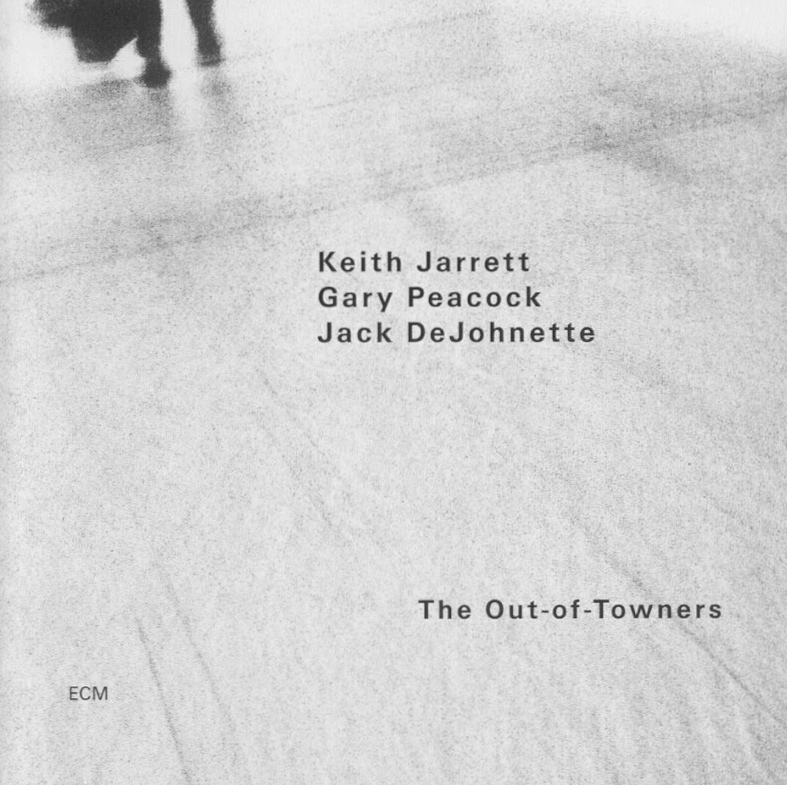
Keith Jarrett Trio: The Out-of-Towners (ECM 1900)

The Out-of-Towners

Keith Jarrett Trio
The Out-of-Towners

Keith Jarrett piano
Gary Peacock double-bass
Jack DeJohnette drums
Recorded live July 28, 2001 at State Opera, Munich
Engineer: Martin Pearson
Mastering: Morten Lund, Masterhuset
Produced by Manfred Eicher

With the insight of legitimate hypnotists, Keith Jarrett and his trio regress seven tunes with a flair for the unexpected. Recorded live at Munich’s State Opera in July of 2001, an especially productive year for the band, the performance whispers into life with a piano intro before waxing nostalgic in a sunny rendition of “I Can’t Believe That You’re In Love With Me.” Jarrett, of course, shines at every turn, but his phenomenal rhythm section has rarely sounded more luminescent. Light in their step and playful in their virtuosity, Jarrett’s sidemen exude effortlessness. Peacock is worth singling out in this opening tune, in which he departs from his usual twang in favor of a smoother, subtler extroversion. He reverts to his tried and true in a rendition of “You’ve Changed” that turns to melted butter in the trio’s hands. With Jarrett’s delicate anchorage behind him, the bassist picks away at edifice of the song’s confusion to a core of resolve. Jarrett pours on the honey for the rejoinder, DeJohnette all the while brushing like the wings of a dying insect, swishing to the rhythm of a broken heart. Brushes turn to cymbals in an effervescent take on Cole Porter’s “I Love You,” which finds the drummer running a parallel course of emotional freedom alongside Jarrett. Artful solos abound.

The freely improvised title cut is a gem. Over its 20-minute vamp, the trio plays with such looseness that it can only cohere by sheer depth of listening. Peacock is the conductor of this epic train, DeJohnette adding dynamite charge to the rails throughout the ride. The follow-up is a crystalline “Five Brothers.” This tune by the great Gerry Mulligan is the very definition of smooth. Jarrett’s punch and charisma here exhaust the barriers around his concluding solo, a heart-stilling rendering of “It’s All In The Game.” Thus sworn by sunset, he walks into a darkening horizon, where rests the origins of these gifts, so selflessly given, which like the figures on the album’s cover are almost gone from view the moment we realize they were within us all along.

Beethoven: Complete Music for Piano and Violoncello (ECM New Series 1819/20)

Beethoven Complete Music for Piano and Violoncello

Ludwig van Beethoven
Complete Music for Piano and Violoncello

András Schiff piano
Miklós Perényi violoncello
Recorded December 2001 and August 2002 at Reitstadel Neumarkt
Engineer: Stephan Schellmann
Executive Producer: Manfred Eicher

Before leaving his indelible mark on the interpretive history of Beethoven through his account of the 32 sonatas for ECM, András Schiff posited an evolutionary affinity between that pantheon of piano literature and the sonatas for piano and cello. Smaller in scope yet bursting with ideas, these pieces pose just as many challenges to any who dare swim in their waters. As an artist of such high yet sensitive caliber, Schiff needed a most able ally with whom to run the gamut of this treasure store. There could be only one answer to that call: cellist (and fellow Budapestian) Miklós Perényi, who brightens the torch of his prodigy via these chamber masterworks with panache and smooth execution.

The program moves in generally chronological order, beginning with the Sonata No. 1, Beethoven’s Opus 5. The two Opus 5 sonatas were written in Berlin in 1796, the result of an association with Friedrich Wilhelm II, a fine cellist in his own right. Both sonatas mark a genetic shift not only in Beethoven’s evolution as a composer, but also in that of the chamber sonata, which in the past treated the featured instrument as a satellite. And yet, while Schiff concedes that the Opus 5 sonatas do indeed weigh in the piano’s favor, he and Perényi play with such balance—the cellist lending especial robustness to the supporting chords—that one would hardly know this without a score at hand.

The complaisant key of F Major imbues the opening measures with sanctity, opening the floor for a harmonious conversation. The foreshadowing is palpable: something is going to give. The pianism realizes these tensions in cascading arpeggios, each the garment of something restless, pure. The seamlessness is such that we needn’t even know the names of these musicians. They become something else entirely: not one with the music but musically one. Take, for instance, the central Allegro, which tents the sonata with effervescent keyboarding and hands the cellist a heavy shovel with which to dig. That an instrument of four strings can hold its own alongside one with 230 is a feat in and of itself. The pianism is exquisite here and indicates a playfulness in the early Beethoven that would translate into the cantilevering architecture of the later works. The concluding Rondo fully realizes the restlessness implied in the opening movement, weighing rocks against piles of feathers. Beethoven’s brilliance, even at this stage, is that he doesn’t give in to the temptation of treating the final movement as an endpoint or culmination of all that came before. It is, rather, its own entity with idiosyncratic hopes and dreams. These and more are borne out in the denouement, which shuffles Apollonian and Dionysian motives in a series of what in his liner notes Martin Meyer calls “surprising displacements of the entries.” These render the anticipatory nature of the sonata as something far beyond the purview of catch and release.

The inaugural Adagio of the Sonata No. 2 in G minor leaves greater room for interpretation than its counterpart in the No. 1. More floral than faunal, it nevertheless bounces its way through another gargantuan middle passage before emerging onto a Rondo of filigreed delight.

Also composed in 1796 are the Variations in G Major on “See the conqu’ring hero comes” from Handel’s oratorio Judas Maccabaeus. Beethoven would not have had chance to hear the oratorio live at the time, and so engaged with this theme by proxy of suggestion. The music is buoyant, typically classical in style yet also speckled with shadows by way of its intakes, leaving one scrambling to indulge in the decorative. As Meyer so eloquently puts it, “The constructive impetuosity minimizes any lingering over ‘beautiful’ passages or ideas; the virtuosic beginnings become displaced at the end by an unprecedentedly compact presentness, with the prospect of an uncertain art of the future.”

The Opus 17 “Horn Sonata” (1800) takes on a distinct arc of its own. That this sonata was originally composed for piano and Waldhorn (hunting horn) and later revised for the combination presented here is perhaps obvious only in the opening Allegro, the impulses of which function as building blocks for all that follows. Its themes burrow underground in a brief Adagio toward the fullness of the conclusion, which leaves us with a structure of integrity and, in its own way, poise.

From clarion to clean, we are treated to two further sets of variations—the 12 variations on “Ein Mädchen oder Weibchen” in F Major, op. 66 and the seven on “Bei Männern, welche Liebe fühlen” in E-flat Major, WoO 46—drawn from Mozart’s The Magic Flute. The former’s polite dance steps contrast artfully with the latter’s sluggish beginnings and sweeping uptake.

Although the Sonata in A Major, op. 69 selectively draws from its predecessors, the thinking put forth by its introduction is progressive and elicits the deepest anticipations in the program thus far. It is, in effect, a sonata unto itself. This is followed by the only Scherzo in the collection, a wonderful hiccup that stretches the sonata to four distinct sections. The golden Adagio is as pious as it is brief, while the final Allegro—tentatively and first but then with resplendence—runs in joyful, secular circles. This sonata is a highlight of the record: for its compression, for its focus, for its spirit.

The two Opus 102 sonatas date to 1815. The first, in C Major, is another compact affair. Not only is it the shortest (its total running time falls just shy of the Adagio of the Sonata No. 1), but it is also the most varied. A tender back and forth builds a core of mutual dependence. The second, in D Major, also crosses tightly engineered bridges. The jaggedness of the outer movements cradles, unscathed, a robust Adagio that practically cries for the gentle fugue that photosynthesizes into the final Allegro.

Although sure to become a benchmark, these renditions may not necessarily replace those of Richter and Rostropovich, but they do make suitable companions. Their forward motion is intriguing: there is little breathing room. In Beethoven’s hands the piano-cello combination slips into a “Zen” sort of oneness between medium and message. That the listener can feel that unity so nakedly is perhaps the greatest accomplishment of this album. Accordingly, it begs deep, undistracted listening.

In his own liner notes, Schiff admits that playing these works in sequence is like surveying Beethoven’s entire biography. Elsewhere, cellist Steven Isserlis has expressed similar feelings toward the cycle, saying, “[I]t is a journey through a life.” To this narrative Schiff and Perényi add a salient point: not only did Beethoven have an extraordinary life, but so too did his music, and forever will so long as ardent interpreters like these walk the earth in his shadow.

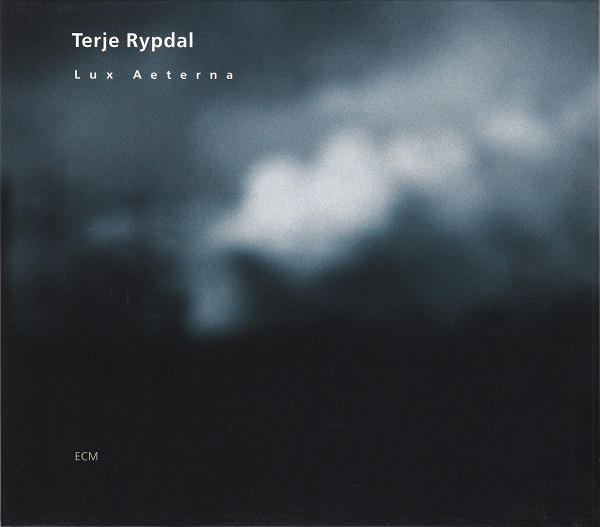
Terje Rypdal: Lux Aeterna (ECM 1818)

Lux Aeterna

Terje Rypdal
Lux Aeterna

Terje Rypdal guitar
Palle Mikkelborg trumpet
Iver Kleive church organ
Åshild Stubø Gundersen soprano
Bergen Chamber Ensemble
Kjell Seim conductor
Recorded live July 19, 2000 at Molde Domkirke
Recording engineer: Jan Erik Kongshaug
Album produced by Manfred Eicher

Regarding the modern Lux Aeterna (Eternal light), György Ligeti’s setting of the Latin text comes foremost to mind. Made famous by way of Stanley Kubrick’s 2001: A Space Odyssey (incidentally, my first exposure to Ligeti’s music), it did, of course, through that association take on cosmic aspects that may or may not have been originally intended. Although Ligeti was an earlier influence on Norwegian guitarist-composer Terje Rypdal’s take recorded here, the latter’s mapping processes are as distant as the faintest star. It is a setting in the truest sense, nesting one vocal movement among four others in a large-scale work that defies idiomatic description.

The first movement, subtitled “Luminous Galaxy,” is a serenade to the universe. Rypdal’s epic arranging skills and attention to color clear the sky of all pollution and distraction, leaving a naked belt, a cleft in the chin of darkness. The strings of the Bergen Chamber Ensemble (under the direction of Kjell Seim) reach heavenward even as their intentions burrow into the soil, spreading fingers and toes in pursuit of a shared, nameless goal. A celeste adds handfuls of stardust to the palette. Palle Mikkelborg then takes to the stage, almost startling in his surety. Warmed by the horse-haired fire around him, his echo-processed trumpet describes a vaulted architecture, of which windows and doors are galaxies unto themselves. The dialogic relationship established here at the outset encompasses so much space that the bulk of existence seems within reach. Swaying key changes mimic the flapping of a dress in the wind, the swirl of Jupiter’s eye, the quiet circumscription of Saturn’s rings. Through it all, the light of many suns coalesces in planetary alignment. And then, another entrance as a church organ (played by Iver Kleive) throws all satellite transmissions into paroxysms of static with its volcanic breath. It looses a subterranean call, rumbling more than singing, and bows in a gesture so luminous that only the pitch of night can contain it.

Rypdal explains the meaning behind “Fjelldåpen” (Baptized by the mountains): “For some reason now forgotten I wanted to teach my parents a lesson. I was 9 or 10 years old. I found a track used by sheep—very steep—and climbed the mountain fast. Once on top for a while I felt a very special connection to the mountain (and still do). At first I felt quite brave, but then a forceful wind started to scare me. And this feeling I’ve tried to capture in the second movement—you can hear when the wind is coming.” Rypdal goes on to say that he came down from the mountain to find that nobody had missed him: the world had gone on turning without him. The profundity of this realization at such a young age—the knowledge that one may be nothing more than an arbitrary arrangement of dark matter—is captured achingly in the composer’s lonely electric guitar as it leaves a trail of fuel to the mountain’s apex. Only when he surveys his achievement does he hold his axe to the sunset and light that trail with its fire. And as the world goes up in flames and licks the sky with its profound indifference, Rypdal shreds, balancing his trademark melodic lasers with the mercury of their fragmentation. His feet lift from the peak and float him beyond the clouds.

Hence the third movement, “Escalator.” Here the strings flow unlike earthly water, moving from land to mountain: a return to origins. Mikkelborg makes a subtle return. Spilling from a caesura in the very firmament, the trumpet liquefies and returns to a solid state in the musician’s hands, already itching with muscle memory to coat the landscape with elliptical grammar.

The fourth movement, “Toccata,” is an interlude for organ that twists the frame until all beings expire as they are, leaving only ruins behind. There, beneath tattered banners and dilapidated thrones, before the corpses of servants and skeleton-inhabited armor, a wordless sermon emerges with the force of a jumping spider. Distant flutes sing the praises of an idyllic age, when maidens and warriors needed no excuse to weep for love. This luxury of beauty plays out tearfully in the windowless corridor of this most titanic of instruments.

The titular movement ends the work with the voice of soprano Åshild Stubø Gundersen, introduced in points of contact and unison with electric guitar. Gundersen is captivating in her fallible tone, whereby she reveals the imperfections that make outer space such a ageless vessel for fascination. The difference between media blurs over time, so that Rypdal and the singer emote on almost exactly the same wavelength. The relationship between throat and pick feels entirely organic, less a shift between than a transfusion from one sonic entity to another. The organ sustains a drone and drops single notes like the signal tones in Close Encounters of the Third Kind—only here, the answer comes from within, from the trumpet (the messenger of peace), from the very rhythms of the heart by which all things cohere and expand. Descending chords—a recurring motif in Rypdal’s classically minded outings—leave their footprints clearly in mind. Thus spent, the densest matter spins into diffusion, leaving only the core theme intact, billiard-struck toward a black hole, silent and waiting.

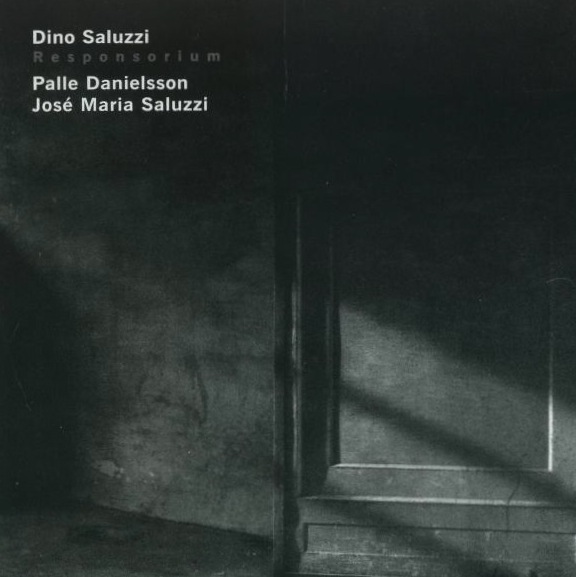
Saluzzi/Danielsson/Saluzzi: Responsorium (ECM 1816)

Responsorium

Responsorium

Dino Saluzzi bandoneon
Palle Danielsson double-bass
José Maria Saluzzi acoustic guitar
Recorded November 2001 at Rainbow Studio, Oslo
Engineer: Jan Erik Kongshaug
Produced by Manfred Eicher

Responsorium is for all intents and purposes a companion album to 1997’s Cité de la Musique. The kinship is suggested not only in the instrumentation (bandoneón, double bass, acoustic guitar), but also by the similar composition of cover art, in which angled sunlight pours through glass and gives warm indications of a world beyond. Joined again by son José Maria, and replacing Marc Johnson with Palle Danielsson on upright, Dino opens the set with a dedication to his brother and fellow bandoneonista Celso (who can be heard on Mojotoro). The rhythmic impulse is uniquely his own and shines in every unexpected turn of phrase. “Mónica” treads even deeper into the forest, leaving a trail of crumbs for the hungry. It, too, feels like a dedication, perhaps to a child, and treats the bandoneón as a body from which to emanate virtue. Bass and guitar carry that virtue through mountains and valleys, leaving traces in every river it crosses. On the subject of crosses, “Responso por la muerte de Cruz” bows its head in reverence to the divine in the human, if not also the human in the divine. José Maria’s steady fingers take on most of the emotional load. His sensitivity arches over Danielsson’s low stitching with forlorn comfort.

The album gets its first boost in “Dele…, Don!!” The spirit of the tango is alive and well in this configuration. One might even hear the feet hitting the floor were it not for the sheer delicacy of the playing, for it is in its ability to float massive traditions in but an inch of water that the trio’s brilliance shines. Each player thus brings a unique stamp to the record. Whether it’s Danielsson’s shadowy punctuation (“Cuchara”), José Maria’s pliant voicing (“Reprise: Los hijos de Fierro”—note also his effortless soloing in “La pequeña historia de…!”), or Dino’s narrative ingenuity (“Vienen del sur los recuerdos”), there’s plenty to admire and re-admire in the spokes of this melodic wheel. And indeed, in the end, as the credits roll languidly across the screen of “Pampeana ‘Mapu,’” those unaccompanied bellows have more to say than an entire orchestra, able as they are to forge a choir of themselves. What they lack in speech they make up for in song, and with that song comes the drizzle of a force so genuine that it might just go on singing forever. There’s only one way to find out: listen.

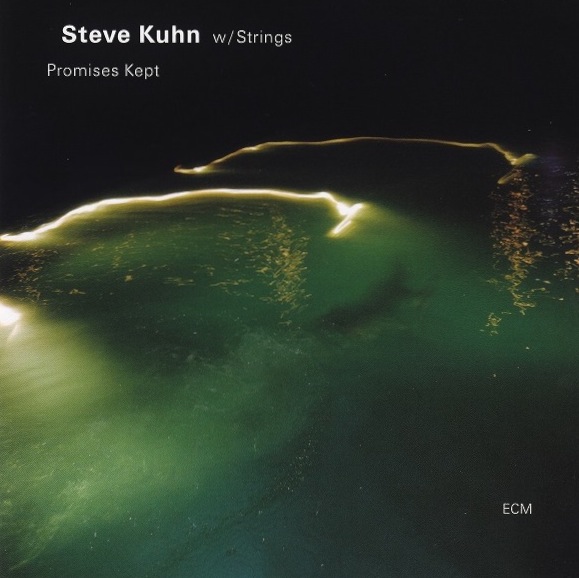
Steve Kuhn: Promises Kept (ECM 1815)

Promises Kept

Steve Kuhn
Promises Kept

Steve Kuhn piano
Krista Bennion Feeney, Elizabeth Lim-Dutton, Richard Sortomme, Karl Kawahara, Barry Finclair, Helen Kim, Robert Shaw, Carol Pool, Anca Nicolau violins
Sue Pray, Vince Lionti, Karen Ritscher violas
Stephanie Cummins, Richard Locker, Joshua Gordon celli
Carlos Franzetti conductor
David Finck bass
Recorded June and September 2002 at Edison Studios, New York
Recording engineer: Gary Chester
Assistant: Yvonne Yedibalian
Remix and mastering by Jan Erik Kongshaug and Manfred Eicher at Rainbow Studio, Oslo
Recording producer: Arthur Moorhead

Promises Kept is something of a watershed moment in the career of pianist Steve Kuhn, who sees the album as the fulfillment of a lifelong wish. Kuhn has always been known for possessing a keen ear for sonority, but here that trait is expanded by the string ensemble—with arrangements by Argentine composer Carlos Franzetti—into which he christens his steadfastly original vessels. Because at Kuhn’s fingertips the piano acts more like an orchestra, the appearance of strings feels less like an addition and more like an audible manifestation of what his playing already holds dear.

Connections to classic ECM sessions abound, including Remembering Tomorrow, Motility, and Playground. Yet their reconstitution here feels like an involution rather than an evolution. This is by no means a bad thing; it lends insight. The pianism of “Lullaby” is thus melodically fortuitous and ushers in the assembly as if by a benevolent emperor’s hand—which is to say, with robust yet gentle authority. “Life’s Backward Glance” is the quintessential Kuhn tune, a touchstone of the pianist’s repertoire making here its fifth label appearance. The piece’s inner sanctum is water-colored one beam at a time in hues of cello and double basses. It welcomes Kuhn at its center as the sun to a planetary system, forming through quiet fission a divine connective tissue across space and time. This tells the story of his relationship to music perhaps better than any other.

“Trance” references the 1975 album of the same name. Whereas in that version the theme seemed almost to leap from a dream fully formed, here the eyes open slowly after a farther-reaching intro from strings and carry in their reflective surfaces most of the music’s weight in strings hammered, not bowed. Another vital moment in Kuhn’s compositional development, it showcases his lyric sensibilities—as does the album as a whole—without kitsch, sugar, or sap. We do, however, get a sprinkle of “Morning Dew” to whet our appetite for natural wonder. This newer tune spreads its sparkle as widely as the wind floats pollen. Its companion is the title track, a memorial to Kuhn’s parents that heaves with a palpable mixture of mourning and gratitude, and faithfully traces the undulating trajectory of grief.

As if the preceding weren’t contemplative enough, “Adagio” clears the slate and writes love letters to Introspection with a capital “I.” In this self-imagining, Kuhn speaks his craft into being through wordless language. Likewise, “Celtic Princess” communicates in images and impressions. The painterly feeling is as light as the touch of brush on gesso. The keyboard’s array of colors lends believability to the emerging scene. And just when the sheer magnitude of this beauty has grown unwieldy, “Nostalgia” enlivens the proceedings in its own unusual way. It wanders with no other purpose than to wonder, to appreciate the privilege of putting feet to dirt, to swim the “Oceans In The Sky” that follow with whispers and propelling strokes. The winds of change are as powerfully represented here as they are quelled in the concluding “Pastorale.” If the album’s initial stirrings were an awakening, let this be the promise of slumber kept, for it is only in the embrace of a dream that Kuhn’s sound-world reaches fullest vibrancy.

The end effect is one of jazz under a magnifying glass, given shape through the beauty of close attention in both the playing and the listening.

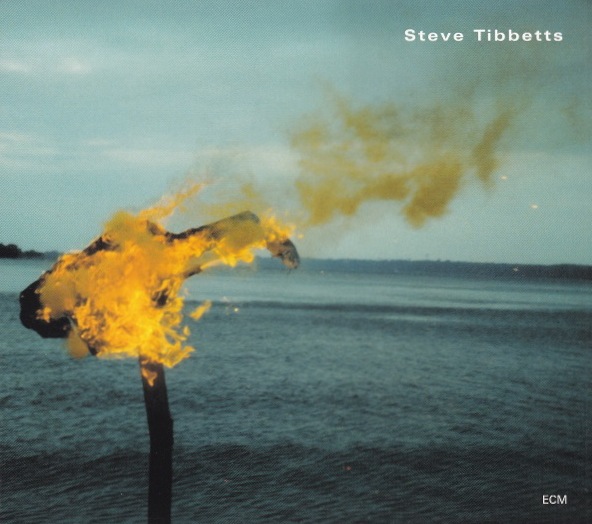
Steve Tibbetts: A Man About A Horse (ECM 1814)

A Man About A Horse

Steve Tibbetts
A Man About A Horse

Steve Tibbetts guitars, percussion
Marc Anderson percussion
Marcus Wise percussion
Jim Anton bass
Recorded 2001 in St. Paul, Minnesota
Produced by Manfred Eicher

Eight years separate 1993’s The Fall Of Us All and A Man About A Horse, during which time Steve Tibbetts met with an accident that required him to have surgery on his right hand. Before the procedure, the story goes, the reclusive Minnesotan laid down all the guitar parts for A Man About A Horse in his home studio, thus leaving a skeleton as solid as his was uncertain. This apocryphal information matters little, however, once “Lupra” reaches its hands, zombie-like, from the soil. The tap of tabla and twang of acoustic guitar engage in intimate conversation, seeming to diagram hitherto unheard regions of the guitarist’s postmodern terrains. The continental drift of his sound is as tectonically aware as ever: sparkling, sure, and ceremonially poignant like the flames on the album’s cover. This teetering session indeed holds on its kindling shoulders a giant cauldron, in which the listener becomes like the fabled frog, unaware of the lethal heat flowering around him. Spirits beckon from behind the beams of the “Red Temple,” wherein slumber the relics of a nameless saint: the faintest sliver of fingernail, a baby’s-breath of hair…each the element of an alchemy that can only be taught through sound. “Black Temple” magnifies the possibility of transformation by polishing its sole crucible to an ember’s glow. Whether in the earthen percussion or transcendent sustains, echoes of The Fall Of Us All permeate every decorated wall, if in a more contemplative mode.

The ambience intensifies in “Burning Temple,” neither exploding nor imploding but shining like a distant sun in search of a planet. The weight of feet sifting through the crumble leaves tracks and trails, and it is over these Tibbetts and his band trace their peace-bringing hands. The scene is crystal clear, as the title of “Glass Everywhere” would seem to imply. The destruction wrought upon the site is internal, and it is along this emotional landscape that the herds of the musicians’ imagination run like the buffalo. The search for reasons continues, forever one step behind the answers. But there is no charity anywhere in the world to mend the damage done. Rather, the music itself becomes the mechanism by which this assemblage coheres into offering. By now, the heat has become so strong that our little frog legs can no longer kick for all the shock. The raw becomes the cooked: a point of no return.

A way out reveals itself in the twisted metal of “Lochana,” in which an electric guitar cries with all the ache of the prairie. A glass eye in the face of “Chandoha” acts as telescope into the private fears that lurk in the backdrop. The air abounds with fragrance, the guitar a match touched to incense. All of which presses “Koshala” into a diamond of such finality that it’s all Tibbetts can do to keep up with its fluttering heart. The delicacy of tabla and sweeping accents of guitar paint an adobe-hued theory of existence at large. With the very landscape as its brush, it emotes in global self-portraits of light. Here emerges a lone sojourner, one who ranges like the Gunslinger of Stephen King’s Dark Tower, unaware of the tangled web of bodies in which he is destined to be enmeshed. And really, destination is something we can always count on in the Tibbetts experience, for we are there the moment we take our first step.

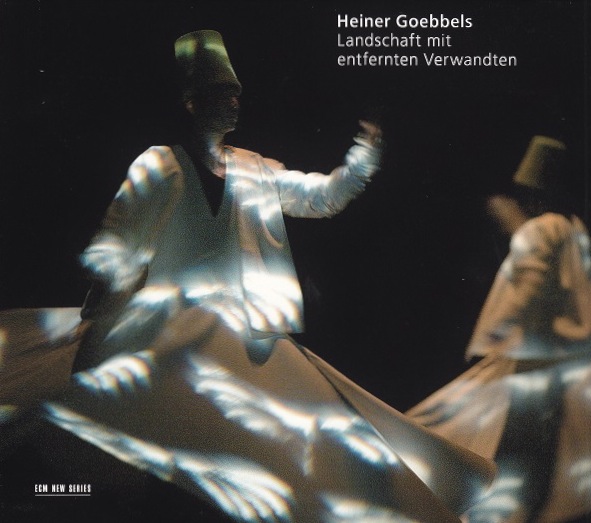
Heiner Goebbels: Landschaft mit entfernten Verwandten (ECM New Series 1811)

Landschaft mit entfernten Verwandten

Heiner Goebbels
Landschaft mit entfernten Verwandten

David Bennent voice
Georg Nigl baritone
Ensemble Modern
Deutscher Kammerchor
Franck Ollu conductor
Recorded live October 2004, Théâtre des Amandiers, Nanterre, Paris
Engineer: Max Federhofer, SWR
Mixed by Max Federhofer and Heiner Goebbels
Executive producer: Manfred Eicher

This recording chronicles the incidental music to Heiner Goebbels’s theatrical juggernaut, Landscape with Different Relatives, a much-lauded work that premiered in 2002. Billed as an opera for soloists, choir, and ensemble with texts by Gertrude Stein, Giordano Bruno, Arthur Chapman, Henri Michaux, T. S. Eliot, Leonardo da Vinci, and Nicolas Poussin, it includes mostly composed material with a mickey of improvisation slipped in. Both modes are taken up with gusto by the Ensemble Modern under the direction of Franck Ollu.

The composer’s polyglot approach to text reveals itself also in the music, which pins a wide-ranging geography of crumbling modernities. Like its librettic assemblage, the listener is eased into the work from the outside in. From above, one sees it divided into two parts. Seemingly disconnected in shape, the first contorts itself around all manner of war machinery while the second sees the body as machine and itemizes the internal workings of that most familiar technology. Closer inspection reveals a kinship between the two halves beyond the grasp of mere words. Both begin with the same introduction, for instance, adding only speech to the second iteration, as if the conscience of the opera’s former half were being revived.

Landschaft
(Promo photo by Oper Frankfurt)

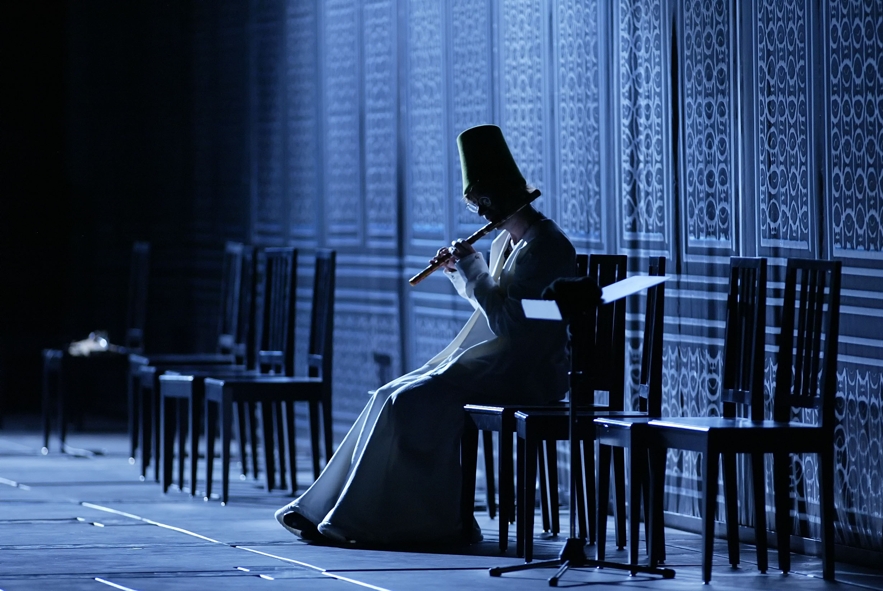
Part One thus inaugurates its concerns without voice. In a bed of organ, flute, and oboe, an electronic beep signals a message waiting to be heard before a wash of light shuttles the listener across narrow waterways into “The Sirens.” Here the vagaries of disgust are re-spun into catalysts, an interweaving of social stereotypes brought home by threats of destruction. Out of this swarm come multiple catharses. Dreamlike and fluid, they imagine procreation in lilting brass and, most notably, in the heavenward flute of “Tanz der Derwische,” one of three centerpieces. Drums and clarinet part the sky to reveal another, a parallel universe where the dead walk as if unscathed as gorgeous improvisations from the clarinetist interact with muted brass. “In the 19th Century” brings science under the lens of its own microscope and questions, as might Foucault, the dangers of expertise. “Triumphal March” is the second centerpiece. An obsessive mélange of lists and figures—and, by extension, of utility and servitude—it builds a monument to interrogation and crushes it to dust. “Schlachtenbeschreibung” is the final centerpiece. It’s title (Battle description) can be said to be the opera’s theme, layering as it does the grids of land and collateral damage that betray any ideological motivations lurking within terror. The playfulness of the instrumental arrangement here suggests a lost art and imbues baritone Georg Nigl with just the agitation he needs to carry off the words. Da Vinci’s pedantry, which guides artists in the depictions of battle scenes, lends a strangely categorical air, adding contrast to the fin de siècle politics that precede it. The ping-ponging of electronic and acoustic beats suggests confusion between the peace and antagonism of “Well Anyway,” which conflates revolution with sustenance, and celebrates the ability to shed tears. “Did It Really Happen?” further addresses the divide between historical revisionism and denial, and pulls the strings of the past clearly into the fray of the present, while “Kehna hi kya” haunts the center with its shrill plucked strings and local flourishes. The latter suggest a cultural archive, packaged and presented to the transient tourist. “Et c’est toujours” (And it is always…) addresses another gap, this between industry and flesh, between art and the earthen origins from which it is produced. It is the twist of a rind in the eye, a squinting of soul into eclipsed sun.

Part Two continues the opera’s marriage of modern and traditional instruments, consolidating many candles into a single flame. As emblematically in the feudalistic satire of “Just Like That,” it plays with minimalism (“Bild der Städte”), bricolage politics (“Krieg der Städte”), travel (“On the Road”), social awkwardness (“And We Said Good Bye”), communication (“On the Radio”), and even delves into a bit of Americana with “Out Where The West Begins,” replete with banjo and wagon procession. This blends into “Train Travelling,” about which the voiceover says, “The irregularity of its regularity is fascinating.” An overarching aesthetic of the opera if ever there was one.

Much of this second half delves deeper into notions of language and category, as in “Ich leugne nicht die Unterscheidung” (I do not deny the distinction), which understands the difference between destruction wrought by hand and by technological intervention, even as it washes both in the same descriptive waters. Such juxtapositions breed nostalgia through lenses of regret and distant complicities. Life takes its path abjectly. The deaths of animals loom as large as those of humans and round the jagged edges of the voices’ autobiographical disguises. Commanding and conquering can occur only where there are speech acts to back them up, and “Different Nations” gives a catalogue of call signs that lend vivid color to the connection between diplomacy and violence. Hence the ultimate arrival of the “Principes,” each a window into the soul that waters ambient soil. This final dronescape hosts only those voices that linger after all the others have expended their welcome. Welcome to their requiem.

Excerpt from the stage production, “Triumphal March”:

Christian Wallumrød Ensemble: Sofienberg Variations (ECM 1809)

Sofienberg Variations

Christian Wallumrød Ensemble
Sofienberg Variations

Christian Wallumrød piano, harmonium
Nils Økland violin, Hardanger fiddle
Arve Henriksen trumpet
Per Oddvar Johansen drums
Trygve Seim tenor saxophone
Recorded October 2001 at Sofienberg Kirke, Oslo
Engineer: Jan Erik Kongshaug
Produced by Manfred Eicher

Pianist Christian Wallumrød surely turned heads—not around in surprise but downward in reflection—with the 1998 release of his ECM debut, No Birch. After passing through the filter of Trygve Seim’s The Source and Different Cikadas in 2002, Wallumrød retained that project’s frontman (who here guests on tenor), held to his trio’s trumpeter, Arve Henriksen, and to them added fiddler Nils Økland and drummer Per Oddvar Johansen. The newly fashioned Christian Wallumrød Ensemble blossoms in an intimate program of composed and improvised material. Named for the Oslo church in which it was recorded, the album’s titular variations thoughtfully capture the spirit of their venue.

“Sarabande Nouvelle” is the touchstone of the program, appearing once as opener and twice more as variation. It bears a worn stamp of melancholy, as if it has been singing for years without sleep. This is precisely how Wallumrød’s music comes to us: wearing a patina. Thus formed, it holds firmly to an emotionally resolute façade even as it struggles to compose itself on the inside. And so, while the combination of horns and rubato swells lends imaginary power to the introduction, it nevertheless speaks of reality as if it were a sibling. That same sense of family lurks within “Memor,” wherein keyboard aligns with space, opening the floor to barest drumming and whispers of brass, reed, and bow. Wallumrød’s pianism is an arrhythmic heart that, through all the disruptions, maintains enough coherence to sustain life for as long as the blood of sound runs through it.

Forest-hued rumblings unearth the portraiture of “Edith.” With rasp of bark and stickiness of sap, it envisions a tree hanging its fruit over a cliff’s edge. Thus suspended, its sustenance finds balance in danger, and in that contradiction a supreme peace. Such is the tension in which the album’s themes incubate. Here the melancholy so easily ascribed to the music begins to blur and, like the cover photograph, kicks its imaging of the world off kilter. Thus skewed, disparity takes on a life of its own. Conversations flit between the silhouettes, coalescing in the alarm of pathos that is “Alas Alert.” This reverie of reveries is a braid of trumpet, air, and metallic signatures. Økland’s bow elicits the tremor, an indication that something in this body is fallible, something in its murmuring worthwhile. Økland adds further shading to “Psalm” and “Liturgia,” one the crossing to the other’s hatching. These decidedly sacred pieces turn memories into sliders on a mixing board of psychological experience that can be tweaked to suit the needs of every crisis. Such inner adaptability is key to understanding the method behind this record, in which there is no promise but only the fulfillment of something unnamed, if not also unnamable. Never before such delicate dissonance. Never such microscopic inference. The most haunting moments, in fact, come from the album’s ticks: a series of “Small Pictures” that surveys abandoned architectures with a ghost hunter’s eye. Ascending and descending motifs walk an Escherian staircase, leaving only a Möbius strip of gray footsteps to show for their having been there.

“Losing Temple” closes the session’s eyes with introspective pianism, with the fiddle again playing a descriptive role. The flute-like trumpeting from Henriksen is astonishing, the osmosis of his step likewise, which treats every wall as a cinematic gateway. This music fades like leaves with the wind that might never have existed to begin with. Their colors linger all the same.

Yet where the album’s spirit becomes clearest is in its handful of variations, which re-spin their referents in slow watercolor bleeds of storytelling. These are not, however, mere refrains, but parallel universes in which the bodies of iterations overlap without the others’ knowledge. Intelligent without being intellectual, it is music that breathes, for we are the lungs to its air.