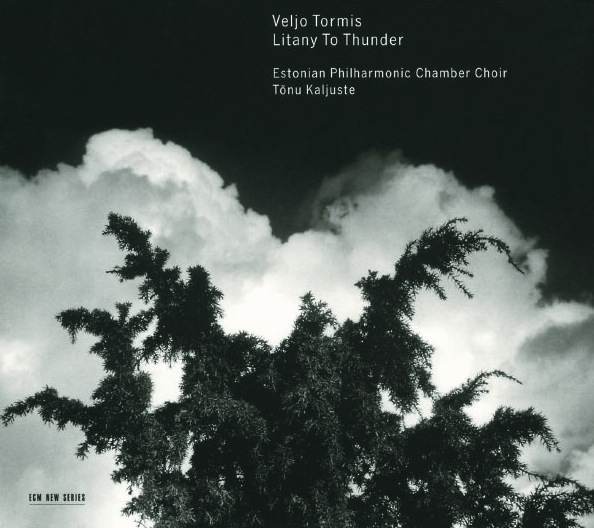
Veljo Tormis: Litany To Thunder (ECM New Series 1687)

Veljo Tormis
Litany To Thunder

Veljo Tormis
Estonian Philharmonic Chamber Choir
Tõnu Kaljuste conductor
Recorded August 1998, Estonian Concert Hall, Tallinn
Engineer: Teije van Geest
Produced by Manfred Eicher

“I do not use folk song. It is folk music that uses me.”
–Veljo Tormis

Since the 1992 release of Forgotten Peoples, the first major survey of Veljo Tormis to be released outside of Russia, ECM has paved an international appreciation of the Estonian composer, whose choral output exceeds 500 pieces. More than number, it is the melodic and textual content of those pieces that asks of the listener attention to source, meaning, and atmosphere. Although so much of Tormis’s work is drawn from Baltic folk traditions, his project is more one of expression than of preservation. He paints a distinct amalgam of texts and motifs, so that what we are left with is a sonic trajectory that moves ever forward. There is no group more qualified to follow that trajectory than the Estonian Philharmonic Chamber Choir. Under the direction of Tõnu Kaljuste, these intensely talented singers breathe the music on Litany To Thunder as if it were their own.

dear girls dear maidens
where shall we go before the night sets in

How Can I Recognize My Home begins the program with a runo-song. This form finds its charge in the pre-Christian beliefs of the Baltic Finnic region, linking stanzas in a two-part round. On the surface a paean to nostalgia, it is more deeply a cartography of origins in which the voice becomes the thread that grows thinner with life and snaps only in death. Between the fatigue of travel and the cold springs that gurgle in wait of parched throats, the moon shines through it all like a maternal eye.

When the boys sang on the ship,
the girls thought it was an organ playing.
They could not imagine that the boys of their village
could sing so well.

Singing Aboard Ship (1983) is an Ingrian-Finnish folk song that features a call-and-response framework welded tight by the contralto of Karin Salumäe. The EPCC’s restraint is in full flower here, lapping at vessel’s edge with the reverence of lips pursed to a holy relic. It is an important setting, for it proves the power of song to be a guiding light through adversity. That the Finnic peoples exiled by the Soviet regime in the wake of World War II managed to preserve this tale is testament to that very fact.

You are earth-born, I am earth-born,
we are both black boil.

The Kalevala-inspired Curse Upon Iron (1972) showcases Tormis’s uncanny ability to soak us in a feeling. With its shamanic drum and tense use of silence, it peers into the heart of elemental forces and further into the human condition, which too often seeks to render those forces into tools of harm. The words reduce iron to its blood, to the evil that is its parasite. They even draw a line of affiliation to modern warfare, to the bane of technology. The furnace becomes a symbol of hatred fueled by temptation. Tenor Mati Turi and bass Allan Vurma bellow its fires, sustaining themselves through (if not on) sirens and shrieks of indignation.

And I, the child, then learned and learned,
I, little one, picked up the words.

In the wake of this aural forge, The Singer’s Childhood (1966) emerges as one of the most ethereal choral compositions to ever grace the ear. It is not only that its relative beauties are gentle enough to break apart from a sigh, but also because its appeal to nature as a source of art pulls our eyes from the upward swing of industrial and social progress and returns them to the wealth of activity and inspiration we have yet to regard on the ground.

The sea has fed us, the sea has watered us,
the sea has taken away many men from us.

Songs Of The Ancient Sea (1979) is overtly programmatic. Its technical admixture of whistling winds, cackling seagulls, and calling of shipmates lure the imagination from land. This piece is akin to performance storytelling, whereby the listener is not only engaged but also implicated in the action. A particularly moving section comes halfway through, when the tenor soloist laments a brother’s loss to the waves.

A hundred swordless men,
a thousand sworded men,
all the men from under a hill,
from the black earth.

The Bishop And The Pagan (1992/95) tells of Bishop Henry, whose death by the hands of a Finnish pagan farmer in 1158 is told from both sides. On the one hand is the memorial feast in Henry’s honor; on the other, an alliance with the victor. History changes places like shuffled cards, each obeisance a faltering shadow of reconciliation. In its careful balance of monastic solemnity and outright vilification, the vocal weave grows more resilient the more it is pulled.

Pour, Thunder, pour

The 1974 title composition for male choir shares similar touch points of battle, turning them into emblems of sacrifice. The meadows, overrun with chaos, funnel like sand through an hourglass, leaving a perfectly formed mountain of time.

I stepped into the house
a chair was brought to me
made of the bones of my geese

The Lost Geese is the forlorn tale of a maiden who must look after the geese on her family’s farm. The task proves more difficult than she imagined, however, when her geese are chased by demons into a spooky manor, where she is offered a meal of her charge. She throws their blood to the earth, where grows a tree populated with wildlife. This and How Can I Recognize My Home comprise the Two Estonian Runo-Songs, composed between 1973 and 1974. Sung as purely as the words are crystalline by sopranos Eve Härma and Kadri Ratt to the unobtrusive commentary of Marrit Gerretz-Traksmann at the piano, they wander without pause.

Tormis’s vitality and aesthetic properties connect the peoples of this music as the shore connects land and sea, establishing a fluid relationship between fields of geography and tradition. Images transcend linguistic barriers. In so being heard, they live anew.

<< Jan Garbarek: RITES (ECM 1685/86)
>> Heiner Goebbels: Surrogate Cities (ECM 1688/89 NS
)

A second look: Pirchner/Pepl/DeJohnette (ECM 1237)

Werner Pirchner / Harry Pepl / Jack DeJohnette

Werner Pirchner tenor vibes, marimba
Harry Pepl ovation guitar
Jack DeJohnette
 drums
Digitally recorded on a Sunday afternoon in June 1982 at Tonstudio Bauer, Ludwigsburg
Engineer: Martin Wieland
Produced by Manfred Eicher

Writing these reviews has been as much an opportunity to learn about the many fascinations of ECM (and music in general) as about myself. Part of that learning process involves reassessment. So far in my explorations of the label, there have been only two bumps in the road—no small feat for a catalogue of 1300 releases. One of these bumps was the self-titled record cut by Werner Pirchner, Harry Pepl, and Jack DeJohnette. Recorded on a Sunday afternoon in June of 1982, it came across to my ears as a one-off session that was perhaps better suited to remain in reissue limbo. Yet after posting a rare critical review, I incurred an unexpected backlash. Rather than let this underscore my defensiveness—which is useless, for how can one argue with another’s appreciation of art?—I took it to heart and have, over the past year, returned to this album on occasion to absorb its expressive secrets. The experience also revealed an imperfection in my system: because I am hearing so many of these records for the first time, and in my sometimes-overzealous efforts to reach synchronicity with ECM’s rigorous release schedule, I tend listen to albums only once before reviewing them. While on the one hand this gives (I hope) a freshness of feeling to my attempts at describing the indescribable, on the other it doesn’t always leave me prepared to expound upon an experience that may be a longer time in coming. I am also an ardent, if idealistic, believer that music tends to come into one’s life when it is meant to, but that sometimes its interest requires incubation. I simply did not give this date the attention it deserves.

“African Godchild” opens its eyes to a savannah dawn and draws us into a scene resonant with life. The depth of Pepl’s talent, now that I’m more familiar with it, is immediately evident in the spaciousness of his evocations. Pirchner matches that spaciousness on the inside, so that our understanding of it becomes unified. We can hear from this that the Pepl/Pirchner relationship is the nexus of the trio, the guitarist providing spider webs of support for the mallet man’s acute inscriptions. DeJohnette’s kick drum and cymbals add relief to their subtle crosstalk. The interrelatedness of foreground and background is deftly realized, especially as Pepl steps forth with an echoing solo, sculpting the drama with practiced fingers. “Air, Love And Vitamines” is perfect for an autumn afternoon. It is a prime vehicle for Pirchner, whose Jarrett-like inflections enchant at every turn and constitute the vertical to DeJohnette’s horizontal. The drummer balances the hidden urgency of this tune and blends seamlessly with Pirchner’s chording. After listless beginnings, “Good-bye, Baby Post” Pirchner leads the way into a resonant groove. Pepl acts the bass player’s part, even more so in his solo, before pinpointing the night with far-reaching flame in “Better Times In Sight,” for which Pirchner brings us back to earth but not to land, preferring as he does to skate the limpid waters of a forgotten sea.

I stand by my original opinion that the processing on Pepl’s instrument obscures what is already such a direct voice (compare this to the more organic buzzing of Pirchner’s marimba), yet I can understand the motivation for contrast. Ultimately, his gorgeous sustains and crunchy backing ring true in spite of the effects applied. And while I still think the recording levels could still use some tweaking, I have found a solution: listen to it loud.

This curious little gem may or may not hold you at first listen, but it does have the potential, like anything worth its salt, to endear as it endures.

<< Arild Andersen: Molde Concert (ECM 1236)
>> Dave Holland: Life Cycle (ECM 1238)

John Surman/Jack DeJohnette: Invisible Nature (ECM 1796)

John Surman
Jack DeJohnette
Invisible Nature

John Surman soprano and baritone saxophones, bass clarinet, synthesizers
Jack DeJohnette drums, electronic percussion, piano
Recorded November 2000, Tampere Jazz Happening and Berlin JazzFest
Engineers: Ralf Sirén and Ekkehard Stoffregen
Produced by Steve Lake and John Surman

Since first recording for ECM as a duo on The Amazing Adventures Of Simon Simon, multi-reedist John Surman and drummer Jack DeJohnette have maintained a connection that finds deeper traction on the seven enhancements of Invisible Nature. Surman gurgles his way through the organ drone of “Mysterium,” which combined with a plodding bass line sounds like the seed of Jan Garbarek’s RITES. It is a silvery tapestry unspooling in flourishes that escape our ken. The music is so much of its own world that to hear applause segueing into “Rising Tide” is jarring. It reminds us that we’re still on Earth, that what we’ve been hearing has come from human hands and breath. The fantastic sweep of baritone amid DeJohnette’s frenetic pacing here elicits a wide spectrum, and charts the same balance of delicacy vs. punch that makes tracks like “Underground Movement” and “Ganges Groove” such inspiring excursions. Painting his snare like the eye of a hurricane, DeJohnette crystallizes steady grooves for Surman’s cerebral and biologically direct highs in the former, while in the latter he paints with his tabla generator a scene as lush as it is arid. “Outback Spirits” makes gorgeous use of digital delay in a trip filled with cinematic tension, equal parts Nicolas Roeg and Stanley Kubrick. It is the elegance of uninhibited joy, the patter of the disembodied. A welcoming freedom of expression prevails. “Fair Trade” is the masterwork of the collection and shows the depth and breadth that these two legends are capable of when the gloves come off and all that’s left to feed on is fire. Between the crunchy baritone and DeJohnette’s astonishing ear for space, there is more than enough to savor for future listening. “Song For World Forgiveness,” the only piece not entirely improvised, floats a swanky bass clarinet on a river of lipstick and smoky alleyways: an homage to roots, to loves, and to new beginnings.

For all the trickery, there is at this album’s core a duo of infinite potential, one that walks a tightrope—blindfolded—across wide canyons. The nature of this music may be invisible, but man, is it ever audible.

<< Arvo Pärt: Orient & Occident (ECM 1795 NS)
>> Trygve Seim: Sangam (
ECM 1797)

Robin Williamson: Skirting The River Road (ECM 1785)

Robin Williamson
Skirting The River Road

Robin Williamson vocals, harp, guitar, whistles
Mat Maneri viola, violin
Paul Dunmall tenor and soprano saxophones, clarinet, border pipes, ocarina, moxeño
Ale Möller mandola, lute, hammered dulcimer, shawm, clarino, drone flutes, natural flutes, bamboo flutes, vibraphone
Mick Hutton double-bass
Recorded March/April 2001 at Gateway Studios, Kingston-Upon-Thames
Engineer: Steve Lowe
Mixed at Albany Productions Ltd, Cardiff
Engineer: Lawson Dando
Produced by Steve Lake

No bird soars too high if he soars with his own wings.
–William Blake

These words have it: despite the mystic winds he rides, Robin Williamson flies close to the ground. He keeps us in sight. He wanders as he speaks, voice rising like the morning’s rooster even as it plunges a laborer’s tools into wet concrete. It is a storm in a teacup, the laugh inside a tear. For his sophomore ECM date, the Scottish singer/songwriter joins musicians whose participation is as unlikely as it is inevitable. With multi-instrumentalists Paul Dunmall and Ale Möller, viol(in)ist Mat Maneri, and bassist Mick Hutton at his side, he trudges his peerless way into fifteen territories under the banner “Songs and Settings of Whitman, Blake and Vaughan.” It is Blake whose legacy weighs heaviest on the scale, reaching the value of an ingot in “The Four Points Are Thus Beheld.” On the surface a lesson in cardinal perception, it is more deeply a catacomb riddled with improvisatory petroglyphs. Dunmall on tenor paints the most dynamic of these while strains of hammered dulcimer pluck the invisible strings that loom the stars with acoustic force. This opens into rich and sharply defined border pipes and peaks in meteorites of sustenance. Like the compass therein, Skirting The River Road has four hearts, for one must add Williamson himself to the subtitle’s list of three. The album carries the lantern of its main title from his “Dalliance Of Eagles.” Resting on a fulcrum of bass and framed by a wordless circle, his verse swivels from past to future and back again at a single breath. “The Journey” unravels its eponym in a pathway of hard-won disregard that recognizes the privilege of its vantage point. Further, “The Map With No North” crochets from every utterance a life bound by the dried skins of wayfarers, casting its far twisted spells for our naked scrutiny. A masterpiece.

Another original, “West From California’s Shores,” adds a drop of dawn to this dusky crucible that delights me. Not only because I am only now discovering the varietal delights of Williamson’s craft, but also because the title takes me back to Fairfax, the small town in northern California where I spent the first twelve years of my life. His animated travelogue drapes smiles like garlands along the neck of experience and underscores the travels that have since taken me far from home. One of Fairfax’s most unforgettable fixtures was The Sleeping Lady, a café and music venue where my mother could be found singing from time to time, and where my father saw Williamson perform with his Merry Band in the early 1980s. Sadly, I was with a babysitter during the show. Aside from the colorful instrumentation, which included the haunting mandocello at the bard’s fingertips, my father recalls harpist Sylvia Woods shooting rubber-tipped arrows from her strings (much to the audience’s chagrin) while the band engaged in bawdy banter in between songs. Above all, he remembers a comment that Williamson made: “The band members and I feel that the best kind of joke is something you can barely laugh at.” We can hear something of that wryness in this tune, so distinct from its gorgeously dour surroundings.

Yet let us not ignore the awakening of “The Morning Watch/A Song Of Joys.” This Whitman/Vaughan diptych opens the program by splashing a ray of golden light across pasture, thereby setting the blend of Williamson’s fullness at the helm and the ornamentation of his crew. A buttery soprano lends notably warm hues to the spectrum on deck, while Maneri’s viola flicks his hairs with programmatic brilliance in “Here To Burn.” Another Blake setting, it sits like its protagonist at a box of masks and destroys them one by one, making note of each parched expression before it fades. “Abstinence Sows Sand” is yet another. It takes some of the Indian influence that imbued much of the earlier Incredible String Band experiments and spins it afresh in dyed reeds. And then, there is “Infant Joy,” with which, as a new father ten weeks into a lifelong journey, I cannot help but hum in sympathetic resonance. Its articulation opens the gift of new life and finds within it infinitely more.

“The Terrible Doubt/The Price Of Experience” is a dire prologue that casts shadows over idyllic life and brings light to the wick of death to which we all must touch a flame. Infirmity looms outside the door of every private joy. This is linked by a lively “Shepherd’s Tune” on pipe into the web of “The Spider,” which along with “The Fly” fills a grave with filamented ale. Whitman makes a late reappearance in “Crossing Brooklyn Ferry.” His strong shadow claps a palm on our backs and guides us through the waters of its epic passage. Upon arrival, “The World Of Light” welcomes us: our immigrant soul turned inside out and signed by the promise of another livelihood.

Williamson doesn’t so much draw out notes as knead them into thumb-printed strands, so that by the end one remembers not the music so much as the histories it activates. Vibrato lies dead by the wayside, caught among the bramble of virtuosos who look on from their perches of fatigue. In its place, the rawness of forgotten things. Skirting The River Road is therefore more than an album. It is an interaction of the deepest kind. Every song is its own entity standing beside Time’s crystal, which with every turn catches the light ever so differently as children awaken to replace others in forever-sleep.

<< Charles Lloyd: Hyperion with Higgins (ECM 1784)
>> Paul Bley: Solo in Mondsee (
ECM 1786)

Mat Maneri: Trinity (ECM 1719)

Mat Maneri
Trinity

Mat Maneri violin, viola
Recorded July 1999 at Gateway Studio, Kingston
Engineer: Steve Lowe
Produced by Steve Lake

There’s something about the title of “Pure Mode,” prologue to Mat Maneri’s first solo album, Trinity, that describes his abilities just right. Like the nine improvisations that follow, it jumps off of a prewritten motive (in this case, by Matthew Shipp) and offers us a four-stringed experience like no other. Maneri goes unplugged this time, feeling out the forest of richness already ingrained into the wood and gut at his bow. He stews in every design for what it’s worth and walks along a slippery melodic slope as if it were dry and even ground. If we take “Almost Pretty” as a mirror, then we know this project is anything but vain, for Maneri consciously eschews the trappings of virtuosity that so often loom before the solo performer like a locked door. He is instead interested in the intricacies of that mechanism. He coaxes it open through disinterest alone. The scuttling crabs of this tidal song do not tempt him. Theirs is a rhythm he does not need. We might, then, look to the title track for a snatch of mission statement. In its 10-minute passage rests the winged key to another realm entirely, one that walks a bridge of half-light. Thus he traces the shores of his own dreams, christening John Coltrane’s “Sun Ship” on its raga-like voyage to the earth’s center. The unerring valences of his notecraft are nowhere more apparent. His quiver stocked with idiomatic arrows, he looses them into the sky, knowing they will never heed gravity. Such artistry extends into the visual, as in “Blue Deco,” for which Maneri treats the violin like paint. He chooses air in place of canvas and renders a world alone. This, along with “Veiled,” is the most chamber-like excursion of the program, a void of interpretable dots and dashes that peaks in children’s squeals. In each, solid walls of pizzicato break the flow. “Iron Man” (Eric Dolphy) and “Lattice” (Joe Morris) form another pair. Wrought in heavy matter and spindling filigree alike, they wander drunkenly into the distilled tonic of “November 1st.” This we can sip and savor, a duster for the cobwebbed staircases of the mind. Meanwhile, the house is littered with “Lady’s Day Lament.” Riffing on a tune by his father, Maneri loosens every nail until the entire structure hums.

Whether or not Mat Maneri’s sound-world will divide listeners is irrelevant, for it already fuses so many disparate strands into a single precious current that everyone gets swept up in it all the same. Open your mouth and drink it. You will never drown.

<< Anour Brahem Trio: Astrakan Café (ECM 1718)
>> Karl Amadeus Hartmann: Funèbre (
ECM 1720 NS)

Robin Williamson: The seed-at-zero (ECM 1732)

Robin Williamson
The seed-at-zero

Robin Williamson vocals, guitar, harp, mandolin
Recorded March 2000 at Albany Productions Ltd, Cardiff
Engineer: Lawson Dando
Produced by Steve Lake

Let us paint library on the library…

“Salt of the earth” comes nowhere close to describing Scottish singer/songwriter Robin Williamson. He is, rather, earth of the salt: when caught in his bardic gaze, we cannot help but take a step beyond the minerals that make up our world and see in them an entirely new one. On his ECM debut, Williamson brings three strands together for a thick and brindled braid. First is the poetry of Dylan Thomas, which he sets to appropriate effect at lips and fingers as if it were hemp with which to weave a basket. Second are the related Welsh strands of Henry Vaughan, Llywarch Hen, and Idris Davies, which are the capture spiral of the ensuing web. Third is the songbook of Williamson himself, who had by this time shaped four decades of craft into a solo art. Armed with only a guitar, a harp, and his own throaty blade, he goes trundling through the undergrowth of joys and wars.

Having once improvised to Thomas’s words for a theater production based on the poet’s life (Geoff Moore’s Prospect of the Sea, 1984/85), Williamson draws on that internal puddle and fashions from it a dark and choppy sea. He sets his boat adrift yet remains on shore, introducing us to broken shells with words from Vaughan in “The World.” Here the voice builds a starfish pore by pore. The title track paints less jaggedly, in ochre and ash. Williamson’s register reveals itself as a different species, and we as mere children who gather round starry-eyed and hungry for tales of yore and the yet to be. In this metaphorical seascape, heroes blend into the living and the dead alike.

This leads us into a most enchanting triptych. First is “Skull And Nettlework.” One of Williamson’s own, it emotes like the artistry of Patrick Ball steeped in a brew of ancestral grievances. In its images are many scales. Of neither fish nor dragon, they gleam of their own accord, beyond the narrative strokes trying to whittle them into something recognizable. The balance between the two registers—string and throat—is inescapably harmonious. It is a ribcage sheltering flames that flicker at the expulsion of Thomas’s “Holy Spring” before opening the cap of a scrimshawed horn in “To God In God’s Absence.” Here is Williamson’s soul on stoneware, alive and impervious to prod of fork and interpretation.

Thomas bleeds in multiple directions throughout the program, at times inscribing verses across the backsides of our hides (“In My Craft Or Sullen Art”), at others dancing to the clink of emotional coinage (“On No Work Of Words”), at still others galloping along the stringed hills with the touch of knowing fingertips, as in “Hold Hard, These Ancient Minutes In The Cuckoo’s Month.” Just as the latter is a catalogue of calendrical time, so is “Poem On His Birthday” a charting of avian life and watery graves. And though melodies launch themselves in the occasional skyward arc, they always settle in the spoken word, where the quaking peace of breath trickles down the throat of a premature end.

Half-spoken, half-sung, if not both at once, “Lament Of The Old Man” is an ode to small things that, without care, bring us pleasure in spite of the heartless land, crooked like a stick bent under the weight of an aging shepherd. Memories of sprightly pasture abound in “Verses At Balwearie Tower.” They dance around the spring of human joy where bathe our transgressions, naked and mute. “Can y Gwynt” is a riddle of creation that fills our cupped hands with the waters of the Weary Well. Under its watchful eyes, wishful romance blossoms away from ours: a memory that tickles the scalp at night and quivers in the reflection of an ale glass by day. Keystones interlock in “The Bells Of Rhymney.” Set to Pete Seeger’s tune, it trips along a trail of ifs on the way to an unborn then and glows like light pollution in low cloud cover—pink yet tinged by the gray of a passing storm. With the decayed smile of a tree-lined horizon, “The Barley” welcomes us to settlement. Williamson drags his feet through the mud in “Cold Days Of February,” clear now in the hierarchy that one censored this old protest song. In its present restored form, it speaks with the power of Ken Loach’s The Wind that Shakes the Barley, a song from the lips of veterans and those too conscionable to fight. It lumbers through foggy paths and obscured vistas of blood-soaked battleground, leaving us paging through “For Mr Thomas” as an epilogue, if not an epitaph, to the album’s inscrutable muse.

Where others have explored Dylan Thomas and his roots, Robin Williamson has tapped them and siphoned the visceral bite of their learning. Their taste may challenge our complacent buds, but never for want of sincerity. Even if we’ve never heard them before, we can be sure these odes to the unlit dark and the snuffed flame have heard us. They know us that well. And if this smirking scholar has anything meaningful to offer in return, let it ultimately be my admiration—the only poetry I can muster.

If purity is a throwaway concept, it has been reborn here.

<< Alexander Knaifel: Amicta Sole (ECM 1731 NS)
>> Annette Peacock: an acrobat’s heart (
ECM 1733)

Elina Duni Quartet: Matanë Malit (ECM 2277)

Elina Duni Quartet
Matanë Malit

Elina Duni voice
Colin Vallon piano
Patrice Moret double bass
Norbert Pfammatter drums
Recorded February 2012, Studios La Buissonne, Pernes-les-Fontaines
Engineers: Gérard de Haro, Nicolas Baillard
Produced by Manfred Eicher

“This album is the echo of my childhood, my exile and my reconciliation with the two worlds that have shaped me—the Albania of my roots and the Switzerland of my life today.”

Matanë Malit. Beyond the mountain. The title of Elina Duni’s ECM debut. Yet something more. A call to the spirit in whose hands rests the diary her quartet inscribes with accounts of a tormented past. With one eye longing for her childhood in Albania, another taking in the classical, blues, and jazz traditions into which she has since grown, Duni treats every word that crosses her lips as if it were the first. By paying homage to the land of her birth, she forges a land in and of itself, each song a tectonic plate beneath the soil of the group’s atmospheric arrangements.

It was pianist Colin Vallon, with whom Duni studied at Berne’s Hochschule der Künste, who encouraged the developing singer to mine the past for inspiration. Her duo work with Vallon formed the seed of the current project, fleshed further by drummer Norbert Pfammatter and Vallon’s trio bassist, Patrice Moret.

In assembling this program, the quartet had to clean out the dust of political distortion that had gathered in its crevices, for many of the songs therein found themselves lyrically changed to suit the propaganda machine of a fervent communist regime. The titular shepherdesses of “Çobankat” long once more for self-sufficiency in the face of an inflexible marriage tradition, their voices wafting over the hills through Duni’s earthen diction with determination, beauty, and wit. Such individualism surely ruffled the feathers of agitprop pundits, who recast these once “progressive” women as “brave” allies bringing provisions and darning socks for anti-fascist partisans in the mountains. Such history further informs “Mine Peza,” a verse often sung by Duni’s maternal grandfather, who fought alongside those very partisans at the mere age of 12. Written under Mussolini’s shadow, it tells the tragic story of its eponymous hero, ending the album on its most solemn note:

Let’s cast off the chains
of this cruel occupation
cries the mother.
But the gun in the hand
of the treacherous soldier
shoots the mother dead.

Along the way, however, we do find moments of joy in a place where even the longest political arms cannot reach: the human heart. The secret love made manifest in “Ka një mot” (For a year) begins the album with youthful optimism, and is emblematic of the group’s democratic energy. Duni’s presence is close as a whisper, even as it seems to sing from a distance. Moret, Pfammatter, and lastly Vallon buffs every rock of this landscape until it speaks. There is also the invigoration of “U rrit vasha” (The girl has grown up), a wedding song from Kosovo that finds a living smile in every change of terrain.

The girl has grown up
in our mountains.
Her body is tall like a cypress
and the birds sing.

“Erë pranverore” (Spring breeze), a once-forbidden song from 1962, rises from the ashes here a beautiful organism. Every muted sentiment rejoices anew at the wonders of a life without borders. Vallon’s muted strings provide a percussive and melodic backbone as Duni follows roads to lovers in full bloom. True to the history being told, however, she looks also at the destitute. We stand with the “Vajzë e valëve” (Girl of the waves) as she yearns for her husband who may never return, invisible as he is among the waves of his vocation. Her love remains potent against the attacks of violent waters, but for how long?

Beautiful birds
my only hope lies in you.

And many of us will relate to the shattered protagonist of “Unë ty moj” (Me and you), whose love proclaims itself far too late, only to find the idol of its affections in the arms of another.

Burn my soul,
burn.

There are, too, the hero songs, which place emphasis on Albania’s vast diaspora. “Kjani trima” (Cry brave ones), for one, pits us against the mighty Ottoman Empire and searches futilely for those lost in the aftermath. Like the evocative “Ra kambana” (The bells are ringing), this is a song of the Alvanitas, Albanians living in northern Greece. “Çelo Mezani,” for another, tells of a local southern Albanian hero whose tragic death by bullets leaves a despondent mother behind. Heartrending even without knowledge of its content, the music embraces his fallen body and inters it with palpable care. Each note is a quiet cry, a reflection upon waters long disturbed but still as glass in memory.

Duni pens the most effective song of the set. Setting verse by the great Ismail Kadare, her “Kristal” fits seamlessly into the rest. A dance of death and forgetting, it lets us fall until we are at peace with what has transpired. “Poetry,” writes Duni in her liner notes, “is what guides and fascinates me,” and this is precisely what we feel coursing through the music even when she absents herself from it. Her silences and wordless flights lift us into a world preserved beyond not only the mountains but also the clouds, giving space for her band mates to expand upon what is painted before us. Their palette is the Albanian language itself, and by extension its heritages; their canvas, the mirror of ignorance that still surrounds this neglected republic. In paying due respect to the past, they have created an anthem for the future.

And when you remember the old house,
the friends we’ve lost
and those who are gone.
You will remember me too
like a stranger.
Like a statue whose arm you broke
in a wild embrace!

(To hear samples of Matanë Malit, click here. See this review in its original form at RootsWorld here.)

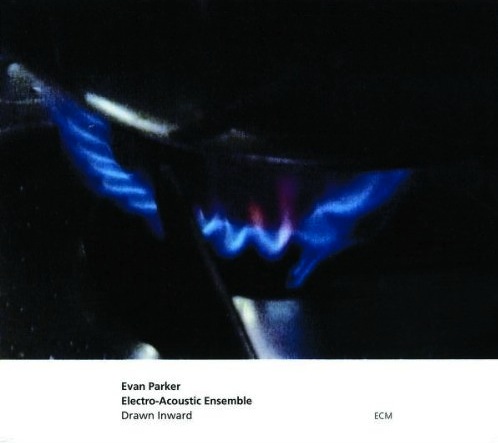
Evan Parker Electro-Acoustic Ensemble: Drawn Inward (ECM 1693)

Evan Parker Electro-Acoustic Ensemble
Drawn Inward

Evan Parker tenor and soprano saxophones, khene
Philipp Wachsmann violin, viola, live electronics, sound processing
Barry Guy double-bass
Paul Lytton percussion, live electronics
Lawrence Casserley live electronics, sound processing
Walter Prati live electronics, sound processing
Marco Vecchi live electronics, sound processing
Recorded December 1998 at Gateway Studio, Kingston
Engineer: Steve Lowe
Produced by Steve Lake

The spheres of composition and improvisation are not so far apart. In fact, Evan Parker and his Electro-Acoustic Ensemble seem to say, they are as inseparable as water from the ocean. Since 1992 the Ensemble has gone, as the title of its 1997 debut suggests, toward the margins, and is content in the asymptotic nature of those margins. This follow-up welcomes Lawrence Casserley and his computer wizardry into an already eclectic admixture of sound processors, thus enhancing the overall atmosphere with real-time entanglements. Because the result feels so much like an aural diary, I can only offer a written one in return.

(1) there is a jagged line in the egg, and the light that spills from it sings, crackling like rain on tarp. in the crooner’s sigh there are wounds, in his laughter there is healing.

(2) aroused from my dream, i creep like a shadow toward the lighted window, throw open its transparent lungs and breathe in the dew-kissed air. but a serpent in the sky mars this otherwise idyllic dawn with S-curved passage, the only afterimage to linger in these eyes as it wriggles through gauzy cloud cover and parhelia. Parker’s lockdown is arresting, a Glassean riff turned on its head and spun like a top.

(3) to travel in the homeland is to walk away from yourself. catharsis of will and locomotion. in the absence of progress, the feet quicken their pace. in the absence of goals, they slumber even as they ambulate. hidden in the watering can behind the barn is the drop i left before parting for the city, where only sewer drains collected the tears of so many others and stirred them into an underground cocktail, never again to be tasted. it is not so radical to think that one might live here, but to think that one might die here. i can turn the radio dial however much i want, but will never find the beacon that i crave. instead, a diffuse comfort whereby the winds of opportunity blanket me with their hush.

(4) to look into the spouting bowl is to blind yourself to the truths of which it is an indifferent receptacle. i can lasso these words to its underwater circus yet fear i might not have the strength to hold on ’til i reach bottom. a fidgety existence i lead when it’s all i can do not to fall away from others’ attention.

(5) the music tells me i can deploy my love as an agent of unrest and offers in that possibility a temptation in whose surface i cannot see myself reflected. my heart is already lost to the cause. i stand in a booth on the corner making collect calls to strangers, my fingers all a-blur at the number pad in their furious attempts to communicate.

(6) i have found it: the spinning globe of circumstance on which i was trapped like a drone on a treadmill. now i can hold it, toss it as a child would a ball. but in so being endowed, i find there is only guilt and discomfort, and the knowledge that the top of the pyramid is a lonely place. i can only follow my wayward guides, playing the part of the child again as i slide down its brick-laid slope.

(7) back to concrete, i run pell-mell, pushing the capabilities of my social craft to the flexible limits of their stature, dangling before myself a carrot of progress. i cannot want this; i must let it want me. somewhere in the body of a cello, my bones are breaking and mending by the laser vision of gas stove flame.

(8) at home in the universe…nowhere else i’d rather be. it is our terrarium, our humid sanctuary, our light and love.

(9) i am writing on ice, using the ink my mother gave me. i let myself seep into the surface, tracing imperfections with newfound script.

(10) they have captured something in the frame, glued it inside with the adhesive of acceptance. timetables and train tracks curl into a tangled ball, it’s shadow the signature in the lower left-hand corner.

(11) the thread has unraveled and the secret is out. i am here only so long as i write myself to be. i take your hand and bid you to take another’s, so that by the end we stand as one. this is the music that goes on in the attic when we are asleep, in concerts attended by mice and other wall dwellers. if we are drawn inward to anything, it is ourselves.

<< Eleni Karaindrou: Eternity and a Day (ECM 1692 NS)
>> Peter Ruzicka: String Quartets (ECM 1694 NS
)