Gudmundson/Möller/Willemark: Frifot (ECM 1690)

Frifot

Frifot

Per Gudmundson fiddle, octave fiddle, Swedish bagpipes, vocal
Ale Möller mandola, natural flutes, hammered dulcimer, folk harp, shawm, vocal
Lena Willemark vocal, fiddle, octave fiddle, wooden flute
Recorded September 1998 at Rainbow Studio, Oslo
Engineer: Jan Erik Kongshaug
Produced by Manfred Eicher

When I smile my face shines like
Sunlight glittering on the water’s surface,
But when I cry my face is like
A dark pine forest under a cloudy sky.

Frifot are Per Gudmundson, Ale Möller, and Lena Willemark, the holy trinity of Swedish folk revivalism. The name means “footloose,” a word that locates their effortless playing in a realm of dance. Much of that spirit comes through in the handful of diptychs scattered throughout this epic self-titled program. These embody layered juxtapositions of sonority and exposition, of comet and tail, rushing through eons at the touch of plectrum and bow. Of them, the intimate pairing of “I hela naturen / Mjukfoten” (In All Nature / Light-foot) is an album highlight, its Robin Williamsonian waves flowing into the mandola’s rich speech acts. “Silder” (Still Waters), an ode from Willemark’s pen, glitters by kindred harp light and reaches out through the lighter “Bingsjö stora långdans.” From the uplifting polskas of fiddle-hunter Sjungar Lars to the brooding shores of “Om stenen” (The Stone), one feels a tireless will at work. The latter’s text by Swedish poet Bengt Berg paints it true: “Listen to the sound of the sun sinking into the lake.”

Surrounding all this merrymaking is deeply considered soil that takes first nourishment in the a cappella “Abba fader” (Abba Father), a song once preserved only in the memory of Baltic islanders whose Swedish ancestors emigrated to the Estonian coast during the Middle Ages. One hears earthen harmonies in the musicians’ voices, the gravel and scrape of time as it leaves its scars. A hammered dulcimer and rustic fiddle cradle “Stjärnan” (The Star), which evokes the miracle in Bethlehem, holding ancient vigil for those with a willing ear. “Tjugmyren” is composed of herding calls. The nasal, almost Bulgarian-sounding singing shows Willemark’s range of height and density. Calling through windswept grain, she plants her feet in the soil and grows where she stands. “Kolarpolskan” (The Charcoal-burner’s Polska) is another herding tune, this one more uplifting and with a bit of a Sephardic twist.

The listener hardly needs names to feel the stories. This is especially true in “Hemvändaren” (The Homecomer), which from hopeful beginnings spins a tale of bittersweet reunion and attempts to answer how one carries the hardships in the context of the resolution toward which they are endured. Another example of the album’s programmatic acuity is the agitated brushwork of “Fåfänglighet” (Vanity), while Gudmundson’s “Drömsken” (The Dreamer) evokes softer crosscurrents of instrumental expression. Yet another is “Skur Leja.” Written by Möller, it tells of a magically virtuous maiden whose purity puts not so virtuous men in their place and through its telling achieves a tense drama of flesh and intrigue. Other evocative standouts include “Metaren” (The Lazy Fisherman) and “Roligs Per-låtar,” a play on motives of itinerant fiddler and entertainer Roligs Per Persson.

As always, Willemark’s voice rings dependably through this cosmos with a palette like the very planet from which it springs: a swirl of blues, greens, and whites. The accompaniment is so much more than that, flapping as it does with all the conviction of a bird of prey even as it nestles, gentle as a lamb, in pasture. Notable also is the attention paid to selection and song order. Its flow runs deeper than a river in the thirstiest of land.

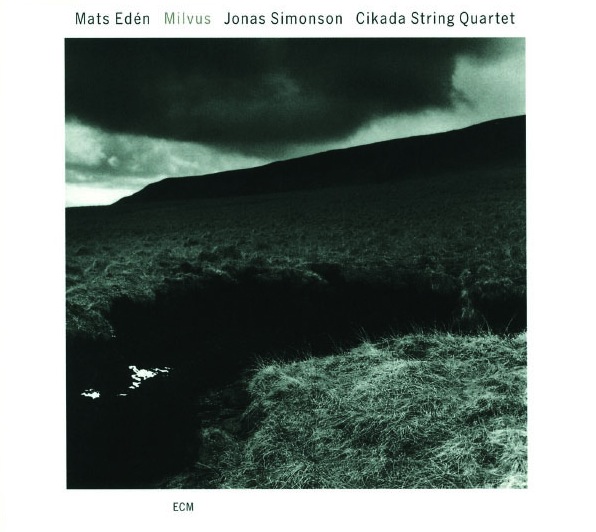
Mats Edén: Milvus (ECM 1660)

Milvus

Mats Edén
Milvus

Mats Edén drone-fiddle, violin, viola
Jonas Simonson flute, alto flute
Cikada String Quartet
Recorded September 1997 at Rainbow Studio, Oslo
Engineer: Jan Erik Kongshaug
Produced by Manfred Eicher

After making vital contributions to the ECM collaborations of Lena Willemark and Ale Möller, Swedish multi-instrumentalist and composer Mats Edén brings his folk revival sensibilities to this leader date from 1999. He joins longtime musical partner Jonas Simonson in paying homage to many great fiddlers, including Ärtbergs Kalle Karlström and Lejsme Per Larsson, and old-time masters Torleiv Björgum and Anders Rosén. The latter revived the use resonating strings, which Edén took on himself in developing a custom instrument called the bordunfiol, or drone-fiddle, featured prominently in Milvus.

Edén

Of that drone we get plenty in “Haväng,” an original tune dedicated to Indian violinist K. Shivakumar. Simonson’s flute is the photographic image that develops in Edén’s solution. This frothy combination of sublime harmonies and cohesive adaptation permeates especially the vibrant polskas that speckle the program. The contrast between airy riffs and tethered harmonics, between flowing lines and jagged accompaniment, between fragrant soil and dry winds makes for an altogether inviting atmosphere.

Having grown up in Värmland, which borders Norway, Edén takes inspiration from the region in “Norafjälls,” which he plays to earthen perfection. Likewise the dirge-like lows of “Vardag.” He also offers two improvised solo “Variations,” which bring with them a darker cast. Their strained quality and wrenching, emotional grit reveals a highly ingrained mind at work.

Simonson brings spiritual centeredness against distant fiddle accompaniment in “Den lyckliga (Beate Virgine),” a devout, reverberant jewel in the album’s rusted crown, and brings reflection and depth to his solo “Spillet,” a brief but profound segue.

As if this weren’t enough, the Cikada String Quartet concludes with Edén’s three-part String Quartet No. 1, of which the first movement feels like an unpacking of all the traditions that came before. As such, it is a distillation, a crystal fragmented and made whole again (the “jigginess” here is far more subtle, internal). The second movement is a quiet agitation of rubber-banded ideas, a spiral into the final Lento, engaged by folk themes amid careful attention to surroundings.

The album’s title refers to the kite bird. Not surprisingly, the music created in its name embodies the cut of those wings, angular and sure against the sky. Such contrasts would seem to be of vital importance to Edén, a musician who understands that the spaces in between the strings are just as important as the strings themselves.

Black Kite
(Photo by Laurent Breillat)

Ken Hyder’s Talisker: Land Of Stone (JAPO 60018)

Land Of Stone

Ken Hyder’s Talisker
Land Of Stone

Ken Hyder drums
John Lawrence bass
Marcio Mattos bass
Davie Webster alto saxophone
John Rangecroft tenor saxophone, clarinet
Ricardo Mattos soprano and tenor saxophones, flute
Brian Eley vocals
Frankie Armstrong vocals
Phil Minton vocals
Maggie Nichols vocals
Recorded April 1977 in London
Engineer Martin Wieland
Produced by Thomas Stöwsand

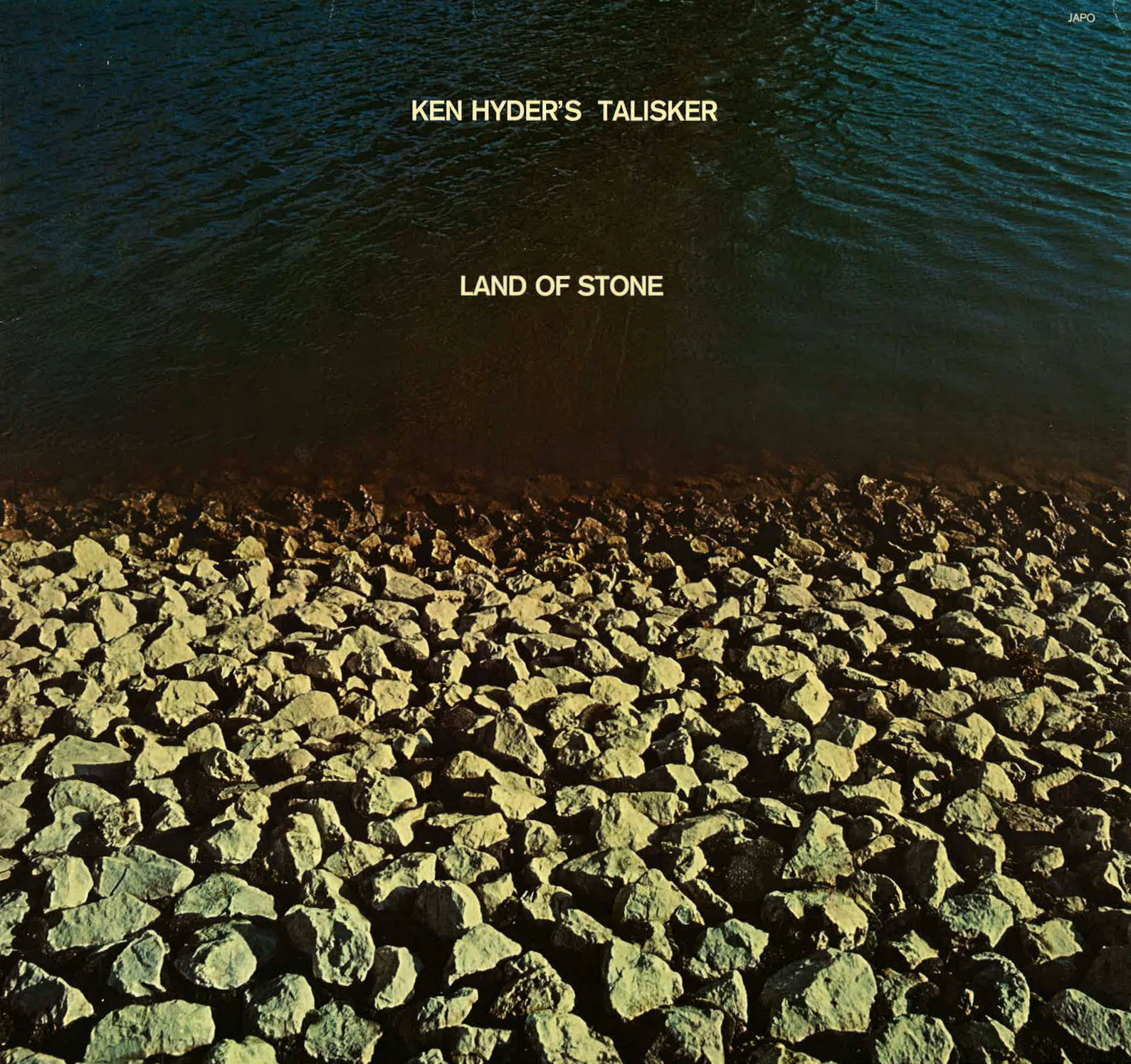
Over a career spanning more than four decades, Scottish percussionist and vocalist Ken Hyder has developed a strong body of work, though perhaps none so robust as his Talisker outfit. Combining Celtic and jazz influences, Talisker debuted in 1975 with Dreaming Of Glenisla on Virgin Records. Yet as Hyder’s musical interests began to expand to traditional Irish music and further to Asian monasticism, his sound opened itself to a world of possibilities. Enter album the second, Land Of Stone, which found a home on the JAPO label two years later.

“The Strathspey King,” a strangely swinging ode to Scottish master fiddler James Scott Skinner (1843-1927), sets a homegrown tone. Clarinetist John Rangecroft proves to be a vital presence in this increasingly enigmatic session, adding swagger aplenty. Like a young hopeful decked out in fresh threads and money in the pocket, he tricks the heart into thinking that harm is a while away. Hyder’s militaristic drum solo intercepts street-side, as if offering free samples of reality before a chorus of bidders drops into view with its haunting brand of Hebridean choral music in “The Men Of Barra Know How To Drink, But The Women Know How To Sing.” A boisterous and colorful chain, its syllables become actions, teetering like drunken instruments into “Close The Window And Keep It Down.” This likeminded island song is an onomatopoetic excursion into the inner lives of house wares and propriety. The latter quickly disintegrates as bonds loosen their friction and slide from grasp in screeching ululations, courtesy of ECM margin-bearer Maggie Nichols. The color wheel darkens further in “See You At The Mission, Eh, If It’s No’ Full,” in which a brood of instruments strains unison phrasings through an upturned colander. Bass and drums form a knot of support, eyes in a flowing wood grain. In the wake of these dirt-caked fingernails, “Derek Was Only A Bairn” rides into the dawn, a smooth caravan lead by Ricardo Mattos on flute and horse’s trot.

Hyder insists that improvisation was a vital component of Scottish bagpipe playing, and in a tripartite pibroch he explores the crossover from the Highlands to the fringes of American free jazz, dedicating parts respectively to the MacCrimmons (a notable family of pipers), John Coltrane, and Albert Ayler. After a microscopic dialogue between bassists John Lawrence and Marcio Mattos, soprano saxophone masquerades as bagpipe in piercing shepherd’s call. Hints of a jig rise and fall from deeper drones, a sky behind mountain silhouettes. Over the click of cymbal, dense voices weave in and out of earshot, taking solid presence in the loam of memory, to slumber and to molt. The banshees return with gentle persuasions, their ashen hair and earthward grins blistered by the rub of their limbo. Yet with the coming of rhythm they achieve communication somewhere on the other side of fear, ecstatic totems each passing through sea and grain until the wind puts fingers to lips and blows.

Cleaning off the dust of age, Talisker shakes out tunes old and new, and with the chaff pieces together charcoal fields as would a cobbler hammer a sole. Or is it soul? There’s plenty to be had in this land of stone.

Trygve Seim/Andreas Utnem: Purcor (ECM 2186)

Purcor

Trygve Seim
Andreas Utnem
Purcor

Trygve Seim tenor and soprano saxophones
Andreas Utnem piano, harmonium
Recorded May 2008 at Tøyen Kirke, Oslo
Engineers: Jan Erik Kongshaug and Peer Espen Ursfjord
Mixed at Rainbow Studio, Oslo by Jan Erik Kongshaug, Manfred Eicher, Trygve Seim, and Andreas Utnem
Produced by Manfred Eicher

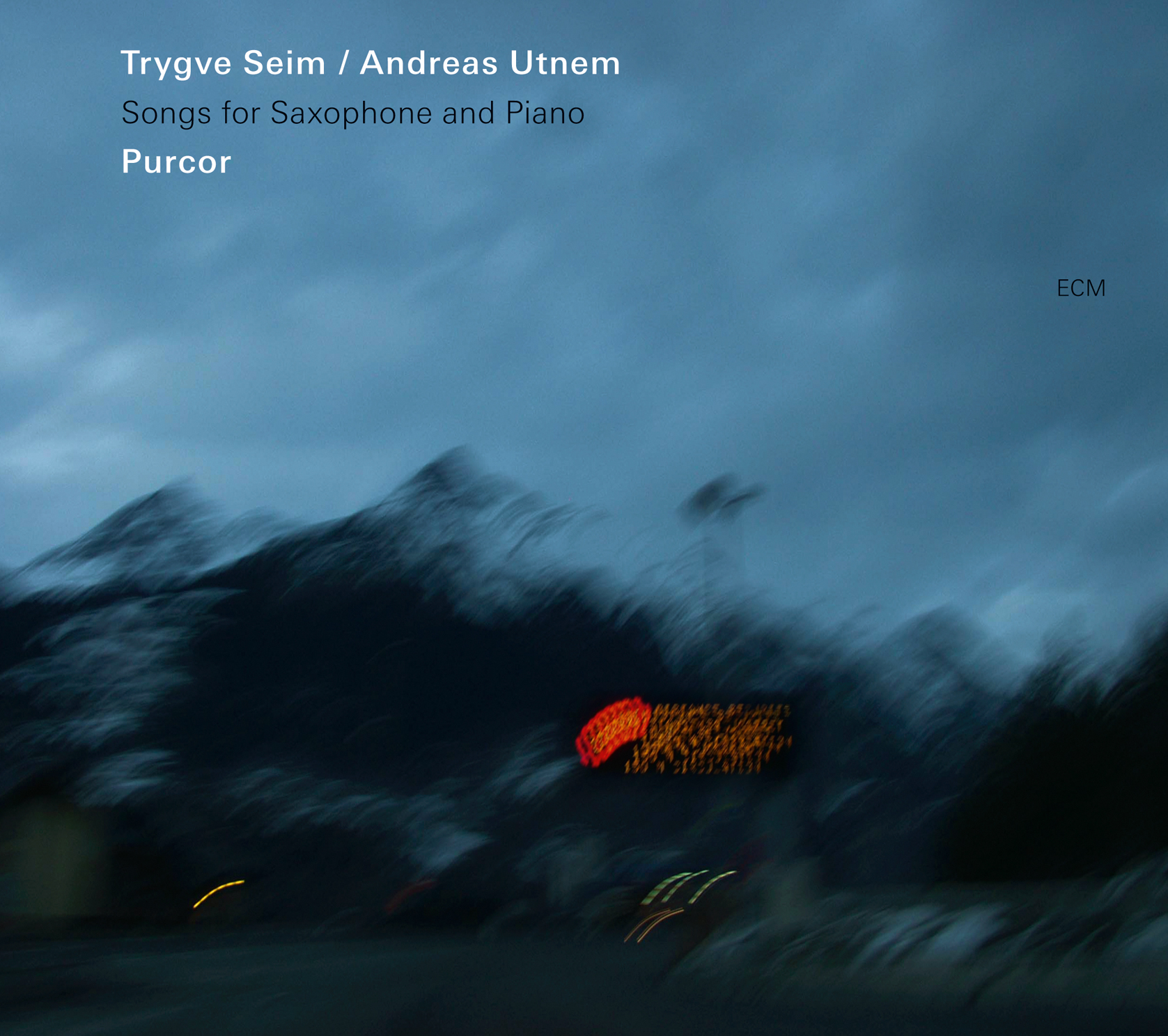
After a 13-year odyssey of collaboration, the duo of saxophonist Trygve Seim and keyboardist Andreas Utnem at last plays under ECM’s microphones in Purcor. Dubbed “Songs for Saxophone and Piano,”  Utnem calls more rightly calls it a program of “improvised church music.” In 1997, Utnem, a practicing liturgical composer, invited Seim to participate in select services under the auspices of Norway’s Church City Mission foundation. The result was a relationship that persisted and which manifests an intimate knowledge of context and practice in this session of 14 pieces that include settings of the Mass Ordinary, music for the stage, improvisations, and a reimagining of “Bhavana,” originally of Seim’s Different Rivers.

A beautiful and intimate album that belongs right alongside Stella Malu, Purcor strains its sentiments through a reductive mesh that distills only the purest extract of each melody. Seim’s breathy tone carries experience in its pockets, which it drops in methodical, dripping handfuls in the opening “Kyrie.” Feathered like the edge of an avian dream, it lisps at the edge of a time when mouths wandered in search of tongues. The album’s splintered Mass is therefore less a structural element than it is the air that gives said structure meaning to begin with. It is the space it inhabits, the climate from which it shelters its inhabitants, the words spoken in its chambers. From the beautiful counterpoint of the “Credo,” through the John Surman-esque sopranism of the jubilant “Gloria,” and on to the heartwarming gentility of cause in the “Agnus Dei,” the duo establishes a devotional yet ecumenical atmosphere, a shroud that reaches forth like arms of light and wraps its sacred conscience around secular means. A “Responsorium” switches piano for harmonium, lending the feeling of an organ hymn. Along with the “Pater Noster,” it is a reflecting pool of the soul whose contemplation is naked before all in Heaven. Such are the wounds that give weight to the meaning of struggle—not threads but veins: vast internal networks, compact and held together by the skin of the Word.

One almost hears the bending of a bass note at the start of “Nu Seglar Vi Inn,” a whalebone of time stretched to its snapping point. The album’s folk roots are first fleshed here, though nowhere so deeply as in the “Praeludium,” which untangles those roots and partakes of the celebratory nectar that flows through them. Likewise in the “Postludium,” for which Seim elicits a bamboo sound from his instrument, a specter of the earth walking toward a horizon aflame. The album ends on a likeminded note with “Når Mitt Øye Trett Av Møye,” laying us like lanterns on the water and splashing us into dusk.

Intensities of contrast abound, moving from whisper to exultation in a few sweeps of a grandfather clock’s second hand. Seim and Utnem’s playing, more akin to painting than to performing, blurs color as if by brush of dream. Like the title track, the program as a whole is a fleeting, primordial lament, a fusion tears into laughter, diamonds into coal, coal into dust, and dust into prayer.

From cover to engineering to sequencing (note especially the placement of the solo harmonium “Solrenning”), this is a quintessential ECM production.

(To hear samples of Purcor, click here.)