

Heiner Goebbels: Ou bien le débarquement désastreux (ECM 1552)

Heiner Goebbels
Ou bien le débarquement désastreux

André Wilms voice
Sira Djebate vocals
Boubakar Djebate kora, vocals
Yves Robert trombone
Alexandre Meyer electric guitar, table-guitar, daxophone
Xavier Garcia keyboards, sampling and programming
Heiner Goebbels sampling and programming
Moussa Sissoko djembe
Recorded June 1994 at Studios De La Grande Armee, Paris

If we have entered into familiarity with these particular offices of nature, if they have acquired the chance to be born in the world, it isn’t merely so that we may offer anthropomorphically an account of this sensual pleasure, it is so that there may result from it a more serious co-naissance (being born together/knowing). Let’s go deeper then.
–Francis Ponge, Le Carnet du Bois de Pins (The Notebook of the Pine Wood)

Ou bien le débarquement désastreux (Or the hapless landing) is another intriguing entry in ECM’s growing Heiner Goebbels lexicon. As a piece intended for the stage, one gets only half the experience, if even that, on disc, though minimal scoring ensures that the text (all of it in French) remains absolute. In this regard, Ou bien… requires only one actor (André Wilms) in the narrative role, and represents a direction that Goebbels has now taken further with his recent Stifters Dinge, which has need of neither actors nor musicians, per se, and relies instead on mechanically controlled “performers,” with Goebbels as their brain.

The present composition is based on texts by Joseph Conrad (from his Congo Diary), playwright and frequent Goebbels collaborator Heiner Müller, and essayist/poet Francis Ponge (from the work epigraphed above). All of these texts intersect at the site of the forest, which emerges as the primary visual field in this postcolonial space. Goebbels ruthlessly combines Senegalese and “Western” musical strands. The former emerges as refined and anything but primitive, while the latter by turns titillates and grates on the ears with its aggressive tendencies. The vivid kora of Griot Boubakar Djebate is the album’s alpha and omega and cuts out, in negative image, a porous backdrop for otherwise opaque texts. The ensemble is completed by instruments both familiar (trombone, electric guitar, djembe, keyboard, and sampler) and not (such as the daxophone, an amplified piece of wood brought to life when a bow is drawn across it). Instrumental interludes are rendered with the rougher textures of guitar and croaking brass. Conversely, the kora cuts through with the smoothness of a scalpel, even if closer inspection reveals a handle with decades of violence burnished into its grooves. Conrad’s diaristic structure contributes to the underlying unease, so that Djebate’s glorious rendition of “Il eut du mal” lifts us only partially from its surface like a scab. The range of emotional registers is pure Goebbels. From the drone of “Dangoma” to the upbeat pastiche of “Haches, Couteaux, Tentacules” and the banal charm of “Le Soir,” this album carries us through a journey as didactic as it is self-destructive, so that by its end we are in a grove of shattered intentions and piecemeal recollections.

In reference to this piece, Rodney Milnes observes: “As in all melodrama there is a conflict between word and note: it is more difficult for the human brain to absorb the two when the words are not simply set to music.” This is precisely what one finds enacted through the colonial process, the mindset behind which seems to bleed through Ou bien…, regardless of whether one understands its texts or not. Such is Goebbels’s gift for evocation. Still, a lack of French knowledge or translations at hand, not to mention of a stage upon which to view the comportment of the work as a whole, gives us an album that is but one reflective facet of a larger crystalline whole. Ultimately, I don’t believe Goebbels so reductive as to reenact oppression through the encroachment of his own musical ideas upon the lineages he exploits therein. Rather, he is interested in the ways in which lingering traces of such oppression may be refashioned into a new mode of speech, one both painfully aware of its roots while also hopeful for an amalgamated future.

<< Stephan Micus: Athos (ECM 1551)
>> Surman/Krog/Rypdal/Storaas: Nordic Quartet (ECM 1553)
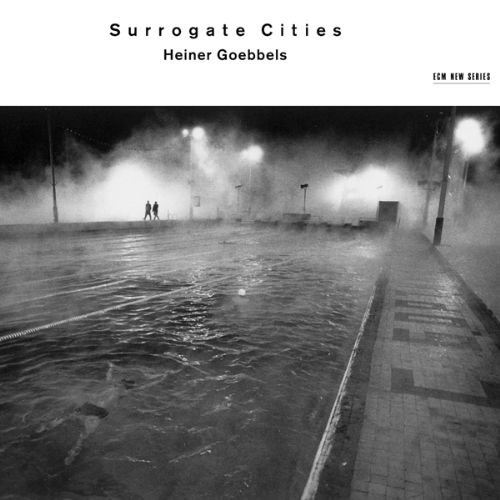
Heiner Goebbels: Surrogate Cities (ECM New Series 1688/89)


Heiner Goebbels
Surrogate Cities

Junge Deutsche Philharmonie
Peter Rundel conductor
Jocelyn B. Smith vocals
David Moss vocals
Recorded 1996, Bayerische Rundfunk, Munich / 1999, Frankfurt
Engineer: Peter Jütte
Produced by Heiner Goebbels & Manfred Eicher

As a longtime fan of David Moss, I needed only to learn of his involvement in Surrogate Cities before rushing out to buy the CD. Sadly, at the time I had no idea who Heiner Goebbels was. I couldn’t have asked for a more comprehensive introduction. The reader will forgive my penchant for abstract analogies when I say that Surrogate Cities is like pricking a piece of paper with a pin and shining a metropolitan nightscape through it so that one may connect those rays of light with brittle chalk. Practically speaking, the project is meant to be an ode to the city of Frankfurt in celebration of its 1200th year. As such, it is an amalgam of atmospheres, moods, and sensual provocations. This project unfolds like a massive suite with instruments drawn from architecture and flesh alike. Each section reads like a novella in the grander scheme of its binding.

Suite for Sampler and Orchestra
Preluded by snippets of cantorial singing, computer-controlled voices seek dominance over the imperialistic power of the orchestra in a kaleidoscopic and utterly focused vision of the urban sprawl. Rather than penetrating the city, Goebbels turns it inside out for our inspection. The samples are not so much quotations as they are memories shaken loose from long-neglected nooks and crannies. The digital flick of “Menuett/L’ingénieur” is haunting in its subtlety, appropriated like so much data flowing through the airwaves. The conclusion, “Air/Compression,” is a chamber piece for the overlooked sounds of our post-industrial comfort. Admirers of John Zorn’s Kristallnacht will find themselves on familiar ground here, as the archival instinct is similarly apparent.

The Horatian – Three Songs
Based on words by Heiner Müller, this song cycle relates a conflict between Rome and neighboring Alba. A lot is cast to determine who will fight as representative of each city. A Horatian is chosen for Rome, a Curiation for Alba. During the course of the ensuing battle, the Horatian strikes down the Curiation and does not spare his life. His sister, who is betrothed to the Curiation, weeps upon his return. He rewards her grief by slaying her. Thus is the victor’s valiant heart tainted with murder. According to Müller, Goebbels “proposes a new form of reading, a different, no longer touristic approach to the landscape of a text.” In this sense, The Horatian is far from the bombastic cantata it could have been. Rather, it heaves with the weight of its own moral conundrum. Joselyn B. Smith is superb as the voice of bipartisanship, weaving in and out of its allegiances with the acuity of a practiced raconteuse. She emotes with a confident Broadway twang that is gorgeously appealing against Goebbels’s orchestral backdrop.

D & C sounds like someone knocking at the outside of a building with no entrance; a book one has been dying to read, but which opens to reveal rain-soaked pages. It is a film noir standing on its head, loose change and candy wrappers falling out of its pockets. The music circles until it loses hope and collapses onto the wet asphalt.

Surrogate, with words by Hugo Hamilton, is the moment I was waiting for during my first listen. Over a lush carpet of piano, Moss runs into the night along with the nameless character of Hamilton’s text. His indulgent enunciation of “surrogate” is priceless, prelude to a tranquil, breathy fade.

In the Country of Last Things
The words here are by Paul Auster. Bleak and morose, they paint a fatalistic picture of urban living. Moss provides the narration here as Smith wails plaintively in the background: “A house is there one day, and the next day it is gone. A street you walked down yesterday is no longer there today…” The city has become the ephemeral soldier, running AWOL from the army of its own becoming. All convictions remain unrequited, leaving the barest puffs of cigarette smoke as the only indications that they ever breathed.

Smith and Moss are the clear winners here. Not to be outdone, however, is the superb orchestra. The presentation is sharp, the sound so crisp you want to teethe on it, and the arrangements fantastically varied. Probably not the best album to play in your greenhouse, but for our psychological biota it does the trick.