Carla Bley/Steve Swallow: Duets (WATT/20)

Duets

Carla Bley
Steve Swallow
Duets

Carla Bley piano
Steve Swallow bass
Recorded by Steve Swallow, with assistance from Joe Ferla, at Grog Kill Studio, Willow, New York, Summer 1988
General co-ordination: Michael Mantler
Produced by Carla Bley and Steve Swallow
Release date: November 7, 1988

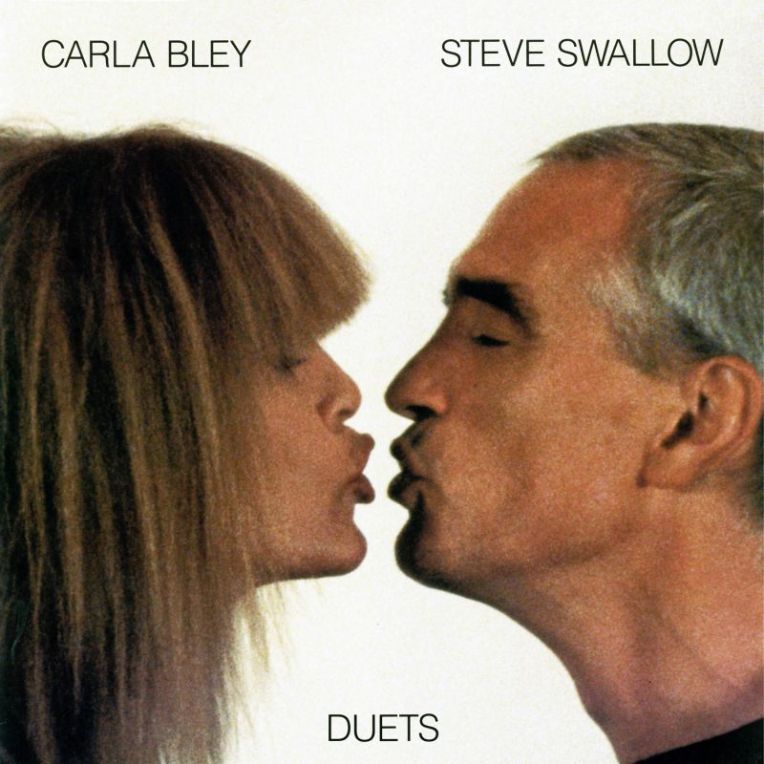
Given the connections they forged on previous outings, it was only a matter of time before Carla Bley and Steve Swallow made a duo album in the literal sense. And with it, a new chapter in the life of both musicians was born.

Bley gets the lion’s share of composing credits, offering a handful of ageless tunes. The first of these to really catch the ear, after the opening act of “Baby Baby,” is “Walking Batteriewoman,” in which abstraction and upbeat invitation run hand-in-hand into unknown futures. A newer addition to her canon is “Romantic Notions #3.” This tongue-in-cheek number walks a tightrope between what society expects of a relationship and what one actually feels after its initial blush has subsided into reality. With organ-like sonority, Bley’s pianism lays bare an understanding that life happens only when love prevails. In the shadow of this experience, “Ups & Downs” seems to ladder its way back to “Útviklingssang.” As a choice recording of this personal favorite (Swallow’s bass sings with especial sweetness and Bley has rarely expounded so tenderly), it is unmissable. Another of Bley’s masterpieces, “Reactionary Tango,” finds its way here. Hearing this three-parter in such close quarters allows its farthest corners to the glow in the light of interpretation.

Moreover, the set list sports two fine diary entries from Swallow’s pen. “Ladies in Mercedes” is a gem that fits in seamlessly with its surroundings. The hand-offs between bass and piano are as organic as their players’ feelings for each other. “Remember” is a highlight for its sheer aesthetic pleasure, against which Bley’s arrangement of the spiritual “Soon I Will Be Done With The Troubles Of This World” wastes not a single note by contrast.

After such a long tour through some of Bley’s densest textures and arrangements, it’s a privilege to settle down and snuggle up against the heart beating within all along.

Michael Mantler: Many Have No Speech (WATT/19)

Many Have No Speech

Michael Mantler
Many Have No Speech

Jack Bruce voice
Marianne Faithfull voice
Robert Wyatt voice
Michael Mantler trumpet
Rick Fenn guitar
The Danish Concert Radio Orchestra
Peder Kargerup
conductor
Orchestra recorded and mixed May 1987 at the Danish Radio, Copenhagen
Engineers: Ole Hviid and Jorn Jacobsen
Producer: Andy Sundstrom
All other material recorded May through December 1987 at West 3 Recording Studios, London (engineer: John McGowan), Grog Kill Studio, Willow, New York (engineer: Michael Mantler), and Newbury Sound, Boston (engineer: Paul Arnold)
Album mixed January 1988 by Michael Mantler at Grog Kill Studio
Mastering by Greg Calbi at Sterling Sound, New York
Album produced by Michael Mantler
Release date: May 30, 1988

After the leaking tire of Live, how redemptive to hear Jack Bruce’s voice hit the ground with the strength of a 4×4 in convoy formation with Marianne Faithfull and Robert Wyatt. Together, they navigate prose and poetry of Samuel Beckett, Ernst Meister, and Philippe Soupault for a symphony of grit and genuine emotion.

The commanding air that flows through Mantler’s trumpet welcomes us as if by the outstretched hands of a keeper of knowledge and opens a semantic portal to the netherworld of communication. The songs that follow are short (some no longer than 20 seconds), thus allowing us to focus on every morpheme with rapt attention. So full are these glimpses of human fracture that the longest tracks—“Something There” (a setting of Beckett sung by Bruce clocking in at three and a half minutes) and the spoken gem “Comrade” (a setting of Soupalt, in Pat Nolan’s English translation, at nearly four and a half)—feel epic by comparison. Thus, words are shown to be self-driven entities as the guitar of Rick Fenn clenches its psychological teeth around the line “songs are songs and the days days.” Faithfull is, for lack of better descriptors, creepy and beguiling. Her reading of Beckett’s “Imagine” is gut-wrenching, Fenn’s guitar serving as an emotional mesh through which hardships are pushed in the hopes of leaving behind flecks of gold. The tenacity of “En Cadence” is another noteworthy dive inward.

Wyatt only gets three appearances, but his voice is a welcome color change. His take on Soupault’s “Tant De Temps” is evocative to the max, the vocal equivalent of paint being moved across a surface as strings, trumpet, and percussion hold their gesso underneath. “L’Abbatoir” burrows deeper under the skin. Its magical combinations presage the insistence of Faithfull’s later tracks. “Prisonniers” is an echo from beyond the grave of atrocity.

Given the aphoristic structure it emplos, Many Have No Speech almost feels like a language instruction tape set to music. Each vignette is filled with enough wisdom, at once practical and profound, to retread many times over. This is not background music. It’s foreground music.

Michael Mantler: Live (WATT/18)

Live

Michael Mantler
Live

Jack Bruce vocals
Michael Mantler trumpet
Rick Fenn guitar
Don Preston synthesizers
John Greaves
bass, piano
Nick Mason drums
Recorded February 8, 1987 during the 1st International Art Rock Festival at the Kongresshalle, Frankfurt, Germany
Festival produced by Off-Tat Frankfurt with the Co-Operation of the Hessischer Rundfunk (Concept and Production: Klaus Schäffer, Peter Kemper, Ulrich Olshausen, Dieter Buroch)
Location recording by Hessischer Rundfunk
Engineer: Wolfgang Packeiser
Concert sound: Sven Persson
Mixed by Michael Mantler with assistance from Doug Epstein at Grog Kill Studio, Willow, New York
Mastered by Greg Calbi at Sterling Sound, New York
Produced by Michael Mantler
Release date: September 1, 1987

Recorded at the 1st International Art Rock Festival in Frankfurt, Live might just be Michael Mantler’s most overt nod to Henry Cow yet. It’s also, to my ears, the trumpeter/composer’s least cohesive album. From the opening track, which marries his fiery “Preview” with “No Answer,” we might be forgiven for thinking we’re in for an incendiary ride when vocalist Jack Bruce goes all in for his delivery of the Samuel Beckett lyric. Whereas his studio recordings often sound multiply refined, despite their sometimes-grim subject matter and atmospheres, in a live setting we get more frayed edges. This is both the album’s blessing and its curse, as the selections from Mantler’s take on Edward Gorey, The Hapless Child, leave one wishing for their original performer, Robert Wyatt. Bruce’s “The Remembered Visit” is flaccid by comparison, though he does revive some of the idiosyncratic aplomb he does best in “The Doubtful Guest” at the concert’s close.

Mantler himself, normally a pungent soloist, meanders on “For Instance” and “When I Run,” setting up journeys without apparent destinations. Having said that, I lend an ear with wonder to the three “Slow Orchestra Pieces,” without which the album might fall apart. Their archival feel, coupled with center-stage moves from Rick Fenn on guitar and Don Preston on synthesizer, make them just worth the price of admission. So listen at least for them, but save your time for the vocal pieces in original form to get their full effect.

Carla Bley: Sextet (WATT/17)

WATT-17-front

Carla Bley
Sextet

Carla Bley organ
Hiram Bullock guitar
Larry Willis piano
Steve Swallow bass
Victor Lewis
drums
Don Alias percussion
Recorded and mixed December 1986 and January 1987 by Doug Epstein at Grog Kill Studio, Willow, New York
Mastered by Greg Calbi at Sterling Sound
Produced by Carla Bley and Steve Swallow
Release date: March 1, 1987

Still steaming from the Night-Glo session that preceded it, Bley might be forgiven for the double entendre of the nearly-as-sensual Sextet. Here she joins forces with new love Steve Swallow in a band of extended family that includes Hiram Bullock on guitar, Larry Willis on piano, Victor Lewis on drums, and Don Alias on percussion. Swallow and Bley are the focal point, essentially a duo whose not-so-hidden thoughts are spun outward by the other musicians.

“More Brahms” opens with smooth stylings all around. The soloing is choice, and Willis’s 98.6-degree comping adds to the brink-of-twilight vibe. Bullock counters with the slow rock infusions of “Houses And People,” for which the rhythm section changes gears as vines and waterfalls go by in a pleasant blur toward a sparkling ending. In “The Girl Who Cried Champagne,” among the bandleader’s most memorable compositions, Willis shuttles a Latin loom as Bley’s organ limns the horizon with pale fire beneath Bullock’s liquid metal sky. From the tropical to the urban, the scenery undergoes a dramatic costume change in “Brooklyn Bridge.” Riding a wave of progressive density, Alias’s detailing accents the passage of time in a tune that might otherwise seem timeless. By the time we run our fingers across the carefully manicured “Lawns,” we find ourselves knee-deep in hope. Every note of Swallow’s lyrical solo plucks a weed from our path. All of which fortifies the final “Healing Power,” a gut punch of love that hits us where it counts.

Without an ounce of the vibrant and ear-changing challenges posed by so many of her previous recordings, this one nevertheless charms with a breeziness that could only be born of the confident left turns taken to get to this two-lane highway.

Carla Bley with Steve Swallow: Night-Glo (WATT/16)

Night-Glo

Carla Bley
with Steve Swallow
Night-Glo

Steve Swallow bass
Carla Bley organ, synthesizers
Larry Willis piano, electric piano
Hiram Bullock guitar
Victor Lewis drums
Manolo Badrena percussion
Paul McCandless oboe, English horn, soprano, tenor, and baritone saxophones, bass clarinet
Randy Brecker trumpet, flugelhorn
John Clark French horn
Tom Malone trombone
David Taylor bass trombone
Recorded and mixed June through August 1985 by Tom Mark at Grog Kill Studio, Willow, New York
Produced by Carla Bley and Steve Swallow
Release date: November 1, 1985

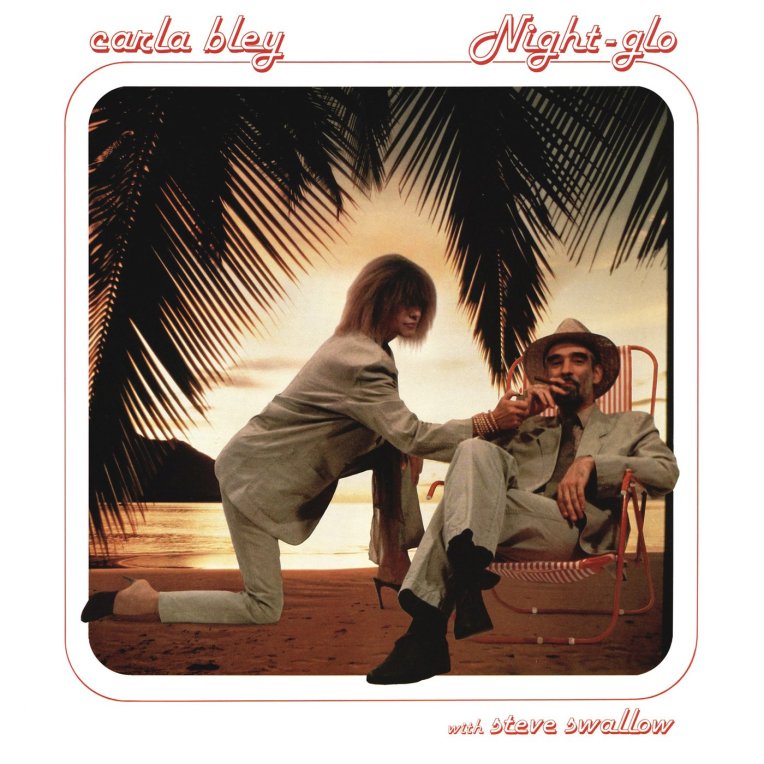
If Carla Bley’s biography were a movie, then Night-Glo would be the love scene. Indeed, around the time this album was being recorded, she and bassist Steve Swallow had elevated their relationship from that of musical to life partners. Their newfound romance, translated here in the studio, might even come across as voyeuristic were it not for the tasteful and sincere way in which it is presented, as warm to the touch as ever.

The arrangement of opener “Pretend You’re In Love” tells us we’re in for an experience so 80s-luscious, so adoringly crafted, we almost expect to hear an R&B singer sauntering into frame. Adding an air of mystery to this candlelit reverie is the unmistakable English horn of Paul McCandless, one of a few adroit inclusions in the band’s roster, along with trumpeter Randy Brecker, percussionist Manolo Badrena, and pianist Larry Willis. The title track is a plush vehicle for Swallow’s bassing, which, luxuriating in the sound of horns (as if from the traffic they’ve stopped), stretches its body to fullest length. Brecker’s trumpet is an ecstatic voice in this fleshy symphony, while Bley’s piano buries the heartache of a past that already feels distant. The guitar of Hiram Bullock echoes in “Rut,” as if manifesting the anticipation of a physical contact that hovers just beyond the reach of consummation. Swallow links a chain of poetic verses from start to finish, drawing an artful segue into “Crazy With You.” Bley’s hot-n’-heavy organ taps a controlled fire into fadeout.

Bley ends with one of her finest suites, the three-part “Wildlife.” It begins with “Horn,” moves into the smoother contours “Paws Without Claws,” and ends on the delicate high note of “Sex With Birds.” An overwhelming sense of transition, of progression from solitude to companionship, prevails. This is humanity at its most beautiful, the resonance that binds and makes us whole.

Maybe it’s just me reading too deeply into things, but I find it significant that the band employed to bring all of this to life should consist of 11 members, for the number itself—“1” on “1”—is the perfect illustration of emotional synthesis. Coincidence? You be the judge. In the meantime, if you want to know what the heart sounds like when reborn, just press PLAY and close your eyes.

Michael Mantler with Don Preston: Alien (WATT/15)

Alien

Michael Mantler
with Don Preston
Alien

Michael Mantler trumpet
Don Preston synthesizers / Yamaha DX7 (with Mimetics Performance Software), Alpha Syntauri (with Mimetics Meta 5.0 Software), Korg Poly-61, Poly-800, DW-6000, Linn Drum
Recorded and mixed March through July 1985 by Michael Mantler at Grog Kill Studio, Willow, New York
Third Ear: Carla Bley
Produced by Michael Mantler
Release date: November 1, 1985

For this album—one as atmospherically rich as its cover’s typography is attention-grabbing—trumpeter Michael Mantler joins cosmic forces with ex-Mothers of Invention keyboardist Don Preston, whose array of synthesizers delineates a virtual reality for us to wander around in. This combination yields a window for every door, cutting out a framed glimpse of what lies beyond before opening into it. Conceived in four phases, each with its own character, it creates a world of elliptical logic and physical properties. Part 1 is a brooding tectonic shift of past and future plates, such that the present is left questioning its own existence. From this reverie emerges an equally visual language of rhythm and tension, Preston’s era-defining drum machine peeking out from the woodwork at the most tasteful intervals. Part 2 is held together by systematic codes. Mantler’s trumpet is the organic outlier in an inorganic world, a traveler without a map whose only assurance is the life that keeps his body from atomizing. One might take Part 3 to be a commentary on postmodern angst over media representation, yet just as easily see Part 4 as a reflection of our own complicity in its proliferation.

Any Mantler fan should want to experience this. Others should want to take the chance. Either way, you are sure to find yourself face to face with profound questions. In absence of explicit answers to the overarching title, we must accept its open-ended invitation to bring personal charge to the fore. If anything is alien, it is our own propensity to turn falsehood into prophecy.

Carla Bley: Heavy Heart (WATT/14)

Heavy Heart

Carla Bley
Heavy Heart

Carla Bley organ, synthesizer
Steve Slagle flute, alto and baritone saxophones
Hiram Bullock guitar
Gary Valente trombone
Kenny Kirkland piano
Steve Swallow bass
Victor Lewis drums
Manolo Badrena percussion
Additional Horns:
Michael Mantler trumpet
Earl McIntyre tuba
Recorded September and October 1983 by Tom Mark at Grog Kill Studio, Willow, New York
Mixed November 1983 by Nick Griffiths at Britannia Row Studios, London
Engineer: Tom Mark
Produced by Carla Bley and Michael Mantler
Release date: March 1, 1984

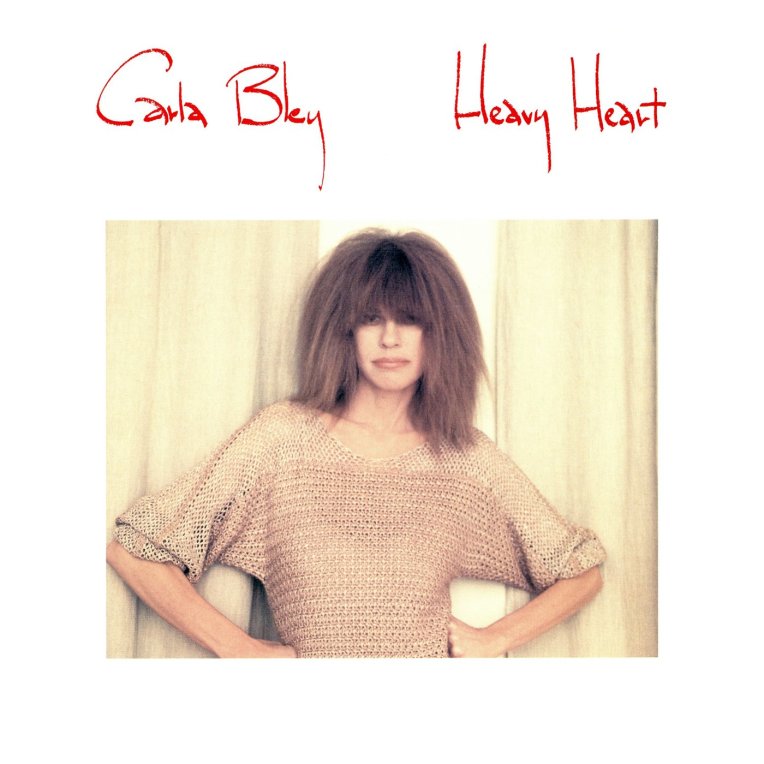
The next phase of Carla Bley’s ten-piece stomp through the space-time continuum ushers us into the chambers of her Heavy Heart. Whether navigating the turns of “Light Or Dark” or making a “Joyful Noise,” Bley and her band prove that life is only as full as one’s ability to roll with the punches. Drenched in sunlight, these musicians converse more like family than friends. Saxophonist Steve Slagle (also on flute) is a foregrounded presence on both tunes, in which Bley displays her formidable ability to speak through melody. The addition of pianist Kenny Kirkland is a genius move, and he paints the canvases at hand with both knife and brush. Guitarist Hiram Bullock, too, lends fresh color to the Bley palette while the bandleader herself applies a topcoat of synthesizer. With this much scenery to enjoy, far removed from the bustle of everyday life, we can come out of the experience having traveled in the most literal way.

“Talking Hearts” is another close-up on Bullock, who pulls on starlight like a thread and uses it to stitch memories together before their narrative falls apart. Bley’s synth comes across as the voice of a childhood refusing to fade, reveling instead in its own retro-ness in an increasingly modern world. This warm and fuzzy feeling revives itself in “Starting Again,” wherein Kirkland’s crosstalk with the rhythm section, resolute against hot-blooded horns, builds to prominence, but not before the total eclipse of “Ending It” shields the glare of Gary Valente’s trombone. The effect is such that when the time comes for the title track to bid us farewell, Bley cannot resist turning back, freeze-framing on what could have been. Remember that face, for the next time we see it, she will be gushing with that sense of renewal only love can bring, on the way to rewriting her script once more.

Michael Mantler: Something There (WATT/13)

Something There

Michael Mantler
Something There

Michael Mantler trumpet
Carla Bley piano
Mike Stern guitar
Steve Swallow bass
Nick Mason drums
Strings of the London Symphony Orchestra
Michael Gibbs arranger and conductor
Recorded February through June 1982 at Grog Kill Studio, Willow, New York
Engineer: Tom Mark
Strings recorded and album mixed July and July 1982 at Britannia Row, London
Engineer: Nick Griffiths
Assistant: Michael Johnson
Produced by Carla Bley
Release date: January 4, 1983

something there
where
out there
out where
outside
what
the head what else
something there somewhere outside
the head

After taking us to the movies a second time, trumpeter and composer Michael Mantler helms a superlative quintet, this time with guitarist Mike Stern, pianist Carla Bley, bassist Steve Swallow, and drummer Nick Mason. Add to them the strings of the London Symphony Orchestra under the direction of arranger Michael Gibbs, and you have a balancing act of observation and exposition that is sure to please a fan of anyone involved. Mantler possesses a unique ability to cut through the bread of sound with a knife that is at once serrated and bloodless. One need only grab a slice of “Twenty,” one of five numbered loaves, to see that each has its own grain, thickness of crust, and shape. The sensation of looking on the inside to describe what is on the outside has rarely been so lucid in Mantler’s work than here. Gibbs’s kindred spirit ensures that every fold of dough rises by virtue of a yeast that is more theatrical than cinematic—which is to say, prone to indeterminate beauty of human error. Mantler’s entrance as soloist is late, touching the horizon like a setting sun before night sets in on “Twenty One.” The guitar takes on an anguished quality, as if its impending dream were a grave in which to bury an effigy of the past.

at the faint sound so brief
it is gone and the whole globe
not yet bare
the eye
opens wide
wide
till in the end
nothing more
shutters it again

“Nineteen” is notable for its propulsive structure and tessellated theme, one that rolls through the head without impediment. Artfully driven by Swallow and Mason, it glues together a full diorama for Stern’s roaming pick. Mantler’s selective applications ring out with poetic authority in what amounts to a masterstroke. “Seventeen” is another geometric wonder, replete with sparkling cymbals and angled lines.

so the odd time
out there
somewhere out there
like as if
as if
something
not life
necessarily

The downtempo funk of “Eighteen” paves a smooth landing strip for the title track, which embodies the feeling of speech loosed into the air as rockets of meaning. Like the words of Samuel Beckett pillaring this review (and from which this album’s title was taken), it understands that utterances are physical locations worth exploring by instruments of tongue and teeth. There is indeed something there, but only when we acknowledge it to be nowhere.

The Carla Bley Band: I Hate To Sing (WATT/12½)

I Hate To Sing

The Carla Bley Band
I Hate To Sing

Michael Mantler trumpet
Steve Slagle alto and soprano saxophones (voice on “The Lone Arranger”)
Tony Dagradi tenor saxophone
Gary Valente trombone (voice on “The Lone Arranger”)
Vincent Chancey French horn
Earl McIntyre tuba (on 1 only; bass trombone and background voice in “Murder”)
Bob Stewart tuba (on 2 only)
Carla Bley organ, glockenspiel (piano on “Very Very Simple” and voice on “The Lone Arranger”)
Arturo O’Farrill piano (voice and organ on “Very Very Simple”)
Steve Swallow bass (voice on “The Lone Arranger” and drums on “I Hate To Sing”)
D. Sharpe
drums (voice on “I Hate To Sing”)
Side 1 recorded live August 19-21, 1981 at The Great American Music Hall, San Francisco, California
Mixed December 1981 at Grog Kill Studio, Willow, New York
Side 2 recorded live January 11-13, 1983 at Grog Kill Studio
Mixed 1984, Willow, New York
Engineer: Tom Mark
Produced by Carla Bley

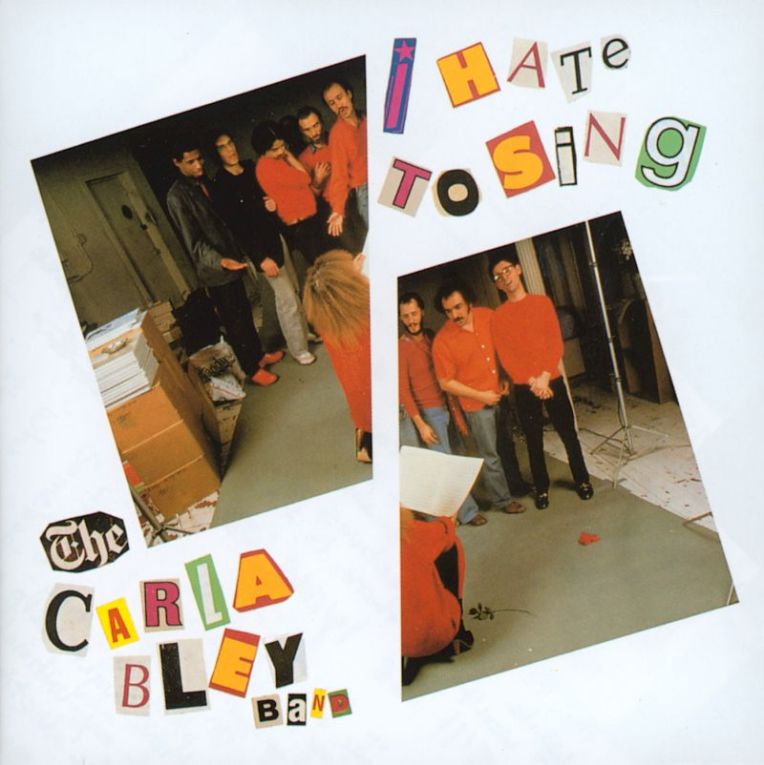
Until this point, Carla Bley has been known to throw in a shot of wry humor into almost every cocktail she mixes. But it’s not until I Hate To Sing that she fashions her live persona into that of a standup comedian. The limited vinyl release from 1984 (reissued on CD in 1996) exhibits some of the bandleader’s slyest compositions via her ability to craft an entire world out of notes and materials.

Despite the talented instrumentarium she has assembled this time around, including such constant companions as trumpeter Michael Mantler, trombonist Gary Valente, bassist Steve Swallow, and drummer D. Sharpe, Bley’s focus is on the very thing the album’s title professes to hate. Such a setup in any other hands might come across as dated, but there’s something undeniably apposite about her songcraft. In “The Internationale,” for example, we find ourselves people watching in the selfsame hotel’s lobby as itinerant travelers from all over the world struggle to understand each other in an ivory Tower of Babel. Its refrain of “What did he say?” feels all too prescient in a politically divided world such as ours. Further highpoints of lowbrow include “Very Very Simple,” in which pianist Arturo O’Farrill sings about the rudimentary song Bley has graciously allowed. Its self-deprecating air would not be out of place on a vaudeville stage. A comically unremarkable drum solo seals the deal. “Murder” is also memorable for its tongue-in-cheek twist on stalking. Background vocals by tuba player Earl McIntyre, assuming the role of impending doom, are spot-on and rile the audience in this live recording to bubbling laughter.

A few non-vocal passages sprinkled in for good measure remind us who we’re dealing with. “The Piano Lesson” is a chain of unsuccessful piano runs, held together by spurts of competence from the whole band; “The Lone Arranger” (one of my favorite Bley titles) is a gentle romp; and “Battleship” threads an SOS signal and explosions through a vivid free-for-all tapestry.

The end effect, as overtly comedic as it is covertly philosophical, is a master class in social commentary. Still, it is sure to polarize listeners. And while it may not share a spotlight with some of Bley’s more recognized albums, it’s a historical jewel and one of the few successful amalgamations of jazz and comedy that I’ve ever heard (for comparison, click here to read my take on Jon Benjamin’s Well I Should Have…). This is nowhere truer than in the title track, in which Swallow takes over on drums to allow Sharpe the microphone, thus adding some uproarious touches to Bley’s swing. A noteworthy moment occurs when the music stops and Sharpe says, “Can I have something to drink please?” And again: “I need a more professional group to back me up when I sing. Get some West Coast cats.” Even at her most audacious, Bley proves the value of balance. In this instance, every element knows its place.