Bill Carrothers/Vincent Courtois: Firebirds (RJAL 397040)

Bill Carrothers piano
Vincent Courtois cello
Eric Séva baritone saxophone on tracks 6 and 7
Recording, mixing, and mastering at Studios La Buissonne, Pernes-les-Fontaines, France
Recorded May 21 and mixed June 21, 2021, by Gérard de Haro, assisted by Matteo Fontaine
Steinway grand piano tuned by Alain Massonneau
Mastered by Nicolas Baillard
Produced and directed by Gérard de Haro & RJAL for La Buissonne Label
Release date: November 12, 2021

Firebirds is many things, but above all, an act of faith. Gérard de Haro, long a quiet architect of improbable encounters in his La Buissonne studio, had carried within him the intuition that pianist Bill Carrothers and cellist Vincent Courtois belonged in the same current. Each had left an imprint on the room’s air in separate sessions, as if their sounds were tributaries waiting for confluence. Yet they had never tested the tensile strength of their voices against one another. Courtois has confessed that without de Haro’s conviction, the meeting might have remained hypothetical. Trust became the catalyst. Trust in the ear behind the glass, trust in the unseen geometry of chance. What followed feels less like a collaboration than a tide answering the pull of a distant moon.

Indeed, despite the album’s title, it is water that courses through it by temperament. The frame is Egberto Gismonti’s “Aqua y Vinho,” placed at the threshold and the farewell. The cello begins alone, tracing the melody as though drafting a map across an empty sea. Its lines appear rectilinear at first, crystalline and deliberate, then soften, bending into arcs that suggest eddies and hidden inlets. When the piano joins, it does not so much accompany as set the shoreline in motion. Its chords fall with the measured cadence of footsteps along wet sand, insistent yet patient. Courtois responds with widening spirals of sound, ascending in vaporous abstraction before returning, each time altered, to the melody’s wellspring. The repetition never repeats. It accumulates.

The improvised title track arrived first in the studio, though it appears later in sequence, as if the musicians wished to let it steep before offering it whole. The title track smolders with a folk-inflected sorrow, embers glowing beneath a veil of restraint. Carrothers coaxes from the piano a warmth that suggests hearthlight flickering on stone walls. Courtois answers with phrases that hover between lament and lullaby, a bowed murmur that seems to remember something older than language. Their interplay suggests two elements seeking equilibrium, flame reflected on water, each transfiguring the other’s hue.

Standards such as “Deep Night” and “Isfahan” are treated as living aquifers. “Isfahan” opens into a spacious dusk, the arrival of guest musician Eric Séva’s baritone saxophone deepening the horizon. His tone spreads like ink in water, dark yet translucent, amplifying the nocturnal hush that permeates the record. The trio does not crowd the melody; they breathe around it, allowing space to function as tidepool and threshold. “Deep Night” shimmers with restraint, its contours revealed slowly, as if the musicians were polishing a stone discovered at low tide.

Even Joni Mitchell’s “The Circle Game” undergoes a gentle metamorphosis. Pizzicato cello skips like pebbles across a pond while the piano lays down chords that ripple outward in concentric rings. The familiar refrain acquires a different gravity here, less nostalgic than reflective, as though time were not a wheel but a river whose surface records every passing cloud.

The original compositions widen the estuary. “Colleville-sur-Mer” unfolds in a hush that feels tidal, grief receding and returning with unbidden regularity. “San Andrea” keens with a salt-etched intensity, its phrases cresting in plaintive arcs. “The Icebird” introduces a glacial clarity, tones refracted as if through frozen air, while “1852 mètres plus tard” paints in gradients of altitude and atmosphere, suggesting ascent through thinning light. Throughout, de Haro’s production captures not only the notes but the air between them, that charged interval where sound prepares to become something else.

To speak of transfiguration here is not mere embellishment. The album enacts it. Themes dissolve and reassemble, melodies shift from solid ground to liquid shimmer, textures ignite and cool. Each musician remains unmistakably himself, yet the encounter alters their outlines. The music seems to ask whether identity is ever fixed or always in the process of becoming, shaped by the streams it consents to enter. Perhaps art works similarly, eroding certainty, polishing rough edges, carving new channels in the bedrock of perception. If so, the true transfiguration may occur not within the notes themselves but within the listener, who steps into those same streams and discovers, upon emerging, that the shoreline has shifted.

Vincent Lê Quang: Everlasting (RJAL 397038)

Vincent Lê Quang saxophones
Bruno Ruder piano
John Quitzke drums
Guido Zorn double bass
Recording, mixing, and mastering, Studios La Buissonne, Pernes-les-Fontaines, France
Recorded December 2019 and Mixed February 2020 by Gérard de Haro
Mastered by Nicolas Baillard at La Buissonne Mastering Studio
Steinway grand piano tuned and prepared by Sylvain Charles
Produced by Gérard de Haro and RJAL for La Buissonne label
Release date: May 21, 2021

Everlasting announces the leader debut of Vincent Lê Quang with a quiet assurance that feels anything but declarative. There is no display of ego here, no virtuosic flourish meant to dazzle. Instead, the album reveals a rarer mastery that effaces itself in service of listening. Lê Quang’s soprano and tenor do not dominate the space so much as inhabit it, breathing alongside pianist Bruno Ruder, drummer John Quitzke, and bassist Guido Zorn in a shared atmosphere where composition and improvisation dissolve into one another. What emerges is a music that seems already ancient, yet continually being born in the present.

This clarity of purpose stems from 12 years of collective life, the quartet bound by a mutual attentiveness that allows each piece to function as a portal to a clearer understanding of the self. Lê Quang speaks of his compositions as keys to a common state, and that metaphor becomes audible across the record. Each track opens a different interior landscape, yet all are connected by a shared commitment to the risk of being fully together in sound. Gérard de Haro’s production deepens this sense of communion, letting the music breathe within the luminous acoustics of Studios La Buissonne, where every resonance carries memory and every silence feels charged with possibility.

The album begins with an environment. In “L’odeur du buis,” piano and drums murmur from beneath the surface while the soprano rises gently into the night air, suspended above an arco bass that glows with lunar patience. Rather than announcing a theme, the piece slowly gathers a climate, a scent of darkness, foliage, and open sky. From this opening terrain, “La fugueuse” moves forward with subtle propulsion, water passing over unseen stones, the band drifting deeper into a current that neither rushes nor rests. These two tracks form a single act of arrival, a descent into the world the album will inhabit.

From there, the music shifts toward flowering and fracture. “Fleur” reveals some of the band’s most delicate interplay, cymbals shimmering with glasslike detail while Zorn’s bass traces a folk-tinged modal path. The group moves as one organism, loose at the edges yet inseparable at the core. This sense of collective breath reaches its most expansive form in “Everlasting,” a ballad built on tremor. Quitzke’s drumming hints at subterranean movement while piano, bass, and reed hold to a semblance of order, a belief that time can be counted. Gradually, that belief unravels. Flow becomes the governing principle of a rising density that never tips into excess, only into gravity.

A quieter inward turn follows. “Novembre” unfolds with the slowness of a season retracting into itself. This introspection deepens in “Une danse pour Wayne,” which refuses dance in favor of drift. Piano and drums speak in a near-telepathic dialogue, light touching darkness and returning transformed. Lê Quang’s soprano hovers above them, trembling with life yet strangely disembodied. Where these pieces search inward, “À rebours” stretches alone, a piano tendon extending between bone and air, longing without consolation.

The album then tilts toward the uncanny. “Dans la boîte à clous tous les clous sont tordus” begins with a solitary soprano that slowly gathers companions, the music assembling itself piece by piece. Tension accumulates, an electric expectancy that never resolves into release, and the listener is left suspended between dread and wonder. That unsettled feeling grows in “Le rêve d’une île,” a land that appears solid only to shift beneath the feet, and in “Rayon violet,” where breath rides atop shimmering harmonics, drawing a luminous arc through darkness.

With “Unaccounted-for pasts,” Lê Quang moves to tenor and opens a deeper register of uncertainty. The sound becomes cavernous, filled with echoes of memory that cannot be named. The album touches collective anxiety without ever becoming rhetorical, transforming fear into a shared vibration that binds the quartet more tightly together.

“Everlast” arrives not as a conclusion but as a threshold. The music hovers at the edge of sleep, brushing the listener with a tenderness that feels neither like a farewell nor a promise, simply a moment of contact. Consciousness thins, time loosens, and the sounds hover between presence and disappearance.

What this music ultimately gives is a space held in common, a quiet breathing room where listening becomes a form of companionship. Everlasting suggests a practice of attention that carries us beyond our habitual divisions of past and present, self and other, motion and stillness. In that quiet recognition lies its lasting power, an invitation to inhabit the space between knowing and listening, where meaning reveals itself on its own time.

Jeremy Lirola: Mock the Borders (RJAL 397036)

Jeremy Lirola double bass
Denis Guivarc’h alto saxophone
Maxime Sanchez piano, keyboards
Nicolas Larmignat drums
Recording, mixing, and mastering, Studios La Buissonne, Pernes-les-Fontaines, France
Recorded and mixed in June 2021 by Gérard de Haro
Mastered by Nicolas Baillard at La Buissonne Mastering Studio
Steinway grand piano tuned and prepared by Alain Massonneau
Produced by La Poulie Production & Gérard de Haro and RJAL for La Buissonne Label
Release date: October 8, 2021

On the heels of 2016’s Uptown Desire, Jeremy Lirola steps beyond the grid of New York City and into a wider, less mapped territory, exchanging subway tunnels for constellations. The shift feels less like a change of scenery than a recalibration of conscience. Lirola is listening deeper, sketching a music that resists the gravitational pull of imitation. Building on the spirit of Ornette Coleman’s Harmolodics, he cultivates individuality with the patience of someone tending rare seeds in a storm-blown garden. Creativity here becomes a quiet counterforce to a world that profits from sameness, speed, and surveillance, a reminder that difference can be a form of justice. Joined by alto saxophonist Denis Guivarc’h, pianist Maxime Sanchez, and drummer Nicolas Larmignat, Lirola assembles not just a band but a small republic of attentiveness, each member accountable to the others and to the air they share. Together they construct music that feels open as a plaza yet grounded like a hearth, spacious enough to wander and steady enough to return to.

The album opens with “Mock the Lines,” a room freshly burnished for arrival, its shine inviting reflection without vanity. The track feels both ceremonial and intimate, as though the listener is being asked to shed shoes and preconceptions. From this polished threshold, the group glides into “Living Symbols,” where groove sits in a warm pocket that is physical, spiritual, and conspiratorial all at once. Sanchez’s keyboards spread color like slow daylight across a floor, while Guivarc’h’s alto illuminates hidden corners. The quartet flows naturally into “Danced Border,” a piece that toys with the very idea of boundaries. Sanchez’s pianism ripples with curiosity over a rhythm that knows how to sway without surrendering its footing. The melodic convergence at the end is a sly reminder that lines are made to be questioned, crossed, and occasionally turned into song.

At this point, the record begins to behave like a set of ethical parables told in sound, sometimes laconic, sometimes luxuriant, always purposeful. “Sensitive Border” leads seamlessly into the expansive “Ghost Dance,” where Lirola’s bass takes on the role of a traveling griot with stories tucked into every string. The latter track hovers between what is seen and what is whispered. Keyboards shimmer like memory about to become myth, while alto moves like a shadow figure, keeping careful watch on every phrase. Rather than a detour, this stretch feels like the album’s moral heart, a meditation on how history lingers, how wounds speak, and how music might listen back.

Midway through, the record blooms into a four-part chain of color impressions. “Red” arrives as glittering dawn, full of resolve without aggression. “Black” follows like an echoing supernova, vast, humming, and strangely tender in its immensity. “White” drifts in as a partial eclipse, bright but uncertain, clarity touched by doubt, while “Yellow” closes the sequence in a twinkling dream that refuses to wake too quickly. Taken together, these pieces suggest that resistance to darkness is never one shade but many, a spectrum of feeling that glows differently at every hour.

The album then gathers itself for its final movement. “Essai éternel” arrives like a love letter that slowly turns into a ritual, affection melting into collective motion, devotion disguised as dance. It is both intimate and communal, a groove that feels like care made audible. From there, “Mock the End Lines” eases the listener toward silence with graceful tact, buttering the bread of finality just enough so that the meal feels complete without overfeeding the moment.

What we are left with is not a protest but a gentle reimagining of how the world might sound if kindness were taken seriously. Lirola offers no sermons, only evidence that beauty can nudge brutality aside, that listening can be a form of courage, and that music can rehearse the habits of a more humane future.

HÜM: Don’t Take It So Personally

HÜM moves with the quiet conviction that composition and improvisation are not opposing forces but twin currents in the same river. Pianist Bojan Marjanović, bassist Bjørnar Kaldefoss Tveite, and drummer Magnus Sefaniassen Eide approach each piece as both blueprint and excavation. Themes arrive as seeds, small melodic cells set carefully in the soil. What grows from them is shaped in real time, yet nothing feels accidental. Even at its most vaporous, the trio’s language carries the imprint of design.

“Dream Beliefs” opens the album as a threshold rather than a statement. Its textures shimmer with a submerged luminosity, gentle yet insistent. There is a sense of memory suspended beneath the surface, glacial fragments drifting through warmer currents. The music feels aware of time’s double exposure. Youthful wonder lingers, yet it has been tempered by experience, by the quiet knowledge that revelation is rarely loud.

On “Kringsjå blå,” a delicate tension governs the exchange. The bass enters with a humility that conceals its strength, shaping space rather than claiming it. Tveite’s solo unfolds in restrained lyricism, each note placed with a sculptor’s patience. Marjanović responds with a piano voice that seems to tunnel into memory itself, carving chambers where nostalgia gathers and resonates. Eide’s cymbals flicker at the periphery, catching light and scattering it across shifting meters. The trio etches emotional calligraphy into the shoreline of the piece, knowing that erosion is part of the art.

The title track deepens this meditation. Its groove settles into intimacy, sincere and unguarded. It feels almost ceremonial, as if casting impressions into wet sand, preserving them for a moment before the tide returns. Marjanović’s pianism here possesses an extraordinary fluency. His lines arc and return, tracing parabolic shapes that suggest both ascent and reflection.

“After Hours” narrows the focus. The rim taps of the drums glow in the foreground, tactile and close. The kick drum recedes, the bass anchors softly, and the piano threads its way through hushed terrain. The intimacy borders on confessional. Each gesture feels whispered directly into the ear. The trio resists drama, choosing instead to cultivate atmosphere.

In “Sedmaya,” the music opens a sealed chamber of recollection. The groove interlocks with playful intricacy, the bass and piano circling one another in spirals of suggestion. Eide’s drumming introduces subtle turns that redirect the current without breaking it. The recording itself seems to glow from within, resonant and nocturnal. There is an undercurrent of longing here, a recognition that memory is both fragile and generative. The musicians do not attempt to recreate the past. They allow it to shimmer and dissolve, then build anew from its residue.

“Day Dreamer” begins with a crystalline piano introduction, each note suspended in patient clarity. The surface is calm, inviting the imagination to wander. As the piece unfolds, its apparent simplicity reveals deeper intricacies. The bass rises into a solo that sings just at the edge of awareness, hovering between articulation and suggestion. Every phrase feels necessary.

“Peculiar Being” shifts the energy. The bass sets a rocking foundation that propels forward with understated momentum. There is a locomotive spirit here, yet it is guided by tenderness rather than force. Marjanović’s solo surges with oceanic breadth, exploring registers with fearless curiosity. Eide’s cymbals and snare weave a rhythmic tapestry that both supports and provokes. The music twists back upon itself in stepwise motions, generating tension that resolves through trust.

“Arctic Ice” introduces arco bass, with a tone that is austere yet luminous. The expanse feels vast, almost ascetic, until warmth begins to seep through the cracks. The trio navigates this terrain with patience, allowing cold and heat to coexist. From this clarity emerges “Cvekje cafnalo,” a hearth after distance. The piece gathers strength without aggression, building toward a crescendo that retains softness at its core. The blade is dulled by compassion.

For listeners attuned to ECM streams, this album will resonate deeply. It shares a lineage with the introspective yet expansive elegance of Bobo Stenson and the lyrical restraint of Tord Gustavsen, yet HÜM’s voice remains distinctly its own. Their sensibility is a climate to be inhabited, one in which light and shadow converse without hierarchy. The blurred boundary between the predetermined and the spontaneous becomes a philosophy of living.

Don’t Take It So Personally ultimately proposes that music can be an act of gentle revision. Each piece reshapes experience, sanding down harsh edges while preserving essential contours, proof that identity itself may be composed in this way, through attentive listening to the spaces between what we expect and what arrives.

Jean-Marie Machado: Majakka (RJAL 397039)

Jean-Marie Machado piano
Keyvan Chemirani zarb, percussion
Jean-Charles Richard saxophones, flutes
Vincent Segal cello
Recording, mixing, mastering Studios La Buissonne, Pernes-les-Fontaines, France
Recorded September 23-25, 2020, and mixed by Gérard de Haro, assisted by Matteo Fontaine
Mastered by Nicolas Baillard at La Buissonne Mastering Studios
Piano preparation and tuning by Sylvain Charles
Produced by Cantabile, Gérard de Haro with RJAL for La Buissonne
Release date: February 5, 2021

On Majakka, a word that in Finnish means lighthouse yet also suggests an inner watchtower, pianist and composer Jean-Marie Machado establishes a roaming state of mind. The album feels like a journey that refuses checkpoints, a music that travels because it knows nothing else. It charts the migration of memory, the drift of identity, and the strange geography of listening itself.

Throughout, Machado speaks of looking back at his own past recordings and discovering a color that had been waiting for him all along, a private illumination that insisted on being seen. That realization becomes the emotional compass of the album. Majakka is less a retrospective than a return that keeps going forward, a circular voyage where the act of remembering becomes another form of departure.

Surrounded by a remarkable ensemble, he shapes this odyssey with great subtlety. Keyvan Chemirani’s zarb (or tombak), a heartbeat of wood and skin, brings a tactile, breathing pulse. Jean-Charles Richard’s saxophones and flutes cut lines through the air like invisible routes, while Vincent Segal’s cello adds gravity, warmth, and a kind of traveling shadow beneath the light. Together they constitute a terrain that is constantly shifting, constantly unfolding.

Born into Italian, Spanish, and Portuguese lineages and raised in Morocco, Machado carries a passport made of histories rather than nations. His affinity for Brazilian music and for the impressionistic expanses of Manuel de Falla and others is his natural climate.

“Bolinha” opens with a sound that feels newly discovered even as it seems traditional. The zarb skims the surface of the music, giving gentle traction to the piano, bass, and saxophone as though the rhythm were lightly tugging the travelers onward. Beneath the beauty lies a quiet insistence, a pulse that suggests inward as much as outward motion. One senses that this journey begins by turning inside before it ever reaches the horizon.

In “Um vento leve,” the wind grows brighter, but longing deepens. Piano and soprano sax converse with tenderness while the rhythm section moves with guarded wisdom, keeping secrets until the landscape demands them. The music carries an ache for destinations that may not exist except in the act of seeking.

Both pieces belong to La main des saisons, a project inspired by Fernando Pessoa, whose poetry itself is a labyrinth of wandering selves. Later, “Emoção de alegria” returns to this spirit, dancing sideways rather than straight ahead. It refuses linear passage, opting instead for meandering revelation. The joy here is full of shadows.

“La lune dans la lumière” pauses the expedition. Cello and low flute circle the piano in a nocturnal embrace, creating a sound at once intimate and distant. The moonlight seems to hover rather than shine, illuminating sorrow without dissolving it. For a moment, travel becomes stillness, and stillness becomes its own destination.

“Gallop impulse,” first heard on Machado’s 2018 Gallop Songs, arrives like a sudden clearing after nightfall. Born from his connection with Chemirani, and colored by Machado’s earlier collaboration with Naná Vasconcelos, the piece blooms into immediate life. Percussion slips in and out of view, shaping the space around it.

The trio of pieces written for the quartet in the studio, “Les pierres noires,” “Outra Terra,” and “La mer des pluies,” carries the tremor of a pandemic-afflicted world. They feel carved from isolation, shaped by a time when itineracy felt forbidden. Yet within that restriction, Machado finds expansive imagination. The latter piece, a solo piano ballad, stands apart like a private confession. Its beauty is spare, unadorned, and devastating. It tells a wordless story of hunger for air, light, and meaning beyond the body’s limits.

“Les yeux de Tangati,” originally conceived for a duet with Dave Liebman, brings the journey back to earth and breath. Wooden flute (perhaps a nay?) and soprano saxophone weave across an imagined desert, while piano and pizzicato cello plant delicate footprints in the sand. A conversation with landscape itself, as though the dunes were speaking back. Finally, “Slow bird” lifts the listener into quiet enchantment, moving with restrained grace before opening into a surging release.

By the end, travel no longer feels like crossing from here to there. It becomes a way of being. Machado’s lighthouse does not guide ships to land but teaches them how to drift with purpose. The album suggests that borders are simply habits of hearing, lines we draw because we are afraid of the open.

And so, Majakka proposes a gentler philosophy. To journey is not to arrive, to belong is not to stay, and to remember is not to return but to keep moving with deeper awareness. The true horizon is not a place but a practice, the quiet art of listening while in motion, forever and without frontiers.

Julia Hülsmann Octet: While I Was Away (ECM 2869)

Julia Hülsmann Octet
While I Was Away

Aline Frazão vocals
Live Maria Roggen vocals
Michael Schiefel vocals
Héloïse Lefebvre violin
Susanne Paul violoncello
Julia Hülsmann piano
Eva Kruse double bass
Eva Klesse drums
Recorded September 2023
Hansa Studio, Berlin
Engineer: Nanni Johansson
Cover design: Sascha Kleis
An ECM Production

Following a lineage of quartet formations, including 2025’s Under The Surface, Julia Hülsmann now opens the doors wide and lets the air rush in. With bassist Eva Kruse and drummer Eva Klesse anchoring the pulse, and the strings of violinist Héloïse Lefebvre and cellist Susanne Paul adding tensile grace, Hülsmann’s piano becomes both compass and hearth. The true masterstroke, however, is the inclusion of three voices, each bearing a distinct history and hue. Aline Frazão, Live Maria Roggen, and Michael Schiefel do not merely sing atop the arrangements. They inhabit them, converse with them, and occasionally conspire against them, for the greater good of surprise.

The album begins with an invocation. “Coisário De Imagens,” drawn from the songwriting partnership of Rosanna & Zélia, brings warmth and motion. This is music that knows how to smile without grinning. Brushed drums sway, the strings shimmer with purpose, and Aline Frazão’s voice carries the tune with organic ease. The groove settles into the body quickly, yet it never stagnates. As voices pull back, cello and piano exchange signatures like old friends swapping secrets, revealing the song’s interior logic with a quiet confidence. Thus, the listener is ushered into a world whose colors feel freshly mixed.

Frazão remains a guiding presence on two Hülsmann settings, each offering a turn of the emotional prism. “Sleep,” based on Emily Dickinson’s meditation on rest and repose, dims the lights and invites reflection. Day and night are no longer opposites here but gradients, each shade carrying its own emotional charge. The ensemble responds with restraint and intent, carving space for a bass solo that speaks with an unguarded eloquence. Hülsmann follows, her piano widening the horizon, patient yet searching, as though mapping the distance between thought and feeling. “Hora Azul,” with lyrics by Frazão herself, deepens the inward gaze. This is a song of attention, of moments caught before they slip through the cracks. A steady piano figure and gently strained strings hold the listener in place, ensuring that the insight offered does not vanish with the final chord.

Michael Schiefel arrives like a flash of theatrical lighting. On Ani DiFranco’s “Up, Up, Up, Up, Up, Up,” he revives the song from its 90s origins and gives it a new passport. Familiar contours remain, but the emotional terrain has shifted. Schiefel’s voice leans into vulnerability and abrasion in equal measure, allowing feeling to fray at the edges. A violin solo spices the mix, proving that nostalgia need not be stale. Hülsmann’s setting of “You Come Back” (with words by Margaret Atwood) sharpens the focus further. A geometric vamp populates the dance floor, and Schiefel’s diction slices cleanly through expectation, revealing scenes of emotional negotiation and unsettled bonds as energy accumulates. On “Iskele,” Schiefel contributes his own composition, rich with understated drama and a quiet electric charge. Morning and night coexist here, possibility balanced against reflection. His presence recalls the particular sort of art song and theatrical jazz that distinguishes Michael Mantler’s work, lending the album an added layer of dramaturgy.

Live Maria Roggen brings a Scandinavian clarity and a gift for storytelling that feels both intimate and expansive. “Felicia’s Song” unfolds like a memory allowed to speak for itself, uncorrected and unpolished. The instrumental center glows with Hülsmann’s melodic assurance, her piano both narrator and witness. “Moonfish Dance” lifts the tempo, introduced by playful pizzicato that clears the stage for Roggen’s imagery. There is a gentle tilt toward the surreal, a reminder that wonder thrives when routine loosens its grip. On “Walkside,” Roggen’s lyrics meet the bandleader’s music in a tender alliance. The tune rocks with a soft inevitability, carrying reflections on time, travel, and promises bent but not broken. Loss and repair intermingle, and the song trusts the listener to hold both in equal measure.

The album’s heartbeat arrives with “TicToc,” Hülsmann’s inspired setting of E. E. Cummings. Here, whimsy becomes discipline. Multiple voices articulate a spoken refrain with crystalline precision, honoring Cummings’s playful defiance of linguistic order.

By the time the final notes fade, the scope of the project comes fully into view. This is not simply a collection of songs but a carefully plotted journey, one that treats collaboration as a way of life rather than logistics. Hülsmann has assembled a community of voices and instruments that dialogue and dream together. The album listens as much as it speaks, and in doing so, it achieves a rare sense of scale. It feels lived in, thought through, and generously offered. What lingers is not just melody or craft, but the sense of having traveled somewhere expansive, a place where time, language, and sound conspire to remind us how large music can be when it refuses to stay in its lane.

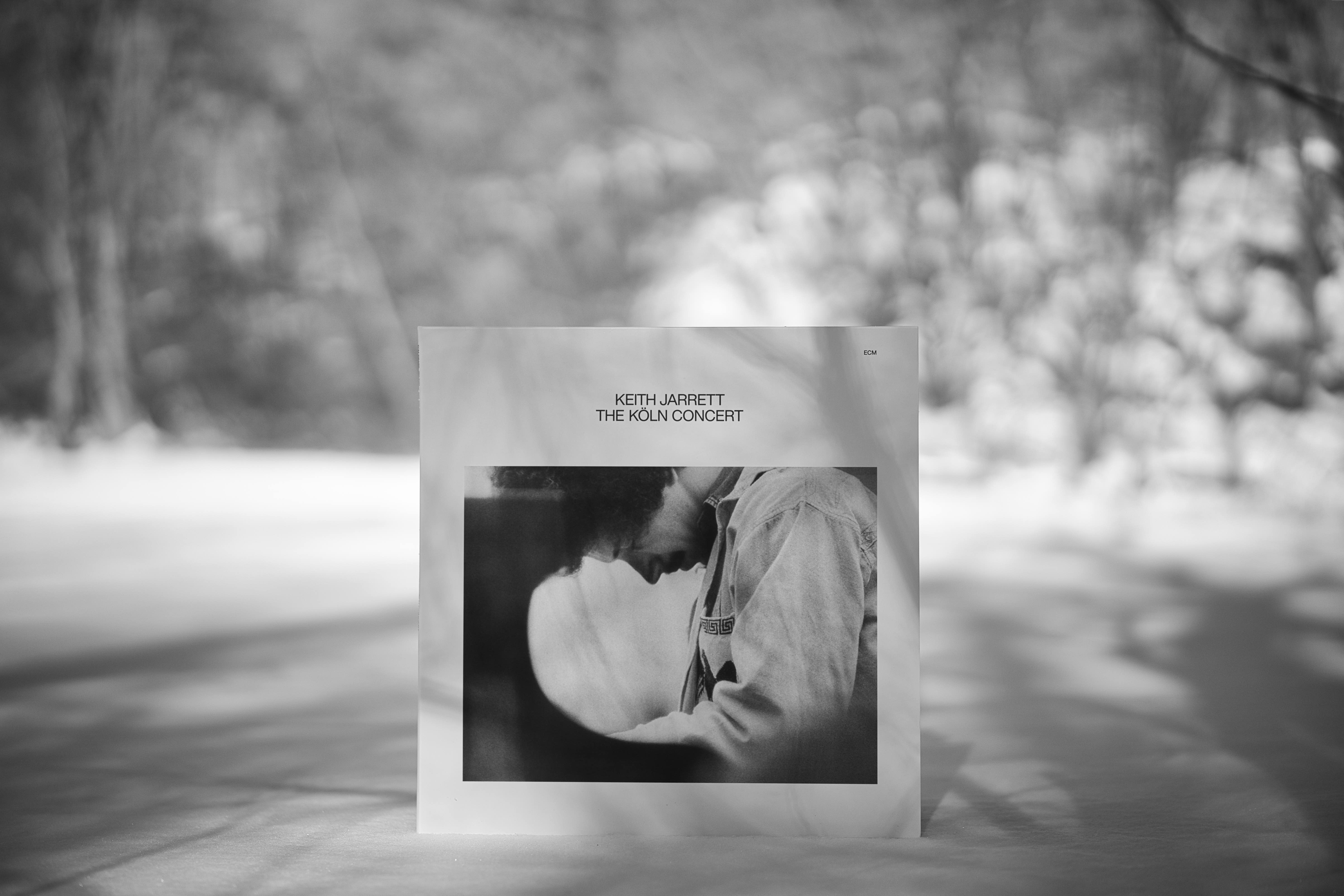
Roberto Masotti: Keith Jarrett – A Portrait

Italian photographer Roberto Masotti (1947-2022) was among the most perceptive visual chroniclers of modern music, a figure whose work shaped the sensibility of ECM Records. His photographs graced nearly two hundred covers and booklets for the label, forming a parallel archive to the music itself. From the austere radiance of Officium to the quietly arresting portrait of John Cage that frames Herbert Henck’s recording of the composer’s early piano works, Masotti played a role in defining how this music would be seen, approached, and remembered. He was not merely a documentarian of studio sessions but a devoted listener whose camera functioned as a secondary instrument, tuned to the inner heartbeat of performance. Nowhere is this fusion of attention more evident than in Keith Jarrett: A Portrait, a volume that reads less as a record of appearances than as an extended act of listening rendered visible.

Masotti’s own words illuminate his method with uncommon clarity. “In this series of photographs that I observe with a retrospective gaze,” he writes, “I play with the concept of presence, that one of the body and the one of the instrument, which appear and disappear in the image.” He speaks not of capture but of exchange, of an intimacy grounded in restraint. These photographs arise from what he calls an “objective attention” shaped by long admiration, yet they are equally the result of Jarrett’s conscious acceptance and active participation. The images are thus collaborative in spirit, not imposed from without but allowed to unfold through mutual recognition. What remains is an archive that resonates with sound even in silence.

To move through the sequence so carefully composed in this book is to encounter a photographer who understands that an artist such as Jarrett cannot be approached through biography or chronology alone. Masotti storytells through a mode of looking that resembles ritual, one without a prescribed outcome, sustained only by attention. For him, photography does not consist of isolated instants but of moments, a distinction that carries ethical weight. Within a moment, an entire accumulation of experience can register itself through posture, gesture, or stillness. This understanding leads naturally to a deeper inquiry: what, after all, constitutes a portrait?

In Masotti’s hands, the portrait ceases to be an act of description. It becomes a site of encounter where identity is neither fixed nor fully disclosed. A portrait does not declare who its subject is; it asks how presence manifests, and under what conditions it withdraws. In this sense, the portrait is not a mirror but a threshold. It holds open the possibility that what is most essential about a person may resist total visibility. Masotti seems keenly aware of this tension. He recognizes the value of distance, of knowing when not to press closer, of allowing the subject’s aura to assemble itself without the insistence of the lens. This discipline is inseparable from his deep admiration for Jarrett, an admiration rooted not in fandom but in experiential listening. He does not set out to check off the pianist’s achievements so much as to dwell within their unfolding.

It was through Jarrett, in fact, that Masotti first came into ECM Records’ orbit. At the pianist’s recommendation, he traveled to Munich in 1973 to present a photo shoot to producer Manfred Eicher. The encounter proved decisive. The images were received enthusiastically and would soon be incorporated into the Bremen/Lausanne release of that same year, marking the beginning of a collaboration that would shape the label’s visual identity for decades to come.

Jarrett’s well-known sensitivity to distraction during performance posed a particular challenge. To photograph him in action required not only technical skill but a form of empathy calibrated to the moment. Masotti met this challenge with a chameleonic tact, adapting himself to the environment rather than imposing upon it. The resulting images often unfold in a montage that feels almost cinematic, though they never lapse into spectacle. Their power lies in continuity, in the quiet accumulation of gestures and expressions that suggest movement beyond the frame.

1971, Miles Davis Group, Philarmonie di Berlino
1973, Monaco di Baviera, America Haus, soundcheck
1974, Pescara, Jazz Festival
1999, Verona, Arena, Jazz Festival, with Manfred Eicher
2002, Lucca, Summer Festival

Taken together, the images chart Jarrett’s evolution from a fiercely expressive sideman in the orbit of Miles Davis to an increasingly enigmatic figure, and finally to a singular presence in solo improvisation. Yet the photographs resist narrative closure. They do not resolve into a story so much as a constellation of states. Among them, one image stands apart. It is the second one above, where Jarrett’s face appears refracted in soft color, suspended between clarity and dissolution. Masotti, a photographer of formidable technical command, rarely indulged in overt manipulation. Here, however, he allows the image to drift toward the spectral. The effect is restrained yet profound. It touches something central to Jarrett’s music, its simultaneous rootedness in the physical act of playing and its persistent reaching beyond the self. The photograph carries within it a residue of sound, an afterimage of music that seems to hover just beyond reach.

Keith Jarrett: A Portrait proposes a way of seeing that honors absence as much as presence. Masotti reminds us that the deepest forms of attention do not seek to possess their subject. They remain open, patient, and receptive. The book closes with a quiet suspension between composition and improvisation, as though the music has not ended but simply moved elsewhere. In that lingering space, photographer and musician meet on equal terms, each attentive to the other, and to the fragile, enduring moment they share.

Björn Meyer: Convergence (ECM 2844)

Björn Meyer
Convergence

Björn Meyer 6-string electric bass
Recorded September 2024
Bavaria Musikstudios, München
Engineer: Michael Hinreiner
Cover photo: Jan Kricke
Produced by Manfred Eicher

In the wake of 2017’s Provenance, Björn Meyer widens his territorial reach on the six-string electric bass with a second solo album that feels less concerned with claiming ground than with listening for its contours. His ever-deepening attunement to space and the forms that allow it to exist becomes the true subject here, and his skills are offered not as a display of mastery but as the slow emergence of a language still discovering its grammar. What might initially register as post-production illusion reveals itself, upon closer attention, to be articulated in real time through a deft choreography of live effects. Magnets prepare the instrument for unfamiliar conversations, finger tapping redraws its internal architecture, and entire washes of sound are permitted to overtake the listener in search of calm.

The album opens with its title track, setting a narrative in motion while refusing to pin it down. Each encounter reshapes the story, rearranging its implications without altering its essence. A fuzzy tone carries a gentle spirit within it, one that moves the way sediment drifts and resettles after a glass of wine has been swirled. Notes surface in reverse order, establishing a tonal context in which the debris of this slow-motion tornado can be articulated through pointillism. The resulting shape and flavor recall Steve Reich’s Electric Counterpoint, though here the patterning feels provisional, animated by a restless urge to stray just as readily as it returns. Deeper strums and higher callings exchange roles, and the sky above the music darkens by degrees, one shade at a time.

As the climate of “Hiver” briefly brightens the scene, it emits a particular quality of light, the muted radiance that arrives under an overcast sky on the verge of snowfall. In this moment, it becomes clear that the narrative forming across the album is inward-facing. This is not the documentation of a journey so much as the journey undertaken by the one who documents. When the echoing bird calls of “Drift” begin to tug at the soul, they do not ask for permission. Direction is accepted without resistance, and the listener seeps further into the flow of time, less a passenger than a dissolving witness. “Gravity” resists the comfort of arrival altogether, suspending any promise of destination in favor of an elliptical song that bends back on itself. Meyer’s guitaristic approach draws a rose’s worth of texture and fragrance from the bass, unfolding petal by petal until only the stem remains. In “Motion,” it becomes a receiver tuned to a distant transmission. Subtle glitches and pulses trace the heartbeat of another time, and when that signal falls silent, only an echo remains to confirm it ever existed.

With “On Hope,” fluttering wings and a tactile fuselage lend lift to the album’s vessel, suggesting ascent without insisting upon it. Just as the cusp seems within reach, a malfunction intervenes, pulling everything back into the improvisational clang and hum of “Rewired.” The interruption does not feel punitive but necessary, a reminder that flight depends on friction as much as flow. When the circuitry is restored and life resumes its forward momentum, “Magnétique” extends the promise of repair. Its circular motifs and palpable sense of contact arrive as a blessing to worn ears, sound reconnecting with touch. That promise finds its fulfillment in “Nesodden,” which lowers itself not into sleep but into a state of awakening, discovering tenderness in the act of becoming and allowing that discovery to stand on its own.

This music reaches us only after its initial blaze has already passed, its transient glory having dispersed into silence somewhere beyond our reach. What remains is not absence but residue, an ember glow that warms the present without explaining itself. To listen is to accept that distance, to recognize that meaning does not diminish as it travels, and to sit quietly with the feeling that something vast has chosen, briefly and generously, to make itself known.

Alessandro Sgobbio: Piano Music 3

To say that Piano Music 3 continues where Alessandro Sgobbio left off on Piano Music 2 would be misleading, since this record feels less a step forward than a careful turning back toward the source, a reversal that reveals new truths by retracing old paths. The electronics remain, but rather than projecting momentum they seem to seep inward, extracting hidden ligaments from the piano’s body and letting them fall gently into the past. In “De Dei Dono,” barely discernible voices hover at the threshold of language, murmuring reminders that intention and consequence are often separated by a breath, that meaning arrives only after action has already passed. This dissolves seamlessly into the fragile radiance of “Red Gold,” an acoustic meditation whose quiet grandeur carries the weight of countless unnamed lives, each one lifted briefly from the archive of history and consigned to its fire, not to be erased but transmuted. “Echoes” reopens the digital aperture, arranging time with almost devotional care, as if memory itself were being sorted and polished in a dream. When the world outside feels uninhabitable, the music invites retreat into an interior sanctuary where despair still sings and hope persists despite knowing better, each phrase reaching upward while slowly collapsing. Within this tension, “Dogs On 5th Avenue” arrives with startling clarity, a cinematic reverie steeped in nostalgia that gestures toward a vanished geography preserved only on fragile film. Each return to it wears away more detail, faces softening into abstraction, footsteps advancing with quiet resolve while already suspecting the promise of arrival. As “Dawns (صور)” unfurls, beauty and grief become inseparable, and the act of listening feels perilously close to mourning, an unguarded response to the daily violence done to faith and empathy by a world addicted to fear. In such a climate, music offers not escape but a rare form of repair. “Veils” draws the self inward with measured grace, its flowing arpeggios and subtle electronic pulses converging into something revelatory, shedding concealment rather than enforcing it, blooming into nocturnal tenderness and the possibility of love. “Forte Rocca,” Sgobbio’s reimagining of Martin Luther’s “A Mighty Fortress Is Our God,” speaks with austere urgency, reframing the piano as a structure of shelter and resistance. At last, “Alang” advances carefully into first light, bearing the quiet residue of what has been lost so that something else may endure, leaving the listener suspended between fragility and resolve, uncertain yet unwilling to surrender the hope that survival itself can still be an act of grace.