Miroslav Vitous double bass, keyboards Gary Campbell soprano and tenor saxophones Roberto Bonisolo soprano and tenor saxophones Aydin Esen keyboards Gerald Cleaver drums Nasheet Waits drums
Recording producer and engineer: Miroslav Vitous
Recorded March and May 2010, February and March 2011 at Universal Syncopations Studios
Assistant engineer: Andrea Luciano
Executive producer: Manfred Eicher
Release date: June 10, 2016
The bass of Miroslav Vitous has been a hub of creative activity since making its ECM debut on 1979’s collaboration with Terje Rypdal and Jack DeJohnette. In the intervening six years since leaving Weather Report, he had deepened his voice on the instrument, taking his arco dialects into more fluent directions than ever. Unlike its soft companion, Remembering Weather Report, which evoked the feel of his seminal band, this latest redux dives headlong into the cofounder’s originals that made Weather Report shine. Fascinating not only for its audacity, but also for its assembly, it pairs drummers Gerald Cleaver, occupying the left channel with saxophonist Gary Campbell, and Nasheet Waits, occupying the right with saxophonist Roberto Bonisolo. Rounded by Turkish keyboardist Aydin Esen, the sound is best realized on the tune “Seventh Arrow,” in which both sides of this improvisationally free equation flip on a glowing equals sign. Along with “Morning Lake,” which unleashes a quiet army of melodic water skeeters, it references Weather Report’s very first album from 1971 on Columbia.
The music of Joe Zawinul is a touchstone of the program, which opens with “Scarlet Woman Variations” in a necklace of reiterations as threaded by an electronically enhanced Vitous and the clarion sopranism of Campbell. In that same spirit the sextet takes on a reshuffled “Birdland Variations,” wherein joy abounds. Like the two “Multi Dimension Blues” of Vitous sandwiching it, it finds beauty behind closed eyes and open hands. Best described in Vitous’s own words as “two galaxies or universes pulling and affecting each other,” the two tandems therein create more than they replace. Esen’s atmospheric touches in “Birdland” evoke more of the same, only now with a more nostalgic feel that’s still fresh as a sunrise. Wayne Shorter’s “Pinocchio” gets an even freer treatment that traces the present band’s luminescence with astronomical precision.
In “Acrobat Issues,” Vitous rebinds an old book with burnished leather, leaving the gold stamping to the dialoguing tenors and the final stitching to his drummers. Hearing their interplay so beautifully recorded will give those familiar with Weather Report much to celebrate, while to those not it will serve as the eyepiece of a time-honored microscope looking in on a watershed moment of jazz history.
If a story is determined by its beginning and ending, then this Selected Signs boxed set, specially curated for the “ECM: A Cultural Archaeology” exhibition held at Munich’s Haus der Kunst in 2013, is a narrative of frayed edges. Put another way: an open circuit waiting for the listener’s magnetic field. Whereas the first sounds are from Heiner Goebbels’s Der Mann im Fahrstuhl, a multimedia drama born from technological anxieties, the last shape the lips of bard-among-us Robin Williamson, whose unaccompanied song “The World” examines the flesh’s place in endless creation.
Between these two extremes, as distant as they are connected by the six-CD spectrum they delineate, ECM Records founder and producer Manfred Eicher has gathered 85 sonic beacons all lit within his creative purview. Unlike Selected Signs I and II, both plucked from a younger catalog, the present collection feels more like the conspectus those predecessors never could have been. As such, it’s as close as the label has ever come to representing itself under one title.
The first disc maps its genetic profile from ECM’s New Series, exploring a variety of topographies, from the temperate zone of Steve Reich’s Music for 18 Musicians and Joseph Haydn’s The Seven Last Words to the peaks and valleys of Arvo Pärt’s Tabula rasa and C.P.E. Bach’s Fantasie für Klavier fis-Moll, while beyond those contrasts tapping into the connective tissue of Tigran Mansurian’s Testament, Betty Olivero’s Neharót Neharót, and Meredith Monk’s Scared Song. The latter, taken from the 1987 portrait Do You Be, is equally concerned with the storytelling impulse to which all humanity is connected by nature. It’s also a neurological masterpiece that realizes an intersection of freedom and intention such as only ECM could forge.
Disc 2 returns to decidedly German territory with a foray into the Hörstücke of Goebbels. This gnarled talisman of voices, orchestra, and saxophone is a jarring yet somehow logical lead-in to Giya Kancheli’s arresting Vom Winde beweint, the first movement of which floats Kim Kashkashian’s fleshly viola on a bodiless current of strings. This is followed by an excerpt of the Funeral Canticle by John Tavener, a composer who has yet to appear on the label. Despite being an outlier (this performance is taken from a 1999 Harmonia Mundi recording by the Academy of Ancient Music), it feels right at home and transitions seamlessly into the String Quartet No. 15 of Dmitri Shostakovich, as played by the Keller Quartet, which in turn opens a doorway onto the Hilliard Ensemble, whose renderings of Arvo Pärt’s Most Holy Mother of God and the 16th-century Spanish song “Tres morillas m’enamoran” (for which they are joined by saxophonist Jan Garbarek) are sandwiched by the Largo of Shostakovich’s Chamber Symphony op. 110. Echoes of that ashen, somber beauty blossom in slow motion throughout two Postludiums of Valentin Silvestrov.
Disc 3 is dedicated almost entirely to composer Eleni Karaindrou. Her music has been a reliable way station along the New Series path for decades. Twelve of the fourteen selections are grafted from Concert in Athens, while the last two are emblematic excerpts from The Weeping Meadow. The sheer depth of feeling in both the writing and the performances prove Eicher’s vision and its ability to embolden others in kind. The most compelling transition comes next via Garbarek’s Dis, the title track of which treats an Aeolian harp as a moving canvas for wooden flute. Closing out this intimate color shift are two songs from Jon Balke and Amina Alaoui’s multicultural Siwan, including the hedonistic “Ashiyin Raïqin,” in which Alaoui sings: “How lucky we are to find this spot for our sojourn.” No sentiment could be truer here. That project’s Iberian roots are echoed in the Passacaglia andaluz II and kindred smattering from Rolf Lislevand’s Nuove musiche.
Things get decidedly cinematic on Disc 4, wherein the ambient touches of Andrey Degatchev’s soundtrack to The Return trace their utterances across physical and metaphysical waters alike. Even the pastiche of Nils Petter Molvær’s seminal Khmer—every track of which, save the last, is preserved—feels like imagery in sound. “Song of Sang II” is transcendent in this and any context, an anthem for all time keening from a past without walls. A new outro is suggested in the spidery “Close (For Comfort)” from Eivind Aarset’s Dream Logic.
As if all of that didn’t already feel like a full-body dip into the ECM font, Disc 5 adds rays to the widening dawn from a range of jazzier persuasions. The Stefano Battaglia Trio regales us first with its 12-minute “Euphonia Elegy,” providing an oceanic set-up for the electronic groove of Food’s “Celestial Food” and the Tord Gustavsen Quartet’s acoustic “Prelude.” What follows takes us all over the ECM map, tracing a red line from the solo guitar of Egberto Gismonti’s “Memoria e Fado” (as well as his magical collaboration with Garbarek and Charlie Haden, “Carta de Amor”) and the vocal honesty of Norma Winstone’s “Like A Lover” to the freer language of the Christian Wallumrød Ensemble and trumpeters Ralph Alessi and Tomasz Stanko. Along the way we also find sacred geometries in the Byzantine renderings of pianist Vassilis Tsabropoulos and cellist Anja Lechner and the Colin Vallon Trio’s appropriately titled “Telepathy.”
Disc 6 chambers the oldest relics, starting with the Jimmy Giuffre 3’s premiere take on the Carla Bley classic “Jesus Maria.” Other archival gems in this final reckoning include “Time Will Tell” (Paul Bley, Evan Parker, and Barre Phillips), “Lonely Woman” (off the 1979 self-titled debut of Old And New Dreams), “Voice from the Past” (title track to Gary Peacock’s outstanding excursion with Garbarek, Stanko, and Jack DeJohnette), and “Kulture Of Jazz” by Wadada Leo Smith. Giving contrast to these precious diamonds are the worldly ores of “Langt innpå skoga” (Sinikka Langeland) and “Psalm” (Frode Haltli). In their dialogue, new orders are suggested, imagined, and liberated.
Because these selected signs, at the exhibition itself, were heard only through headphones or in walk-in listening stations, a strange balance of privacy and openness hovered in the background of their presentation. But like the field recordings interspersed throughout the sequence suggest, they were but itinerant souls in search of a home. And in this box they have found just that, waiting to become a part of yours.
Thomas Strønen drums Ayumi Tanaka piano Håkon Aase violin Lucy Railton violoncello Ole Morten Vågen double bass
Recorded March 2017, Auditorio Stelio Molo RSI, Lugano
Engineer: Stefano Amerio
Produced by Manfred Eicher
Release date: January 19, 2018
Time is a blind guide….
To remain with the dead is to abandon them….
One becomes undone by a photograph,
by love that closes its mouth before calling a name…. –Anne Michaels, Fugitive Pieces
Since its ECM debut in 2015, drummer and composer Thomas Strønen’s “Time Is A Blind Guide” has grown by apparent parthenogenesis into a project of malleable form. On Lucus, that form assumes a variety of shapes, intersecting in the same limpid pool of night. As a treatment of celestial expressions, the material is as much suggested as composed, trusted to flourish in fortifying hands. Strønen kindly explained to me via email TIABG’s continued growth:
“Time Is A Blind Guide has more and more become an autonomic organism with its own musical life. Different constellations (duos, trios, etc.) appear within the ensemble, and the material is treated with more freedom and stronger interplay. Variations in how the pieces are preformed have grown and a stronger personal language has been developed, to the point where we manage to form ideas into our own world, thus allowing us to widen our musical expression.”
Strønen’s sense of widening expression wraps its amorphous arms around “La Bella,” which by its triangulation of violin (Håkon Aase), cello (Lucy Railton), and malleted drums elicits a feeling of circulation given blood by the piano (Ayumi Tanaka). This quiet yet resolute introduction, itself an awakening into moving imagery, embodies a cinematic process: a projection of light onto uniform surfaces where freedom dances to the tune of a faintly outlined script. “Friday” is potent in this metaphorical regard. From its montage of recollections emerges a story to which only listeners may add a beginning and an end. Bassist Ole Morten Vågen taps into the very spine of this music, while Tanaka’s presence, a relatively new addition to the TIABG nexus born from live performances, is magical in these turns of phrase. Her gestures elicit speech without words. And while there are no solos to speak of, save for Strønen’s narrative stroke of brilliance in “Baka” and Vågen’s intro to “Tension,” as organs of the same body, each has its function, singing with the whole in mind.
“Fugitive Pieces,” referring to the novel from which Strønen adopted the band’s name, is an intimate and poetic character study, given wings by instruments of touch. The title track, too, separates filaments of interpretation from emotional moonbeams. So much of what happens in the horizontal regressions of “Release” or the more detail-oriented rhythms of “Wednesday” is built on foundations wrought in the foundry of live performance:
“We have toured a lot over the past year, having played in the US, Brazil, Japan, and Europe. This, combined with rehearsals, has contributed to the way we play today. We knew the material well and recorded the whole album within a day and a half. The music was written with the acoustics of the studio in mind and that has also lead to us wanting to play more concert halls and larger concert rooms than small clubs.”
Producer Manfred Eicher, as always, had a hand in what transpired, giving that extra puff of wind needed to satisfy even the most tattered feathers:
“I wasn’t surprised but rather happy that Manfred had great belief in the record. He also contributed strongly in studio, communicating ideas and details that shaped the compositions. He quickly understood what I aimed for and was a strong force during the recording.”
If inclinations of that force of, and desire for, space weren’t already apparent, they step forth most boldly in “Truth Grows Gradually” and “Weekend,” both of which unfold as stories told out of time. Like the album as a whole, they are a chronology of the soul, wrapped and unwrapped until nothing but truth remains.
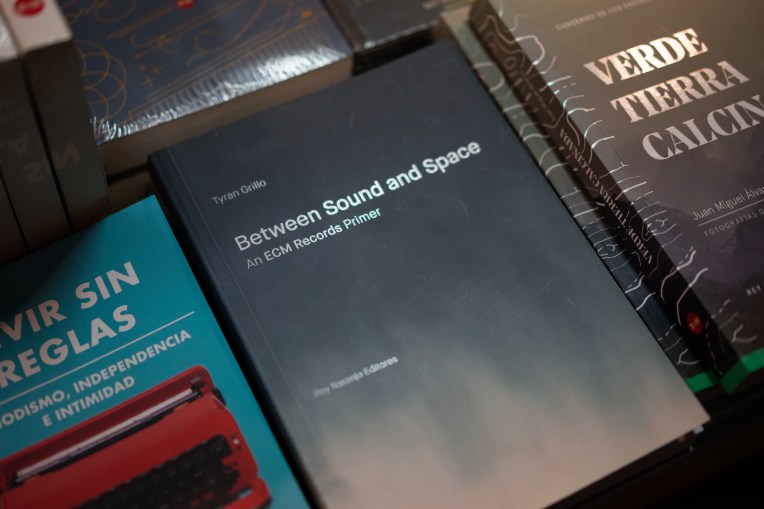
On 10 February 2010, I began this blog with the goal of reviewing every album issued by ECM Records proper and its New Series imprint. Four years ago, I achieved said goal. Within hours of announcing this milestone, I was approached by Raúl Zea of Rey Naranjo, a publisher of fine books based in Bogotá, Colombia. As it turned out, Raúl was a huge ECM fan and had been reading my blog from almost the beginning. His proposal: To publish a book of selected reviews. My answer: When can we start? Fast-forward to 27 April 2019, and I found myself boarding an airplane bound for the annual Bogotá International Book Fair (a.k.a. FILBo) to hold the volume in my hands at last and present its contents to fans and newcomers alike over the course of five days.
As the book evolved into its present form as Between Sound and Space: An ECM Records Primer, my editors and I felt it necessary to marshal the reviews to speak to a variety of audiences. True to its designation as a “primer,” it is first and foremost intended as a doorway into the label’s manifold wonders. For that reason, inclusion of such classics as The Köln Concertwas absolutely necessary. On the other hand, I wanted to highlight albums that even seasoned listeners might have overlooked. Out of those two extremes emerged 100 specially curated and recrafted essays, rounded out by a smattering of personal favorites: a journey through ECM’s ongoing history that I hope will inspire readers in new directions of listening.
This slideshow requires JavaScript.
Upon arriving at my hotel, I was draped with my FILBo credentials and guided to my publisher’s table. Yet before I could even marvel at a product years in the making, I had to take in the sheer scale of the fair and its throngs of passionate attendees—many of whom, I would discover the next morning, would be lined down the block three hours before opening time.
As I waded through cliques of voracious readers, I at last came face to face with the editor who had made this trip a reality, and with the work of art he and the Rey Naranjo team had labored to print in time for this event.
After a round of introductions, and a sampling of local cuisine (including my first bowl of ajiaco), I was ready to succumb to the toll of travel knowing that my love letter to a life-changing record label now had a life of its own.
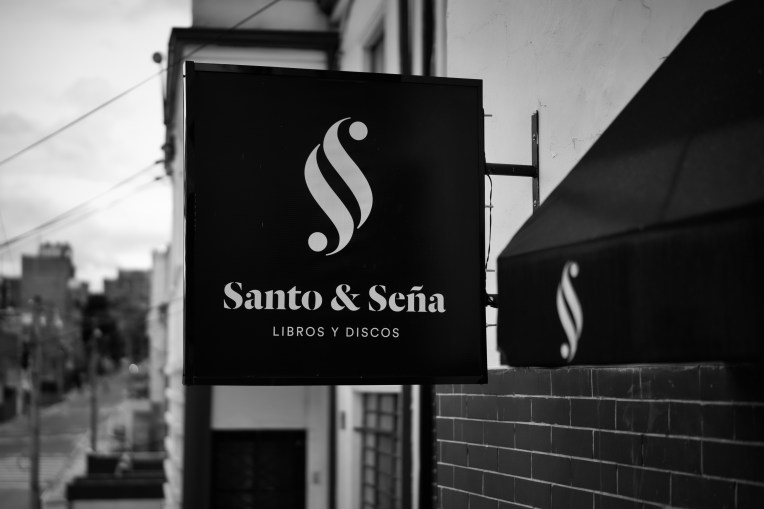
The next few days were a promotional whirlwind, including two interviews for Colombian radio, two book talks, an interview with The Bogotá Post, and a video shoot at my publisher’s bookstore, Santo & Seña, for an upcoming crowdfunding campaign in anticipation of the book’s international version (to be released in early 2020). While it was exciting to be the center of so much attention, I also knew that none of it would have taken place without the vital music that had brought me into that center to begin with. Being able to share my knowledge with ECM fans in another country felt like the first step toward a larger conversation that I can only hope my book will provoke and sustain in the future.
Before leaving the city, I rode a cable car to the top of Monserrate, where Bogotá’s wider embrace became at last apparent.
The long stairway to the very top was a sobering reminder that no journey is possible without the steps required to bring its destination into view. And, like the gradations of mountain and concrete that bid me farewell, nothing we do is possible without the input of untold lives, laboring through cycles of sun and moon until our blessings are indistinguishable from all others.
For those blessings, I would especially like to thank Raúl Zea and John Naranjo for believing in me from day one, Andrea Salgado for the gracious invitation, Aurélie Radé for navigating the complexities of airline politics, Dulce María Ramos for coordinating interviews and rushing me to every venue on time, Luisa Martínez for her gentle kindness (and the flower), Guillermo Concha and Liladhar Pendse for proving that strangers should never stay that way for long, Juan Carlos Garay and David Roa for enlightening conversations in front of vastly different audiences, and the interpreters, including Ale Bernal, who rendered those conversations into Spanish under tight circumstances.
Bill Frisell guitar Thomas Morgan double bass
Recorded live at the Village Vanguard, New York, March 2016
Engineers: James A. Farber and Paul Zinman
Assistant engineers: Own Mulholland and Jim Mattingly, SoundByte Productions Inc., New York
Mixing at Avatar Studios, New York, December 2016: James A. Farber, Manfred Eicher, Bill Frisell, and Thomas Morgan
Produced by Manfred Eicher
Release date: April 12, 2019
Recorded live at The Village Vanguard in March 2016, Epistrophy continues where the conversation between guitarist Bill Frisell and bassist Thomas Morgan left off on Small Town. In the hands of this duo, a song like “All In Fun” assumes a double meaning. While the pair indeed are enjoying this musical experience, they bring an unforced profundity to the occasion. This tune in particular has what only can be described as a dark buoyancy, a feeling of bobbing along evening waters.
A nod to the folk song “Wildwood Flower” introduces “Save The Last Dance For Me,” which in this context takes on a magical realism. Liberated from their popular associations, tensions emerge in melodic symmetry. Played as lovingly as one could imagine, Paul Motian’s “Mumbo Jumbo” finds Frisell tastefully augmenting Morgan’s psychosomatic filter. The James Bond theme “You Only Live Twice” also gets a heartfelt makeover, its machismo now a quieter drama. And Billy Strayhorn’s “Lush Life” emerges from a series of still images, each further detailing the narrative. The title track and “Pannonica,” both from the Thelonioius Monk songbook, are the set’s core, each a reflection of the other: The former’s sprightly charm and linear paths pair beautifully with the latter’s eddying contemplations. The traditional “Red River Valley” is another key passage of synergy that seems tailor-made for these musicians. Like the Frank Sinatra hit “In The Wee Small Hours Of The Morning” that closes, it activates what is tru- est and purest within them, and in us for being privy to their dialogue.
(This article originally appeared in the June 2019 issue of DownBeat.)
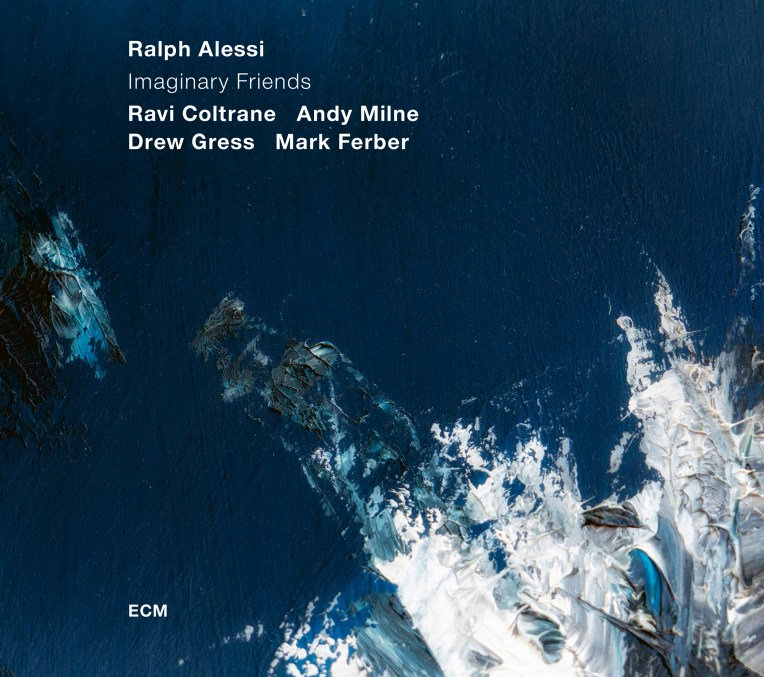
Ralph Alessi trumpet Ravi Coltrane tenor saxophone, sopranino Andy Milne piano Drew Gress double bass Mark Ferber drums
Recorded May 2018, Studios La Buissonne, Pernes-les-Fontaines
Engineer: Nicolas Baillard
Produced by Manfred Eicher
Release date: February 1, 2019
Imaginary Friends marks an ECM threepeat for trumpeter Ralph Alessi. His connectivity with Ravi Coltrane (mostly on tenor saxophone), pianist Andy Milne, bassist Drew Gress and drummer Mark Ferber glows throughout nine originals, of which “Iram Issela” is the heartfelt introduction. Dedicated to Alessi’s daughter (the title is her name spelled backward), it meshes trumpet and piano without a hint of coercion. Coltrane lays low, letting the waves carry him where they will. Alessi’s friendship with him, going back to their student days at the California Institute of the Arts, resonates, as well as in the title track and “Oxide,” one of Alessi’s most exquisite compositions.
Their horns seem to have minds of their own. As free to roam as they are to harmonize, either can take the helm at any given moment, leading to exciting listening. Reflective turns like “Pittance” are all about the trumpet’s emotive powers while “Improper Authorities” allows Coltrane enough room to pave a highway over the rhythm section’s solid roadbed. “Melee” is another compositional masterstroke, which recalls the jigsaw approach of labelmate Tim Berne yet takes on fresh distinction by dint of a calligraphic sopranino. All of this and more funnel into “Good Boy,” a tender quietus.
Most impressive is the relentless spirit of invention. With an average track length of about seven minutes, each tune is a feast for the ears. Indeed, there’s something downright edible about this session, scrumptious from first bite to last and in that proverbial sense dishes out one of the most savory records of the year so far.
(This review originally appeared in the April 2019 issue of The New York City Jazz Record, a full PDF of which is available here.)
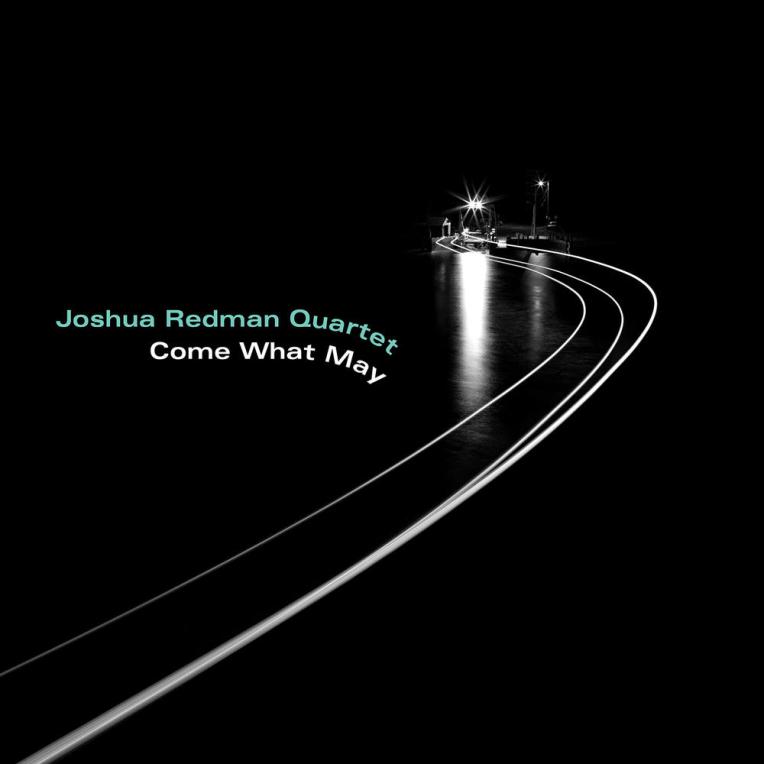
Come What May is the third round for saxophonist Joshua Redman, pianist Aaron Goldberg, bassist Reuben Rogers and drummer Gregory Hutchinson. Like its predecessors, the album presents a spectrum of tunes, working at an even deeper level of maturity. Given that their last studio effort was recorded in 2000, it makes sense that the band should have taken a giant leap in intuition, but such a process is easier said than done and more than a mere consequence of sharing the road and the stage together.
Although varicolored from a thematic standpoint, these seven Redman originals partake of a binding confidence reflective of a conscious willingness to treat medium as message. The title cut and its follower, “How We Do,” are the front and back of the band’s aural business card. In both, Redman and Rogers define and unravel a genuine compositional voice, which resonates through the bandleader’s willingness to explore every idea to its logical end. Goldberg and Hutchinson, for their part, shine in the power walk that is “I’ll Go Mine,” crossing every ‘t’ without a hint of intrusion. These four musicians, whether at their quietest (“Vast”) or most forthright (“Stagger Bear”), would need to expend unfathomable effort not to let their two-plus decades of camaraderie show through. Indeed, “DGAF” sounds like a bunch of old friends finishing each other’s sentences.
That same spirit is reflected in the engineering, which allows every instrument to occupy its own space. While at first this effect feels jarring (there is none of that sense of movement through space only a live experience can articulate), it ultimately leaves it up to the quartet to bridge the gaps between them. The end result is best described as a laid-back adventure, one that is smooth yet grounded enough to withstand the force of expectation.
(This review originally appeared in the April 2019 issue of The New York City Jazz Record, a full PDF of which is available here.)
Giovanni Guidi piano Gianluca Petrella trombone Louis Sclavis clarinet, bass clarinet Gerald Cleaver drums
Recorded February 2015, Auditorio Stelio Molo RSI, Lugano
Engineer: Stefano Amerio
Produced by Manfred Eicher
Release date: September 2, 2016
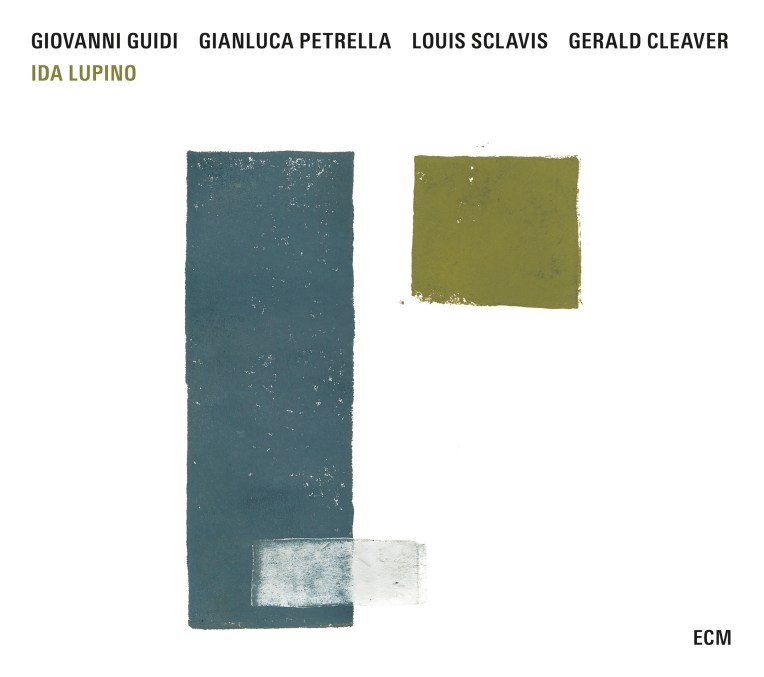
Since making his ECM leader debut with 2013’s City of Broken Dreams, Italian pianist Giovanni Guidi has paved a new path with every release. For Ida Lupino, he convenes Enrico Rava bandmate and virtuoso trombone player Gianluca Petrella, clarinetist Louis Sclavis, and drummer Gerald Cleaver for a set built almost entirely on improvisation. Two exceptions are the album’s eponymous tune by Carla Bley, which here receives an ode-like treatment in celebration of its composer’s 80th birthday, and “Per I Morti Di Reggio Emilia,” a song written by Fausto Amodei in memory of demonstrators who fell victim to police violence on July 7, 1960. The latter’s guttural trombone and persistent cymbals rekindle those political fires as warmth against the frigid climate in which we now find ourselves.
At the heart of this session are Guidi and Petrella, who among the quartet share the longest working relationship. Their spotlight shines brightest in “Gato!” This nearly 10-minute narrative reveals itself one sentence at a time, toeing a line drawn by cymbals with dialogic abandon, before ending in a lullaby of piano. This same combination begins the album in “What We Talk About When We Talk About Love” and ends it in the tactile stumble of “The Gam Scorpions.” Notable for its subtle shadings is “Hard Walk,” throughout which Petrella focuses on breathing over notecraft as primary method of communication. He and Guidi row their most fascinating waters, however, in “Fidel Slow” and “Zweig.” These distinctly three-dimensional duets write their own dictionary as they go.
Sclavis’s reed work, as always, abounds with invention. Whether roaming the desert of “Just Tell Me Who It Was” with plenty of groovy water to spare or exchanging bon mots with Petrella in the witty “Jeronimo,” he treats virtuosity like breathing. Further highlights include the fibrillated “No More Calypso?” and “Things We Never Planned.” The latter might as well have been the title track, showcasing as it does the band’s willingness to go wherever the music leads. Guided by intuition alone, they make no effort to understand anything but the moment, eschewing concrete rhythms for liquid assets.
An altogether worthwhile peek into minds that always seem to be expanding into the next motif before the current one is finished.
Harmen Fraanje piano Mats Eilertsen double bass Thomas Strønen drums
Recorded May 2018, Auditorio Stelio Molo RSI, Lugano
Engineer: Stefano Amerio
Produced by Manfred Eicher
Release date: February 1, 2019
A feeling of transcendence occurs the moment Harmen Fraanje’s pianism wraps its arms around you in “22,” the introduction to bassist Mats Eilertsen’s And Then Comes The Night. And as the brushes of drummer Thomas Strønen complete the triangle, you find yourself being ushered through a portal unlike any other to a space where harmony whispers between every air molecule. That this tune—one of Eilertsen’s—also closes the album in variation is testament to the circularity of life, the very dust from which melodies arise and to which they must return.
The spontaneous creations of “Perpetum” and “Then Comes The Night” yield the most intimate moments of the session. Whether in the former’s subterranean percussion and arco bassing or the latter’s angular pianism, passion exudes from the pores of this music’s skin. This is by no stretch of the imagination a group in search of a groove or means to convey it, but rather, as in the Fraanje-penned “Albatross” and “Soften,” concerns itself with memories in the making. The piano/bass duets of “After The Rain” and “Solace” underscore the necessity of climate in their evocation of wind and stillness. In both, comfort is achieved by virtue of awareness alone. This is playing that relies on faith to shield its feet from burning sands and frozen tundra alike.
In Eilertsen’s own “Sirens” and “The Void,” mosaics dissolve into watercolor and vice versa. Each is a window into the other, flush to the touch yet visually dimorphous in contrast, and the second in particular cradles the most nocturnal of bass solos.
Although this album represents a decade of R&D in the trio’s laboratory, and follows two appearances on the Hubro label, you might just feel a genesis at play, reaching tendril after tendril from darkness into light, until galaxies are drawn together into one amorphous whole, spinning quietly if for no other reason than to hear itself sing.









 Between Sound and Space: ECM Records and Beyond