This week marks a new venture for me as a writer for The New York City Jazz Record, for whom my first review appears in the May 2016 issue. Scroll down to read the review. You may also access the entire issue directly in PDF format on the magazine’s website here. The issue also features an article about ECM artist Nik Bärtsch, whose CD release concert for the new album Continuum I will be reviewing for All About Jazz in May.
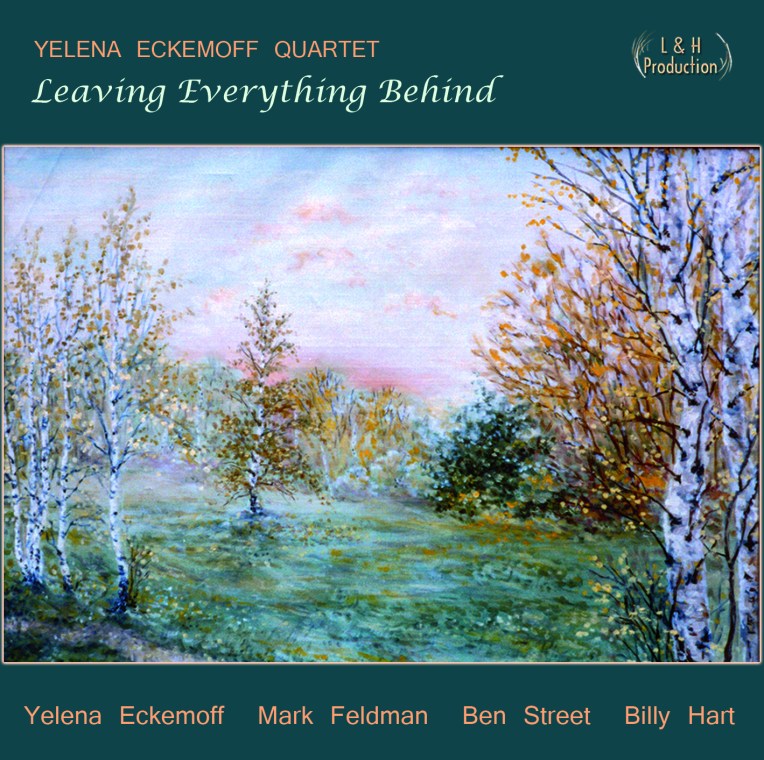
Since 2006, pianist Yelena Eckemoff has been stirring a chamber jazz cocktail two parts through-composed for each one improvised. With Leaving Everything Behind, she has perfected it. Eckemoff’s road to this point has been paved with classical roots, but has attracted increasingly heavier hitters of jazz to her entourage. Her friendship with bassist Arild Andersen, for one, led to their “Lions” trio with drummer Billy Hart. The latter’s approach to color makes for an easy corollary to Eckemoff’s painterly ways and his retention this time around is felt alongside two new collaborators: violinist Mark Feldman and bassist Ben Street.
Though Eckemoff has always been a self-aware musician, Leaving Everything Behind finds her in an especially conceptual mode. She repurposes earlier compositions among the fresh to tell the story of a young woman fleeing Soviet Russia and the ways in which music has constructed bridges to the places she put behind her. Whether comping with confidence in “Mushroom Rain” or drawing with light in “Hope Lives Eternal,” she moves around her bandmates by means of a genuinely expressive outreach.
The Eckemoff-Hart nexus gives off its broadest spectrum in the more programmatic pieces. Between the raindrop impressions of the “Prologue” to warmth of closer “A Date in Paradise,” pianist and drummer dispel an overcast sky until only sunshine remains. Titles such as “Spots of Light” and “Ocean of Pines” further indicate that silver linings reign supreme.
The balance of distinctly classical arrangements and jazzier change-ups yields affirmative soloing, most effectively through Feldman’s clear and present notecraft, as in the evocative “Coffee and Thunderstorm,” a quintessential embodiment of what unites Eckemoff’s chosen genres: namely, the ability to expand fleeting moments into poetry. Other highlights in this regard—all the more so, ironically enough, for being so darkly ponderous—include the panoramic “Love Train” and, above all, the simpatico title track.
This set of variations on a theme of memory is Eckemoff’s finest to date and may at last put her on a map where she has been largely ignored.
My latest review for All About Jazz is of Indonesian guitarist Dewa Budjana’s smooth and sultry Hasta Karma. Pat Metheny fans: take note. Watch the video below for a sample, or click the cover to read on.
Bernie Worrell may be best known as the backbone of George Clinton’s Parliament-Funkadelic, but on Elevation that spine sprouts veins, flesh, and wings in the keyboardist’s first solo piano transformation on record. While one may find it to be a surprising turn in an already-varied career, here is where the most paramount vessel of his seeking can be found: the heart.
The tune “In A Silent Way” by Joe Zawinul begins the album with a lyricism more expected of Tord Gustavsen, whose patience is echoed here. Worrell brings out a feeling of the American South in this rendition, painting the then and the yet-to-be in single brushstrokes. Hanging somewhere in the middle, he forges music like the glue between polarities of time. A low bass tone rises from a subconscious abyss, and writes its name across the mind’s eye with the control of a master calligrapher.
Whereas many jazz albums might use such tenderness as a warmup for quicker movements, this one keeps its promises. And so, Bootsy Collins’s “I’d Rather Be With You” lengthens the thread being pulled from this garment, removing a band of color from an overall pattern at once fading and forming. The balladic wavelengths allowed through this sonic portal are of the same frequency as those which link separated lovers by thought alone. Such transcendence is so damn immediate that you can’t help but feel like it’s your hands at the keys. And as Worrell draws lines in the water in order to feel its droplets clinging and separating, he evokes every human life caught in the karmic wheel.
It’s one among a handful of popular songs reimagined to be as naked as possible. Between the anthemic goodness of Carlos Santana’s “Samba Pa Ti” and Bob Marley’s “Redemption Song,” one common theme rules: the hidden truth of slowing down. It’s a philosophy epitomized in his take on “Ooh Child” by one-hit wonders The Five Stairsteps and “I Wanna Go Outside In The Rain” by The Dramatics. Both melt down the base metals of improvisation into the key of Worrell’s uniqueness. He makes no efforts to reveal secrets hidden in these melodies, but rather something far more difficult. He reveals their true selves.
John Coltrane’s “Alabama” is another example, which in the present version evokes rolling plains and clouds of smoke curling from pursed lips. A bittersweet nostalgia seeps through its curtain like light onto a kitchen table that was once alive with laughter but at which now sits only one. The pacing makes every snap of this uprooting that much more lucid to bear, while a stormy shadow trembles beneath it all.
Charles Mingus’s “Goodbye Pork Pie Hat” enacts further transformations from solid to liquid, throughout which balances of technical and creative emotions are under constant negotiation. Worrell turns the entire piece into one long inhale, as if to incorporate every particle of breath before expelling the carbon dioxide of his own infinitude.
Even more permeable borders outline such ruminations as “Light On Water” and “Realm Of Sight.” Each is the culmination not only of elements, but also of impulses that can only be sung, not spoken. Together, they form a modal flower, floating through the dust of history in search of that one stem held in the fingertips of an artist who continues to teach us that connecting with listeners requires the lone musician to unravel into their ears.
This is music you don’t interpret, but which interprets you.
My latest review for All About Jazz is of NYC-based singer Kosi’s tribute to the great Abbey Lincoln, Ghosts Appearing through the Sound. Click the cover to read on.
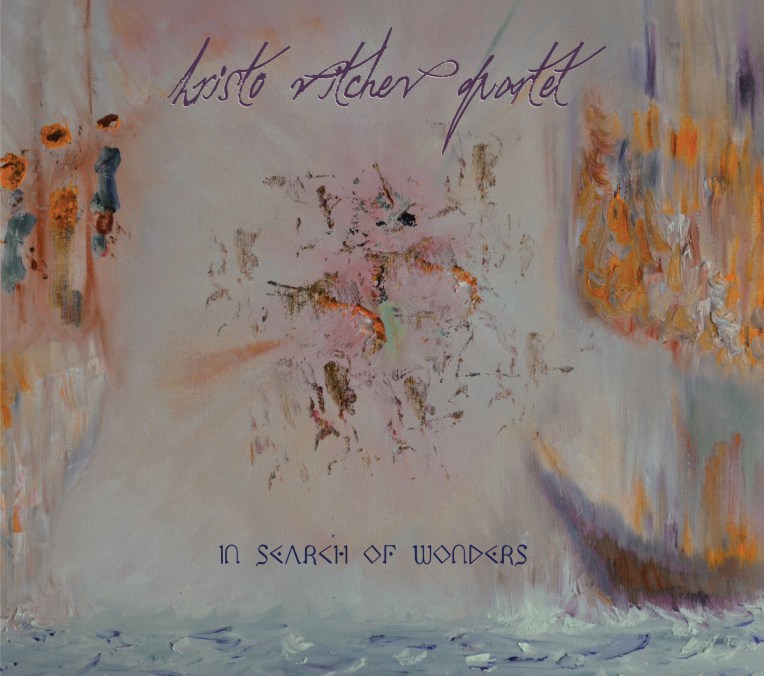
Few guitarists have carried the torch of Pat Metheny so humbly as Hristo Vitchev, and never with such brightness of purpose as on his latest quartet album, In Search Of Wonders. The Bay Area-based musician and producer has since 2009 put out a consistent, top-flight catalog of records, ranging from explorations of his Bulgarian roots to straight-ahead jazz road trips, but always by original design. With Wonders, he has at last tackled that most risky of studio ventures: the double album. The result is not only a magnum opus, but his most emotional work so far, and one that is sure to put smooth jazz naysayers in their place.
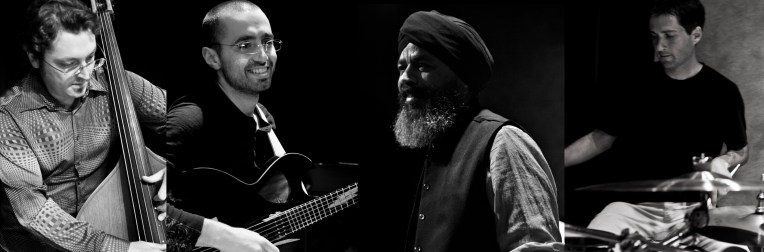
I asked Vitchev to elaborate on the significance of this album, which to me feels like his most autobiographical. “It has been an exciting journey since I started recording and publishing my own work. All the music presented in this release describes who I am both as an artist and person.” And if opener “The Transitory Nature” is any indication, Vitchev’s life has been one lived in deepest gratitude. It’s right there in the brotherhood he shares with his dedicated crew of pianist Jasnam Daya Singh (a.k.a. Weber Iago), bassist Dan Robbins, and drummer Mike Shannon. Their connections are key to the integrity of Vitchev’s sound, which by virtue of its infrastructure expands the limitations of any foundation. “All of us are first and foremost best friends,” says the leader of his bandmates. “The camaraderie, trust, respect, and love we all share is very special. That is in reality all you need as an artist to be able to open and present even the most fragile sectors of your soul and heart. I have only them in mind when I write this music.”
(Photo credit: Don Barnes)
Vitchev further stresses that he has never subbed in other players when performing this music live, and it shows in the leaps of evolution taken by his distinct method of archaeology, which now yields its best preserved artifacts. Among them is “It May Backfire.” Singh’s intro leads the band into a groove of geometric proportions. The unity of vision, held together in no small way by Shannon’s drumming, is well muscled. And while Vitchev may be the light that gives it sanctity, and Robbins a sense of corporeality through his articulate soloing, it’s the density of build through which the collective reality of this music is best spoken.
If I were to draw any internal relationship from the whole, however, it would be that shared between Vitchev and Singh, whose bond in “Post Nubes” and “Fuchsia Brown Eyes” is unbreakable. The latter’s tenderness reveals a hidden, spectral blues in the pianism, which in tandem with Vitchev’s adlibs adds layers of photorealism. The title track, too, with its Brazilian underlay, opens many doors with a single key.
It’s not by chance that tunes like the understated “Falling In Orange,” which opens the second disc, and the greener “It Is Here, Somewhere” should feel so visual. Vitchev has cultivated this quality in his music with great awareness. “My composing process as well as the arrangements are always driven by vivid imagery,” he explains. “When I sit down on the piano to write I will often close my eyes call up a picture. Only when that picture is in sharpest focus do notes, chords, and rhythms take form in ink.” With this in mind, it’s impossible not to read a growing nostalgia into the album’s progression, at its peak in “Old Theme.” The slick, youthful theme yields some of Vitchev’s most inspired soloing on record, rendered all the more exploratory by the rhythm section’s keen regularity.
Memories thrive throughout the album’s remainder. From the rhythmically savvy “Almost Home” to the dreamlike twists of “The Invisible Stairway,” moving pictures abound, at once frozen in, and animated by, time. In this respect, the album is a living portrait of Vitchev as composer, “a little corner of this musical landscape,” as he puts it, “I can call my own.” In other words, Wonders feels more at home than ever because it reaches farther than ever. This feeling of comfort is perhaps what distinguishes it from its predecessors and underscores the message epitomized in the piano-guitar epilogue, “We Search For Wonders.” Vitchev is quick to underline this point by way of conclusion. “Life is full of amazing things, but it takes desire and energy to lift your head, look around, and notice them. We are so grateful to have found each other and do the things we love as a group. These are our wonders, and this is our musical tribute to all that is around us.”
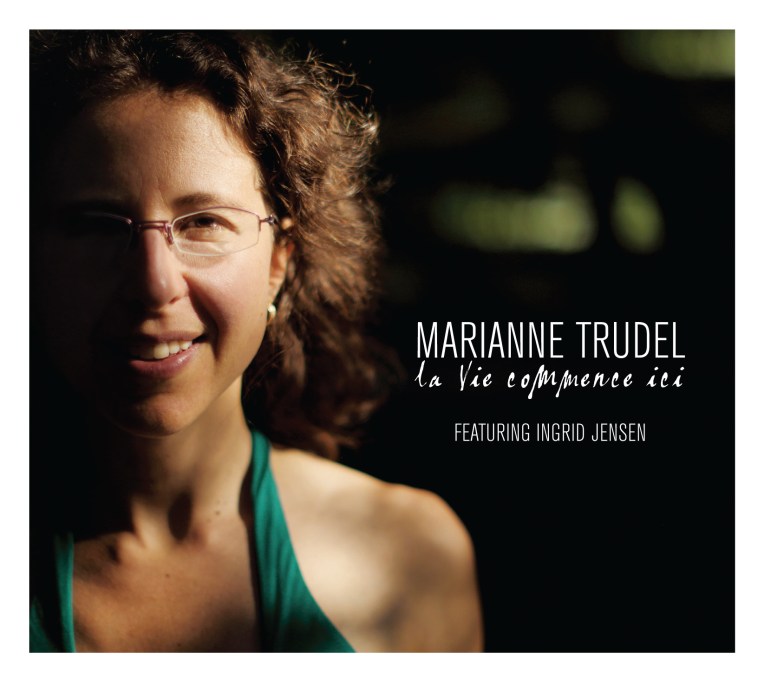
I have two new reviews up on All About Jazz: one of a recently issued live album of an older Sheila Jordan concert with Harvie S and Alan Broadbent, another of of Canadian pianist Marianne Trudel’s La vie commence ici, which should appeal to fans of ECM’s Nordic sounds. Click the covers to read on.
Anat Fort piano Gary Wang bass Roland Schneider drums Gianluigi Trovesi alto clarinet
Recorded November 2013, Auditorio Stelio Molo RSI, Lugano
Engineer: Stefano Amerio
Produced by Manfred Eicher
U.S. release date: April 8, 2016
On Birdwatching, Anat Fort’s third album for ECM, the Israeli pianist and composer proves once again that music is a journey without repetition. I trace this axiom back to her label debut, 2007’s A Long Story, from which “Something ’Bout Camels” carried over into the 2010 follow-up, And If. This time around, another tune from that same record—“Not The Perfect Storm”—makes a reappearance, now re-cloaked by the melodic overlay of Italian reedman Gianluigi Trovesi, who joins her trio with bassist Gary Wang and drummer Roland Schneider for her farthest-reaching record to date. The rumbling pianism of that latter track speaks at once to Fort’s illustrative prowess and willingness to sidestep its clichés. Indeed, beyond the thunder implied in the lower register of her keyboard, the broad wingspan of Trovesi’s alto clarinet speaks of clearer skies. The forces at work are greater than the sum of their parts, which over the course of six and a half minutes emit more light than they absorb.
Moved by this collaboration, I opened a recent interview with Fort by asking about Trovesi’s involvement—a partnership perhaps as inevitable as it was unexpected.
“Unlike with Paul Motian, I was never intimidated by working with Gianluigi. I really loved his work, which I’d known through ECM, and fate brought us together on stage for a jazz festival in Novara, Italy in 2013. A few months later, he joined my trio in Israel. He’s such a gentle and beautiful human being, so there was never any conflict. The only thing that gets in the way is the language barrier, but at any rate we communicate through the music.”
Case in point: “Earth Talks,” which finds them conversing as a duo. Like Fort herself, Trovesi seems to attract entire planetary systems into orbit than be gravitationally pulled into others. His chromatic inflections are the blood flow of her ebony and ivory veins, which pulse with solitude even as they drink in joyful praises. Trovesi walks over, never through, Fort’s articulate themes, so as not to disturb their archaeological integrity. Even when he joins the full trio, as in “Jumpin’ In” or “Murmuration,” his sinewy topography feels like grass in love with the soil. In other words: an affirmation of roots.
Neither does the trio engage with blatant exhibitionism, but finds unity—and utility—in the negative spaces that frame each intimate spectacle. Such alignment to the inner workings of faith gives the quartet all the oil it needs to burn through the collectively improvised “Inner Voices.” Though delicate and exploratory, it never breaks its stare. Such disparate elements reach deepest convergence in two variations of “Song Of The Phoenix,” in which the trio clears a path for Trovesi’s transformation from roaming to mourning. His rougher bending of pitch enhances the emotional gravity at hand. Wang and Schneider reveal themselves to be so much more than a rhythm section, but a listening organ attuned to every gradation. Which is not to say their individual talents are not forthcoming. In the trio-only “It’s Your Song,” Schneider’s drumming is remarkably fluent, moving with the insouciance of an Olympic ice-skater, while Wang’s kinetic solo lends the scene some much-needed heat.
It’s impossible for me to experience such gestures without reading biographical impulses behind each tune. The beauty of this record, as with all of them, is that Fort allows more than enough space for individual interpretation:
“I think that’s how I usually treat my music, or how my music treats me, I should say. It’s a very personal thing. I could even call it a private universe, which of course I’m trying to share by playing and putting out there. This recording is different for having so many short pieces, which wasn’t something we planned to do. But as [producer] Manfred [Eicher] and I started mixing it together, we did more editing than I’ve ever done. It clearly needed to be a story of vignettes. That was a surprise for me, and something that the music initiated, and which we answered collaboratively. As I say in the promo video, the music will convey its own story if you let it.”
Listening to what the music was saying led to Fort to add two improvised piano solos: “First Rays” and “Sun.” Added at the last minute, these became the first and last tracks of the final mix. Within this frame, the album is better able to balance color and monochrome.
On that note of production, Birdwatching marks the first time Fort has worked with Stefano Amerio at the Auditorio Stelio Molo RSI studio in Lugano, Switzerland, thus completing her unintended tour of ECM’s heavyweight engineers, rounded out by Jan Erik Kongshaug in Oslo (And If) and James Farber in New York (A Long Story).
“Each of these experiences has been great,” Fort admits, “and Stefano has a great ear. It was very special to record at the RSI studio, because you record live, setting up on a stage in a very small auditorium without headphones or dividers. It’s really unique to do it that way, and he knows how to record so that it feels live but also clean enough to be crafted.”
One can hear this especially in “Meditation For A New Year,” which boasts some of Fort’s most soulful playing on record, but keeps its expansiveness within reason in search of a major chord. Like “Milarepa,” of which only the first of three parts appears on this album, it indicates a new phase of self-expression, a turning of the ear toward the self to know what may become of love.
Check out my review of this phenomenal new album by violinist Curtis Stewart, who blends classical and jazz influences with equal rigor. Click the cover to read on.