Live Report: Avi Rothbard Trio at Smalls Jazz Club

Avi Rothbard Trio
with Jay Leonhart (bass/vocals) and Tomoko Ohno Farnham (piano)
Smalls Jazz Club
22 June 2015
7:30pm

Israeli-born guitarist and composer Avi Rothbard has earned his stripes in the relentless music scene of New York, where he has lived since 1999 and where his talents have found their way into a range of projects. With such a full palette already on his own, only those musicians with the right sensibility will do for bandmates, and a trio performance with bassist Jay Leonhart and pianist Tomoko Ohno Farnham at Smalls in June of 2015 was just what the doctor ordered in this regard.

Over the course of two richly varied sets, Rothbard and friends managed to balance their idiosyncratic strong points within a smooth group unity. Each musician brought a distinct signature to the stage without ever clashing for dominance. Farnham’s compacted, cellular approach to soloing, for instance, tapped the flavors of old-timey jazz to everything she touched. Whether comping beneath Rothbard’s leading tone in Randy Weston’s “High Fly” or bringing nostalgia and joy to the music of Wes Montgomery and Kenny Baron, she maintained a free, conversational tone. She further showed her inventiveness in Herbie Hancock’s “Dolphy Dance,” for which, in tandem with Rothbard’s sensitive touch, she spun fresh colors from the older threads.

Rothbard, for his part, stretched each tune until it fit like a favorite shirt. As composer, he spearheaded some of the most impressive turns of the night. Three originals—“Eye Talk,” “Twin Song,” and “Minor Impact”—acted as vibrant springboards for the band’s communicative potential, each more appealing than the next. With moods ranging from lyrical to blinding, they had an overall ductile quality that adapted itself to the themes at hand. As technician, Rothbard bared his chops on the theme from I Love Lucy, an unexpected highlight made all the more brilliant for its arrangement and virtuosic energies.

Overall, the drum-less roster allowed the band members to revel in open improvisational spaces. Leonhart was particularly on point in this regard, his playing so percussive that the sticks and skins were hardly missed. A fixture in the New York jazz club scene, Leonhart sang not only through his instrument but also along with it, offering two originals of his own—a self-deprecating blues called “Joy” (another fine vehicle for Farnham) and a humorous ditty about sitting next to Leonard Bernstein on a plane—and a lighthearted take on “Cool,” from Bernstein’s West Side Story.

With so much to appreciate in terms of execution and variety, the Avi Rothbard Trio delivered exactly as advertised, plus a few surprises thrown in for good measure, for a thoroughly enjoyable summertime gig that was the very essence of cool.

Two live reviews for All About Jazz

My latest reviews for All About Jazz should be of interest to ECM fans. The first is of a concert at New York’s Birdland given by Sheila Jordan, who reunited with pianist Steve Kuhn for a week of stellar performances. The second is of a concert given at Cornell University by the Ravi Coltrane Quartet. Among the band was pianist David Virelles, who stole the show with a tune from his ECM leader debut, Mbókò.

Keith Jarrett: Creation (ECM 2450)

Creation

Keith Jarrett
Creation

Keith Jarrett piano
Produced by Keith Jarrett
Recorded April, May, June and July 2014
Engineers: Martin Pearson and 
Ryu Kawashima (Tokyo)
Mastered at MSM Studios by Christoph Stickel and Manfred Eicher
Executive Producer: Manfred Eicher

Keith Jarrett’s second of two recordings released in 2015 is his most recent vintage, and a first in his discography for being a compilation of solo improvisations handpicked by the pianist from concerts in Toronto, Tokyo, Paris, and Rome the year before. As with all of the best solo recordings, this one develops patiently and with a sense of something so grandiose yet so intimate—the universe in a drop of ocean—that it’s all one can do to stay afloat in the sheer expanse of it all. Then again, Jarrett offers these pieces with such solemnity that we cannot help but feel invited to share in their rituals as equal partners.

Keith at the keyboard

Part I opens in deepest pulse, notes circling around one another like magnets that cannot decide whether they are polar complements or opposites. During the unfolding, it becomes clear that Jarrett was ready to pick up right where he left off on Rio, unraveling time through heart and fingers. The plodding nature of its construction does nothing to obscure a filament of light, which is then singled out by the nostalgic purview of Part II. In a promotional interview with NPR’s Rachel Martin, one of a few marking his 70th birthday, Jarrett stressed his new role as producer: the creation of Creation was indeed his first attempt at sequencing. Once he had settled on the first track, this second one followed, and so on. If the emerging narrative feels intentional, it’s only because it has a will of its own.

Lyricism reigns in Part III, which sounds like every ballad you’ve never heard. Its clarity is also its mystery. That such a fully formed openness could crawl out of any human being is astonishing to consider—that is, unless you count the birth of a child, which may just be the only wonder in this world to surpass it. Part IV nourishes this theme of growth from infancy, tracing as it does the wide-eyed expression of new parenthood even as it prunes back the shadowy branches of mortality sprouting foliage overhead. As so often happens when these emotions become too concentrated to keep inside, Jarrett’s voice makes its tender emergences. “It’s potential limitlessness,” he says in the aforementioned interview of that singing. “My main job is listening.” And rightly so, for we may feel him listening as intently as we are to Part V, which helicopters to the ground like a flurry of maple seeds in summer before wiling away the heat under the shade of a less threatening tree. Impressions of the prairie, of undying wilderness and civilization in kind, intermingle with anthemic signatures until the piano seems an open font.

Part VI marks a turning point in the program from the merely soulful to the fully sacred. Its every hue is captured with archaeological precision before it is set free. As the album’s widest vista, it encompasses the fewest impulses, and only magnifies them to the point of such scope that they feel more populous than they are. Every rolling hill becomes a puff of dandelion before us, the dream of a gentle giant with no harm in its past…or future. Part VII chooses one path among many and follows it as far as it will go. The river’s flow of its desperation is strangely tempered by solitude and leads to the angular way station of Part VIII. Here the slumber is more fitful, but nevertheless unbroken by violence. Indeed, peace is the order of the day in the final Part IX, which by virtue of its placement is destined to speak in the language of departure.

With such an extensive archive as yet unrendered, one may no longer speak of “classics” in the plural when referencing Keith Jarrett’s output. It’s all part of one ongoing song to which our attention is as mandatory as breathing.

(To hear samples of Creation, click here.)

Mathias Eick: Midwest (ECM 2410)

Midwest

Mathias Eick
Midwest

Mathias Eick trumpet
Gjermund Larsen violin
Jon Balke piano
Mats Eilertsen double bass
Helge Norbakken percussion
Recorded May 2014 at Rainbow Studio, Oslo
Engineer: Jan Erik Kongshaug
Produced by Manfred Eicher

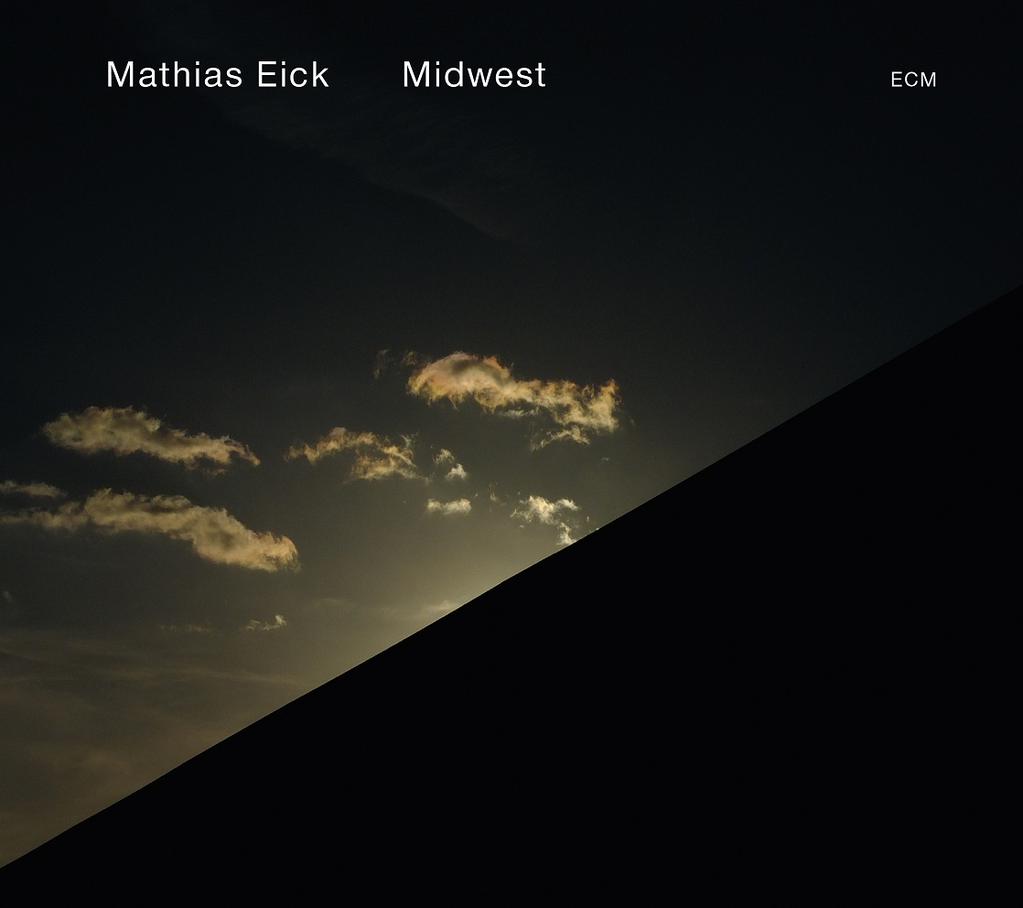
So many of ECM’s finest trumpeters also happen to be skilled travelers. Tomasz Stanko and Enrico Rava in particular have hopped the globe in search of inspiration, life experience, and musical expansion. Yet few, among the possible exceptions of Nils Petter Molvær and Per Jørgensen, have gone so deeply inward and emerged with such painstaking lyricism as Mathias Eick. Midwest was inspired by a North American tour, during which time Eick recalls feeling very homesick: “Then we reached the area called the Rural Midwest and I suddenly had the strange feeling that I was home. It occurred to me that some of the early settlers must have felt this way, when they looked at the rich soil of the plains and saw that this was wonderful land for farming. Parts of the Midwest remind me strongly of parts of Norway including the southeast of Norway where I grew up.” Even with this, and the migratory tunes that comprise this album, in mind, the journey on which we are led is far more psychic than geographic. Joining his caravan are violinist Gjermund Larsen (last heard on the Christian Wallumrød Ensemble’s Outstairs), pianist Jon Balke, bassist Mats Eilertsen, and percussionist Helge Norbakken: a continent unto themselves.

ME

The word “lyrical” gets rehashed a lot to distinguish jazz that is “pretty” versus that which is “raw.” Yet no rule says that the two must be exclusive. In fact, Eick has forged just such an alloy on this album, and you can hear it in everything from his tone to his soulful interactions in and among the band. Eick has clearly worked hard to establish an identity on the trumpet, because we can hear it the moment he sounds his first note. In this vein the title track pans us into the emotional thick of things, blessing the land with the gentle rain of cymbals and the tilling of piano. Eick and Larsen set an album precedent by way of their give and take, threading the ether with a sound so lucid it’s almost dreamy. Larsen’s folk inflections do, in fact, make Midwest as much of what it is as its bandleader. Their harmonizing in “Hem” is just one example of this successful blend. The latter tune further epitomizes the sheer magnification of detail that has overlaid Eick’s playing and composing since his leader debut, The Door. More than ever, he is like the master photographer, who puts his eyeglass to every questionable grain and tinkers behind the scenes to get just the right emulsion before presenting the finished, developed image. That said, his pictures are often moving than still. Much of this movement can be found in either the emotional journeys at hand (cf. “March”) or in the contributions of individual musicians. Eilertsen pulses through “At Sea” like the power of recollection incarnate in one of two more straightforward thematic vehicles. The other, “Dakota,” also emphasizes the wonderment and space Balke brings to the palette, while Norbakken sends harmonic minnows into the periphery.

“Lost” is, along with the title tune, an emblematic one. Its evocation of slippage across space and time heightens Eick’s apparent dislocation even as it deepens his newfound connections to faraway soil. A lovely solo from Balke, nestled in a reed-bed of cymbals and bass, adds to the feeling. So, too, does “November,” by which we arrive at the bittersweet yet inevitable farewell, a taking stock of things learned and gained, those things long left behind and others soon to be, and still others waiting for return. It is the realization that the pleasure of going home is always darkened by the sadness of departure.

If Eick has so far crafted a distinct melodic solar system on ECM, Midwest is a galaxy unto itself. Fresh, spiraled, and classic to the core, it’s sure to be one of the label’s most enduring statements of all time.

(To hear samples of Midwest, click here.)

Jormin/Willemark/Nakagawa: Trees Of Light (ECM 2406)

Trees Of Light

Lena Willemark voice, fiddle and viola
Anders Jormin double bass
Karin Nakagawa 25-string koto
Recorded May 2013, Konstepidemin, Göteborg
Engineer: Johannes Lundberg
Executive producer: Manfred Eicher

Angels
Childangels
Opportunities come with the rainbow
and the children
Sing to us
so our hearts come back to us!

Anders Jormin returns to ECM with yet another surprising blend of multi-genre elements. The Swedish bassist welcomes folksinger Lena Willemark and, in her ECM debut, virtuoso of the 25-string koto Karin Nakagawa in settings and improvisations around Willemark’s poetry, sung in her native Älvdals dialect. Jormin has always been one for self-reinvention, and on Trees Of Light he has stepped into some of his most ambitious territory yet. Not because of any sense of scope (although the trio does evoke some rather expansive scenery), but because the import of every gesture is magnified in such an intimate setting.

Yet it’s Willemark, absent from the label since Jormin’s 2004 In winds, in light, who crafts the center of the current project. Her words and melodies inform every song of the program, with the sole exception of Jormin’s instrumental “Hirajoshi.” The latter piece’s title refers to the hirajōshi mode of pentatonic (plus semi-tonal) tuning in which it is played and foregrounds the koto’s dry-wing rasp, percussive accents, and open field. When Nakagawa sweeps her hands over its waters as Willemark’s viola and Jormin’s arco bass sing their way into union, the trio captures something ancient in its hands.

Around this wordless center flows a veritable ecosystem of dreams, recollections, and impressions. It’s not simply that jazz, Swedish folk, and traditional Japanese music are melding into something new. Rather, it’s that they are speaking to one another in the interest of honest friendship. Both the title and music of “Krippainggler” (If you listen) best exemplify this philosophy, as each musician occupies her or his place. Where Willemark’s voice is like the reed and Jormin’s bass is the riverbed, Nakagawa draws the waterline between them in a song of angels and resuscitation of life forces.

TOL

Pairings occur naturally throughout. Nakagawa and Jormin sometimes beckon their vocal traveling companion as if she were the sun itself, while at others koto and voice share ululations and whispers. Spotlight moments also abound, as when Nakagawa proves her improvising strengths in “Urbanus” or Willemark sings alone on “Minni” (Memories), an arresting segment of horizon. Whatever the mood, the listener can be sure to feel it wholeheartedly. “Ogadh Dett” (Your eye), for one, opens with a bass solo that is muscular yet somehow gentle, giving way as it does to the koto’s fairytale strains and taking lyric comfort in the warmth of unbroken regard. “Uoruo” (Worry), for another, walks the way of sorrow as if it were the clearest path of all.

And perhaps there is some truth here: that which leaves the deepest scar is also the easiest to follow, so that even when we are dancing, as in the title track or the “Slingerpolska” (Winding polska), somewhere in the back of our minds we know that we will end up alone, and all the stronger for it.

I am still standing where I left me
I walk on as another
See that the earth is still there
Still there
That I must remember
I have loved

(To hear samples of Trees Of Light, click here.)

Gary Peacock Trio: Now This (ECM 2428)

Now This

Gary Peacock Trio
Now This

Marc Copland piano
Gary Peacock double bass
Joey Baron drums
Recorded July 2014 at Rainbow Studio, Oslo
Engineer: Jan Erik Kongshaug
Produced by Manfred Eicher

After decades of sharing a legendary board with Keith Jarrett and Jack DeJohnette, bassist of bassists Gary Peacock rides a choice wave of his own with pianist Marc Copland and drummer Joey Baron. Now in his 80th year, Peacock needs no introduction except to those who’ve been living with their hands over their ears. He’s the pioneer of a lyrical and dynamically inflected style, a consummate player who knows no boundaries of expression, and, let us not forget, an influential composer to boot. The latter point finds appropriate stress on Now This, which nestles a few featherless tunes among the fully plumed.

GPT
(Photo credit: Eliott Peacock)

Perennial classics such as “Moor,” which here achievements the wonderment of renewal, and “Gaia,” which opens the set, confirm the breadth of Peacock’s abilities. Copland’s lyricism is a most welcome addition to their unfolding, peering into the heart of this music and making it crystalline. Yet the unforced feeling of emergence is shared by all, perceivable in a glint off Baron’s cymbals and in Peacock’s own forthright intimacy. Even at his most cautious, as in “Shadows,” the bassist is so sure of where he is going. Not because he sees the end in sight, but because he knows he will always arrive where he is meant to arrive. It’s one thing to trust your bandmates so wholeheartedly; quite another to trust yourself. Such commitment is a lifetime in the making.

“Christa” melts like a candy in the summer sun and finds Peacock humming through his instrument like someone newly in love. There’s also “Vignette,” a set highlight—not least of all for Copland’s beautification. The pianist’s elucidations are such that it’s all one can do to fend off surrender. That being said, his two composition credits elicit some of the most balanced playing on the record. Between the eddying, watercolor world of “And Now” and the slippery “Noh Blues,” there’s much to savor in the currency of their exchange. Baron, for his part, contributes one in turn: “Esprit de Muse.” What begins as an enigmatic tune, however, gains traction midway through and rides the rails into some concentrated swing. Another gem comes by way of Scott LaFaro’s well-polished “Gloria’s Step.” Lithe and limber as ever, Peacock navigates its familiar corridors with eyes closed and heart open, while Copland and Baron provide equally percussive support into interlocking bliss.

As epitomized by “Requiem,” last of the Peacock originals and of the set as a whole, Now This is marked by the sheer maturity of its players. To be sure, so long as you walk into this album without expectations of dramatic flourishes, you will walk out of it with something much longer-lasting: grace.

(To hear samples of Now This, click here.)

Jack DeJohnette: Made In Chicago (ECM 2392)

2392 X

Jack DeJohnette
Made In Chicago

Henry Threadgill alto saxophone, bass flute
Roscoe Mitchell alto, soprano and sopranino saxophones, bass recorder, Baroque flute
Muhal Richard Abrams piano
Larry Gray double bass, cello
Jack DeJohnette drums
Produced by Dave Love and Jack DeJohnette
Recording engineer: Martin Walters
Assistant engineers: Jeremiah Nave and Daniel Santiago
Recorded live August 29, 2013 at the Pritzker Pavilion Millennium Park Chicago at the 35th Annual Chicago Jazz Festival
Sponsored by Chicago’s Department of Cultural Affairs & Special Events
Programming in part by the Jazz Institute of Chicago
Tour manager: Ken Jablonski
Mixed at Avatar Studio, New York by Manfred Eicher, Jack DeJohnette, and James A. Farber (engineer)
Mastered at MSM Studios, München, by Christoph Stickel
Executive producer: Manfred Eicher

As the story goes, when legendary drummer Jack DeJohnette was named a National Endowment for the Arts Jazz Master and given carte blanche to perform at the Chicago Jazz Festival in 2013, he immediately thought of his old jam buddies from the early 1960s, the founding sessions of which had led to the Association for the Advancement of Creative Musicians (AACM), whose most hallowed disciples formed the Art Ensemble of Chicago, resolutely documented on ECM. As Roscoe Mitchell recalls, “Every time I get together with musicians from the AACM it’s like we are just picking up from wherever we left off.” To be sure, the conversation between reedmen Henry Threadgill and Roscoe Mitchell, pianist Muhal Richard Abrams, bassist Larry Gray, and DeJohnette himself feels like it’s been going on forever. Despite the fact that these musicians had never recorded before as a quintet, much less played as one, it feels as if they have been plowing through ether on its way to the cosmos all along, and that we can count ourselves fortunate for catching even a snippet of their time on this planet. As if in service of this analogy, the recording is very present in relation to the musicians, while the crowd cheers like some distant panel of stars whose appreciation arrives light-years after the fact.

Made in the Streets of Chicago

Mitchell—who plays alto, soprano, and sopranino saxophones, bass recorder, and Baroque flute—offers two substantial originals to the stage. “Chant” cracks the concert’s outer shell with a sacred tap. From raw, arpeggiated materials it constructs a body from the ground up and, by addition of instruments, imbues it with consciousness. Likewise, every member knows his place in the larger symphony of his setup. DeJohnette pays off his timbral dues with handfuls of Benjamins, especially in his dialoguing with Mitchell, while Threadgill touches off more angular lines of flight. Gray meanwhile appears, stealthily at first but with increasing conviction, to be the psychological impetus behind it all. But it’s Abrams whose torrent of ideas seems most organic. Like a healing energy itself in want of healing, he plays the all-important trickster as Threadgill curls his fist in staunch refusal of suspension. Thus do we return to the center of the spiral, only to find another waiting to be sung. The aptly titled “This” reveals an adjacent facet, fronting Baroque recorder and Threadgill’s bass flute in an excursion of astute reflectivity. Abrams again proves vital to the physical nature of this sound, his pianism attaining downright Beethovenian proportions.

The bandleader’s “Museum Of Time” fuels the Abrams fire. Spanning a gamut from whirlwind to delicacy, its touch provides spatial reference for the reeds and a still larger context for the slippery groove in which DeJohnette and Gray find themselves. Threadgill’s “Leave Don’t Go Away” flips this approach, beginning in interlocking fashion before spawning a lone piano with a mind of its own. Bass and drums jive their way into frame, while sopranino nears bursting from the strength of its inner poetics. And then there is “Jack 5” by Abrams himself. Light cymbals clear the air before late-night sounds ground an alto and all the soulful things it has to say. DeJohnette then takes the reigns and builds his steed one muscle at a time, each part mutually independent of motion.

As the MC of the evening, DeJohnette extols the spirit of brotherly love on which all such jazz must feed. It’s a love you can feel when the band jumps into a spontaneously improvised encore titled “Ten Minutes,” which actually clocks in at just over six. Abrams checks a pulse, reeds exchange powerful mutations, DeJohnette and Gray ride the middle line: these become the markers of giving in. Mitchell saves his best for last this time around, his mind reveling in its own synapsial wanderlust.

A masterpiece? Please. This is more than a piece. It’s mastery incarnate.

(To hear samples of Made In Chicago, you may watch the EPK above or click here.)

Jakob Bro: Gefion (ECM 2381)

Gefion

Jakob Bro
Gefion

Jakob Bro guitar
Thomas Morgan double bass
Jon Christensen drums
Recorded November 2013 at Rainbow Studio, Oslo
Engineer: Jan Erik Kongshaug
Produced by Manfred Eicher

After playing with Tomasz Stanko on Dark Eyes and, before that, less conspicuously a part of the Paul Motian Band on Garden of Eden, Danish guitarist Jakob Bro reaches a milestone with his first ECM leader date. For this auspicious recording event, one could hardly ask for finer support than Thomas Morgan and Jon Christensen. Morgan stands as one of the most versatile bassists of his time, as borne out on a number of diverse projects for the label, whose fans will of course need no introduction to Christensen. Bro cites the drummer’s sound as a formative inspiration, and one can hear the joy of sharing the art of jazz with someone whose contributions to the same he so adores. After premiering at the 2012 Copenhagen Jazz Festival, this intergenerational trio stepped into Oslo’s Rainbow Studio to document after only a year’s worth of refinement. The end result sounds like 10.

Bro Trio

At nearly 11 minutes in duration, the title opener may be the longest of the set, but it is neither longwinded nor overwhelming. Rather, its spacy guitar is a fire in winter you don’t want to leave. Christensen’s cymbals awaken in the light of dawn, eyes still carrying afterimages of the night. Beyond this, Bro takes his first steps from the cabin into the open forest. Morgan’s bass follows suit, leading us to belief we are in for a long hike. But then something magical happens as the view now goes aerial. A clear Bill Frisell influence reigns in this transition, mellifluous and spun from open sky. The band traces a spectral parabola from one glade to the next, until every animal trap along the way has been disabled and burned to ash. And it is to ash we return at the album’s straightforwardly titled “Ending,” which at just under three minutes is its shortest. Still, looping arpeggios and tactile strums give it a fullness of structure, fading out on the moonwalk with which the album began.

As if to stretch this metaphor, “And They All Came Marching Out Of The Woods” finds Bro opening up a little more in tandem with Morgan’s flexible backbone. His guitar shines like a prism at a laser’s touch, until individual notes split into spectrums, but not before we dive into the streets of “Copenhagen.” Or is it into the water gently lapping the city’s harbors? This would seem to be the image evoked by Bro’s understated motifs. Or might it also be the sky above? For is it not the realm from which Bro drops a rope ladder for his bandmates to climb?

In thinking of the sky over Copenhagen, I find my thoughts turning to Gefion herself, a Norse goddess of land and plowing immortalized in the famous fountain I photographed during a trip in March of 2015:

Gefion Fountain

With her whip in hand she pushes her oxen through the land, but does so without need for virtuosity or flourish. Rather, like Bro, she sees music in the work itself.

Other references point to the heavily arpeggiated solo compositions of guitarist Jeff Pearce, a prime example being the ghostly nocturne of “Oktober,” and in “White” to the slow-motion streamers of a Motian ballad. Bro navigates both with the surety of a hiker in his favorite woods, one who knows every tree so well that he needn’t bother trying to account for them all. He leaves—no pun intended—that task to his sensitive support team, a rhythm section that foregoes rhythm toward an environmental approach. But urbanity, we soon realize, is never far behind, as we squint into the glare of “Lyskaster” (Searchlight). This can only be an ode to travel, for it embodies the constant balance, known to any itinerant, between missing what you love and craving what you have yet to love. “Airport Poem,” on the other hand, is an exercise in capture, of layover and tedium, Christensen’s barest presence only adding to that feeling of suspension.

Bro is a breath of fresh air for eschewing the trappings of technical virtuosity and instead plowing the far more challenging field of atmospheric integrity. His playing is so rich, in fact, that Gefion at times feels more like a solo album. This is not to insult the contributions of Morgan and Christensen, but to praise them for understanding that every white square needs a black one to keep it company, and that in the cosmos of any one of them exists far too many pieces to fit on one chessboard anyway.

In closing, it’s worth noting that Gefion bears dedication to Ib Skovgaard. The late jazz journalist and radio producer, who died in early January at the age of 67, was a tireless champion of improvised music in his native Denmark and a particularly stalwart supporter of Bro and his generation. With this knowledge in mind, we do well to see the album as the closing of one circle of appreciation by way of opening many others in its place. Here’s hoping you’ll be one of them.

(To hear samples of Gefion, click here.)

Giovanni Guidi Trio: This Is The Day (ECM 2403)

This Is The Day

Giovanni Guidi Trio
This Is The Day

Giovanni Guidi piano
Thomas Morgan double bass
João Lobo drums
Recorded April 2014, Auditorio Stelio Molo RSI, Lugano
Engineer: Stefano Amerio
Produced by Manfred Eicher

When Italian pianist Giovanni Guidi, American bassist Thomas Morgan, and Portuguese drummer João Lobo made their ECM debut as a trio with City of Broken Dreams, they quietly shrugged off the trend of splash-making entrances. What they produced instead nearly took me aback with a lyricism not heard, I dare say, since Paul Motian at the peak of his invention. The style was, at the same time, very much its own and begged many contemplative returns to understand the breadth of its purview. Now, on This Is The Day, Guidi and his cohorts again tend a field of largely original soil, leaving twelve meticulously tilled rows for a harvest of 74 glorious minutes.

GG

The aching lyricism of “Trilly” (including its later variation) hits the chest in slow motion. Guidi’s pianism is assuredly delicate from the start: every note knows its place. And yet, while his craft may be the heart of everything, its beats are nothing without mind and body, and these his rhythm section most healthily provides. Be it through Lobo’s thoughtful traction in “Carried Away” or Morgan’s lucidity of expression in “Game Of Silence,” they further the trio’s mission of lifting every rock in places torn to their foundations by strife, salvaging whatever melodic material they can in the hopes of reuniting it with the original owners. Whereas in the first album there was little time for rebuilding, here the band is constantly separating and fitting architectural elements together. Through intensive understatement, each member’s contributions are translucent enough to let the others show through.

Also showing through are the band’s heightened powers of illustration. The plucked piano strings and pointillist accompaniment thereof are only the beginning of “The Cobweb,” which builds to an almost frantic density. Despite its brevity and abstraction (most of the surrounding tracks are melodic and of sizable duration), it holds a wealth of information and, like a web, trembles at even the most peripheral movement. This, along with the rubato poetics of “The Debate” and the sporadic “Migration,” comprise the freest portions of the set. Guidi makes it all sound effortless by never giving in to the drama of verticality. Even the cosmically good melodizing of “Where They’d Lived,” the album’s master ballad, rests on a hammock between skyscrapers, so content in the danger that it wears fear like a blanket. Behind closed eyes, Guidi’s dreams sound like “The Night It Rained Forever,” a boat ride through drone and mist that resolves into shores both empty and alive.

Only three tracks bear non-leader credit. Lobo’s “Baiiia” is a nuanced construction of cymbals and drums, of which tracings from piano and bass build to a tidal finish, while the standards “Quizas Quizas Quizas” (penned by Cuban songwriter Osvaldo Farrés and made famous by Nat King Cole) and “I’m Through With Love” recall Tord Gustavsen’s likeminded trio in its finest hour. As songs without words, they have so much more to say than with. At their departure, the currents of a thousand rivers converge into one, sending us on our way toward the hope of a thousand more.

A modern classic before a single note was laid down.

(To hear samples of This Is The Day, you may watch the EPK above or click here.)