Wolfert Brederode Quartet: Post Scriptum (ECM 2184)

Post Scriptum

Wolfert Brederode Quartet
Post Scriptum

Wolfert Brederode piano
Claudio Puntin clarinets
Mats Eilertsen double-bass
Samuel Rohrer drums
Recorded May 2010, Studios La Buissonne, Pernes-les-Fontaines
Engineers: Gérard de Haro and Nicolas Baillard
Produced by Manfred Eicher

Four years after their ECM debut, Wolfert Brederode and his quartet go Post Scriptum. The bandleader takes most of the composing credit with seven tunes to his name, the first four of which start with something of a 20-minute suite. “Meander” puts us on the right path at the encouragement of the pianist’s foundations. In this track especially, he evokes the same richness of progression and insight as Tori Amos at the keyboard. Bassist Mats Eilertsen and drummer Samuel Rohrer flesh out this unfurling skeleton as clarinetist Claudio Puntin jumps from branch to branch, snagging not a single feather along the way. Like so much of what follows (an exception being the piano-drums duet “Sofja”), emphasis is on the quartet sound, a multifaceted wonder that fronts each player in equal turn. Whether highlighting arid hand percussion and arco bassing in “Angelico” or crosstalk of piano and cymbals in “November,” the unity is uplifting and consuming. Through it all, Brederode’s comping weaves a caravan out of thin air, transporting Puntin’s precious melodic cargo. The title track is as surreal as it is brief, a haze of rhythm and reason that moves like a lotus along a river. Among the remaining Brederode originals, the groovy “Inner Dance” is a highlight. Anchored by pliant bass lines and soft touches from inside the piano, and with a clarinet that shines like a desert moon, it beats like the heart of a gentle giant. “Silver Cloud,” too, emotes tenderly, patterning the air in the manner of a Japanese woodblock print.

Eilertsen’s contributions, though more abstract, are no less engaging. The rattling interiors of “Aceh” yield dampened bass notes from Brederode, which resound with distant explosions of poetry. The babbling brook of “Brun” lends an air of spring to the canvas, while “Wall View” juxtaposes the rhythm section’s pointillism with Puntin’s legato phrasings. He and Roher offer a tune apiece, one a river of melodic beauty and the other a twisted network of roots and soil.

The landscapes of the Brederode Quartet are unfamiliar and unpopulated. This dynamic actualizes their movements by the grace not of cartographers but of artists who paint for the future, confident that eyes may hear the music of every brushstroke as a memory of a shared antiquity.

Easily another of ECM’s Top 10 of this century.

(To hear samples of Post Scriptum, click here.)

Tord Gustavsen Quartet: Extended Circle (ECM 2358)

Extended Circle

Tord Gustavsen Quartet
Extended Circle

Tord Gustavsen piano
Tore Brunborg tenor saxophone
Mats Eilertsen double bass
Jarle Vespestad drums
Recorded June 2013 at Rainbow Studio, Oslo
Engineer: Jan Erik Kongshaug
Produced by Manfred Eicher

Norwegian pianist Tord Gustavsen’s sixth ECM album concludes his second trilogy for the label, this in a quartet setting with saxophonist Tore Brunborg on tenor, bassist Mats Eilertsen, and drummer Jarle Vespestad. Gustavsen’s—and producer Manfred Eicher’s—sense of timing and sequence is more crystalline than ever, yielding a crossroads of melody and circumstance that will be at once familiar and progressive to seasoned listeners.

“Right There” bids gentle welcome in trio, Eiltersen’s melodic tracery standing out early on for its unforced hand. It’s a fitting introduction to one of Gustavsen’s most indistinctly distinct efforts to date, ending as it does with a question answered by the 11 tracks that follow. The Norwegian hymn “Eg Veit I Himmerik Ei Borg” (A Castle in Heaven) adds Brunborg’s tenor into the mix, one voice capping a rising tide of them. Vespestad’s underlying propulsions emphasize the theme’s airiness with their scuffling groove. “Entrance” is a free improvisation based on elements that have previously caught the band’s working orbit. Brunborg and Gustavsen work off each other’s nerve impulses down a spinal helix. And in a variation of the same track, Eilertsen provides a tactile foundation for the divine considerations therein, allowing Brunborg to unchain himself from the congregation.

“The Gift” and the album’s remaining tunes embody everything that makes Gustavsen’s writing exactly that: an offering to those who would listen without prejudice. This is a characteristically slow-motion spelunk for the trio, who as a unit express what only individuals in harmony can. With a touch worthy of an archaeologist, Gustavsen and his bandmates unearth one geode after another but leave them unbroken, so that their inner jewels become the subject of contemplation rather than of material obsession. “Staying There” evokes the title of the trio’s Being There, preaching but also practicing a gradation of continuity between projects, eras, and spaces of development. Brunborg’s melodizing, in combination with the rhythm section’s oceanic support and Gustavsen’s tidal comping, gives depth of voice to the music’s heartland.

“Silent Spaces” is one of two solos. This one is from Gustavsen and calculates an inter-dimensional telemetry, whereby distances are measured by angles between notes, by that which remains unsung. Eilertsen’s solo “Bass Transition” is likewise a ladder disappearing into cloudy sky.

“Devotion” rearranges a choral piece Gustavsen was commissioned to write in a liturgical context. In its present form, the music sings by inhaling. More of the trio’s classic dynamics bleed through in “The Embrace,” expanded by the soulful gilding of Brunborg’s bell. But even this one—and this is the magic of Gustavsen’s art—has sacred overtones, stemming from a faith in the sounds. That said, the full quartet achieves a unique balance of structure and substance in “Glow,” across which each musician glides like the blade of a skate on a frozen pond: their coming together produces only the smoothest pathways of travel. All of which leaves “The Prodigal Song.” This bittersweet letter draws its signature in forest ink and proves yet again that Gustavsen ends every album by extending another circle into the unknown. For just when you think it couldn’t get any more beautiful, it swings around and taps you on the shoulder.

(To hear samples of Extended Circle, click here.)

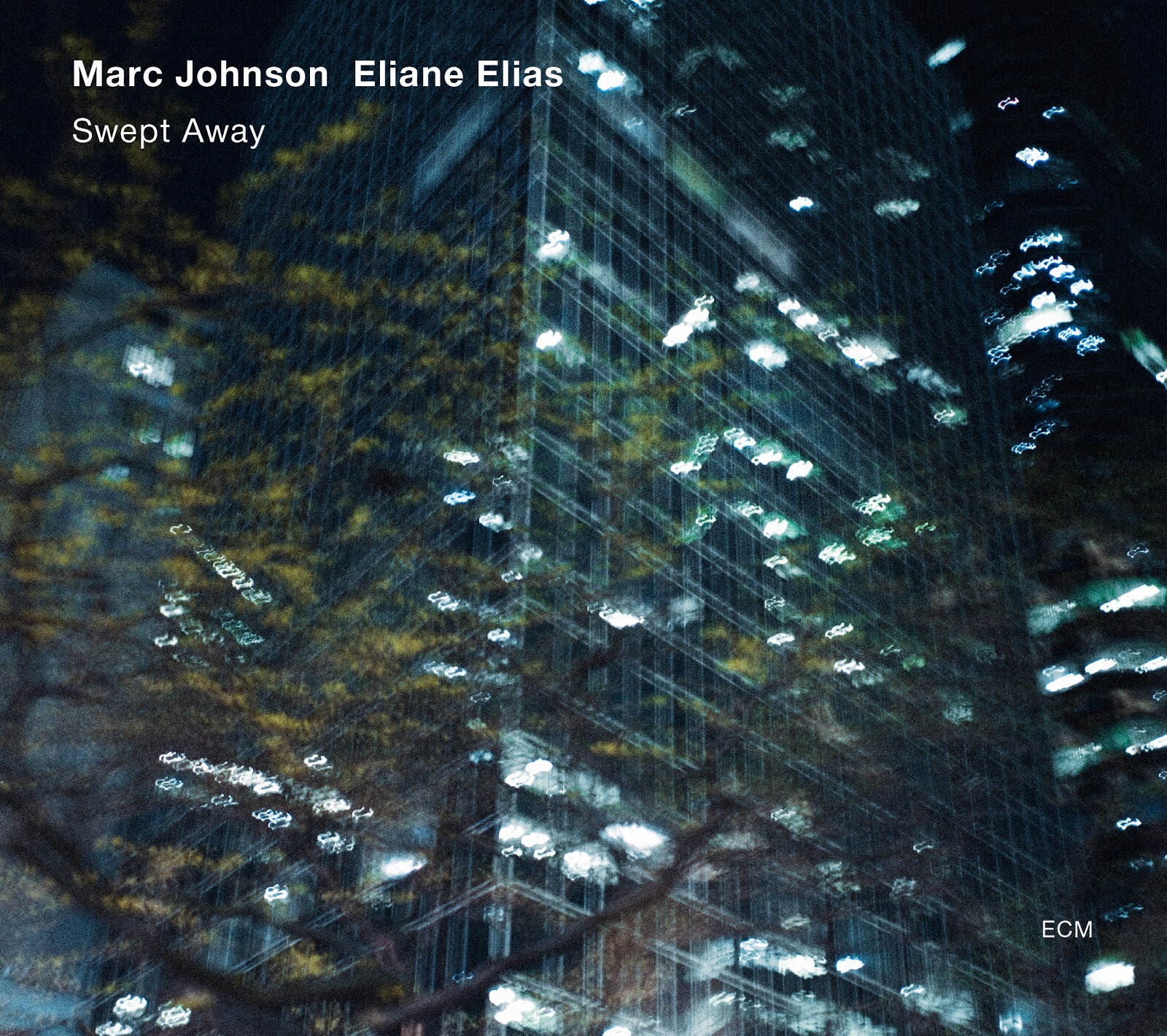
Marc Johnson/Eliane Elias: Swept Away (ECM 2168)

Swept Away

Marc Johnson
Eliane Elias
Swept Away

Eliane Elias piano
Marc Johnson double-bass
Joey Baron drums
Joe Lovano tenor saxophone
Recorded February 2010 at Avatar Studios, New York
Engineer: Joe Ferla
Produced by Eliane Elias and Marc Johnson

Although bassist Marc Johnson and pianist Eliane Elias are the heart of this distinctly melodic album (only their names appear on the cover), let us not ignore the atmospheric contributions of saxophonist Joe Lovano and drummer Joey Baron, whose completion of the quartet thus featured lends a sweeping quality to these mostly original tunes. With the latter contributions in full effect, Elias’s lush, classic sound and Johnson’s ever-thoughtful navigations ring that much more authentically.

The working trio of Johnson, Elias, and Baron produces five delectable tracks, of which “One Thousand And One Nights” and “B Is For Butterfly” are the most upbeat. Where one is engaging and modal, the other emits springtime warmth. Elias’s comping is dense but never invasive, lending context to her partner’s bass solos with a love shared both within and without the studio. One may read signs of this connection throughout the title track, in which Johnson’s prosody serves as yang to Elias’s poetic yin. These intimate settings prove fine vehicles for Elias, but none so nostalgic as “Inside Her Old Music Box” nor so impressionistic as “Foujita.”

With Lovano the band curves inward—more spaciously yet with lesser travel. This is no small feat, considering the powers of evocation possessed by each member. “It’s Time” introduces Lovano to the record’s sound-world and references Michael Brecker, in whose memory the tune was written, with richness. “When The Sun Comes Up” and “Sirens Of Titan” are jewels in their own right, contrasting hills of awakening with valleys of darker energies. Whether spurring the drums to lively enterprise or stretching intergalactic wormholes into sonorous infinity, Elias abounds. “Midnight Blue,” for difference, portraits a softer romance, the following “Moments” even more so, Lovano swaying like the night itself with the assurance of a touch shared by two.

Johnson’s solitary rendition of the American folksong “Shenandoah” closes out this well-rounded album with poise and purpose. In addition to being an autobiographical look back to the bassist’s Midwestern roots, it leads with equal footing into a future where one never need go far to find a song to sing.

Swept Away is a flawless reckoning of intuition and compositional integrity. The engineering, courtesy of a crack team at New York’s Avatar Studios, processes each cymbal hit as if it were the only thing sounding, while every channel around it remains clear and alive. Fresh yet familiar, sparkling yet serene, this is the kind of record you want to come home to.

(To hear samples of Swept Away, click here.)

Paul Bley: Solo in Mondsee (ECM 1786)

Solo in Mondsee

Paul Bley
Solo in Mondsee

Paul Bley piano
Recorded April 2001 at Schloss Mondsee, Austria
Engineer: Jan Erik Kongshaug
Produced by Manfred Eicher

The release of Solo in Mondsee in 2007 marked the 75th birthday of Paul Bley, and his first solo recording since 1972’s Open, To Love. Like the first, it owes its existence to producer Manfred Eicher, who on both occasions lured Bley onto solitary terrain. This time, the Montreal-born pianist sits at a massive Bösendorfer last heard under the fingers of András Schiff in a New Series program of Schubert’s C-major Fantasies. The instrument equally suits Bley’s preference for long sustains, as made lucid in the album’s opening statement: a resonant hit of the lowest strings. From this he summons ghosts of familiar songbooks, and bodies of those more distant, across ten so-called “Variations,” whose only theme is the absence of one.

Bley’s craft is an admixture of the ethereal and the gravid. He works from a palette so expansive that perhaps only Keith Jarrett has matched it in this unaccompanied format, and with tenderness so beguiling it tightens the ribcage to hear it. The freedom of his exponentially refreshing playing imbues the first numbered section with declamatory sparkle. Like Variation IV, it evokes warmth in winter by a peerless ballet of touch and tendon.

In contrast to these sweeping narratives, Bley gives props to whimsy on a handful of Variations. There are the dissonances and chromatic ladders of II, the centrally focused III, and the busier V and VIII, the eddying of which evokes the end of a waterfall. Variation VI is an especially brilliant turn for its fusion of the epic and the intimate. Its densities never occlude, but allow the light to sing over a flourishing undercurrent. The tenth and final Variation possesses an almost teasing quality, but leads toward a fragile, shape-shifting meditation.

Bley finger-walks on water and gifts solace in return, turning the world into a chamber, and the chamber into a universe.

<< Robin Williamson: Skirting The River Road (ECM 1785)
>> Yves Robert: In Touch (
ECM 1787)

Konitz/Mehldau/Haden/Motian: Live at Birdland (ECM 2162)

Live at Birdland

Konitz/Mehldau/Haden/Motian
Live at Birdland

Lee Konitz alto saxophone
Brad Mehldau piano
Charlie Haden double-bass
Paul Motian drums
Recorded live at Birdland, New York, December 2009
Engineers: James A. Farber, Paul Zinman, Nelson Wong, Sean Mair, SoundByte Productions Inc., NYC
Mixed at Avatar Studios by James A. Farber and Manfred Eicher
Assistant: Akihiro Nishimura
Produced by Manfred Eicher

On December 9 and 10, 2009, New York’s legendary Birdland jazz club hosted a quartet of three sages and one acolyte for a string of ad hoc performances. Altoist Lee Konitz, bassist Charlie Haden, and drummer Paul Motian, being of the older generation, brought lifetimes of experience to their respective instruments, but more importantly a willingness—if not a need—to share their wisdom with those of the up and coming. That said, pianist Brad Mehldau was already well established in the scene when he laid fingers to keys for this unusual gathering and proved himself a masterful chameleon within a jazz of patience that asks only the same in return from its listener.

With only six tunes to the album’s credit, there’s plenty of meat on the bone. Konitz’s signature sound swoons from the first in the ballad “Loverman,” his alto’s rounded tone sounding more like a soprano than its larger cousin. Haden and Motian make for a phenomenal rhythm section, sectioning rhythm as they do into base components. Motian’s brushes are the opposite end of Haden’s plunking color wheel. Meldau, for his part, goes wherever the winds may take him. At one point he inverts the standard solo, using the right hand to comp and the left for melody, and with a polish so radiant that the album might as well come with a pair of sunglasses. Haden’s reflection is likewise true to form, seeming to float beyond the stage by virtue of some slick postproduction.

George Shearing’s “Lullaby Of Birdland” comes as a subtle energy boost. Konit’z beauteous stream of consciousness over a cool back end scouts a prime location for Meldau, whose dense pockets give up handfuls of gold. His right hand has a mind of its own here, straying but always holding a tether line back to the fundament. Haden’s soliloquy is a remarkable stop of the journey. It’s a solo that keeps up the appearances of the tune while unraveling dreams of others in real time. This time the engineering is more forward, even as the musicians look back with angels of nostalgia on their shoulders.

Konitz introduces a spontaneous rendering of the Miles Davis classic “Solar.” The loose coalition that ensues works a collage-like magic very much like the album’s cover: mixing signatures that are familiar yet made novel by their overlap. Meldau’s complex and mind-altering denouements find balance in Haden’s contemplations, leaving Motian free to flail toward smooth finish.

“I Fall In Love Too Easily,” a ballad made famous by Frank Sinatra, turns down the lights but ups the tension. Konitz, soulful as ever, is the central candle of this altar in a vigil for a love that might have been, but wakes up bright and early for “You Stepped Out Of A Dream.” Here the band holds every detail in mind, as also in a glowing version of Sonny Rollins’s “Oleo.” Motian and Konitz set the stage in duet for the most endearing portion of the set list. Meldau thickens the stew, throwing his chords like spices and watching them mingle, as underneath Haden’s subdued funk culminates in a chiming brilliance.

It’s sobering to realize that, as of this review, half of the album’s roster is no longer with us. Haden and Motian may be gone, but their sounds will live on as long as there are ears to hear them.

(To hear samples of Live at Birdland, click here.)

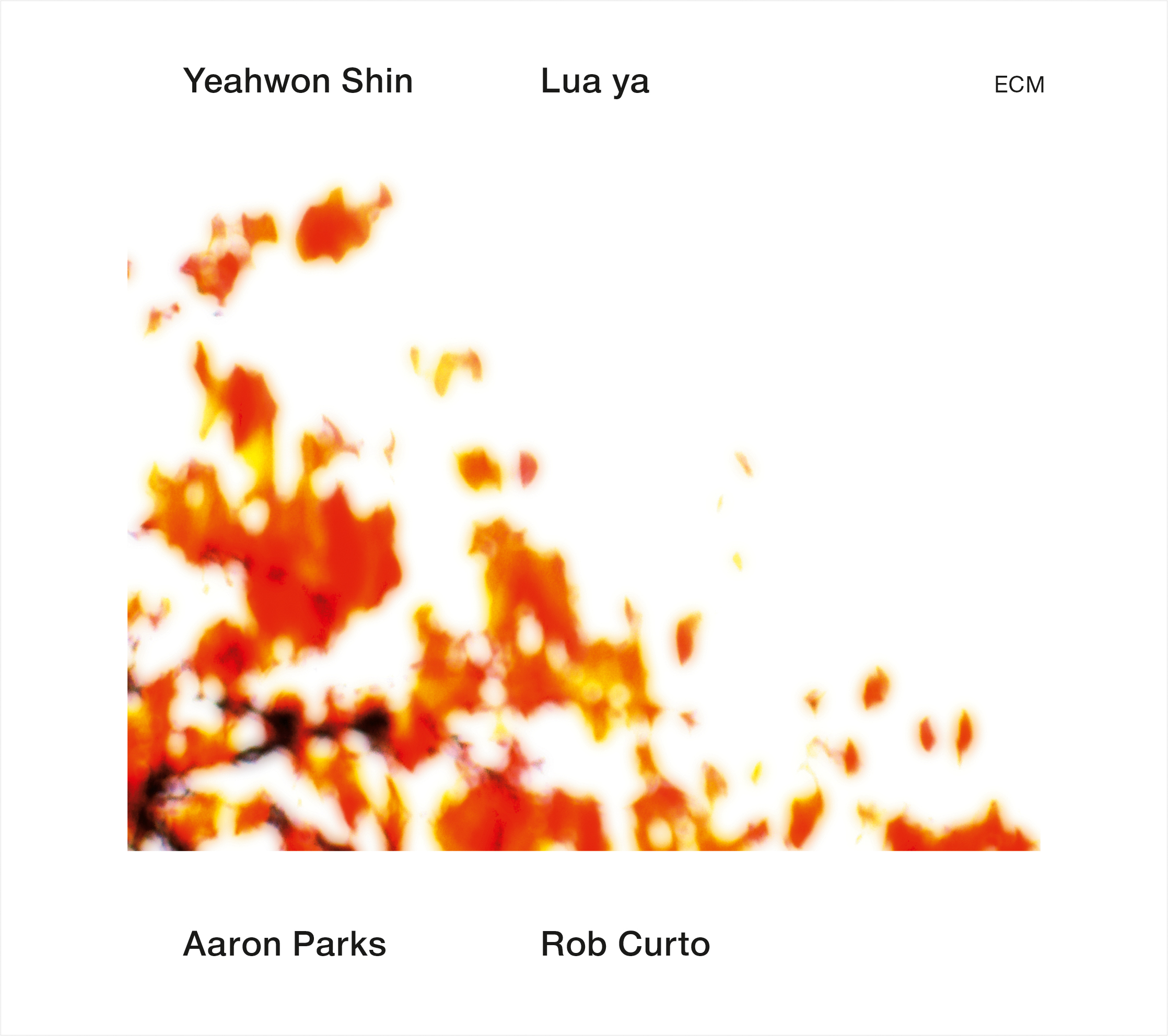
Yeahwon Shin: Lua ya (ECM 2337)

2337 X

Yeahwon Shin
Lua ya

Yeahwon Shin voice
Aaron Parks piano
Rob Curto accordion
Recorded May 2012 at Mechanics Hall, Worcester, MA
Engineer: Rick Kwan
Mixed at Rainbow Studio, Oslo by Jan Erik Kongshaug, Manfred Eicher, and Sun Chung
Produced by Sun Chung

If we can believe poet Federico García Lorca, who in a 1928 lecture entitled “On Lullabies” claimed that “Spain uses its saddest melodies and most melancholy texts to darken the first sleep of her children,” then we can also believe in a culture where lullabies nourish the growing soul. Of the latter persuasion are those offered by Yeahwon Shin on Lua ya. Shin’s selections give voice to transitions of darkness to light, spirit to flesh, dependence to independence, and all with a grace of expression that pretends nothing. Although best known as a Brazilian music specialist (her 2010 self-titled debut was nominated for a Latin Grammy), the singer rejoins accordionist Rob Curto and, for the first time, pianist Aaron Parks, in an enchanting survey of Korean children’s songs.

“The album’s theme is the remembrance of childhood,” Shin tells me in an e-mail interview. “I would like the listeners to have the freedom to imagine the story themselves.” In light of this invitation, we may still feel the need to tread lightly, for each song is of such fragile constitution that it would seem to crumble at the slightest mishandling. Then again, the music blossoms with such strength—a strength born of unconditional love—that it also feels impervious to misunderstanding. As in the opening improvisation, called simply “Lullaby,” it crafts a world of tracings and starlight. Parks’s pianism introduces the landscape across which Shin’s voice emerges as a maternal whisper, carrying with it the histories of countless mothers before, and the countless more to follow, in life’s eternal cycle.

Yeahwon Shin
(Photo credit: John Soares)

Shin grew up enchanted by the music of Egberto Gismonti, who along with the iconic Tom Jobim spun the tapestry of her appreciation for Brazilian music. She looks back even further to Chopin and Bach, composers who informed her first love—the piano—as fundamental inspirations in her development as an artist. “I like Korean traditional music, as well,” she says. “I am strongly bonded to Korea’s rhythmic patterns. I still want to discover more about this music.” Lua ya is a new step in precisely this direction. It is also a return to origins. For Shin, what seems most important in life is that which imparts it: “My parents are very important figures in my life. I respect my father’s wisdom, my mother’s unlimited love and spirit of self-sacrifice. They are not musicians, but the way they express themselves by singing shows a pure love for music. I have always wanted to feel that way in music.”

To be sure, Shin’s filial respect echoes in the songs passed down from her own mother, whose voice is forever preserved in memories of a family that was always singing. Of those songs directly passed down, “Island Child” is among the album’s most emblematic. Syllables roll off the tongue from both singer and instrumentalists until language ceases to matter. Indeed, Shin is at her most powerful when singing wordlessly (as she does here, and in “Moving Clouds”), as one needs not struggle against the elastic of linguistic barriers. “The Orchard Road” is another descendent of personal experience and shows the trio at its densest. Shin’s breathy storytelling develops over a rustic backdrop, as affecting as it is brief.

If Lua ya feels less like a cycle and more like one continuous song, it’s because it was, at the behest of producer (and Shin’s husband) Sun Chung, conceived and realized as a concert, played from start to finish with no edits. Chung acted as both audience and director when the performance was being recorded in Mechanics Hall in Worcester, Massachusetts. His presence is palpable in the album’s dynamic flow. Also present are Shin’s attentive accompanists, both of whom take her voice as a compass takes magnetism.

(Click here to see this article as it originally appeared in RootsWorld magazine, where you can also hear samples.)

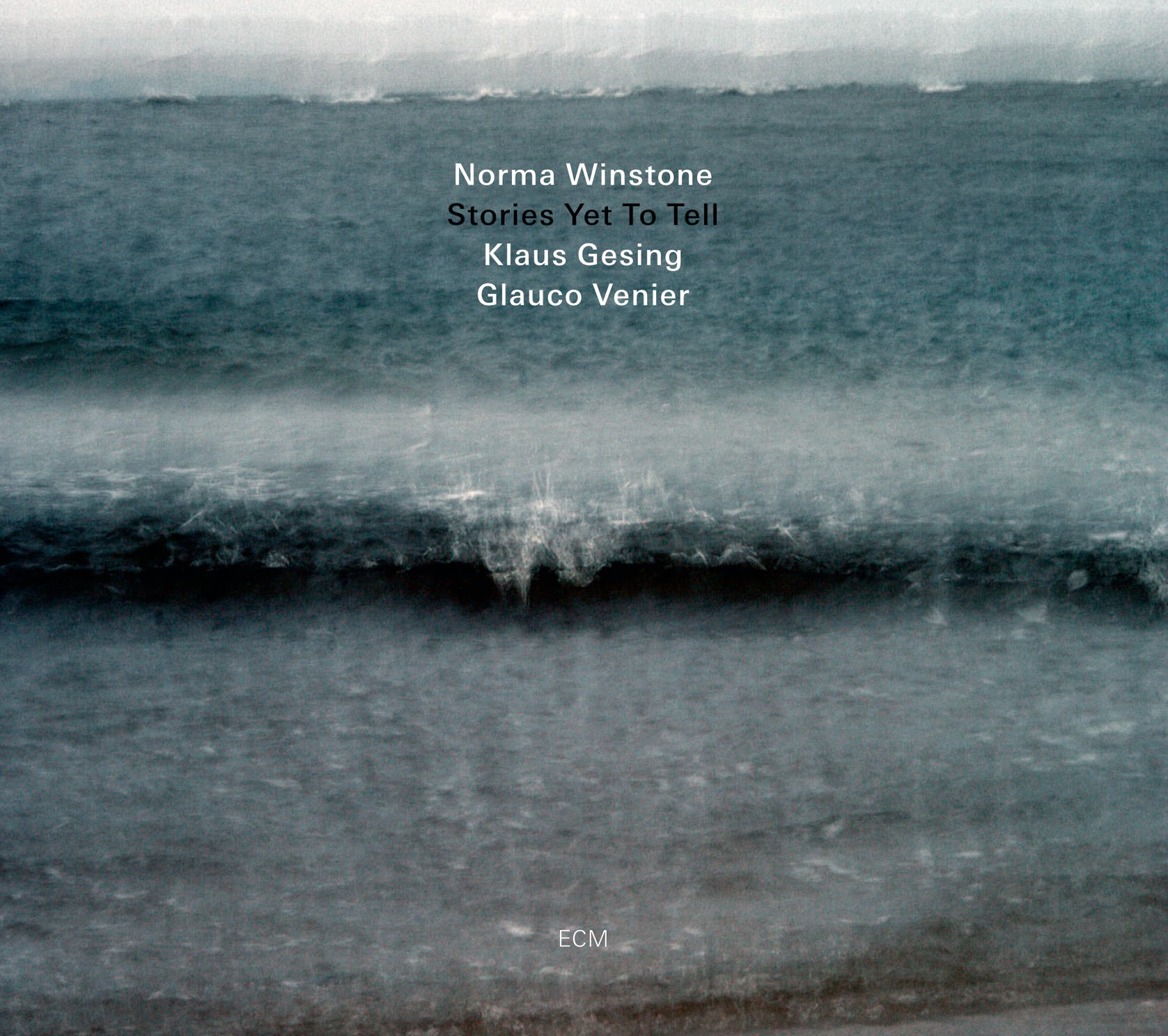
Norma Winstone: Stories Yet To Tell (ECM 2158)

Stories Yet To Tell

Norma Winstone
Stories Yet To Tell

Norma Winstone voice
Klaus Gesing bass clarinet, soprano saxophone
Glauco Venier piano
Recorded December 2009 at Arte Suono Studio, Udine
Engineer: Stefano Amerio
Produced by Manfred Eicher

While walking home on 8 October 2014, I was listening to Norma Winstone’s Stories Yet To Tell on my iPod. The opening song, “Just Sometimes,” had already enchanted me with its tender traversal of the heart’s shadowed chambers. Its bittersweet emotions lingered on in my mind as the second track, “Sisyphus,” held my ears captive. Named for the Corinthian king of Greek mythology forced to endlessly roll a giant boulder up a hill, the song evokes the curse of repetition in Glauco Venier’s pianism and the vain hope of breaking free in the tension of Klaus Gesing’s bass clarinet. While immersed in the atmosphere of this music, I felt a tap on my shoulder. I pressed PAUSE, removed my headphones, and turned to see my friend Andy, who had terrible news: our dear mutual friend Taylan had committed suicide that morning.

In the weeks following this tragedy, my iPod remained stuck halfway through “Sisyphus,” stymied like my desire for listening. By the time I returned to the song, I couldn’t help read the myth into Taylan’s untimely end. His life, it seemed, had thrown one boulder too many in his path, and he’d grown tired of rolling them upward in vain. While learning to cope with my grief, I was also comforted by the album’s title. It was a gentle reminder that, although he was gone, stories of Taylan’s legacy as a musician (he was an electronics genius for whom Evan Parker’s The Eleventh Hour was a life-changing record) had yet to be told. It was only a month later that I had the courage to continue where I’d left off in “Sisyphus,” which will forever be for me an elegy.

It’s not entirely morbid, however, to read a certain understanding of mortality into Winstone’s craft, singing as she so often does of moments that are fleeting, captured only through imagination. In the sadness of “Among The Clouds,” the retrograde of “Goddess,” and the wordless farewell of “En mort d’En Joan de Cucanh,” Winstone and her attuned trio understand that directions below are written in scripts above. Each song searches for meaning in a world that so often denies the divinity of simplicity. Furthermore, Winstone’s lyrics, especially in “Rush” and “The Titles,” linger on impermanence and, like the second, break down the theatrical stage of experience into its component parts.

In a few tracks, Winstone uses her voice as wordless instrument, employing melodic flight paths in the service of folk songs and lullabies. And even when she does inhabit the domicile of language, as in the tender “Like A Lover,” she does so with an insightful balance of coarse action and empty heroism, all the while keeping fear at bay with the shapes of her mouthing. She demonstrates that those of us still living must recognize that death is not an end but the first sentence in a story waiting for the spark of remembrance to reveal its narrative arc.

(To hear samples of Stories Yet To Tell, click here.)

Taylan
Taylan Cihan
(June 13, 1978 – October 8, 2014)