Arve Henriksen: Cartography (ECM 2086)

Cartography

Arve Henriksen
Cartography

Arve Henriksen trumpets, voice, field recording
Jan Bang live sampling, samples, beats, programming, bass line, dictaphone, organ samples, arrangement
Audun Kleive percussion, drums
David Sylvian voice, samples, programming
Helge Sunde string arrangement and programming
Eivind Aarset guitars
Lars Danielsson double-bass
Erik Honoré synthesizer, samples, field recordings, choir samples
Arnaud Mercier treatments
Trio Mediaeval voice sample
Vérène Andronikof vocals
Vytas Sondeckis vocal arrangement
Anna Maria Friman voice
Ståle Storløkken synthesizer, samples
Recorded, engineered and mixed at Punkt Studio, Kristiansand, except
Track 1
Recorded live at Punkt Festival, Kristiansand, June 2005
Overdubs recorded at Punkt Studio
Track 2, Part one
Recorded at Samadhisound
Trumpet recorded at 7.de Etage
Additional trumpet recorded at Punkt Studio
Track 10, Part Two
Recorded live at Punkt Festival, Kristiansand, August 2006
Track 11
Recorded live at Stadtgarten, Cologne
Assembled at Punkt Studio
Voice recorded at Samadhisound
Mastered at Audio Virus Lab, Oslo by Helge Sten
Engineered and produced by Erik Honoré and Jan Bang

After lurking as a figural, melodic force on many ECM sessions, at last Arve Henriksen dropped his unique brand of acid with Cartography. Although his place among Norway’s defining trumpeters—including Nils Petter Molvær, Per Jørgensen, and Mathias Eick—had already been firmly established, this leader date gave that badge some spit shine. As with his compatriots, electronics are a vital part of his toolkit, and here the incorporation achieves new levels of organicity courtesy of associates Erik Honoré and Jan Bang, who has contributed equally memorable soundscaping to the work of Eivind Aarset (see his recent Dream Logic), Jon Hassell (a huge influence on Henriksen), and singer-songwriter David Sylvian. In fact, Sylvian appears twice on this disc, bringing his idiosyncratic wordsmithery to bear on some amorphous territory. In “Before And Afterlife,” his speech is split and stitched, flashing cosmopolitan utterances across rural stages. The silvery ebb and flow running through Henriksen’s trailing commentary tilling the soil gently in his wake. “Thermal” further sets Sylvian’s stunning poetry of object-oriented diaspora in motion.

Henriksen
Photo credit: Oliver Heisch

With such evocations of land, (un)settlement, and water, the album’s title might seem an obvious one: the art of mapmaking translated into sound, comprising a trans-idiomatic survey recorded in multiple locations. To be sure, such connotations abound. Whether floating through the gossamer electronic spread of “Poverty And Its Opposite” or hooked by the widening beat of “Migration,” Henriksen moves through thick clouds with surety of calibration. The sense of continuity in his trumpeting evokes a romantic sort of cinema, a feeling of sustained emotional lift and robust physicality.

Henriksen is indeed often the focal center—sometimes of ambient rustlings and digitalia, sometimes tracing the shadows of voices, sometimes diving headlong into them. In the latter vein is “Recording Angel,” which samples the singing group Trio Mediaeval in a half-conscious sleep. The effect is eerily similar to Stephan Mathieu and Janek Schaefer’s Hidden Name (2006, Crónica), which was created using source material from composer John Tavener’s personal record collection. Words waver in and out of consciousness, swapping exigencies and feeling patterns. Through this goopy mixture, Henriken’s lines glide like water snakes, blind yet ever attentive to their food source.

The album also veers into deeply personal spaces, as in “The Unremarkable Child,” a short and dulcet piece with an orchestral backdrop, swaying and mellifluous. “Sorrow And Its Opposite” is likewise inward looking, revealing Henriksen’s warmth to the utmost against a shifting assemblage of upheavals, a ballad for time immemorial, for the enchantment within and the whispers without. A piano turns like an Escherian helix, until only the sounds of footsteps remain. Therein lies the real cartography: a form of travel not across tactile surfaces but through ghosts of mortal ends.

Another one of ECM’s finest.

Andy Sheppard: Movements in Colour (ECM 2062)

Movements in Colour

Andy Sheppard
Movements in Colour

Andy Sheppard soprano and tenor saxophones
John Parricelli acoustic and electric guitars
Eivind Aarset guitar, electronics
Arild Andersen double-bass, electronics
Kuljit Bhamra tabla, percussion
Recorded February 2008, Studios La Buissonne, Pernes-les-Fontaines
Recording engineer: Gérard de Haro
Assistant: Nicolas Baillard
Mixed January 2009 by Gérard de Haro, Manfred Eicher, and Andy Sheppard
Produced by Manfred Eicher

British saxophonist Andy Sheppard’s ECM debut is a phenomenon in sound. A musician of remarkable integrity, Sheppard takes full advantage of the opportunity to broaden his reach farther than ever before. For this project, he indulges in his Indian, African, and Latin affinities, as reflected in the eclectic lineup that shapes this set into something greater than the sum of its parts. Guitarists John Parricelli (last heard on Kenny Wheeler’s A Long Time Ago) and Eivind Aarset weave acoustic and electronic impulses into a yielding web of support throughout; Arild Andersen, a bassist who can do no wrong, brings melodic heft to what might otherwise have been a supporting role; and tabla master Kuljit Bhamra makes his only ECM appearance in a fine showing of percussive breadth.

Sheppard himself likens Movements in Colour to a dream made realizable only through the fit of its talent. In this respect, Bhamra is a revelation. Encounters with tabla in a jazz context are sure to inspire memories of Collin Walcott’s all-too-short career, but here the results are more akin to Charles Lloyd’s powerful Sangam trio with Eric Harland and Zakir Hussain. Bhamra’s entrance in the 15-minute opener “La Tristesse Du Roi” touches off an intimate symphony, more figural than instrumental. Light-footed yet secure, his stitching keeps the sky from blowing away like a cloth in a cosmic sneeze. Gorgeous bassing and keening electric guitar add a dual coat of ash and flame to the eggshell of this freshly hatched bird. Andersen stands out early on, tracing our ears as would a master painter lay down the underdrawing. His contributions continue to shine as fully embodied images, even from beneath the layers of Sheppard’s melodic gifts.

The album’s compositions—fully Sheppard originals—are its lifeblood. “Bing” is a particularly luminescent example. Bhamra and Sheppard play beautifully off each other, while Parricelli adds cosmic sheen. Ghosts of influence haunt this and other tunes. One might trace lines of flight back to Jan Garbarek, whose muscled lyricism echoes in “Nave Nave Moe” and “May Song,” although the music is quintessentially Sheppard’s own. Deeper contacts abound in “Ballarina,” which by virtue of its shaded, waltzing comportment sounds like a Paul Motian sketch.

The final two tracks of the disc, “We Shall Not Go To Market Today” and “International Blue,” give offering to land and sky, respectively. Where one is a patch of sunlight on misty canvas, thus hinting at spring thaw with its celebratory undercurrent, the other floats Sheppard’s insights over Aarset’s wash of electricity. Andersen gives foothold throughout, indicating only barely the wistfulness of things.

Affirmative and healing, Movements in Colour is a collect call from the ether. Sheppard’s virtuosity is such that one hardly feels the focus and effort required to translate the messages thereof. His mastery of the saxophone’s periphery in particular breathes like the rest of us, singing even as it speaks.

By far one of ECM’s best of the new millennium.

Batagraf/Jon Balke: Statements (ECM 1932)

Statements

Batagraf
Jon Balke
Statements

Frode Nymo alto saxophone
Kenneth Ekornes percussion
Harald Skullerud percussion
Helge Andreas Norbakken percussion
Ingar Zach percussion
Jon Balke keyboards, percussion, vocals, sound processing
Arve Henriksen trumpet
Sidsel Endresen text recitals in English
Miki N´Doye text recital in Wolof
Solveig Slettahjell vocals
Jocely Sete Camara Silva voice
Jennifer Myskja Balke voice
Recorded 2003 and 2004 at “Bugge’s Room” by Andy Miteis
Mixed at “7. Etasje” by Reidar Skår
Mastered at “Lydlab” by Ulf Holand
Produced by Jon Balke

Statements represents a leap in intuition for pianist Jon Balke, who by way of his self-styled “private research forum” Batagraf holds a meeting of percussionists Kenneth Ekornes, Harald Skullerud, Helge Andreas Norbakken, and Ingar Zach, along with Frode Nymo on alto saxophone, trumpeter Arve Henriksen, and an array of voices that includes label familiars Sidsel Endresen and Miki N’Doye, the latter making his second ECM appearance (his first: Balke’s Nonsentration) and here not as percussionist but as poet, reciting texts in the language of the Wolof people of West Africa. As one of ECM’s most up close and personal records (there’s hardly any reverb to speak of), Statements unfolds nakedly, transcending the heavy touch of technology in favor of the freer language of acoustic drums. Indeed, language flows through this project like blood, whether through actual or implied speech.

N’Doye is a defining presence early on in the program, which opens with the spliced diction of “Haomanna.” Seemingly engaged in one-sided antiphony, he inhales savanna and exhales urban networks, barely stitching the lines of keyboard and saxophone trading places at the periphery. Nymo’s parasitic reed work locates further hosts throughout, threading needles through the geographical mash-up of “Altiett” and careening freely across the open skies of “Whistleblower.”

Despite its organic charge, Statements occasionally dresses itself in the peculiar fashion of postproduction. The mélange of instruments and distorted speech that is “En vuelo” reveals wires for veins. “Doublespeak” refracts likewise. Less Orwellian nightmare than Aristotelian breakdown, its word choice flirts with impropriety. Another example in this regard is “Pregoneras del bosque,” a bazaar of the mind whose fruit is weighed by the emotion. Electronic beats and croaks share the air with live murmurings of hand on drum. The final triptych, however, forms the pièce de resistance. In “Pajaro” toddling echoes of childhood linger against a din of buzz saws and insects. All of this encrypts the data entry point of “Karagong,” an archival glitch that reveals its skeleton in “Unknown.” Here uncertainty is the norm, a world through which denizens go on teetering for another hit of oxygen. This is the new ecology, a scrape of survival, anointed by fear.

Statements again proves Balke to be one of the most consistently surprising and uncompromising artists in ECM’s stable. Those seeking points of comparison to this particular disc may find them in “Betong,” for which the closest analogue would be the proliferations of the late Bryn Jones (1961-1999), a.k.a. Muslimgauze, bonded as it is by a likeminded politics and disdain for injurious media, spoken through the drum. In both is a misunderstood flag that flaps only when the wind of our attention shifts its way.

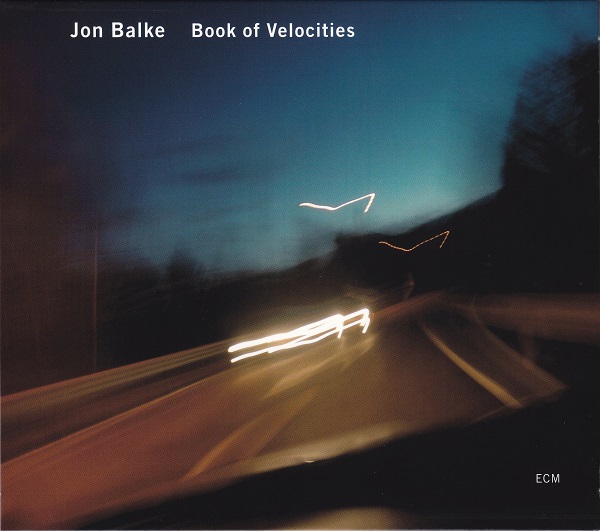
Jon Balke: Book of Velocities (ECM 2010)

Book of Velocities

Jon Balke
Book of Velocities

Jon Balke piano
Recorded September 2006 at Radio Studio DRS, Zürich
Engineer: Markus Heiland
Produced by Manfred Eicher

“We believe that mere movement is life, and that the more velocity it has, the more it expresses vitality.”
–Rabindranath Tagore

Tagore’s statement harbors an implicit question: Does vitality necessarily correlate with velocity? Wittingly or not, Jon Balke would seem to have an answer in this unique album. After a series of memorable appearances on ECM as sideman and group leader (notably, in the latter vein, with his Magnetic North Orchestra), we at last find the Norwegian pianist unaccompanied. The title alone is enough to place the music in a modern tradition of fragmentary collections: Bartók’s Mikrokosmos and Kurtág’s Játékok come most immediately to mind. Yet listening to what Balke has done with both form and instrument, one quickly realizes the profundity of his crafting.

Divided into four Chapters and an Epilogue, Book of Velocities extricates the finer implications of its elements—improvised and composed alike—via thorough examination of the piano itself. By way of introduction, “Giada” flutters between plucked piano strings and dotted punctuations at the keyboard proper. The descriptive cast of “Scintilla” that follows sets the stage for a procession of dreamlike actors, each a cipher for something elemental and transfigured. Other examples in this regard include “Single Line” and “Double Line,” “Gum Bounce,” and the nail-scratched mysteries of “Finger Bass,” the latter droning in Gurdjieff-like meditation.

Many pieces, like the penultimate “Sonance,” exert an organic influence of exhale and inhale, of speech and pause. Indeed, the deepest moments are those least audible, as in the non-invasive contact of “Resilience,” in which one finds the piano’s fantasy life made real. The bodily nature of the music thus shines at carefully selected moments of expression. Whether in the substrate of its own becoming or in the opacity of its outer skin, Balke’s language refashions grammar through every contour. In this respect, the poignant “Drape Hanger” is among the more precious turns of phrase and foreshadows the photorealism of “Scrim Stand,” undulating in real time.

The mirrors of this disc are more than reflective; they are embodied, a dance between beauty and blues. Slowly and surely, Balke turns paths of teardrops into channels of blood flow. This is his art distilled in a crucible of origins until pure feeling remains. It transcends the need for means and returns to the sky whence it came.

Nik Bärtsch’s Ronin: Holon (ECM 2049)

Holon

Nik Bärtsch’s Ronin
Holon

Nik Bärtsch piano
Sha bass clarinets, alto saxophone
Björn Meyer bass
Kaspar Rast drums
Andi Pupato percussion
Recorded July 2007, Studios La Buissonne, Pernes-les-Fontaines
Engineer: Gérard de Haro
Produced by Manfred Eicher

“A band should mature into an integral organism—then it is alive, like an animal, a biotope, an urban space.”
–Nik Bärtsch

With the release of its ECM debut, Stoa, Nik Bärtsch’s Ronin hit the air flying with its meticulous brand of Zen-funk. Two years and eons of experience later, we have Holon, the title of which reveals the band’s underlying ethos: that which is simultaneously part and whole. The beats of this sophomore studio effort are no less regular than those of their predecessor, but now there is something more unitary and, as Bärtsch himself observes above, downright biological going on. Such wording is no mere metaphor, but a lived reality helped along by the decidedly acoustic mix (only Björn Meyer’s bass is plugged), as well as by the fearless integration the group has honed over countless hours of playing as one.

“Modul 42” is where Ronin’s openness comes most explicitly into play. It is an aural body built around contrasting elements. Sparkle and shadow, peace and unrest, freshness and decay—all of these intermingle in recurring dreams, inflected slightly differently with each repetition. Here and elsewhere on the album, Bärtsch’s contact inside the piano reveals a percussive, resonant core less obvious in previous recordings: a staple of his performance style since.

“Modul 41_17” is the first of two transfusions, this one offsetting the same earlier Modul 17 that was dovetailed with 38 on Stoa. Set atop a spinning plate of two notes, Meyer’s contemplative spirals join with others in the fray, cohering into a veritable golem of groove. One can almost feel the platelets conjoining in renewed life as the elements shift and sway to the pulse of some physiological alterity, which marks by its upward chromatic swings the flexion of something divinely ordered. Bärtsch’s dampened finger tapping looses sonic sponges, which soak up all the surrounding water until nothing is left. The second pairing, “Modul 39_8,” is among Bärtsch’s most enchanting. A delicate chemical infusion, it strikes the ether as if it were a matchbook.

“Modul 46” is a blush of autumnal nostalgia that proceeds by delicate propulsions. From the enchanting pianism to the underlay of rhythmatists Kaspar Rast and Andi Pupato, Meyer’s rounded spine and reedist Sha’s tender pocket, this especially jazzy module builds to a luminescent peak.

Rhythmic stacking continues to be a leitmotif of Bärtsch’s vocabulary, and the corridors of “Modul 45” are noteworthy in this regard. Anchored by a rubbery bass and smoothed by interplay between piano and saxophone, it slows into utter transcendence, balancing the piano’s reflective highs with Meyer’s twangs of reconciliation before opening into a stretch of desert music. Sha’s yodeling saxophone cleaves the night with rifts of ebony, while Bärtsch’s solo epilogue reveals nakedness beneath an outer skin.

“Modul 44” tells the story of the former’s slumber, not a dream but a sleepwalk through vestiges of time and space. This is a skeletal creation, a constellation that maps an intergalactic railroad ridden by remnants of ethers whose tickets have yet to be punched.

Call the music of Ronin whatever you will. I call it a jamming of dark matter that abides by its own string theory, and which through self-absorption finds an alternate identity waiting in the wings. One flap, and its echo is felt galaxies away.

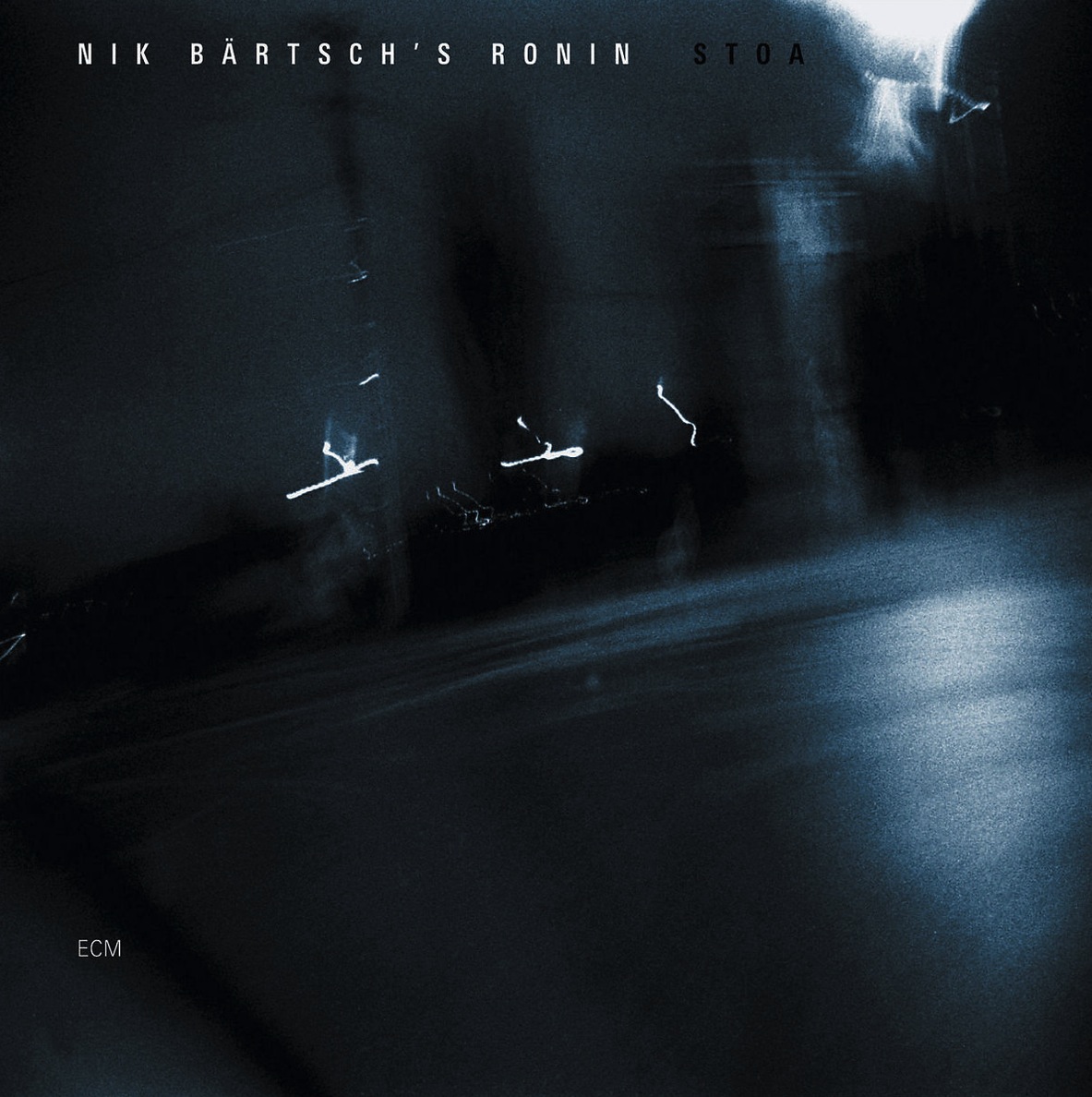
Nik Bärtsch’s Ronin: Stoa (ECM 1939)

Stoa

Nik Bärtsch’s Ronin
Stoa

Nik Bärtsch piano
Sha contrabass and bass clarinets
Björn Meyer bass
Kaspar Rast drums
Andi Pupato percussion
Recorded May 2005, Studios La Buissonne, Pernes-les-Fontaines
Engineer: Gérard de Haro
Produced by Manfred Eicher

“The rule of Japanese martial arts is: think with your body.”
–Nik Bärtsch

With Stoa, Nik Bärtsch’s Ronin dropped into the pond of ECM—indeed, of the world—with profoundly concentric ripples. Listeners can be thankful the effects of those ripples have yet to dissipate, and can only hope decades’ worth more from this nonpareil collective awaits. Pianist Bärtsch drafted the architecture of Stoa while in Japan, the enigmatic and fiercely vivid culture of which had long been the philosophical foundation of his work, yet which remained distant to him until fortune brought him there during the rainy season of 2003.

The formula of Ronin is rooted in the “module,” a molecular prism of being through which Bärtsch’s headstrong quintet splashes light. “Modul 36” thus opens the program with the intermittent glow of a harmonic piano hit, tolling the hour with fallacies of salutation. The only things tangible in these inaugural stirrings are those lone hands at the keyboard. Divorced from body, they step even as they hold themselves against the chill. Wrists plant themselves in the first patches of soil they come to, glowing like eyes in the black ice. Their fingers stretch into branches, from which scatter the blossoms of Ronin’s melodic art proper.

More than any Ronin album since, Stoa measures its respiration in clear-cut rhythmic overlay—this courtesy of drummer Kaspar Rast and percussionist Andi Pupato—with phenomenally engaging results. The stealthy bass of Björn Meyer in “Modul 33” sets off the deepest chain reaction in this regard, followed in kind by the piano’s upper register, Rast’s careful flurry, and the popping bass clarinet of reedist Sha. Overlapping circles, squares, and triangles—each the essence of a different spiritual idea—dance in lockstep toward densities in the latter half. A solid bass line muscles through the smog with finesse. Even subtler syncopations abound in “Modul 32.” Phasing heart rates with magical depressions, it braids the air of the studio with timelessness. From planetary to nebular, its hip-rocking moves evoke the gait of a tireless nomad who has found that middle ground by which to renounce any claims to territory.

“Modul 35” is classically urban Ronin, a world of revolving doors and robotic drones, whose mouths open and close to the tune of cash registers and credit swipes. Yet hovering around these bar-coded souls is a guardian angel of repose, one that counts not tender but connections on its fingers and who speaks through Bärtsch’s own fingers in pylons of light. Microtonal lifts from Meyer add spongy evanescence. Similar contrasts abound in the finishing “Modul 38_17,” another mechanistic fantasy that cuts a line through landscape like a bullet train—which is to stay, smoothly and with barest indications of its actual speed. Winds follow, rolling like the hills in denser chord voicings here. A gorgeously minimal flavor laces the proceedings with tension, urgency growing like a beard on the face of change. Before long that sense of speed catches up with us and tousles our hair, keeping sleep at bay with the sheer energy of self-realization and pulsing through to silence, as resolute as it is fragile.

What we have, then, is not a journey, per se. Instead, a flame rejuvenating itself with every flicker. It travels down the match, edging ever closer to bare fingertips until a gasp of pain and shaking hand offer its ashen frame to the water. But its smoke trails upward yet, the final tether between flesh and firmament.

Martin Speake: Change of Heart (ECM 1831)

Change of Heart

Martin Speake
Change of Heart

Martin Speake alto saxophone
Bobo Stenson piano
Mick Hutton bass
Paul Motian drums
Recorded April 2002 at Rainbow Studio, Oslo
Engineer: Jan Erik Kongshaug
Produced by Manfred Eicher

Saxophonist Martin Speake makes his first—and so far only—ECM appearance in a dream quartet rounded out by pianist Bobo Stenson, bassist Mick Hutton (who debuted for the label with another English reedman, Ken Stubbs, on Eréndira), and drummer Paul Motian. The group’s account of eight Speake originals is as poetic as his titles.

Being made aware of the river that is “The Healing Power of Intimacy” as if we’d already had a toe in its waters is a startling way to introduce us to the session’s flow. Speake’s free-blowing ways fill the covers of Lee Konitz’s signature sweetness with pages all his own, on each of which is written a day in the life of a melodic sage. In the latter sense, we might also reference Charles Lloyd, whose tender drive seems to lurk in the altoist’s dream-weaving. Stenson offers some of his loveliest improvisatory reparations ever committed to disc as sideman. In this regard, the title track shuffles its feet by candlelight, in the soft illumination of which Speake puts pen to paper and lets the muses sing.

Hutton and Motian play catch and release throughout the set, gelling rather swingingly on “Barefaced Thieves” and spreading their fingers wider on “Venn,” into which Stenson and Speake interlace their own. The latter cut contains top-flight thematizing and shows the band at its most aligned. Speake’s golden hour comes in “Buried Somewhere.” This balladic tour de force casts its spell without thinking, lures the muses closer and grazes their palms with methodical freedom.

The rhythm section’s tailwind is that of a comet: vivid yet distant enough to seem frozen in time. And on the question of time, “In the Moment” has much to say. Its sweep is generous, allowing each member’s breath to circulate in the warmth of elegy. Here the flame flickers, never losing hold of its wick. Motian’s charcoal turns to pastel in “Three Hours” with no loss of blend. The steadiness of this tune gives it arms with which to hug, legs with which to move, and a mind with which to lower the cerebral to relatable levels. Listeners can appreciate the respect of this move, hard to come by in a sometimes far too intellectual business. All of which might help to explain why the album ends “In Code”—not for want of secrecy but for honesty of message. Encryptions take place at the very moment of creation. And even as Speake’s alto careens across the night, we can be sure that its soul will stay behind, awaiting further instructions.

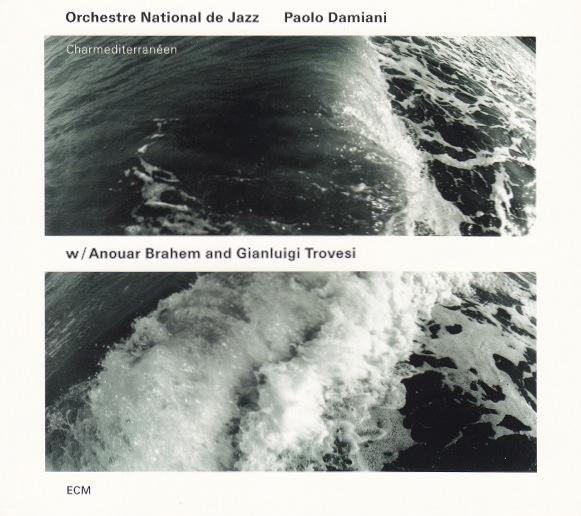
Orchestre National de Jazz: Charmediterranéen (ECM 1828)

Charmediterranéen

Orchestre National de Jazz
Charmediterranéen

Paolo Damiani cello
Anouar Brahem oud
Gianluigi Trovesi piccolo clarinet, alto saxophone
François Jeanneau soprano sax, flute
Thomas de Pourquery soprano, alto and tenor saxophones
Jean-Marc Larché soprano, alto and baritone saxophones
Médéric Collignon pocket trumpet, fluegelhorn, voice
Alain Vankenhove trumpet, fluegelhorn
Gianluca Petrella trombone
Didier Havet sousaphone
Régis Huby violin
Olivier Benoit guitar
Paul Rogers double-bass
Christophe Marguet drums
Recorded October 15 & 16, 2001 live in concerts at Scene Nationale de Montbéliard, Palot/L’Allan
Mixed at Studios La Buissonne, Pernes-les-Fontaines
Engineer: Gérard de Haro
Assisstant: Gilles Olivesi
Produced by l’Association pour le Jazz en Orchestre National

The seeds for the Orchestre National de Jazz were planted in 1982, when France’s Ministry of Culture set out to promote non-classical forms of music in general, and jazz in particular. The ONJ was at the forefront of this movement and, since its establishment in 1985, has cut across musical divides with utmost professionalism and slick telepathy. In the spirit of developing and exploring fresh repertoire, the ONJ takes on a new director every few years. This album comes from a period under the artistic vision of cellist and double-bassist Paolo Damiani, who spearheaded the ensemble between 2000 and 2002. Although Damiani had previously appeared on ECM as part of the Italian Instabile Orchestra (see Skies Of Europe), his presence here gains frontline recognition. Guesting with him are Tunisian oudist and Anouar Brahem and Italian reed maestro Gianluigi Trovesi.

The album begins with a suite composed around the myth of Orpheus. Told in four chapters, plus a prologue and epilogue, they key to this revisionist narrative lies in its array of psychological insights. The journey into the underworld, for example, feels as if it begins the moment the music exhales with its playful mélange of modern classical touches and eclectic flourishes. Yet rather than a torturous slog through fire and brimstone, we get a swinging gait through the pits of human despair toward the reflected light of Eurydice’s mirror. As much Godard as it is Cocteau, the resolve of this mise-en-scène blisters across a free jazz landscape. Electronic enhancements to the horns render ghostly faces that swirl in and out of focus. Such infusions align this album more closely to Evan Parker’s Electro-Acoustic Ensemble than to more conventional outfits. This isn’t your grandmother’s big band.

One suite follows another in the form of “Estramadure.” This three-parter is attuned to overtly compositional impulses, overlaying jagged themes onto smooth backings of winds and brass. Rhythms are tight but spongy, absorbing all that comes their way. Damiani glows in a superb solo turn, making way for a rainy montage cut to ribbons by the sharp relief of Trovesi’s altoism.

Those expecting to hear more of Brahem and Trovesi will either be disappointed or pleasantly surprised. Still, enthusiasts can bask in the warm light of “Montbéliard Trio,” in which the heroes of the hour spend twenty luxurious minutes in various stages of audibility eliciting gorgeous, elliptical themes toward rapture. Brahem also gilds the title track—which translates to “Mediterranean spell”—with appropriately dream-like patterns. Equally deserving of attention are the contributions of violinist Régis Huby, whose restless technical precision recalls that of Mark Feldman. Huby gives especial vibrancy to this 14 and a half-minute epic and elicits a memorable performance in the first of two iterations of “Argentiera.” The fluid stylings of electric guitarist Olivier Benoit also deserve special note.

All told, this is a consistently detailed and sometimes surprising effort that is sure to reward repeated listening.

Gianluigi Trovesi Ottetto: Fugace (ECM 1827)

Fugace

Gianluigi Trovesi Ottetto
Fugace

Gianluigi Trovesi alto saxophone, piccolo, alto clarinets
Beppe Caruso trombone
Massimo Greco trumpet, electronics
Marco Remondini cello, electronics
Roberto Bonati double-bass
Marco Micheli double-bass, electric bass
Fulvio Maras percussion, electronics
Vittorio Marinoni drums
Recorded June 2002 at Next Officine Meccaniche Studios, Milan
Recording engineer: Marti Jane Robertson
Assistant engineer: Guido Andreani
Mixed at Rainbow Studio, Oslo
Engineer: Jan Erik Konshaug
Produced by Manfred Eicher

Gianluigi Trovesi is a maverick in ECM’s stable. His ear for melody and, above all, aesthetics makes him a perfect fit for the label and a standout among its crowded roster. The Italian multi-reedist and composer has, it seems, always had his fingers in many pies, yet consistent to his flavor has been the acidity of celluloid. Indeed, Trovei’s penchant for cinematic atmospheres is a running theme throughout his work on all scales, but nowhere more so than on Fugace. The album’s tasteful admixture of noir, new wave, and expressionist “imagery” enables a deep journey to take place for the open-minded listener. Black-and-white figures shake hands with old-time jazzmen and sultry Technicolor beauties alike—all of them bound to a code of traditional and popular European elements. The latter serve to clear all distractions and highlight the diasporic nature of each genre sampled therein. These elements and more come together in what essentially amounts to a fantasy soundtrack, for it needs no film in order to find focus. Rather, moving pictures would be a hindrance to this music, already so robust in its evocativeness that a screen would be just that: something in the way.

The psychedelic electronic refrain of opener “As strange as a ballad” smacks of a dream sequence, Trovesi’s clarinet the psychoanalyst with an ulterior motive hovering at its periphery. Between this and the follow-up, “Sogno d’Orfeo,” there is already much to admire. The latter’s swanky air opens wispily before floating along the avenues of times past in vintage clothing, clutching worn-out hopes all the while. Sampled harpsichord runs add clink and spatter to this astute rollick, as also to the four “Siparietti,” or entr’actes, that pepper the album’s second act. Each turns a similar motif into a corkscrew of Baroque energy just waiting for the right moment to spawn. The title track performs the same trick, replacing one impact with another.

The “African Triptych” is an indisputable highlight of the program, moving across swaths of landscape in smooth and easygoing melodies. The musicianship is at once careful and carefree, the composing likewise. The second section, “Scarlet Dunes,” unveils a refreshing turn from alto, plying that middle range with all the depth of a sailor dropping anchor. Trovesi manages to scrape the horizon with his fingernails and reveal the gessoed backing. His screeching works wonders here and hereafter, and enhances the band’s subconscious qualities.

Of said band, one can hardly say enough. With Trovesi in the lead, it includes two bassists, two percussionists, a cellist, trombonist, and trumpeter. Its recipes expand upon the minimal ingredients of Trovesi’s chamber projects, and the decade of experience that comes to the table here is detectable in every course. The incorporation of electronics is an ingenious touch, resulting in a hybrid that is as much nu jazz (cf. the dancing breakbeats of “Clumsy dancing of the fat bird”) as Vivaldi; at times haunting (“Canto di lavoro”) and at others parodic. “Blues and West” fits squarely in the vein of parody. Fronting gritty electric guitar work over a smooth bass line and hip blowing from the horns, it gives off whimsical pheromones to be sure. Trovesi’s nod to W. C. Handy, “Ramble,” is another fascinating mélange of eras and styles, shifting John Zorn-like from Dixieland to free jazz in the blink of an eye. The rhythms are totally on point and keep us locked into every chameleonic change. Further along, the whitewash of “Il Domatore” dovetails the beauteous desolation of a William Basinski loop with the hard post-bop of a Dave Holland joint. Its arc goes into hiding until it touches ground in “Totò nei Caraibi,” which pulls the mournful final credits like a curtain in reverse.

Of all possible genres to have been referenced here, neo-realism remains unacknowledged, perhaps in fear of its own reflection. That its hard-won lessons might jump out and startle us at any time is part of the appeal of Fugace, which quells those urges with tightly wound lyricism and colorful appeal. Another masterstroke from Trovesi and his circle.