Andersen/Vinaccia/Smith: Live At Belleville (ECM 2078)

Live At Belleville

Live At Belleville

Arild Andersen double-bass, live-electronics
Paolo Vinaccia drums
Tommy Smith tenor saxophone
Recorded September 2007 at Belleville, Oslo and Drammen Theatre
Engineers: Svyer Frøyslie and Asle Karstad
Edited and mixed June 2008 at Rainbow Studio
Produced by Arild Andersen

Hearing and seeing bassist Arild Andersen, tenorist Tommy Smith, and drummer Paolo Vinaccia will be one of the last memories to fade if and when I ever go senile. The concert was proof positive that these musicians have hit on something special and drove home the point that together they are no mere trio, but a triangle, each side as vital as the others in maintaining the shape of its overall purpose: to emote in a clear and focused way across landscapes at once ethereal and ridden with earthly histories.

The lion’s share of the set is consumed by Andersen’s four-part “Independency.” The infusions of bow taps and fluid pizzicato that open the suite betray nothing of its muscle power. Smith’s bronzed melody-making and Vinaccia’s tremors hold restrainedly yet fiercely to thematic resolve. The reedman’s no-nonsense kaleidoscope foils his increasingly entrenched bandmates with robust ingenuity. Andersen casts a multifaceted shadow across the center of all this, each string of his bass a solitary voice that lives for harmony. Smith carries much of the weight of Part 2, opening with a protracted improvisation that skirts multiphonic edges and catapults its voice across the valley stretched out before him like a royal carpet. Yet where the latter would yield to the touch of uncalloused feet, here the footprints are erratic, as much animal as human, and uninterested in the rules of dominion. Rather, its complexities lie in the simple act of giving in to the glorious potential for jazz to turn the moon like the dial of some cosmic safe and let the magic of spontaneous interpretation come spilling out as stars. Bass and drums connect on yet another level, swinging so hard that the chain wraps full circle until the inertia of Smith’s frenzy gives way to the polyglot freedom of his cohorts. Part 3 works a spell of pretty desolation. For every skyward step, it falls two inward and settles into the comfort of dreams. Part 4, though anchored only by a mid-tempo swing, actually fans the suite’s brightest flames. The band evokes every gradation of color: Smith’s free-blowing soul is the white-hot core, Andersen’s chromatic dance the outer orange and yellow, and Vinaccia the ephemeral sparks kicking the light fantastic out into ether. All the while, the tenor’s gritty squeals add shots of fuel to every indication of waning oxygen. Phenomenal.

To this magnum opus are appended three tunes. First is a flexible take on Duke Ellington’s “Prelude to a Kiss.” Like a heavy marionette, it responds to the pull of Smith’s sax to slog through alleyways of hunger, finding at last the promise of a love supreme in the singsong music of the city, of which only a screen holds the line between desolation and consummation. Vinaccia sets the mood of “Outhouse” with his distinctly bundled sound. Smith joins the theme tentatively at first, Andersen more forthcoming, before they trip into a poised, full-on groove. This skittering jive is the album’s shining beacon toward which all surrounding vessels sail with confidence. And there, on the shore, they dance like they never have before while Smith unearths mounds of treasure onto the sands. Their prized offering is “Dreamhorse,” in which Andersen’s methodical and alluring bass line invites some fast-fingered antiphony with Smith, thereby ending with a touch of the sacred in view.

Even with such a rich (and enriching) career behind him, it’s heartening to discover that in some ways Andersen is just getting started. He is, quite simply, making the best music of his life, made possible through a life of music.

Jon Balke & Magnetic North Orchestra: Diverted Travels (ECM 1886)

Diverted Travels

Jon Balke & Magnetic North Orchestra
Diverted Travels

Magnetic North Orchestra
Per Jørgensen trumpet, vocals
Fredrik Lundin bass flute, saxophones
Jon Balke piano and keyboards
Bjarte Eike violin
Peter Spissky violin
Thomas Pitt bass violin
Helge Andreas Norbakken percussion
Ingar Zach percussion
Recorded September and November 2003 at La Buissonne Studios, Pernes-Les-Fontaines and Rainbow Studio, Oslo
Engineers: Gérard de Haro and Jan Erik Kongshaug
Mixed at Rainbow Studio by Jon Balke, Manfred Eicher, and Jan Erik Kongshaug
Produced by Jon Balke and Manfred Eicher

For his third Magnetic North Orchestra release (following Further and Kyanos), pianist Jon Balke pools together a new band of Scandinavian talent under the same name in the project’s most focused iteration to date. With only trumpeter Per Jørgensen retained from the original lineup, the overall effect is that of a watchmaker and his apprentices turned composers. Such attention to detail has always been part and parcel of Balke’s recognizable approach, but nowhere more so than in the facets of Diverted Travels, where it manifests in shorter pieces, a few of which hover on either side of the one-minute fence. The reconfigured roster reveals itself in the album’s wealth of intimate sub-combinations. The breathy horns and electric piano of “Sink,” for instance, turn ice into water and set a climatic precedent for its companions.

“Machinery” sets the clockwork beat to which the band tunes its heart. The chamber aesthetic so vital to Balke’s aural psyche sings with vibrancy here. Indications of his encounters with West African music are already apparent, clarifying themselves in such pieces as “Nutating,” “In Patches,” and “River,” in which the pulse becomes the melody. The latter’s muted trumpet is especially organic and foils the waterwheel motions of its backing with genuine augury. “Climb” is another energizing walkabout with all the makings of a nervous breakdown yet with none of the weak spots. Agitations darken into a lullaby beneath a giant eyelid closing to reveal the starlit canopy of its inner surface.

“Columns” boasts the unmistakable vocal stylings of Jørgensen, whose tense histrionics slalom like an aria from a lost Michael Mantler opera through spokes of arid strings. The trumpeter reveals further mysteries in “Deep,” working his craft through the prism of saxophonist Fredrik Lundin amid a smattering of percussion. Likewise, the mysterious “Downslope” is an album highlight. Rendering molecules of horns within a sul ponticello fringe, it turns air into breath and breath into bodies, footsteps audible on the plains as they balance a hunter’s lance atop the scalp of the setting sun. In the shadow of this piece is “The Drive,” a drone of stunning capacity.

At nearly seven minutes, “And On” is the longest selection, a storm that utilizes the full force of the MNO to evoke changes in atmospheric pressure. Balke’s pianism is wondrously compact, running tighter and tighter circles until it expends itself with jouissance. How else to deal with this than by “Falling,” which brings together the three violinists and Jørgensen’s recorder-like throat in ashen harmony, signing off this love letter to cloudy skies with a taste of antiquity.

Jon Balke & Magnetic North Orchestra: Kyanos (ECM 1822)

Kyanos

Jon Balke & Magnetic North Orchestra
Kyanos

Magnetic North Orchestra
Per Jørgensen trumpet
Morten Halle saxophones, flute
Arve Henriksen trumpet
Svante Henryson cello
Jon Balke piano, keyboards
Anders Jormin double-bass
Audun Kleive drums, percussion
Recorded November 2001 at Rainbow Studio, Oslo
Engineer: Jan Erik Kongshaug
Produced by Jon Balke and Manfred Eicher

For Kyanos, Jon Balke continues the journey begun on Further with an assembly of likeminded label mates—among them trumpeters Per Jørgensen and Arve Henriksen, bassist Anders Jormin, and drummer Audun Kleive—under the moniker Magnetic North Orchestra to ply the glaciers of the Norwegian pianist’s nostalgic compositional approach. Many permutations of the album’s title (which means “blue” in Greek) find purchase in the album’s intimate geography. “Mutatio,” for one, unpacks the depressing implications of the color, trading piano-heavy gestures with soft punctuations from the MNO, each a hope sidestepped in favor of seclusion. “Katabolic” tells the same story but reverses the formula, fronting Jørgensen and Henriksen against intermittent swells of synth. “In vitro” seems to speak in the language of the color itself, as if it were an entire species with specific taxonomic histories and genetic signatures.

Balke’s introduction to opener “Phanai” is the most evocative of them all, dancing like sunlight between tree branches. Sudden intakes betray a drama waiting to leap out into the wider world, finding instead the slow entry of percussion and brass. The feeling is one of a giant sleepwalking through forest as if it were underbrush. Balke and Jormin’s rhythmically savvy interplay bleeds contrast. With insectile harmonics and trembling heart, Jormin bounces along the inner walls of “Zygotos” with a string of genetic possibilities while the surface around him glows to the horns’ intervals, though nowhere no delicate as in “Ganglion,” a masterful conversation between Balke, Jormin, and Kleive that is the most microscopic portion of the set. Haunting accents from flutist Morten Halle and cellist Svante Henryson indicate a world much farther away, a place where the eddying winds cease only for the fearless.

The second half of Kyanos consists of miniatures in more ways than one. The intimate details of “Plica” and “Nano”—mostly percussive expressions and dream-tracings—intensify the magnification. Clicks on piano strings and sibilant fluting designate especially fruitful cells of intent. “Karyon” is the album’s truest groove and packs huge emotion into barest gestures. Its evolution from blind wandering to keen-eyed flight reaches its peak in the form of Jørgensen’s unique vocal edge. Henryson duets enigmatically with Jormin in the concluding “Apsis.”

A prevalence of biological imagery in the song names characterizes this album as a mapping of bodily spaces, thus clarifying the ultimate nuance of blue: namely, as the stain beneath a cover slide. The title track is the most concentrated solution to be found on this laboratory bench, enhancing as it does the emotional details of everything around it. Just turn up the volume as you would a focus knob, and it will all become clear.

Keith Jarrett: Concerts – Bregenz/München (ECM 1227-29)

Concerts

Keith Jarrett
Concerts – Bregenz/München

Keith Jarrett piano
Recorded May 28, 1981 in Festspielhaus Bregenz (Austria) and June 2, 1981 in Herkulessaal München (Germany)
Engineer: Martin Wieland
Produced by Manfred Eicher

Concerts may just be the brightest star in the galaxy of Keith Jarrett’s live solo improvisations. Where previously one could get only a third of the nearly two-and-a-half-hour experience on CD (the entire experience was, of course, always available on vinyl), it has at last been restored to its celestial glory in digital form. Indeed, form is what this recording is all about, for its spins, seemingly from nothing, a fibrous body of sound. The first of the album’s concerts took place in Bregenz on 28 May 1981, the second in Munich on the 2nd of June that same year. Though markedly different, their kinship is overwhelming.

Bregenz is the meatier of the two, and comes into being, as Jarrett’s improvisations so often do, as if midstream, a reverie from which attention has been diverted by the circadian rhythms of life. A quiet and reverential tone pervades its initial stirrings, which sometimes dart into the sky like meteors in reverse. Yet one gets the feeling as Jarrett lays into jazzier motives that he is neither floating nor falling but emotes in softest paralysis. He intensifies urgency, stomping to a drum only he can hear. Within each solemn depression of key and spirited cluster alike, there is constant medi(t)ation. Like fingers uncurling, his music melts through tension and ego. Shostakovichian flourishes enable ecstatic transition into Part II, where the clockwork of his instrument further opens his performing self. He is a reflection of the interior, eliciting rolls that hum their way along the edges of unforeseeable futures into the stillness of bated breath. Were it not for the applause, the spell might never be broken. “Untitled” is terse and brightly syncopated, trail-marked by Jarrett’s paroxysms. These get a deservedly strong reaction from the crowd before ending on a soulful note with the anthemic, and iconic, “Heartland.”

Munich swaddles with its porous sound. Part I is likewise born to humble beginnings. Individual droplets spread into sheets of rain, in which one tastes a bittersweet concoction of trial and transcendence. Fingers slide into Gurdjieff-like homage, Jarrett grunting with intense joy between pauses, where breathes the generative energy that sustains his brilliance long into the enigmatic Part II. With this savory swing he mortars fractured arcs of time by way of uncontainable expectorations, every note emoting the staying power of a keystone. He breaks the stillness with his feet, easing into a liquid ostinato. Gently at first, then with more insistence, Jarrett gilds the frame with increasingly frenzied ornaments. At their center are the gospel sounds of Part III. Threaded by Jarrett’s singing on and off the keys, these bustle with a deep commitment to pastoral resolution, evoking the majestic patchwork of clouds as well as that of the land below them. This switches to rich ascending phrases and chord voicings, taking pleasure in the therapy of an unobstructed view, which Jarrett manages to describe to us as if we were blind. The little staircase of Part IV burrows deeper into the ear, opening into a full-blown lighthouse of sound before jumping off into the sparkling horizon. Abstract touches inside the piano break the monochromatic spell and pour us into the colorful world of “Mon Cœur Est Rouge,” in which Jarrett achieves such poignant balance that it might just be his most astonishing solo ever recorded. Running with the abandon of a child yet marked by experience, it beams a laser into a reprise of “Heartland.” The latter is the perfect title for Jarrett’s emotional geographies, inspired as they are by the terrain of love and photosynthesis that sustains them.

Most compelling about these solo concerts is that, no matter how epic their tales become, they never seem more than flecks of dew, noticeable only because Jarrett angles the sunlight on them just so. What stands out in these oceans of technical flourish, therefore, are those carefully rendered single notes. Whether finger-pedaled or hanging in space like gongs, each mitochondrial curlicue recedes into another life. That life may be yours or a stranger’s. Or maybe it’s trying to tell us that those lives are one and the same, and that a need for music has all along been the eternal chain of being from which we all swing and of which we all will one day let go.

<< Gary Burton Quartet: Picture This (ECM 1226)
>> Don Cherry/Ed Blackwell: El Corazón (ECM 1230)

Keith Jarrett: No End (ECM 2361/62)

No End

Keith Jarrett
No End

Keith Jarrett electric guitars, Fender bass, drums, tablas, percussion, voice, recorder, piano
Recorded 1986 at Cavelight Studio, New Jersey
Executive producer: Manfred Eicher
An ECM Production

There seems to be no end to Keith Jarrett’s output, so what better title for this archival gem? Recorded directly to cassette in his personal studio in 1986, No End is in many ways the secular counterpart to Spirits, produced under similar circumstances not a year before. Where that earlier album was something of a catharsis for its one-man band, here the emphasis is on essentials. What’s most delightful to hear in this recording is the foundational emphasis on rhythm. Jarrett has always had a flair for syncopation, and here we can experience that impetus in all its naked precision, conveyed by means less mitigated that we’re used to hearing. Foremost in his toolkit are electric guitar, bass, and drums, with hardly a piano lick in earshot. Girded by a refreshing sense of freedom, an inexhaustible creativity that simply must manifest at the intersection of body and instruments, it spins the wheel consistently and spontaneously.

Because so much music has followed this album, it is perhaps inevitable that any comparisons should be retroactive. The opening section, for example, may put one in mind of John Zorn’s film soundtracks—notably downtempo segments of The Big Gundown and Notes on Marie Menken—both in terms of its fecund atmosphere and because of a penchant for Phrygian scales. Gunslinging surf guitar and steady percussion add ornament and charisma. Likewise the mournful sweep of Part XII, which evokes a brand of desolation not out of place in a spaghetti western. Jarrett’s Gibson electric forges a beautiful scene. Indeed, his picking is the loveliest revelation of the album. Slack-jawed and expressive, it emotes with commitment.

There are many details to be savored throughout, such as the vocoder-ish backing vocals, the complementary tribal beats, the occasional deep pocket (e.g., Parts VII & XVI), and the touch of blues that creeps in to finish. Although the piano makes a noticeable appearance only halfway through, Jarrett brings a pianistic approach to the entire assembly, as if each instrument represented a finger in the symphonic economy of his keyboarding. Psychedelic touches are few and far between, blooming only in the more protracted grooves and instances of staggered layering. In the latter regard, Part XVIII is a welcome departure from the regularity that surrounds it, an altered state unto itself.

The beauty of No End is its possibility. It could soundtrack a spy film, for at times its motives seem playfully clandestine. It could just easily stand alone, as here: a valuable experience for the Jarrett enthusiast. The free-flowing jam aesthetic and nostalgic patina of the home recording are in full effect. Tape hiss and distorted max-outs emphasize the fact that this music has come to us out of time and context, wearing the clothing in which it was buried and which it wears under the spotlight of this new millennium.

More of a want than a need for the collector’s shelf, No End might have achieved its purposes in one disc instead of two. Either way, its length serves to emphasize a consistency of vision. As Jarrett avers in his liner notes, “Music is the strongest medicine I know,” thereby dismantling any critical ammunition for what ultimately amounts to an honest slice of sonic pie from one of the greatest musical minds of our time.

(To hear samples of No End, click here.)

Keith Jarrett: The Carnegie Hall Concert (ECM 1989/90)

The Carnegie Hall Concert

Keith Jarrett
The Carnegie Hall Concert

Keith Jarrett piano
Recorded live September 26, 2005
Engineer: Martin Pearson
Executive Producer: Manfred Eicher

After a long preparatory breath, the experienced gardener digs his fingers into the soil: this is what it feels like to put on Keith Jarrett’s The Carnegie Hall Concert. The ensuing harvest offers a veritable rainbow of sonic fruits and vegetables, each with its distinct shape, texture, and flavor. Such is Jarrett’s post-millennial approach, which finds just as much depth in the self-fulfilling vignette as in the arcing narratives of years past. From heartaching lyricism (Part III) to mystical convolutions (Part IV), elegiac resolutions (Part V) to anthemic revelries (Part VII), the language of contrast is alive and well.

The concert’s most intuitive moments emerge in the latter half, wherein Jarrett makes a landscape audible by touch alone. Part VIII evokes the undulating line of purple hills. Part IX is the campfire at field center and the dancers who make the most of its warmth in the encroaching twilight. The tenth and final improvisation is a culmination of impending forces, a smoothing of wrinkles in the bed sheets of experience that leaves a most pristine surface for slumber.

The strangely satisfying mix of parallels and cross-hatchings one can expect to hear in any Jarrett solo program are all here to be savored, an expectation that bears out naturally for avid listeners, enchantingly for newcomers. Either way, Jarrett seems less interested in surprising anyone—himself least of all—throughout this nonetheless monumental performance. Rather, he bathes in the music’s unfolding as might a child watch clouds go by overhead. What we have, then, are readings of amorphous shapes: faces, figures, and objects that fuse and separate, congeal and dissolve.

Such depths might have been enough, but Jarrett felt it appropriate to append five encores, together an autobiographical compendium that cuts across his career like a knife through cake. Each original layer reveals something true and undying within him. “The Good America” is the sweet icing, beneath which “Paint My Heart Red” beats with a pulsing stratum of fruit. “My Song” references the classic 1978 album of the same name. The enthusiastic applause discloses the surprise of recognition. The audience has been given a gift of long ago, a nostalgic prism that still refracts for all who lend an ear. The downright edible vamp of “True Blues” makes for a rich, chocolaty foundation, while the concert’s only standard, “Time On My Hands,” lights the candles on top, inhales, and lets the ensuing blast of adoration blow them out.

The Carnegie Hall Concert is, of course, just one of many wondrous pieces of an unparalleled archive. Ultimately, comparisons to Jarrett’s influential appearances in Köln, Tokyo, and Milan need not apply. Each is its own animal with unique cadences and features, and together they nurse an ecosystem of timeless ingenuity.

Keith Jarrett: Radiance (ECM 1960/61)

Radiance

Keith Jarrett
Radiance

Keith Jarrett piano
Radiance, Parts I-XIII
Recorded live, October 27, 2002 at Osaka Festival Hall
Radiance, Parts XIV-XVII
Recorded live, October 30, 2002 at Metropolitan Festival Hall, Tokyo
Engineer: Martin Pearson
Assistant engineer: Yoshihiro Suzuki

“We are all players and we are all being played.”
–Keith Jarrett

Keith Jarrett is a composer without a score, a melody with a body. He is a soul in constant transition. Such is life.

In his liner notes, Jarrett tells us he was trying something new with these solo improvised performances (his first in 15 years after an illness-ridden hiatus), forging paths for the most part devoid of melodic and motivic footholds, and fragmenting the epic journeys for which he’d come to be known. Durations of tracks—ranging from from a minute and a half (Parts IV, XI) to 14 minutes (Parts X, XIV, XVII)—speak to the program’s cellular makeup.

Parts I through XIII are cumulative, in the sense that each could not have existed without the other. Jarrett: “I was slightly shocked to notice that the concert had arranged itself into a musical structure despite my every effort to be oblivious to the overall outcome.” That such structure emerged at all is testament to his soul, which lives and breathes for the communication of his art, and to the music he unearths, all the more everlasting for being unplanned. One can hear him thinking through the notes as if they were words in a James Joyce novel, skimming just enough meaning off the top to tell a story but also leaving behind so much to discover during future listens. Passages of controlled frustration blend into heavenly resolutions, though one is always quick to succumb to the other. This is especially true in Part I, which sets a precedent for open reflection, shuffling honesty into a deck without spades.

Occasional mechanical rhythms (Parts II, VIII, and especially the vampy XII) demonstrate the unpredictability of Newton’s clockwork universe, sometimes digging so deep into the earth that they come out the other side and continue onward toward neighboring galaxies. Reveries, on the other hand, are fragrant and abundant (Parts III, VI, IX, XIII). In these Jarrett wanders like the traveler whose satchel has been emptied of its material artifacts yet which overflows with spiritual relics of the journey that emptied it. He takes in the sights along with the sounds, folds each into his tattered scrapbook, and stores their energy for the next concert. As effective as these snapshots are, even more so are the abstract and beguiling ones. In this respect, the heavily sustain-pedaled Part V is a masterful stretch. Here Jarrett turns the keys into putty and flexes the piano’s infrastructure to a breaking point. Part X, for its breadth and sheer melodic force, is another highlight that combines reverence with fearless distortions.

Parts XIV through XVII are excerpted from the concert recorded in full on ECM’s Tokyo Solo DVD, and demonstrate the vignette-oriented Jarrett to clearest effect. There is playfulness in these concluding acts, a dramaturgy of detail and respect for spontaneous character. So easy are they to get swept up in that the urge to sing along may be almost as strong as that which compels Jarrett to emote in just that way. That song becomes our tether to land as the tidal currents of Part XVII take us back to the Mother Ocean, where swims our shared love for the sounds that kept us from sinking in the first place.

Keith Jarrett Trio: Yesterdays (ECM 2060)

Yesterdays

Keith Jarrett Trio
Yesterdays

Keith Jarrett piano
Gary Peacock double-bass
Jack DeJohnette drums
Recorded April 30, 2001 at Metropolitan Festival Hall, Tokyo
Engineer: Yoshihiro Suzuki
Produced by Manfred Eicher and Keith Jarrett

Yesterdays follows Always Let Me Go, The Out-of-Towners, and My Foolish Heart (link to all) as the fourth and final ECM album recorded during Keith Jarrett, Gary Peacock, and Jack DeJohnette’s inaugural tour of the new millennium. Like beads on a necklace, these albums guide a singular thread, a development of attitude and polish, which colors the music of this enduring trio. Pianist, bassist, and drummer respectively buff another set of standards to a sheen of crystalline ebullience.

Horace Silver’s “Strollin’” blossoms with free-blowing fragrance, carrying its symbolic weight in gold down pathways toward reminisced-about times and places. Although Jarrett’s wings may be almost as fast as a hummingbird’s, they are living proof of mind over matter, if not mind as matter, doing more than putting feet to ground as the title would imply. Peacock likewise enamors the scene with an emotional rather than physical leap in his solo. “You Took Advantage Of Me” returns from its appearance on My Foolish Heart with even greater sanctity, while the title track, tender as tender can be, holds its heart in its pocket so that it may never forget where it came from. Peacock builds a fluid, chromatic ladder in his duly heartfelt solo before an enchanting finish from the keys. “Shaw’nuff,” a Charlie Parker/Dizzy Gillespie joint, launches into its vamp with the resolve of a high diver. There is fantastic, sparkling energy here that bears out in a concise and to-the-point narrative style. The forlorn ballad “You’ve Changed” works its craft in subtlest ways. Originally a song of needing to move on but not knowing how, here it cups a more hopeful carnation in its hands. Peacock does wonders with this tune, as does Jarrett in the afterglow. Parker’s “Scrapple From The Apple” makes a welcome cameo in the trio’s set list after a debut appearance on up for it and elicits pure trio magic. Harold Arlen’s “A Sleepin’ Bee” is a steady, mid-tempo tune that adds a dose of whimsy to this Tokyo performance. Peacock and DeJohnette sit deep in the pocket, adding copious amounts of fibrillating swing. “Smoke Gets In Your Eyes” is another soft tune which glows like an ember in memory of a doused fire, of the feeling of togetherness that once convened around it. After these blue notes, the upbeat take on “Stella By Starlight” (recorded during soundcheck) that ends the album pours fresh sunshine onto the scene, inspires some fine drumming, and puts Jarrett in a restrained yet joyful mode, ending smoothly and unexpectedly on a whim.

Track for track, a solid outing, with soft spots in all the right places.

(To hear samples of Yesterdays, click here.)

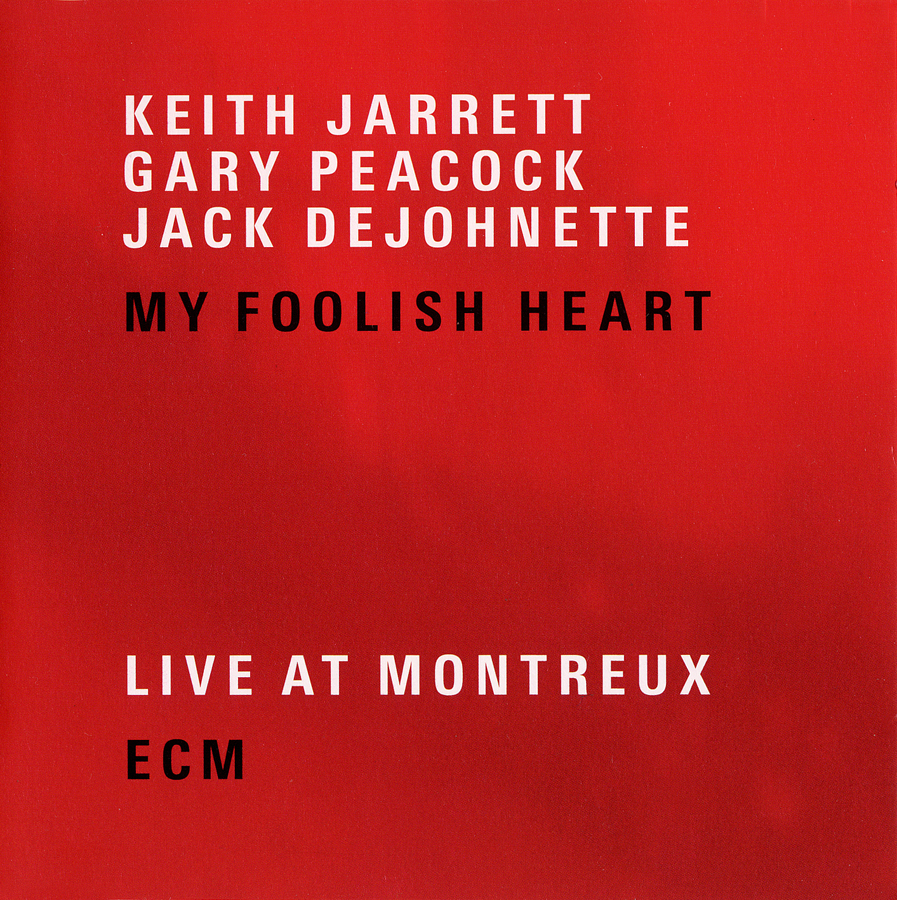
Keith Jarrett Trio: My Foolish Heart (ECM 2021/22)

My Foolish Heart

Keith Jarrett Trio
My Foolish Heart

Keith Jarrett piano
Gary Peacock double-bass
Jack DeJohnette drums
Recorded July 22, 2001 at Stravinski Auditorium, Montreaux with Le Voyageur Mobile Studio
Engineer: Martin Pearson
Produced by Manfred Eicher

My Foolish Heart may just be, between Still Live and Somewhere, the missing piece of the Keith Jarrett Trio’s Triforce. Recorded live in Montreux in July of 2001, it shows the trio—both in general and this specific—in brightest light. The bounce of “Four” kicks things off with so much panache that anyone even thinking of laying fingers to keyboard might just want to crawl into a hovel and listen in awe. The tune is, of course, by Miles Davis and draws lines of history back to Jarrett’s association with the Prince of Darkness, flipping that nickname into an exercise in luminescence. The feeling of togetherness practically shouts its decades of experience from the rooftops and calls any who will listen in ecstatic gathering. Peacock almost flies off the handle from all the excitation, but reins in his enthusiasm just enough to build his first solo of the night with architectural integrity. DeJohnette, too, revs the engine a few times without losing traction.

This formula works wonders in subsequent takes on Sonny Rollins’s “Oleo” and two Fats Waller tunes (“Ain’t Misbehavin’” and “Honeysuckle Rose”), imbuing the stage, respectively, with flow, flourish, and ragtime charm. At once progressive and nostalgic, these fast-fingered excursions attract wonder like magnets. The emotive genius of Jarrett’s sidemen is extraordinary throughout. “The Song Is You” is another instance of revelry that unpacks entire fields’ worth of implications in single sweeps, in which DeJohnette’s skills blossom most blissfully.

“You Took Advantage Of Me,” a Rogers and Hart show tune, finds a holistic place in the Jarrett set list and obscures none of the whimsy of its absent lyrics. From the florid we move to the tough love of Thelonious Monk’s “Straight, No Chaser,” which pours a stiff drink indeed. Jarrett spins like a top, inspiring gorgeous circling from DeJohnette and a pin-cushioned solo from Peacock. It sits comfortably alongside “Five Brothers,” an earlier Gerry Mulligan tune that oozes 1950s charisma: monochromatic, debonair, and veiled by cigarette smoke. The trio ends somberly with a quietly spirited “Guess I’ll Hang My Tears Out To Dry.” More than any other portion of the concert, Jarrett’s infallible respect for melody comes to the fore and paints for us a picture so realistic, it might as well be a photograph, a moment in time, a memory to cherish.

Two encores further express the trio’s balance of wind and water. “On Green Dolphin Street” whisks on by with such ebullience that it hardly leaves a trace of its passing, while “Only The Lonely” tears the heart in two and mends it in just over six minutes. Yet nowhere is the telepathy of this trio so nakedly conveyed than in the title tune, which sways, full-figured and proud, with all the rustle of a willow tree. The combination of singing pianism and melodic rhythm support hides a perfect scar in its core. There’s a song to be sung here, and its name is: YOU.