Keith Jarrett: Paris/London – Testament (ECM 2130-32)

Testament

Keith Jarrett
Paris/London – Testament

Keith Jarrett piano
Recorded in concert
November 26, 2008 at Salle Pleyel, Paris
December 1, 2008 at Royal Festival Hall, London
Producer: Keith Jarrett
Engineer: Martin Pearson
Executive producer: Manfred Eicher

“Communication is all. Being is all.”
–Keith Jarrett

Since the release of his endlessly influential live record The Köln Concert, Keith Jarrett has done more than any other at the keyboard to clarify improvisation’s infinite shape. When basking in the music that pours from his fingertips, it’s easy to wax poetically from one’s armchair about the effortless brilliance with which he seems to play. Yet Jarrett wants us to know that the process is not all intuition, for often—as is true of the concerts documented here—the physical and emotional challenges are intense, unrelenting. In his liner notes, he lays out the taxing nature of his efforts, saying, “It is NOT natural to sit at a piano, bring no material, clear your mind completely of musical ideas, and play something that is of lasting value and brand new.” He further mentions that the role of the audience has always been of the “utmost chemical importance” and is more apt to change the dynamics of the performance than any technical concerns, such as those that permeate the lore of Köln. Whether it’s a concert hall, a microphone, or the ether itself, every adlib needs an ear.

On November 26, 2008, Jarrett put this theory into practice when he took the stage at Salle Pleyel in Paris for the first of two ad hoc solo concerts. Although a noticeably bipolar performance, it also draws many intersections of contact between extremes. Over a glorious 70 minutes of music in eight parts, Jarrett works an asana of fixation and letting go and touches hand to heart in sporadic gestures of deference. Like water set to boil but which is turned down at the last moment, it skirts the edge of conversion from liquid to gas. At some moments Jarrett’s spontaneous motifs funnel into a single dream of flight, realized in his unbridled feeling for thermals that only he can see. Such depth is palpable in Parts III and VIII, both of which make sweeping peace of untapped wisdom, now opened like a book to reveal an as-yet-unwritten past. With every shake of the snow globe, Jarrett seeks new patterns. Whether in the mournful procession of Part V or the jazzier syncopations of VI, we can feel a working-through that gnaws the edges of philosophy. The final section synthesizes what came before. At once elegiac and scintillating, it finishes with a deluge of ephemeral signifiers.

The London concert, recorded five days later, is clothed by even more intense variety. One can not only hear but feel the debates raging inside Jarrett, who with Part I renders the rib cage a ladder to radiance and catches an eddying wind in Part II, kicking up leaves and dry soil. In this concert, too, the sheer breadth of Jarrett’s sweep is staggering in a way rarely heard since the early concerts. From Part III to the concluding XII, every step of this journey flirts with optimism, though gnarled eyes mark the wood grain periodically along the way. Gospel progressions infuse spiritual longing with living resolution, fingers digging into every chord like hands into soil, while Parts VII and X vamp across vales of blues. In likeminded vein, Parts IV and VIII hark to the divine tracings of Köln in some of his most unmitigated playing since that fateful performance. Sparkling and transcendent, they cascade over themselves in a constant rebirthing process. This is what lies at the heart of his craft: a total oneness with the elements. It’s like discovering the inner workings of a clock you once believed ran on magic, only to realize that in those gears lies the deeper magic of the ingenuity that set them running.

No such program would be complete without some jazzier flashpoints, and these we get in Parts VI and XI, both of which feel like ballads lost from the American Songbook that have wandered into view after a long redemption. Though haggard, they convey perseverance through their melodies. Close to elegies but ultimately wishes fulfilled, they touch with a caress that feels like mountains and sky.

Most impressive about the Paris and London concerts is their scope. Jarrett’s hands wander independently of one another while also keeping at least an artery pulsing between them. Jarrett knows the piano like he knows his own voice; for him they are one and the same. He does not surrender to what he creates, for surrender implies an advantage of which to be taken. The beauty of it all is that one need listen only once to live off the memory for a lifetime.

(To hear samples of Paris/London – Testament, click here.)
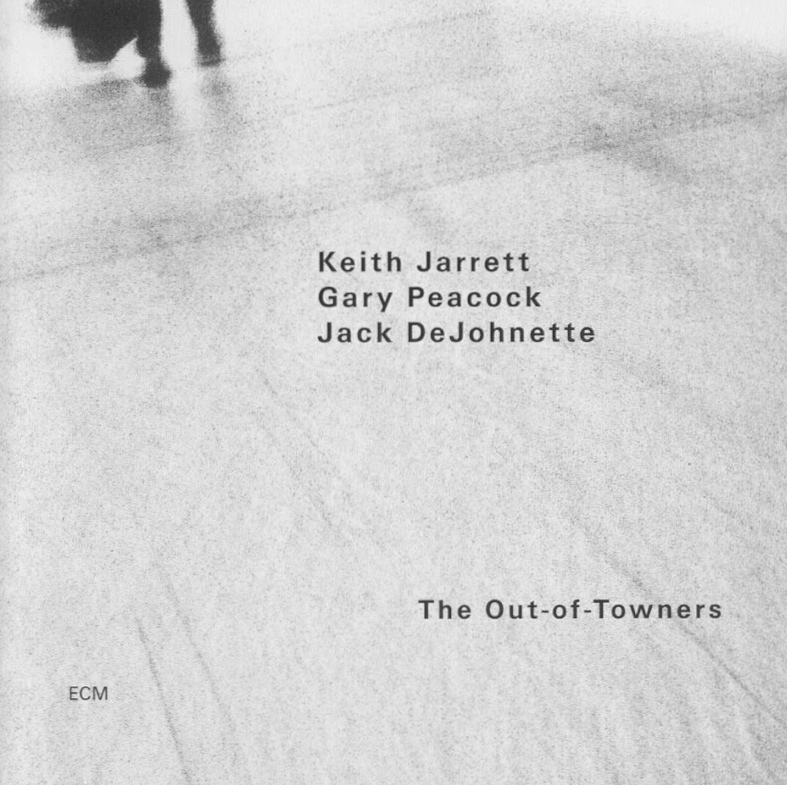
Keith Jarrett Trio: The Out-of-Towners (ECM 1900)

The Out-of-Towners

Keith Jarrett Trio
The Out-of-Towners

Keith Jarrett piano
Gary Peacock double-bass
Jack DeJohnette drums
Recorded live July 28, 2001 at State Opera, Munich
Engineer: Martin Pearson
Mastering: Morten Lund, Masterhuset
Produced by Manfred Eicher

With the insight of legitimate hypnotists, Keith Jarrett and his trio regress seven tunes with a flair for the unexpected. Recorded live at Munich’s State Opera in July of 2001, an especially productive year for the band, the performance whispers into life with a piano intro before waxing nostalgic in a sunny rendition of “I Can’t Believe That You’re In Love With Me.” Jarrett, of course, shines at every turn, but his phenomenal rhythm section has rarely sounded more luminescent. Light in their step and playful in their virtuosity, Jarrett’s sidemen exude effortlessness. Peacock is worth singling out in this opening tune, in which he departs from his usual twang in favor of a smoother, subtler extroversion. He reverts to his tried and true in a rendition of “You’ve Changed” that turns to melted butter in the trio’s hands. With Jarrett’s delicate anchorage behind him, the bassist picks away at edifice of the song’s confusion to a core of resolve. Jarrett pours on the honey for the rejoinder, DeJohnette all the while brushing like the wings of a dying insect, swishing to the rhythm of a broken heart. Brushes turn to cymbals in an effervescent take on Cole Porter’s “I Love You,” which finds the drummer running a parallel course of emotional freedom alongside Jarrett. Artful solos abound.

The freely improvised title cut is a gem. Over its 20-minute vamp, the trio plays with such looseness that it can only cohere by sheer depth of listening. Peacock is the conductor of this epic train, DeJohnette adding dynamite charge to the rails throughout the ride. The follow-up is a crystalline “Five Brothers.” This tune by the great Gerry Mulligan is the very definition of smooth. Jarrett’s punch and charisma here exhaust the barriers around his concluding solo, a heart-stilling rendering of “It’s All In The Game.” Thus sworn by sunset, he walks into a darkening horizon, where rests the origins of these gifts, so selflessly given, which like the figures on the album’s cover are almost gone from view the moment we realize they were within us all along.

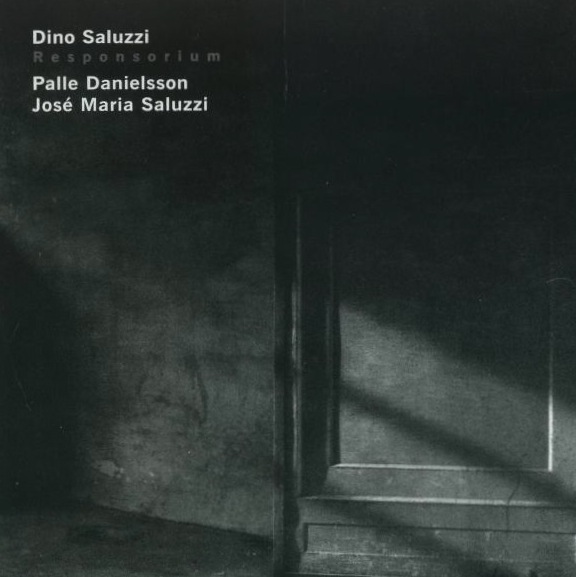
Saluzzi/Danielsson/Saluzzi: Responsorium (ECM 1816)

Responsorium

Responsorium

Dino Saluzzi bandoneon
Palle Danielsson double-bass
José Maria Saluzzi acoustic guitar
Recorded November 2001 at Rainbow Studio, Oslo
Engineer: Jan Erik Kongshaug
Produced by Manfred Eicher

Responsorium is for all intents and purposes a companion album to 1997’s Cité de la Musique. The kinship is suggested not only in the instrumentation (bandoneón, double bass, acoustic guitar), but also by the similar composition of cover art, in which angled sunlight pours through glass and gives warm indications of a world beyond. Joined again by son José Maria, and replacing Marc Johnson with Palle Danielsson on upright, Dino opens the set with a dedication to his brother and fellow bandoneonista Celso (who can be heard on Mojotoro). The rhythmic impulse is uniquely his own and shines in every unexpected turn of phrase. “Mónica” treads even deeper into the forest, leaving a trail of crumbs for the hungry. It, too, feels like a dedication, perhaps to a child, and treats the bandoneón as a body from which to emanate virtue. Bass and guitar carry that virtue through mountains and valleys, leaving traces in every river it crosses. On the subject of crosses, “Responso por la muerte de Cruz” bows its head in reverence to the divine in the human, if not also the human in the divine. José Maria’s steady fingers take on most of the emotional load. His sensitivity arches over Danielsson’s low stitching with forlorn comfort.

The album gets its first boost in “Dele…, Don!!” The spirit of the tango is alive and well in this configuration. One might even hear the feet hitting the floor were it not for the sheer delicacy of the playing, for it is in its ability to float massive traditions in but an inch of water that the trio’s brilliance shines. Each player thus brings a unique stamp to the record. Whether it’s Danielsson’s shadowy punctuation (“Cuchara”), José Maria’s pliant voicing (“Reprise: Los hijos de Fierro”—note also his effortless soloing in “La pequeña historia de…!”), or Dino’s narrative ingenuity (“Vienen del sur los recuerdos”), there’s plenty to admire and re-admire in the spokes of this melodic wheel. And indeed, in the end, as the credits roll languidly across the screen of “Pampeana ‘Mapu,’” those unaccompanied bellows have more to say than an entire orchestra, able as they are to forge a choir of themselves. What they lack in speech they make up for in song, and with that song comes the drizzle of a force so genuine that it might just go on singing forever. There’s only one way to find out: listen.

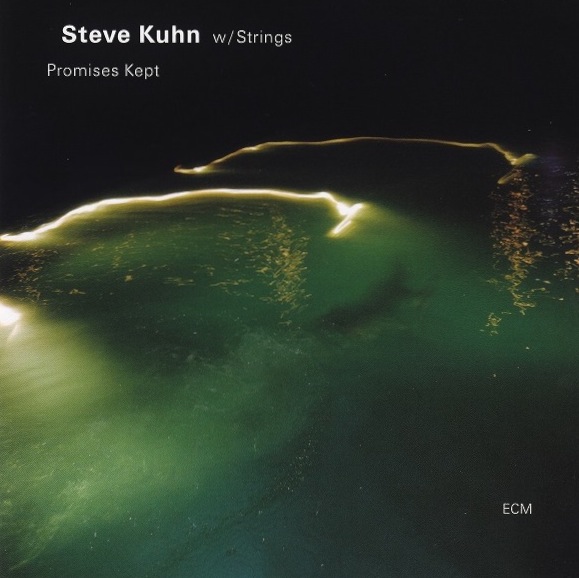
Steve Kuhn: Promises Kept (ECM 1815)

Promises Kept

Steve Kuhn
Promises Kept

Steve Kuhn piano
Krista Bennion Feeney, Elizabeth Lim-Dutton, Richard Sortomme, Karl Kawahara, Barry Finclair, Helen Kim, Robert Shaw, Carol Pool, Anca Nicolau violins
Sue Pray, Vince Lionti, Karen Ritscher violas
Stephanie Cummins, Richard Locker, Joshua Gordon celli
Carlos Franzetti conductor
David Finck bass
Recorded June and September 2002 at Edison Studios, New York
Recording engineer: Gary Chester
Assistant: Yvonne Yedibalian
Remix and mastering by Jan Erik Kongshaug and Manfred Eicher at Rainbow Studio, Oslo
Recording producer: Arthur Moorhead

Promises Kept is something of a watershed moment in the career of pianist Steve Kuhn, who sees the album as the fulfillment of a lifelong wish. Kuhn has always been known for possessing a keen ear for sonority, but here that trait is expanded by the string ensemble—with arrangements by Argentine composer Carlos Franzetti—into which he christens his steadfastly original vessels. Because at Kuhn’s fingertips the piano acts more like an orchestra, the appearance of strings feels less like an addition and more like an audible manifestation of what his playing already holds dear.

Connections to classic ECM sessions abound, including Remembering Tomorrow, Motility, and Playground. Yet their reconstitution here feels like an involution rather than an evolution. This is by no means a bad thing; it lends insight. The pianism of “Lullaby” is thus melodically fortuitous and ushers in the assembly as if by a benevolent emperor’s hand—which is to say, with robust yet gentle authority. “Life’s Backward Glance” is the quintessential Kuhn tune, a touchstone of the pianist’s repertoire making here its fifth label appearance. The piece’s inner sanctum is water-colored one beam at a time in hues of cello and double basses. It welcomes Kuhn at its center as the sun to a planetary system, forming through quiet fission a divine connective tissue across space and time. This tells the story of his relationship to music perhaps better than any other.

“Trance” references the 1975 album of the same name. Whereas in that version the theme seemed almost to leap from a dream fully formed, here the eyes open slowly after a farther-reaching intro from strings and carry in their reflective surfaces most of the music’s weight in strings hammered, not bowed. Another vital moment in Kuhn’s compositional development, it showcases his lyric sensibilities—as does the album as a whole—without kitsch, sugar, or sap. We do, however, get a sprinkle of “Morning Dew” to whet our appetite for natural wonder. This newer tune spreads its sparkle as widely as the wind floats pollen. Its companion is the title track, a memorial to Kuhn’s parents that heaves with a palpable mixture of mourning and gratitude, and faithfully traces the undulating trajectory of grief.

As if the preceding weren’t contemplative enough, “Adagio” clears the slate and writes love letters to Introspection with a capital “I.” In this self-imagining, Kuhn speaks his craft into being through wordless language. Likewise, “Celtic Princess” communicates in images and impressions. The painterly feeling is as light as the touch of brush on gesso. The keyboard’s array of colors lends believability to the emerging scene. And just when the sheer magnitude of this beauty has grown unwieldy, “Nostalgia” enlivens the proceedings in its own unusual way. It wanders with no other purpose than to wonder, to appreciate the privilege of putting feet to dirt, to swim the “Oceans In The Sky” that follow with whispers and propelling strokes. The winds of change are as powerfully represented here as they are quelled in the concluding “Pastorale.” If the album’s initial stirrings were an awakening, let this be the promise of slumber kept, for it is only in the embrace of a dream that Kuhn’s sound-world reaches fullest vibrancy.

The end effect is one of jazz under a magnifying glass, given shape through the beauty of close attention in both the playing and the listening.

Christian Wallumrød Ensemble: Sofienberg Variations (ECM 1809)

Sofienberg Variations

Christian Wallumrød Ensemble
Sofienberg Variations

Christian Wallumrød piano, harmonium
Nils Økland violin, Hardanger fiddle
Arve Henriksen trumpet
Per Oddvar Johansen drums
Trygve Seim tenor saxophone
Recorded October 2001 at Sofienberg Kirke, Oslo
Engineer: Jan Erik Kongshaug
Produced by Manfred Eicher

Pianist Christian Wallumrød surely turned heads—not around in surprise but downward in reflection—with the 1998 release of his ECM debut, No Birch. After passing through the filter of Trygve Seim’s The Source and Different Cikadas in 2002, Wallumrød retained that project’s frontman (who here guests on tenor), held to his trio’s trumpeter, Arve Henriksen, and to them added fiddler Nils Økland and drummer Per Oddvar Johansen. The newly fashioned Christian Wallumrød Ensemble blossoms in an intimate program of composed and improvised material. Named for the Oslo church in which it was recorded, the album’s titular variations thoughtfully capture the spirit of their venue.

“Sarabande Nouvelle” is the touchstone of the program, appearing once as opener and twice more as variation. It bears a worn stamp of melancholy, as if it has been singing for years without sleep. This is precisely how Wallumrød’s music comes to us: wearing a patina. Thus formed, it holds firmly to an emotionally resolute façade even as it struggles to compose itself on the inside. And so, while the combination of horns and rubato swells lends imaginary power to the introduction, it nevertheless speaks of reality as if it were a sibling. That same sense of family lurks within “Memor,” wherein keyboard aligns with space, opening the floor to barest drumming and whispers of brass, reed, and bow. Wallumrød’s pianism is an arrhythmic heart that, through all the disruptions, maintains enough coherence to sustain life for as long as the blood of sound runs through it.

Forest-hued rumblings unearth the portraiture of “Edith.” With rasp of bark and stickiness of sap, it envisions a tree hanging its fruit over a cliff’s edge. Thus suspended, its sustenance finds balance in danger, and in that contradiction a supreme peace. Such is the tension in which the album’s themes incubate. Here the melancholy so easily ascribed to the music begins to blur and, like the cover photograph, kicks its imaging of the world off kilter. Thus skewed, disparity takes on a life of its own. Conversations flit between the silhouettes, coalescing in the alarm of pathos that is “Alas Alert.” This reverie of reveries is a braid of trumpet, air, and metallic signatures. Økland’s bow elicits the tremor, an indication that something in this body is fallible, something in its murmuring worthwhile. Økland adds further shading to “Psalm” and “Liturgia,” one the crossing to the other’s hatching. These decidedly sacred pieces turn memories into sliders on a mixing board of psychological experience that can be tweaked to suit the needs of every crisis. Such inner adaptability is key to understanding the method behind this record, in which there is no promise but only the fulfillment of something unnamed, if not also unnamable. Never before such delicate dissonance. Never such microscopic inference. The most haunting moments, in fact, come from the album’s ticks: a series of “Small Pictures” that surveys abandoned architectures with a ghost hunter’s eye. Ascending and descending motifs walk an Escherian staircase, leaving only a Möbius strip of gray footsteps to show for their having been there.

“Losing Temple” closes the session’s eyes with introspective pianism, with the fiddle again playing a descriptive role. The flute-like trumpeting from Henriksen is astonishing, the osmosis of his step likewise, which treats every wall as a cinematic gateway. This music fades like leaves with the wind that might never have existed to begin with. Their colors linger all the same.

Yet where the album’s spirit becomes clearest is in its handful of variations, which re-spin their referents in slow watercolor bleeds of storytelling. These are not, however, mere refrains, but parallel universes in which the bodies of iterations overlap without the others’ knowledge. Intelligent without being intellectual, it is music that breathes, for we are the lungs to its air.

Art Ensemble of Chicago: Tribute to Lester (ECM 1808)

Tribute to Lester

Art Ensemble of Chicago
Tribute to Lester

Roscoe Mitchell reeds, flute, percussion
Malachi Favors Maghostus double-bass, percussion
Famoudou Don Moye drums, percussion
Recorded September 2001 at Chicago Recording Company
Engineer: James A. Farber
Mixed by Manfred Eicher and Roscoe Mitchell
Produced by Manfred Eicher

In 1999, jazz lost in Lester Bowie more than one of its great trumpeters; it lost one of its most charismatic voices. Deeply set in the blues yet flushed by affirmation, this celebratory album references the legacy of the Art Ensemble of Chicago’s frontman via languages of his surviving cohorts. Yet while the music has a deep history and pins acupuncture points across the body of the AEC’s vital discography, this experience is self-contained. It is neither a swansong nor a requiem, but an entity that has gained wisdom in passing and uses that wisdom to make most of the here and now. The moment matters.

Although of course Bowie’s charismatic trumpeting is sorely missed, revelations abound in hearing the AEC as a trio. Roscoe Mitchell, Malachi Favors, and Don Moye each foment an entrancing sort of cacophony, building unrepeatable chemistry from base elements. Indeed, Moye’s “Sangaredi,” with its guttural reed work and driving percussive force, is a ritual all its own—a mode of summoning born through loss. That said, to call this a catharsis would be a gross reduction of what’s going on. It is instead a call to spirit, an invocation and teasing of the sutures that keep souls communicating across celestial phases, of which life and death are but two of infinitely more. Overlapping gongs hold us close to that resonant bosom of the cosmos, bow their heads in prayer, and open onto the brief vista of “Suite for Lester.” Its composer’s soprano saxophone blusters through a maze of footsteps, each a gift to which these three wise men give unconditional attention. A switch to flute cuts a swath of sunlight across the darkness. The feeling of hope, by way of classical reference, shines a beacon not of high art but of clarity in the void, not pure but speaking of purity.

In the wake of this rumbling bop, “Zero/Alternate Line” pairs respective tunes by Bowie and Mitchell. The effect is evolutionary, the feeling at once mathematical and diagrammatic. Mitchell’s improvisatory turns flow into the gaps Bowie has left behind like molten titanium into a ring mold. Imperfections become mission statements within a fierce optimism. A solo from Favors against Moye’s cymbal backdrop lends sanctity to the urban pall and gives name to the art of exchange. Moye then takes up the call in monologue, throwing all manner of sprigs onto the water to see what sinks (answer: none of it). Mitchell walks the very line he draws as he goes, touching flame to torch at every turn. Favors counters with “Tutankhamun.” Here bass saxophone gouges out the tiles and makes music of what lies under the floorboards, while a costume change to soprano gives the light a broader spectrum. The rhythm work is straightforward and holds Mitchell to a virtuosic standard he surpasses with gusto. This is the height of the spirit, spoken from the depths of the soul.

The album closes with two freely improvised pieces. The color tracings that open “As Clear as the Sun” betray nothing of the display about to ensue as Mitchell flutters on his soprano like a moth trapped in a street light designed by Evan Parker. It is as if the pick of the previous track has tapped a wellspring of technological exactitude. The shawm-like tone of Mitchell’s playing only serves to distance the music in time. After these powerful 13 minutes of thick description, “He Speaks to Me Often in Dreams” implies transcendence in a characteristically down-to-earth style. Consisting mostly of percussion, with a few breaths expelled for good measure, it pulls the group into its origins, where sound and space pass through one another and back again. From ambient solitude to whiffs of village life, earthen solitude to dream-like contacts, the prophecy proves itself alive and well.

Bowie once said, “We’re just beginning to learn the importance of jazz in our society.” Listening back to his music, and to this made in his honor, it’s clear that his statement still applies. We might also extend his notion to encompass the world, to the universe, to the blush of all existence which dances across the skin of some unknowable divine. Whatever cosmologies we may bring to his altar, we can be sure his electricity still dances somewhere.

Keith Jarrett Trio: up for it (ECM 1860)

up for it

Keith Jarrett Trio
up for it

Keith Jarrett piano
Gary Peacock double-bass
Jack DeJohnette drums
Recorded live on July 16, 2002, La Pinède Gould 42nd Festival de Jazz d’Antibes, Juan-les-Pins, France
Engineer: Martin Pearson
Executive producer: Manfred Eicher

One of the liveliest of lives for the Keith Jarrett Trio, up for it celebrates two decades behind the wheel of this purring vehicle. Jarrett and his peerless backing flaunt their way through a set of eight tunes, each dropping its own distinct fruit from the branch. Indeed, in the nurturing hands of this trio, what once were chestnuts sprout into mighty trees in and of themselves.

Jarrett leads the trio in a rollicking good time with “If I Were A Bell” (Frank Loesser). Proceeding with airy confidence, the trio floods the ether with reflections sublime, sophisticated, and piquant, Peacock and DeJohnette holding the line as few rhythm sections can. Thus supported, Jarrett manifests some of his most delightful playing on record. “Butch & Butch” (Oliver Nelson) gets an invigorating treatment that reaches new levels of tasteful abandon. Each musician feeds off the others in a golden braid of inspiration. Jarrett hangs the most sparkling, whimsical ornaments from this many-spindled tree, while DeJohnette fires on all cylinders in his solo dives.

As incendiary as these three can be, it’s in the ballads where they stoke the deepest hued fires. Ballads are also where Jarrett extends the breadth of his flavors with some of the most creative intros in the business. Take, as one of countless instances, the pentatonic lilt that smoothes into as heartfelt a rendition of “My Funny Valentine” as the seasoned fan is likely to hear. Yet there is more to this ballad than meets the eye, as Jarrett & Co. run off its cliff into a scintillating hang-glide. Even Peacock, a normally grounded player, gets airborne in his hollow-boned solo. “Someday My Prince Will Come” is another standby to which Peacock adds so much life. Whether in solo or support, he flirts with the keys in rich, figural language. DeJohnette, meanwhile, builds a house of cards and hits each out of the air with his sticks as it falls into new deck order. The greatest of the album’s hits is undoubtedly “Autumn Leaves,” a tune that seems to sprout a new limb at Jarrett’s command with every iteration. In this especially coordinated take, it effervesces like never before and morphs into the title closer, a Jarrett original of spunk and verve that links back to the ritually minded improvisations of Always Let Me Go.

Charlie Parker’s “Scrapple From The Apple” is, along with “Two Degrees East, Three Degrees West” (by John Lewis of the Modern Jazz Quartet), a newcomer in the trio’s arsenal. The first breezes along with carefree ebullience, grabbing just enough wind in its sails to reach the island it seeks. The second stops to light up a smoke in a sparsely populated part of town. With suitcase at the feet and a Want Ad section tucked under the arm, our hapless protagonist takes in the prospect of a new day in stride. Such gritty realism is the truth behind Jarrett’s mastery. As transcendent as he is, his playing rests on a foundation of complicated experience, fatigue, and uncertainty: the mothers of all invention.

Mathias Eick: Skala (ECM 2187)

Skala

Mathias Eick
Skala

Mathias Eick trumpet
Andreas Ulvo piano
Audun Erlien electric bass
Torstein Lofthus drums
Gard Nilssen drums
Morten Qvenild keyboards
Tore Brunborg tenor saxophone
Sidsel Walstad harp
All compositions by Eick
Recorded December 2009 and January 2010 at Cabin Recorders, Bugges Room, and Pooka Studio, Oslo
Engineers: Even Enersen Ormestad and Audun Ofstad Borrmann
Mixed May 2010 at Rainbow Studio by Jan Erik Kongshaug, Manfred Eicher, and Mathias Eick
Produced by Mathias Eick and Manfred Eicher

Mathias Eick follows up his melodically charged leader debut, 2008’s The Door, with something delectable. This time he fronts an expanded, smoother band that includes saxophonist Tore Brunborg within a nest of Scandinavian talent. Ever at their center is Eick, whose threefold role as composer, performer, and arranger takes on fuller idiomatic body.

Eick
(Photo credit: Andreas Ulvo)

Skala shares key aspects with its predecessor. It is another set of eight originals, which too can be divided into three acts of two, three, and three scenes, respectively. Act I likewise opens with the title track and, like its earlier counterpart, only seems to grow more translucent as instruments are added. Yet the similarities end there, for the music is something else entirely. Here is a musician who not only has listened deeply to others on the path to enriching his compositional breadth, but has also listened to himself, taking into the account all the work done before so as to tattoo new shapes into the same skin. And so, while his trumpet draws more smooth, echoing rainbows, the sky it inhabits is groovier in color. Channeling the catch and release of the Jan Garbarek Group at its best, he activates a unified band sound. Brunborg’s tenor, burnished like a well-shined shoe, steps confidently into the optimistic expanse set before him and assures us that all the wrongs of the past will turn to gold in the morning sun. All along, the pliant bass work of Audun Erlien keeps things moving toward “Edinburgh,” in which Eick strays just enough to stretch his palette, the band expanding and contracting in anticipation of his gorgeous marginalia.

“June” begins Act II with a haunting plot twist, joining the pianism of Andreas Ulvo and Sidsel Walstad’s harping in peaceful communication: proof that even the album’s darkest hour keeps its finger on the pulse of luminescence. “Oslo” counters with majesty, throwing itself into a groove akin to those of Nik Bärtsch’s Ronin. Concise and self-assured, its inner workings reveal Eick’s communal spirit, which felt distant behind The Door. “Joni” (as in Mitchell—one of Eick’s many popular touch-points) makes for a flowing companion. The Lyle Mays-like pianism drops a screen for Eick, who doubles on marimba in a display of cinematographic imagination.

Act III awakens with the stretch of urban reflection that is “Biermann” and ends with “Epilogue,” the latter a catalyst for escape. Between them is “Day After,” which looks at the world through rose-colored glasses and jumps from the peak of Brunborg’s solo into bliss. Building molecules from atoms, the reedman muscles its way between clouds, a lightening bolt in search of its originary spark.

It would be no exaggeration to say that on this album Eick has brought back the luscious aesthetics of those seminal ECM records from the 70s and 80s, when Solstice and the Pat Metheny Group were charting territory so new it could only seem familiar. Skala is proof that a silver lining needs no cloud to shine. A treasure, through and through.

(To hear samples of Skala, click here.)

Mathias Eick: The Door (ECM 2059)

The Door

Mathias Eick
The Door

Mathias Eick trumpet, guitar, vibraphone
Jon Balke piano, Fender Rhodes
Audun Erlien electric bass, guitar
Audun Kleive drums, percussion
Stian Carstensen pedal steel guitar
Recorded September 2007 at Rainbow Studio, Oslo
Engineer: Peer Espen Ursfjord
Produced by Manfred Eicher and Mathias Eick

Norwegian trumpeter Mathias Eick makes his ECM debut with The Door. Label mainstays Jon Balke (piano) and Audun Kleive (drums), along with Nils Petter Molvær associate Audun Erlien (bass), forge a memorable session of lyrical crystal.

The Door can be divided into three parts. The first begins with the title tune and ends with its follow-up, “Stavanger.” Both mark their passage by way of Balke’s unmistakable threading. Strumming the inner strings like a giant zither, he welcomes the rhythm section’s appliqué as might a stained glass window welcome light. Over this, Eick draws his arcs into neighboring lands. Both tracks achieve a remarkable thing: sounding sparsest when the band volumizes its playing, and densest when it treads quietly. Such are the unexpected turns of the album’s flight path, which cleaves trumpet through Balke’s flurry of snowflakes, catching every nuance of the band’s thermal and disappearing in a pinpoint of light just above the horizon line.

For the central three songs, Stian Carstensen (last heard at the bellows on Trygve Seim’s Different Rivers) augments the band with pedal steel guitar. His fluid keening maps the backdrop with its feline prowl and adds a visceral, mournful edge. Of this portion, “October” is a thematic highlight, if not also a low shadow. Situated between “Cologne Blues” and “December,” it scans a city in blackout, working through painful memories in want of the positives that engendered them to begin with. Despite the frigid climate, there is also great movement, a rolling and crashing of waves that recalls The Sea.

The final act is comprised of three further scenes. “Williamsburg” is, like the album as a whole, a tessellation of form and content, which through the voice of Eick’s horn unravels clock parts and rearranges them as a holistic composition. The easygoing nature of this track settles into the album’s moral tinge. “Fly” reaches even higher, soaring into fadeout with the crackle of parchment. This leaves only “Porvoo” to make sense of the traces. Its trio of horn, piano, and brushed cymbals imagines a protracted spelunk into the depths of a solitary mind.

On that last point, what amazes about Eick’s music is the hermetic seal of its arranging. Regardless of how many instruments accompany him, he stands alone. His soulful soliloquizing embraces the listener with its performative strengths, patterning the world over with tree branch and sky. And while the overall narrative seems blanketed in snow, beneath that wintry crust its mementos are still dissolving from last year’s thaw. The effect is sure to please fans of Molvær and Manu Katché, both of whom lead without being lead, saying everything through contact of body and technology.