She looked at me with intensity. “It is the gift of the great,” she went on, and the sound of her low voice seemed to have the accompaniment of all the other sounds, full of mystery, desolation, and sorrow, I had ever heard—the ripple of the river, the soughing of the trees swayed by the wind, the murmurs of the crowds, the faint ring of incomprehensible words cried from afar, the whisper of a voice speaking from beyond the threshold of an eternal darkness.”
–Joseph Conrad

(photo by Richard Conde)
Anglo-Trinidadian songstress Tessa Souter has been called a “vocal butterfly.” The comparison stands, but deserves elucidation. It is not simply that words seem to flutter from her lips with all the shimmering delicacy of a Blue Morpho, but also that she spreads sentiments like pollen across a veritable field of musical touch points. Her diction lilts with natural care, as might a windblown leaf or feather, yet her sense of melody reveals such profound commitment to clarity that our meager analogies begin to break down once we let ourselves get carried away. And yet who can help it, when she splits the compass in so many directions that we wish we could chase after them all?
Souter’s career began in writing, through which she established a voice. On paper her words were already singing. She officially dropped that voice in the roiling pond of the New York City music scene in 1999, where she has been beguiling audiences ever since. As a newcomer to said scene and the varicolored jazz it nurses, I came to Souter’s magic in a roundabout way when, after reviewing a performance at which she was also present, she e-mailed me with her compliments. Thus it was through our shared appreciation of the art of live music-making that I first discovered her string of studio pearls. With a kindness and openness that all would do well to follow, she welcomed me into a sound-world where countless others have traveled. These are not journeys from which one returns unchanged, but through which one grows through her singular narrative power.
As you read on to my reviews of her first three albums, I encourage you to click open her website and let its samples wash over you.

Listen Love
Tessa Souter vocals
Mark Berman piano
Freddie Bryant guitar
Miles Okazaki guitar
Essiet Essiet bass
Chembo Cormiel percussion
Souter begins this, her self-produced debut, with a nod to Norma Winstone (one of jazz’s few comparable voices), whose lyrics to Jimmy Rowles’s “The Peacock” only enhance the lushness of a lone voice, swept along by graceful pianism. Like its namesake’s tail fan, aesthetic pleasures provide the practical function of gathering and directing sound, that we might better match its rhythms. Traversing love’s more painful avenues, Souter guides us to Pat Martino’s “Willow,” using her own lyrics to unravel the protection of its shade. Nature and passion tighten, yearning for someone with whom to share its undiscovered vistas. “Caravan” glistens with Sephardic curves as it works its spell somewhere between sleeping and waking, laying its constellation bare, one star at a time. After these darker considerations the title song from Jon Lucien urges us into happier oases, where Souter’s gorgeous ad-libbing lights up the night with dance. Here, as throughout, the sparse arrangements allow her all the sky she needs to unfurl. The album’s tenderest surprise comes with “Fragile.” The Sting tune reconnects with its ancient heart, winding in a slow descent into life’s deepest limitations. Souter then offers her intimate original, “You Don’t Have To Believe.” Its almost conversational language again casts Nature as a force that both brings lovers together and keeps them apart. On a planet where storms comingle with peace, we must remember such things about ourselves. After the voice-and-drum duet of “Daydream,” we are stirred into the cocktail of Antonio Carlos Jobim’s “Insensatez.” Threaded by the chatter of woodblock and improvisations, it is the memory we hold dear as we step through the waters of “Left Alone” and onto neo-soul shores of Pharoah Sanders’s “The Creator Has A Master Plan.” A positive note, to be sure, on which to end an album of tense ups and downs, tying threads into a unified line, sustained like her final perfect high into that cloud where rainbows hide in the shadows of adoration.

Nights of Key Largo
Tessa Souter vocals
Joel Frahm tenor and soprano sax
Kenny Werner piano
Romero Lubambo guitar
Jay Leonhart bass
Billy Drummond on drums
Nights of Key Largo is a love letter to love letters—in this case, thirteen standards, whose contours tremble with renewal in her breath. From the Braziliana of “The Island” to Souter’s drop-dead gorgeous rendition of John Lennon’s “Imagine” (just listen and feel it), this Japan-only release builds upon the instrumental telepathy of its predecessor with even more pronounced solos and interaction between musicians. Bassist Jay Leonhart is especially notable, lending as he does a pure alchemical touch to such cuts as “Moon Dance” and “Close Enough for Love,” the latter a smooth and sultry dip into nocturnal waters, where sleep is as far from those who want to dream as touch is from those wish to love, and yet in which the promise of passion lingers. A breathy rendition of “The Look of Love” finds Souter, accompanied only by Kenny Werner at the keys, mending this fragile melody into something unbreakable. Werner excels further in “All or Nothing at All” and in the title number, which sounds like something that might soundtrack a cruise dining room while also plunging us overboard into a complex ocean of resolute affections. Yet his prettiest vibes emote from “Night of the Carnival,” which contends with “Moon and Sand” as the album’s crowning jewel, made all the more sparkling by Joel Frahm’s soprano. Frahm also solos beautifully on (and with) “Slow Hot Wind,” while guitarist Romero Lubambo adds his patent touches to “You Only Live Twice” and “So Many Stars,” drawing threads in both to every lonely soul looking for escape in a universe that is two parts darkness to every flash in the proverbial pan of love. Not to be forgotten, Billy Drummond is the album’s heartbeat. With a palette as colorful as Souter’s, he brushes his fingers through the hair of songs like “I’m Glad There is You” with a tenderness to match. Like the album as a whole, he paints in swaths of dazzling minutiae.

Obsession
Tessa Souter vocals
Jason Ennis guitar
Gary Wang bass
Conor Meehan drums
Victor Prieto accordion
Todd Reynolds violin
Ansel Matthews backing vocals
As soon as those first licks of “Eleanor Rigby” caress our ears, we know that on Obsession we are in for the most eloquent and mature Souter experience yet. Color me shocked if anyone has turned a Beatles cover into something more enchanting. Once we hit Nick Drake territory on “River Man,” if not already, we begin to see the themes Souter loves so dearly. Its conflation of the organic and the emotional is a meta-statement, a cascade of words as fluid as her fantastic session band. And as the title track twists and turns, carried to awesome fruition by a sure vocal line and the ever-descriptive solos of Jason Ennis (a standout), we realize that sometimes our most life-changing moments are those most bittersweet. Sheila Jordan would be proud. Urged by a propulsive rhythm section, Cream’s “White Room” gets a soaring treatment. A groove for our age, it once again proves Souter’s ability to revitalize the cover. Her honeyed meringue tops Gary Wang’s flowery bass lines in “Afro Blue Footprints” and “Make This City Ours Tonight” as if they were made for one another. Obsession works in contrasts, as between the brooding introspection of “Crystal Rain (Sun Shower) and the heavenward glance of “Empty Faces (Vera Cruz),” but Souter’s originals are reason enough to become familiar with this album. “Now and Then” floats on Victor Prieto’s watery accordion, laying down a path where the sunlit past and the moonlit present stroll hand in hand toward reconciliation. And let me be the last to undermine “Usha’s Wedding” with my paltry expressions, for however we may choose to characterize that which must be heard to be understood, in the end that naked voice is the angel who promises a vessel waiting to carry every last one of us into loving arms.
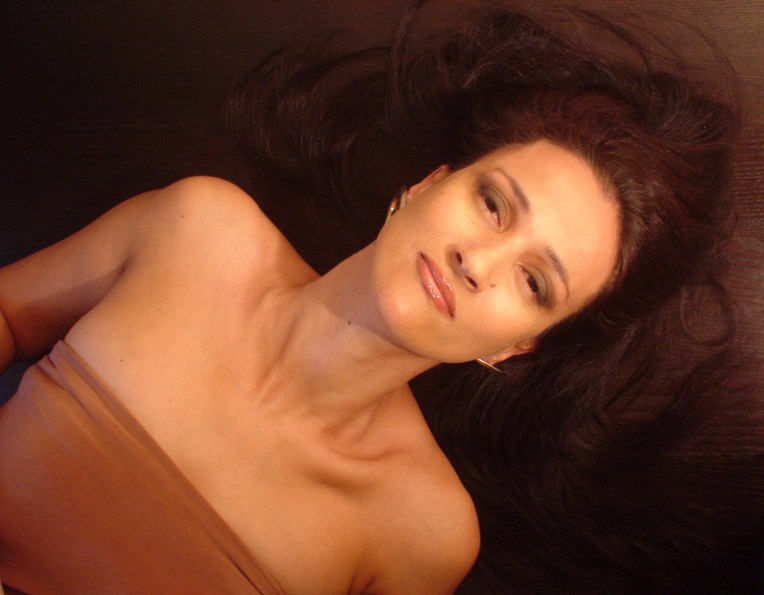
(photo by Janis Wilkins)
As of this writing I have yet to experience Souter live, and so for the moment I can only listen from afar. In attempt to bridge that listening gap, she kindly took time out of her busy schedule (having just returned from a successful Russian tour) to answer my questions via e-mail:
Your voice is clearly at the center of every song. How do you combine it so selflessly with other instruments and their players? Is this a relationship of tension? of harmony? of conversation? of painting?
Hmm, well, I really love listening to the other instruments being played by wonderful musicians. And I played the guitar and sang during my formative years, so maybe I like to create a space for the other instruments, too, just naturally.
I remember my art teacher talking about “tension” and how every work of art had to have it. So I guess there is that element, too: the question of, is it going to work out, or will we fall off the tightrope. Holding your breath.
And sometimes it is a conversation. I love to make loose arrangements that give the instrumentalists the space to create within them. I don’t like to say, “It has to go exactly like this.” I want to know what YOU have to say, what YOU feel about it. I want to hear them play what that story—of love lost, of a newborn, of new love, whatever—makes them FEEL. And that will make me hear it differently.
And sometimes it is—as you put it—like painting, but with two of you working on the same canvas, without having to tell each other in words where to put the brushstrokes. I was knocked out when I first started singing jazz at how musicians who have never even laid eyes on each before can get together and make music that sounds like they’ve been a band for years, even sometimes making the same hits in the same places. Like dancing with a stranger perfectly. It means everyone has to be really listening to each other, not playing by rote, but listening and responding.
Not a few of your songs begin with voice alone. I often think I could listen to them unaccompanied, as the expressive power of your voice carries the emotional contents therein with ease. For example, in the track “Daydream,” the single conga drum that accompanies you seems to saunter forth from within the shadows of your voice rather than adding something that was never there. The single guitar in “Left Alone” is the same. In relation to my first question, how do you see your voice as an entity? Is it a fully formed life, or one that is always learning from its surroundings?
Gosh. What a hard question. Well, the unaccompanied thing…I sang a lot unaccompanied when I was a teenager. In my early teen marriage I spent a lot of time alone and singing was my solace. I would spend all day in the house, singing entire songs that I would mean every word of, mostly long folk songs with stories that had beginnings, middles, and endings, about sailors going off to sea never to be seen again, or bereft maidens, or married women falling in love with local young men and it all ending in tears (usually death-by-husband).
As for fully formed or learning from its surroundings, the voice is always learning and absorbing. Every experience you have eventually comes out in your voice. I think I noticed that first about 25 years ago after a friend died, and the very next time I sang, it was a slightly different voice, it seemed to me.
When listening to your music, I hear a range of possible influences. One who comes to mind is Susheela Raman. Has she in any way played a part in your musical path?
Someone else said that to me about eight years ago on a gig in London. I’d never heard of her so I researched online and bought her CD Love Trap. I like it but it was/is not an influence—obviously, because I heard her long after I was singing like that.
But following on a bit from the previous answer, we might be similar people. Sort of foreign (my father was black, and my mother white) in England, where we were vaguely “other.” So perhaps we are drawn to similar expressive styles. But I think she is Tamil and consciously strove to identify musically with that part of herself and had a Tamil singing teacher who taught her that style, whereas my music just seemed to come out of me like that.
That isn’t to say I don’t have influences. I always described my style as kind of jazz with a twist of Middle Eastern and Indian, and then a few years ago I bought some of the music I was listening to in my youth—Pentangle and Fairport Convention—and I REALLY heard the influence of that music. I guess you could call it Celtic folk-rock. I realized that Celtic music has that Middle Eastern influence, using those same Phrygian scales.
I also identified very strongly with Spain for various reasons as a teenager and young adult, so that’s in there, too. And England, where I grew up, is very multicultural, so you hear all these different kinds of music all around you and I guess you absorb it.
I don’t know why I love that Phrygian thing, I just do. Maybe because it is somehow simple, easy to move around in, and yet emotionally complex. But when I hear it in its pure form, it is also a bit one-dimensional for me. It’s not enough somehow to stick to one very distinct style of music. But jazz is so open you can take a myriad of influences, put them all in a big pot with some Captain Beefheart, Frank Zappa, Soft Machine, and a dash of Carmen Jones, and out comes…you.
When I first started singing in public and learning jazz songs ten years ago, a very good friend of mine, who is a wonderful singer (Mansur Scott), would always say to me, “Tell your story. Don’t worry about it being jazz or not.” That was very good advice. I don’t think you should try to be anything except yourself. People are always telling me at gigs that they feel like they know me, and they actually DO, because that’s what I’m giving them. You can’t copy another singer, because you can never BE that person with that person’s experiences. It will always be fake.
Your songs are intensely evocative. Each is the feeling, the joys and sadness, of a place. When singing, do you feel that you are in those places? Do you wish to put the listener there from a distance, or do you want to share in that experience right there alongside the listener?
I don’t think, “Oh, this song is about this or that.” Not in a conscious way. Not once I know it. It might have been inspired by an experience initially, but once I know it (whether I wrote it or someone else did) I just literally feel it without thoughts. It’s wordless. Evocative more than literal. So even though songs might have words, their job is to, along with the melody, create the mood.
I used to be crazy about the writer Joseph Conrad and I was always amazed by how he could use really beautifully descriptive LANGUAGE to express something WORDLESSLY. The real thing he was saying was there in between the lines. I think that’s what music does. I also like that you can write a lyric or a song about something very specific, and if you don’t tell an audience what it means it will mean something completely different to them.
But yes, I do want listeners to experience the emotion with me, even if it is a different story for them. Definitely not at a distance. When I first started singing I liked that, unlike my former job, writing (which required a certain distance, not to mention having to be alone in a room to do it), music was like injecting yourself into people and getting an instant response.
Growing up always feeling “other” gives you a yearning to connect. And that is one of the things I love about music. It makes you feel connected, both as a listener and a performer.
I feel like I’m hearing about myself when you describe solitary songs as a coping mechanism through trying times, for I have often found that, even at life’s lowest points, the voice can never be contained. What is it, do you feel, about singing that has such restorative power?
I think it is so visceral. Your whole body is engaged, it’s very sensual (as in engages all your senses) and somehow the voice expresses, even without words, feelings that sometimes I don’t know I’ve even been feeling. Feelings that don’t even have names. It gets them out into the open somehow. A great exercise sometimes is to let a feeling be expressed with sounds that you haven’t planned in advance, unlike what happens with a song you already know. In fact, I think that’s how I compose.
The more people come in contact with your music, the more you have been given opportunities to tour in new and unexpected places. What lessons does the act of travel bring to bear upon your musical experiences?
When I had my first concert in Russia—at the Moscow International Performing Arts Center in 2007—I was terrified that no one would understand me and that they would want me to sing all standards. A friend who’d already played in Russia said, “No, they’ll love you as you are! Do your regular stuff.” So I chanced it, and it was actually perfect. In fact, I was shocked that at Cream’s “White Room” people started applauding and shouting “Brava!” pretty much as soon as I had sung the first line. So I suppose the ultimate lesson I’ve learned is that the best thing you can give to an audience, wherever it is, is yourself.
Some might say you are bold in the cover songs you choose, that no one needs yet another version of the tried and true. Yet I find your versions of classics like “Eleanor Rigby” and “White Room” to be spectacular. These are, of course, great songs in their own right, but you turn them into personal statements. What is it about them, first of all, that captures your attention, and how do you decide to pluck these particular jewels from among countless others?
I personally love music that is familiar but different. I think for audiences it can be a doorway to other music. “Eleanor Rigby” came about when I was singing in Japan on a hotel gig for two months. I was walking home from the shops one day in the rain and that ostinato pattern came to me and I ran into my apartment and played it on my toy piano. It was so simple I performed it that night and the Brazilian percussionist I was playing with sang long tones underneath it and it just worked. I cut out some of the lyrics and changed the form to make it tell the story of two people who are in love but never tell each other. I call it my song version of the movie Remains of the Day. For “White Room” I did an arrangement with guitarist John Hart originally. It was kind of Brazilian and I scatted over a simple intro of descending chords and John came up with that fabulous ending that unexpectedly stops dead on the 5. Then just before we recorded Obsession Jason re-did the arrangement so that it had more of an African feeling in the playing, but without changing the chords and keeping John’s ending. I love that song because it reminds me of my brother when we were totally into Cream as teenagers. All my song choices have a reason.
Can you talk about the differences in production between these three albums? There seems to be a progression between them, from the intimacy of Listen Love to the full-blown flower of Obsession. How did the sound of each album emerge?
Listen Love is two demos put together. I made a quick demo in 2000. I had no money so I went in and said, look this is all I have, what can I do with it, and we did four songs, including mixing, in a few hours. It was very organic. I think the reason it sounds intimate is that it was just the two of us in someone’s home studio. Then the other songs were recorded in 2002. Honestly, finances more than anything kept that album sparse. But that is actually one of the things I liked about it. I was the producer so it was very hard work, listening over and over. But all the artistic decisions were entirely mine, which I also like—even though it’s harder physically, in a way.
Nights of Key Largo was recorded in two days with barely any rehearsal, and no band rehearsal. Those songs were mostly chosen because the record label wanted a certain tempo and style. So, working with that, I thought about songs I could mean, learned some new ones, spent about two hours with Kenny Werner upstate to go over some of them and had a separate two-hour rehearsal with Jay Leonhart and Romero Lubambo at my house, and then we all went in and recorded.
Obsession was a bit different because I had been singing the songs for years and just wanted to get it down before I moved on to new material. It was a lot more thought-out than any of my other CDs. We rehearsed, even! And we’d been playing together for a year, so it was more of a band and everyone contributed ideas to the final album.
The most recent CD, Beyond the Blue, which is coming out this May, is different again. Classical songs with my lyrics to nine of them, made into jazz with an incredible band of jazz titans that got together over two days with no rehearsal and made magic happen with repertoire most of which they had never laid eyes on until that day. I think because of that it feels completely fresh to me. And everyone really had to listen to everyone else and maybe that inspired them all the more. Normally I can’t listen to my own CDs but I listen to this one just to marvel at their playing. This is my favorite CD so far.
Before this one, I think I’d always had a special soft spot for Listen Love. Okay, I still have a soft spot for it, partly due to the repertoire. I have to STOP myself singing “The Creator Has A Master Plan” and I still sing “You Don’t Have To Believe” on almost all my gigs.
Love is a very spiritual thing. In what ways do your religious views flow in and out of your songs?
I think everything I am flows in and out of my songs. I just did a tour with a friend and we talked about the fact that who you are is how you play—for good or ill. I don’t think I have any religious views, as such. I am one of those “spiritual but not religious” types. But I am totally inspired by Love, yes.
What was it like working with Mark Murphy? In what ways did that experience leave its mark (no pun intended)? What were his greatest words of wisdom?
He had so many! It was wonderful working with him. He would make me do things I didn’t want to do like scat, to get me off needing to be “Mrs Perfect.” He’d question your motivation for things—like holding a note: was that in the service of the song, or was that just to show off how long you could hold a note? And he was so supportive. He’d come to my gigs with huge bunches of flowers and say I was his “star” and just be like the sun shining on me, really. I love Mark very much and feel absolutely blessed to have been mentored by him. And of course his singing is itself a lesson. You can hear his influence in practically every male singer under 50. He is so in the moment. So connected. His timing is perfect, even on ballads, maybe especially on ballads. And he always gave great advice. Like when I went through this terrible phase of having unbelievable stage fright, which lasted about six months. I finally asked him what to do about it and he said, “Just remember it’s not about you. Your job is to make these people who have come to see you feel good. They just want to have a good time. That’s it!” It cured me instantly.
Has anyone ever told you that s/he started singing because of you?
Some have. Mostly people who have read my book Anything I Can Do You Can Do Better. I still get letters from people who have read it. I’ve no idea how they hear about it. But I love those letters. Then I feel the book did its job.
What has been your most gratifying experience with a fan?
I think what is most gratifying is that so many people who started out as “fans” have become real friends. If I had to pick one thing, it’s that the then four-year-old daughter of a friend was so insistent on Listen Love being played whenever they drove anywhere that the car with the CD player in it was called “the Tessa car.” And a friend in San Francisco just wrote to tell me that her four-year-old has to play Obsession before she goes to sleep every night and the other day just sighed, “I love Tessa!” But I don’t think I could single out one experience. Of course it’s always great when someone comes up in tears and tells you how touched they were. Or, as happened the other day, when a teenage boy in Belarus tells you that they want to play with you one day and that you are “magic” and they “don’t have words to describe.” Or when strangers come back and pay again to hear you the second night, too. Or when people have said that the tone of my voice makes them feel calm. Or that it is healing. I’ve actually had a few people tell me that Listen Love got them through a depression and one woman who loved music until she got hit with depression said it was the only CD she could bear to listen to for six months, until she got better. It’s like Mark Murphy said, that’s your job.
The blossoming of your art is a real testament to the power of music to triumph over adversity. What advice do you have for those facing solitude, who feel there is no one who cares for them?
I have to say I have never felt that there is no one who cares for me. I have a lot of wonderful friends. But I’ve been depressed, of course, and, when I felt in the absolute depths I used to force myself to go to open mics. It always cured me. So sing! Or draw, or write. Anyway, EXPRESS! Or get lost in something else—a movie, a novel, listening to music, supporting a friend, going to a concert. That can be super helpful. I went to hear a friend sing once when I was in a terrible space, and it totally flipped me—lastingly. I don’t sing the blues myself, but listening to Marlena Shaw sing the line about how she put her head on the train track, “and then I thought, hang on, I haven’t paid for the hat!” or BB King sing, “I gave you seven children and now you want to give them back!” never fails to cheer me up. The great thing about the blues is that it’s always got a sense of humor.
Lastly: What is your favorite color and what does it remind you of?
Gold-sequin gold. It’s so warm and sparkly. It’s summer.
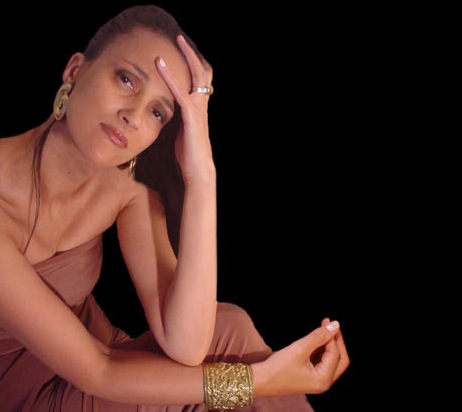
(photo by Janis Wilkins)







 Between Sound and Space: ECM Records and Beyond