


Jeremy Lirola double bass
Denis Guivarc’h alto saxophone
Maxime Sanchez piano, keyboards
Nicolas Larmignat drums
Recording, mixing, and mastering, Studios La Buissonne, Pernes-les-Fontaines, France
Recorded and mixed in June 2021 by Gérard de Haro
Mastered by Nicolas Baillard at La Buissonne Mastering Studio
Steinway grand piano tuned and prepared by Alain Massonneau
Produced by La Poulie Production & Gérard de Haro and RJAL for La Buissonne Label
Release date: October 8, 2021
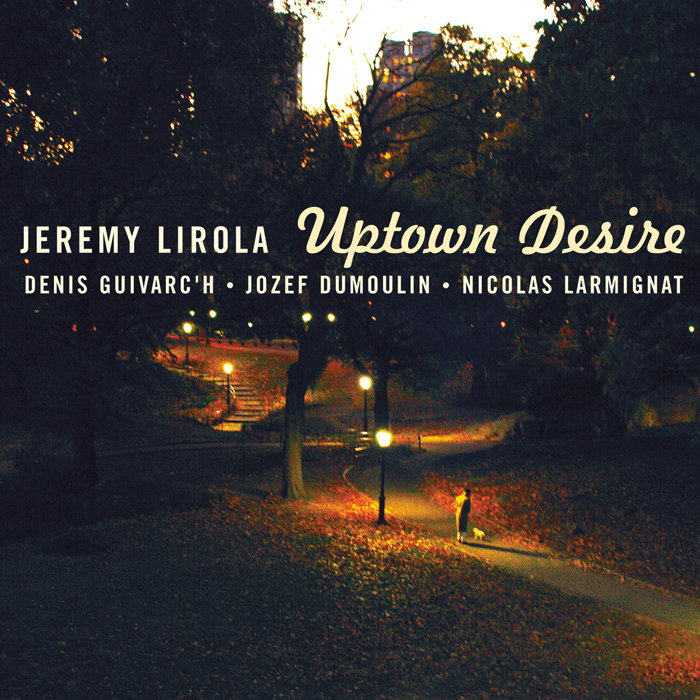
On the heels of 2016’s Uptown Desire, Jeremy Lirola steps beyond the grid of New York City and into a wider, less mapped territory, exchanging subway tunnels for constellations. The shift feels less like a change of scenery than a recalibration of conscience. Lirola is listening deeper, sketching a music that resists the gravitational pull of imitation. Building on the spirit of Ornette Coleman’s Harmolodics, he cultivates individuality with the patience of someone tending rare seeds in a storm-blown garden. Creativity here becomes a quiet counterforce to a world that profits from sameness, speed, and surveillance, a reminder that difference can be a form of justice. Joined by alto saxophonist Denis Guivarc’h, pianist Maxime Sanchez, and drummer Nicolas Larmignat, Lirola assembles not just a band but a small republic of attentiveness, each member accountable to the others and to the air they share. Together they construct music that feels open as a plaza yet grounded like a hearth, spacious enough to wander and steady enough to return to.
The album opens with “Mock the Lines,” a room freshly burnished for arrival, its shine inviting reflection without vanity. The track feels both ceremonial and intimate, as though the listener is being asked to shed shoes and preconceptions. From this polished threshold, the group glides into “Living Symbols,” where groove sits in a warm pocket that is physical, spiritual, and conspiratorial all at once. Sanchez’s keyboards spread color like slow daylight across a floor, while Guivarc’h’s alto illuminates hidden corners. The quartet flows naturally into “Danced Border,” a piece that toys with the very idea of boundaries. Sanchez’s pianism ripples with curiosity over a rhythm that knows how to sway without surrendering its footing. The melodic convergence at the end is a sly reminder that lines are made to be questioned, crossed, and occasionally turned into song.
At this point, the record begins to behave like a set of ethical parables told in sound, sometimes laconic, sometimes luxuriant, always purposeful. “Sensitive Border” leads seamlessly into the expansive “Ghost Dance,” where Lirola’s bass takes on the role of a traveling griot with stories tucked into every string. The latter track hovers between what is seen and what is whispered. Keyboards shimmer like memory about to become myth, while alto moves like a shadow figure, keeping careful watch on every phrase. Rather than a detour, this stretch feels like the album’s moral heart, a meditation on how history lingers, how wounds speak, and how music might listen back.
Midway through, the record blooms into a four-part chain of color impressions. “Red” arrives as glittering dawn, full of resolve without aggression. “Black” follows like an echoing supernova, vast, humming, and strangely tender in its immensity. “White” drifts in as a partial eclipse, bright but uncertain, clarity touched by doubt, while “Yellow” closes the sequence in a twinkling dream that refuses to wake too quickly. Taken together, these pieces suggest that resistance to darkness is never one shade but many, a spectrum of feeling that glows differently at every hour.
The album then gathers itself for its final movement. “Essai éternel” arrives like a love letter that slowly turns into a ritual, affection melting into collective motion, devotion disguised as dance. It is both intimate and communal, a groove that feels like care made audible. From there, “Mock the End Lines” eases the listener toward silence with graceful tact, buttering the bread of finality just enough so that the meal feels complete without overfeeding the moment.
What we are left with is not a protest but a gentle reimagining of how the world might sound if kindness were taken seriously. Lirola offers no sermons, only evidence that beauty can nudge brutality aside, that listening can be a form of courage, and that music can rehearse the habits of a more humane future.
 Between Sound and Space: ECM Records and Beyond