

Joe Lovano: Homage (ECM 2845)

Joe Lovano
Homage

Joe Lovano tenor saxophone, tarogato, gongs
Marcin Wasilewski piano
Slawomir Kurkiewicz double bass
Michal Miskiewicz drums
Recorded November 2023
Van Gelder Studio, New Jersey
Engineers: Maureen Sickler and Don Sickler (assistant)
Mixed by Manfred Eicher and Michael Hinreiner (engineer)
Bavaria Musikstudios, Munich, October 2024
Cover: Fidel Sclavo
Album produced by Manfred Eicher
Release date: April 25, 2025

Saxophonist Joe Lovano’s collaboration with pianist Marcin Wasilewski, bassist Slawomir Kurkiewicz, and drummer Michal Miskiewicz has evolved remarkably since the release of Arctic Riff and En attendant. While the quartet was knee-deep in its Village Vanguard residency during the fall of 2023, they stepped into New Jersey’s Van Gelder Studio to record this album, riding the wave of their live performances. Those who may have questioned the quartet’s intentions the first two times around may just find themselves now humbled. The third time is indeed the charm and proof positive that self-examination is a vital part of what makes this such a human endeavor.

“Paying Homage, Giving Thanks, Projections and Reflections is a way of life for me,” writes Lovano in his liner note, and, perhaps more than ever, we can feel the visceral charge behind that philosophy, which guides his horn throughout six substantial tunes. Of those, only the opener, “Love In The Garden” by Zbigniew Seifert, bears the name of another composer. Not only is it a beautiful welcome, with pitch-perfect trio work and Lovano’s plasticity, but it also proves that where there’s smoke, there need not necessarily be fire. Lovano’s “Golden Horn” follows with 10 minutes of quasi-spiritual sound paths. In addition to tenor, he dialogues on percussion with Miskiewicz and later switches to the tarogato as the rhythms intensify. Such costume changes are playful and thoroughly enjoyable to encounter.

The title track pays tribute where it is due: “The piece is dedicated to Manfred and the label’s history,” Lovano says. “I grew up listening to ECM recordings, because those were the cats that I wanted to play with, and it turned out to be the music that gave me a lot of direction.” It’s also a testament to the label’s progression from free jazz to modern cool and everything in between, never wavering from a certain underlying ethos.

“This Side – Catville” is a veritable sound collage. Like a train running instead of rolling, it forgoes the tracks laid before it in favor of pushing its way through trees, over rivers, and around mountains in search of its own mode of being. Lovano is unbound, as is Wasilewski, who takes inspiration from the wake and stirs it into a fresh concoction over Kurkiewicz’s distinct bedrock. This 12-minute juggernaut is hugged by two brief improvisations from Lovano that are exploratory and never forced, showing that he is always in deference to the unknown.

I know not everyone has been keen on this project, but if anything, Homage proves that the worth of jazz isn’t always determined by its creature comforts. Rather, it depends on whether the listener feels acknowledged. And in that respect, we are invited with open arms and open hearts to sit, stay awhile, and nourish ourselves on music that fills more than the ears—it fills the belly as well.
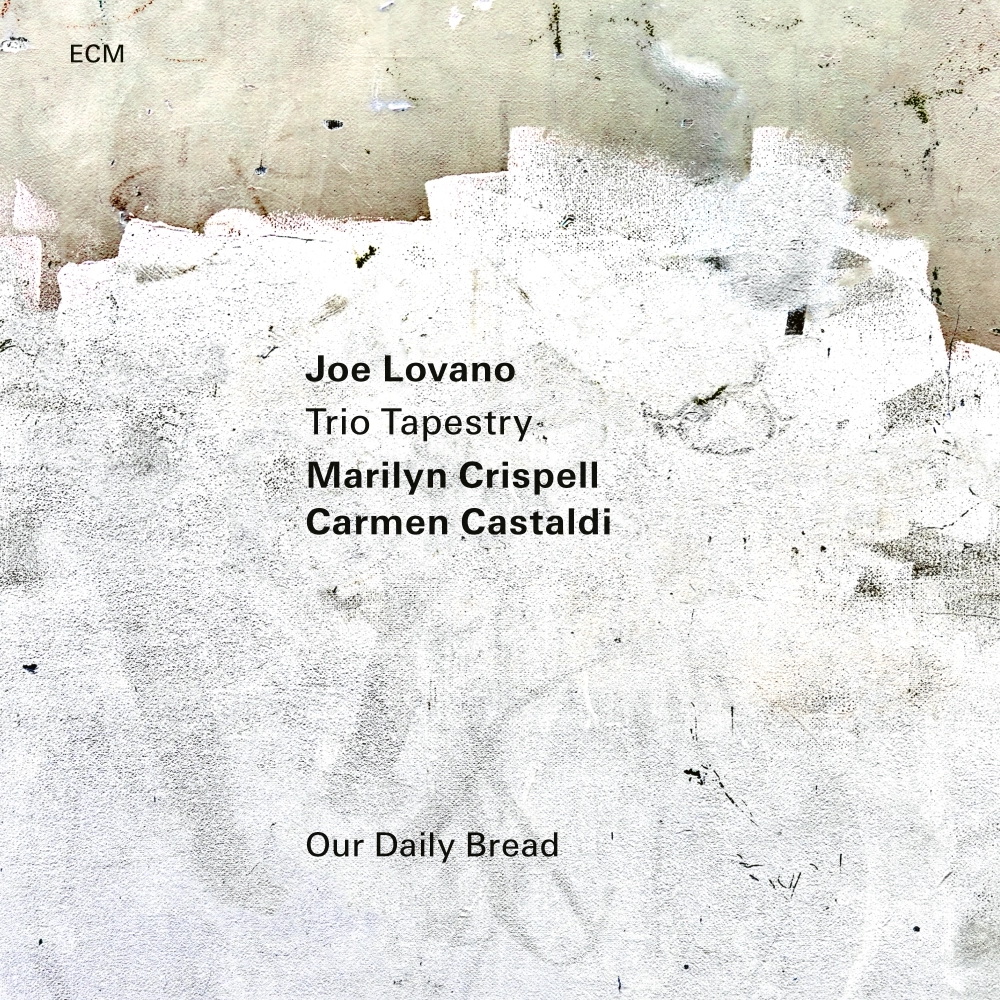
Trio Tapestry: Our Daily Bread (ECM 2777)

Trio Tapestry
Our Daily Bread

Joe Lovano tenor saxophone, tarogato, gongs
Marilyn Crispell piano
Carmen Castaldi drums, gong, temple bells
Recorded May 2022, Auditorio Stelio Molo RSI, Lugano
Engineer: Stefano Amerio
Cover photo: Thomas Wunsch
Produced by Manfred Eicher
Release date: May 5, 2023

Joe Lovano’s Trio Tapestry is one of the profoundest projects to grace ECM records in recent years, and for this, the group’s third round, we are welcomed into a chamber within a chamber within a chamber. This set of eight Lovano originals, each written exclusively for the project, draws from the wells of pianist Marilyn Crispell and drummer Carmen Castaldi, whose gifts of abundance unwrap themselves to reveal one grace after another.

“All Twelve” takes a 12-tone approach to the proverbial welcome mat, greeting us with open arms and closed eyes. Lovano takes liminal account of Crispell’s architecture, rendering an experience that takes two steps inward for every step outward. The ghosts of albums past linger with a loose developmental feel. Every motif, as much a child of atmosphere as of melody, works a speech-like filigree into every wall, sconce, and pew. Like “The Power Of Three” and “Crystal Ball” that come later, its introspections have the presence of someone who has absorbed the world to squeeze out only its most inclusive drops.

Despite an overarching solace, there is variety to be found. Where “Rhythm Spirit” is a heartfelt duet for tenor and drums highlighting breathy lows and delicate highs, “Grace Notes” floats the tarogato on a seascape of dreamy complexion, Castaldi’s cymbals hinting at a groove that never catches, buried instead in the crashing brine. On “One For Charlie,” Lovano returns to tenor with a monologue dedicated to the late Charlie Haden.

At the heart of this session are two balladic verses. The snaking indeterminacy of “Le Petit Opportun” and the title track’s potent lyricism give us plenty to savor even as they savor us. This is chaos theory in slow motion and proof that if this album is a match between day and night, the latter has surely won.

(This article originally appeared in the August 2023 issue of The New York City Jazz Record, a full PDF of which is available here.)

Jakob Bro/Joe Lovano: Once Around The Room – A Tribute To Paul Motian (ECM 2747)

Jakob Bro
Joe Lovano
Once Around The Room: A Tribute To Paul Motian

Joe Lovano tenor saxophone, tarogato
Jakob Bro guitar
Larry Grenadier double bass
Thomas Morgan double bass
Anders Christensen bass guitar
Joey Baron drums
Jorge Rossy drums
Recorded November 2021 at The Village Recording, Copenhagen
Engineer: Thomas Vang
Cover photo: Woong Chul An
Produced by Manfred Eicher
Release date: November 4, 2022

Guitarist Jakob Bro and saxophonist Joe Lovano head an ensemble that includes bassists Larry Grenadier and Thomas Morgan, bass guitarist Anders Christensen, and drummers Joey Baron and Jorge Rossy in a sprawling tribute to drummer and composer Paul Motian. That the set includes only one tune by Motian proper (“Drum Music”) is by no means an oversight but a testament to its dedicatee’s spirit, which continues to glow in musicians who cup its embers with reverant care. Rather than simply recreate or distill Motian’s personal and creative principles, the band expands on them with heartfelt accuracy.

“As It Should Be” is the first of two pieces by Lovano (the second being “For The Love Of Paul”). It also opens the curtain with a swell of patient beauty as only ECM could render. The atmosphere is rich, far-reaching, yet always firm in its immediacy. Bro’s guitar architects the pulsing kingdom over which Lovano’s tenor reigns supreme, a melodic giant of kindest temperament. The freely improvised “Sound Creation” follows with a near-ritual quality, made all the more clairvoyant by Lovano’s tarogato before the tenor dances in its dust clouds.

Bro offers two tunes of his own: “Song To An Old Friend” and “Pause.” Between delicate arpeggios and tender melodizing, he stands to the side of either foreground, content in avoiding the spotlight to be heard rather than seen. Nestled between them is the above-mentioned “Drum Music,” which yields scorching playing from the leads. After some thoughtful building, a squeal for the ages from Lovano’s tenor makes for an unforgettable catharsis.

That the recording was made on the 10th anniversary of Motian’s death only shows how much he lives on in the articulations of those who knew him best. Having played in the drummer’s trio with Bill Frisell for 30 years, Lovano should know that a strong metaphysical melody can be enough to make the departed feel near again.

Trio Tapestry: Garden of Expression (ECM 2685)

Trio Tapestry
Garden of Expression

Joe Lovano tenor and soprano saxophones, tarogato, gongs
Marilyn Crispell piano
Carmen Castaldi drums
Recorded November 2019 Auditorio Stelio Molo RSI, Lugano
Engineer: Stefano Amerio
Cover Photo: Caterina Di Perri
Produced by Manfred Eicher
Release date: January 29, 2021


Following in the footsteps of its 2019 self-titled debut, Trio Tapestry returns with an intensely meditative successor. Saxophonist Joe Lovano (playing tenor and soprano, as well as tarogato and gongs), pianist Marilyn Crispell, and drummer Carmen Castaldi take their atmospheric coherence to the next level with this set of eight Lovano originals. His lilting tenor in “Chapel Song” manifests spiritual possibilities from first breath. As piano and brushes render the sky at his back a canvas of lost hopes, keys and time signatures melt into an echo of their former meanings. This nexus of the two Cs functions as the album’s paper, across which Lovano keeps an honest diary in his flowing script.

The notes of “Night Creatures” speak with the power of a supernova, which through a satellite telescope appears peaceful and nebulous but in the moments of its birth was surely violent at the molecular level. Such are the dichotomies being sung, where something as unseeable as the transmission of a virus can bring the world to a virtual standstill. The title track is a melodic wonder, which Crispell cradles as a mother would the head of a newborn. Implications of life dance in “West of the Moon.” With all the understated charge of a Paul Motian tune (and by no force of comparison, given that Lovano played in the drummer’s trio with guitarist Bill Frisell for three decades), it finds contentment not in the fallback of a groove but in the ever-changing currents of air that a groove risks prematurely denying.

Lovano’s tenor enables a study in physical contrast. Between the delicate altissimo of “Sacred Chant” and guttural lows of “Dream on That,” he paints with a variety of liminal shades in the middle range. His soprano in “Zen Like” points to yet another register, speaking in haiku rather than tanka. Any quantifiable border between day and night, except for that delineated by the act of sleep, loses all importance. We are bid to listen with eyes open to the language of a distant solar system. With so much to discover on repeated listening, perhaps no other description could feel so apt as that which names track 5: “Treasured Moments.” Given its focus on the simple and the beautiful, we can take the album’s dedication to victims of COVID-19 as more than a reactionary statement but as a prayer within a prayer.

(A condensed version of this review originally appeared in the July 2021 issue of The New York City Jazz Record, a full PDF of which is available here.)

Marcin Wasilewski Trio/Joe Lovano: Arctic Riff (ECM 2678)

2678

Marcin Wasilewski Trio
Joe Lovano
Arctic Riff

Joe Lovano tenor saxophone
Marcin Wasilewski piano
Slawomir Kurkiewicz double bass
Michal Miskiewicz drums
Recorded August 2019, Studios La Buissonne, Pernes-les-Fontaines
Engineer: Gérard de Haro
Mastering: Nicolas Baillard
Cover photo: Thomas Wunsch
Produced by Manfred Eicher
Release date: June 26, 2020

Too much time, it seems, has passed since pianist Marcin Wasilewski and his trio with bassist Slawomir Kurkiewicz and drummer Michal Miskiewicz graced the studio for our privileged scrutiny, and as soon as “Glimmer Of Hope” tickles the ear drum, we are reuniting with old friends. A glimmer is exactly what we encounter in Wasilewski’s pianism, which opens this tender vision with a play of light and shadow such as only he can render. In turning these movements into song, he opens a new portal through which to step on our way toward musical discovery. But then a new companion in Joe Lovano joins the shoulder-link of arms to block any who would even dream of passing across the double line of expectation. And so we trail behind, absorbing the language of their traversal. Three more selections by the bandleader, including the flowy sojourning of “Fading Sorrow” (a yielding stage for Kurkiewicz’s soloing) and the sparkler-to-fireworks groove of “L’Amour Fou,” along with Lovano’s “On The Other Side,” complete the in-group compositional picture. The latter tune unfurls a veritable tapestry from the tenorist’s bell and pictures the synergy of ears and fingers required to pull off this collaboration. Carla Bley’s “Vashkar” gets two treatments thereby. In keeping with its ever-deepening roots, and nourished by five decades of interpretation, the quartet taps into its historical embeddedness.

If these are the album’s bricks, then its mortar is mixed in freely improvised material. The nine-minute “Cadenza” is the most cohesive of the bunch, metaphysically speaking. Its balance of gentility and strength is downright beautiful, as is the linear unfolding of “Arco.” Where one moment might breed shimmering near-stillness and the next a fibrillation of darkness, neither mood dominates. Instead, the musicians follow where they are led without struggle. One hears it just as vividly in the nocturnal slink of “Stray Cat Walk” as in the restless leg syndrome of “A Glimpse.”

2678_Wasilewski Lovano_PF1

What really distinguishes this record, however, is the apparent gap between the trio’s interlocking poetry and Lovano’s hard-won prose. What at first may seem to be a disjunction actually opens up a space that can only be filled by the listener. By inserting ourselves into the equation, the proof becomes clear: our presence has been desired from inception to execution, our variable the final piece. And with that completion, we emerge on the other side of the equals side having carried the one of experience.

Enrico Rava/Joe Lovano: Roma (ECM 2654)

Roma.jpg

Enrico Rava
Joe Lovano
Roma

Enrico Rava flugelhorn
Joe Lovano tenor saxophone, tarogato
Giovanni Guidi piano
Dezron Douglas double bass
Gerald Cleaver drums
Concert recording, November 10, 2018
Sala Sinopoli, Auditorium Parco della Musica, Rome
Engineer: Giampiero Armino
Editing: Manfred Eicher and Stefano Amerio (engineer)
Album produced by Manfred Eicher
Release date: September 6, 2019

Recorded at Rome’s Auditorium Parco della Musica during a pop-up tour in November 2018, this album preserves a formidable group led by Italian trumpeter Enrico Rava (heard on flugelhorn throughout) and American saxophonist Joe Lovano. Alongside pianist Gianni Guidi, bassist Dezron Douglas, and drummer Gerald Cleaver, they take us through a set of originals, classics, and original classics in the making.

Rava opens the set with two tunes of his own. The delicate swing of “Interiors” unfurls a scenic backdrop as the frontmen stretch firmament over fundament. It’s incredible to hear just how organically Rava and Lovano—each a master in his own right—avoid stepping on each other’s toes. The moment they occupy the same space, theirs feels like an inevitable collaboration. Like two shooting stars crossing in the night, they seem to be a once-in-a-generation coincidence, yet in the process yield an even brighter star that careens beyond the asteroid belt of expectation. Neither is foreign to the healing power of poetry. “Secrets” elicits a more itinerant sound with Rava as primary storyteller. Despite their titles, this and the opener are reveal their love of creation like a morning glory drenched in the rising sun. Cleaver reaps a gorgeous harvest of cymbals, adding splashes of color amid the monochrome, and through those actions works up a lather of protection against the march of time. Lovano, for his part, shows his ability to immerse himself in the ever-evolving soul of things.

“Fort Worth” initiates a Lovano-penned sequence with upbeat inflections, by which memories of the past and predictions of the future are adhered. Lovano is the winding spirit of the rhythm section’s uncanny swing. When he gives the floor to Rava, the warmth of the venue feels more palpable than ever. Guidi’s solo is particularly superb, unpacking two gifts for each one wrapped, and holds light in its hands. “Divine Timing” is a more free-wheeling vehicle for Cleaver, who primes the canvas for some unbridled color schemes. Douglas, meanwhile, understands the need to give as much space as he occupies.

The quintet ends with a powerful triptych, kicking off with Lovano’s “Drum Song,” which takes an anciently leaning bass solo as its seed and finds the composer on tarogato before morphing into John Coltrane’s “Spiritual,” of which Rava is the shining galaxy. All of this funnels into the dream of Guidi alone playing “Over The Rainbow” a nod to the cosmos to which we must all one day return.

Joe Lovano: Trio Tapestry (ECM 2615)

2615 X

Joe Lovano
Trio Tapestry

Joe Lovano tenor saxophone, tarogato, gongs
Marilyn Crispell piano
Carmen Castaldi drums, percussion
Recorded March 2018 at Sear Sound, New York
Engineer: Chris Allen
Mixing: July 2018 at Studios La Buissonne by Gérard de Haro (engineer), Manfred Eicher, and Joe Lovano
Mastering: Nicolas Baillard
Produced by Manfred Eicher
Release date: January 25, 2019

After decades of appearing on ECM as sideman, Joe Lovano makes his leader debut for the label. Bearing the gift of 11 original compositions built around 12-tone processes, the saxophonist celebrates life and creativity with a new trio, welcoming pianist Marilyn Crispell and drummer Carmen Castaldi into New York’s Sear Sound studio. The result is one of the most intimate jazz experiences to come out from the label in years.

The gongs on “One Time In” process as if grieving for silence, itself so rare a commodity in today’s world that it’s all we can do to seek out a musical experience as enmeshed in stillness as this. The effect is such that when the piano rains down on “Seeds Of Change,” we’ve already become accustomed to melody as a reflection of what quivers between the notes. So much of what follows reminds us that, in art, form and function need not ever be the same. For if the breathy poetry of “Sparkle Lights” and “Tarrassa” are indicative of something tangible, they’re equally aligned to something diffuse.

At times, as in “Piano/Drum Episode” and “Gong Episode,” gestures are as literal as can be, and yet also ineffable. At others, as in “Mystic,” the feeling is so mysterious as to be undeniably immediate. The latter tune features Lovano on the Hungarian tarogato, a mournful woodwind that blows aside the curtains of the future like gusts from the past. Crispell and Castaldi are in finest form in “Rare Beauty” and “Spirit Lake,” either of which might aptly describe the mood of what we’re hearing. The pianist understands that every note has the potential to become a sutra, while the drummer fills the air with diacritical markings. How glorious, then, that all of this should culminate in “The Smiling Dog,” a freely explosive romp through streets paved in grainy night.

Trio Tapestry is the essence of atmosphere as substance and the soundtrack of things unseen, singing in honor of those without songs.