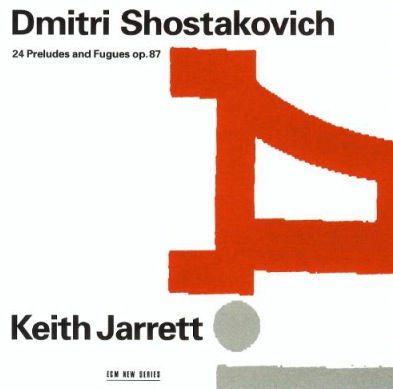
Shostakovich: 24 Preludes and Fugues – Jarrett (ECM New Series 1469/70)

Dmitri Shostakovich
24 Preludes and Fugues

Keith Jarrett piano
Recorded July 1991, Salle de Musique, La Chaux de Fonds
Engineer: Peter Laenger
Produced by Manfred Eicher

“When I first saw these pieces in a music shop, I knew I wanted to play them. I recognized the language. But when I started playing them, they were so close to me that I knew I had to record them.”
–Keith Jarrett

In 1950, during a trip abroad as a cultural ambassador, Shostakovich was treated to a performance of selections from Bach’s The Well-Tempered Clavier by pianist Tatiana Nikolayeva in Leipzig, where the composer had been asked to serve as a judge for the first International Johann Sebastian Bach Competition. Just two years later, Nikolayeva would have Shostakovich’s 24 Preludes and Fugues in hand as their dedicatee for the first public performance in Leningrad. Although one can hardly talk about these pieces without being aware of Bach’s shadow, I think it is precisely Bach’s shadow that Shostakovich is interested in here. In modern parlance one might say these are the “b-sides” of The Well-Tempered Clavier, a record of previously unreleased demos that refused to be lost to time. Like Bach, Shostakovich rallies through a lifetime of moods: from naivety (D major Fugue) to gentility (D major, B major, and F-sharp major Preludes); dawn (E minor Prelude) to destruction (B minor and G-sharp minor Preludes); death (F-sharp minor Fugue) to joy (E major and B major Fugues), resplendence (the standout A major Fugue), and playfulness (A-flat major Prelude and Fugue, B-flat major Prelude). The overall tone, however, is one of exuberance. Whenever this music isn’t dancing, it’s waiting to pick up its feet and resume. The carefully laid out balance of the entire work is clear not only in the distribution of slow and fast movements, but also in Jarrett’s dynamic pianism. He excavates the keyboard like an adult unearthing a time capsule buried as a child—such is the nostalgia folded into every note. From the punctuational bass notes of the E-flat minor Prelude to the poignancy of the F major Prelude and the smooth legato phrasing of the Beethovenian G minor Prelude, Jarrett negotiates a wealth of obstacles with the kind of fluidity that can only exist behind closed eyes. Moments of dissonance creep in only briefly, as if to remind us of perfection in that which is imperfect.

This is incredibly insightful music played by a musician who seems to see more in it than Shostakovich himself. In bearing his heart to us, Jarrett also bears the composer’s. Not only do Shostakovich’s 24 Preludes and Fugues make up one of the most important works of the twentieth century, but Jarrett’s performance and ECM’s flawless production also turn them into one of its most important recordings. Need I say more?

<< Keith Jarrett Trio: Bye Bye Blackbird (ECM 1467)
>> Kancheli/Schnittke: Vom Winde beweint (ECM 1471 NS)

Bach: Goldberg Variations – Jarrett (ECM New Series 1395)

Johann Sebastian Bach
Goldberg Variations

Keith Jarrett harpsichord
Recorded January 1989, Yatsugatake Kōgen Ongakudō, Nagano, Japan
Engineer: Peter Laenger
Produced by Manfred Eicher
Harpsichord (1988) by Tatsuo Takahashi
(Double manual Italian/German style)

Although the original 1741 title page of the Goldberg Variations reads, “Composed for connoisseurs, for the refreshment of their spirits, by Johann Sebastian Bach,” one need hardly be a connoisseur of any kind in order to feel one’s spirits refreshed by this superb collection, the informal conclusion to the composer’s so-called Klavierübung, or “keyboard exercises,” which also includes the Opus 1 partitas. For his own rendition of the Goldberg, pianist Keith Jarrett has made an admirable decision in opting for the harpsichord, just as he did with his ECM recording of Book II of Bach’s Well-Tempered Clavier. Unlike the many piano recordings of these significant miniatures, all of which of course have their own merits, the harpsichord lends a certain quality of immediacy and uncompromised revelation to Bach’s music that is otherwise impossible to elicit. The opening Aria glows with the benefit of experience, a long look back at a full musical life that continues to burst forth with ever-inventive ideas, and sets the stage for the thirty variations to follow. The first of these immediately injects energy into the theme with effervescent syncopation. The fifth variation is a lively miniature in which the right hand remains centered at the keyboard as the left leaps back and forth across it. The seventh is a lively gigue in the French style, and the eighth mesmerizes with its stepwise chromatic flair and little waterfalls of thirty-second notes that close each section. The fugal tenth circles like a merry-go-round of trills and regular punctuations. For the thirteenth variation, a quaint sarabande, Jarrett makes clever use of the buff stop in the left hand, drawing out the piece’s inner gentility all the more. With its descending trills and gorgeous contrapuntal resolutions, the fourteenth overflows with an electrifying energy. The grandiose sixteenth is like a series of temples that keep getting torn down before they can be completed, but which remain standing just long enough to etch the firmament with their majesty, while the twentieth blossoms in a sweeping toccata of virtuosic proportions. A ring of arabesques lays the foundation for the twenty-sixth, which gives a harder pull on the collection’s red thread. The variations end with a recapitulation of the opening Aria, bringing the music full circle in its infinite wisdom.

Jarrett’s fingers are as committed as always, navigating the music put before them with practiced dexterity. The recording is somewhere between internal and external, capturing the nuances of its Japanese-built harpsichord with all the respect they deserve. Ultimately, the Goldberg Variations are more about affect than effect—which is to say they find permanence in their expressivity rather than in their emotional consequences—and the Jarrett/ECM partnership has produced yet another fine recording of music that should never go out of style.

<< AM 4: …and she answered: (ECM 1394)
>> Misha Alperin/Arkady Shilkloper: Wave Of Sorrow (ECM 1396)

Keith Jarrett: Tokyo Solo (ECM 5501)

Keith Jarrett
Tokyo Solo

Keith Jarrett piano
Recorded October 30, 2002, Metropolitan Festival Hall, Tokyo
Directed by Kanama Kawachi

Over a career spanning nearly 70 recordings for ECM alone, Keith Jarrett has established himself as one of the world’s most inimitable and revered musicians. We marvel at his music-making, at his technical prowess and innovation, but rarely do we get to experience the physiological creativity so vital to what he does. For this concert, Jarrett’s 150th in Japan, the one and only has given us a primary source in video form, a clearer glimpse into the complexity of his craft. On the surface Jarrett is a lone pianist whose humble frame elicits some of the more towering improvisations one is ever likely to hear, and here we get to see what lies beyond that surface to the fiery core that sustains him. As he quietly takes the stage the house lights dim to circumscribe the piano, leaving Jarrett and his instrument suspended in darkness.

He blows on his hands and draws an abstract veil over our eyes and ears. What we hear is serial, boastful yet self-deprecating, and, while not entirely accessible, betrays total commitment to a challenging trajectory. Jarrett works his way through a dense cloud of notes, as if searching for the perfect one, which he finds and intones as his face contorts in mimicry of the depths plied with every repetition.

This instigates an ecstatic passage of finger pedaling, which eventually brings Jarrett to the piano’s outermost reaches. He plays a single high and low tone together before returning to the center, as if he were gently embracing every note available to him before singling out a privileged few.

We then enter the most emotional portion of the concert. Jarrett cannot help but sing along, as much in deference as we are to the sounds flowing through him. At this point we come to realize that the opening jumble was nothing more than a search for any fragment he might be able to expand into a larger narrative, and that this is the tale we are about to hear. As Jarrett begins the next section, someone claps. He stops and listens carefully before scrapping everything in favor of a new idea. What follows is an agitated catharsis that gradually beats itself into a more elegiac shape. So ends Part 1.

Part 2 is more like what we have come to expect from a Jarrett solo concert: protracted, pastoral bliss. With lips puckered and brow furrowed, Jarrett dives headfirst into a quiet maelstrom of beauty, precursor to a grinding tangent that stops as suddenly as it develops. In spite of the serious approach he manifests in his performance style, Jarrett is not without his lighter moments. He even flirts with the audience’s attentions at one point during the concert. He has just played a delicate high note to close an epic improvisation. Applause begins, but he signals silence, only to play that same note a final time. He smiles and says, “That’s it.”

From this laughter he emerges with a brilliant cascade to close. Not wanting to leave his audience without something familiar, he returns to the stage for three encores: Danny Boy, Old Man River (Jerome Kern), and Don’t Worry ‘Bout Me (Art Tatum/Count Basie)—all of them pulled off with unparalleled intuition.

Those wanting to get more out of the Keith Jarrett experience need look no further than this DVD. The camerawork and recording are simple and direct, capturing the full range of expressions and contortions at Jarret’s disposal, and the crisp sound ensures that we hear every surrender. Jarrett shows a profound respect for what he plays, be it a standard or something composed on the spot. The image of his spotlit piano is the perfect metaphor: the musical alchemist toiling over his crucibles while his admirers fall awestruck into shadow. That being said, it’s easy for us to over-romanticize Jarrett’s process, to wonder where he goes when he improvises with such fluidity. Thankfully in Tokyo Solo we no longer need to wonder, for in a performance such as this we share the same space.

Bach: Das Wohltemperierte Klavier, Bücher I & II – Jarrett (ECM New Series 1362/63 & 1433/34)

Keith Jarrett never ceases to astound me: not because of his chameleonic ability to shift between jazz and classical music, but by the sheer passion and commitment he brings to both. On these recordings of Bach’s The Well-Tempered Clavier, Jarrett proves himself to be a more than consummate classical performer. That being said, I don’t think Jarrett is out to “prove” anything here. Neither does he seem interested in laying to rest—despite critiquing others’ approaches, particularly Glenn Gould’s, in his liner notes—the ongoing debate of authenticity regarding the interpretation of Bach (and if you ask me, perhaps not even Bach ever played Bach “authentically,” tailoring as he did his keys and tempi to the occasion). What Jarrett does seem interested in is taking his ego out of the equation as much as possible. And while one cannot, of course, completely disavow a performer’s presence, this presence can be intrusive and overblown all the same. For what it’s worth, Jarrett toes the line between restraint and levity, humbly approaching the music from below rather than attacking it from above. Essentially a series of preludes and fugues written for keyboard students and enthusiasts, The Well-Tempered Clavier consists of generally short pieces, each its own microcosm of energy and ideas. Jarrett opts for a no-frills approach, though he has made a bold decision in recording the first book on piano and the second on harpsichord. Nevertheless, whatever novelty there is of “Jarrett playing Bach” wears off quickly, allowing the listener to focus on the music rather than dissect the performance thereof. Quite simply, this is a singular talent playing music by a singular composer.

ECM 1362_63

Johann Sebastian Bach
Das Wohltemperierte Klavier, Buch I (ECM New Series 1362/63)

Keith Jarrett piano
Recorded February 1987
Engineer: Martin Wieland
Produced by Manfred Eicher

Book I opens with one of the most significant musical utterances of the Bach catalogue: the Prelude and Fugue in C major (Gould’s recording of which was deployed into space on the Voyager Golden Record). Jarrett plays these with a strong sense of forward motion that sets the tone for a beautifully articulated journey through every major and minor key of the chromatic scale. Jarrett excels in the faster movements, of which notable examples are the G major and B-flat major Preludes, as well as the Fugue in E minor. But he shows an equal aptitude for those quieter moments, able to switch from sprightly (Prelude and Fugue in F major) to ponderous (Prelude and Fugue in F minor) in one fell swoop. Other gems in the latter vein include the C-sharp major Prelude, to which Jarrett brings a flowing pace that is fast enough to excite while also allowing the notes to breathe; the languid C-sharp minor Fugue; the sensitively handled E-flat major Fugue; the E-flat minor Prelude with its dexterous simplicity and emotive ritard; and the intimate A-flat major Fugue. Throughout Book I, Jarrett revels in his love for rhythm and a relatively bare aesthetic. The sound quality is accordingly muted, the piano recorded as if it were a harpsichord. Jarrett takes time with his trills, and while some might disagree with his pedal choices, for the most part they add a welcome splash of color.

<< Keith Jarrett Trio: Still Live (ECM 1360/61)
>> Tamia/Pierre Favre: de la nuit … le jour (ECM 1364 NS)

… . …

ECM 1433_34

Johann Sebastian Bach
Das Wohltemperierte Klavier, Buch II (ECM New Series 1433/34)

Keith Jarrett harpsichord
Recorded May 1990
Engineer: Peter Laenger
Produced by Manfred Eicher

Book II ushers in an entirely different sound when the piano is abandoned for harpsichord. Jarrett’s choice to do so may seem arbitrary, but I like to think it was more deeply thought out. On the surface Book I is more elegiac and perhaps therefore amenable to a pianistic performance. Book II, however, offers more in the way of the grinding syncopations and dance-like diversions more often associated with the instrument for which it was written. Where the piano seems an expansive medium, the harpsichord is a supremely tactile one that arrests us with its plucked immediacy, and the relay from one to the other gives us the luxury of both worlds, as it were. From the dazzling C-sharp major Prelude to the lush F minor Fugue, Book II is replete with gorgeous moments. The C-sharp minor Fugue is another wonderfully syncopated affair with jarring half-turns and unexpected phrasing. The harpsichord holds its own here in a variety of moods, ranging from vivacious (Prelude in D minor) and stately (E-flat major and A minor Fugues) to perpetual (E minor and A major Fugues,; Prelude in G major) and resplendent (Fugue in G major), while the final B minor Fugue caps things off with a rousing flourish.

<< Anouar Brahem: Barzakh (ECM 1432)
>> Arild Andersen: Sagn (ECM 1435)

… . …

At every moment during the 4+ hours it takes to get through The Well-Tempered Clavier, Jarrett allows the music into his heart and releases it verbatim. He exercises little dominance over the score and follows it as closely as he can. Where some interpreters turn these purely didactic exercises into showpieces, Jarrett lets them stretch their limbs and remain comfortable where they are. Oddly enough, the fact that Jarrett had already been playing Bach for 22 years before recording Book I, and the harpsichord for nine before recording Book II, has done little to staunch the flood of insults thrown his way for even attempting such a feat. Yet I find much of the criticism leveled against him to be rather self-defeating. “He’s so pretentious,” people say, “trying to establish himself as a serious classical pianist when everyone knows he’s a jazz musician,” but then in the same breath call him out for not taking a more avant-garde approach to the canon. What these hypocrisies fail to acknowledge is the kindred spirit Jarrett brings to one of the most monumental works in Western art music. We do well to remember that Bach was also a master of improvisation and that his skills as such were at the heart of his comparably prolific output. I, for one, have heard many recordings of The Well-Tempered Clavier, and would never resort to calling any of them bad, uninspired, or somehow incorrect, for what and where is the “original” interpretation to which they might be compared? Regardless of whether or not one cares for what Jarrett has done with Bach, his utter devotion to the music at hand reduces the debate to a simple matter of preference over quality. And so, when Jarrett proclaims that “This music doesn’t need my help,” I propose that we take him seriously. What this music does need is our help, which we can offer by setting aside our own pretensions and listening with open minds.

Keith Jarrett/Charlie Haden: Jasmine (ECM 2165)

Keith Jarrett
Charlie Haden
Jasmine

Keith Jarrett piano
Charlie Haden double-bass
Recorded March 2007 at Cavelight Studio
Mastered at MSM Studios
Produced by Keith Jarrett and Manfred Eicher

“This is spontaneous music made on the spot without any preparation save our dedication throughout our lives that we won’t accept as a substitute. These are great love songs played by players who are trying, mostly, to keep the message intact. I hope you can hear it the way we did.”
–Keith Jarrett

We sometimes think that the older we get, the more complicated we become, and that in our complexity we have more ammunition with which to defend our individuality in a dying world. This album proves that maturity is about filtering out all that distracts us from being who we are and finding just the right melody, taking comfort in the method over the message. The title of the first track, “For All We Know,” says it all. That two musicians, walking such different paths, can come together and create something so powerfully understated, so viscerally unfettered, is a testament to the creative potential of knowledge and the gift of life that allows it. Recorded in Jarrett’s home studio, this is more than just The Melody At Night, With You with an added bass. It is a heartfelt meditation on the philosophy of experience, a direct statement regarding the lives of its performers. This album might as well be called “Jazzmine,” for that’s exactly what it is: a mine of tried-and-true standards, each plucked carefully from the surrounding rock and arranged in a row of sparkling gems.

The album is generally mellow, but always effective. Tracks like “Where Can I Go Without You” brim with soulful introspection. Others like “One Day I’ll Fly Away,” “I’m Gonna Laugh You Right Out,” and “Goodbye” talk of resignation, filling our cup with unkept promises in the hopes that one final showing will make up for all of them. It is a bittersweet sadness, born from the pain that comes with loving someone who is too far away to requite, much less know of, that same love. “Body and Soul” strikes a delicate balance between recollection and regret and just grazes the edges of dissonance, giving certain traction to the tune. Jarrett sings as he spins a subtle energy. In this track we also get the most unmitigated bass solo, Jarrett merely providing the punctuation marks to Haden’s poetry. “No Moon At All” is more upbeat, a touch more joyful. And yet we come to realize this joy has been lost upon us with the passing of time. Haden’s solo here revels in the simple things that bring it melodic joy. Perhaps not coincidentally, this is one of the shorter tracks, further reminding us that our happiest moments are also the most fleeting. Last but far from least is “Don’t Ever Leave Me,” a comforting ballad that closes the album in near silence.

Over thirty years in the making, Jasmine was already a classic before Jarrett and Haden ever stepped into the studio to record it. It is as if the music had already existed and our dynamic duo merely needed to catch up with it. As Jarrett observes, Haden singularly embodies a “dichotomy between control and letting it go,” laying down righteous melodies that at once support and lead the way. Haden’s renderings are supremely gentle, the subtlest retouches on an already masterful painting. His solos go down easy like good advice, while Jarrett’s gorgeous supporting chords put that advice into action. Jarrett himself adopts a more autobiographical approach that manifests itself in a uniquely laid-back passion. He displays an intuitive sense of rhythm in the left hand, and with his right weaves variegated threads through the four-stringed loom of Haden’s bass. This mesh produces an unmatched synergy: take one variable away and you are left with an unsolvable equation.

The album jacket could hardly express more visually the magic that resides within its sleeve. Each rectangle, separate but also sharing the same line, is like the life of its respective musician. Neither is perfectly straight at the edges; a life drawn in freehand, as all lives are. There is an eternity contained in each, and yet for an indeterminate amount of time these two lives intersect, and from that overlap comes music so transparent that only its borders remain clear. For the musicians those borders are their instruments. Heavy and tangible, they respond only to the touch of those who know them best. For the listener those borders are the song titles, each telling a different side of the same story.

This is an album in the past tense, every sound a memory caught in the branches of our curiosity. Jarrett and Haden would seem to prize nostalgia above all—not by putting it on a pedestal, but by laying it at the pedestal’s feet. And while each track essentially follows the same format—i.e., a democratic entrance, a piano introduction followed by adlibbing, and solos from Haden and Jarrett before the two equalize—the formula never grows tedious, if only because its subtle negotiations speak volumes of an invisible history. And that is exactly the point. They’re not trying to break new ground here, but to see what can still be built upon the old ground before it disappears. And why not, for their materials are still resilient, pliant, and reliable. Listen to Jasmine for its quiet charm, for the way it sings without words, for the tireless care it embodies, but above all listen to discover just how honest music can be. Jarrett puts it best when he says: “An ecstatic moment in music is worth the lifetime of mastery that goes into it, because it can be shared.” How fortunate we are to be on the receiving end.

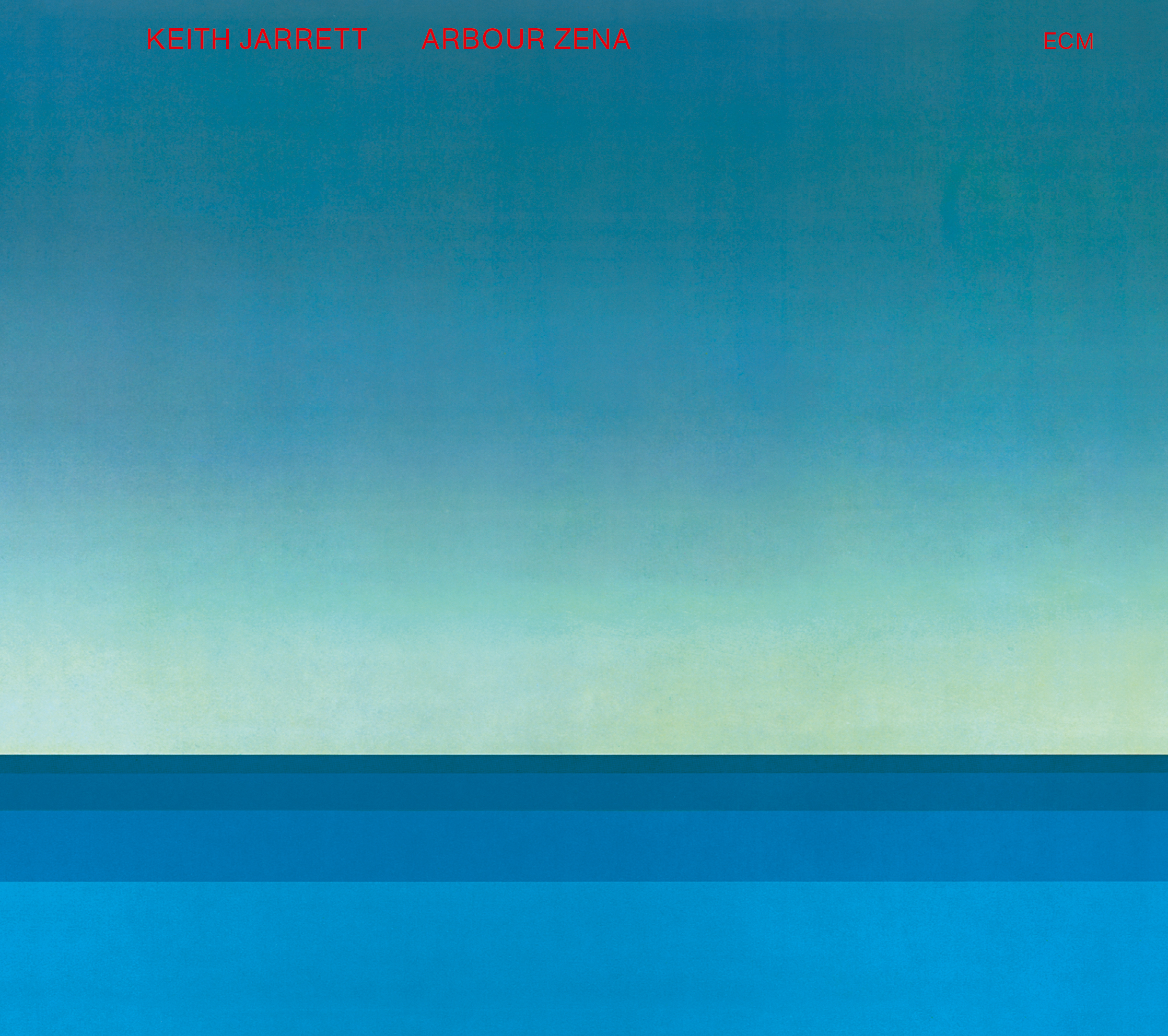
Keith Jarrett: Arbour Zena (ECM 1070)

1070 XKeith Jarrett
Arbour Zena

Keith Jarrett piano
Jan Garbarek soprano and tenor saxophones
Charlie Haden bass
Mladen Gutesha conductor
Recorded October 1975, Tonstudio Bauer, Ludwigsburg
Engineer: Martin Wieland
Produced by Manfred Eicher

The moment I lie in bed and begin listening to this album in my dorm room for the purposes of this review, my suitemate launches into a volatile argument with his girlfriend. As their loud verbal match breaches the gap under my door, I trace its implications across the geography of Arbour Zena. I think about the fallibility of relationships, about the trials and rewards of a musical life, and about the often contrived ways in which we attempt to validate our own experiences through the art of others.

Against a backdrop of accusations of infidelity, “Runes” blooms to quiet life with a slow orchestral tremolo. Jarrett disturbs the crystalline stillness with shafts of light and the bass falls like thick droplets as the orchestra turns to the morning sun, treading lightly upon the water so as not to disrupt its surface tension. The piano fades, leaving Haden to amble along the banks, skirting the limits of our visible world. Jarrett returns as if back from a foraging expedition, peering carefully into the scene laid before us as he unfurls a background of epic dimensions. He then pulls the orchestra in a new direction, leaving the bass to contemplate the fate of its own path. At first, we aren’t sure if the two are even connected. Perhaps they will join again, we wonder. Jarrett’s intimate piano improvisations dip their toes into waters familiar to fans of his solo work. Yet for all the music’s scope, we don’t so much travel as burrow deeper into the recesses of indecision until Garbarek’s entrance wakes us. In its own strange way, the music does resolve itself as these disparate voices achieve harmony over time. Where Luminessence was a conversation, “Runes” feels more like a narrative that jumps from one character’s head to another. It is also very difficult to picture the music, for Jarrett works in emotions here rather than in images. These aren’t simply the antagonistic ramblings of a polemicist, but rather the careful scripts of one whose relationship to determinacy is as complex as life itself, fragile as the flutter of breath over reed that ends the piece.

“Solara March” draws its plaintive curtains back to reveal an orchestra and bass. This is but the preamble to some stunning passages in which the piano touches off a lush tripping of orchestral sound while the bass seems only to meander, as if content to face an oncoming storm. As Jarrett plays a linear melody on the keyboard’s higher register, the bass continues to murmur in the background, as if unaware of its own critical potential. Garbarek injects some liveliness halfway through the “March.” With a characteristic buoyancy, Jarrett nudges us toward an opulent climax. The music finds its stride and renders worthwhile our disjointed path to getting there.

The third and final piece, entitled “Mirrors,” reflects a keening orchestral introduction, segueing into an extended meditation for piano and strings. As improviser over his own orchestral writing, Jarrett draws from the same threads and with the same colors, whereas his other improvisers mix their hues on an entirely different palette, if on the same canvas. With Jarrett leading the way, Garbarek has a much easier time fitting into the constantly shifting puzzle of the former’s evocative presence: the din of a distant flock of birds conveyed by the wind from an unseen field, or perhaps the sound of waves flitting in and out of our audible range. The lack of bass here is somehow comforting, leaving Jarrett and Garbarek to glide ever more assuredly across the album’s opaque surface. During this movement my suitemate’s girlfriend shouts, “That’s it! We’re through,” leaving behind not only a silent partner, but also emptiness in what would otherwise be a Saturday evening filled with laughter and sounds of lovemaking bleeding through these hollow walls.

This album is strangely recorded. The orchestra is given very little breathing room while Haden stands aloof, sounding as if he were recorded in a separate room and eased in later at the mixing board. In many ways, the bass is our mediator, our interpreter between languages and worlds, operating as it does a subliminal space. The music on Arbour Zena is diffuse, composed of blurry snatches of memory. There is nothing incredibly arresting about it. It doesn’t invite the listener and only barely acknowledges that it is being heard, playing not even for itself. It is like a dance missing a few steps, a garden with a trampled flowerbed and only a few unblemished specimens holding fast to their roots. It is the liberation of desire from the trappings of its own desire to be desired. Jarrett’s fellow musicians are rather well suited to this project, for to provide such continual commentary must be a challenge to even the most skilled.

Since writing this review, I am happy to report that my suitemate and his girlfriend have gotten back together, and I have taken to listening to Arbour Zena anew as an expression of hope—a musical talisman of emotional harmony in an unsympathetic world.

<< Kenny Wheeler: Gnu High (ECM 1069)
>> Tomasz Stanko: Balladyna (ECM 1071)

Keith Jarrett: Luminessence (ECM 1049)

ECM 1049 CD

Keith Jarrett
Luminessence

Jan Garbarek tenor and soprano saxophones
Strings of Radio Symphony Orchestra Stuttgart
Mladen Gutesha conductor
Recorded April 29 and 30, 1974 at Tonstudio Bauer, Ludwigsburg
Engineers: Kurt Rapp and Martin Wieland
Produced by Manfred Eicher

Having come to know Keith Jarrett primarily through his astounding improvisatory skills and classical interpretations, this recording marks my first time encountering him as composer proper. On the one hand, I feel as if setting Jarrett down on paper somehow limits his potential (note, for instance, his understandably longtime reluctance to publish a score version of the lauded Köln concert). On the other, Jan Garbarek is given such free reign of the icy territory into which he is deployed on this recording that he is able to channel Jarrett’s essence to its fullest. It’s difficult to imagine Jarrett’s music being any other way.

Any work for soloist and orchestra may be likened to a conversation in which the former introduces topics for the latter to work through “verbally.” At some point this dialectical relationship begins to take on a life of its own in the recording process. Yet in listening to Jarrett’s compositions one gets not conversation but conversion, a real-time transfiguration through which music implodes rather than expands. Garbarek doesn’t engage with the orchestra so much as traverse it, lifting and dropping his weighted feet across its rosin-dusted expanse. If there is dialogue to be found here, it’s entirely internal.

“Numinor” eases its way into the listener’s field of vision, across which Garbarek uses mournful reedwork to draw a series of jagged constellations. The orchestra sometimes bleeds, as if it were a cloth sheared by the edge of these gritty ruminations. Garbarek shouts with his instrument, treating it more as an extension of his voice by which the placement of his fingers articulates syllables in lieu of notes. Although we might not recognize the language, something intelligible comes through. In spite of some inspired solo passages, the music remains decidedly horizontal: every step forward is countered by one step sideways. There is, however, an incredibly moving scene in the final passage of “Windsong” where the saxophone blends into its surroundings, sharing an intimate moment of continuity made all the sweeter for its unexpected cessation. The title track, which closes the disc, is playful and romantic, slaloming its way through triadic signposts. The mood is contradictory, Garbarek engaged in two entirely different dialogues in a semblance of one.

Overall, I find Luminessence to be a challenging listen. Not because the music is particularly modernist, but because Jarrett makes so visible the often hidden dynamics of authorship we come to take for granted. As one who is continually enlarging the notion of musicality in everything he touches, Jarrett provides us here with an unabashed document of the compositional process. It is the audible equivalent of looking at the master’s sketchbook. I also find this album to be quite dark in spite of its glowing title, like a hidden shadow beneath the unturned page. It is an album that erases as many words as it inscribes, a memoir of images rather than prose. All of this makes for an effective, if threadbare, project. There are very few motives to speak of, which is liberating, as one is never subjected to the often-dominant reprise, nor to the subservience of secondary themes. Notes are sustained in ways they couldn’t have been sustained before, ending as abruptly as they began. This process is illustrative of the title’s clever play on words, a symbiosis of color and opaque desire.

<< Paul Motian: Tribute (ECM 1048)
>> Keith Jarrett: Belonging (ECM 1050)

Keith Jarrett: Belonging (ECM 1050)

ECM 1050

Keith Jarrett
Belonging

Keith Jarrett piano
Jan Garbarek tenor and soprano saxophones
Palle Danielsson bass
Jon Christensen drums
Recorded April 24 and 25, 1974 at Arne Bendiksen Studio, Oslo
Engineer: Jan Erik Kongshaug
Produced by Manfred Eicher

From beginning to end we are treated to a mélange of moods in this, the first effort from Keith Jarrett and his European quartet. Compositionally astute and clearly the work of steadied hands, Belonging finds each musician in fine form. Whether it is Garbarek’s punctilious doubling in the buoyant “Spiral Dance,” Danielsson’s mellifluous bass solo in “Blossom,” or Christensen’s rollicking snare in “The Windup,” everyone gets their moment in the spotlight. Jarrett’s fingerwork is, of course, superb throughout, but it is the energy underlying his playing—the very spirit of his pianism—that really seems to drive things forward. The album is zigzagged, fading adeptly from head-shaking abandon to heavy darkness from one cut to the next. Ballads make up the longest passages on Belonging and seem to turn ever inward within the confines of their own emotional borders. For the most part, sax and piano are explicitly unified, as if trekking on either side of the same divide, although sometimes they seem to look in opposite directions, as if involved in a long-running debate, unsure of whether reconciliation can be had in the throes of so much dialogue. Jarrett’s jilted approach is well suited to these down-tempo moments while the bass gently asserts its tremulous presence in the background. Garbarek’s sudden entrances weave a dense stratosphere of brassy elegance. “’Long As You Know You’re Living Yours” is pure Jarrett and provides Garbarek with plenty of space to run amok with his screeching serenade. The title cut is another ballad, this one of a different shade than the rest; not an alleyway, but a brief lapse into self-pity. As the album’s center, it also encapsulates a core theme: this music evokes a past from which one cannot escape or, more positively, simply a sense of belonging as the title would imply, the inescapability of one’s roots in place and time. Overall, this is an essential example of what ECM can do when it throws a handful of singular talents into a studio.

<< Keith Jarrett: Luminessence (ECM 1049)
>> The Gary Burton Quintet with Eberhard Weber: Ring (ECM 1051)

Keith Jarrett: Solo Concerts Bremen/Lausanne (ECM 1035-37)

ECM 1035-37

Keith Jarrett
Solo Concerts Bremen/Lausanne

Keith Jarrett piano
Recorded July 12, 1973, Kleiner Sendsaal, Radio Bremen
and March 20, 1973, Salle de Spectacles D’Epalinges, Lausanne
Engineers: Kurt Rapp and Martin Wieland
Produced by Manfred Eicher and Keith Jarrett

In his timeless solo concerts, Jarrett displays the uncanny ability to drop himself into a piece of improvised music as if it has been playing invisibly in the ether all along, requiring him only to pick up from whichever measure he encounters and leave the music to continue on after he has left the stage. This album predates Jarrett’s Köln concert by just two years and was the one that really put him on the map before that legendary successor. Yet we cannot simply say that Jarrett is channeling the cosmos and leave it at that, for he inhabits a melodic space that is tangible, his own. Though filed under jazz, this music is something far more than any generic summary could express. Still, I persist in trying.

The work in Bremen feels to me like travel. In Part I, we run through many modes of transportation: from air to earth to rail, we are given a glimpse of new places and spaces (both inner and outer). We don’t so much physically as emotionally go there, feeling our way through unfamiliar territory as if it were our very home. Part II has a more decidedly gospel feel to it, rushing headlong into an ecstatic communion. For nearly 45 minutes, Jarrett manages to ride a wave of endless creative fervor as if every moment were not the last, but the first. Just then, halfway through, the mood darkens. Until now we have been heading for the sun when suddenly we are looking back to the earth, thinking of all that we would miss: the sensation of water trickling through our fingers, kisses upon our children’s foreheads, the rustling of wind blowing through our back yards. With a mere gathering of notes, Jarrett manages to imagine a lifetime’s worth of memories, departing at last with an exultant resignation, perhaps even rebirth.

Lausanne, on the other hand, crosses the previous series of vertical strokes with horizontal ones. Every time Jarrett slips into another intersection, he locks himself into a new idea until its beauty becomes too much for him and he must move on. “Transcendent” doesn’t even begin to describe the effect, for it is also confrontational, painful, and transportative. For the latter portion of the Lausanne solo, Jarrett ventures inside the piano, slapping and plucking his way through a percussive and surreal call-and-response and, eventually, a frenzied fade into silence.

Of all of Jarrett’s solo piano recordings, I love the sound of this piano over the rest. Whatever instrument he is playing here seems to let go of any and all inhibitions in his presence and shines steadily like a planet in its higher regions. Jarrett plays with unparalleled diction. Like any great orator, he means to ensure that we understand every word through his delivery, and for that he has chosen the perfect mouthpiece.

<< Keith Jarrett: In The Light (ECM 1033/34)
>> Art Lande/Jan Garbarek: Red Lanta (ECM 1038)