Keith Jarrett: The Köln Concert (ECM 1064/65)

ECM 1064-65

Keith Jarrett
The Köln Concert

Keith Jarrett piano
Recorded January 24, 1975 at the Opera in Köln, Germany
Engineer: Martin Wieland
Produced by Manfred Eicher

I have a confession to make. One that borders on blasphemy for a professed ECM fanatic such as myself: before writing this review I had never heard The Köln Concert. What is perhaps the most highly revered, and certainly the best-selling, album in the ECM catalog has managed to escape my ears all these years. Part of me wanted to save the experience for the right moment, while another had possibly been afraid that I might not like the album. Whatever the reason, I am happy to say that the wait is over…and it has been more than worth it.

The story behind this recording has, of course, already become the stuff of legend. On a dreary January day in 1975, Jarrett arrived at the Köln (Cologne) Opera House fatigued and malnourished and was bid to play on an inferior piano designed for rehearsals and not for live performance. As a result, the concert was almost never recorded. One can read about Köln lore ad nauseum elsewhere, not least in the album’s liner notes, so let’s have nothing more to do with it. The Köln Concert deserves to be listened to as it was created: without borders and without assumptions. And so, last night, as I lay awake in bed unable to sleep, I decided that it was time to fill this gaping hole in my listening life. With the lights already off, I put on the album and let the music take me wherever it wanted to take me. All I can offer in return is the following “travel diary” in honor of Jarrett’s achievement.

The opening chords of Part I set us upon an almost otherworldly path, providing gospelly signposts along the way to remind us of home. The music brims with the need for release, but Jarrett seems to want to hold onto it for as long as he can before its messages are lost forever. There is a persistence to his playing that speaks of countless internal dialogues all vying for attention. Delicate phrasing is suddenly punctured by a rhythmic depressing of the sustain pedal before flowering into an open exposition of higher energy. The music cascades as Jarrett’s voice careens off its towering contours when, just as suddenly, the majesty is swapped for an intimate chamber within its walls. Shadows of a former empire loom large, tethered by ecstatic cries.

Jarrett picks up the pace during the second act, moving from the elegiac to the frantic. Everything “fits,” joined by the same threads: a patchwork in which every seam is uniformly sewn. The progression is as lush as can be. It is as dense as a forest, and just as ordered in its own way. Jarrett brings us to a clearing, only to make us aware of the silence we left behind. So we turn around and jump right back into the thick of things as he expands his architecture to greater depths, carving out a subterranean labyrinth of cavernous sound that will never be charted again. The encore (labeled “Part IIc”) is both a montage of what came before and a preview for that which has yet to arrive.

It might seem clichéd to write this, but sometimes there are moments in one’s musical life that are simply magical. Clearly, Jarrett experienced over an hour’s worth of such moments here, and we are fortunate enough to be able to experience them ourselves, if only vicariously through the mediation of technology. Jarrett seems to know the piano’s vocabulary as well as his own speech, which might very well explain the involuntary vocalizations for which he is so often criticized. Structurally, the album could hardly be simpler: a series of vamps provide ample ground for floating improvised lines that stick primarily to the piano’s middle range. And yet, the scope of his vision is staggering in its implications. Jazz is Jarrett’s anchor, even if the voyage does carry him far beyond its generic boundaries. The applause only heightens the spell, reminding us that what we have just heard is indeed of this world, and was shared spontaneously with a crowd of our peers.

Despite what some might have you believe, by no means should this be anyone’s only Keith Jarrett experience. It needn’t even be one’s introduction. As sublime as it is, it is but one of many formative and breathtaking examples of his prolific output. This album is a lullaby for anyone who has no need for slumber, and Jarrett’s heartfelt voice explicitly conveys the rapture of living in the moment, his vocal interjections enhancing the “live” feel considerably and making for an even more visceral document.

<< Enrico Rava: The Pilgrim And The Stars (ECM 1063)
>> Eberhard Weber: Yellow Fields (ECM 1066)

Keith Jarrett: Facing You (ECM 1017)

ECM 1017

Keith Jarrett
Facing You

Keith Jarrett piano
Recorded November 1971 at Arne Bendiksen Studio, Oslo
Engineer: Jan Erik Kongshaug
Produced by Manfred Eicher

Keith Jarrett will always be something of an enigma to me. Not because he is more than human, but because he plays with an honesty that is practically unfathomable. His melodies have a way of spiraling in on themselves and the effect is intoxicating.

This seminal album (his first for ECM) arguably finds Jarrett at his most focused and at his most transparent. Every note seems perfectly placed. His intuition is on fire here and we are only too happy to be engulfed along the way. “In Front” establishes a flavorful and scintillating mood from the get go before taking things down a notch with a requisite set of ballads. Of these, “My Lady, My Child” is achingly beautiful and gets only more so as it unspools. “Starbright” lifts the spirits with a shade of whimsy and gushes with the natural force of a breached dam, with “Vapallia” comprising its final trickles. Last but not least is “Semblence,” which rolls and bounces with the sheer exuberance Jarrett is known for.

What can one say about Jarrett’s performance style? Words like “fluid” and “unbridled” don’t even begin to capture it. His fingers seem to have minds of their own, anticipating each and every note before the next key is struck. Jarrett transcends the rubric of improvisation into something else entirely: improvisition. By this, I mean that his ability to call upon the music to speak is so compositionally disguised that it can only occur when one surrenders oneself to the freedom of the empty score. This produces not objective music, but rather the utmost subjective experience one can have with an instrument.

While Jarrett has been given all the credit for instituting the solo piano as a viable instrument beyond the confines of classical music, let us not forget his wonderful predecessors on ECM (and whose work I have previously reviewed on this blog). This disc is, I daresay, downright groovy. A real discovery to be treasured. Just listening to it makes me want to contort my face and screech along as if I were the one at the keys.

Essential.

<< Terje Rypdal: s/t (ECM 1016)
>> Circle: Paris Concert (ECM 1018/19)

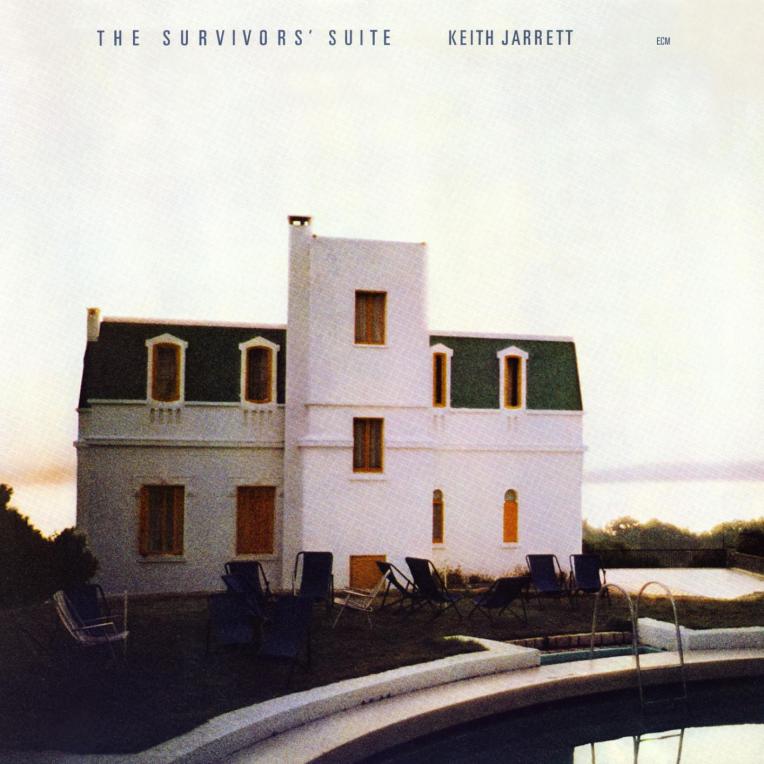
Keith Jarrett: The Survivors’ Suite (ECM 1085)

ECM 1085

Keith Jarrett
The Survivors’ Suite

Keith Jarrett piano, soprano saxophone, bass recorder, celeste, osi drums
Dewey Redman tenor saxophone, percussion
Charlie Haden bass
Paul Motian drums, percussion
Recorded April 1976 at Talent Studio, Oslo
Engineer: Martin Wieland
Produced by Manfred Eicher

A quick perusal of the personnel and mechanics of this album is practically all one needs to get an idea of the tonal colors and moods with which its imagery is composed. The Survivors’ Suite finds Jarrett in a multi-instrumental role along with the all-star cast that makes up his American Quartet. The sheer synergy of the playing truly makes this music shimmer. For this reason, I hesitate to single out particular solos and motifs. Suffice it to say each member has his moment of glory in the concisely knit fabric of the album’s 49-minute duration.

The music shifts dramatically from soulful dirges to upbeat thematic variations in a vibrant flow of ideas. A sense of control reigns. One never feels lost while listening (or is, in fact, lost but doesn’t care), for the surroundings are so resplendent with life. This is a supremely evocative experience and the similarity of associations it has inspired in so many listeners is striking to say the least (peruse a few other reviews, and you’ll see what I mean). The Survivors’ Suite reaches beyond jazz, even if firmly rooted in jazz’s soil. Its sound is vast yet intimate, breathing with the sheer life force of its music-makers. There is a marked difference between its two sections, simply titled “Beginning” and “Conclusion.” They are not polar opposites and are more than complementary. They walk the same trails, perhaps pointing out different sights along the way, all the while knowing they will soon meet again. Where the former is timid yet progressive, the latter is democratic and viscous.

This is, without a doubt, a high point among Jarrett’s many ECM outings. It is expertly recorded (as evidenced by its superb balance of warmth and coolness), fluidly played, and widely cherished, as I am sure it will continue to be for decades to come.

<< Eberhard Weber: The Following Morning (ECM 1084)
>> Keith Jarrett: Hymns/Spheres (ECM 1086/87)