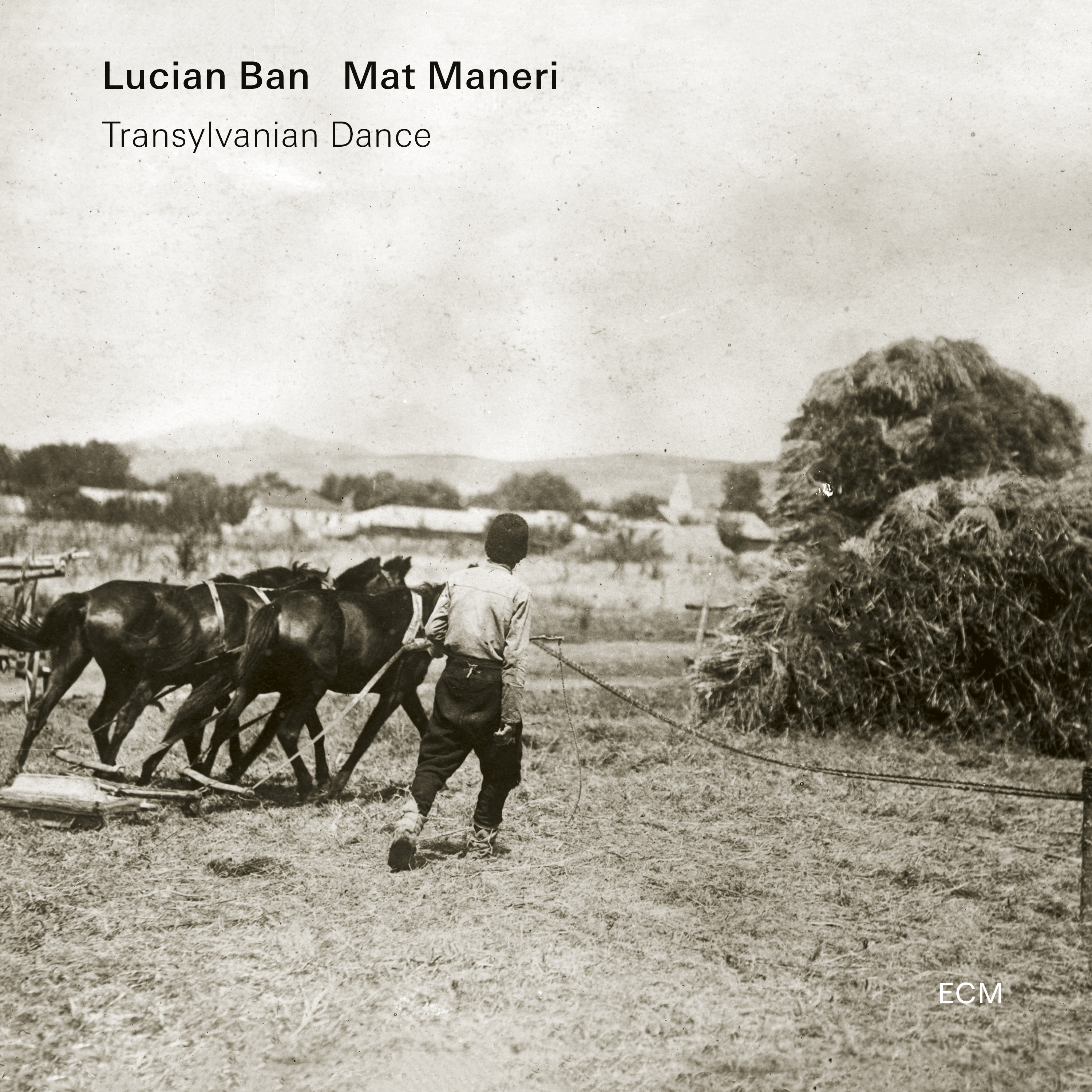
Lucian Ban/Mat Maneri: Transylvanian Dance (ECM 2824)

Lucian Ban
Mat Maneri
Transylvanian Dance

Mat Maneri viola
Lucian Ban piano
Recorded live at CJT Hall in Timișoara, October 29, 2022
Recording engineer: Utu Pascu
Mixing: Steve Lake and Michael Hinreiner (engineer)
at Bavaria Musikstudios, Munich
Cover photo: Romania farm scene, 1919 (courtesy Library of Congress, Washington)
Album produced by Steve Lake
Release date: August 30, 2024

Transylvanian Dance is the long-awaited follow-up to 2013’s Transylvanian Concert. The latter ECM debut of pianist Lucian Ban and violist Mat Maneri’s collaboration was a landmark showcasing the duo’s ability to immerse and blend in a partnership written in the stars. The present program, recorded live in October 2022 in the context of the Retracing Bartók project in Timișoara, is based entirely on songs and dances collected by Béla Bartók in Transylvania. And yet, the recapitulation of this music is more than a gesture of preservation; it’s an act of solidarity. If Ban and Maneri are archaeologists, they regard every artifact on its own terms. Rather than dust off the caked sediment, they appreciate it as a part of what the object has become.

In his liner notes for the album, Steve Lake invokes the “treasure-house,” a term used by Bartók and fellow composer Zoltán Kodáldy to describe the folksongs that may have gone lost without their efforts and one that feels duly appropriate to label the container built by these four hands. Drawing from his own experience growing up in Transylvania, Ban stains the wood with an ancestral quality, while Maneri carves adornments patterned after the imprints of far-reaching histories from within.

Open the door and take any interpretation stored a few steps beyond it, and you’re sure to find something to connect to. That being said, “Poor Is My Heart” is about as sparkling an introduction as one could hope for into this archive of still photographs come to life. To be welcomed into this space so freely is more than a privilege; it speaks to the human right of free expression against tyrannies of silence. Appropriately, the pianism is lithe yet strong, while the viola is a pliant voice that speaks of reeds and winds from bygone eras, its harmonics turning shafts of recollection into particles of real-time action. Like the title track later in the program, it keeps no secrets from us. However near or far the musicians feel, their balance of extroversion and introversion is superbly rendered. If Ban is the earth, then Maneri is the tiller of its collective memories. “Romanian Folk Dance” is another ripe harvest. Through disjointed yet natural movements, it breathes with an unsettled (but never unsettling) quality. The instruments circle each other, closing but never tightening the knot past the point of loosening.

What might seem to be a discerning focus on revelry is the oxygen for the darker flames of “Lover Mine Of Long Ago,” which treats its garments as layers of skin to be shed at will. Ban’s exploration of the piano’s inner strings, whether by plucking or muting, polishes a dowry of coins and other trinkets to be left behind with it. Meanwhile, “The Enchanted Stag” is a keening hymn in which bluesy accents bend to the will of the compass’s needle. Both “Harvest Moon Ballad” and “The Boyar’s Doina” turn the concept of the soul into a playing style. Wavering yet never faltering, each is a house creaking in the night, reminding us of the fragility of what we call home. Settling ever deeper into the ground, their candlelit windows beacons for wandering dreamers, they create a breezeway for the final song, “Make Me, Lord, Slim And Tall.” Not a single note feels wasted: percolating, germinating, and fragrant as a forest floor after the rain. With so much fertility, we can only wonder at the gifts it will yield with repeat listens.

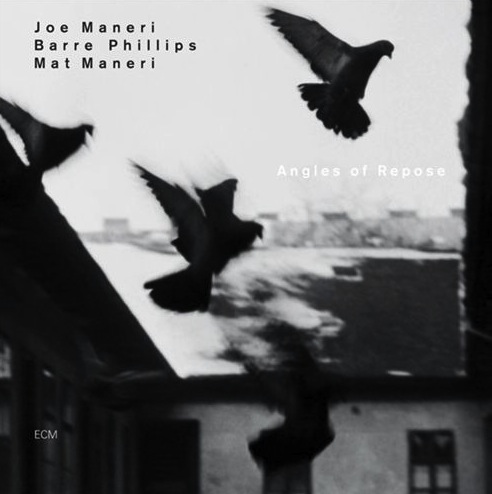
Maneri/Phillips/Maneri: Angles of Repose (ECM 1862)

Angles of Repose

Joe Maneri alto and tenor saxophones, clarinet
Barre Phillips double-bass
Mat Maneri viola
Recorded May 2002, Chapelle Sainte Philomèe, Puget-Ville
Engineer: Gérard de Haro
Produced by Barre Phillips and Steve Lake

When Joe and Mat Maneri and Barre Phillips materialized in the studio to record Tales of Rohnlief, the result was a magical recipe of microtonal blues and other off-the-beaten-path catharses. The session begged for a sequel, and its name is Angles of Repose. This time around, our synergistic trio throws rules into the air like pigeon feed for the small frame of life that is the cover photograph (incidentally, my favorite ECM sleeve/title combination in the entire catalogue) in the name of integrity.

Number One
Phillips is a grounding force in this opener, adding as much as he takes away and saving the sawdust, so to speak, from his whittling. Joe snakes his prophetic way through vocal and instrumental languages in a veritable feast of biological rumination, tempered by analysis in the immediacy of discovery.

Number Two
The internal machine may be vast, but its weak spot is infinitesimal. Father and son patty-cake the earth into submission. You can skitter and flitter all you want, but you’ll never find the path unless it finds you, whether gelled by time or fragmented by the violence of discovery.

Number Three
Joe cracks the fountain with faith and signs his nameless art with dots and dashes. If he seems winded, it’s only because he is the wind. Ameliorated by the corona of experience, he tempers his weapons with air, that they might never pierce the skin of any mortal fear, along which flounders the death of discovery.

Number Four
Twisting between thumb and fingers, the night rolls the city into a cigarette and smokes it until it sleeps. Every noteless space only makes it stronger. Butterflies and rhinoceri now share the same breath, fraught with the wonder of discovery.

Number Five
A duet for strings of spacious mind channels the wastes of contradiction and melts them into a mold. As the sculpture cools, it becomes a shadow. Its visage weeps invisibility. The hands of passersby inadvertently float through it, so that all they are left with is the fallacy of discovery.

Number Six
The cup has tipped, its contents spreading in a partially eclipsed circle. In this pool where broken mirrors float, we see the multiplicity of our genetic code’s sonority. Harmonics are the edges of fingernails on glass, and further the edge of that glass on sky. Resonant beauty briefly surfaces—a dolphin’s back—before plunging into the brine of discovery.

Number Seven
Blood begets blood begets the onlooker, whose wayfarer soul quivers with the loss of discovery.

Number Eight
The metamorphosis has occurred, not from man to insect but from insect to man, still carrying the language of its forbearers, dribbling into the cupped hands of discovery.

Number Nine
Birdsong becomes liquid mercury in the room-temperature stare of indifference. It is here where music is born, shedding truth for its simulacrum in the hopes that it will be consumed more quickly and forgotten on the way to the core. When our ears spread their wings, they need only lift one talon to leave their carrion. All the screeching and scratching accomplishes one thing: activation. We can feel in the air a vibrant disturbance, which brings its own instructions, blank as October sky. There is a beginning in every end, the anode to galactic circuits in search of a name. And if you lean in close enough, it may just whisper it to you, for it is the breath of discovery.

Number Ten
The whale scratched by Ahab’s spear swims for a song. Its balanced lyric of play guides the sonar true. It wakes you up just to tell you to go to sleep. This is the dream of discovery.

Three lines make not a braid, but a single unbreakable filament plugged directly into the kundalini of any listener willing to close the mind and open the body to the possibility of its activation. Yes, the album has its highlights (Numbers Five and Nine, I’d say, if you asked me), and contains Joe’s most heart-wrenching playing on record, but its lowlights are just as expertly realized, for in this sound-world there is no hierarchy, only the contemplating line that wraps around us as it goes along its way. If pinnacles have restless dreams, these are their soundtracks.

Mat Maneri: Trinity (ECM 1719)


Mat Maneri
Trinity

Mat Maneri violin, viola
Recorded July 1999 at Gateway Studio, Kingston
Engineer: Steve Lowe
Produced by Steve Lake

There’s something about the title of “Pure Mode,” prologue to Mat Maneri’s first solo album, Trinity, that describes his abilities just right. Like the nine improvisations that follow, it jumps off of a prewritten motive (in this case, by Matthew Shipp) and offers us a four-stringed experience like no other. Maneri goes unplugged this time, feeling out the forest of richness already ingrained into the wood and gut at his bow. He stews in every design for what it’s worth and walks along a slippery melodic slope as if it were dry and even ground. If we take “Almost Pretty” as a mirror, then we know this project is anything but vain, for Maneri consciously eschews the trappings of virtuosity that so often loom before the solo performer like a locked door. He is instead interested in the intricacies of that mechanism. He coaxes it open through disinterest alone. The scuttling crabs of this tidal song do not tempt him. Theirs is a rhythm he does not need. We might, then, look to the title track for a snatch of mission statement. In its 10-minute passage rests the winged key to another realm entirely, one that walks a bridge of half-light. Thus he traces the shores of his own dreams, christening John Coltrane’s “Sun Ship” on its raga-like voyage to the earth’s center. The unerring valences of his notecraft are nowhere more apparent. His quiver stocked with idiomatic arrows, he looses them into the sky, knowing they will never heed gravity. Such artistry extends into the visual, as in “Blue Deco,” for which Maneri treats the violin like paint. He chooses air in place of canvas and renders a world alone. This, along with “Veiled,” is the most chamber-like excursion of the program, a void of interpretable dots and dashes that peaks in children’s squeals. In each, solid walls of pizzicato break the flow. “Iron Man” (Eric Dolphy) and “Lattice” (Joe Morris) form another pair. Wrought in heavy matter and spindling filigree alike, they wander drunkenly into the distilled tonic of “November 1st.” This we can sip and savor, a duster for the cobwebbed staircases of the mind. Meanwhile, the house is littered with “Lady’s Day Lament.” Riffing on a tune by his father, Maneri loosens every nail until the entire structure hums.

Whether or not Mat Maneri’s sound-world will divide listeners is irrelevant, for it already fuses so many disparate strands into a single precious current that everyone gets swept up in it all the same. Open your mouth and drink it. You will never drown.

Maneri/Phillips/Maneri: Tales of Rohnlief (ECM 1678)

Tales of Rohnlief

Joe Maneri alto and tenor saxophones, clarinet, piano, voice
Barre Phillips double-bass
Mat Maneri electric 6-string and baritone violins
Recorded June 1998 at Hardstudios, Winterthur
Engineer: Martin Pearson
Produced by Steve Lake

Tales of Rohnlief is an exercise in recitation. Joe Maneri’s histrionics call out to grasslands and briny spray. He preaches at the edge of the world, where rocks cut like scissors through wrapping paper: only a push and not a squeeze. In his voice is all the landscape one needs to find purchase for the journey that follows. The voice expresses itself by way of throat and reed, a pitch-bent nightmare turned frosty and sweet. It pales into a spontaneous croak as Barre Phillips and Mat Maneri press their palms to an elaboration of surrender. And with that, these three uncannily attuned improvisers touch the sky with more sky. A break in the clouds reveals a backdrop of revelry.

“A Long Way From Home” feels like anything but, so intimate is its delivery. It whisks us through points of contact as familiar as our subcutaneous selves, and just as sensitive to the errant touch. Mewing cats trade places with stone idols flicking their tongues in the face of condemnation, licking away the possibility of failure as a hand wipes away condensation. Paltry rhyme schemes fail, however, to express the depth of this game of halos. We may, then, search for another method to the genius we now face. I propose that we turn our ears away from what is being told and focus rather on the telling itself. For if we look beyond titles like “When The Ship Went Down” and “The Aftermath,” neither of which help us despite the wonders of their contents, we realize that the inaugural voice has never left us. Its register curls a ghost’s hand and guides us through the gnarled lessons of “Bonewith” until, lo!, it casts its oracle shadow across the “Flaull Clon Sleare” and watches, silent, as we attempt to “Hold The Tiger” (a particularly brilliant pop-up). Watery yet never watered down, the song cackles. “The Field” is another notable mention, if not for its mournful qualities then for the color of its blood. Three dark and winding paths bring us to the tongue-tied destination of “Pilvetslednah.” Now that he’s shown us the yard, Joe welcomes us into his home, forever full of warmth.

There is so much sincerity in this music that it hurts.

Joe Maneri/Mat Maneri: Blessed (ECM 1661)

Joe Maneri
Mat Maneri
Blessed

Joe Maneri alto and tenor saxophones, clarinet, piano
Mat Maneri violin, electric 6-string and baritone violins, electric 5-string viola
Recorded October 1997 at Hardstudios, Winterthur
Engineer: Martin Pearson
Produced by Steve Lake

The stone gate. Vagary of an age lost to the water that swallows its knees. To listen to this record is to step through that gate, and find on the other side not ocean but a new kind of air in which water and vapor bleed like the sun’s light from the moon, the parent in the child. Many father-son teams have thus riddled the history of jazz, but between Joe and Mat Maneri one not only hears the biological bonds at play, but feels their electrical charge, and nowhere more so than on this first duo recording for ECM. Much can be made of the microtonal grammar that Maneri Senior has perfected over decades and which rests so intuitively at his fingertips, but at the end of the day it’s all about physicality and attunement. “If I play a thousand microtones, what’s that worth if the rhythm isn’t happening,” he tells us. “In some ways the rhythm is the most vital part of what we’re doing.” Listening to them emote is akin to listening to Paul Motian on the drums. Such is their fluency. Comparing them and their fashionable counterparts, however, is night and day. Which is to say, night on Earth and day on a different planet. By the same token, there is something so deeply integrated about the playing that we cannot help but look inward to find its pulse.

And yes, we may search for the pulse, but in doing so forget that the search is itself the pulse. Its most potent strain breathes through the lungs of “There Are No Doors,” “Never Said A Mumblin’ Word,” and the title track, all three of which feature Maneri Senior at the piano. If the titles seem to be proclamations, it’s only because the Maneris practice what they preach, tracing the crevices of experience for all the grit we’ve left behind. From this they build microscopic castles and flag them with rapid eye movement. “Sixty-One Joys” is perhaps the most achingly beautiful animal Maneri Junior has ever tamed, an electric baritone violin solo that drinks pathos like honey and exhales sugar in the raw. The insectile blues “From Loosened Soil,” another thing of elemental attraction, bridges us into “Five Fantasies,” which draws on Webern’s bagatelles and ends on a light scream. “Is Nothing Near?” comes closest to an identifiable place, a place where reedmen convene to spit life in the dead of night. Waves of arco fortitude flounder in slow motion, the outtakes of a film starring cigarettes and rainwater. And what of light? For this, we turn to “Body And Soul,” an acoustic violin solo knocking at the door of a homespun dream. It is the rat in the kitchen who eyes the cheese, the teacher in the classroom who nods off mid-lesson, the child in the playground who sees a rainbow and cries, “Race You Home.” The clarinet gets a klezmer test spin in “Gardenias For Gardenis” before shifting into a Lombard Street drive in “Outside The Whole Thing.” At the end of it: a hole in the ground.

Unearthed is what this music is, like a gold nugget or gemstone—only these two mavericks are not interested in priceless rarities but rather take exquisite interest in the sifted dirt. When watered by the gifts of these performances, the dirt burgeons with syllables. They may not be of a language we can all produce on command, but it is one we can always translate.