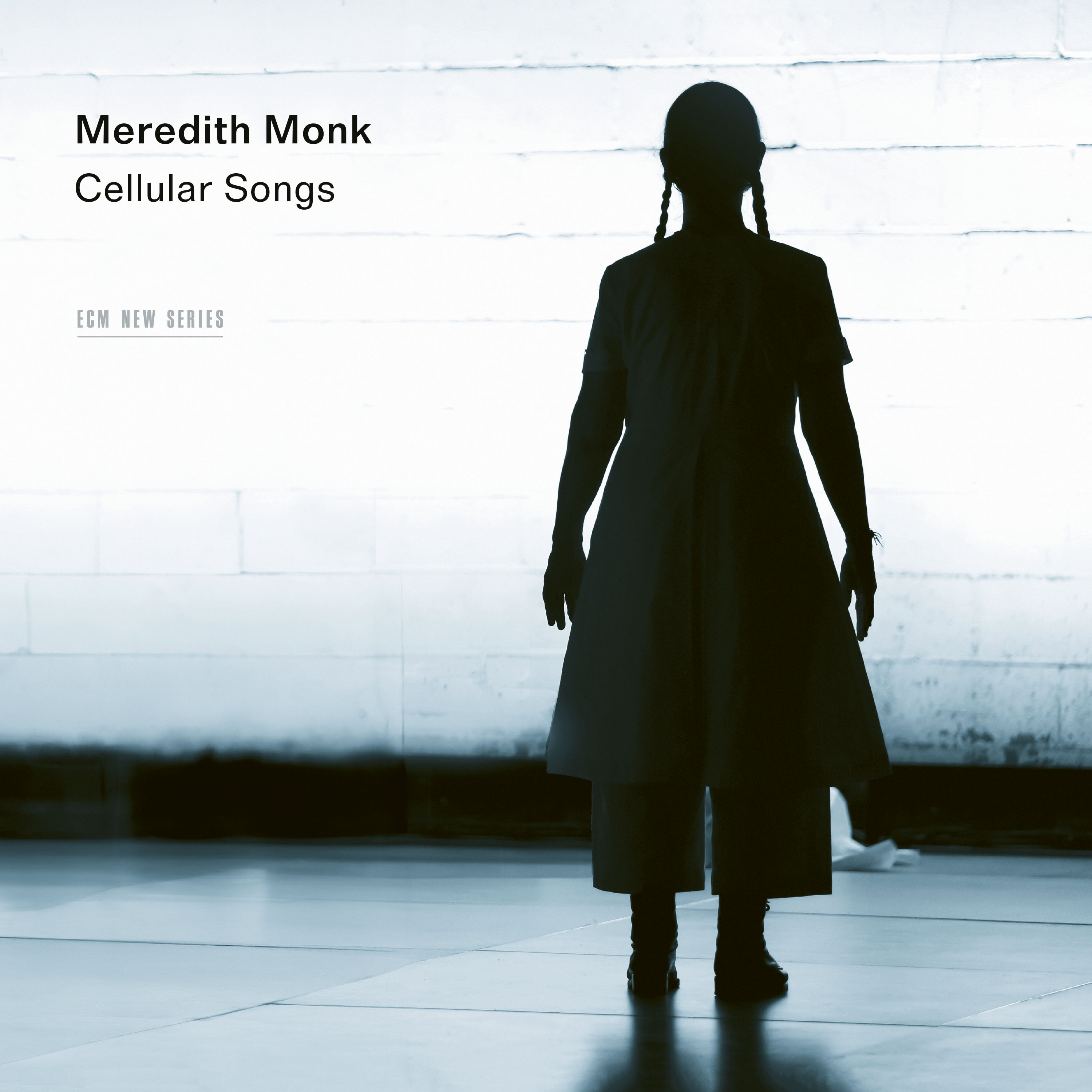
Meredith Monk & Vocal Ensemble Ellen Fisher Katie Geissinger Joanna Lynn-Jacobs Meredith Monk Allison Sniffin John Hollenbeck Recorded January-March 2022 / March 2024 Power Station Studios, New York Engineers: Kevin Killen (2022), Eli Walker (2024) Assistant: Matthew Soares Mixing: Eli Walker, Alexann Markus (assistant) Cover photo: Julieta Cervantes Recording producers: Meredith Monk and Allison Sniffin with John Hollenbeck Executive producer: Manfred Eicher Release date: October 17, 2025
All too often, women have been mythologically depicted as vindictive creatures who exist only to distract and destroy. Whether in the Sirens of the ancient Greeks or Tennyson’s Lady of Shalott, they sing, weave, and create in isolation, forbidden the pleasures of love, peace, and community. And while the work of singer and composer Meredith Monk has always been concerned with questions of agency, it was never made so clear to me as when the boxed set of her collected ECM recordings materialized in 2022. As the first album to appear since that watershed release, Cellular Songs doesn’t so much continue the journey as fold in upon itself, so that by the end, the listener is left with a compact flower of such potent expressivity that it seems capable of leading one’s ears in directions never thought possible yet which sound intimately familiar, as if remembered from a dream that preceded language.
Cellular Songs is the second part of a trilogy that began with On Behalf Of Nature, a work exploring our global ecosystem from a molecular vantage point. For Monk, the title names what is fundamental not only to life but to all of creation. “What is going on in the cell is so complex,” she writes, “and it’s a prototype of the possibility of what a society could be if you take those same principles and expand them.” As Bonnie Marranca suggests in her liner notes, composing and contemplation are synonymous, which makes Monk a meditator of worlds, one who reduces the act of communication to a microcosmic array of consonants, vowels, and blends. In this regard, it is difficult to imagine anything so biologically poetic as the opening “Click Song #3 Prologue,” in which Monk and her vocal ensemble (Ellen Fisher, Katie Geissinger, Joanna Lynn-Jacobs, Allison Sniffin, and Monk herself), with percussionist John Hollenbeck, get to the heart of things. Their tongue clicks are droplets in a distant cave, each carrying minerals and unfelt emotions until, over millennia, stalagmites rise as records of their passage. Like the three “Cell Trios” that follow, they constitute an internal code that locks into place. Flowing harmonies and dissonances encompass the breadth of life itself, a reality in which the voice is central, porous in its itinerant grace.
Hollenbeck’s vibraphone appears organically in a handful of pieces, a trace element in the soil of this music. Whether documenting a universal grammar in the syllabically potent “Dyads,” playing alongside the piano in “Dive,” or bowing a glassy surface in “Melt,” it allies itself with the building blocks of existence, defying the horrific structures so often fashioned from them. It is the vein in every vocal leaf, seeking photosynthesis without flesh and treating entropy as the dissolution of time. Sniffin’s pianism is equally cathartic in “Lullaby for Lise,” where she joins Geissinger. Rather than leaning on lyricism to seek fantasy, it straddles the threshold between waking and dreaming, recognizing that lived experience is always a blend of both. I hear it as a song to a child not yet born, gestating and growing with all the possibilities of time in her blood and brain, opening her eyes at last in “Generation Dance.” Thus, she comes to know the vision of her mother and her mother’s mother, and as she exhales in “Breathstream,” Monk’s solo voice gives shape to inherited traumas, now able to be wielded in the name of healing.
In the unfolding of “Branching,” each voice becomes the first in an ever-multiplying lineage of wisdom. Speaking of rituals and sacrifices, their repetition serves not as comfort but as a catalyst born of a primeval, generative power. “Passing” finds those same figures trading off vocalizations with a precision that is open to nature’s chaos, while “Nyems” reveals the playfulness of communication for the ephemeral metaphor it truly is.
Given that nearly all of the work presented here is stripped of linguistic meaning, what a radical blessing to encounter the coherence of “Happy Woman.” Here, the feeling is one of transparency, yet also of quiet critique, an awareness of the many roles women inhabit, whether by choice or by force. The opening refrain and its variations (“I’m a happy woman,” “I’m a hungry woman,” “I’m a thinking woman,” etc.) are the stitches of a mother among mothers, quilting herself into the patchwork of history.
By the album’s end, the sacredness of vibration becomes paramount. From these humming atoms emerge animals, rivers, and clouds, leaving us to wonder where the so-called intellect fits into the larger picture. Because if a heartbeat is nothing without silence, then its divisions are where forgiveness begins.
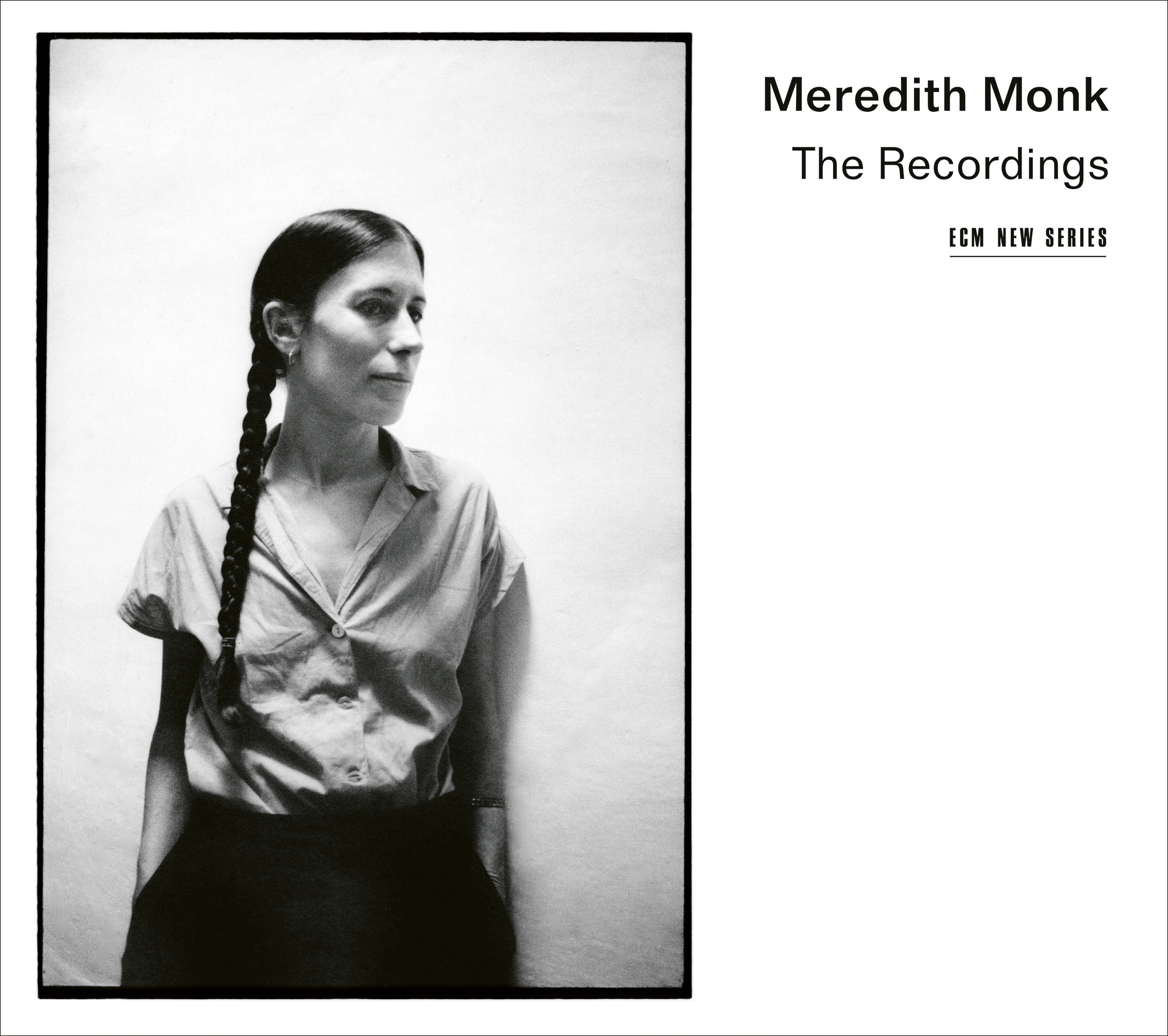
In November of 2022, ECM released this boxed edition compiling all 12 of Meredith Monk’s New Series discs to celebrate her 80th birthday. The set also includes a 300-page book reprising the original liner notes, along with new texts and interviews, photographs, archival documents, press quotes, and more. The result is more than a commemoration but a testament to the strength of the human spirit to make itself heard even in the face of inevitable entropy.
Manfred Eicher speaks of two important organs in the composer and singer’s oeuvre: their inspiration and their visual quality. In both, she finds a perfect partner in the producer, who has honed this approach across the territories of other singular artists, though none with quite the same combination of whimsy, ritual, and universalism.
In his essay, “The Worlds of Meredith Monk,” Frank J. Oteri characterizes the music as follows: “It paradoxically feels as if it was created at the very beginning of time and yet sounds completely new.” And while the works recorded here are scores in their own right since so much of her output defies standard notation, there is, he observes, a consistency that transcends the frameworks of their articulation. As part of a “living repertoire,” they seek out our ears as if they were extensions of themselves, thoughts on opposite sides of the brain spinning a seemingly impossible neural connection across oceans of time.
In an artist statement titled “The Soul’s Messenger,” Monk speaks of what the voice was able to reveal to her in the absence of its cultural reference points:
“Sometime in the mid 1960s, as I was vocalizing in my studio, I suddenly had a revelation that the voice could have the same flexibility and range of movement as a spine or a foot, and that I could find and build a personal vocabulary for my voice just as one makes movement based on a particular body. I realized then that within the voice are myriad characters, landscapes, colors, textures, ways of producing sound, wordless messages. I intuitively sensed the rich and ancient power of the first human instrument and by exploring its limitless possibilities I felt that I was coming home to my family and my blood.”
In other words, the voice was no longer an expression of the physical; it was physicality incarnate. “I began playing with what a vocal gesture would be,” she continues. “How would the voice jump, spin, spiral, fall? How would I abstract the sound of a laugh, of sobbing, of shouting, into a musical phrase?” Since then, her ”daily work” has not been to refine her singing so much as open it to its unadulterated imperfections, for in them are veins of possibility. These “gifts from a larger and wiser realm” are dug up like archaeological discoveries after long periods of waiting, each an old world made new.
At the age of three, Monk was diagnosed with strabismus, whereupon her mother enrolled her in a Dalcroze eurhythmics program, a technique that integrates music with movement. This experience, she recalls, “influenced everything I’ve done. It’s why dance and movement and film are so integral to my music. It’s why I see music so visually.” It’s also why the body has figured so viscerally in her live performances. Movement, dance, and shaping of sound all come across in the studio, not least of all because of Eicher’s attention to detail and Monk’s willingness to see where it leads. Without the shadow of infirmity hanging in the balance, questions of perfection become self-fulfilling prophecies.
Nowhere is the beauty of being off kilter expressed with such genuine poetry as in 1981’s Dolmen Music. In an excerpt from an interview by Ingo Bierman for his video series ECM50 | 1969-2019, Monk describes working with Eicher on this seminal session and how, after laying down Gotham Lullaby, she recorded a second take after concerns over her voice cracking in the first:
“It was technically perfect, but it really didn’t have that spirit, the kind of magic that the first take had. I have always respected Manfred for recognizing that, because you can edit yourself out of existence and get everything right, but there is something about the emotional continuity that communicates more deeply.”
The chamber program of which it is a part is quite varied and offers as full a portrait of Monk as you’re likely to find in one place. From the koan-like humor of The Tale to the 24-minute title piece, a larger narrative unfolds in almost liturgical fashion, each a step toward mortal awareness, with dashes of urban morbidity thrown in where it counts.
A touching piece of ECM lore worth mentioning is that Collin Walcott was a dear friend and frequent collaborator of Monk early on. He was, in fact, responsible for introducing her to Eicher and served as co-producer for Dolmen Music (playing violin and percussion on the album as well), which, along with Turtle Dreams, was thus shepherded into the ECM New Series stable after the imprint was created.
Speaking of Turtle Dreams, it makes for an enchanting companion. Although Monk’s performances used to confuse critics for their equal incorporation of dance, theater, and music, this 1983 follow-up shows her ethos to be based in the sounding body. Where this album’s predecessor regarded primordial realities, this one reflects the dissonance of living in the city through what she calls “Manhattan folk music.” Its intimate combination of keyboards and voices is nonetheless grand in its emotional scope, a dance with silence that sustains itself on contradictions and their resolutions and leaves room for what she calls “places to breathe, live, and play.”
All of this feels like a prelude to Do You Be. Released in 1987, Monk’s third album for ECM contains a melange of pieces from The Games: a science fiction opera and Acts from Under and Above, while the album’s title piece is from Vessel: an opera epic. Its incorporation of explicit words rather than the liminal spaces of and between feelings with which she was normally concerned places us at the center of a quiet storm of communication. The culminating effect is one of the voice as an instrument of memory, a beacon of futures that come to us as warnings.
Not coincidentally, Book of Days(1990) expands on that metaphor with even greater intensity in reimagining the incidental music to Monk’s film of the same name. Having seen the film, I can confirm its sense of dislocation and engagement with the human condition writ large. The story, set in Medieval times, tells of a young Jewish girl named Eva who is transfixed by visions of the modern world. Finding little comfort in her grandfather’s Torahic interpretations, she seeks solace in a local madwoman before her entire village succumbs to the plague. At the end, workmen who inadvertently unearth the village centuries later find Eva’s clairvoyant drawings of humanity’s demise. More than a soundtrack, the album is cinema in and of itself, morphing into weighted pathos.
Such ruminations of desolation were even more firmly on Monk’s mind when, at the end of 1989, while in residence at the Leighton Artists Colony in Banff, Monk found herself looking out her window at the Canadian Rockies. Despite being there to work on her opera ATLAS, she took inspiration from the scenery and produced a set of a cappella pieces that would become Facing North (1992). Conceived as a duet for her and Robert Een, it is a reflection of a place of cold uncoverings. The opera itself also made its way onto ECM. Over the course of three acts, ATLAS(1993) tells the life of Alexandra Daniels, an explorer who learns that the real journey is internal. This ambitious piece shows a transparent approach to instrumentation. Unlike the bombastic walls of sound that can dominate canonical opera, its accompaniment emerges from within instead of being forced from without. Interestingly, Eicher and Monk decided to cut the opera’s conclusion. “In the live performance,” she admits, “it was a crucial part of the whole. In the audio form, it became more of an epilogue, which seemed to both of us to make too much of a closure instead of letting the listener remain in motion at the end of the journey.” Such is the quintessential expression of movement through music, and how the soul breaks through the cracks in our voices is indicative of the necessity of imperfection to reveal self-worth.
Said cracks run even deeper in Volcano Songs(1997). As manifestations of human archetypes, these metaphysical pieces pay deference to Monk’s ongoing ethos of “always trying to explore forms that balance rigor with freedom.” Her melding with singer Katie Geissinger is astonishing to behold. Another program of strong variety, it includes such vital works as New York Requiem and Three Heavens and Hells, both of which deal with the transience of life and our regard for human suffering. Similar themes are explored in mercy(2002) and Songs of Ascension(2011), both of which represent collaborations with sculptor and installation artist Ann Hamilton. Whereas the former is built around the idea that the mouth can harm as much as heal, the latter was originally performed in an eight-story tower designed by Hamilton. In both, the instruments are just as vocal as the voices (and vice versa) in their explorations of fragility. As I wrote in my original review of mercy, “Monk’s is not a world in which the voice is primary but rather a voice in which the world is primary.” I stand by that statement and would point to these as Exhibits A and B. Nestled between them is 2008’s impermanence. A distinctly chromatic work, it eschews standard narrative in favor of a feeling, a connection to somewhere beyond the immediacy of experience.
Piano Songs, released in 2014, is a remarkable cross-section of Monk’s life and career, with purity and sameness through difference in mind, containing such touchstones as Paris, a piece from 1972 that marks her return to the piano after focusing intensely on the voice, and Ellis Island from 1981, which ties history and memory into one inexorable package. Last is On Behalf of Nature(2016), which speaks for the voiceless, the abused, and the forgotten. It has the most connective tissue of all, bleeding as much through the leaves as from the soil in which they are born.
If any red thread can be said to run through the above tapestry, it is that selves were made to expand. However, part of being human is realizing that with that expansion comes the responsibility of charting our way through all the extra space. With Monk at our side, we can feel sure of placing our feet on loving ground.
Meredith Monk & Vocal Ensemble
Sidney Chen, Ellen Fisher, Katie Geissinger, Meredith Monk, Bruce Rameker, Allison Sniffin voices
Bohdan Hilash woodwinds John Hollenbeck percussion Allison Sniffin piano, keyboard, violin, French horn Laura Sherman harp
Recorded June 2015 at Avatar Studios, New York
Engineer: James A. Farber
Assistant: Akihiro Nishimura
Produced by Manfred Eicher
Release date: October 21, 2016
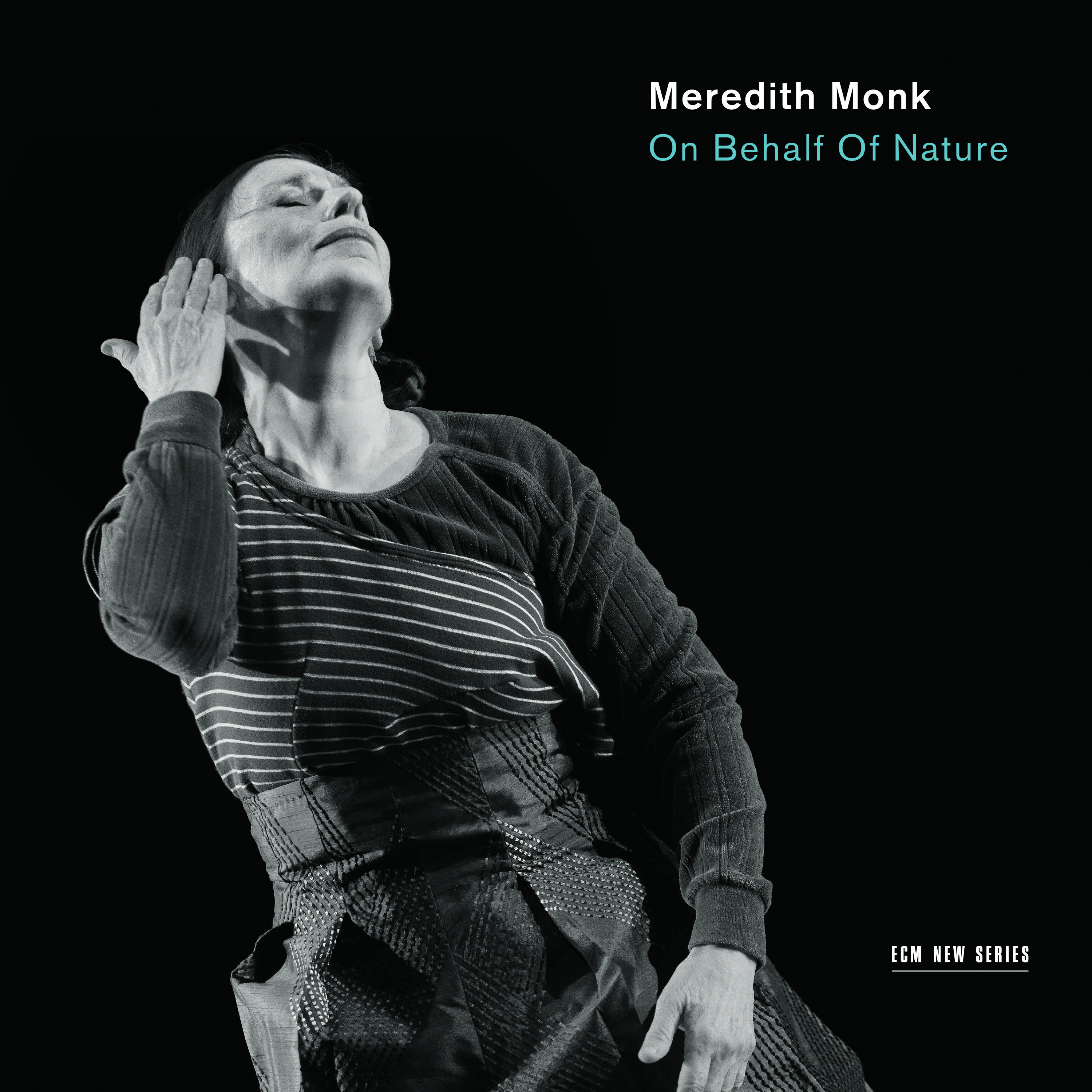
Since 1981’s Dolmen Music, Meredith Monk has contributed an integral DNA segment of ECM’s evolution as a label. But at no time in history has she felt as poignant as in On Behalf Of Nature. Tracing echoes of relevance to today’s social, spiritual, and terrestrial climate, the album is a mouthpiece for those who are voiceless, epitomized in the lone wooden flute that opens “Dark/Light 1.” As a call born of its own will to be heard, it flowers by nourishment of an egoless sun. Such can be also said of Meredith Monk and her vocal ensemble, whose own voices shape that same will selflessly, dutifully, necessarily—because opportunities to do so are dwindling more rapidly than can be articulated by breath and touch. By these signs is established a grammar that lives beyond codification, yet which is felt in the body even as it wanders into our dreams.
While the 19 offerings placed on this altar of creative sacrifice belong to the same ecosystem, Monk seems to link them to three distinct streams of consciousness. The most visceral of these is accessible in three pieces titled “Environs,” in which the fearful heart trembling at the core of a scarred earth sheds both light and darkness on injuries in which we would much rather never admit complicity. Deep yet delicate, these are about as honest as music gets.
A second stream is heard flowing through the album’s largest forests, which acclimate themselves in the prepared piano of “Ritual Zone,” the prophetic violin of “Memory Zone,” and the joyful cries of “Harvest.” Further gifts emerge in “Duet with Shifting Ground,” “Evolution,” and “Water/Sky Rant.” The latter’s harp-infused anthem of abuse, recovery, and hope is perhaps the most powerful statement Monk has ever committed to record. Each of these is a chamber of truths that have existed since the dawn of humanity, reminding us that harmony must be chosen, not expected. As by the ligaments of “Spider Web Anthem,” cohesion requires patient work and purpose by which to cultivate it.
Such connective tissue is the mantra enlivening interlinear pieces throughout. Through them flow the base elements of all life, whether natural (“Eon”) or human-made (“Pavement Steps”). Therein beats the heart of a question that cannot be spoken yet whose answer is so clear as to be anxiety-inducing. It is not the planet itself but those on it without the means to communicate their traumas across electronic signals or paper who sing. On Behalf Of Nature, then, is their stage: an album so relevant as to be worthy of beaming into outer space in the hopes of clearing a path to salvific inner spaces.
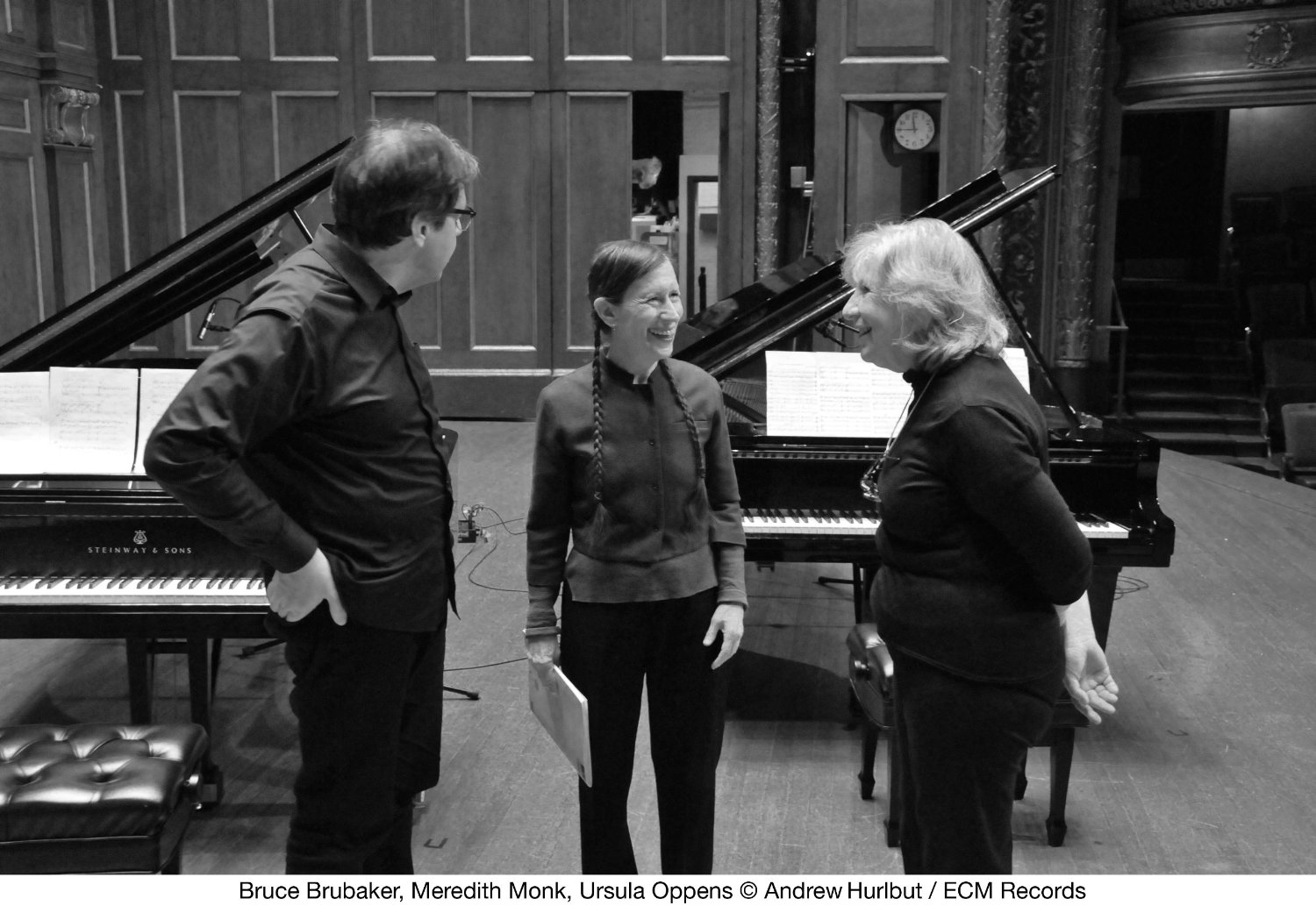
Ursula Oppens piano Bruce Brubaker piano
Recorded April 2012 at Jordan Hall, New England Conservatory, Boston, Massachusetts
Recording and editing engineer: Jody Elff
Assistant engineer: Jeremy Sarna
Project coordination: Peter Sciscioli
Score preparation: Allison Sniffin
Mastering: Christoph Stickel
Produced by Meredith Monk and Allison Sniffin
This 2014 release marks the third instance of “songs” in a Meredith Monk ECM album title, following Songs of Ascension and Volcano Songs. And yet, aside from the occasional rhythmic chant, you will find no voices here. Even so, these pieces for one and two pianos sing with as much viscereal power as any of Monk’s more well-known ensemble projects.
Representing a 35-year period from 1971 to 2006, the program seems to ask: What does a song embody? The root of the word is incantation, and the magical, ritualistic functions that meaning implies. And certainly, few descriptors could describe Monk’s output (and input) so well. Hers is a continent of generative design, an environmentally aware space in which the tactility of melody fades in deference to its intangible worlding. The real question is, then: What does a song disembody?
According to Ursula Oppens and Bruce Brubaker: everything.
Piano Songs is an album in the second person. It tells the story of your lives and mine, of anyone willing to join Monk’s sacred circle and hear the sonority of a biography unfold. In this respect, “Paris” (1972) is a highlight, for it represents the composer’s return to the piano after an intense period of concentration on the human voice. It begins innocently enough but throws canvases from windows and watches them crash to the streets below, thus breaking through an amnesic barrier toward the shedding of earthly possessions. It’s one of two solo pieces played by Oppens, who for contrast navigates the snowy streets of “St. Petersburg Waltz” (1993) as might a bird its most familiar patch of bramble. Brubaker plays two solos of his own. The 1981 “Railroad (Travel Song)” is among the more overtly programmatic selections. You can feel the metronome of the tracks beneath you. “Window in 7’s” (1986), on the other hand, is a nowhere-specific tessellation of heptatonic arpeggios.
Among the pieces written for two pianos, 1996’s “Obsolete Objects” makes for an evenly balanced introduction to this skeletal yet emotionally multifaceted soundscape. “Ellis Island” (1981) is another descriptive wonder, in which properties of water and hints of ocean brine shake the global web of personal histories as if it were an instrument. Here is the terrible yet beautiful mystery of it all, where the only life preserver you have left is the wreath of memories around your neck. “Folkdance” (1996) digs to the base of the self, clapping and chanting as if to confirm the illusion that is your body. And so, you stomp your feet on the ground, bridging traditions of an untouchable past and the immanence of an unknowable future.
And then there are three pieces arranged for two pianos by Brubaker: further transformations of impulse into form. From the triangle-turned-pyramid that is “urban march (shadow)” (2001) through the pagoda of “Tower” (1971) and on to the intimate “Parlour Games” (1988), each brings you face to face with open interpretations, each a picture connected to the next until together they mimic reality like a film.
Part of the appeal of Piano Songs is that its titles are virtually interchangeable. Not because they all sound the same, but because there is something of each in the other. For example, the synchronicities of “totentanz” (2006) might work just as well under the title of “Phantom Waltz” (1989), while the latter’s dissonance might likewise signal a dance of death. Whatever we may choose to call them, they are fragments of Monk’s soul, spun from essence to object, and from object to open breath.
If you are new to Monk, I would suggest that you start with Dolmen Music and Book of Days, if only because it is good to first love the soil, so that the diamonds will seem but one of its infinite treasures.
Meredith Monk & Vocal Ensemble Ellen Fisher, Katie Geissinger, Ching Gonzalez, Meredith Monk, Bruce Rameker, Allison Sniffin voices Bohdan Hilash woodwinds John Hollenbeck percussion Allison Sniffin violin Todd Reynolds Quartet Todd Reynolds violin Courtney Orlando violin Nadia Sirota viola Ha-Yang Kim violoncello The M6 Sasha Bogdanowitsch, Sidney Chen, Emily Eagan, Holly Nadal, Toby Newman, Peter Sciscioli voices Montclair State University Singers Heather J. Buchanan conductor
Recorded November 2009, Academy of Arts and Letters, New York
Engineers: James Farber and Paul Zinman
Assistants: Nelson Wong and Sean Mair
Editing engineer: Paul Zinman
Location Recording Service: SoundByte Productions Inc., New York
Mixed at Avatar Studios, New York by James Farber, Manfred Eicher, and Meredith Monk
Assistant: Akihiro Nishimura
Produced by Manfred Eicher
These pieces grew out of inspiration from poet Paul Celan, whose “Song of Ascents” suggested heavenly upward motion, and by extension a project to explore the sacrality of directions. Fortuitously, composer Meredith Monk was asked by artist Ann Hamilton to perform on site in Geyserville, California, where an eight-story tower with staircases in the shape of a double helix awaited Monk and her dedicated musicians. The beauty of the image, despite its live-giving implications, is that a helix has no up or down—or, rather, embodies both simultaneously—so that divinity comes to be expressed through suspension of the body.
As Monk’s subtlest assemblage, Songs of Ascension births a masterfully realized bioform. I use the adverb not lightly, because only mastery could stretch such a stable tightrope between being and non-being and walk between the two as easily as falling. To her vocal montage Monk adds string quartet, percussion, and woodwinds, for an amalgamated effect of such intimate proportions that the seemingly massive roster only serves to compress the music’s molecules into a galaxy of interpretation: it holds its shape by strength in numbers, an ethereal note inked in long before the earth dotted it on the then-blank score of outer space.
Indeed, one might trace an evolution of global life in the album’s embedded structures. Four seasonal “variations” and three so-called “clusters” are its spiritual campgrounds, from which sparks fling themselves into the night sky as the firewood settles. Songs are intoned and invoked, touched by percussion and overlapping strings, and moving in unison renderable only through total corporeal commitment. Gatherings and inner psalms blur into one another until the topography changes into air. Whether in the pointillism of “cloud code” or the ricocheting pings of “burn,” the topographic circles of “mapping” or the piercing meditation of “fathom,” a consistency of vision prevails. The instrumental passages are just as vocal, the vocal just as instrumental.
Songs of Ascension brings the atmosphere down to soil level. It speaks a continuity of earth and sky, the elemental composition of which draws notecraft from the farthest reaches of the universe, which happen to reside between our ears.
Meredith Monk and Vocal Ensemble Theo Bleckmann voice Ellen Fisher voice Katie Geissinger voice Ching Gonzalez voice Meredith Monk voice Allison Sniffin voice Sasha Bogdanowitsch voice Silvie Jensen voice Allison Sniffin piano, violin John Hollenbeck percussion Bohdan Hilash woodwinds Recorded January 2007, Avatar Studios, New York Engineer: James Farber Produced by Manfred Eicher
“War belongs to our souls as an archetypal truth of the cosmos…. To this terrible truth we may awaken, and in awakening give all our passionate intensity to subverting war’s enactment, encouraged by the courage of culture, even in dark ages, to withstand war and yet sing.” –James Hillman, A Terrible Love of War
I start with this provocative comment from author James Hillman for two reasons. First, for the way it fogs its breath over an unsettling facet of creative expression: namely, that the shape of our singing is often determined by violence. Second, because Meredith Monk’s impermanence opens with “last song,” a piece inspired by Chapter 2 of The Force of Character: And the Lasting Life, also by Hillman, in which the author writes: “By putting closure to a series of events that otherwise could run on and on, the last time is outside serial time, transcendent.” Perhaps no other statement could describe Monk’s latest ECM project more astutely. To be impermanent is indeed to transcend time, shrugging off rules like so much weight from the proverbial shoulders. The core message of Character stresses the primacy of the body in the acquisition of wisdom. In saying as much, Hillman also recognizes the value of life in precisely the moment at which it fades. Hence his take on war, which dives into the rubble of our denial and emerges with a body that is nothing if not the human experience personified.
For those of us who place ourselves outside its shadow, war would seem an impossible ideal, a reality in which utter ruin can be the only outcome. What we are so often led to forget—and on that note, I can only speak for myself—is that war is a multivalent term. The crossing of arms over contested borders may be no more fraught with tragedy than, say, the equally unstable terrain of our emotional battlegrounds. That such language has crept into the vocabularies of our internal lives is proof positive of the power of language to mold human relationships. In light of this, the act of memorializing trauma may seem a primal and universal phenomenon to those who have no investment in its implications. And yet, the process of forging an immediate conveyance of meaningful representation in the wake of death is one filled with choices, and it is these choices that keep it from merely being filed in the annals of psychoanalysis as a narcissistic reflex against loss. For although this album grew out of perhaps the most profound of losses (that of Monk’s partner Mieke van Hoek), there is much to be cultivated from the wisdom of its traumatic seeds. The music throughout this emotional document, drawn from the voice of a life unhinged, marks an auroral trajectory with its own lungs. Although a six-year gap separates impermanence from Monk’s previous ECM effort, mercy, it is filmed with lifetimes’ worth of residue.
Condensed from the larger synesthetic composition of the same name, as we encounter it here impermanence is far from incidental to its source. Here, Monk branches out from her usual diatonic trunk into more chromatic foliage. The staples of her craft are dutifully maintained: cyclical patterns and semantic dissolutions, keyboard parts that lumber like human figures, and a suitable array of extended techniques. The ordering of pieces suggests a structure that may crumble at any time yet which is all the more resilient for its empty spaces. From the clattering metal of “disequilibrium” to the ethereal rounds of “passage,” there is a clear lingual flow to be distinguished. Some of the sounds, such as can be found in “sweep 1,” are organic and vulnerable, while others, such as the clattering of “particular dance,” are picked apart like ancient automatons. Ultimately, the reverberations of the digital recording process lend such music a parable quality. Rather than being didactic, the lessons to be learned have more to do with silence than with moral truths. Our habit of reading prescriptive meanings into the human archive is an endless circle, an offering of shadow in a realm without light. Here, at least, we can cast aside such shackles and take comfort in the liminal.
Monk humbles me with her consistency in engendering new experiences. This album is a fine example of her indomitable generative spirit. This may very well be her textually richest album thus far, though it has its fair share of gracious confusion and impossible-to-complete sentiments. Her aphasia is distinctly her own, and I believe its frequency serves to interpolate speech into the human body. As such, it is anything but narrative. As with so much of Monk’s (sub)textual work, every semantic concept is consistently wound and unwound, so that by the end the word’s immediate power is at once erased and underlined. Much like the disc upon which they have been digitally imprinted, these songs epitomize the album’s title. As concepts, they are dead the moment they are uttered. As utterances, they are reborn as concepts the moment they are silenced.
Meredith Monk voice Theo Bleckmann voice Allison Easter voice Katie Geissinger voice Ching Gonzalez voice Allison Sniffin voice, piano, synthesizer, viola, violin John Hollenbeck voice, percussion, melodica, piano Bohdan Hilash clarinets
Recorded March 19/20, 2002
I regularly have dreams about flying. Said ability never comes, however, without focused and sustained effort on my part. In order to achieve flight, I must push against the air with my arms, gaining height ever so incrementally—sometimes losing altitude on the downswing—until I am in a position to navigate obstacles such as buildings, trees, and power lines. If these dreams had a soundtrack, it might sound something like mercy, for here is a space in which the human voice soars, to be sure, but not without the utmost discipline on the part of its performers. The “rudimentary” nature of this album serves to accommodate its broader wingspan, thereby widening our view to that much greater distance. As the booklet contains no liner notes, we become integral to the narrative evolution of what passes through our ears.
Created in collaboration with artist Ann Hamilton (whose work I’ve always felt begins and ends with the body, in both its implicit and fully realized forms), mercy is as much a visual composition as it is an aural one. Its scoring is modest: anywhere from one to six voices are accompanied throughout by varied clusters of percussion, piano, and clarinet. In spite of the somewhat scattered programming, most of the pieces have a partner or can be grouped with others. The two “braids” and “leaping song” that open the album, for instance, form a tight weave of likeminded vocal information. Monk runs down their helical spirals with such organic potency that when a piano suddenly makes its presence known, its jazzy syncopation in the left hand almost comes as a shock. Throaty squeals meanwhile ascend toward an aphasic finish, leaving instruments to dance around a private ceremonial fire.
From gong-like meditation to whispered desperation, the psychokinetic interludes that are the three “lines” use more diffuse gestures to express miniscule things. These are not the artist’s marks seeking to define space against non-space. They are the projections of thoughts as vibrations. To “line 3” Monk adds a “prisoner,” whose voice is echoed from a variety of distances as the clink of knuckles on jail cell bars is heard, thus providing the album’s eeriest moments. “doctor-patient” is driven by piano and mallet percussion. Through a haze of illness and infirmity, the body’s internal condition resolves into focus. As the doctor-patient relationship stems from language, the former translates the latter’s internal melodies through external conjugations. In essence, the doctor mimics the ailment in question, hence his echoing of the patient’s literal cry for help. “woman at the door” transcends communicative barriers with the possibility of silence. Slight dissonances operate rather like a hearing test, eventually unwinding into an alluring cascade of voices, leaving us with a solitary invitation: “Come in, come in.”
As I listen to the final track, “core chant,” I am wont to ask myself: What chant? The core of what? Perhaps our first clue into either query is the seemingly abrupt ending, the incompleteness of which is rendered inconsequential, for without even the most basic morpheme at one’s disposal the pantheon of meaning begins to crumble in the face of more immediate auditory signatures. In the end, the performers’ humility is the most vital dynamic of the music in question, personal and steadfast in light of its possible resolution.
Monk’s is not a world in which the voice is primary but rather a voice in which the world is primary. Her centrality ensures that she is not alone, spared the burden of carrying the others, while also making her utterances the most visible. The variety of instrumental arrangements represented on mercy shows us some of the more tangible aspects of her compositional process, balancing beautifully with the voices’ less mechanical nature. “urban march (shadow),” for one, features an almost harp-like synthesizer, while its exuberant cousin, “urban march (light),” boasts enthralling percussion and ecstatic chanting. Just as the body remains unseen in the recorded voice, so too does the instrument betray its own biology through the unleashing of its sound. Of course, the voice is also an instrument, and nowhere more so than in the rhythmic mosaic of “masks,” where breath alone imparts the voice its defining shape.
My flying dreams typically end the same way. The fatigue becomes overpowering and I must seek solid ground. Yet I always seem to land in a high place. Rather than empowering me, this humbles me to the landscape I have just traversed, reminding me of its insurmountable vastness, which is always greater than the sum of my actions. So, too, do we end mercy on a higher place from where we began. And is that not one possible outcome of mercy? Does compassion always leave one elevated? Fortunately, we are given the freedom to answer such questions differently every time we listen.
Meredith Monk voice Katie Geissinger voice Allison Easter voice Dina Emerson voice Harry Huff piano Nurit Tilles piano
Recorded July 1995, Clinton Studios, NYC
Engineer: James Farber
Produced by Tina Pelikan
The Random House Dictionary defines volcano as “a vent in the earth’s crust through which lava, steam, ashes, etc., are expelled, either continuously or at irregular intervals.” In spite of human fears, the volcano is vital to the earth’s formation, sculpting the very landscapes we inhabit. For Meredith Monk, it would seem more importantly a source of fertility, and it is from this fertility that she opens herself to the generative spirit that infuses the world as a living organism. In this sense, she vocalizes a point of continuity between herself and listener, between the illusions of recorded sound and the illusions of physical bodies.
Like their referent, Monk’s Volcano Songs (1993-94) reveal the earth’s hidden forces, at once violent and graceful, as they are embodied in the human form. Fissures in the great cosmic wheel release their breath in chant, foregoing the detriment of words in search of untinctured expression. Therein lies the great irony of this music, and of the earthly condition that engenders its existence: namely, that in order to express detachment one must hold steadfastly to the ephemeral utterance as a point of departure. Hence the uncanny splitting of the self we find between Monk and Katie Geissinger in the duet portions of the Volcano cycle (for indeed, were I unaware of the album’s personnel, I might have thought that Monk was overdubbing herself). Undulating breaths open into distant cries, like shepherdesses reaching deep into their lungs to lure their spiritual flocks out into the open. For all their microtonal friction, grunting expulsions, and sustained laments, these songs cut through the darkness like lightning bolts in slow motion. Of note are the guttural “Boat Man” and the playful “Skip Song.” In these, Monk’s mimicry is at its most humble, fleshing out evocative characters and histories with the most minimal of palettes. And how can one resist the siren-like ascents and delicately applied throat singing techniques of “Old Lava,” with its appropriately languid crawl, dripping like molten rock?
Although New York Requiem (1993), for piano and voice, profoundly intersects with the AIDS epidemic and is, says Monk, “really about all kinds of loss,” for me it is also about gain: of awareness, of situatedness in one’s sociopolitical surroundings, and perhaps even of silence. By the latter, I mean to imply that, through the art of wordless singing (for what requiem is without a text?), Monk has caressed the contours of mourning with a uniquely feathery touch so as not to disturb the memories being circumscribed. It is a slogging, diaphragmed journey in which narration must be forged rather than found. A truly heartfelt composition matched by an equally committed performance.
St. Petersburg Waltz (1993) is a solo piano piece that peers back into Monk’s genealogical roots. Falling with the solemnity of snow on wide streets and narrow alleys, its columnar gestures and understated motives were “inspired by the idea of a place rather than the place itself.” Thus is the complex web of genetics and circumstance delineated only vaguely, a ragged film reel on its last revolution, its swan song fading like a credit roll in the throes of this digital age. We find in its preservation an archival quality that speaks of a history beyond the confines of personal reflection.
Three Heavens and Hells (1992) sets a poem of the same name by an 11-year-old Tennessee Reed. In a humble quartet of voices, Monk and her sistren unravel a rather brief splash of words into a vaster ocean of implications. They open with an invocation:
There are three heavens and hells
Every breath seems to revel in the words, underscoring the unity of the flesh that binds them in worldly care. Over a precise macramé of chants and variations, the voices continue:
People, heaven, and hell Animal, heaven, and hell Things, heaven, and hell
Reed tellingly uses the word “animal” in the singular, thereby planting the text into a more unified field of impression and evocation. A deeper exploration of each word ensues, where “People” are mournful, pitying; “Animal” abounds with calls of the wild; and “Things” become externally convoluted yet internally ordered. Latched as we are onto the lure of meaning, a single question hangs over us:
What do the three heavens and hells look like?
This unreachable dilemma constricts our understanding of the piece’s thematic core, and renders any possible answer a barrier to enlightened solutions. In the end, we are left with:
Heaven, heaven, heaven Hell, hell, hell
And as we flounder in the wake of our own attentions throughout this 21-minute piece, we come to realize that the act of listening doesn’t always mean being a receiver, that it can just as easily suspend the mask of the questioner from our attentive ears. On a side note, the strong rhythmic breathing throughout this piece plays a role not unlike beatboxing in modern hip-hop, and puts me in mind of Björk’s Medulla-era vocal menageries—which makes me curious as to the contemporary shadows that might be hovering at the edges of either artist’s ever-evolving craft.
The album ends intimately with two of Monk’s Click Songs (1988). These self-styled “duets for solo voice” further expand upon the refracted aesthetics through which the album’s opening seeps, thereby calling our attention to the finality of subjecthood and the selfish desires that are its attendants.
Compared to Monk’s six previous ECM New Series efforts, Volcano Songs is perhaps the most intimately recorded. Microphones seem fully embedded in these voices, subtly processed for reverberant effect. Ultimately, I feel that one gets out of this music only what one is willing to lay at its feet. It is both the beauty and the tragedy of the human voice: in pulling at the threads of our emotions, we must undo one thing to communicate another, so that by the end we have forgotten where we started, inhaling an idea that may very well outlive us. And just as a volcano spews forth its scalding breath into the atmosphere, so too must we eventually exhale, licking the fragile layer that separates our survival ever so delicately from the blank space beyond. The magic of Monk’s music is that it offers a glimpse of that other side, in terms that we can relate to.
<< Louis Sclavis Sextet: Les Violences de Rameau (ECM 1588)
>> Erkki-Sven Tüür: Crystallisatio (ECM 1590 NS)
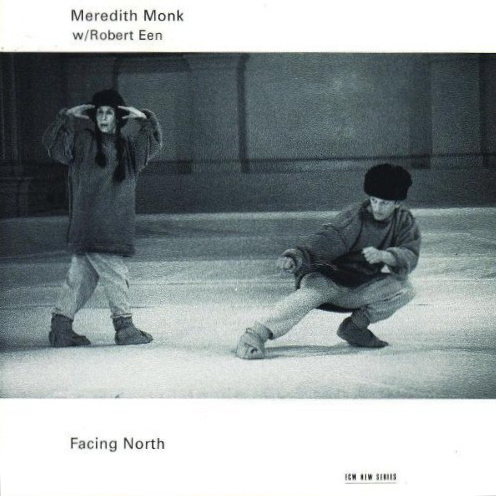
Meredith Monk voice, piano, organ, pitch pipe Robert Een voice, pitch pipe
Recorded April 1992, Rainbow Studio, Oslo
Engineer: Jan Erik Kongshaug
Produced by Manfred Eicher
While working on her opera Atlas during a residency in Banff, Meredith Monk found herself drawn to the Canadian wilderness just outside her window. Perhaps inspired by the stillness of snow and the silent steps of animals pressed into it, Monk developed Facing North out of a desire to evoke that same profound stasis, an opportunity to reconnect to something taken for granted. “As I worked,” she writes, “I tried to evoke the elemental, bracing clarity of the northern landscape. I realized then that ‘north’ is also a state of mind.” Monk’s multilayered compositions are always a state of mind, but Facing North is especially potent in this regard. The piece is distinguished by its dual landmarks. Two “Northern Lights” sections are played on pitch pipes and seem to function as invocations. Acting as artificial threads, they translate the breath into a vocal sound, substituting tracheae with factory-honed tubes and vibrating metal plates. Like the ritual sweeping of a temple, every strand seems to clear the stage for arrival, leading a modest procession into sacred space. The two “Long Shadows” sections, however, are vocally dominant, describing the ending of one journey and the beginning of another. These both upset and grant structure to the piece as a whole. Other movements bristle with creative fervor. “Chinook” is a medley of voiced postalveolar fricatives that circles around itself like two flies in the morning light, unable to figure out who is chasing whom. “Keeping Warm” is sung in short bursts. We hear movement, implied footsteps, some slapping of the body. It is rhythmic but not a dance; it is survival amid the elements. Sure to please is “Arctic Bear,” an open game of cries and hiccups, darkened by Een’s distant howls. In spite of its icy atmosphere, Facing North is equally about arid interiors drenched in endless daylight, illuminating the delicate cartography of the body and its relationship with the life-giving (and death-bringing) earth.
Two shorter selections round out the disc. First is a scaled-down version of Vessel: an opera epic. At its center lies the story of Joan of Arc, while at its periphery spreads the story of a landscape divided by human contact. Though it may not seem like it when caught up in the moment, Monk roams through a great number of techniques throughout this piece. An organ provides a lush backdrop to her gallery of overdubbed stuttering, fluid calls, playful cries, dirges, lullabies, overtone singing, flying leaps, and ululations. Last but not least is “Boat Song,” excerpted from the opera Recent Ruins. This is one of those quintessential Meredith Monk moments that is at once familiar and mysterious. It is the enigma of what lives and breathes inside us, veiled in darkness and in silence, yet given voice in the outer world.
Like so much of Monk’s music, everything on this album was conceived for the stage. As such, it is rife with spatial possibilities, limited only by the listener’s imagination. The melodies are extremely organic, following a path that existed long before there were feet to press it into being. Stepping into this album is like stepping into another dimension in which the same objects exist around us, seemingly unchanged, yet from which we can never completely extrapolate a sense of purposeful belonging. We may find a piece of ourselves floating above the voices of an entirely descriptive universe, yet even as we fly off into those lands where the sun shines brightest and longest, we can never find ourselves without listening to the endless nights of what our hearts prefer.
<< Keith Jarrett: Vienna Concert (ECM 1481)
>> Heiner Goebbels: La Jalousie (ECM 1483 NS)





 Between Sound and Space: ECM Records and Beyond