

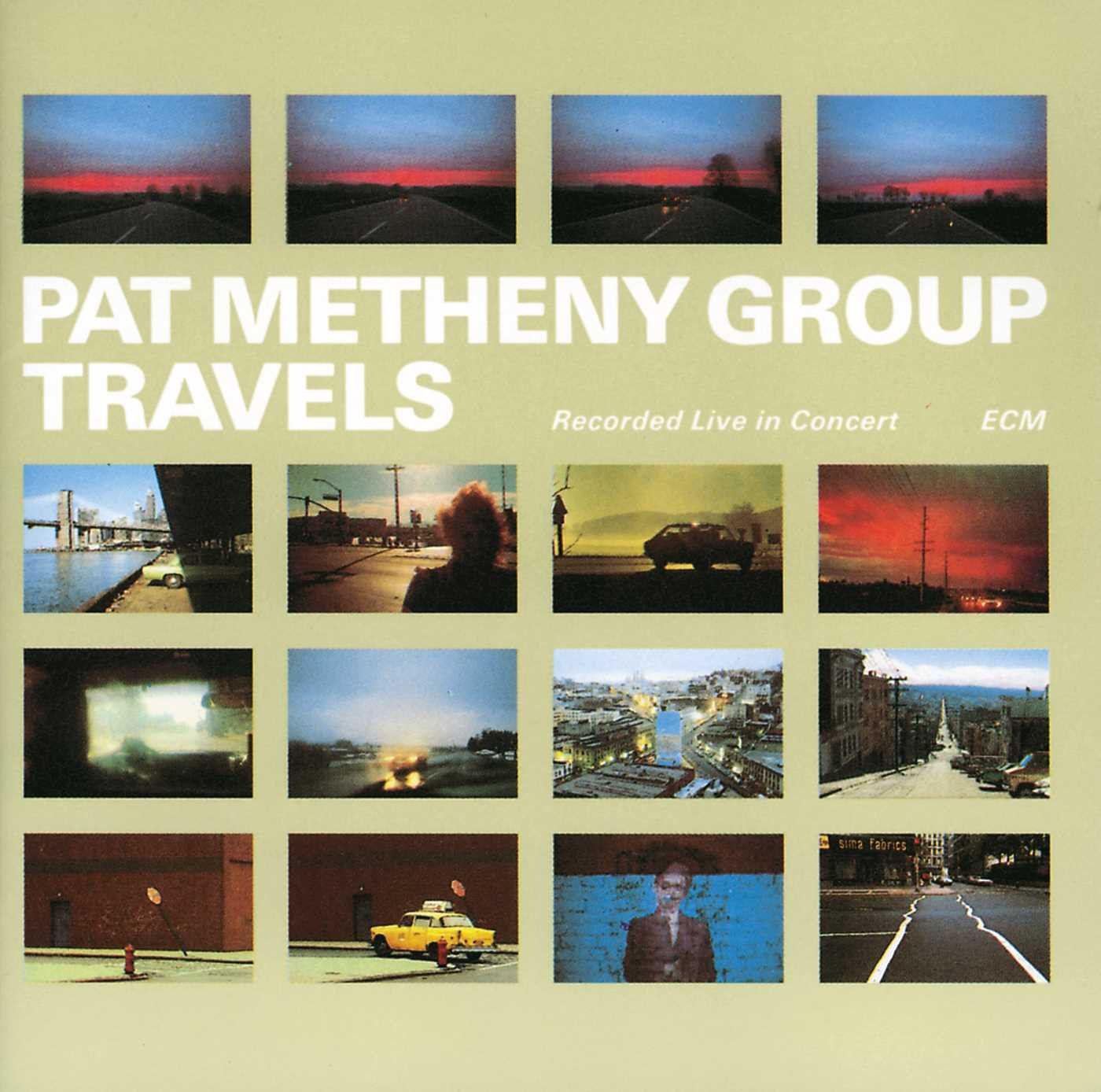
Pat Metheny Group: Travels (ECM 1252/53)

Pat Metheny Group
Travels

Pat Metheny guitars
Lyle Mays piano, synthesizers, organ, autoharp, synclavier
Steve Rodby basses
Dan Gottlieb drums
Nana Vasconcelos percussion, voice, berimbau
Recorded July, October, and November 1982
Engineer: Randy Ezratty
Produced by Pat Metheny and Manfred Eicher

If you’ve ever desired a Pat Metheny Group greatest hits album, then Travels is for you. Compiled from the group’s touring activities in 1982, this double set is a must-have. From the glittering lotus of melody that is “San Lorenzo” to the even more effusive “Phase Dance,” the requisite classics are all here. We also get a curtailed, though no less epic, version of “As Falls Wichita, So Falls Wichita Falls,” which here draws out like a long cinematic fade and throws the windows open wide to the band’s boggling sonic purview. And one can hardly help but swoon from the dizzying heights reached by this live version of “Are You Going With Me?” Here the studio version seems but a memory on the path to glory, and finds exuberant life in what is perhaps Metheny’s best solo on record. An absolute affirmation.

Yet the album’s true value comes in the handful of songs exclusive to it. Through these we encounter softer sides of the PMG, each burnished like a different shade of leather. “The Fields, The Sky” is an outstanding place to start. Vasconcelos’s unmistakable berimbau threads a supremely melodious backdrop, while Metheny is at once distant and nearby, winding a slow and organic retrograde around the fiery center within. Vasconcelos is also the voice of “Goodbye,” a forlorn piece of sonic stationery across which Metheny inscribes a most heartbreaking letter toward a ripple of an ending. This pairs nicely with the title track, a laid-back photograph of Americana that is like a rocking chair on the back porch: lulling, and affording an unobstructed vista. Similar strains await us in “Farmer’s Trust,” a slow plunge into an ocean of undriven roads gilded by the whispering of baby birds and the rustling of the leaves that hide them, and in the smoothly paved blacktops of the synth-driven “Extradition” and “Song for Bilbao.” Each of these creeps along like wispy clouds over badlands, spun by keyboardist Lyle Mays into sunset. But it isn’t all drawl, as drummer Dan Gottlieb proves in the invigorating “Straight On Red,” throughout which he provides the perfect springboard for the masterful dialogues of Metheny and Mays.

Travels are what the PMG are all about, and the selfsame album shows us the collective at its finest hour. Those hearing the PMG for the first time will want to start with the studio sessions—and especially Offramp—from which Travels was in part drawn. That way, one can appreciate the enthusiasm of the crowds, and get at least a taste of what it must have felt like to be there among them. With a depth and cleanliness of sound that no band can match, the PMG were a force to be reckoned with, but also one so welcoming that reckoning need never have applied. Theirs is a space where nature and nurture shared the same pair of lungs.

Should posterity ever look back on our age as one of overconsumption, warmongering, and greed, one listen to Travels will prove to them that in our hearts we continued to cherish all that is good and true.

<< Dino Saluzzi: Kultrum (ECM 1251)
>> John Surman: Such Winters of Memory (ECM 1254)

Pat Metheny Group: Offramp (ECM 1216)

Pat Metheny Group
Offramp

Pat Metheny guitar, guitar synthesizer
Lyle Mays keyboards
Steve Rodby basses
Nana Vasconcelos percussion, berimbau, voice
Dan Gottlieb drums
Recorded October 1981 at Power Station, New York
Engineers: Jan Erik Kongshaug and Gragg Lunsford
Produced by Manfred Eicher

When I was a freshman in high school, our science teacher brought us outside one day to observe a partial solar eclipse. Though he had set up a telescope, provided us with special glasses, and prepared a lecture, my eyes were glued to the ground. As anyone who has experienced a solar eclipse knows, the sun’s light pocks the shadows like Swiss cheese, splashing the earth with countless little crescents of a half-eaten sun.


Eclipse shadows (photo source: Ketchum family blog)

Every note of Pat Metheny’s heavenly soloing on Offramp is its own crescent. His is a talent spun from sunlight, and one that might damage the eyes were its full force to be unleashed at once. Thankfully, we need no special equipment but our own ears to appreciate the intensities he brings to this immortal PMG date, which after the global reach of As Falls Wichita… expanded the compositional and technical prowess of Metheny and keyboardist Lyle Mays to deeper, more serpentine caverns of experimentation.

The Synclavier-enhanced calls of “Barcarole” are the album’s birth cries, each a punctilious footstep into the greater semantic complexities of “Are You Going With Me?” This smooth ride through sun-kissed plains drips with the tears of an unrecoverable past, Metheny’s guitar bellowing like a human trumpet keening at the speed of travel. “Eighteen” inoculates the proceedings with the livewire exuberance in which these musicians so deeply excel. Metheny is light on his feet and infinitely careful about his twists and turns, infusing each with that unmistakable audible grin. Dan Gottlieb kicks up a dust storm in the title song, which also features Metheny in one of his wildest excursions yet. Fractured pianism, an explosive glockenspiel, and Steve Rodby’s fantastic ground lines paint just the right ambiance to allow Metheny to uncork a bottle of some unrepeatable tincture that he seems to have been saving for this very occasion. After this flip and a half, “James” comes across as an acrobatics of its own kind, gracing our cochlea with heartwarming electricity, leaving the wispy skies of “The Bat Part 2” as our only postcard.

Yet all of the above combined barely tickles the underbelly of “Au Lait,” which still stands as Metheny’s most perfect statement. Though something of a carnivalesque on the surface, complete with rolling snare and haunting vocals courtesy of Vasconcelos, one also feels sung to of something far more serious. Whatever that might be, we experience it in real time, every wordless call a way station to where it all began. Metheny is as transcendent as he will ever be, each swing more harmonic than the last over the Joe Hisaishi-like touches from Mays. Oracular and airborne, this is a space we never wish to leave. And on the inside, it never does.

Metheny is a skillful writer who, with heart in place of pen, takes a kernel of an idea and draws every imaginable root before starting in on the leaves. Like a solar eclipse, such music comes all too rarely in any given generation. The beauty of Offramp is that it always feels like the first time. Is your turn signal on yet?

<< Steve Reich: Tehillim (ECM 1215 NS)
>> Ulrich Lask: Lask (ECM 1217)

Pat Metheny & Lyle Mays: As Falls Wichita, So Falls Wichita Falls (ECM 1190)

Pat Metheny
Lyle Mays
As Falls Wichita, So Falls Wichita Falls

Lyle Mays piano, synthesizer, organ, autoharp
Pat Metheny electric and acoustic 6- and 12-string guitars, bass
Nana Vasconcelos berimbau, percussion, drums, vocals
Recorded September 1980 at Talent Studio, Oslo
Engineer: Jan Erik Kongshaug
Produced by Manfred Eicher

Listening to any Pat Metheny album for the first time is like finding a long-forgotten photograph, interleaved in a dusty book marked to the brim with the marginalia of a past life. And just when one thinks that feeling might dull over time, Metheny whittles from the vast block of wood that is his genius a masterpiece like As Falls Wichita, So Falls Wichita Falls, on and through which the Missouri-born guitarist begins to expand his reach to “global” proportions. His Instrument—with a capital “I”—and his playing of it define supernovas of emotional distance in the most compact lines. From these he unspools spectrums upon spectrums.

Where many of his albums might open with a shout of joy, a heavy acoustic rhythm, or a sweeping grandeur, the 20-minute title track’s genesis lies in the ambience of a field recording. We hear a crowd, a voice chanting taals, the rasp of shakers. Thus (dis)located, Metheny begins to map this human web through the drone of Lyle Mays. Only then, from thunderous rumblings, does his slack guitar take our hand and lead us through the crowds. With a drum machine at his side, Nana Vasconcelos clothes us in local colors. The electronic accents and attentive sense of evocation evoke Steve Tibbetts as the band coalesces into a shimmering, autoharp-laden catharsis. Riding a leviathan of strings, a voice recites numbers, as if in code. With the sounds of children at play still in our ears, the upbeat “Ozark” crests into the wave of extroverted Americana that is Metheny’s standby. Mays at the keys makes this stage, gliding effortlessly along a landscape tessellated by a rainbow of impressions. “September Fifteenth” is as intimate as the last is expansive, a prayer for Bill Evans, who left us on the selfsame date while the album was in session. The pianism of Mays (for whom Evans was a formative influence) could hardly be more fitting. To be sure, it glitters like the rest, only this time with the beads of falling tears. The title of “It’s For You” lends delight to the cover montage. If its colorful combination of sounds is meant to brighten our mood after the mournful turn that precedes it, then it certainly does the trick. Metheny’s signature electric traces in silhouette every footprint leading into the mystical shores of “Estupenda Graça,” where he sketches for us a more diffuse version of street on which we began.

Some have remarked on the “regrettable” cover art and the title that brands it, but I for one believe it to accurately illustrate Metheny’s process. Making or receiving a phone call is a form of travel in itself, for those precious moments of communication seem to collapse the two spaces that both speakers inhabit. And which of us has not, when experiencing something sonically profound, held up a phone so that the person on the other end could get some sense of the experience? “It’s For You” isn’t just a catchy phrase; it’s a thank you for the listener.

<< Jack DeJohnette’s Special Edition: Tin Can Alley (ECM 1189)
>> John Abercrombie Quartet: M (ECM 1191)

Pat Metheny: 80/81 (ECM 1180/81)

Pat Metheny
80/81

Pat Metheny guitar
Charlie Haden bass
Jack DeJohnette drums
Dewey Redman tenor saxophone
Michael Brecker tenor saxophone
Recorded May 26-29, 1980 at Talent Studio, Oslo
Engineer: Jan Erik Kongshaug
Produced by Manfred Eicher

With 80/81, Pat Metheny took one step closer to his dream of working with The Prophet of Freedom (a dream he finally achieved with 1985’s Song X), and what better company than Coleman alumni Charlie Haden and Dewey Redman, both fresh off the boat of Keith Jarrett’s newly defunct American Quartet and both welcome additions to the extended Metheny family. Along with the technical mastery of reedman Mike Brecker and drummer Jack DeJohnette, plus a dash of post-bop spice, the result was this still-fresh sonic concoction. The atmospheres of the opening “Two Folk Songs” invite us with that expansive pastoralism so characteristic of Metheny. This makes Brecker’s highly trained yet raw stylings all the more marked, bringing as they do a sense of presence that explodes into a million pieces. Metheny’s benign sound catches at the threshold of perfection with every turn of phrase, allowing Brecker fiery bursts of abandon. DeJohnette throws on a log or two with his rocketing solo, while Haden wipes the slate clean with shadings of his own. Metheny shows off his unparalleled command of two-string harmonies, fading on a lightly skipping snare. This feeling of perpetual motion lingers throughout the title track. Content in sharing the revelry, Metheny relays to Redman who, though he may not fly as high, emits no less intensity in his groove. “The Bat” gives us a minor-keyed shadow of “I’ll be Home for Christmas” before diving headfirst into Coleman’s “Turnaround.” This trio setting boasts inventive melodies and a plunking solo from Haden. “Open” is, suitably enough, the freest track on the album, emboldened by trade-offs between Redman and Brecker, while “Pretty Scattered” dances more lithely with John Abercrombie-like exuberance. A ringing high from Metheny laser-etches this track into our memory. Balladry abounds in “Every Day (I Thank You),” one of his most gorgeous ever committed to disc. This is music that grins even as we grin, and shines through the darkest cloud of a Midwestern storm. Metheny ends alone with “Goin’ Ahead.” This breath-catching piece works its farewell into our hearts with every suspended note, effortlessly walking the beaten path of all those souls who have traveled before, so that those yet to be born might know where they come from, and to where they might return.

Like much of what Metheny produces, 80/81 is wide open in two ways. First in its far-reaching vision, and second it its willingness to embrace the listener. Like a dolly zoom, he enacts an illusion of simultaneous recession and approach, lit like a fuse that leads not to an explosion, but to more fuse.

<< Bengt Berger: Bitter Funeral Beer (ECM 1179)
>> Corea/Burton: In Concert, Zürich, October 28, 1979 (ECM 1182/83)

Pat Metheny: New Chautauqua (ECM 1131)

ECM 1131

Pat Metheny
New Chautauqua

Pat Metheny electric 6- and 12-string guitars, acoustic guitar, 15-string harp guitar, electric bass
Recorded August 1978 at Talent Studio, Oslo
Engineer: Jan Erik Kongshaug
Produced by Manfred Eicher

Pat Metheny is one of those rare artists whose virtuosity is so fluid that it is no longer a necessary lens through which to view his music. Despite the 43 strings at his disposal for this fourth ECM outing, Metheny opts for pure expanse over density. While his first three projects found him fronting equally captivating support, here we see the Missouri native charting heretofore-unrecorded autobiographical depths that remain as resonant as they ever were.

New Chautauqua is bookended by two travel diaries. The title opener cracks like a morning egg onto a sizzling griddle. Here, as throughout, we find an entire desert compressed into a single grain of sand, needing only the microscope of Metheny’s meticulous syncopations to make our way through its staggering terrain. At the far end of the tunnel is new life lit by “Daybreak.” Additional guitars and bass ooze with optimism in this divided smile, holding fast to the idea of—but never the physical need for—a destination.

Along the way, we encounter a string of contemplative rest stops, each the trail marker of a limpid night. Every verse of “Country Poem” makes for a fitting prelude to the diptych of “Long-Ago Child/Fallen Star,” in which the 15-string harp guitar dialogues with an open slide in the lead. Such delicacy can only be drawn in negative space, using pigments of regret and joy in equal measure. A heavy pause inhales deeply before expelling its acoustic splendor, hovering over arpeggiated flowers like a silent and thoughtful bee whose days are numbered, but whose memory lives on through a psychological pollen of sorts that cross-fertilizes vaster, less visible pastures. “Hermitage” might as well be the album’s title, so thoughtful are its steps, each a point along a circle of plot and resolution. Yet the needle in the New Chautauqua haystack is “Sueño Con Mexico.” Threaded by an acoustic ostinato, around which Metheny gilds ornamental embraces, its unyielding grace never fails to unhinge. It has the entire world’s natural cycles in its purview, turning as might an eddy in an April stream.

Metheny’s is a highly refined world that is as loose as it is exacting, written in the kind of polished script that can only come from a musical path forged through love of communication. Among decades of varied output, this stands as one of his most vivid sonic postcards for the yet-to-be.

<< Azimuth: The Touchstone (ECM 1130)
>> Walcott/Cherry/Vasconcelos: CODONA (ECM 1132)

Pat Metheny Group: s/t (ECM 1114)

ECM 1114

Pat Metheny Group

Pat Metheny 6- and 12-string guitars
Lyle Mays piano, oberheim synthesizer, autoharp
Mark Egan bass
Dan Gottlieb drums
Recorded January 1978 at Talent Studio, Oslo
Engineer: Jan Erik Kongshaug
Produced by Manfred Eicher

There’s no mistaking a Pat Metheny album, and along with running mates Lyle Mays, Mark Egan, and Dan Gottlieb, the experience is unforgettable. From its inaugural moments, the group’s self-titled debut overflows with radiance. Ironically, this was one of the last PMG albums to cross my ears. During my first listen, the seamless combination of guitar and keyboard on “San Lorenzo” in its original guise was enough to show what I’d been missing, for clearly it had already kicked up the ECM ethos up a notch or two. This quiet revelation is further enhanced by the synth lead, gently skating its way across a surface that glitters with an artfully placed autoharp (which presages the sound of Metheny’s Pikasso guitar). Egan’s weighty but smooth bass works magic through the unmistakable lyricism of Mays’s pianism as both are swept favorably along by Gottlieb’s foamy breakers. And there is Metheny himself, whose own waves scorch the shorelines of our expectations with fragrant sunset. There is much to be found here in the way of timeless material, such as “Phase Dance,” another formative cell of the PMG canon. Buoyed by a seesawing bass, effortless soloing from Metheny and Mays scintillates over tight drumming. The wide open spaces of “Jaco,” named for the bassist and early collaborator Jaco Pastorius, veer our attention to a savvy and vigorous funk from which Metheny spins his web with both the grace of a ballerina and the raw emotive power of a blues guitarist. The following tune, “Aprilwind,” is as elegiac as the previous is jubilant. This solo guitar lozenge, wrapped in bittersweet introspection, proves a brief medicinal corrective to the positively acrobatic “April Joy.” A dream within a dream, it awakens our senses to a life renewed. But perhaps none is more uplifting than “Lone Jack,” in which an upbeat narrative flair and superb ground line make for a perfect sling with which to hurtle Metheny’s flames for one arousing final lap around the firmament.

Metheny’s sound has a bright and fluid posture that never fails to work its way into our hearts. No matter what mood we are in before pressing PLAY, we can always be sure of finishing with a smile. This is life-affirming music that stays true to itself no matter what the weather. One sometimes speaks of “desert island discs”—i.e., albums that are indispensable in our listening lives. This is beyond that, for once we hear it we have it with us always.

<< Tom van der Geld and Children At Play: Patience (ECM 1113)
>> Keith Jarrett: My Song (ECM 1115)

The Gary Burton Quartet with Eberhard Weber: Passengers (ECM 1092)

ECM 1092

The Gary Burton Quartet with Eberhard Weber
Passengers

Gary Burton vibraharp
Pat Metheny guitar
Steve Swallow bass guitar
Dan Gottlieb drums
Eberhard Weber bass
Recorded November 1976 at Talent Studio, Oslo
Engineer: Jan Erik Kongshaug
Produced by Manfred Eicher

Gary Burton’s Passengers has it all: its frontman’s incomparable mallets, Dan Gottlieb keeping the beat, the unmistakable bass of Eberhard Weber paired with the equally unique stylings of Steve Swallow, the fluid fingers of guitarist Pat Metheny (who would soon go on to front his own super group with Weber and Gottlieb), and the all-important bow of ECM’s attentive production. Not enough to whet your appetite? All the more reason to buy it.

Chick Corea’s “Sea Journey” opens with the floating exuberance that Burton carries off like no other. Weber pulls out all the stops here, proving to be perfect complement to Burton’s sound. A stunning piece of work with a heightened groove-oriented trajectory. This is followed by three Metheny compositions. In the subtle ballad “Nacada,” vibes rest on a gentle surface tension of flowing bass, guitar, and brushed drums. “The Whopper” locks into more upbeat strides. Weber’s bass is as bright and attractive as it gets, while Metheny’s solo dances on a pinhead. Listeners will recognize “B & G (Midwestern Nights Dream)” from his seminal Bright Size Life, its fractured rhythms maintained beautifully here. The quiet background supports a glowing solo from Weber, not to mention another from Metheny himself. “Yellow Fields” (Weber) is another exuberant number, and features the album’s most incredible vibe work. The bittersweet farewell of Swallow’s “Claude And Betty” contorts its hands in shadow puppets, backlit as if by a sad and lonesome dream.

Mindfully recorded and expertly executed, the melodies of Passengers come alive with unpretentious joy. The synthesis of players forms a palette in the truest sense, its colors already artfully arranged before they are ever mixed and applied to canvas. An essential addition to any Burton library, and a must-have for any Weber fan looking to complement his brooding, handsome meditations with something more uplifting.

<< Keith Jarrett: Staircase (ECM 1090/91)
>> Jan Garbarek: Dis (ECM 1093)

Pat Metheny: Watercolors (ECM 1097)

1097 X

Pat Metheny
Watercolors

Pat Metheny guitars
Lyle Mays piano
Eberhard Weber bass
Dan Gottlieb drums
Recorded February 1977 at Talent Studio, Oslo
Engineer: Jan Erik Kongshaug
Produced by Manfred Eicher

From the opening strains of Pat Metheny’s second album, we immediately know that we have a calming yet powerful journey ahead of us. The present company—among which keyboardist Lyle Mays, a Pet Metheny Group fixture, makes his first appearance—renders his characteristic combination of form and style into an instinctive wash of comfort. Mays’s pianism proves the perfect complement to the guitarist’s untainted sound. Just listen to the way he buoys the music in the opening title track, and his fluent solo in “River Quay,” and you will hardly be able to imagine the music without him. We get a lingering look at Metheny’s own abilities in “Icefire,” in which he solos on a cleverly tuned 12-string that lobs between solid chords and higher callings. Midway through, the music melts into its second titular half, flowering in a cluster of Ralph Towner-esque harmonics. “Oasis” introduces the harp guitar, a sympathetically strung instrument that shines in Metheny’s hands like the charango in Gustavo Santaolalla’s. A mournful electric sings at its center, ever shielded by an unrequited embrace of acoustics. Varied rhythms and bold chord changes animate its otherwise stagnant beauty. After these quiet submersions, we come up into air, and into light, with the beautiful “Lakes,” which positively glows with quiet ecstasies. Again, Mays broadens the edges to new waterlines, cresting like a wave that never crashes upon its thematic shores. A two-part suite proves a complex call and response with the self before the 10-minute “Sea Song” reprises the harp guitar for its swan song. The music here is beyond aquatic, and could easily have seeded a Ketil Bjørnstad project. Eberhard Weber’s smooth bass introduces the morning’s regular activities with the first rays of sunrise in countless awakening eyes, before rolling out once again, drawn back into the depths like the tide that gives them life.

Metheny’s precision dives and soars, a most selfless bird, his fingers running together like the colors of the album’s title. His supporting crew is in tune at every moment (and one mustn’t fail to praise Dan Gottlieb’s drumming in this regard), protecting every melody with passionate detail. This is perfect music for travel, for the music travels itself. It’s a plane ride above a shimmering landscape, a hang-glide over open valleys, a dive into crystal waters—and yet, our feet never leave the ground. One might call it otherworldly, were it not so firmly rooted in the earth in all its glory. Pure magic from start to finish.

<< Collin Walcott: Grazing Dreams (ECM 1096)
>> Julian Priester and Marine Intrusion: Polarization (ECM 1098)

Pat Metheny: Bright Size Life (ECM 1073)

ECM 1073

Pat Metheny
Bright Size Life

Pat Metheny guitars
Jaco Pastorius bass
Bob Moses drums
Recorded December 1975, Tonstudio Bauer, Ludwigsburg
Engineer: Martin Wieland
Produced by Manfred Eicher

The tunes on Bright Size Life, Pat Metheny’s first studio album as frontman, tell a story that begins at the outskirts of Jim Hall, traverses the vast plains of the American Midwest, and ends smack dab in the middle of Ornette Coleman. From the moment fingers hit strings, we are launched into the luscious warmth that would come to characterize an ECM era. Flanked by the late Jaco Pastorius on bass and a cymbal-happy Bob Moses on drums, Metheny carries the brunt of the record’s melodic thrust. Positively overflowing with gorgeous circuitousness, organic inversions, and unwavering execution, Metheny and his sidemen make it sound as if it were harder not to produce such flawless synergy. With the obvious exception of his solo efforts, this is Metheny at his barest. And while his larger group projects tend to stray into more fusion-oriented territory, here we get a trio of musicians whose sensibilities, no less intertwined, arrange themselves into a more consistent rural flavor. There is something unmistakably outdoorsy about Bright Size Life. One can’t help but want to pop this music in the stereo during a long drive or cross-country trip, and maybe even have it in one’s ears during a hike (assuming that such digital trappings aren’t antithetical to the activity). An utter delicacy of phrasing and controlled abandon is what makes Metheny such a joy to listen to as he weaves his monochromatic web. Even during those moments in “Missouri Uncompromised” and “Omaha Celebration,” which swell into ecstatic fervor, Metheny exercises stylish restraint, as if pushing too far might break an already fine thread of articulation. Slower numbers like “Midwestern Night Dream” put Metheny in a more supportive mood, spinning a web of chords in equity with his fellow musicians. The bass adopts a more chorused presence, hopping over Metheny like a frog on lily pads. “Unquity Road,” along with the title track, foregrounds a composed doorway into an improvisatory wonderland, looking back regularly to its origins, as a child would its mother. Metheny closes out the set with “Round Trip/Broadway Blues,” an Ornette Coleman medley that seems to write its script as it goes along, until the vanishing point swallows and spits us out whole.

Bright Size Life is suitably recorded, with drums given the widest berth beneath the evenly spaced leads. Pastorius has plenty of opportunities to strut his stuff on center stage, and it is astounding to hear how he manages to thread every needle that Metheny fashions from the ether. At times, guitar and bass walk hand-in-hand, while at others one trails the other. Listening to this album is like tracing a map in sound. As followers, we may not know the next phase of our journey and can only trust that our guides will come through in the end. Metheny and company deliver above and beyond in this respect, with plenty of unexplored terrain left over to do it all over again.

Many consider the 1970s to be jazz’s deadest era. With records like this, ECM sufficiently laid that myth to rest. Listen and find out why.

<< Gary Burton Quintet: Dreams So Real (ECM 1072)
>> Jack DeJohnette’s Directions: Untitled (ECM 1074)