

Alexander Knaifel: Chapter Eight (ECM New Series 2637)

Alexander Knaifel
Chapter Eight

Patrick Demenga violoncello
State Choir Latvija
Riga Cathedral Boys Choir
Youth Choir Kam
ēr
Andres Mustonen
 conductor
Concert recording, March 2009
Jesuitenkirche Luzern
Engineer: Charles Suter
Assistant Engineers: Urs Dürr, Ruedi Wild
Executive Producer (SRF): Rolf Grolimund
Cover: Eberhard Ross
Co-production ECM Records/Radio SRF 2 Kulture
Release date: March 14, 2025

Set me as a seal upon thine heart, as a seal upon thine arm: for love is strong as death; jealousy is cruel as the grave: the coals thereof are coals of fire, which hath a most vehement flame.
–Song of Songs 8:6

The music of Alexander Knaifel (1943-2024) is a chain of lakes in the ECM New Series landscape. In this latest release, consisting of the slow-motion embrace that is Chapter Eight (1992/93), we encounter his setting of the eighth chapter of the Song of Songs. Conceived as a “community prayer,” it places a cello (played here by Patrick Demenga) at the center of three choirs arranged crosswise in a cathedral, itself listed among the instrumentation in the score.

Demenga is the welcomer whose song leads the way as the voices emerge from the wood- and stonework of the space itself, where human hands have left behind forms we can hear, see, and touch. Such tactility is at the heart of everything Knaifel composed. By stretching words and images to their breaking point, he showed how fragile our relationship to sound really is. For that reason alone, we should not be surprised that Chapter Eight is not a straightforward rendering of its source text, as verses are reordered, and not every one is accounted for. Some are also repeated (verse 1 appears six times, verse 6 appears five times, etc.), and by the time we get to the last of the piece’s 32 stanzas, we are reduced to fragments thereof. In that reduction, however, lies the key to understanding the truth we are being given: Scripture is nothing without its orality. And so, by favoring these far-reaching suspensions in his choral writing, the composer is redefining transcendence not as overcoming of the physical but as a manifestation of the liminal. The world seems to stop spinning, the clouds are no longer moving, and the sun is held in its dial. Through it all, the cello is a thread pulled through a veil not of our own making.

Although the passionate dialogue of Song of Songs is often read as a metaphor between the Jewish and Gentile churches at a time when Christ’s reconciliation had yet to be born out through the new covenant, Knaifel goes one layer deeper to highlight such tensions in every believing heart. While the cello and choirs become more unified in vision, they turn rapture into capture, whereby the body-solvent spirit is held gently in place by God’s plan. The repeated verses remind us that we must never leave others behind in our spiritual walk and that salvation is never ultimately about the self but is a means of glorifying the one who bestows it. The lover’s jealousy, therefore, is that of a God who hopes that all of us might lay our heads in his bosom. We feel this when Demenga’s bow falls from its perch (high notes like lasers through the mind) and scrapes the bottom of its fleshly allegiances (low notes like rusty chains through the heart). The singers move methodically, each syllable becoming a verse unto itself, the roles of call and response gradually reversing.

Thus, the pace of time becomes distorted, like seeing the world through a window down which drips a quiet rain. The storm is the language of faith, a test of our immaterial resolve against the material. And when we fail, we are ready to be lifted again and remade in the image of what we are meant for. And as these forces meet in the middle, they stand at the intersection of all things, whispering, “The unfinished statement is where life begins.”

This is music you can leave on to exist on its own terms until it becomes a part of the architecture you call home.
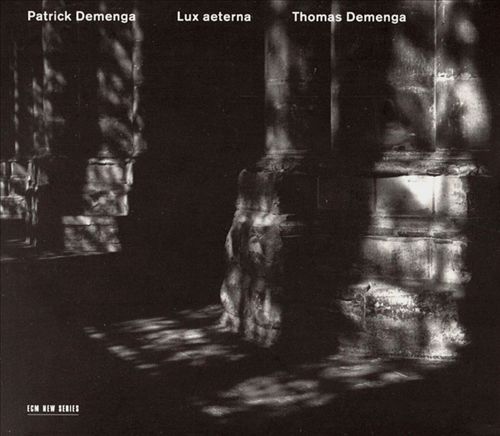
Patrick and Thomas Demenga: Lux Aeterna (ECM New Series 1695)


Patrick Demenga
Thomas Demenga
Lux Aeterna

Patrick Demenga cello
Thomas Demenga cello
Recorded November 1998, Propstei St. Gerold
Engineer: Teije van Geest
Produced by Manfred Eicher

This album is a special one for having introduced me to the awe-inspiring pathos of Alexander Knaifel. Here, the phenomenally talented Demenga brothers give their most heartfelt performance in the composer’s Lux Aeterna. It is, by no simple means, a glorious meditation on the notion of divine light. Its structure is simple: high harmonics on the cellos give way to words intoned by the musicians themselves (cast in the score as “psalm singers”) before combining with strings, so that song is produced from all aspects of the body, through gesture and through sacred vibrations. A profound and moving piece, played with utter sensitivity and a dedicated sense of direction, this title work is more than the album’s theme, but also its genesis. One cannot help but be comforted in its ethereal embrace.

We might hope this mood could be sustained throughout the entire program, but the remaining offerings are no less engaging in their own right, comprising an intriguing potpourri drawn from the duo’s longstanding repertoire. Thomas offers up his own piece, Duo? o, Du…, an insightful look into the mind of this singular (albeit twinned) musician that delights with its deep-throated croaks and delicate relay of harmonics.

French composer Jean Barrière (1707-1747) was the finest cellist of his day, but his music is hardly ever recorded. Despite its upbeat tempi and virtuosic scoring, there is solemnity to be found in his G-major Sonata No. 10. Its buoyancy presages the Mozartean paradigm by half a century and rests on laurels of comforting fluidity. At certain moments the cellos ring out in lush, sweeping harmonies, leaving the bass line to float like a ghostly implication in the corner of our mental eye. The raw Adagio plays like a viola da gamba divided into its complementary personalities and captivates with its Baroque sensibilities. The resonant space in which the album is recorded ensures the cellos are given the widest berth possible, stretching the sonata’s third movement into a majestic fabric. After this tour de force, the Demengas change gears with a piece from Swiss compatriot Roland Moser. A student of Sándor Veress and Wolfgang Fortner, Moser writes in feverish yet contained bursts, as evidenced in the dizzying pizzicati and sharp bowings of his Wendungen. A sprinkling of silence ensures that the immediacy of its drama stays true to its quieter affirmations. Barry Guy’s Redshift brings us full circle to Kniafel’s invocation of light. The title references a process by which, not unlike a Doppler effect in sound, changes the visible spectrum as distance increases. With bows a-bouncing the cellists reap a varied crop of meditations and improvisations through which a cunning rhythmic acuity is brought to fruition. We end on a lullaby, left to writhe like Odysseus strapped to the ship that threatens to sail him into a song that will mean his demise.

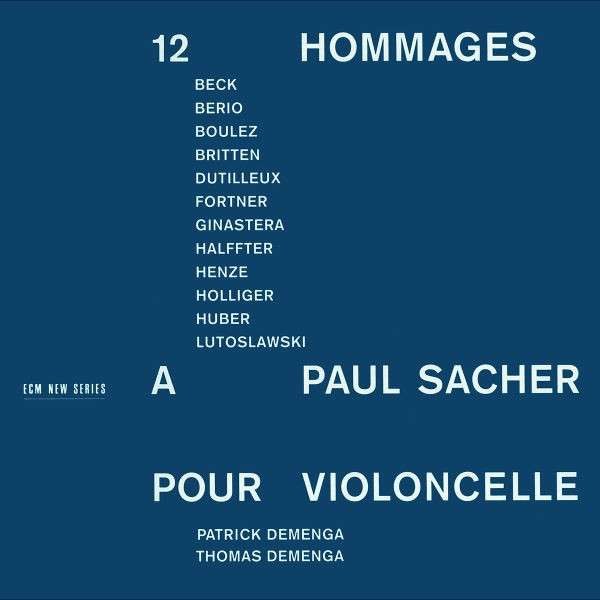
12 Hommages A Paul Sacher (ECM New Series 1520/21)

12 Hommages A Paul Sacher

Thomas Demenga
Patrick Demenga
Jürg Wyttenbach Conductor
Recorded June 1993, Kirche Blumenstein, CH
Engineer: Teije van Geest
Produced by Manfred Eicher

Before first encountering this recording, Paul Sacher was an unfamiliar name to me. Now that the album has been with me for fifteen years, it is a name I cannot forget. Sacher (1906-1999) was a Swiss conductor and patron of the arts who championed all of the composers represented in this 2-CD tribute. His wealth and musical acuity led him to commission some of the most defining works of the twentieth century. Without him we wouldn’t have, for example, Bartók’s Music for Strings, Percussion, and Celesta or Stravinsky’s Concerto in D. For this project, realized in commemoration of his 70th birthday, a choice group of composers were commissioned to write pieces for cello around the so-called “Sacher hexachord,” a tone row derived from Sacher’s name: Eb=Es A C B=H E D=Re. The concept is similar to that of the B-A-C-H motif (Bb=B, A, C, H=B natural), which has been incorporated into works by, among many others, Liszt, Busoni, Pärt, Webern, and Bach himself (see ECM’s Ricercar for a creative juxtaposition of the latter two). The project was originally spearheaded by Mstislav Rostropovich, but has been recorded here with requisite flair by Thomas and Patrick Demenga.

At the heart of this project is Benjamin Britten’s Tema, the most straightforward iteration of the Sacher theme. Originally, the other composers were asked to simply write variations thereof, but their ideas soon developed into full-fledged pieces in their own right. Alberto Ginastera’s Puneña No. 2, Op.45 immediately draws us in with its keening melody, crying out like a hawk losing sight of its prey. The majestic bird tears at the sky as it would the earth, eliciting a flurry of virtuosic leaps and plucked asides. Each whispered harmonic lifts the bird with the silent power of a thermal. But then the prey is spotted, and falls as if pierced by an arrow from its hunter’s very gaze. Agitated pizzicati scamper like the rodent’s ghost into a dense thicket of trees as the hawk raises calls of revelry and tears its meal limb from limb. To my ears, this is one of the most technically demanding pieces on the album, sometimes requiring the cellist to pluck with the left hand while bowing with the right. Wolfgang Fortner’s Zum Spielen für den 70. Geburtstag – Thema und Variationen für Violincello solo is a more somber affair, its flashes of consonance piercing the surrounding dissonant fabric with divine light. The Capriccio by Hans Werner Henze is among the more cryptic pieces. Its complex narrative and subtle details beg repeated listening. This is followed by a string of vignettes. Of these, Henri Dutilleux’s 3 Strophes sur le nom de Sacher and Witold Lutosławski’s Sacher-Variationen are remarkable. Both give us a “conversational” portrait, perhaps reflective of the relationship either composer may have had with the man behind the music, for like a conversation among friends these pieces are fraught with conflict and agreement in equal measure. They are also very “alphabetic” and are perhaps the most committed to the their morphological assignment. Cristóbal Halffter seems to take a similar tack in his Variationen über das Thema eSACHERe, while Conrad Beck and Luciano Berio opt for a more concise approach that favors melodic dissection over prosody. By far the longest piece is Klaus Huber’s Transpositio ad infinitum – Für ein virtuoses Solocello, another compelling delineation of attenuate character and detail. Following this, Heinz Holliger yet again flexes his brilliant compositional muscle with the Chaconne für Violoncello solo. This rather enumerative piece makes apt use of the acoustics of the recording space and exploits the incidental sounds of the strings against the fingerboard as a sort of parallel dialogue. And just when we begin to suspect all possibilities have been exhausted, Pierre Boulez, ever the nonconformist, throws us for a loop with his Messagesquisse for seven cellos, which seems to blend all that came before until smooth.

Even though all of this music inhabits the same landscape, each piece digs up its own relic and turns it into music. The album is passionately performed, and recorded in clear and present sound. It is a unique testament to a unique individual, one that unlocks Sacher in a way those of us who will never know him cannot ever experience otherwise. Essentially, it is the Sacherian equivalent of A Hilliard Songbook, for just as the latter would not exist without the Hilliard Ensemble, so too is this album a timeless memorial to a figure whose absence might have effectively erased an entire generation of masterworks.

<< David Darling: Dark Wood (ECM 1519)
>> Charles Lloyd: The Call (ECM 1522)