

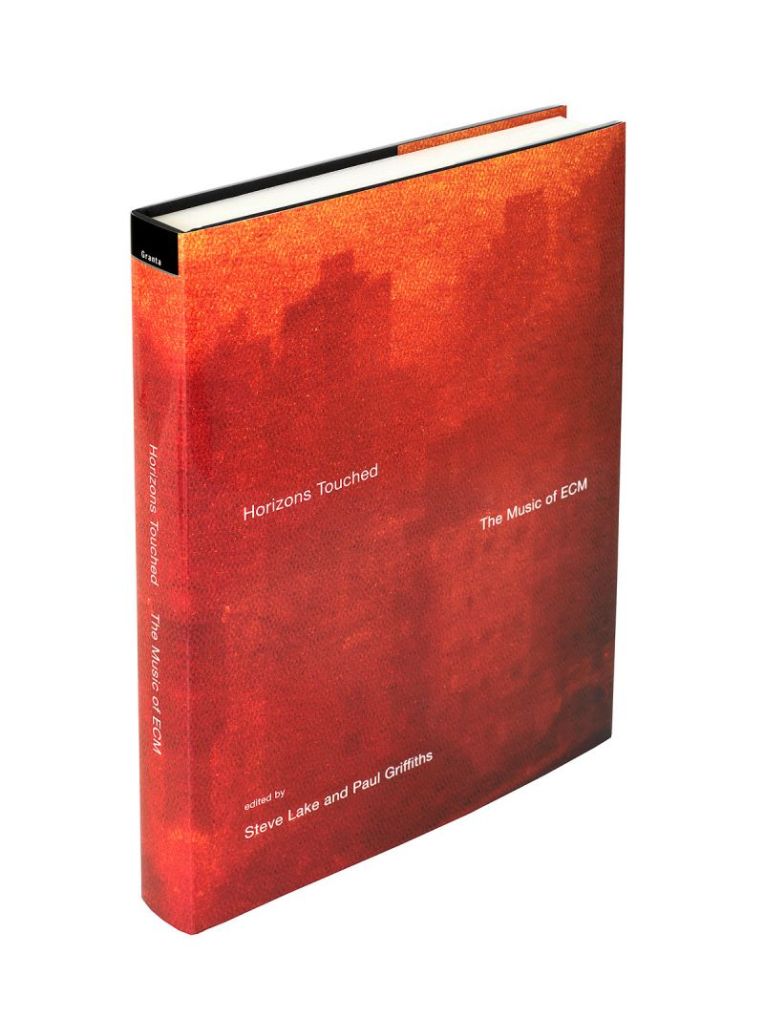
Horizons Touched: The Music of ECM

Horizons Touched

It’s all our music.
–Robert Frost, “The Self-Seeker”

I. A Living Archive

Few record labels compel us to approach them in any way other than chronologically. ECM is one of them. Its catalogue does not merely document music made; it charts ways of listening learned, unlearned, and learned again. Horizons Touched: The Music of ECM arrives, then, not as a monument erected after the fact but as an attempt to take measure of a phenomenon still in motion, to listen back without closing the ear to what has yet to sound.

The importance of this book, devotedly published by Granta Books in 2007, lies precisely here. Rather than offering a definitive account of ECM, it gathers voices, memories, and reflections in a way that mirrors the label’s own refusal of finality. It does not summarize so much as resonate. In doing so, it becomes something rarer than an institutional history: a field of attentiveness, an act of collective listening directed both backward and forward. What is preserved is sensibility over consensus.

In his introduction, Steve Lake rightly calls ECM a “work-in-progress.” Indeed, ECM is not a repository of completed statements but a living archive in which the contributions of everyone who makes it a reality function as vital organs within a larger, thriving body. The questions posed throughout the book are as follows: How does one listen to a past that refuses to settle into style, school, or doctrine? How does one write about music that has always positioned itself slightly ahead of its own reception?

Before ECM and its leadership under bassist-turned-producer Manfred Eicher, no one had thought of space in jazz in quite the same way. Through Eicher’s early work with engineers Martin Wieland and Jan Erik Kongshaug, the recording studio itself emerged as an unspoken player, an active participant rather than a neutral container. Light entered sound. Atmosphere became structural. Silence was no longer an absence but a condition. Yet even this often-cited “ECM sound” resists fixation, not because it lacks identity but because it repels reduction.

Given that so many locations, musicians, and traditions have passed through the label, to distill its ethos into a single style would be to flatten precisely what has given it life. As Eicher admitted in a 1999 interview, “All that can be really said about the ‘ECM sound’ at this point is that the sound that you hear is the sound that we like.” From this deceptively modest admission unfolds an expansive reality. What began as a jazz imprint grew far beyond the conventions of genre, making room for folk music, film soundtracks, electro-acoustic alchemy, and, with ECM New Series, classical streams grafted into the same current. Even there, the borders remain porous: Jan Garbarek improvising alongside the Hilliard Ensemble; curated excerpts from a Heiner Goebbels sound installation; Keith Jarrett playing Bach’s French Suites on harpsichord.

Horizons Touched matters because it understands this permeability not as a problem to be solved but as a condition to be honored. Enabled by over 100 contributors, the book presents itself as an “oral history,” though the term hardly captures its scope. What emerges instead is a polyphonic portrait of a label that has always worked obliquely through implication, atmosphere, and trust. Like the music it documents, the book does not insist. It invites. And in doing so, it affirms ECM as a listening practice still unfolding.

II. Seeing as Listening

It is telling that, following Lake’s opening statement, the essays do not begin with Eicher but with “Our Music: Synopsis for a Film” by Jean-Luc Godard and Anne-Marie Miéville. The filmmakers speak of seeing as listening, and few in their art would know better. This inversion of sensory hierarchy sets the tone for what follows.

Eicher’s essay, “The Periphery and the Centre,” originally delivered as a speech upon receiving the Kultureller Ehrenpreis of the City of Munich in 2005, continues this meditation on margins and essence. He speaks of the ECM office in Munich, located in what he calls “a no man’s land of industrial culture” at the periphery of things. Having been there myself, I can attest to its uncanny contradiction of placelessness and situatedness. Yet Eicher cautions against romanticizing such things: “We must never settle too comfortably at the periphery—the margin should only be a source, a spot from which to grasp the essence of the centre.”

His reflections braid together formative years in music school and the cinema, early encounters with Godard and others yielding a profound understanding of the overlaps between ears and eyes. For Eicher, atmosphere is not decorative but catalytic. “The atmosphere produced at a recording session,” he writes, “should be inimitable and awaken the desire to make changes or, where necessary, to improve and perfect.”

III. Redefining Tradition: European and Northern Voices

John Fordham’s “ECM and European Jazz” traces how figures like Jan Garbarek and Eberhard Weber became pioneers not by breaking with tradition but by redefining it as personally as possible. Weber’s admonition to his band—“you can play anything, as long as it doesn’t sound like jazz”—was a refusal of complacency. As Americans like Keith Jarrett, Bill Frisell, and Pat Metheny entered the fold and collaborated with European musicians, the sound expanded further. British artists such as Norma Winstone and John Taylor, alongside Kenny Wheeler in the influential Azimuth trio (with Ralph Towner welcomed into the circle), contributed to this widening field. Saxophonists John Surman—particularly in his solo recordings—and Evan Parker, with his Electro-Acoustic Ensemble, ensured that the threat of typecasting never fully took hold.

On the mainland, artists like Louis Sclavis, Enrico Rava, Tomasz Stańko, and Miroslav Vitouš laid the groundwork for a new canon. And then there are the Scandinavians, whose presence Michael Tucker explores in “Northbound: ECM and ‘The Idea of North.’” What Tucker calls “a multi-hued Northern aura” begins with Afric Pepperbird, Garbarek’s historic recording with Terje Rypdal, Arild Andersen, and Jon Christensen. Yet this “North” is less a geographic persuasion than an idea taking shape in those who inhabit it or yearn toward it.

To my ears, few albums embody this sensibility more adroitly than Rypdal’s If Mountains Could Sing. But the Northern idea is not all cool washes and snowbound stillness. There is also unrest and existential fervor, as in the shamanic charge of Garbarek’s Visible World, which, despite its cool sheen, is rich with colorful flame. Even in the gentler worlds of Tord Gustavsen and Mathias Eick, there is a nomadism that never feels quite settled in its skin.

IV. Liminal Spaces and Less is More

This sense of in-betweenness finds articulate expression in Ivan Moody’s 2004 conversation with Jan Garbarek, “On Parallel Lines.” Garbarek speaks candidly about the difficulty critics have in placing his music. Jazz and classical camps alike often seem unsure how to approach it, leaving it to resound in a liminal space. “I consider myself extremely lucky,” Garbarek says, “because ECM already has a given audience, and they don’t really think of it as jazz or classical: it’s just a certain approach.”

Their dialogue ranges across questions of collaboration with musicians from other traditions, converging on a shared belief that constraints can be the most liberating conditions for creation. “I only seem to have dreams when I’m awake,” Garbarek remarks, a line that feels like an unofficial ECM motto.

V. New Series: Shadows, Voices, and Reinvention

The ECM New Series emerges throughout the book not as an offshoot but as an intensification of the label’s core ethos. John Potter’s “Early Music Discoveries and Experiments” marvels at Eicher’s uncanny ability to bring together musicians, ideas, and inspirations no one else would think to combine—most famously in Officium, but also in the Dowland Project.

Helen Wallace’s “Musicians of the New Series” observes that “the musicians who make ECM recordings are shadowy presences.” (My own early encounters with the New Series included Paul Giger’s Chartres. I remember trying to imagine what he looked like, how he moved while playing. When a clearer photograph finally appeared on Schattenwelt, it felt like seeing, through time, a mythical figure brought briefly into focus.) Wallace also notes the lack of musician biographies in the CD booklets, emphasizing that these recordings arise not from contracts but from shared visions and relationships with living composers illuminated by deeply human interpretations, resting in a nest of empathy.

Peter Rüedi’s “Continuity in Change: The Metamorphoses of Keith Jarrett” goes on to frame genius as a state of constant reformation rather than a sustained pinnacle. Jarrett’s “many-sidedness,” of “supernatural proportions,” exemplifies this restlessness. Rüedi speaks of the hymnic quality shared by Jarrett’s music and ECM: an ember that glows with varying degrees of warmth, sometimes sparking fires that take on lives of their own beyond the hearth.

VI. Free Playing, American Roots, and the Canvas Without an Edge

Josef Woodard’s “ECM and US Jazz” reminds us that the label has always been “a source of cohesion” for American artists and a further corrective to simplistic notions of the “ECM sound.” The label’s genesis lay with Mal Waldron, and figures like the Art Ensemble of Chicago brought incendiary free-jazz energy into its orbit. Jack DeJohnette, Pat Metheny, John Abercrombie, Ralph Towner, Bill Frisell, Joe Lovano, Peter Erskine, Paul Bley, Paul Motian, Steve Swallow, Gary Burton, Chick Corea, and Charles Lloyd all testify to a lineage of hard-edged expressivity as much as lyric spaciousness.

In “The Free Matrix,” Steve Lake’s interview with Eicher, free playing again emerges as a foundational principle. Eicher recalls early encounters with Paul Bley and identifies a “special electricity” shared by artists as varied as Glenn Gould, Chick Corea, and Keith Jarrett—an ability to act as “an inspired catalyst whatever the context.” Music, Eicher says, is “a canvas without an edge.” He recounts the genesis of the label’s name, inspired by Werner Goldschmidt’s Wergo series and Stockhausen’s From the Seven Days, leading him to imagine loosening borders through the idea of an “edition” (borrowed from the world of visual art) of contemporality. Thus, Edition of Contemporary Music was born. He likens the label to a sea: “A continuous movement of undercurrents and unexpected drifts… But sometimes the sea is tranquil, and stays tranquil.”

Keith Jarrett’s essay, “Inside Out: Thoughts on Free Playing,” deepens this philosophy. He distinguishes between artists who treat nothingness as lack and those who understand it as a state “pregnant with everything.” His notion of having “accidents on purpose” feels like a quiet manifesto for improvisation.

VII. Forms, Covers, Folkways, and Modernist Echoes

ECM’s visual identity receives eloquent treatment in Lars Müller’s “The ECM Cover.” Müller sees the label as transforming its musical philosophy into the realm of vision. The covers rarely illustrate the music directly, yet they exist in harmony with it—two verses from the same poem, not mirror images.

Karl Lippegaus, in “Colours, Densities, Forms,” traces how ECM reshaped folk music through artists such as Egberto Gismonti, Anouar Brahem, Lena Willemark, Savina Yannatou, Eleni Karaindrou, Gianluigi Trovesi, Shankar, and Dino Saluzzi. He also recounts asking Eicher why ECM albums open with five seconds of silence. Eicher laughed: “People need time to sit down, don’t they?”

Paul Griffiths’s “Against the Grain: Modernist Voices” reframes modernism not as rupture but as continuity. For example, in Thomas Demenga’s fifteen-year traversal of the Bach cello suites—paired with works by Holliger, Veress, and Isang Yun—Bach emerges as modern for his time, just as modern works echo the past. Griffiths writes lovingly of Holliger and Kurtág as poets, a lineage that includes the spoken-word forays of Bruno Ganz (to say nothing of Griffiths’s own).

Hans-Klaus Jungheinrich’s “All Roads Lead to Bach” both confirms and dismantles Bach’s mythic status. Bach was no passive vessel of divine inspiration but a laborious musical scientist whose work fell out of favor for decades. Returning to Bach, Jungheinrich argues, is an anti-Romantic gesture, one that resonates deeply with jazz musicians like Jarrett. Yet ultimately, the metaphor inverts itself: not all roads lead back to Bach; they stem from him outward into space and time.

VIII. Instruments, Futures, and the Listener’s Life

John Cratchley’s “ECM and the Guitar” charts the instrument’s breadth across the label—from Abercrombie, Towner, Connors, Frisell, Tibbetts, Rypdal, and Metheny to figures like Keith Rowe, Mick Goodrick, Derek Bailey, and Christy Doran—extending into the next generation with Jacob Young.

John Kelman’s “Present and Future Songs” characterizes ECM as a place of discovery. Alongside its mainstays, it has consistently welcomed new voices: Trygve Seim, Christian Wallumrød, Tord Gustavsen, Savina Yannatou. What unites them, Kelman writes, is not style but vision: “All hold humanity as paramount; all ask that music be accepted as a contradiction, engaging perfectionist ideal and practical imperfection.”

Geoff Dyer’s “Editions of Contemporary Me” offers a listener’s diary, his discovery of ECM entwined with the formation of his inner life. It makes me nostalgic for my own early listening sessions with friends, before digital fragmentation fractured albums into isolated tracks.

Further interviews, such as Griffiths and Lake’s with Eicher, reaffirm that the New Series was never a departure, only a continuation of ECM’s inner spirit. Thomas Steinfeld’s “Words and Music” explores the “aesthetical alliances” listeners inevitably draw across the label’s vast terrain.

IX. Voices, Engineers, and the Hand Holding the Key

Interleaved among the essays, Horizons Touched offers biographical sketches and first-person statements from ECM’s musicians, each a small window that opens onto a whole climate. These fragments do not merely annotate the label’s history; they humanize its method. They remind us that ECM’s continuity is not a doctrine but a chain of encounters: one musician hearing another across a room, across a record, across years, then walking away altered.

Jan Garbarek’s recollections of meeting Don Cherry glow with this catalytic force. Cherry’s folk sensibilities did not function as ornament or exotic garnish; they sank into Garbarek’s musical bloodstream, shaping how the saxophonist would understand melody as something older than genre, something carried like a story rather than “played” like a role. John Surman, too, appears not as a solitary figure descending fully formed but as someone who fell in with the Norwegian jazz scene by way of circumstance and gravity via Karin Krog’s quintet with Arild Andersen, Jon Christensen, Garbarek, and Terje Bjørklund—a scene, then, as a confluence of players finding shared weather.

The book is equally attentive to the invisible labor that turns vision into sound. Iro Haarla’s memories of bringing her partner Edward Vesala’s musical worlds to life are among the most moving examples. Vesala would sing ideas into a tape recorder—raw transmissions, half-formed, urgent—and Haarla would transcribe them, arrange them, translate the unrepeatable into something held and shared, using those recordings and other means of transmission. Here, creativity is shown not as solitary lightning but as an act of listening so deep it becomes architecture.

Generational echoes reverberate as well. Trygve Seim recalls his first encounter with Jan Garbarek—not in person, but through the spell of Eventyr, which set him on the path toward the saxophone at a time in his life when he was more interested in sports. That detail matters: it gives us the unmistakable sense of a life diverted by sound, a horizon touched early enough to become destiny.

From the New Series world, Kim Kashkashian offers a statement that feels like reassurance and challenge: the intense preparation of a recording is precisely when “preconceived notions are abandoned and the music is created anew.” ECM’s paradox—rigor as the gateway to freedom—finds proof in her fearless championing of Kurtág, Mansurian, Kancheli, and so many others, repertoire approached not as museum artifact but as living material, remade in the present tense. András Schiff appears, too, animated by a seeking spirit that never settles for attainment, spurring him toward greater interpretative levels, as if interpretation were not a finishing touch but an ethical pursuit, a way of staying in motion.

Anouar Brahem’s reflections widen the field again, returning us to that Godardian hinge where sight and sound exchange roles. He speaks of the silence that precedes image and the music that follows it, a dynamic mirrored in many bands along the ECM spectrum, where what is withheld becomes part of what is said, and where the breath before the phrase is meaning. Annette Peacock, in turn, expresses gratitude for Manfred Eicher, whose prophetic understanding of her essence became a leitmotif at ECM, less the discovery of a new artist than the recognition of someone already speaking in her own dialect, waiting for ears fluent enough to listen.

Several statements arrive like aphorisms—compact, paradoxical, strangely complete. Christian Wallumrød’s reflections on harmony and freedom turn composition and improvisation into mirror arts: “You write something because you couldn’t improvise it, and you improve something because it couldn’t be written.” Carla Bley’s slow, forward-thinking approach to making music is distilled into another truth earned over decades: “My solos usually end because I’ve had to abandon them.” Such statements suggest minds always moving ahead of what the hands can say.

Folk tradition is not treated as a quaint inheritance but as a living accumulation. Ale Möller speaks from deep knowledge, describing folk music as cumulative and locating ECM’s contribution in inward intensification, “increasing the inner density in music by reducing the external.” Dino Saluzzi sharpens this imperative by insisting on emotional sensitivity as the bridge to freedom: “Art doesn’t need muscles.” Robert Wilson’s poetic hymn to ECM (stylized as “Every Color Maginable”) extends the label into chromatic metaphysics. And Gidon Kremer, attentive to the bond between composer, performer, listener, articulates his love for Eicher’s vision of bringing them lucidly to us: “ECM stands for music intent on communicating something to us.”

Taken together, these voices form their own ensemble, less a supplement to the book than its beating heart. They do what ECM has always done at its best: place the “work” back into the work, the human back into myth, reminding us that the key is never merely the catalogue, the studio, the aesthetic.

The book closes not with an argument but with a gesture. Paul Griffiths raises a glass in the form of a prose poem written in Ophelian, in which meaning and music collapse into one another: “The key is in his hand. The key is his hand. There’s music in that hand.” The image lingers, unfinished, as if the act of letting go is where melody begins.

Leading up to this closing utterance is a dotted path of voices whose work has shaped ECM as surely as any score or improvisation. Reflections from photographers and visual artists—Roberto Masotti, Jan Jedlička, Jim Bengston, Mayo Bucher, Thomas Wunsch, Dieter Rehm—remind us that ECM’s sound has always traveled with an image, even when that image defies the conventions of illustration. Their contributions affirm the label’s belief that vision and music are parallel arts, each extending the other’s reach without collapsing into it.

Equally essential are the engineers, those who inhabit the threshold where intention becomes vibration. Peter Laenger, Jan Erik Kongshaug, James Farber, Stefano Amerio, and Gérard de Haro speak from within the studio’s invisible architecture, where listening is technical and moral. Amerio’s remark—“Recording for ECM means opening your mind to 360 degrees”—could stand as an epigraph for the enterprise. It names a practice of attention that is spherical rather than linear, attuned not only to what is played but to what surrounds it, precedes it, remains after it fades.

In ending this way, Horizons Touched refuses closure in the conventional sense. Instead, it disperses authorship, returning the music to the many hands that have shaped it, hands that frame images, tune microphones, adjust distances, wait for silence to speak. The key does not lock the door behind us. It stays in the hand, warm, provisional, ready to be passed on.

X. The Horizon Remains Open

Horizons Touched does not seek to close a circle. It leaves it slightly ajar, breathing. ECM has always seemed less concerned with preservation than with readiness for the next silence, the next alignment of breath and intention, the next sound that arrives without asking permission. To listen in this way is to relinquish certainty. It means accepting that meaning does not always announce itself, that music may resist immediate comprehension, that its most lasting truths often surface obliquely, long after the final note has faded. ECM’s legacy, if it can be called that, is not a fixed aesthetic but a discipline of sustained attention.

In this sense, the future of listening suggested here is neither utopian nor nostalgic. It is quieter, more demanding. It asks for patience in a culture of acceleration, for depth in a time of surfaces. It asks us to sit with ambiguity, to trust that what has not yet resolved may still be working on us, shaping us from within. The music does not rush to meet the listener; it waits. And in that waiting, something essential is restored.

Perhaps this is the true horizon being touched. Not a distant line toward which we move but a threshold we learn to inhabit. A space where sound and silence exchange roles, where intention loosens its grip, where listening becomes less about capture than encounter. The future implied by Horizons Touched is one in which music continues to arrive from unexpected directions, carrying with it traces of many worlds, yet asking only one thing in return: that we be present enough to hear it.

The horizon remains open because it must. To close it would be to mistake listening for possession. And ECM, at its heart, has never been about owning sound—only about making room for it, and trusting that what enters will know what to do next.
Paul Griffiths: Mr. Beethoven (Book Review)

If fiction is the art of revivification, then let Mr. Beethoven be one of the most self-aware products of its wonders. The 2021 novel from Paul Griffiths grafts archival leaves to branches of nourishing speculation to imagine a journey the German composer might have taken in 1833 (six years after his death) to America to finish an oratorio on the Biblical figure of Job.

Although the Handel and Haydn Society of Boston indeed considered commissioning such a work, the only motif of it we will ever know may be articulated in the mind’s ear as we read of its stumbling fruition and premiere. Written in a narratively and stylistically episodic style and using only statements recorded as having been uttered by Der Spagnol, it unfolds not unlike his Ninth Symphony, building a dome’s worth of clouds one wisp at a time until the light of something divine pushes its way through to illuminate the ground at our feet anew.

If any of this sounds too good to be true, that’s because it’s too true to be good. Whereas the “real” Beethoven—as if the persona of that name weren’t already enigmatized by our constant recapitulations—reads to us today like the quintessential poète maudit, he marks the zoetrope of this book in moments of pandering frustration but also, more importantly, cadenzas of openheartedness, interpersonal profundity, and sheer delight.

Hints of a holistic portrait shade the opening act, wherein we encounter Beethoven as an enigma aboard a ship in the Atlantic bound for New England. He is a figure rendered by charcoal in intercontinental candlelight rather than oil in the Roman sun. “A stare, from a stranger,” we are told, “can be a flooding of humanity through whatever dams of difference.” Thus, we see and feel through the eyes of characters as fleeting as their target’s evergreen status. Such moments point to one of the novel’s most brilliant aggregations of historical impulse in Griffiths’s ability to articulate Beethoven before his place in the canon, itself in flux at this point, was assured by the validation of hindsight. By the same token, it emphasizes the unique disjointedness of place one experiences at sea before making landfall in realms of emotional economy. Says the muse of takeaways: Recognition is never universal.

By the time he gets to Boston, Beethoven’s dishevelment reads not like a caricature of the man but as the ravages of a harrowing journey. When encountering subsequent dramatis personae, we view them as he does: in his polite disinterest in Lowell Mason (responsible for the commission), in his enjoyment of Quincy under the auspices of hostess Mrs. Hannah Hill (a widow in whose company the bee legs of his heart collect no small amount of pollen), in his disappointment with the Reverend Ballou (a dismal librettist whose failures end up provoking a textual revival), and in his enchantment with Thankful (a sign language teacher and interpreter variously dubbed his “ear” and “amanuensis”). Every instance in which Herr Beethoven shakes a hand, exchanges words, or consumes a morsel of food reinforces the illusion that the music is imminent.

Each chapter is a composition unto itself. Whether in his iridescent vignette on the Fourth of July or in the careful construction of possible yet unprovable interactions, Griffiths sews his story with a leitmotif of concerns that make it clear he is wrestling as much as we are with the implications of his reality. While Chapter 32 is almost entirely footnotes, 33 only dialogue with dynamic markings, and 38 a single run-on sentence, these artifices never feel out of place or contrived. Each is a libretto unto itself for a musical work yet to be written.

From the selection of voices to travails with the local punditry, the story arc is pulled like a shuttle through looms marked by clefs instead of wooden frames, culminating in a virtuoso performance from musicians and Griffiths alike, as the author provides a full text for the oratorio, interleaved with reflections such as:

“To this Boston audience, the music is untoward, beyond familiar reference points, and yet at the same time wondrous, perhaps most of all in its successions of harmonies, how they float, swerve or dive while also proceeding forward inexorably, how they keep their sights on that one sure path while sometimes veering to the side or soaring high above, carrying their first listeners into new air.”

The book’s constant fourth-wall breaking may be its greatest pleasure. At one point, Griffiths even invites us to call him out on his conceit, only to retreat further into its fascinating depths. Hanging on what-might-have-beens (“it could all so easily have gone a different way,” “Scraps of paper might have survived,” etc.), he is content to vary his approach to the theme at hand as a seasoned improviser at the keyboard.

Among the many things to adore about Mr. Beethoven is that it sidesteps the trap of forcing a creative swoon. Unlike The Agony and the Ecstasy, whose Michelangelo rhapsodizes in the presence of unhewn marble, itself a cipher for escape, we get none of the romantic privilege of the artist at work. Hints of influences, witting or not, also make this a joyful effort. Top notes of James Cowan’s A Mapmaker’s Dream and Thomas Pynchon’s Mason & Dixon and a splash of Umberto Eco in the middle make way for a powerful dry down that leaves plenty of room for Griffiths’s base notes to settle in the nose for the long haul. In the latter vein, nods to his own work (“Let me tell you,” says Mrs. Hill at one point, naming his Ophelia novel) remind us of who is telling the story. Setting aside such comparisons leaves us with a three-dimensional object to regard in the light of our hopeful imaginations. The more we turn the key, the more it can sing when we let go. 

Like the composer, we hear nothing yet feel every note.

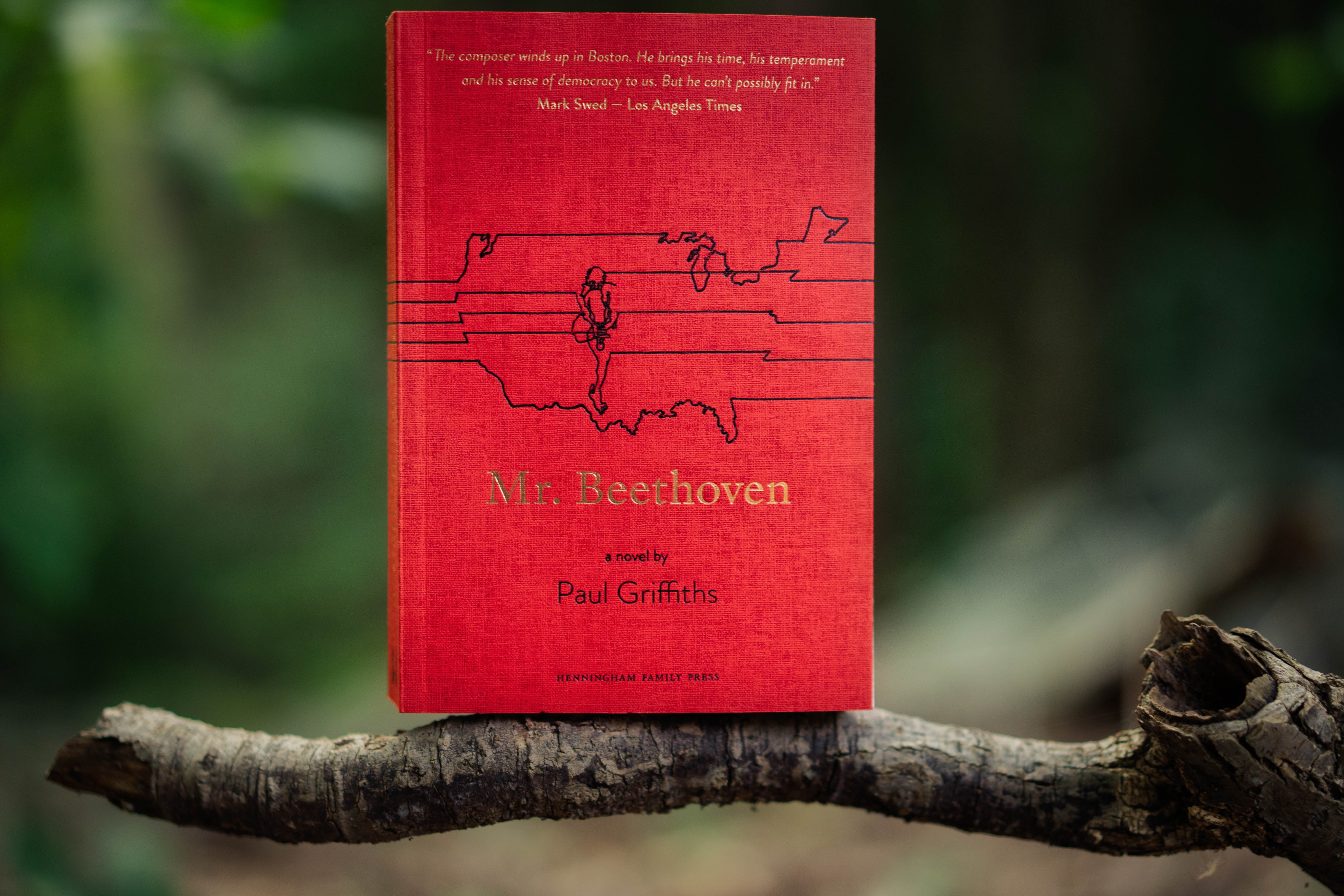
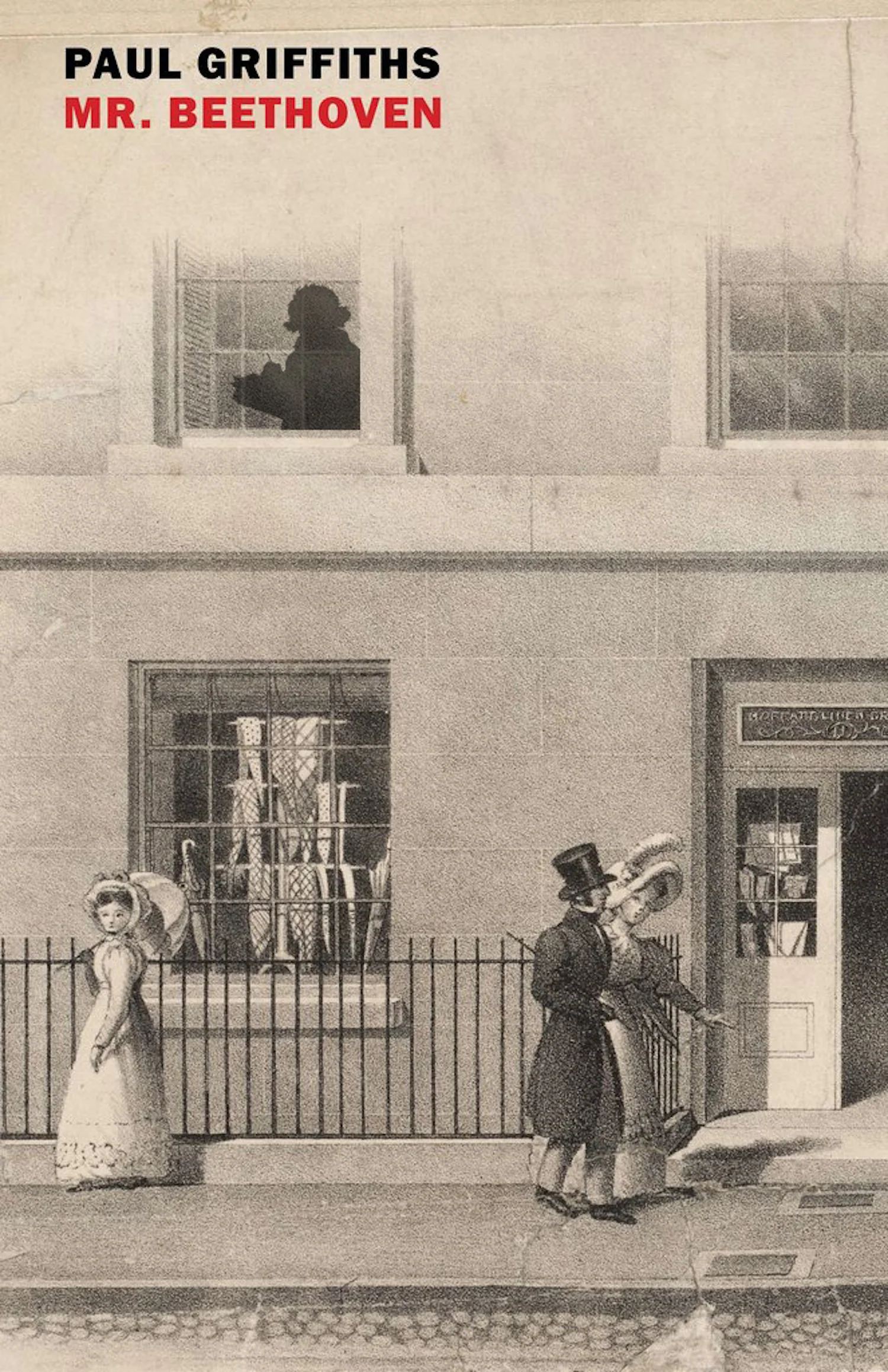
Mr. Beethoven is available from New York Review Books (pictured below) for those in the U.S. or from Henningham Family Press (pictured above) for those in Europe.

Paul Griffiths: let me tell you

Paul Griffiths
let me tell you
Hastings, East Sussex: Reality Street Editions, 2008

She is like the rest of us; we all have no more than the words that come to us in the play. We go on with these words. We have to.

So the king prefaces let me tell you, an ode to Ophelia, whose limited vocabulary as Shakespeare allots her in Hamlet—481 distinct words—forms the toolkit for Paul Griffiths’s autobiographical exercise. Avid ECM listeners will have caught a glimpse of this language via there is still time, wherein his own recitations of similarly restricted poetry are the moon to cellist Frances-Marie Uitti’s sun and prove that the conceit is not a restriction at all, but rather a microscope’s mirror throwing light on that which might otherwise be left to inference. Ophelia’s brother, Laertes, and her father, Polonius, are the main specimens on her slide, and Shakespeare himself the dye that imparts context.

1
The story begins with a concession to concessions. Ophelia speaks, and speaks of speaking. Her call to speech is musical: like music, an act in the fullest sense, moving to rhythm of grass and herb.

This is like being one of my own observers, but with no powers over what is observed.

She remembers her birth, but muses upon the art of memory as gift bestown over keep earned. She sees, or rather hears, her father in the cadence of his anticipation, connecting sole to stone as amniotic darkness readies itself to break light around her.

False memory may speak, I find, as well as true. I have to know the difference.

The sounds are immaterial, as true in origin as lies. Father’s feet fade into alliteration, his face alive with death. As it is, we come to realize that it is not her birth after all, but her brother’s—pulled from in to out by the dimples of Achilles. The maid sings of tears and roses, equates tears and roses with glass, and frets them to the consistency of wet paper. The maid sounds herself only through singing. Otherwise,

She would look down at us and say nothing—say nothing but look and look, harsh with love.

The face as medium: it knows of love beyond the bounds of her charge, carries it through the yeast of her other half, percolating through the dough of secret passion until it crackles like a finely browned crust that all but burns eager hands. She is a character of vocal shadows. The young siblings take this challenge as a game, and spin from it a fiber they can only hope will survive the distance she puts between herself and them as she follows her nose to a kitchen beyond the mountain.

2
The flowers come and go, but leave a trail of their scent. With the mark of a pansy, the pollen and blood of it smeared across the hands, it changes from solid to liquid in the blink of a written eye. The iris materializes on her arm, a curiosity in relief, a sisterly longing temporarily branded.

And there is the sun, and there is the mountain: all where we are is in an ecstasy of expectation.

From this fragile experience, the winds of which linger in curls from a photo tinter’s brush, she knows the value of intimacy within bounds, the buzz of the almost-was. And in fact, beauty is never an indulgence here. It flits in and out of touch, floats in musings on music, and comports itself loosely in the presence of bodies and minds.

Here all is still, still as night. We do not have the joy of music.

Thus the melody of language, inherent as crickets to midnight, also reveals a dream: the wish for something to give up, for the choice to do so. The father looms, bearded but not, lavishing brother and sister with warm breath. In them pools reflect the stories of his travels, and they too tremble and distort those memories with every telling. Words come verily, jumping gaps shallow and deep. It is the battler’s tale, wrapped in water and set adrift, farther to sea than any memory might have been.

3
Here is an Ophelia whose childhood resembles a stained glass window. Each section is its own color. Some are uniform and almost transparent, others milky and swirled, but they cohere at once-molten boundaries. Anxieties surround the maid who spent so much of her time with the siblings. Her absence is fraught. She is home, lost to the whim of another relationship in an empty life. But the maid returns with something dour, her actions choreographed to royal step. In them are mirrors for the end-aware glance of a sick girl.

But do I long for death and not know it? Is this what my words tell me?

A play within a play, performance at Polonius’s beck and call. Behind its curtain stretches the actor of death, the rise and fall of death. Ophelia questions her remembrance of the stage, but in the asking answers the conundrum that is the root of her. She knows quietude equals harmony.

The after reads into the before. This she admits. Drawing a name from the play and the fortress, she twists a mock fiber of reality from the shavings of fiction and holds to her bosom the flowers that will end her.

4
We discover her need for flowers, a trip over the mountain by a path startlingly seen. She meets the maid’s daughter, whose animosities are at once vague and clear. This daughter becomes an anti-Ophelia, a mirror-Ophelia, an other-Ophelia in one. She glares and resists, pushes the girl into our capture, from which the only escape is a dip.

It’s cold. My eyes weep.

Those same eyes see profundity incarnate, wrapped in glass and splashed through the atlas of openness that is her heart. A visitation, a spark and a candle, fearful and awed. Her memory unfolds one morpheme at a time, a hand-game shielded by paper pyramids and children’s scrawl. Her memory looks back to the shadows. It pulls the oxcart of the present, heavier with distance and jangling with a litany of bells.

5
She grows into an awareness that constricts her, even as it opens those eyes beyond where light may reach. Hers is the desire for visions and valences. The unkempt window, cobwebbed and secure, frames it all in quadrants. Music waits like fatality, a game played only once and which leaves a trail of mimics until the temptation to lose overcomes. Strategies are windows of a different sort. They facilitate emotional insight, forming bonds that would never have been without competition.

With music, thank God, you cannot speak.

Behind the façade of affection beats the drum of fate, and Laertes follows his along a divergent path. This, Ophelia would seem to know—if not then, then ever more. She was the one who let go of his hand, that it might transcend the arras of his brokenness. It is written on her skin.

6
I wish he had been well more of the time, says Ophelia of her father, whose letters adhere to her. She remembers the words as if they were her own (as of course they are). Not only are his eyes weak, but also his denials. Yet she remembers his time in uniform during a time that was not uniform. Since then his speech has become his synecdoche. I do not know what I would do without him.

7
Her mother: the italicized she. Notorious indifference and depravity of the one who neither listens nor reads, yet has no compunctions in letting the children know what goes on in her chambers. Mother shares these details, imposes them upon daughter, to ensure that power and separation are one and the same. And the suitors don’t stop there. They have eyes for the younger.

She had made it so that I could not believe my own memory.

Sharing is a double-edged blade: one side run with the blood of the unavoidable turn, the other licked clean by bedroom trysts. She must hide these things. Her father cannot know, though his eyes implore. In his absence, mother calls her close and opens the floodgates of illogic. The vessel of that deluge is as quiet as her motive, and sands away the grit of intangible things.

She was a length of hell.

But then she is gone. The sister bids good riddance. The brother inquires.

8
Hamlet appears pronominally, as nature and nurture wrapped into one. His presence has long since faded, though abstractly it flickers in and out of sense. Ophelia fishes his limpid brain, but comes up short every time. Into her chamber the boy steals and, along with her brother, ganders what he cannot ever have. There is a lack of affection in Hamlet’s past that speaks to the dwindling nature of her own. The cloak of yearning frays at last when Hamlet takes an education. Words hang from his tongue like raindrops at the tips of leaves.

Without music it means nothing. Without music it could make me fear.

Polonius wanders into the background, but ties a string to Ophelia’s finger ere exeunt. In light of this, she hopes the hearts of both men will see her silhouette and marvel. And when the young man swoons as if in the plays he attends, she closes the light around herself and wonders what brought her here.

9
The play is not still: it becomes something.

She is aware of the theater. Loves the theater, insofar as she knows her lines. And so we jump into a mise-en-abyme…only it’s not, for we have the ending already in grasp. The trio—father and children—takes a comedic bow.

10
Praying to a God she knows to be absent, she supplicates a mountain away from the kingdom, calculates in her heart the mathematics of foretelling. How can she not doubt the music of life, when all it amounts to is silence?

Now there is no eye on us, and the night goes on without end.

11
Yet silence can be an act of kindness, of a love so deep it cannot be defined—as when Laertes throws himself into manhood at the arm of a pretty young thing or two. Unlike their mother, he locks his tingling away from the girl, who wonders still about what is over. When she confronts him on it, the answer is morbid, final.

There is a change in the brother. His person shines.

In this erotic turn, speech becomes excitement, contact, and self-realization.

In my heart as in yours there is no doubt:
What reason then, my love, not to come out?

12
Night,
A letter to the curtain, behind which the body thrums. A time when mouths open—not to speak but to sing.
day:
Sun burns away the flesh of pretense, leaving skeletons of passion to rest on the hills. Glass weeps with light.
there is no difference for me.
The difference is love: they make the night as the night makes them. Togetherness blossoms like those pansies by the path, now overgrown beyond recognition. The weeds are quills in the playwright’s hand, flung one after another until the inkwell runs dry. The hand will open, say nothing, and drop. It cracks a door to tragedy.

13
Last night I made up my mind: I must go.

The young lord has left her to the darkness. Death is no longer the correct term. If only there was remembrance to tell her father and brother what they cannot know, they might respond. Their tears will tell enough.

Ophelia in the castle, hands on knotted ore, seeks the king and in him lays the infant of her choice.

There’ll be no remembrance of you here. It will be as if you had never been. The effect of O.

14
“O” is all that I am. Through the portal, a ring on a finger left in the forge’s keep. The knob turns at my touch. For as long as the snow powders the earth like the face of another, I will linger here, a trace and a scent. If crowds should gather and resurrect me a million times, only to throw me and my vocabulary into the abyss of plot development, so be it. I have said my piece, and the piece has said me.

If there is anything to be found in these images, it is a version of ourselves. The pathos of life is clearest when the means are limited. They express changes in light. The text begins to take on an anatomy: shoulders, hearts, tongues, and arms all fit together in changing combinations. Quotidian essentials like food and children’s games become a linguistic game to best capture the essence of nonexistent fare. Words become names, and names objects. The color green is at once generative, sinful, and divine.

To be sure, these parameters are fascinating but in the end imply something greater than the sum, if not also the subtraction, of their parts. Just as we can forever impose shapes on the water vapor we call “cloud,” also infinite is the potential of the graph we call “letter.”

By the time we have read this Ophelia, she has already read us.

Frances-Marie Uitti / Paul Griffiths: there is still time (ECM New Series 1882)

there is still time

there is still time

Paul Griffiths speaking voice
Frances-Marie Uitti violoncello
Recorded August 2003 at Rainbow Studio, Oslo
Engineer: Jan Erik Kongshaug
Produced by Manfred Eicher

“I shall th’ effect of this good lesson keep
As watchman to my heart.”
–Ophelia

Subtitled “scenes for speaking voice and cello,” the fortuitous meeting of music writer, novelist, and librettist Paul Griffiths and cellist Frances-Marie Uitti that resulted in there is still time wears no masks. Using only the 482 words available to Ophelia in Shakespeare’s Hamlet, Griffiths works with a vast magnetic poetry set on a refrigerator that runs on Uitti’s often-haunting improvisations. It is neither Ophelia nor Griffiths who speaks, but someone in between, a voice not so much twice removed as one once excavated and once buried. And while the backstory to this recording is fascinating in and of itself, its aural language is such that one may enter it blind and emerge from it fully sighted, if not the other way around. Griffiths treats language as a precipice from which to hang rather than as a spine from which to sprout nerves and muscle. Thus does the music’s grip deepen our mood with each weakening finger.

“I cannot remember” are the first words to awaken our senses, “when this is all over” the last before silence engulfs us: a brief life forgotten, regained at death’s door. Only the future can be held close, swaddled in opaque linens as it slips slowly from our hands into Uitti’s mournful fundaments and harmonic firmaments alike. Her reverberation becomes a stencil, and breath the paint sprayed through its glyphic wounds, where plasma congeals at the hinges of revelation. Griffiths’s intonations are fatigued, as if from the effort of articulation alone. In “think of that day,” he asks, “what should I fear?” A question that slithers thence, only here we get one of its clearest answers: what the voice fears is that “you,” the other to whom is being spoken, will say nothing. Such trepidations are thematic, hidden like Hamlet behind the curtain, stabbing at the wrong enemy. This troubled air returns for “how I wish,” over which the cello looms, a commentary on a commentary. Again, Griffiths speaks as if the very effort were much to bear, as if utterances of desire were the sole means of undoing it. The “you” remains silent, stagnant like a pool in some deserted landscape where the wind is never missed beyond perpetual cloud cover.

Griffiths doesn’t merely read his words, but comports them. If there is such a thing as method reading, then via his delivery we find an especially potent example in “call from the cold.” Its poetry draws a series of contact points between the body and the intangible, between expectation and inception, between the cello’s snowy scrapings and the listener’s suspension of disbelief. The narrative then sprouts bittersweet fruits from the buds of “touching,” skins of hope peeling away from flesh of horror. The melodious “there it was” measures the past like some vast diurnal clock compressed into the mouth before being expectorated in but a fleeting conjuration of lips, teeth, and tongue as Uitti draws whisper-screams in the air with her sobbing. Where the sunrays once frolicked at dawn, we find traces of “the bells,” no longer immortal yet still haloed by a lost cause, fading beyond every closing ear-lid. We are alone with their voices “some where,” bound by a capsule of parallel selves and places split by the prism of a single morpheme. The internality of it all is lifted once “for you” flies off the tongue with urgency. As much a question as it is a challenge, it emotes like an animal peering through the foliage at its own reflection, cello rasping, a gravelly Echo. “I did look” further slices open memory—an impossible dissection, it seems, for only more memory lies within, beating to the rhythm of an extended arco meditation, drawing out this operation to its most healing conclusion yet.

These points of contact are at once a source of expression and a denial of the self-generation implied by spoken words, such as in “my one fear.” The verb “touching” rings truest here and surfaces vividly as a means of grappling with the unknown. The nameless other is drawn in whispers and time, through which all is revealed, vulnerable and contrived. At this point, I cannot help but extend a line to King Lear, for it is speech over which the maddening patriarch harbors the deepest anxiety. Without Cordelia’s obligatory words of praise, for instance, he is but a blank page before her. (We hear this again in Lear’s deprecation: “She hath…struck me with her tongue.”) Similarly, in “the door,” the voice fears finding what it searches for: the mouth shut like a gate to possibility. In light of this, Griffiths’s final words (every detail captured by the superb engineering) are perhaps the most Ophelian. They lie in wait beneath the surface of the lake, grabbing hold of refractions baited on the cello’s fish hooks, pulled like a sheet from a sleepless bed.

Uitti’s ability to sound as if she were at once reacting to the words and birthing them is captivating, as are her wordless interludes, four of which trail-mark the program. The recitations strung between them make statements by enhancing the fallibility of statements, each utterance a fantastic implosion. Griffiths’s circadian rhythms are sometimes off center, sometimes regular to the point of apathy, and in being so speak with immediate effect. This is, perhaps, why Uitti’s art meshes so organically, for it pulls at the same frayed edges in hopes of unraveling a color, a texture, and a pattern unfamiliar to them both. Whether or not that unfamiliarity extends to us depends on our willingness to touch the text as a living sound, so that by the end we are renewed through impermanence, redrawn in monochrome by a parallel self in the here and now. What we fear is not to receive but to give and be received.

My own humble gift, then, is an offering cast from those same 482 runes:

his breath does honour to the words
his countenance more patient than a soldier’s
cold letters compos’d in noble fashion
in them I know doubt

it is not for naught
that the lady is here
the daughter of a lord
nay, of an owl

there’s a saint
larded with false affection
please, fear him not
for he hath bore it all for you

what is a courtier’s mind but a steward
held on the tongue of a king
a watchman in the closet
touching his eye with tragedy

belike the lady rises on this day
and becomes snow
on a mountain of dead flowers
as grace is deceived by remembrance

quoth she,
“steep is the way to dalliance”

a scholar’s tongue is his sword
it becomes a play
a chorus of tragedy
a shroud of charity

lock’d by his command of speech
the key to which is
something of a piteous fear
in our rich perusal

I know not where
I twice observ’d
the maid unkind and shaking
like a glass mould blasted by the night

I was lost
promis’d to another
when these eyes
wither’d in fennel perfume

down a thorny path
the music treads
long o’erthrown by horrors
young and beauteous

quoth she, “take them again
these flaxen columbines
and cast them by your deathbed
for they will keep you heavenly”

some may call it sweet
I call it an oath to memory