Jon Balke: Skrifum (ECM 2839)

Jon Balke
Skrifum

Jon Balke piano, Spektrafon
Recorded November 2023
The Village Recording, Copenhagen
Engineer: Thomas Vang
Mixed by Sven Andréen and Job Balke
at Klokkereint Studios in Gjøvik
Cover: Jan Groth, Sign I (1973-74)
Produced by Manfred Eicher and Jon Balke
Release date: February 28, 2025

Although billed as the latest solo recording from pianist Jon Balke, the instrument here doubles as its own accompanist by virtue of the “Spektrafon.” Created by Balke in collaboration with music technology professor Anders Tveit at the Norwegian Academy of Music, this new tool captures ambient sounds in real time as the performer draws out chords of harmonic material via a tablet interface. “In a way,” Balke notes, “the player enters into a dialogue with a live active reverberation to the piano sound – a dialogue with oneself.” The result is his most meditative offering to date.

On Skrifum (“handwriting” in Icelandic), what we encounter is a series of mostly monophonic miniatures that frees his other hand to manipulate the effect of his keystrokes accordingly. Thus, Balke writes the music into being with that most ancient of gestural impulses to leave a record of one’s existence, only instead of cave walls and pyramids, he chooses the multiverse as his canvas. Pulling on the thread of Warp (2016) and Discourses (2020), both electro-acoustic explorations of the keyboard, he continues to unravel new metaphysical possibilities from wood, felt, and string.

“Calligraphic” and “Tegaki” (another word for handwriting, this from the Japanese) reiterate the theme as much in name as in execution, tapping the shadows cast by the primitive utterances we make. But it is in “Traces” where we are welcomed into the inner sanctum of the Spektrafon, which speaks as if it were only being spoken to. It is not an echo chamber but echo incarnate, self-sustaining and sentient. As the ink moves into “Lines” and “Streaks,” origins reveal themselves more clearly, emerging as afterglows of implied chords. If the piano is the soil, these are the crops it yields in digital harvest. All of which reminds us that contemplative gestures always leave their remnants, each with a life of its own. Such are the often-unrendered impulses of performance.

“Sparks” and “Strand” communicate in sporadic bursts, breaching realms out of which we are normally locked. From the finger-dampened strings of “Rifts” and the unsettled foundations of the title track to the almost-forbidden secrets of “Stripes,” there are more than enough articulations to spin a narrative that feels like our own. When Balke plays with two hands (as in “Ductus” and “Kitabat”), memories we never experienced start to become normal.

We often talk about improvisation coming from the ether. Skrifum makes that notion duly real. The pianism itself is of the past, as if played by the most conscientious children in an attic with no audience but themselves. Their explorations give way to unbridled dreams that manifest in the waking world, extending their tendrils to whoever will grab them.

Keith Jarrett: New Vienna (ECM 2850)

Keith Jarret
New Vienna

Keith Jarrett piano
Recorded live July 9, 2016
Goldener Saal, Musikverein, Vienna
Producer: Keith Jarrett
Engineer: Martin Pearson
Mastering: Christoph Stickel
Cover design: Sascha Kleis
Executive producer: Manfred Eicher
Release date: May 30, 2025

Today marks the 80th birthday of Keith Jarrett, one of the most uncompromising visionaries of modern music. Although he is unlikely to be heard from again in a live setting, we can rejoice that ECM still has recordings in its vault waiting to be released. Among them is New Vienna, the label’s fourth document from the pianist’s final European solo tour (the previous recordings being Munich 2016, Budapest Concert, and Bordeaux Concert). The title of the present disc is a nod to his seminal Vienna Concert, recorded 25 years earlier, almost to the day.

Part I jumps into the bramble of our expectations and slinks through the sticks and foliage with the litheness of a mountain lion. The music evolves in a convoluted dance, moving ever forward to its sudden cessation. In light of such focused energy, it’s only fitting that the shadows of Part II should cast their pall over the scene at hand. Rather than tell a story, each resonant chord lingers long enough for us to come up with our own, so that by the end of this meditative slip, we are closer neither to the destination nor the point of departure. The applause between this and Part III is especially jarring, even as it prepares us for the latter’s spell-breaking properties. Every stomp of its feet is a declaration of the shorter forms that Jarrett came to favor in his latter-day performances. Part IV is an anthem for the soul, drawing a dangling hand through the waters of reflection on its way to the opposite shore. A brief shift into dissonance in the final leg is the only tinge of regret we encounter.

The balladic Part V represents a sea change in the program, channeling feelings so familiar that we must close our eyes to contain them. Every new layer reveals an older memory—this one of a hermetic childhood, that one of an unbridled young adulthood, and yet another of generations interconnected by love—leaving behind a gift unwrappable by time and space. The rise and fall of Jarrett’s left hand mimics the trepidations of an anxious heart that finds truest release at the keyboard alone. The hall recedes, the audience fades, and the lights dim until there is only vibration existing for no other sake than its own.

Part VI is the aftermath of an argument. An unnamed protagonist picks up the physical and immaterial pieces of what has just transpired in the hopes of refashioning them into a semblance of unity. But no matter how much he tries, the cracks are always visible. Part VII evokes the mourning of self that follows, creating hope from scratch before the clouds have a chance to weep. The increasingly dense textures come across as simultaneously desperate and liberated, while Part VIII cleans the proverbial slate with a brief yet cathartic blues. The gospel-infused Part IX is a return to form, giving joy to everything it touches. This glorious turnaround shows us that hope is a many-pronged path. And of all the places it might take us, “Somewhere Over The Rainbow” couldn’t be more suitable. Its timelessness is the frame of a building that continues standing even when the mortar crumbles away. And as the winds blow through its open walls, they seem to whisper, “In a life filled with so much wonder, melodies are the only language that matters.”

Fred Hersch: Silent, Listening (ECM 2799)

Fred Hersch
Silent, Listening

Fred Hersch piano
Recorded May 2023 at Auditorio Stelio Molo RSI, Lugano
Engineer: Stefano Amerio
Cover: Andreas Kocks
Produced by Manfred Eicher
Release date: April 19, 2024

“I don’t use ideas. Every time I have an idea, it’s too limiting and usually turns out to be a disappointment. But I haven’t run out of curiosity.”
—Robert Rauschenberg

After making his ECM debut with trumpeter Enrico Rava on 2022’s The Song Is You, pianist Fred Hersch releases his first solo album for the label. Pleased with the feel of recording at Lugano’s Auditorio Stelio Molo RSI and the piano on which he played that spontaneous session, he felt committed to the idea of returning to the same space and instrument. In the album’s EPK, Hersch speaks of the title as connoting not listening silently but rather a mode of patience from which music grows of its own accord, as is immediately palpable in “Star-Crossed Lovers.” Through the keyhole of this Billy Strayhorn/Duke Ellington classic, we glimpse a realm only articulable in notecraft such as this. Hersch’s sense of touch is profoundly ahead of so many other players, his feeling for melodic form (not just prettiness for the sake of it) giving flesh to every bone.

After such a suspension, the abstractions of “Night Tide Light” set the stage for a swath of freely improvised and original music. They break the spell without ever removing its base components, distilling them into a new tincture for creative souls. Upon drinking it, the mystical aura of “Akrasia” pulls away the proverbial veil to reveal a not-so-proverbial landscape populated by memories knowable only to the listener. As starlight weaves through dampened strings, we are shown new constellations in our image. As the story goes, Hersch brought his sheet music for this original composition, which he realized was on the floor after the recording started, so he just played the beginning and went from there. “Aeon” is one of a few titles taken from the oeuvre of painter Robert Rauschenberg and speaks more to the transcendence at play here. “Volon” is another, working dissonance into a grammar all its own.

The title track is pure transcendence. Improvised without preparation, its feeling is never stable. It wavers between weightless highs and gravid lows—the very qualities of life itself. “Starlight” is perhaps the most descriptive title for the album. It flirts with Debussy’s Clair de Lune before veering off along its own paths, always keeping a toe in the former’s shadow. Distant fires, whispering of a destructive power that looks beautiful from afar, burn quietly. “Little Song,” originally written for the duo project with Rava, receives its premiere here. It’s a tune that bends itself in three dimensions to the listener’s ear, needing nothing but its heartbeat as accompaniment.

“The Wind” (Russ Freeman) is a first take that flows as if it were the tenth. There is something nostalgic about its contours, a certain magic of the past that permeates so many of ECM’s past solo piano gems, including Keith Jarrett’s The Melody At Night, With You and Paul Bley’s Solo in Mondsee. Similarly, this must be heard from beginning to end to be appreciated fully. Hersch lets the sounds go wherever they must, never forcing the keys where they will not bend. It ends with a rustling of leaves, a stirring of the soul, and a baptism of moonlight. The standard “Softly, As In A Morning Sunrise” is a nod to Hersch’s self-professed hero, Sonny Rollins, whereas “Winter Of My Discontent” is an inspiration to itself. Like James Joyce at his most accessible, this is modernism given a fine mesh through which to steep its tea. Thus, the predetermined is not a seed but a base layer for something humane to be built on top. The taller it gets, the more it reacts to the wind, never toppling but gracing the clouds with its teetering metronome.

Pascale Berthelot: Saison Sècrete (RJAL 397037)

Pascale Berthelot
Saison Secrète

Pascale Berthelot piano
Recorded November 29, 2018
Studios La Buissonne, Pernes-les-Fontaines
Engineer: Gérard de Haro
Mastered by Nicolas Baillard at La Buissonne Mastering Studio
Steinway grand piano prepared and tuned by Alain Massonneau
Release date: October 26, 2020

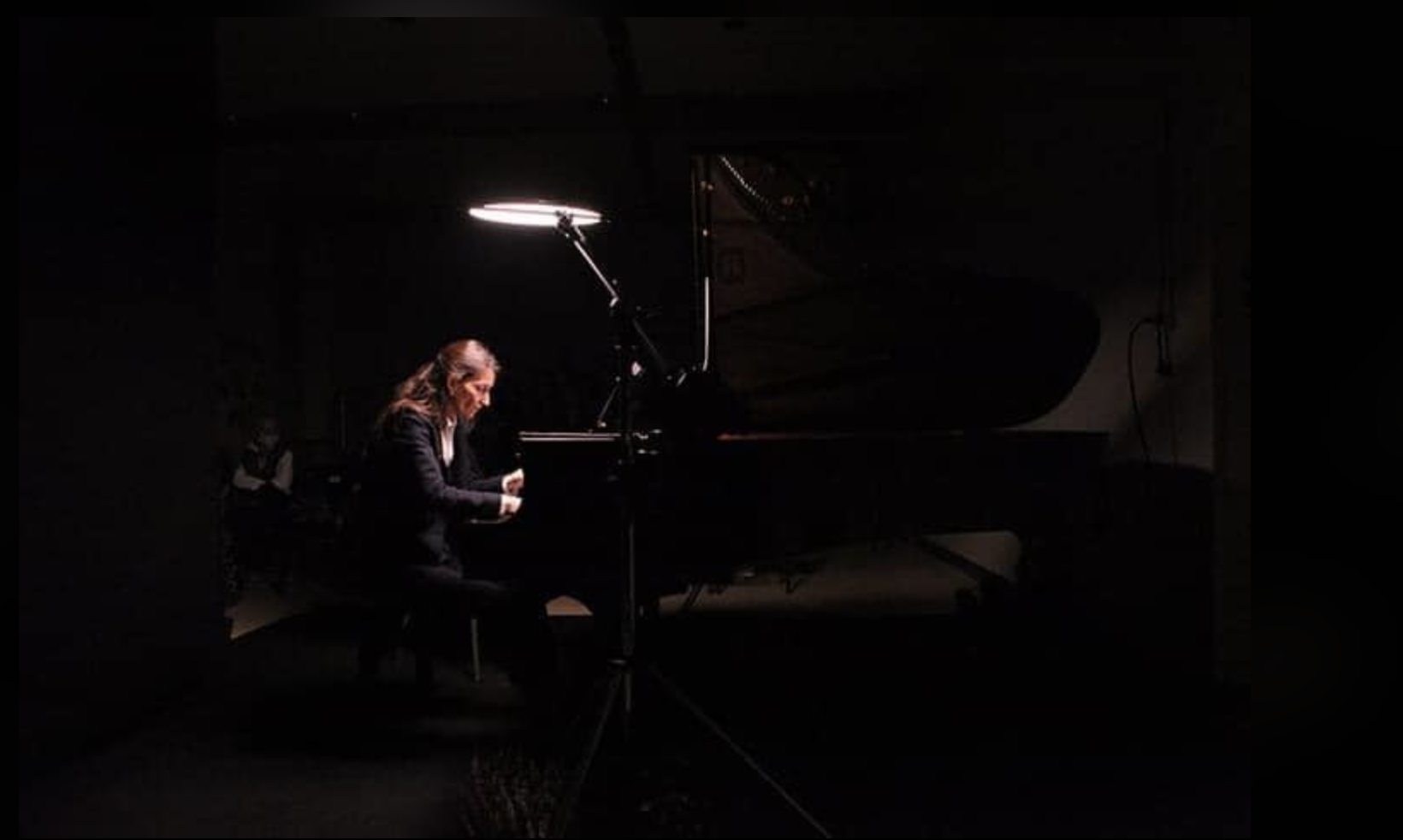
Pianist Pascale Berthelot, a remarkable interpreter of (and favorite among) living composers, becomes one herself—in a sense—throughout this program of five extended improvisations. Liberated at the behest of Gérard de Haro, engineer and head of Studios La Buissonne in France, these unabashedly visual evocations of in-the-moment imaginings constitute one of the most multidimensional piano recordings I’ve heard in years. While its impressionism lays its head as much on the shoulder of Poulenc as Jarrett, it shapes itself one body part at a time without the ultimate need for such comparative garments. Regardless of the lines of reckoning we might connect from Earth to its distant galaxy, it validates the listener’s imagination, and in that spirit I offer mine in return.

“Balance des étoiles” opens the curtains as if in expectation of morning but instead finds the moon masquerading as the sun, rising in mimicry of dawn. The toes become restless for the feel of soil between them, the heart for a lamp to light the way. What began as a reverie ends as a descent into ocean, where prose and poetry comingle until the difference is impossible to make out. In “Ciel s’illune,” the sky and earth are flipped, so that another distinction—that between inhalation and exhalation—is rendered mythological. When we at last get to the center of this genetic spiral, “Nuits, chères” abandons the lie of tranquility for the truth of its unsettling, thus evoking the bliss and deeper love that a relationship conflict can yield. Even in “Chambre sans langage,” in which the intonations of dampened piano strings resound like a knock at the door, spiritual tendencies move beyond prayer into communion. And so, when the dream of “Clair éclat de l’M” lights a ponderous candle with its tongue, it adds one last link to the chain we’ve been extending all along, dragging behind us a memory box whose contents we have already forgotten.

And yet, we mustn’t fool ourselves into thinking that the world Berthelot describes existed before these utterances. Rather, we experience it as she does, unfolding in real time at the touch of flesh and key until something inevitable arises. Thus, the recording itself is a song made up by a child lost in the woods, holding on to lullabies as the only answers to her questions of fear and emerging all the stronger for it.