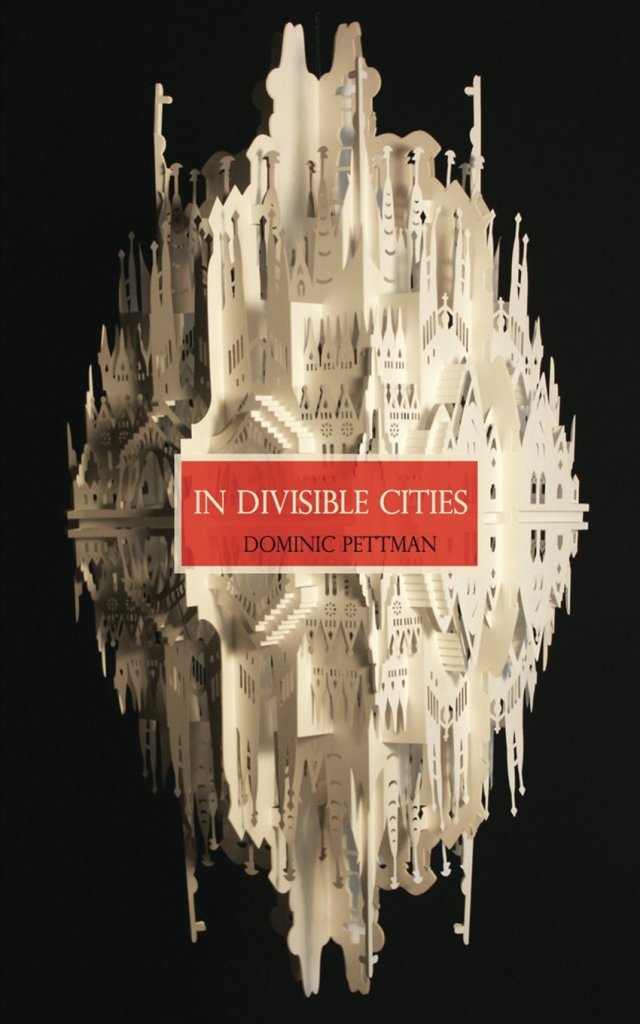
Book Review: In Divisible Cities by Dominic Pettman

In Divisible Cities

If Italo Calvino’s Invisible Cities is an act of translation, then Dominic Pettman’s self-styled “phanto-cartographic” missive, In Divisible Cities (published 2013 by dead letter office), is a translation of a translation. Not of locales into words, but of impulses into figures. Where one plies intellect as world-building, a process wherein repetition is the consensus of quotidian life, the other delineates mappings that are themselves generative. Calvino says, “Desires are already memories.” Pettman says, “Memory is already an act of desire.” Pettman’s book is therefore more of a responsory, his words a string of choruses to the soloists of altered images. The latter, courtesy of visual artist Merritt Symes, bypass illusory stillness in favor of a dialogue that moves with every page-flip. Like the list of cities that opens the text in flying V formation, they embody a migration of fixity.

Pettman proceeds diaristically, if not diacritically, through recollections and impressions, savvily reworking experience into expression. Overseeing all of this, as much as tearing it to shreds, is a nameless “she,” whose steps dislodge the virgin spring of ink for maps skin-written along the way. As much thumbprints as footprints, “her” traces dig reliquaries of travel to be filled with souvenirs of perception. They are engaged in what the author calls a “mutual stalking,” a cartoonish tangle of limbs from and into which flows the shared singularity of their comportment.

It’s never enough, he seems to say, to transgress one’s home toward attaining another. One must be prepared to unscramble the very notion of maturation in order to appreciate the encryptions of the childlike, to see the self as actor in want of scripts and foreseeable locales on continents of broken machinery.

The fatigue of modern life, then, is not in the everyday but in the unrelenting stock-taking of the everyday. As Pettman notes in a flash essay entitled “Material Girls,” our desire for any commodity is proportional to its evanescence. “To barely be there: the ultimate fashion statement,” he writes, piecing together some of “her” shreds into portraits as ephemeral as their subjects. In the wake of this observation, it’s difficult to abide by the rationale of collective ennui—no longer the fear of death but of living that stuffs far too many of us into the vegetable drawers of this refrigerator we call society, forgotten until the smell alerts higher-ups to their crimes.

As “ontological origami,” cities crease their inhabitants until they begin to interlock, so that if one falls the others will feel it. This explains Pettman’s need to communicate with everyone, even when it means talking to no one. The absence of human contact is its own form of construction, being an attempt to fill space with that which has never occurred. In this sense, empathy, collaboration, and sex are all mappings in disguise.

Wrapped in the blanket of such narrative anthropology, the reader may wonder how order can have survived so long in the hovels of mammalian intellect. One possible answer lies in the ambiguity not only of geography but also orthography. Presence of, and allegiance to, the almighty scrawl carries those same scents which, in finding their way inside this planet’s nasal passages, have provoked some of the most brilliant sneezes in history.

But Pettman’s is, below all, a speculative geography. His interest is in the preemptive, as if places somehow yielded their addresses instead of bearing them as retroactive badges. Because some places are too obvious, while others barely leave their pieces in you. Because disappearance is the most difficult project of the imagination. Because the only way to complete a journey is to leave its destination behind.

In the complex of these emotional keytones, it’s all we can do to matter. For while earthly engines may run on fuels as yet unspoken, their implosion is so clear it hurts like a staring contest with the sun. At least we can be sure of one thing: Love has blasted its trumpets through every city more than any other music, and if we listen hard enough, we just might recognize a tune.

(Click here to experience the digital version of In Divisible Cities.)
Live Report: Freiburg Baroque Orchestra w/Christian Gerhaher at Cornell

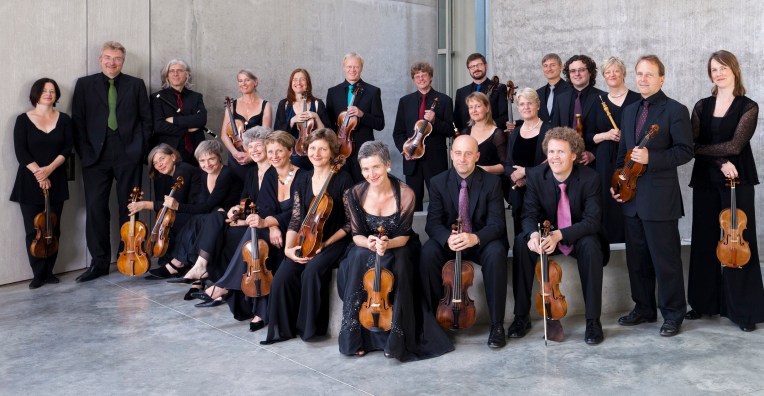
Freiburg Baroque Orchestra
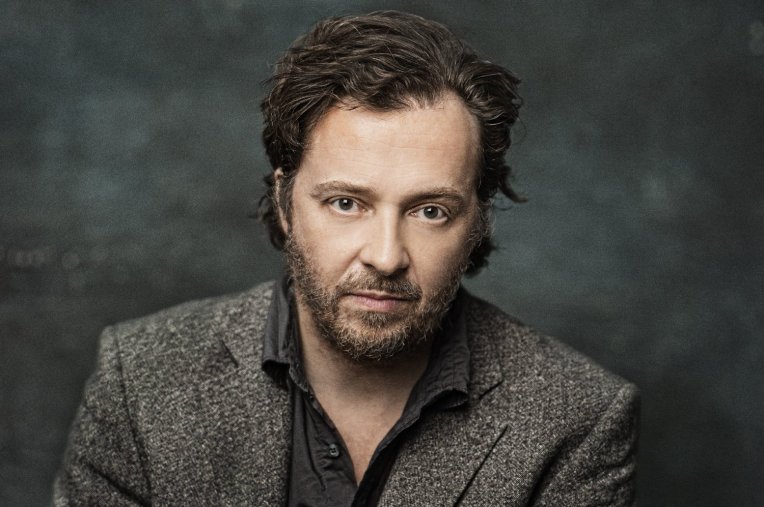
with Christian Gerhaher, baritone
Bailey Hall, Cornell University
February 26, 2016

FBO 2011 Photo: Marco Borggreve

(Photo credit: Marco Borggreve)

On Friday, the Freiburg Baroque Orchestra brought its crisp, pristine sound to Cornell’s Bailey Hall. They were in the company of world-renowned baritone Christian Gerhaher and clarinetist Lorenzo Coppola for an all-Mozart program. It was just the hearth by which we needed to warm ourselves on a blustery night.

The first half of the program was backboned by Mozart’s Symphony No. 36. Known as the “Linz Symphony” — so nicknamed for the Austrian town where the composer dashed off the piece in just four days — its merits are about as appealing as room-temperature soda. A conservative choice, to be sure. But FBO conductor Gottfried von der Goltz did something brilliant by shuffling a handful of Mozart’s operatic arias between its individual movements. The arias, culled from Don Giovanni and Le nozze di Figaro, were comfortable territory for Gerhaher, who recently released his first Mozart album with the same musicians.

Gerhaher proved his reputation as perhaps the world’s greatest living baritone as he navigated every Mozartian maze with dynamic vibrancy and method acting. The otherwise tepid symphony provided an imaginary context for the songs. The opening movement was now an overture, its slightly ominous blush and fluid transitions showing off the orchestra’s winds and pristine intonations. The Freiburgers made it fresh with inflections borrowed from Vivaldi (reflective of their Baroque roots) and Beethoven.

Christian Gerhaher

After hearing Gerhaher plunge into the piquant “Metà di voi qua vadano,” from Don Giovanni, during the symphonic Andante it was all one could do not to expect his voice to come ringing out at any moment. The interminable teaser endings so common to Mozart stretched patience a bit when watching one of the world’s finest singers sit it out on a chair between blast-offs, but paid dividends when he handled verbal workouts such as “Ah, pietà, signori miei!” and “Tutto è disposto… Aprite un po’ quegli occhi”—from Figaro and Giovanni, respectively—with absolute fluency.

Though Gerhaher continued to command following intermission, it was the A-major Clarinet Concerto that provided one of the most memorable performances to grace the Bailey stage in recent years. Not only because the piece, with its universally recognized Adagio, provoked gasps of recognition throughout the audience, but also because soloist Coppola simply gave the finest rendering of the piece I’ve ever heard in a live setting. This was as much a matter of technique as of instrument, playing as he did the rare clarinet d’amour, a predecessor to the modern counterpart, that would have been played at the time of the concerto’s premiere. Coppola delighted us with a preamble about this “theatrical” instrument and invited us to see the concerto as a “little opera in three acts.” His seamless, animated performance made it so.

Two encores validated the enthusiastic applause, including crowd favorite “Deh, vieni alla finestra,” for which Gerhaher was accompanied by mandolin in Giovanni’s famous serenade. And in the end, this was the concert’s greatest appeal. When big name acts come to the Cornell Concert Series, it’s sometimes clear that we are a minor stopover during a larger tour. But von der Goltz and his synergistic band gave us their all, and we couldn’t have asked for more.

(See this article as it originally appeared in The Cornell Daily Sun here.)

Yelena Eckemoff Quartet: Everblue

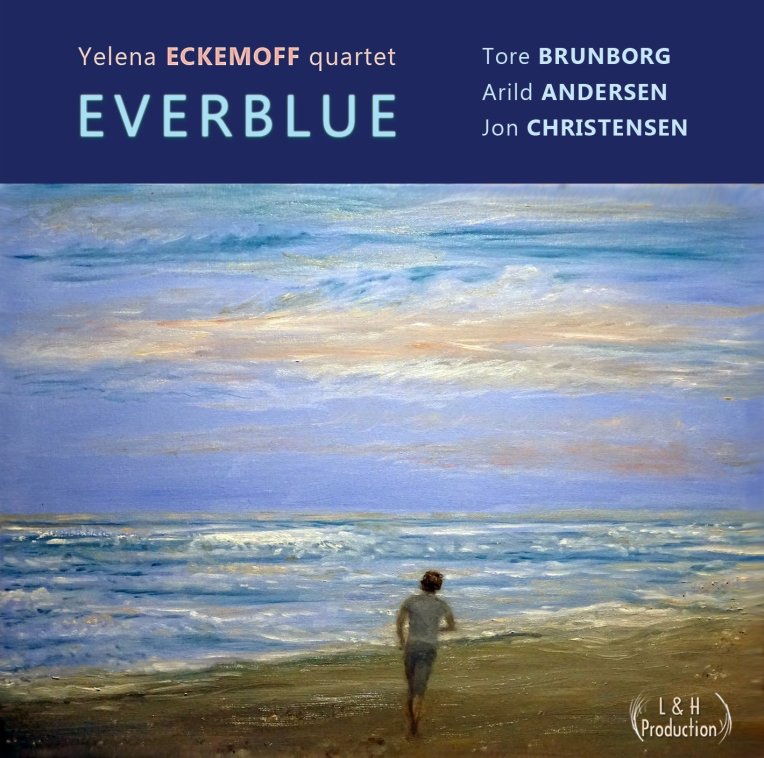
Everblue

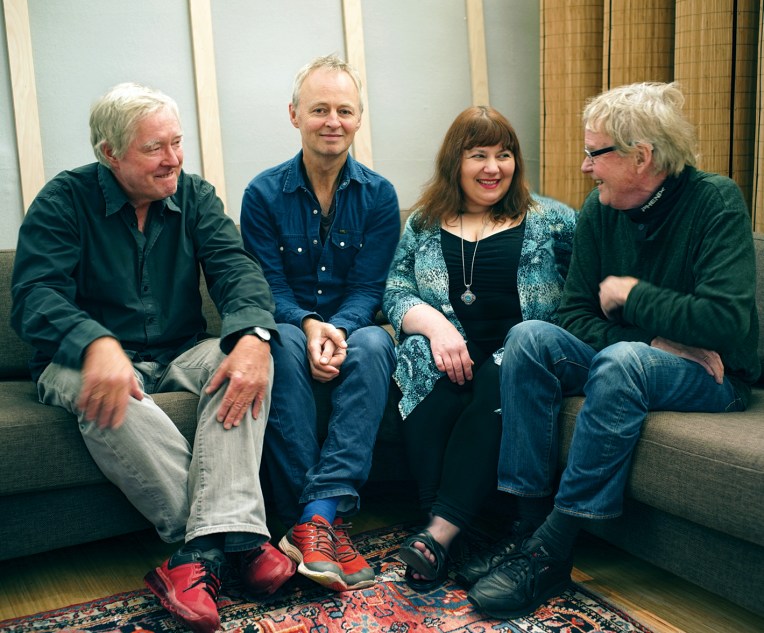
Everblue introduces the Yelena Eckemoff Quartet, for which the Russian-born pianist is joined by a trio of ECM’s Norwegian regulars—saxophonist Tore Brunborg, bassist Arild Andersen, and drummer Jon Christensen—in what amounts to her most sublime effort to date. All the more so for being recorded at Oslo’s hallowed Rainbow Studio, with none other than Jan Erik Kongshaug at the helm. That it is self-produced like Eckemoff’s previous albums shows the commitment with which she has paved her road.

Since dedicating herself as a jazz recording artist, Eckemoff has intrigued at every stage of development, as with each new release she draws bigger and bigger names into her circle. More than any other, this album shows just how far she has grown from her purely classical roots. That’s not to say she’s let go of them entirely. On the title track, as well as “Sea-Breeze,” she solos tentatively at best. One can hear her struggling against the rigidity of her training to branch toward improvisatory skies, and the learning process, as for any musician, will for her be lifelong. But here she is among masters of the field whose very presence audibly rubs off as synergy begins to take hold. Between Brunborg’s golden veils, Andersen’s sagacious wisdom, and Christensen’s peerless feel for coloration, her allies are like the tide: they ebb and flow with surety.

Yelena Eckemoff Quartet promo photo
(Photo credit: Odd Geir Sæther)

Two aquatically themed tracks are, in fact, among Eckemoff’s best, “Waves & Shells” boasting evocative dialogue between her and Brunborg and showing the pianist in her element. “Skyline” is just as painterly, Eckemoff and Brunborg again sounding beautifully off each other over the rhythm section’s tectonic support. This time the leader’s soloing is more thoughtful and confident, blending organically into Andersen’s own. Eckemoff shines when the lights are low, as in the tenderer glow of “Blue Lamp” and “Abyss,” in both of which she draws clear and present inspiration from the saxophonist.

Brunborg is an especially vital component of these interlocking puzzles, but Andersen and Christensen bring especial wonders to bear on “All Things, Seen and Unseen,” over which Eckemoff’s pianism skirts genre lines, brushing sparkle into the robust currents of her bandmates. A spry solo from Andersen toward the end speaks of younger memories. “Ghost of the Dunes” highlights Christensen, who contrasts light splashes of cymbal with deeper drums. But it’s Andersen, with his two originals, “Prism” and “Man,” who brings out the best in Eckemoff. Thus freed from the tunnel vision of her own writing, she attains freshness of sound. One can only hope, in light of her obvious excitement, that she will tackle more jazz works by others in the future, if only to see how much she might flower still.

Errol Rackipov Group: pictures from a train window

pictures from a train window

With pictures from a train window, Bulgarian-born vibraphonist and composer Errol Rackipov debuts his eponymous group with guitarist Hristo Vitchev, reedman Lubomir Gospodinov, pianist Martin Bejerano, bassist Josh Allen, and drummer Rodolfo Zuniga. Listening to the groove laid down by the bandleader on “Mad Djore,” it won’t come as any surprise that the mallet man studied under greats Gary Burton and Ed Saindon. But there’s also an underlying sensibility that is uniquely his own, and which he expresses in his ability to keep his musicians in focus.

The ever-prolific Vitchev trades his normally outgoing smoothness for the back road, architecting his virtuosity distinctly in “Folk Dance” but for the most part content in providing tender underpinnings. Gospodinov carries the band into nostalgic territory on “Far Away From Here, A Long Time Ago,” where his sopranism reveals the art of a genuinely melodic improviser. Then there’s Allen, whose bassing draws triple-metered spirals in “Dill Man,” also a fine vehicle for Bejerano’s pianism. As for Zuniga, he is the heartbeat of heartbeats, anchoring the set from start to finish with chameleonic ability.

Yet despite, if not also because of, these contributions, pictures is Rackipov’s baby through and through. He is a consummate player who shows not only the skin but the internal organs, and whose geometric styling leaves few facets un-rendered. Be it the Eastern European folksiness of “Jumble” and “The Other (Wrong) Way,” the sparkling dialoguing with Vitchev in “Wild River,” or laid-back beauties of the title track, he spins the wheel with assurance and tenderness. As on the final “Once A Mother Had A Child” by Dimitar Ianev, the only non-original of the album, his attention to structure leaves an aftertaste that is clean, sonorous, and itinerant, making for a lovely addition to any vibraphone enthusiast’s shelf.