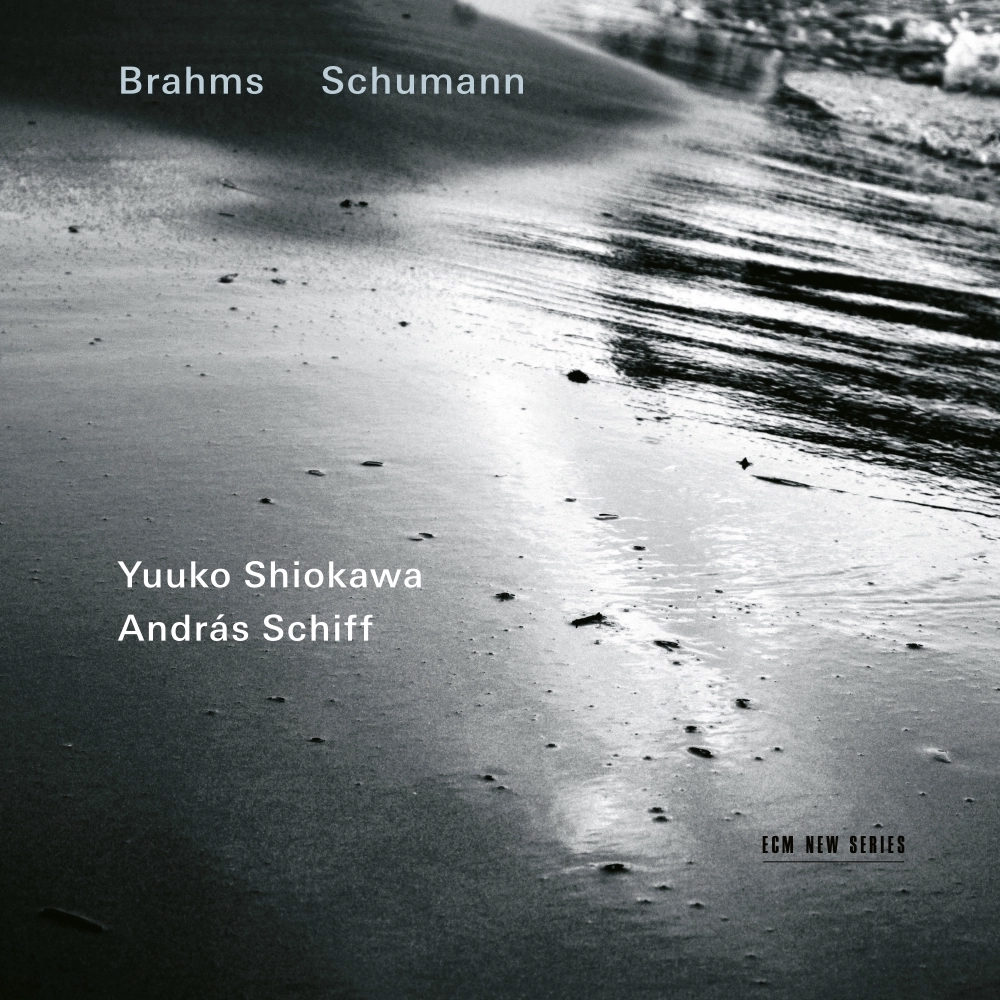
Yuuko Shiokawa/András Schiff: Brahms/Schumann (ECM New Series 2815)

Yuuko Shiokawa
András Schiff
Brahms/Schumann

Yuuko Shiokawa violin
András Schiff piano
Recorded December 2015 (Brahms)
and January 2019 (Schumann)
Auditorio Stelio Molo RSI, Lugano
Engineer: Stephan Schellmann
Cover photo: Nadia F. Romanini
Produced by Manfred Eicher
Release date: October 11, 2024

In their second full disc for ECM New Series, violinist Yuuko Shiokawa and pianist András Schiff present two 19th-century sonatas of the highest caliber by Johannes Brahms (1833-1897) and Robert Schumann (1810-1856). The first half of the program is taken by Brahms’s Violin Sonata No. 1 in G major, op. 78. Composed in 1878, immediately after his violin concerto, it is affectionately known as the “Regenliedsonate” (Rain Sonata) for references to his two songs, “Regenlied” (Rain Song) and “Nachklang” (Lingering Sound), both gifted to Clara Schumann for her 54th birthday. We can easily share in her gratitude for finding those melodies she so cherished incorporated into a sonata of abundant riches, especially when considering that Brahms burned his early attempts at the genre. “Regenlied” opens the first and third movements, growing from the earth not as a sprout but as a fully formed tree. Like time-lapse photography, it allows us to see an entire life cycle in hindsight before we can fully grasp what is being reflected upon. Between the seamless notecraft in the violin and the piano’s dynamic underpinning, there is an orchestral sensibility at play. Despite the lively development, the outer husk is rooted in melancholy and emotional density. It whispers when it dances, shouts when it prays. The central Adagio is more funereal by contrast. As the violin works its lines from inner to outer sanctum, it never lets the wind get in the way of its grief. Meanwhile, the piano is more insistent and rouses its companion from slumber into the sharper edges of reality, leading it through every turn thereof without so much as a nick. The final stretch works through shaded pathways and hard-to-reach areas with sublime attention to detail, ending on a transcendent double stop.

Although Brahms’ great admirer Robert Schumann had never written a violin sonata, at the urging of Ferdinand David (concertmaster from the Leipzig Gewandhaus and the dedicatee of Mendelssohn’s violin concerto), he eventually relented. However, being displeased with his first attempt, he dedicated the Violin Sonata No. 2 in d minor, op. 121, to David instead. Clara and violinist Joseph Joachim gave its premiere in 1853. A massive piece in four parts, it turns the concept of “chamber music” on its head. Unlike this program’s accompanying sonata, it takes its time to mature (at 13 minutes, the opening movement alone is exactly half the length of Brahms’ entire sonata). It is also a profound litmus test of any duo’s attempts at the form, and in that respect, Schiff and Shiokawa defer to the score instead of their egos. The second movement is a soft burst of energy, giving shape to each motivic cell as if it were a brief dance to be savored before its steps are forgotten. From flowing to syncopated, we are carried through the third movement on the back of a groundswell that always keeps its shape, only enlarging and reducing before morphing into a tender staccato. The final movement is a masterclass in controlled drama that feels made for these four hands.

The sensitive playing, which gives its fullest, most heartfelt attention to every detail, is only matched by the recording. Engineer Stephan Schellmann brings a somewhat distant quality to the proceedings so as not to cloud the listener’s judgment with virtuosity. Instead, we are invited to sit in the back of the room, letting the music find us of its own volition, ready and waiting.
A Walk in the Magic Garden: Bostridge and Drake Bring Lieder to Bailey

Imagine yourself as the protagonist in poet Heinrich Heine’s Ich wandelte unter den Bäumen (“I wandered among the trees”). You’ve been wandering through a forest, your only companion grief over an unrequited love. Suddenly, a “little word” flittering in the trees, a simple utterance that pulls the wool of the past over your eyes. You wonder how the birds know it, why they torment you so. They sing:

“A young woman once passed by,
She sang it again and again,
And we birds snatched it up,
That lovely gold word.”

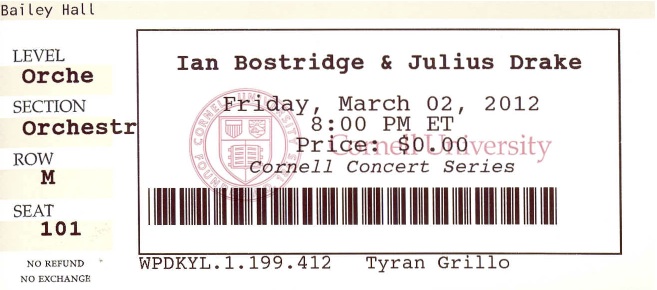
You feel the sparkle, ironic and stabbing, of every rounded syllable. You are pressed by the weight of their diction. Only then do you realize that you’ve been sitting in a concert hall with a flock very much of your kind. The voice comes not from the trees but from English tenor Ian Bostridge, who looms almost as tall as one, onstage at Cornell’s Bailey Hall.


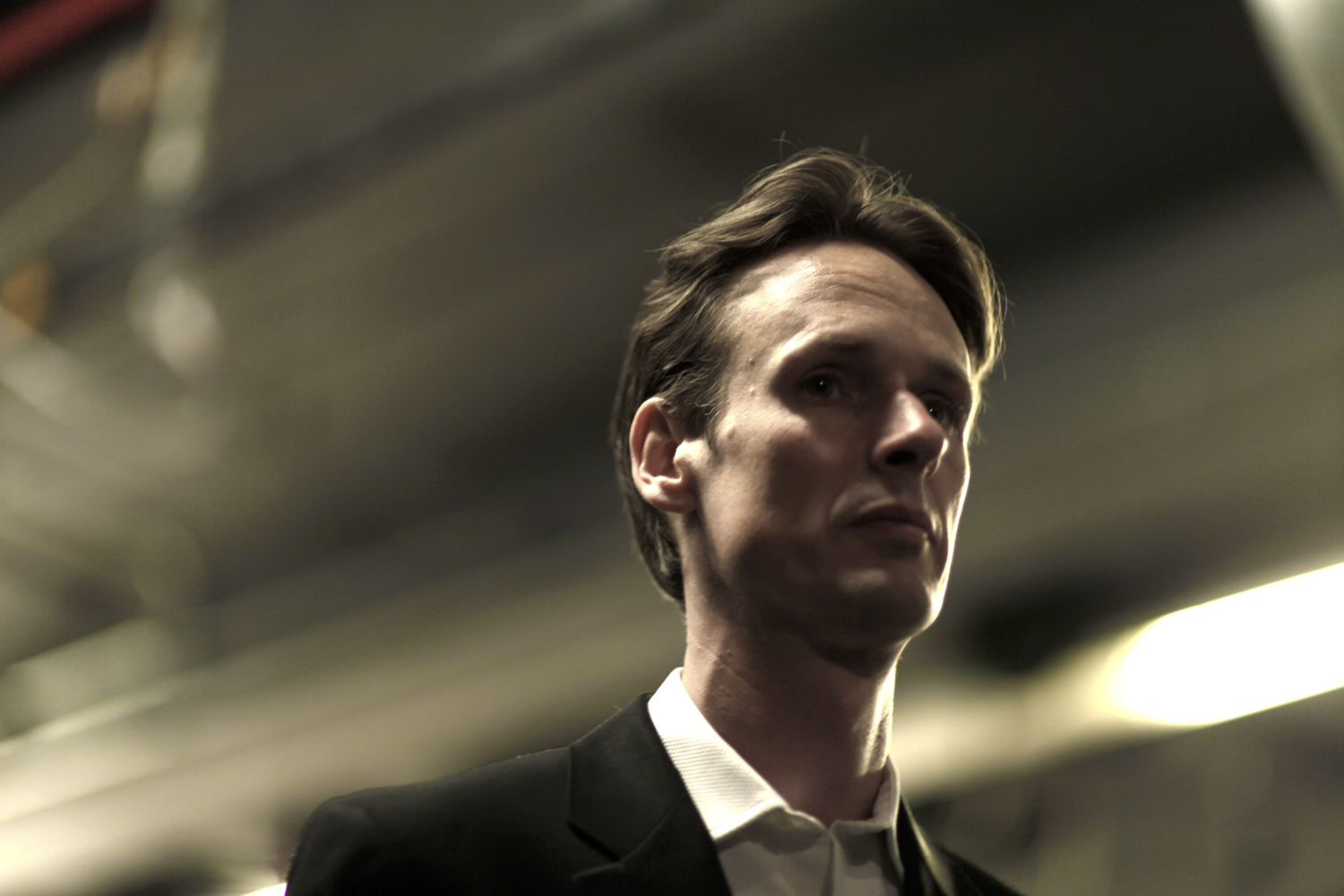
Ian Bostridge

Although Bostridge started out as an aspiring physicist who also wrote a seminal book on witchcraft before devoting his life path to singing in 1993, his audiences would be the last to refute that his command of, and interest in, either physics or witchcraft has waned. To wit, his accompanist of choice for we fortunate Friday few was Julius Drake. An in-demand recitalist and professor at London’s Royal Academy of Music, Drake maintains an alchemical interest in Robert Schumann and in German lieder, or art songs, both of which fuse together via the composer’s setting of the poem above, one of nine by Heine in the op. 24 Liederkreis (Circle of Songs). Written in 1840, a period known as his Year of Song, the cycle bears dedication to his wife, Clara. Despite its passionate origins, the Liederkreis tends to fall by the wayside of Schumann’s monumental Dichterliebe, though one can hardly deny the mastery with which piano and voice share their creative duties in both. Schumann blends folk idioms and a flair for the programmatic, into which Bostridge and Drake pour over twenty years of collaborative experience.


Julius Drake

During this performance it was clear that for Bostridge the sounds of words are as important as their meanings. Throughout the Liederkreis and the quartet of Dichterliebe apocrypha that preceded it he fashioned a living, breathing persona that was as chameleonic as the sentiments he so punctiliously enunciated, while Drake matched his depth gesture for gesture. Both artists found themselves surpassed only by the lyricism of Schumann, whose adorations blossomed before our ears in the passions of Lehn’ deine Wang’ (“Rest your cheek”) and the sweetness of Berg’ und Burgen schaun herunter (“Mountains and castles look down”), the latter contrasting starkly with the morose Es treibt mich hin (“I’m driven this way, driven that”), the fiendish difficulties of which Bostridge navigated with apparent ease. Artistic witchcraft was also in order for Mein Wagen rollet langsam (“Slowly my carriage rolls”), during the middle stanza of which he sang an internal thought as if it were his own. Not to be outdone, Drake’s pianism cast its share of enchanting spells, as in the brightness of Morgens steh’ ich auf und frage (“Every morning I awake and ask”) and the chromatic sweeps swirling like smoke from a breeze-blown candle throughout Mit Myrten und Rosen (“With Myrtle and Roses”).


Robert and Clara Schumann

While Bostridge and Drake were obviously comfortable with Schumann, much of the evening’s treasure was buried in the relatively uncharted maps of Johannes Brahms, in whose poetics they steeped the program’s first half. With a life-affirming, if not transformative, energy Brahms’s songs made for a fitting introduction to anyone not familiar with the lieder tradition from which he is so often excluded, typically dominated as it is by Franz Schubert, Hugo Wolf, and Schumann himself. For one, he favored the words of “minor” poets—a downfall in an art built from the text up. This and his disinterest in grand cycles pegged him as something of an outsider. Yet Brahms saw no necessary correlation between great music and great poetry. Each was its own melody. As with Schumann, whom Brahms much admired, folk motifs were an important touchstone and sometimes led him boldly where his contemporaries dared not tread.


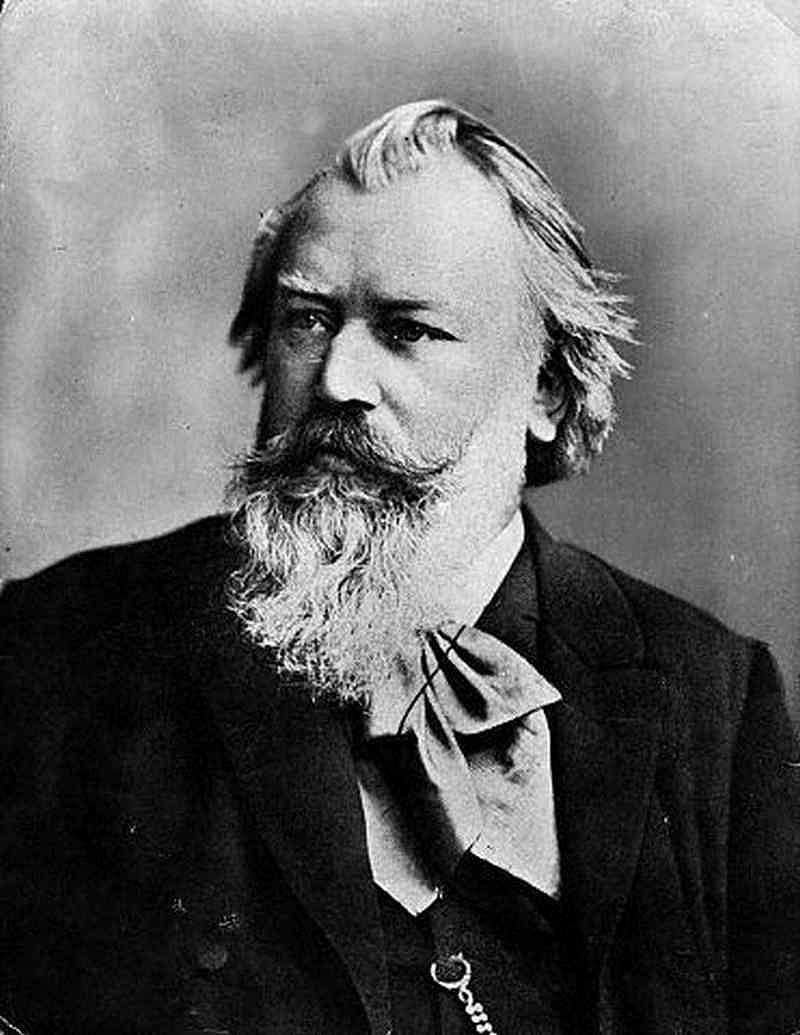
Johannes Brahms

His was, and continues to be, a music filled with worlds that don’t so much collide as pass through one another. From the mighty gales of Auf dem Kirchhofe (“In the churchyard”) and on through the Chopinesque backcloth of Der Gang zum Liebchen (“The way to the beloved”) to the raging seas in Verzagen (“Despair”), the pianism was of a vastly different order, with the result that Bostridge pushed himself to engage every facet of its relief. This resulted in an unexpected hiccup during a high reach in Geheimnis (“Secret”). Yet even this did nothing to detract from what was for this listener the most awe-inspiring song of the program (if anything, it broke a tension that threatened to sweep us away entirely), and may explain the marked determination with which he dove into the set’s most turgid waters—notably, Alte Liebe (“Old Love”) and O kühler Wald (O cool forest).

Due perhaps to Brahms’s rich keyboard writing, Drake’s interpretive nuances were most effulgently realized here. He was at once impressionistic and exacting like a carver’s tool, but always playing the words at hand. The lushness of chording in his right hand atop the rising arpeggios of his left in the concert’s opener, Es träumte mir (“I dreamed”), assured us that the best accompanists also know how to sing. Bostridge was reverently aware of this. One could see it in the way he looked into the distance between verses, as if watching the Steinway’s notes mingling with his own over the horizon. He interacted with the piano, now resting on it like a poet’s tree, now at an intense moment breaking free from its pull.

Oftentimes the more careful one is, the more conservative one becomes. In the case of these two performers, however, care seems to have bred nothing but expressive potential. In this respect Bostridge sings as might a Shakespearean actor surrender to a soliloquy—which is to say, by stepping outside the self and into the landscape of another space and time. His ego flees like the poetry from his lips, even as he shows us the vitality of the body in the singing of lieder, its centering and de-centering, its bows and cringes, and in all the winged commitment required to make every syllable fly. Drake, meanwhile, proves himself supremely attuned to every color change, and stands respectfully poised on the edge of drowning. He listens to the voice just as the voice listens to itself, intoning with the wavering realism of a reflective surface.

We return to Heine, in whose beauties we find ourselves lost:

In the magic garden wander
Two lovers, silent and alone;
The nightingales are singing,
The moon is shimmering.

So sings the now familiar voice, no longer birdlike but nonetheless profoundly arboreal. Bostridge takes us fearlessly into that garden and shapes its flora and fauna, each more magical than the last for the Midas touch of his vocal presence. Said garden is his gift to us, a place to which we can always return when remembering this night.

(See this article in its original form at the Cornell Daily Sun.)