Sokratis Sinopoulos/Yann Keerim: Topos (ECM 2847)

Sokratis Sinopoulos
Yann Keerim
Topos

Sokratis Sinopoulos lyra
Yann Keerim piano
Recorded February 2024
Sierra Studios, Athens
Engineer: Giorgos Kariotis
Cover photo: Jean-Marc Dellac
Produced by Manfred Eicher
Release date: October 17, 2025

There is nothing quite like the sound of the lyra when Sokratis Sinopoulos takes it in hand. The instrument exhales an ancient soul into the modern air, and few musicians draw from its strings such a fusion of myth and immediacy. From his quartet recordings, Eight Winds and Metamodal, this more intimate duo with pianist Yann Keerim distills their chemistry into an even deeper alchemy of tone and silence. Their collaboration of nearly twenty years has ripened into an art of pure intuition, where melody and freedom speak the same language.

At the album’s heart lies Béla Bartók, whose Romanian Folk Dances serve as both axis and atmosphere. Yet it is in “Vlachia,” one of four original pieces inspired by the Hungarian composer, where their vision truly unfolds, as melancholy and art relate like light through water. The piano’s chords rock gently, a cradle of memory, while the lyra hovers between waking and dreaming, resisting the lull of its own tenderness. “Valley,” by contrast, opens like a watercolor, the soul of the landscape awakening at dawn, when even the smallest stones remember their own luminosity. Between the modally inflected interlude “Mountain Path,” with its blues-tinted horizons, and the quietly breathing “Forest Glade,” the musicians walk among elderly oak, beech, and elm, each exhaling the voices of forgotten peoples, their songs hanging in the air.

The Romanian Folk Dances themselves are reimagined here as meditations on time’s elasticity. “In One Spot,” normally brief and fleeting, becomes a slow unfurling, each phrase examined as though through a magnifying glass instead of a telescope. What was once a dance is now an act of remembrance, a transmission through hands, hearts, and breath. Keerim’s improvisations shimmer with restraint, unveiling the dance as a living organism rather than a set of steps. “Sash Dance” begins like a gift being unwrapped, its introduction a flowering reverie, before the familiar theme emerges, tender as an heirloom passed from parent to child. Sinopoulos’s harmonic touch is radiant, his bow tracing lines that dissolve as soon as they are drawn, while Keerim decorates with the grace of rain gathering on the edge of a leaf.

A solo lyra ushers us into “Dance from Bucsum,” its lament carrying the weight of centuries. Gradually, it finds vitality again, as if memory itself were relearning its steps. The piano’s entrance is light breaking through foliage. “Romanian Polka” delights in this interplay, its bowings and pluckings coaxing the piano into a rhythmic embrace. The music feels rooted in the soil, yet perpetually on the verge of flight. “Fast Dance” is not so much quickened as transfigured. What was once earthy now becomes spectral, its pulse sifted through the mesh between moments.

“Stick Dance” closes the circle, beginning in abstraction before broadening into a spacious terrain of inspiration. There is such reverence here that one hesitates to call it an ending at all. In returning to the first of Bartók’s dances, the album folds time in upon itself, reviving what it has just allowed to rest. It becomes not a conclusion, but a threshold, suggesting that each listening might return us to the beginning with altered ears.

As Sinopoulos and Keerim write in the album’s booklet:

“Our Topos is where tradition meets the present, the Balkan Mountains meet urban space, the music of the countryside meets contemporary creation. Our Topos is where we meet and interact, shaping our individual and common identities.”

Indeed, Topos is less a location than a living field, a place where listening itself becomes part of the composition. Between the lines of melody and silence, we, too, are invited to breathe, to dwell, to remember. And as the final tone recedes, one wonders whether the music has ended at all or merely crossed into another realm, where echoes continue to shape the clouds, unseen but never lost.

Alice Zawadzki/Fred Thomas/Misha Mullov-Abbado: Za Górami (ECM 2810)

Alice Zawadzki
Fred Thomas
Misha Mullov-Abbado
Za Górami

Alice Zawadzki voice, violin
Fred Thomas piano, vielle, drums
Misha Mullov-Abbado double bass
Recorded June 2023 at Auditorio Stelio Molo RSI, Lugano
Engineer: Stefano Amerio
Cover painting: Emmanuel Barcilon
Produced by Manfred Eicher
Release date: September 13, 2024

Collected on our travels and taught to us by our friends, these are songs we have learnt and loved together. Gathered from Argentina, France, Venezuela, Poland, and the deep well of Sephardic culture, these folk tales speak to the moon, the mountains, the rain, the madness of humans, and the prophecies of birds.

The above is more than a collective artist statement from Alice Zawadzki (voice, violin), Fred Thomas (piano, vielle, drums), and Misha Mullov-Abbado (double bass). It’s also an example of how traditions, regardless of geographical distance, are organs of a larger body. Said body is literal, not metaphorical, insofar as it connects all of humanity at the internal level (the blood), even when the external (the voice) seems so disparate. The album’s title, Za Górami, says the same. Although it translates to “Behind the Mountains,” it is the Polish idiomatic equivalent of “Once upon a time…,” less a prompting of place than of possibility—not unlike the selections gathered here.

Within the trio’s curation of material, there is a liberal sprinkling of Sephardic songs. And yet, while some of the most well-worn treasures of the repertoire, including “Los Bilbilikos” (The Nightingales) and the lullaby, “Nani Nani,” are to be expected, the tact of each arrangement is remarkable. Even when the latter builds to an almost rapturous conclusion, it never loses sight of slumber’s healing effect. Such restraint is only made possible by a receding musicianship that lets the verses speak for themselves. This is increasingly rare to hear in Ladino programs, which can feel over-arranged as early music ensembles seek to outdo one another, favoring the interpreters over the interpreted. Not so in the hands of Zawadzki, who pours vocal plaster into “Dezile A Mi Amor” (Tell My Love) and “Arvoles Lloran Por Lluvias” (The Trees Weep For Rain) as if they were footprints in a landscape to be disturbed as little as possible. The tone and shape she brings to even wordless improvisations constitute natural delineations of their source material.

In Gustavo Santaolalla’s “Suéltate Las Cintas” (Untie The Ribbons), we find a most suitable modern companion. Steeped in the composer’s characteristically cinematic qualities, it lends itself to broader strokes in an instrumental economy. Thomas’s pianism is a warm evening breeze that equalizes the ambient air of its chamber and the lovers breathing it in. Its denouement alongside Mullov-Abbado’s heartbeat weaves a veil of privacy before Zawadzki renders their ecstasy a poetic afterimage. Another kindred spirit awaits in “Tonada De Luna Llena” (Song Of The Full Moon) by Venezuelan singer Simón Díaz, which yields some of the most evocative descriptions:

I saw a black heron
Fighting with the river
That’s how your heart
Falls in love with mine

The moon, even when not explicitly mentioned, is a constant presence in these songs, shining on the maiden in “Je Suis Trop Jeunette” (I’m Too Young, after Nicolas Gombert) who dreams of being swept away from her family. Her internal conflict is only heightened by the prepared piano in the upper registers, which carries over into the title song by Zawadzki, after the Polish traditional about a girl who defies her mother and ends up dancing her life away. “Gentle Lady,” Thomas’s setting of James Joyce, is a folk song in and of itself, stepping out of time to unravel its literary knot with grace.

ECM listeners familiar with the label projects of Savina Yannatou, Arianna Savall, and Amina Alaoui will feel swathed in comfort here, even as they are caught up in the unique flow that only this trio can bring forth from the hillsides of their wanderings. How fortunate we are that their paths have aligned on this side of the mountains.

Anouar Brahem: After The Last Sky (ECM 2838)

Anouar Brahem
After The Last Sky

Anouar Brahem oud
Anja Lechner violoncello
Django Bates piano
Dave Holland double bass
Recorded May 2024
Auditorio Stelio Molo RSI, Lugano
Engineer: Stefano Amerio
Cover: Emmanuel Barcilon
Produced by Manfred Eicher
Release date: March 28, 2025

Where should we go after the last frontiers?
Where should the birds fly after the last sky?

–Mahmoud Darwish

After The Last Sky marks the return of oud virtuoso and composer Anouar Brahem to ECM, eight years after Blue Maqams. That groundbreaking album also featured pianist Django Bates and bassist Dave Holland, both of whom are retained here, along with a new addition in cellist Anja Lechner. The result is a culmination of culminations, blending Brahem’s evolving integrations of jazz, European classical music, and, of course, the modal Arabic maqams at their core. Gaza was firmly on his mind leading up to and during the recording, and the titles reflect this awareness in a contemplative way. Despite the music’s delicacy (if not because of it), it offers prescient meditations on the horrors of violence that, sadly, seem to be the most inescapable leitmotif in the symphony of our species. That said, Brahem is not interested in proselytizing. “What may evoke sadness for one person may arouse nostalgia for another,” he says. “I invite listeners to project their own emotions, memories or imaginations, without trying to ‘direct’ them.” By the same token, notes Adam Shatz in his liner essay, “as with ‘Alabama,’ John Coltrane’s harrowing elegy for the four girls killed in the 1963 bombing of a Black Church by white supremacists, or ‘Quartet for the End of Time,’ composed by Olivier Messiaen in a German prisoner of war camp, your experience of Brahem’s album can only be enhanced by an awareness of the events that brought it into being.” Either way, After The Last Sky invites us into a conversation between ourselves and the political realities we would rather avoid.

And so, when wrapped in the tattered garment of “Remembering Hind” to start, we must remind ourselves that music, like life, is only what we can experience of it. If something never enters our sphere of awareness, it might as well not exist, which is precisely why we so often choose to ignore rather than engage. Here, we are given a space in which to reconcile those two attitudes, in full recognition that the sacred is forged from the ashes of the profane and that beauty is a fragile compromise for destruction. In some ways, this contradiction is inherent to Brahem’s instrument and its vulnerabilities, which he animates from within.

The more we encounter, the less we can deny our complicity in suffering. Whether in the post-colonial shades of “Edward Said’s Reverie” or the painful imagery of “Endless Wandering” and “Never Forget,” the weight of exile weighs on our shoulders. Meanwhile, the instruments take on distinct personas. Bates is the bringer of prayer, Holland is the bringer of faith, and Lechner is the bringer of community. Through it all, Brahem is the one who brings trust. Through his establishments, he reminds us that intangible actions have very physical consequences. By the thick threads he pulls through “In the Shade of Your Eyes,” we draw close for comfort in the afterglow of bombs.

Despite the sadness casting its pall over this journey, there are way stations where gravity has less of a hold on us and where, I daresay, hope becomes possible again. This is nowhere truer than in “The Eternal Olive Tree,” an improvisation between Brahem and Holland. As bittersweet as it is brief, it finds the oudist feeding on the bassist’s groove as if it were a ration to be savored, not knowing where sustenance might come from next. Other sparks of resignation are carefully breathed upon in “Dancing Under the Meteorites,” “The Sweet Oranges of Jaffa,” and “Awake.” In all of these, Lechner’s playing transports us to another level, inspiring Brahem to dramatic improvisational catharsis (yet always restrained enough to maintain his sanity). The album ends with “Vague.” Among his most timeless pieces, it is lovingly interpreted. Bates renders the underlying arpeggios with artful grace, while Holland and Lechner open the scene like a hymnal for all with ears to hear.

I close with another quote from Shatz, who writes: “Brahem’s album is not simply a chronicle of Gaza’s destruction; but its very existence, it offers an indictment of the ‘rules-based order’ that has allowed this barbarism to happen.” Thus, what we are left with is an indictment of indifference, as profound as it is melodic. What Brahem and his band have done here, then, is not to simply make an album of beautiful music (which it is) but rather to offer themselves as a living sacrifice to the altar of reckoning to which we all must bow if we are to make a difference that matters. When we are stripped of all we have, music is what remains.

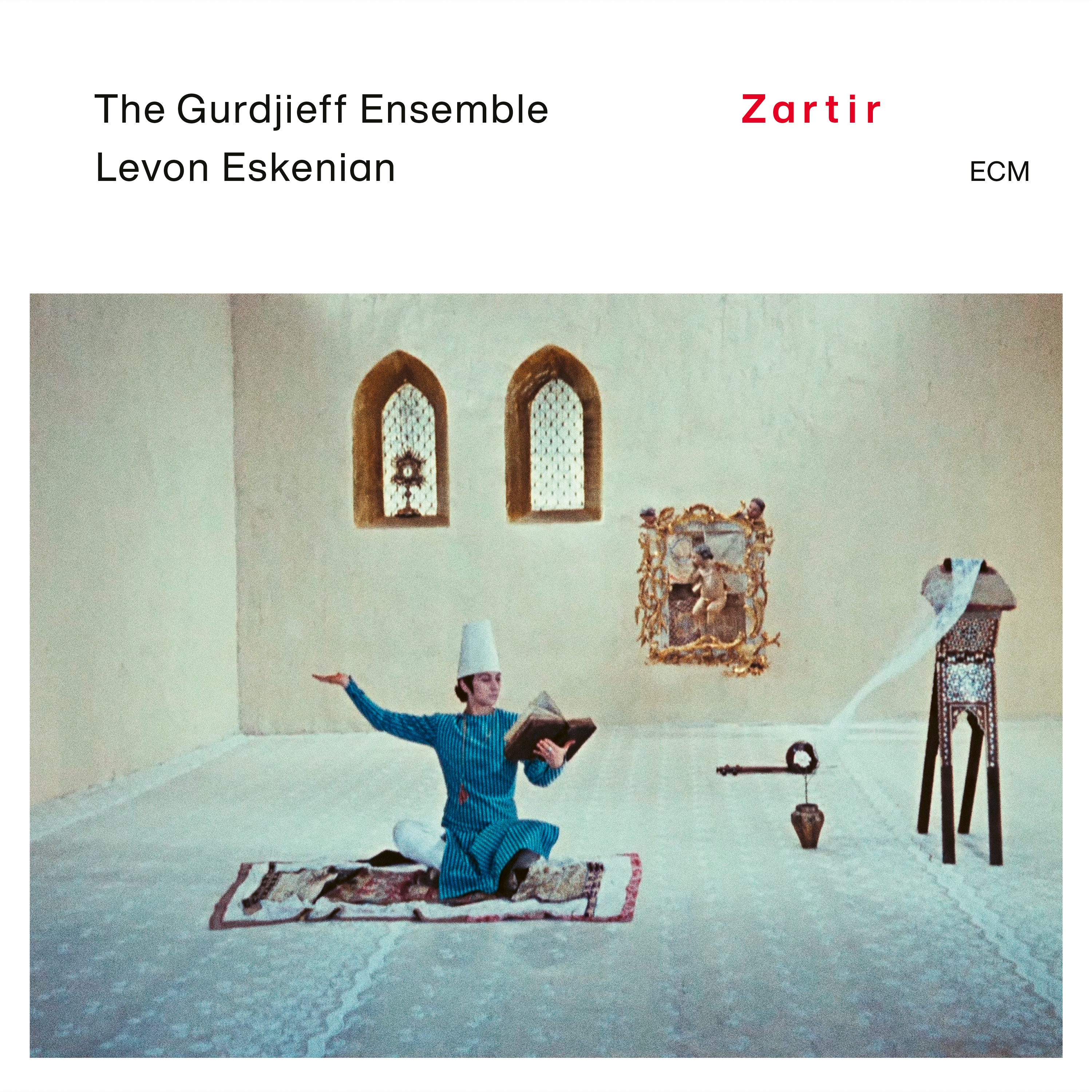
The Gurdjieff Ensemble: Zartir (ECM 2788)

The Gurdjieff Ensemble
Zartir

The Gurdjieff Ensemble
Levon Eskenian
 artistic director
Vladimir Papikyan voice, santur, burvar, tmbuk, singing bowls
Emmanuel Hovhannisyan duduk, pku
Meri Vardanyan kanon
Armen Ayvazyan kamancha, cymbal
Gagik Hakobyan duduk
Norayr Gapoyan duduk, bass duduk, pku
Avag Margaryan blul
Aram Nikoghosyan oud
Astghik Snetsunts kanon
Davit Avagyan tar
Mesrop Khalatyan dap, tmbuk, bells, triangle
Orestis Moustidis tombak
National Chamber Choir of Armenia
Robert Mlkeyan
 director
Recorded December 2021 at Radio Recording Studio, Yerevan
Engineer: Tigran Kuzikyan
Mixed November 2022
by Manfred Eicher, Levon Eskenian, Michael Hinreiner (engineer), and Tigran Kuzikyan (engineer)
at Bavaria Musikstudio, Munich
Cover photo: Still from Sergei Parajanov’s film The Color of Pomegranates
Album produced by Manfred Eicher
Release date: October 27, 2023

“Who can say that I will live from dawn till dusk? Man’s entry and man’s exit is simple work for the hand of God.”
–Sayat-Nova

Continuing the journey on which they first embarked for ECM in 2011, Levon Eskenian and The Gurdjieff Ensemble deepen their relationship with the enigmatic Georges I. Gurdjieff (c. 1877-1949). Given the mystery surrounding the Armenian-born teacher/philosopher, one can hardly say that the music on Zartir is a historically informed recreation. Rather, writes Steve Lake, “Eskenian’s ensemble resituates the music along the paths of its possible interpretations.” On said paths, one encounters travelers of Armenian, Assyrian, Greek, Caucasian, Kurdish, Persian, and Arabic persuasion, each a reflection of the other in the grander sense yet simultaneously individual enough to lend historico-cultural insight. Given that the bulk of Gurdjieff’s music is preserved in 250 pieces for piano (an instrument he saw as a compromise at best), Eskenian has once again brought new life (or is it old life?) to melodies that speak of their lineage more deeply than whatever we might glean from biographical speculations. Lake calls these “triple-distilled reverse transcriptions,” reflecting how they might have been intended to sound on the folk instruments that would surely have been a familiar soundtrack to Gurdjieff’s own itinerancy.

The album’s title, which means “Wake up!”, seems to evoke the Zen concept of satori, referring to a sudden enlightenment of mind, body, and spirit. However paltry that comparison might be, it nevertheless points to the undeniable alignment of this trifecta in the music arranged for us by Eskenian here. For example, in the twilit sagacity of “Pythia,” the first of many tears in the veil of obscurity, the mood is almost regal, as if welcoming some great royalty to step on a carpet woven just for the occasion, only to be torn to shreds and burned after so that no mere mortal feet dare taint it. At the same time, however, the palace and any tokens of grandeur it might contain are not on display. Rather, this is music that lives in the nooks and shadows of its architecture, so that we might know its inner secrets before sharing them with the world. Even in the briefest glimpses, including “Sayyid Chant and Dance No. 41” and “Oriental Dance,” we stand at the edge of a precipice with an eye seeking the unsettled territories as yet before us, ignoring the opulence at our backs. In “Introduction and Funeral Ceremony,” flight becomes possible so that we might leave the trappings of men in favor of the natural resources they all too often neglect. Whether in the sound of the duduk or the touch of percussion, the listener is rendered a spirit in search of a body, if only to feel the burden of gravity once again.

Beyond Gurdjieff himself, the program expands its reach to invoke the bards and troubadours of Aremania known as the ashughs, a tradition to which Eskenian’s father, Avedis (to whom this album is dedicated), was a vital link. This introduction of voices to the milieu adds another layer of fragile humanity. Ashugh Jivani (1846-1909) gives us

“Kankaravor Enker” (Friend of Talents), a poignant lament on the weaponization of humility in the land of the self-righteous. “Ee Nenjmanet Arkayakan Zartir” (From your royal slumber, awake) by Baghdasar Dbir (1683-1768) is a song of love from a distance (always from a distance). Nothing is ever touched, felt, or tasted; nothing more than an impression that must be concretized in music. And in the sound paintings of the legendary Sayat-Nova (1712-1795), namely “Dard Mi Ani (Do Not Fret)” and “Ashkharhes Me Panhjara e” (The World Is a Window), the mortality of love serves as a prayer against entropy.

Speaking of prayer, we end with Gurdjieff’s “The Great Prayer,” for which the National Chamber Choir of Armenia joins the ensemble. Eskenian calls this “one of the most profound and transformative pieces I have encountered in Gurdjieff’s work.” Indeed, it unfolds like a metastatement among metastatements. A culmination of life and death into a single neutral point, it is existence for its own sake, divine yet without doctrine, the lifeblood of our every waking hour.

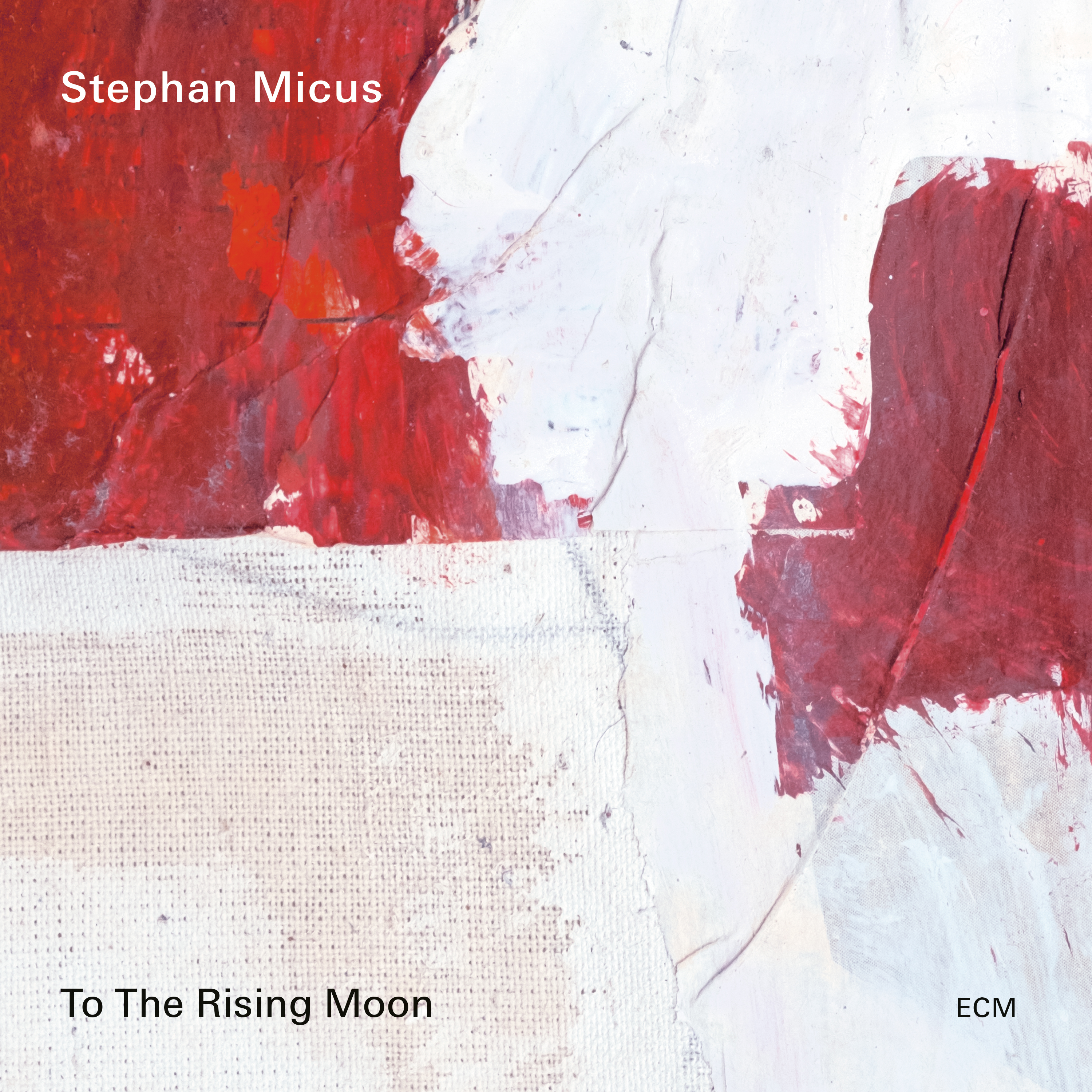
Stephan Micus: To The Rising Moon (ECM 2834)

Stephan Micus
To The Rising Moon

Stephan Micus tiple, dilruba, sattar, chord zither, tableharp, nay, sapeh
All music and voices composed and performed by Stephan Micus
Recorded 2021-2023 at MCM Studios
Cover art: Eduard Micus (1925-2000)
An ECM Production
Release date: November 15, 2024

my house burned down
now I have a better view
of the rising moon
–Masahide Mizuta (1657-1723)

To step into a new Stephan Micus recording is to approach a koan from the inside out. For while every world he creates feels immediately familiar, there’s also something about it that distances us from ourselves. In To The Rising Moon, his 26th solo album for ECM, he unravels an out-of-body experience through characteristically novel combinations, transcending cultural and historical borders in search of a collective humanity.

His narratives always seem to have a central protagonist; this time, it is the tiple. Sounding like a charango but with a looser feel, it is the national instrument of Colombia, but in the present context, it steps out of space and time into its own. “To The Rising Sun” features two of them: one to establish a percussive jangle, the other to sing through its contours. Building a monument one stone at a time, even as Micus scales it, he comes prepared with the finishing capstone, so that we can fully admire the valley of which it affords a sacred view. This format is later replicated in “Unexpected Joy,” which has all the internal tension of a young warrior walking through the forest on his first solo hunt, and in “To The Lilies In The Fields,” where gemstones rounded by the river’s current are ignored in favor of the greater value of leaving them as they are. “In Your Eyes” increases the count to three and adds a lone voice. Its juxtaposition of steel strings and Micus’s rounded singing gives us room to explore. At the heart of all this is “The Silver Fan,” a tiple solo through which light and shadow merge with a kiss.

On the topic of voices, another prominent one is the dilruba, an Indian bowed instrument with sympathetic strings. Six of these band together for “Dream Within Dream,” painting a realm where the physical world recedes into the farthest corners of consciousness. The sound is thin and incisive. Like wisdom offered by a sage on his deathbed, its truth can never be forgotten. The dilruba finds a long-lost brother in “Embracing Mysteries,” where the sapeh, a four-stringed lute from Borneo (normally plucked but modified to be played with a bow), evokes nature and nurture in equal measure. Meanwhile, Micus’s voice cuts the figure of a traveler with a rucksack filled with hymns, which he drops in place of crumbs.

Yet another member of this ad hoc family is the sattar, a long-necked bowed instrument of the Uigur people. In triplicate, it elicits one of Micus’s most spiritual creations: “The Veil.” He runs his hands gently across, feeling every pleat and fold as if it were an era of history to be navigated. In that sense, there is also mourning for the past and a hope that all the destruction we’ve brought has not ultimately been in vain. Despite taking part in the album’s largest ensemble in “Waiting For The Nightingale” (which brings together two dilruba with five sattar, five voices, three Cambodian flutes, and two chord zithers), the result feels open, a spider’s web touched with dew that has withstood an entire day’s worth of climatic change. Micus’s chorusing is a call to the wilderness within. The sattar also binds three tableharps (which combine elements of bowed psaltery, zither, and harp) in “The Flame,” leaving blurred traces of its past like paintings on stone. Finally, in the title track (alongside two tiples and two nay), it is a birthing ground of fluidity and purpose. Having nowhere else to go but inward, it bows its head in offering to silence, a prayer without words to get in the way of meaning.

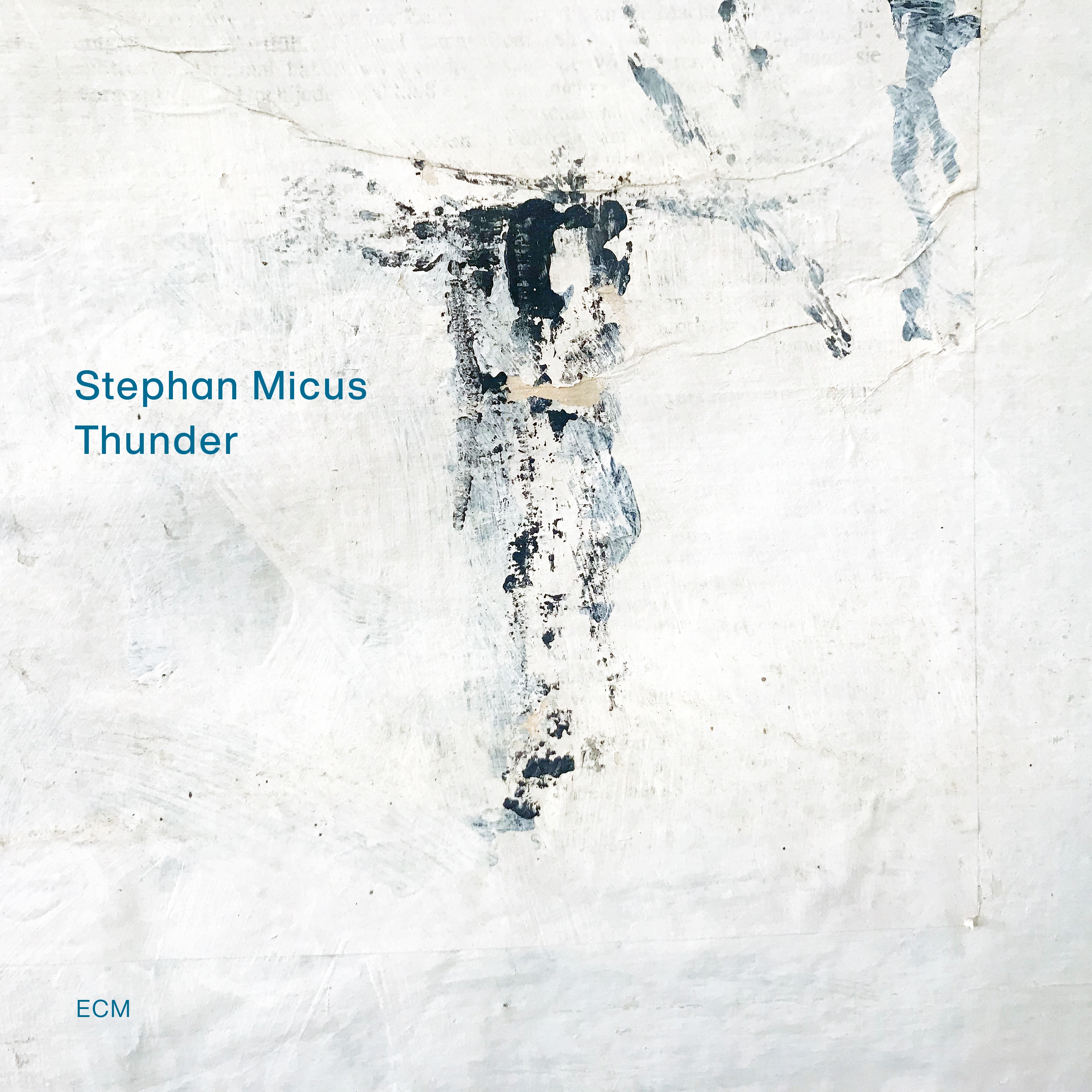
Stephan Micus: Thunder (ECM 2757)

Stephan Micus
Thunder

Stephan Micus frame drum, storm drum, dung chen, Burmese temple bells, Himalayan horse bells, ki un ki, bass zither, bowed dinding, kyeezee, shakuhachi, sarangi, nyckelharpa, kaukas, sapeh, voice, nohkan
Recorded 2020-2022 at MCM Studios
Cover art: Eduard Micus (1925-2000)
An ECM Production
Release date: January 20, 2023

Multi-instrumentalist Stephan Micus goes bigger than he ever has before on Thunder, his 25th solo album for ECM. Inspired by the dung chen, a four-meter-long trumpet heard booming from monasteries during his travels to Tibet, he long dreamed of incorporating it into a series of compositions. After immersing himself in its depths (only in Kathmandu did he find someone willing to teach him how to play this instrument normally reserved for monks), he settled on the ki un ki (a cane stalk common among the Udegey people of Siberia played by inhaling) and the nohkan (a transverse bamboo flute from the Japanese Noh theatre). From this trinity arose a series of nine compositions, each dedicated to a different god of thunder from different world traditions.

Despite the album’s concept, however, and the decidedly spiritual overtones, there is something undeniably elemental about the music itself. For while there are certainly far-reaching moments of great drama and development, others are intimate spirals of reflection that are just as content in staying where they are. Of the former persuasion are pieces like “A Song For Thor,” “A Song For Vajrapani,” and “A Song For Perun.” All three make use of dung chen, frame drums, Burmese temple bells, Himalayan horse bells, bass zither, and either the ki un ki or nohkan. The drums are the heartfelt griots of this primal tale, evoking the sound of footsteps on dirt and stone. The ki un ki moves with an eagle’s precision, so determined that every clod seems to get out of its way as it barrels through with a human soul firmly in its sights. As it traverses the landscape, passing through every dead object as if it were made of air, it finds its way to life itself. Through this transformation, it lingers on the edge of speech. Meanwhile, the dung chen move like elephants across the plains, each carrying a virtue known only by its ancestors.

So much of what we encounter here, however, is as reflective as a pond in moonlight. For example, “A Song For Raijin” and “A Song For Leigong” feature the storm drum, which, despite its name, betrays only the slightest hint of a climatic disturbance on the horizon. Both tracks also feature bowed sinding (a West African harp), kyeezee (bronze chimes from the Buddhist temples of Burma), and shakuhachi. With so much tenderness between them, each wrapped in the arms of a subcutaneous drone, the Japanese bamboo flute can only plant its prayers in whispers. It is a frail warrior that would be torn in the next violent rainfall, the possibility of which haunts every dream.

Of those dreams, we get two glimpses through the lenses of “A Song For Armazi” and “A Song For Zeus.” These share the same scoring (3 sarangi, 2 bass zithers, and nyckelharpa), opening spaces of translucent incantation. Speaking of which, Micus’s voice enters magnified in “A Song For Shango” and “A Song For Ishkur.” Accompanied by the sapeh (a lute from Borneo) and kaukas (a five-string lyre of the San people in Southern Africa), he traces the aftermath of nature’s fury. We can feel the humidity in the air, the sweet musk of precipitation in the nostrils, and the tang of love on the tongue. The sapeh shimmers, while the singing rolls across the mountains, flattening everything it touches with quiet power—not a ritual but a revelation that manifests itself as a footnote on the page of time.

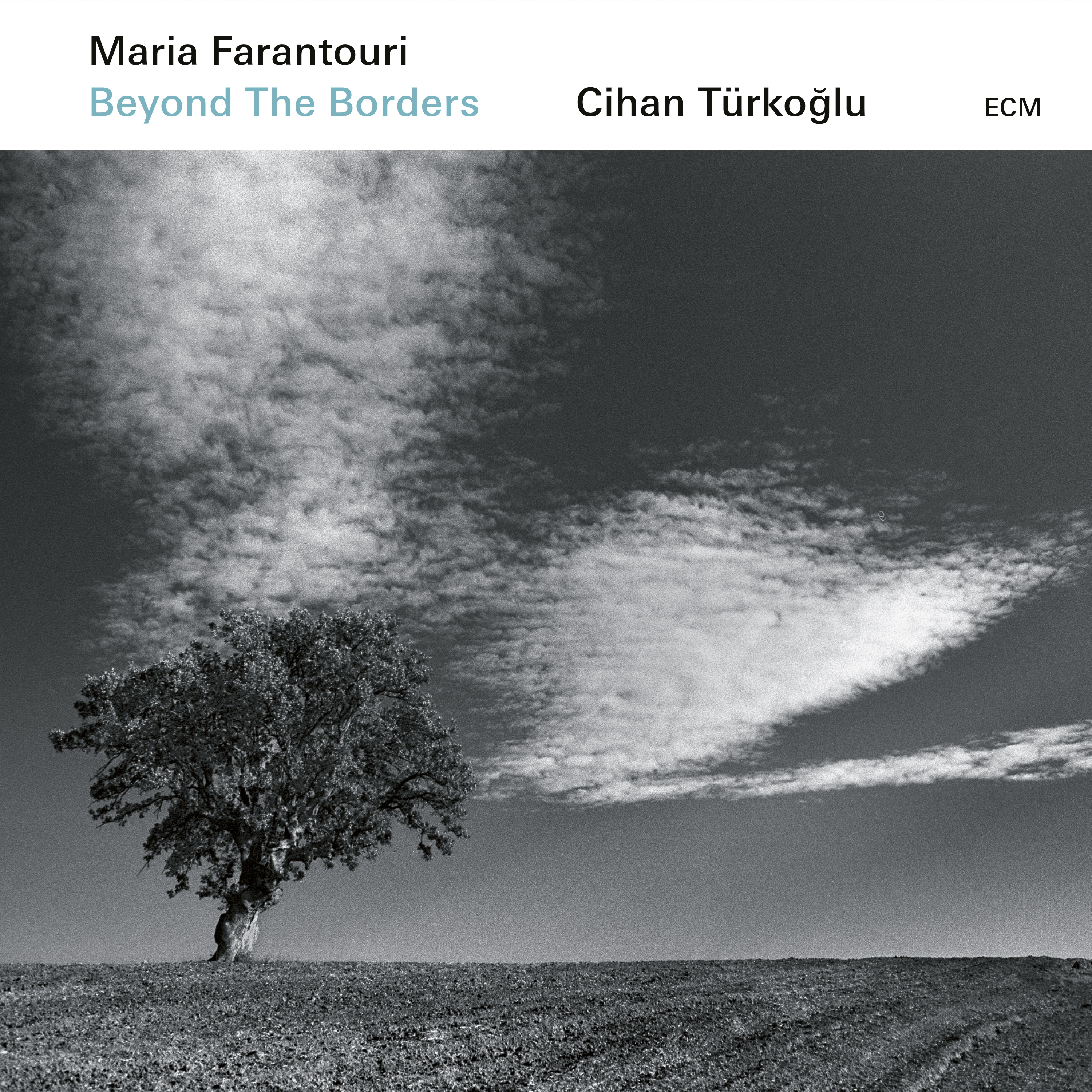
Maria Farantouri/Cihan Türkoğlu: Beyond The Borders (ECM 2585)

2585 X

Maria Farantouri
Cihan Türkoğlu
Beyond The Borders

Maria Farantouri voice
Cihan Türkoğlu
saz, kopuz, voice
Anja Lechner 
violoncello
Meri Vardanyan kanon
Christos Barbas
ney
İzzet Kızıl percussion
Recorded June 2017, Sierra Studios, Athens
Engineer: Giorgos Karyotis
Produced by Manfred Eicher
Release date: June 21, 2019

“Everything flows.
Out of one thing there comes unity,
and out of unity one thing.”
–Heraclitus

The project documented on Beyond The Borders was born when Greek singer Maria Farantouri first heard Cihan Türkoğlu, a saz virtuoso of Anatolian extraction who had been living in Athens for ten years. After proposing the idea to ECM, producer Manfred Eicher helped shape the program into its present form, debuting it as part of the 2017 Athens Festival. For this live performance, they are joined by Anja Lechner on cello, Meri Vardanyan on kanon, Christos Barbas on ney, and İzzet Kızıl on percussion. Their collective sound is distinctly individual, like a soul of many cities and eras compressed into the flesh of a single body.

Most of the songs are traditional treasures from the lands of Turkey, Armenia, Lebanon, and Greece. Each tells a story preserved by centuries of reiteration, and achieves relevance as a cool drink of water in today’s political firestorm. The scintillating arrangement of “Drama köprüsü” (The Bridge of Drama) finds both Türkoğlu and Farantouri singing the life of Hassan, a legendary Robin Hood-like figure who went rogue after slaying his superior, stealing from the rich and giving to the poor while shadowing the village just to glimpse the woman to whom he was once betrothed. The Sephardic ballad “Yo era ninya” (I Was a Girl) tells of a highborn maiden ruined by a deceitful man. A mournful quality made resolutely genuine by Farantouri’s delivery, as if sung through a cloud, makes this a standout among standouts. Lechner’s cello is remarkable, a red thread drawn through shadows of time.

From Armenia we receive “Kele kele” (Strolling), an anonymous song preserved by Komitas Vardapet around the turn of the 20th century. In it, a lovelorn girl sings: “I am dying for your footsteps, my precious.” An extended intro from Vardanyan paints a wide terrain on which to seek the traces of her loved one. Not all is so gloomy, however, as the Macedonian wedding song “Triantafylia” (Upon the Rosebush) works from a quiet introduction to an energy powerful enough to shine unscathed through a pessimistic future. “Wa Habibi” (My Beloved), a Christian hymn from Syria and Lebanon, unravels with a lifetime’s worth of experience in every throaty word.

The program is rounded out by songs written specially for Farantouri with music by Türkoğlu and words by Agathi Dimitrouka. “Dyo kosmoi mia angalia” (Embraced Worlds) takes Eros as its theme and evokes loving attributes via kanon, in which are felt reflections of sunlight upon a body of water whose surface is a portal between realms. “Ta panda rei” is a setting of Heraclitus, whose blurring of parts and wholes, of lives and life itself, yields percussive details from Kızıl and breaths from the ney of Barbas. Between “Lahtara gia zoi” (Yearning for Life), an empathic song for the uprooted, and “Anoihtos kaimos” (A Secret Yearning), a surreally uplifting dream, we feel the connective tissue of death and life as if it were the very substance of our hearts. With every beat, we get closer to this music, even as it follows its own path through the tragedies of our world.

Stephan Micus: Inland Sea (ECM 2569)

2569 X

Stephan Micus
Inland Sea

Stephan Micus balanzikom, nyckelharpa, chord and bass zithers, shakuhachi, voice, steel-string guitar, genbri
Recorded 2014-16 at MCM Studios
An ECM Production
Release date: June 16, 2017

When talking about differences between cultures, it’s tempting to uphold products such as food, art, and music as foci of distinction. On the latter point, Stephan Micus has dedicated his life to that without which music would not exist: the instruments themselves. From the staggering amount in his repertoire, he draws stories that could never have been written by any other means. Take the duo, for example, which makes its first appearance in his milieu via the opening “Haze.” The balanzikom, an obscure seven-stringed lute from Tajikstan, feels so much like the mountains and open plains of its origins that it could never have come from anywhere else. The very land is its womb, as also of the wordless gestures projecting life into being. The nyckelharpa, a Swedish bowed instrument keyed like a hurdy gurdy, is as crisp as the climate of which it was born, accordingly grounded. Micus listens to these instruments much more than he plays them, and through his performances allows them to learn new languages by the same tongue and teeth. As the only one-on-one conversation between them, “Haze” sets a precedent of civil and spiritual exchange for all to follow. The nyckelharpa, for its part, glows in triplicate in “Dawn” and “Dusk.” Their combined song is more than diurnal; it’s life and death.

Likewise, the shakuhachi is more than a conduit for breath. For while Micus has rewritten its futures many times over, its ancestral home is unalterable. In “Sowing Wind,” he matches this Japanese bamboo flute with the chord zither, a 68-string instrument of his own design. The arc thereof is a primordial one, along which feelings of mutual regard flow as if they were a mythology to which we’ve blinded ourselves. This relationship deepens in “Reaping Storm,” switching chord zither for its bass counterpart. Now the mood is fragile and of a different season, fragrant of a world humbled by nature.

The balanzikom delineates further circles for Micus’s singing in “Flor del Sur.” Radiating along cardinal axes as if to hold continents in its embrace, the solo voice welcomes five percussive nyckelharpa, chord zither, and shakuhachi in “Nuria,” and among that assembly enacts a tale of disparate peoples brought together by tragedy. For “Virgen de la Mar,” Micus choruses his voice fifteen times over, and to it adds three genbri, a three-stringed bass instrument from Morocco. Treading the same soil packed by the feet of “Dancing Clouds” (plucked nyckelharpa, 6 percussive nyckelharpa, 3 bowed nyckelharpa, steel string guitar, genbri, bass zither) and laid to rest by “For Shirin and Khosru” (2 bass zithers, 2 nyckelharpa, 3 steel string guitars, genbri), it treats melodic resolution as the caress of a loving parent who dispels fears of darkness. Thus we are protected, hoped for, and fortified to face new days, bringing our own children to the well of mortality, that they might also see the reflections of all who came before them.

Maya Youssef review for RootsWorld

My latest review for RootsWorld online magazine is of Damascus-born qānūn virtuoso Maya Youssef’s Syrian Dreams, a heartfelt album of mostly original material evoking the tragic spirit of her war-torn homeland. Click the cover below to read more and listen to sample tracks off the album.

Syrian Dreams